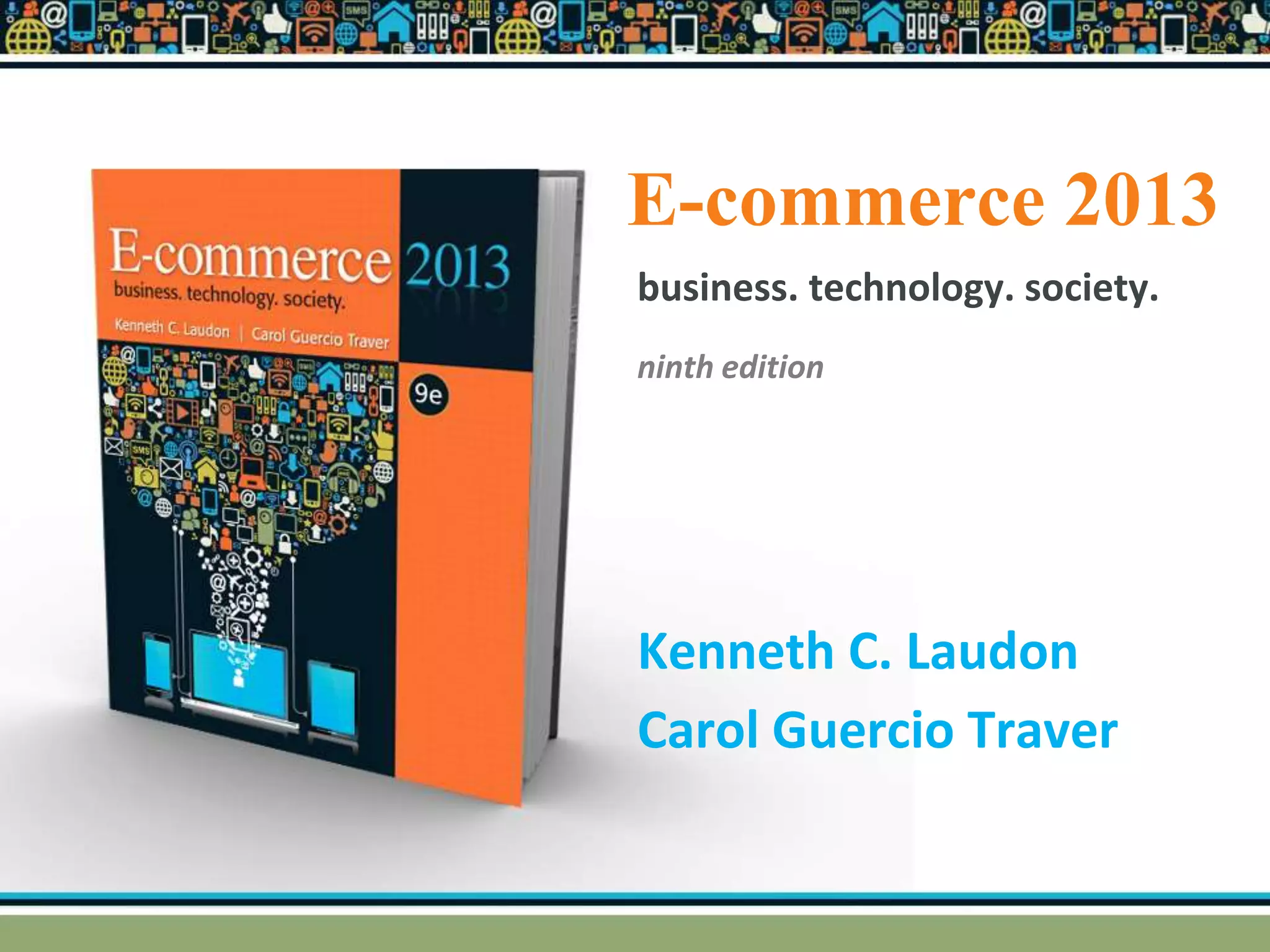
E-commerce 2013
Kenneth C. Laudon
Carol Guercio Traver
business. technology. society.
ninth edition
Chapter 8
Ethical, Social, and Political Issues in
E-commerce
Copyright © 2013 Pearson Education, Inc.
Class Discussion
Internet Free Speech: Who Decides?
■ Is the Internet a form of “public speech”?
■ How can the different national perspectives on free
speech be managed in a global environment like
the Internet?
■ Given that the Internet is supported by
governments and private companies, should these
institutional and corporate needs supersede the
free speech rights of individuals on the Internet?
Copyright © 2013 Pearson Education, Inc. Slide 8-*
Understanding Ethical, Social, and
Political Issues in E-commerce
■ Internet, like other technologies, can:
❖Enable new crimes
❖Affect environment
❖Threaten social values
■ Costs and benefits must be carefully
considered, especially when there are
no clear-cut legal or cultural guidelines
Copyright © 2013 Pearson Education, Inc. Slide 8-*
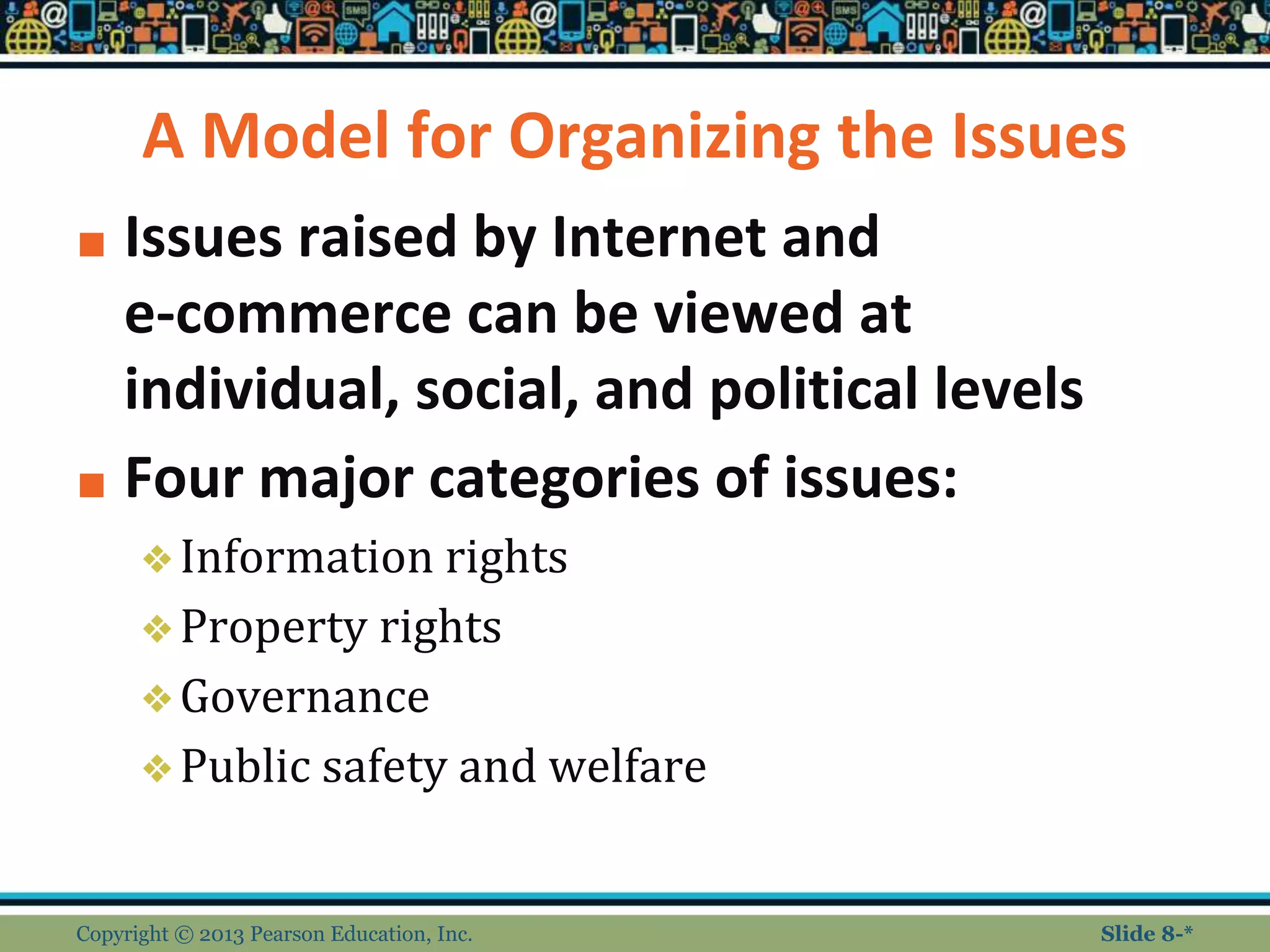
A Model for Organizing the Issues
■ Issues raised by Internet and
e-commerce can be viewed at
individual, social, and political levels
■ Four major categories of issues:
❖Information rights
❖Property rights
❖Governance
❖Public safety and welfare
Copyright © 2013 Pearson Education, Inc. Slide 8-*
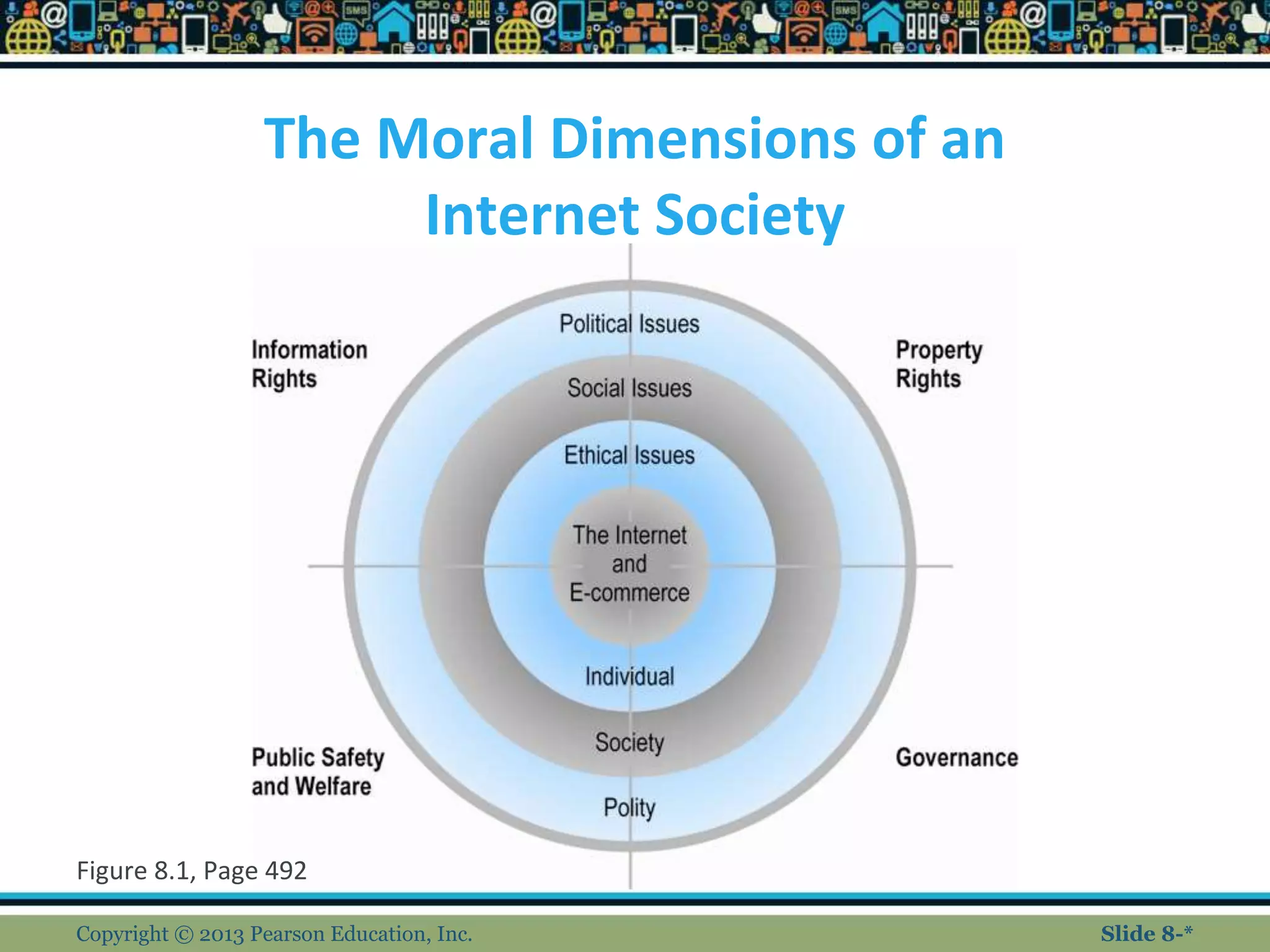
The Moral Dimensions of an
Internet Society
Figure 8.1, Page 492
Copyright © 2013 Pearson Education, Inc. Slide 8-*
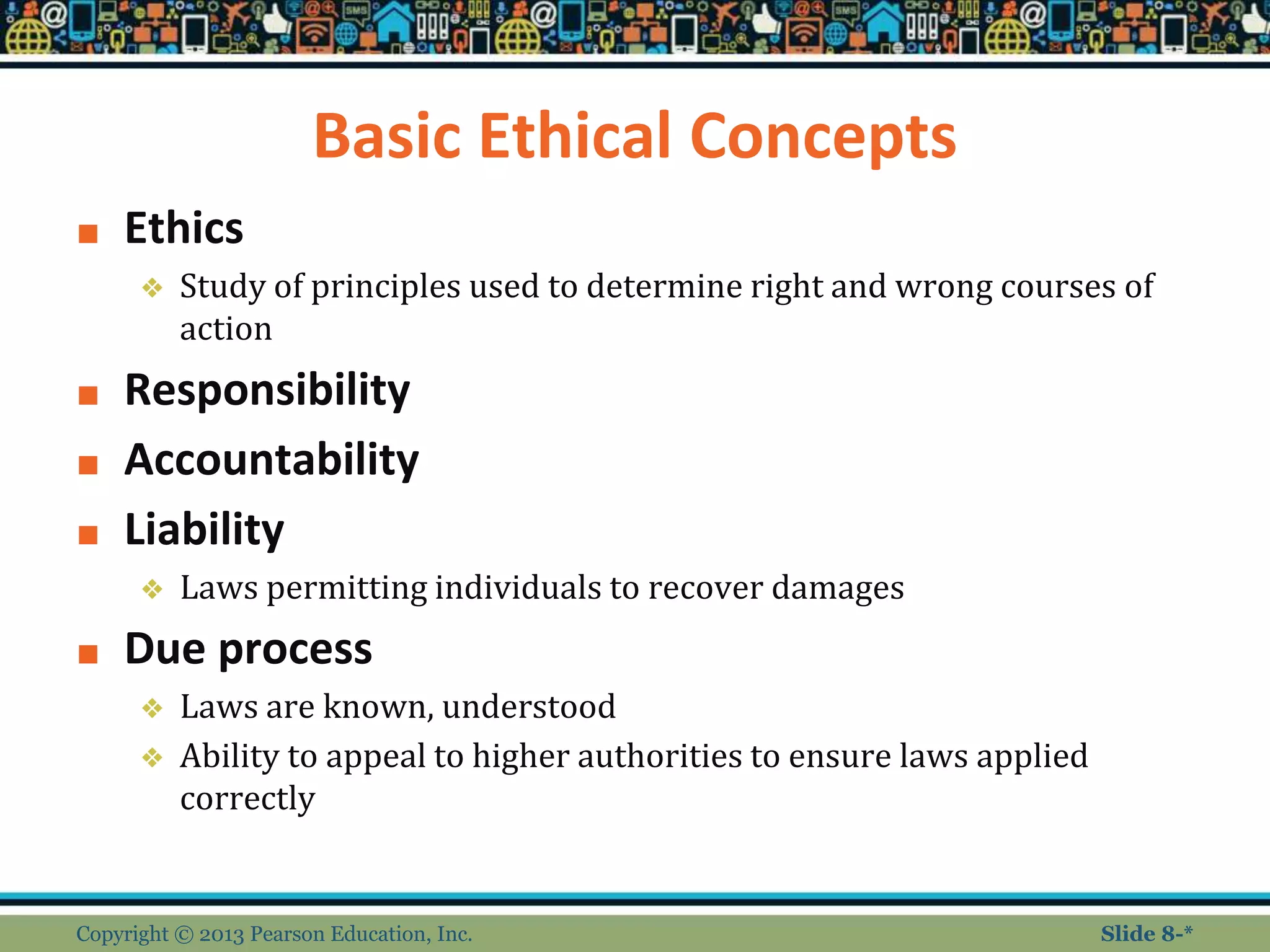
Basic Ethical Concepts
■ Ethics
❖ Study of principles used to determine right and wrong courses of
action
■ Responsibility
■ Accountability
■ Liability
❖ Laws permitting individuals to recover damages
■ Due process
❖ Laws are known, understood
❖ Ability to appeal to higher authorities to ensure laws applied
correctly
Copyright © 2013 Pearson Education, Inc. Slide 8-*
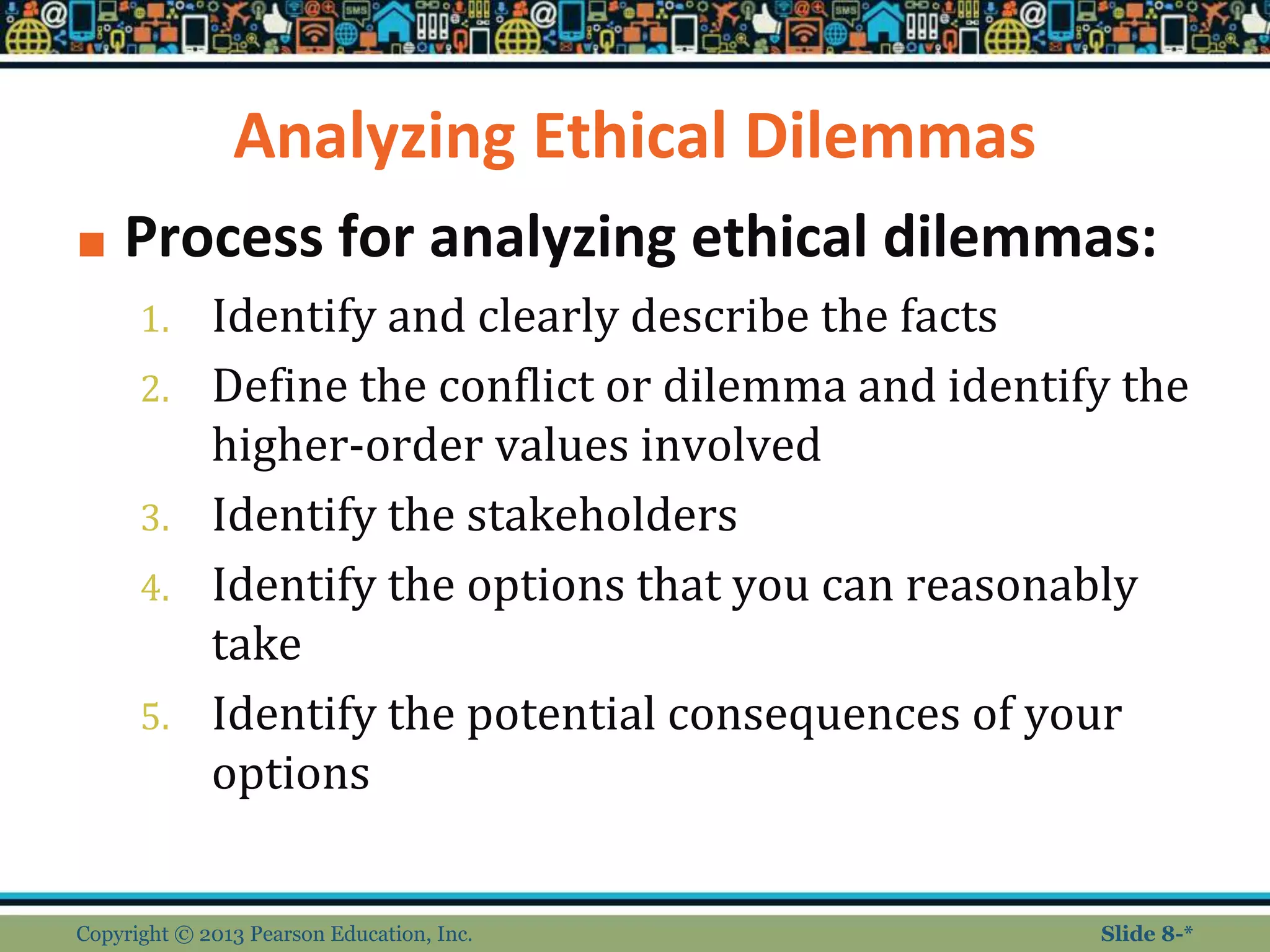
Analyzing Ethical Dilemmas
■ Process for analyzing ethical dilemmas:
1. Identify and clearly describe the facts
2. Define the conflict or dilemma and identify the
higher-order values involved
3. Identify the stakeholders
4. Identify the options that you can reasonably
take
5. Identify the potential consequences of your
options
Copyright © 2013 Pearson Education, Inc. Slide 8-*
Candidate Ethical Principles
■ Golden Rule
■ Universalism
■ Slippery Slope
■ Collective Utilitarian Principle
■ Risk Aversion
■ No Free Lunch
■ The New York Times Test
■ The Social Contract Rule
Copyright © 2013 Pearson Education, Inc. Slide 8-*
Privacy and Information Rights
■ Privacy
❖ Moral right of individuals to be left alone, free from
surveillance, or interference from other individuals or
organizations
■ Information privacy
❖ Subset of privacy
❖ Claims:
■ Certain information should not be collected at all
■ Individuals should control the use of whatever information is
collected about them
Copyright © 2013 Pearson Education, Inc. Slide 8-*
Privacy and Information Rights (cont.)
■ Major ethical issue related to e-commerce
and privacy:
❖ Under what conditions should we invade the privacy of
others?
■ Major social issue:
❖ Development of “expectations of privacy” and privacy
norms
■ Major political issue:
❖ Development of statutes that govern relations between
recordkeepers and individuals
Copyright © 2013 Pearson Education, Inc. Slide 8-*
Information Collected at
E-commerce Sites
■ Data collected includes
❖Personally identifiable information (PII)
❖Anonymous information
■ Types of data collected
❖Name, address, phone, e-mail, social security
❖Bank and credit accounts, gender, age,
occupation, education
❖Preference data, transaction data, clickstream
data, browser type
Copyright © 2013 Pearson Education, Inc. Slide 8-*
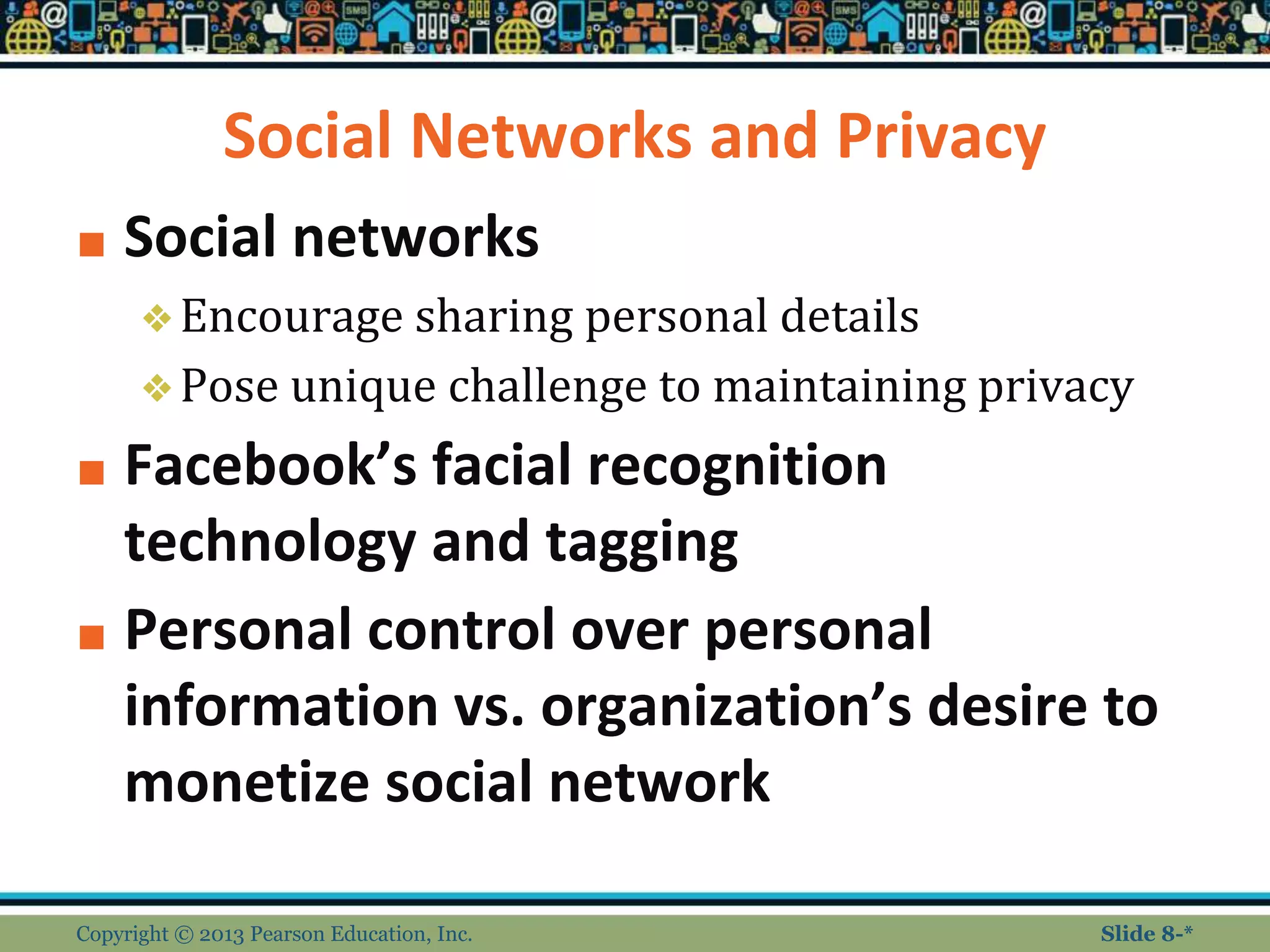
Social Networks and Privacy
■ Social networks
❖Encourage sharing personal details
❖Pose unique challenge to maintaining privacy
■ Facebook’s facial recognition
technology and tagging
■ Personal control over personal
information vs. organization’s desire to
monetize social network
Copyright © 2013 Pearson Education, Inc. Slide 8-*
Mobile and Location-based
Privacy Issues
■ Smartphone apps
❖ Funnel personal information to mobile advertisers for
targeting ads
❖ Track and store user locations
■ 42% of users say privacy a concern
■ Mobile Device Privacy Act
❖ Not yet passed
❖ Requires informing consumers about data collection
Copyright © 2013 Pearson Education, Inc. Slide 8-*
Profiling and Behavioral Targeting
■ Profiling
❖ Creation of digital images that characterize online
individual and group behavior
❖ Anonymous profiles
❖ Personal profiles
■ Advertising networks
❖ Track consumer and browsing behavior on Web
❖ Dynamically adjust what user sees on screen
❖ Build and refresh profiles of consumers
■ Google’s AdWords program
Copyright © 2013 Pearson Education, Inc. Slide 8-*
Profiling and Behavioral Targeting (cont.)
■ Deep packet inspection
■ Business perspective:
❖ Increases effectiveness of advertising, subsidizing free
content
❖ Enables sensing of demand for new products and
services
■ Critics’ perspective:
❖ Undermines expectation of anonymity and privacy
❖ Consumers show significant opposition to unregulated
collection of personal information
Copyright © 2013 Pearson Education, Inc. Slide 8-*
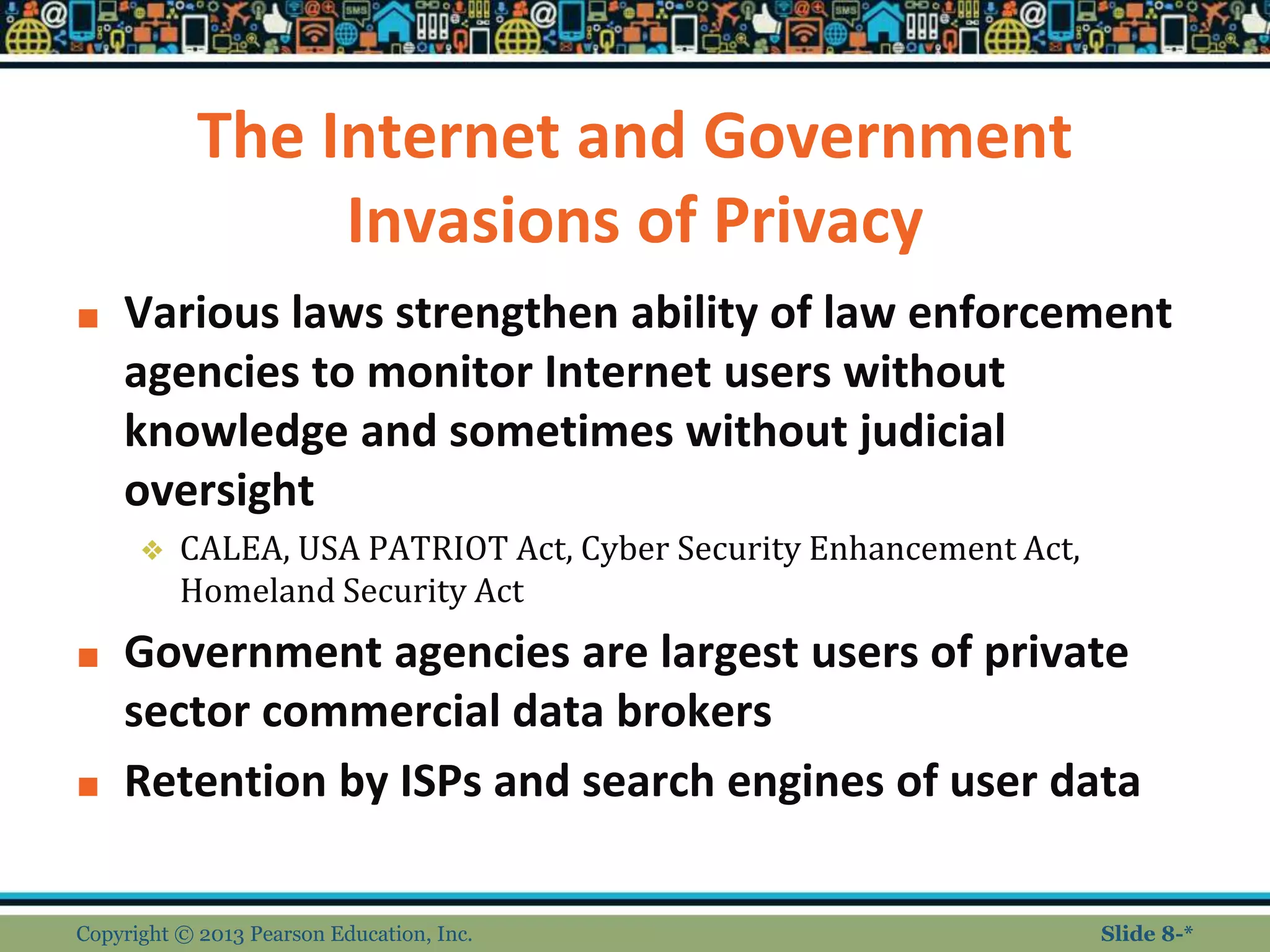
The Internet and Government
Invasions of Privacy
■ Various laws strengthen ability of law enforcement
agencies to monitor Internet users without
knowledge and sometimes without judicial
oversight
❖ CALEA, USA PATRIOT Act, Cyber Security Enhancement Act,
Homeland Security Act
■ Government agencies are largest users of private
sector commercial data brokers
■ Retention by ISPs and search engines of user data
Copyright © 2013 Pearson Education, Inc. Slide 8-*
Legal Protections
■ In United States, privacy rights explicitly
granted or derived from:
❖Constitution
■ First Amendment—freedom of speech and association
■ Fourth Amendment—unreasonable search and seizure
■ Fourteenth Amendment—due process
❖Specific statutes and regulations (federal and
state)
❖Common law
Copyright © 2013 Pearson Education, Inc. Slide 8-*
Informed Consent
■ U.S. firms can gather and redistribute
transaction information without individual’s
informed consent
❖ Illegal in Europe
■ Informed consent:
❖ Opt-in
❖ Opt-out
❖ Many U.S. e-commerce firms merely publish
information practices as part of privacy policy or use
opt-in as default
Copyright © 2013 Pearson Education, Inc. Slide 8-*
The FTC’s Fair Information Practices
■ Guidelines (not laws)
❖ Used to base assessments and make recommendations
❖ Sometimes used as basis for law (COPPA)
■ Fair Information Practice principles
❖ Notice
❖ Choice
❖ Access
❖ Security
❖ Enforcement
❖ Restricted collection
Copyright © 2013 Pearson Education, Inc. Slide 8-*
The FTC’s Fair Information Practices
■ New privacy framework (2010)
❖ Scope
❖ Privacy by design
❖ Simplified choice
❖ Greater transparency
■ 2012 Report: Industry best practices
❖ Do not track
❖ Mobile privacy
❖ Data brokers
❖ Large platform providers
❖ Development of self-regulatory codes
Copyright © 2013 Pearson Education, Inc. Slide 8-*
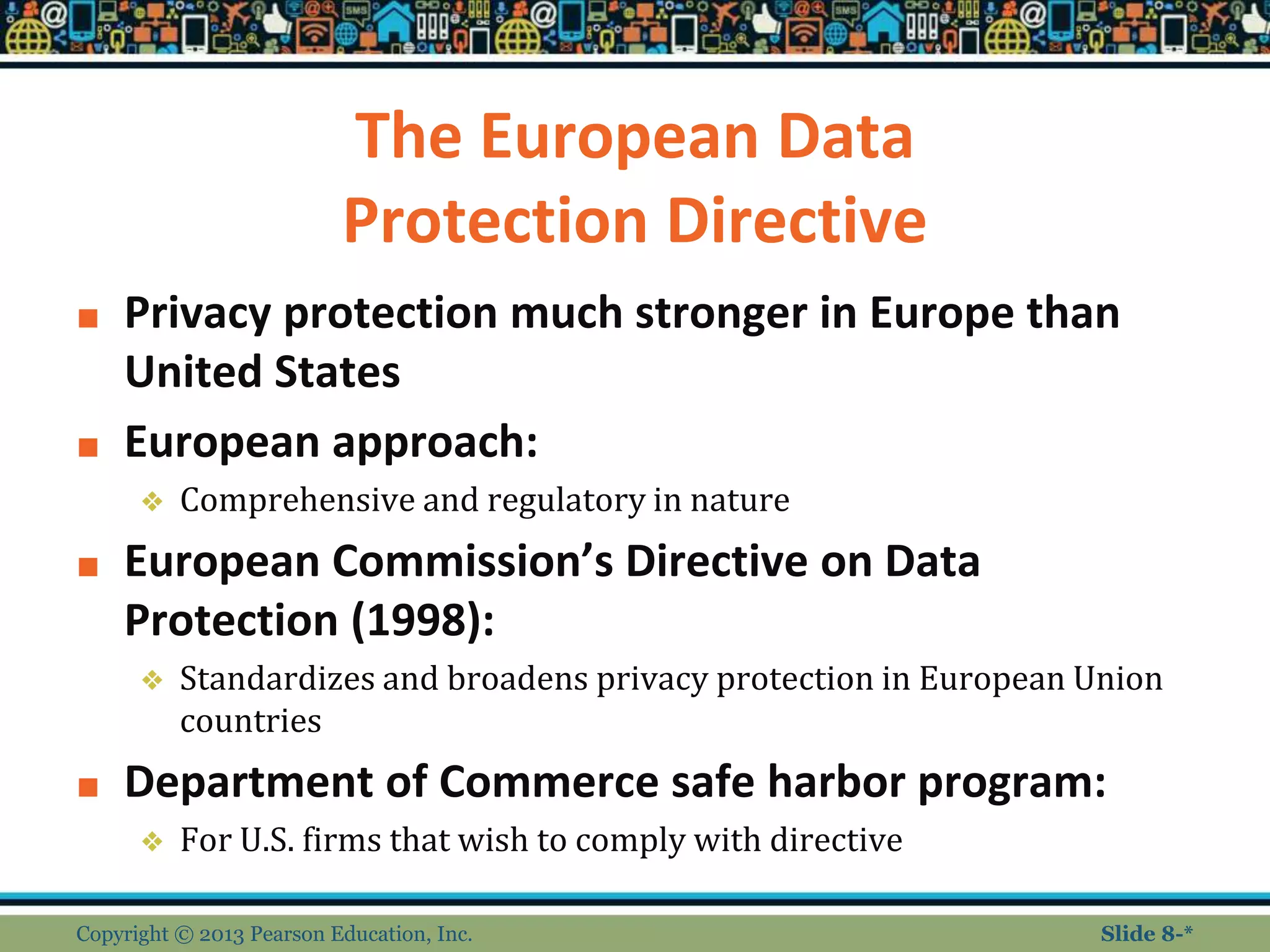
The European Data
Protection Directive
■ Privacy protection much stronger in Europe than
United States
■ European approach:
❖ Comprehensive and regulatory in nature
■ European Commission’s Directive on Data
Protection (1998):
❖ Standardizes and broadens privacy protection in European Union
countries
■ Department of Commerce safe harbor program:
❖ For U.S. firms that wish to comply with directive
Copyright © 2013 Pearson Education, Inc. Slide 8-*
Private Industry Self-Regulation
■ Safe harbor programs:
❖ Private policy mechanism to meet objectives of government
regulations without government involvement
❖ Privacy seal programs
❖ TRUSTe
■ Industry associations include:
❖ Online Privacy Alliance (OPA)
❖ Network Advertising Initiative (NAI)
■ CLEAR Ad Notice Technical Specifications
■ Privacy advocacy groups
■ Emerging privacy protection business
Copyright © 2013 Pearson Education, Inc. Slide 8-*
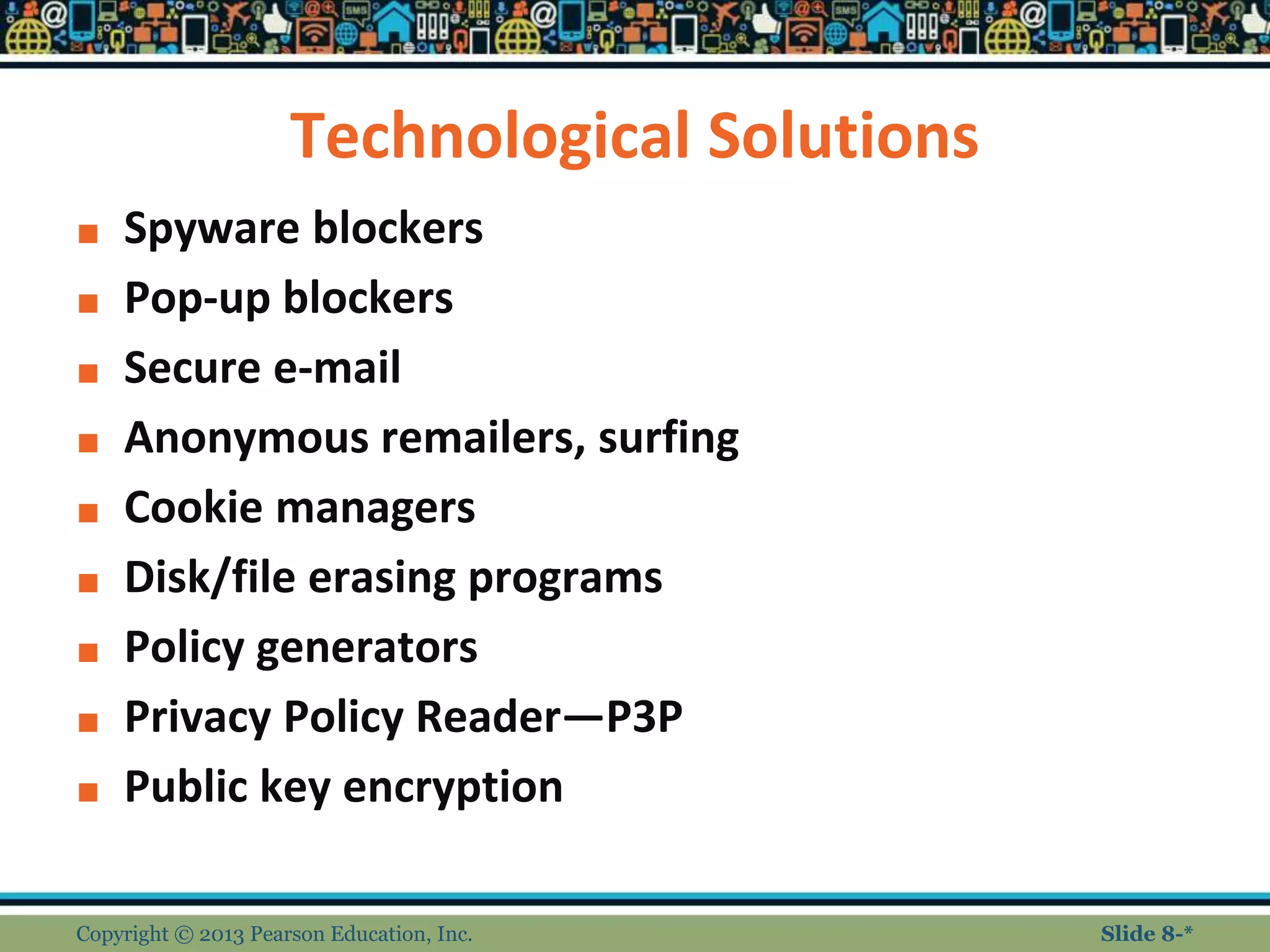
Technological Solutions
■ Spyware blockers
■ Pop-up blockers
■ Secure e-mail
■ Anonymous remailers, surfing
■ Cookie managers
■ Disk/file erasing programs
■ Policy generators
■ Privacy Policy Reader—P3P
■ Public key encryption
Copyright © 2013 Pearson Education, Inc. Slide 8-*
Intellectual Property Rights
■ Intellectual property:
❖ All tangible and intangible products of human mind
■ Major ethical issue:
❖ How should we treat property that belongs to others?
■ Major social issue:
❖ Is there continued value in protecting intellectual
property in the Internet age?
■ Major political issue:
❖ How can Internet and e-commerce be regulated or
governed to protect intellectual property?
Copyright © 2013 Pearson Education, Inc. Slide 8-*
Intellectual Property Protection
■ Three main types of protection:
❖ Copyright
❖ Patent
❖ Trademark law
■ Goal of intellectual property law:
❖ Balance two competing interests—public and private
■ Maintaining this balance of interests is
always challenged by the invention of new
technologies
Copyright © 2013 Pearson Education, Inc. Slide 8-*
Copyright
■ Protects original forms of expression (but not ideas)
from being copied by others for a period of time
■ “Look and feel” copyright infringement lawsuits
■ Fair use doctrine
■ Digital Millennium Copyright Act, 1998
❖ First major effort to adjust copyright laws to Internet age
❖ Implements WIPO treaty that makes it illegal to make, distribute, or
use devices that circumvent technology-based protections of
copyrighted materials
Copyright © 2013 Pearson Education, Inc. Slide 8-*
Patents
■ Grant owner 20-year monopoly on ideas behind an
invention
❖ Machines
❖ Man-made products
❖ Compositions of matter
❖ Processing methods
■ Invention must be new, non-obvious, novel
■ Encourages inventors
■ Promotes dissemination of new techniques through
licensing
■ Stifles competition by raising barriers to entry
Copyright © 2013 Pearson Education, Inc. Slide 8-*
E-commerce Patents
■ 1998 State Street Bank & Trust vs.
Signature Financial Group
❖ Business method patents
■ Most European patent laws do not
recognize business methods unless
based on technology
■ Patent reform
❖ Patent trolls
❖ 2011 America Invents Acts
Copyright © 2013 Pearson Education, Inc. Slide 8-*
Insight on Technology: Class Discussion
Theft and Innovation:
The Patent Trial of the Century
■ Do you agree with the jury finding that Samsung
violated Apple’s patents in the Samsung Galaxy
design?
■ Should “trade dress” patents cover basic shape
elements, such as round-cornered squares used for
icons?
■ The Apple “look and feel” has inspired the “looks
and feel” of many other Web sites and devices.
How is this different from the Samsung case?
Copyright © 2013 Pearson Education, Inc. Slide 8-*
Trademarks
■ Identify, distinguish goods, and indicate their
source
■ Purpose
❖ Ensure consumer gets what is paid for/expected to receive
❖ Protect owner against piracy and misappropriation
■ Infringement
❖ Market confusion
❖ Bad faith
■ Dilution
❖ Behavior that weakens connection between trademark and
product
Copyright © 2013 Pearson Education, Inc. Slide 8-*
Trademarks and the Internet
■ Cybersquatting
❖ Anticybersquatting Consumer Protection Act (ACPA)
■ Cyberpiracy
❖ Typosquatting
■ Metatagging
■ Keywording
■ Linking and deep linking
■ Framing
Copyright © 2013 Pearson Education, Inc. Slide 8-*
Governance
■ Primary questions
❖Who will control Internet and e-commerce?
❖What elements will be controlled and how?
■ Stages of governance and e-commerce
❖Government Control Period (1970–1994)
❖Privatization (1995–1998)
❖Self-Regulation (1995–present)
❖Government Regulation (1998–present)
Copyright © 2013 Pearson Education, Inc. Slide 8-*
Who Governs E-commerce
and the Internet?
■ Mixed mode environment
❖Self-regulation, through variety of Internet
policy and technical bodies, co-exists with
limited government regulation
■ ICANN : Domain Name System
■ Internet can be easily controlled,
monitored, and regulated from a central
location
Copyright © 2013 Pearson Education, Inc. Slide 8-*
Taxation
■ Non-local nature of Internet commerce
complicates governance and jurisdiction
issues
■ Sales taxes
■ MOTO retailing tax subsidies
■ Internet Tax Freedom Act
■ Unlikely that comprehensive, integrated
rational approach to taxation issue will be
determined for some time to come
Copyright © 2013 Pearson Education, Inc. Slide 8-*
Insight on Business: Class Discussion
Internet Sales Tax Battle
■ Given the nature of the Internet, should
sales tax be based on the location of the
consumer rather than the seller?
■ Why is there a struggle to define the
nature of “small business”? How big do
you think a “small business” is?
■ Are bricks-and-clicks retailers
disadvantaged by local sales tax laws?
Copyright © 2013 Pearson Education, Inc. Slide 8-*
Net Neutrality
■ Neutrality: All Internet activities charged the same
rate, regardless of bandwidth used
■ Differentiated pricing strategies
■ Cap pricing (tiered plans)
■ Speed tiers
■ Usage metering
■ Congestion pricing
■ Highway (“toll”) pricing
■ Comcast slows users for certain traffic
■ FCC’s 2010 “compromise” net neutrality rules
Copyright © 2013 Pearson Education, Inc. Slide 8-*
Public Safety and Welfare
■ Protection of children and strong
sentiments against pornography
❖Passing legislation that will survive court
challenges has proved difficult
■ Efforts to control gambling and restrict
sales of drugs and cigarettes
❖Currently, mostly regulated by state law
❖Unlawful Internet Gambling Enforcement Act
Copyright © 2013 Pearson Education, Inc. Slide 8-*
Insight on Society: Class Discussion
The Internet Drug Bazaar
■ What’s wrong with buying prescription drugs online,
especially if the prices are lower?
■ What are the risks and benefits of online pharmacies?
■ Should online pharmacies require a physician’s prescription?
■ How do online pharmacies challenge the traditional business
model of pharmacies and drug firms?
■ What are the challenges in regulating online pharmacies?
■ Who benefits and who loses from online pharmacies?
Copyright © 2013 Pearson Education, Inc. Slide 8-*

Chapter 8

  • 1.
    E-commerce 2013 Kenneth C.Laudon Carol Guercio Traver business. technology. society. ninth edition
  • 2.
    Chapter 8 Ethical, Social,and Political Issues in E-commerce Copyright © 2013 Pearson Education, Inc.
  • 3.
    Class Discussion Internet FreeSpeech: Who Decides? ■ Is the Internet a form of “public speech”? ■ How can the different national perspectives on free speech be managed in a global environment like the Internet? ■ Given that the Internet is supported by governments and private companies, should these institutional and corporate needs supersede the free speech rights of individuals on the Internet? Copyright © 2013 Pearson Education, Inc. Slide 8-*
  • 4.
    Understanding Ethical, Social,and Political Issues in E-commerce ■ Internet, like other technologies, can: ❖Enable new crimes ❖Affect environment ❖Threaten social values ■ Costs and benefits must be carefully considered, especially when there are no clear-cut legal or cultural guidelines Copyright © 2013 Pearson Education, Inc. Slide 8-*
  • 5.
    A Model forOrganizing the Issues ■ Issues raised by Internet and e-commerce can be viewed at individual, social, and political levels ■ Four major categories of issues: ❖Information rights ❖Property rights ❖Governance ❖Public safety and welfare Copyright © 2013 Pearson Education, Inc. Slide 8-*
  • 6.
    The Moral Dimensionsof an Internet Society Figure 8.1, Page 492 Copyright © 2013 Pearson Education, Inc. Slide 8-*
  • 7.
    Basic Ethical Concepts ■Ethics ❖ Study of principles used to determine right and wrong courses of action ■ Responsibility ■ Accountability ■ Liability ❖ Laws permitting individuals to recover damages ■ Due process ❖ Laws are known, understood ❖ Ability to appeal to higher authorities to ensure laws applied correctly Copyright © 2013 Pearson Education, Inc. Slide 8-*
  • 8.
    Analyzing Ethical Dilemmas ■Process for analyzing ethical dilemmas: 1. Identify and clearly describe the facts 2. Define the conflict or dilemma and identify the higher-order values involved 3. Identify the stakeholders 4. Identify the options that you can reasonably take 5. Identify the potential consequences of your options Copyright © 2013 Pearson Education, Inc. Slide 8-*
  • 9.
    Candidate Ethical Principles ■Golden Rule ■ Universalism ■ Slippery Slope ■ Collective Utilitarian Principle ■ Risk Aversion ■ No Free Lunch ■ The New York Times Test ■ The Social Contract Rule Copyright © 2013 Pearson Education, Inc. Slide 8-*
  • 10.
    Privacy and InformationRights ■ Privacy ❖ Moral right of individuals to be left alone, free from surveillance, or interference from other individuals or organizations ■ Information privacy ❖ Subset of privacy ❖ Claims: ■ Certain information should not be collected at all ■ Individuals should control the use of whatever information is collected about them Copyright © 2013 Pearson Education, Inc. Slide 8-*
  • 11.
    Privacy and InformationRights (cont.) ■ Major ethical issue related to e-commerce and privacy: ❖ Under what conditions should we invade the privacy of others? ■ Major social issue: ❖ Development of “expectations of privacy” and privacy norms ■ Major political issue: ❖ Development of statutes that govern relations between recordkeepers and individuals Copyright © 2013 Pearson Education, Inc. Slide 8-*
  • 12.
    Information Collected at E-commerceSites ■ Data collected includes ❖Personally identifiable information (PII) ❖Anonymous information ■ Types of data collected ❖Name, address, phone, e-mail, social security ❖Bank and credit accounts, gender, age, occupation, education ❖Preference data, transaction data, clickstream data, browser type Copyright © 2013 Pearson Education, Inc. Slide 8-*
  • 13.
    Social Networks andPrivacy ■ Social networks ❖Encourage sharing personal details ❖Pose unique challenge to maintaining privacy ■ Facebook’s facial recognition technology and tagging ■ Personal control over personal information vs. organization’s desire to monetize social network Copyright © 2013 Pearson Education, Inc. Slide 8-*
  • 14.
    Mobile and Location-based PrivacyIssues ■ Smartphone apps ❖ Funnel personal information to mobile advertisers for targeting ads ❖ Track and store user locations ■ 42% of users say privacy a concern ■ Mobile Device Privacy Act ❖ Not yet passed ❖ Requires informing consumers about data collection Copyright © 2013 Pearson Education, Inc. Slide 8-*
  • 15.
    Profiling and BehavioralTargeting ■ Profiling ❖ Creation of digital images that characterize online individual and group behavior ❖ Anonymous profiles ❖ Personal profiles ■ Advertising networks ❖ Track consumer and browsing behavior on Web ❖ Dynamically adjust what user sees on screen ❖ Build and refresh profiles of consumers ■ Google’s AdWords program Copyright © 2013 Pearson Education, Inc. Slide 8-*
  • 16.
    Profiling and BehavioralTargeting (cont.) ■ Deep packet inspection ■ Business perspective: ❖ Increases effectiveness of advertising, subsidizing free content ❖ Enables sensing of demand for new products and services ■ Critics’ perspective: ❖ Undermines expectation of anonymity and privacy ❖ Consumers show significant opposition to unregulated collection of personal information Copyright © 2013 Pearson Education, Inc. Slide 8-*
  • 17.
    The Internet andGovernment Invasions of Privacy ■ Various laws strengthen ability of law enforcement agencies to monitor Internet users without knowledge and sometimes without judicial oversight ❖ CALEA, USA PATRIOT Act, Cyber Security Enhancement Act, Homeland Security Act ■ Government agencies are largest users of private sector commercial data brokers ■ Retention by ISPs and search engines of user data Copyright © 2013 Pearson Education, Inc. Slide 8-*
  • 18.
    Legal Protections ■ InUnited States, privacy rights explicitly granted or derived from: ❖Constitution ■ First Amendment—freedom of speech and association ■ Fourth Amendment—unreasonable search and seizure ■ Fourteenth Amendment—due process ❖Specific statutes and regulations (federal and state) ❖Common law Copyright © 2013 Pearson Education, Inc. Slide 8-*
  • 19.
    Informed Consent ■ U.S.firms can gather and redistribute transaction information without individual’s informed consent ❖ Illegal in Europe ■ Informed consent: ❖ Opt-in ❖ Opt-out ❖ Many U.S. e-commerce firms merely publish information practices as part of privacy policy or use opt-in as default Copyright © 2013 Pearson Education, Inc. Slide 8-*
  • 20.
    The FTC’s FairInformation Practices ■ Guidelines (not laws) ❖ Used to base assessments and make recommendations ❖ Sometimes used as basis for law (COPPA) ■ Fair Information Practice principles ❖ Notice ❖ Choice ❖ Access ❖ Security ❖ Enforcement ❖ Restricted collection Copyright © 2013 Pearson Education, Inc. Slide 8-*
  • 21.
    The FTC’s FairInformation Practices ■ New privacy framework (2010) ❖ Scope ❖ Privacy by design ❖ Simplified choice ❖ Greater transparency ■ 2012 Report: Industry best practices ❖ Do not track ❖ Mobile privacy ❖ Data brokers ❖ Large platform providers ❖ Development of self-regulatory codes Copyright © 2013 Pearson Education, Inc. Slide 8-*
  • 22.
    The European Data ProtectionDirective ■ Privacy protection much stronger in Europe than United States ■ European approach: ❖ Comprehensive and regulatory in nature ■ European Commission’s Directive on Data Protection (1998): ❖ Standardizes and broadens privacy protection in European Union countries ■ Department of Commerce safe harbor program: ❖ For U.S. firms that wish to comply with directive Copyright © 2013 Pearson Education, Inc. Slide 8-*
  • 23.
    Private Industry Self-Regulation ■Safe harbor programs: ❖ Private policy mechanism to meet objectives of government regulations without government involvement ❖ Privacy seal programs ❖ TRUSTe ■ Industry associations include: ❖ Online Privacy Alliance (OPA) ❖ Network Advertising Initiative (NAI) ■ CLEAR Ad Notice Technical Specifications ■ Privacy advocacy groups ■ Emerging privacy protection business Copyright © 2013 Pearson Education, Inc. Slide 8-*
  • 24.
    Technological Solutions ■ Spywareblockers ■ Pop-up blockers ■ Secure e-mail ■ Anonymous remailers, surfing ■ Cookie managers ■ Disk/file erasing programs ■ Policy generators ■ Privacy Policy Reader—P3P ■ Public key encryption Copyright © 2013 Pearson Education, Inc. Slide 8-*
  • 25.
    Intellectual Property Rights ■Intellectual property: ❖ All tangible and intangible products of human mind ■ Major ethical issue: ❖ How should we treat property that belongs to others? ■ Major social issue: ❖ Is there continued value in protecting intellectual property in the Internet age? ■ Major political issue: ❖ How can Internet and e-commerce be regulated or governed to protect intellectual property? Copyright © 2013 Pearson Education, Inc. Slide 8-*
  • 26.
    Intellectual Property Protection ■Three main types of protection: ❖ Copyright ❖ Patent ❖ Trademark law ■ Goal of intellectual property law: ❖ Balance two competing interests—public and private ■ Maintaining this balance of interests is always challenged by the invention of new technologies Copyright © 2013 Pearson Education, Inc. Slide 8-*
  • 27.
    Copyright ■ Protects originalforms of expression (but not ideas) from being copied by others for a period of time ■ “Look and feel” copyright infringement lawsuits ■ Fair use doctrine ■ Digital Millennium Copyright Act, 1998 ❖ First major effort to adjust copyright laws to Internet age ❖ Implements WIPO treaty that makes it illegal to make, distribute, or use devices that circumvent technology-based protections of copyrighted materials Copyright © 2013 Pearson Education, Inc. Slide 8-*
  • 28.
    Patents ■ Grant owner20-year monopoly on ideas behind an invention ❖ Machines ❖ Man-made products ❖ Compositions of matter ❖ Processing methods ■ Invention must be new, non-obvious, novel ■ Encourages inventors ■ Promotes dissemination of new techniques through licensing ■ Stifles competition by raising barriers to entry Copyright © 2013 Pearson Education, Inc. Slide 8-*
  • 29.
    E-commerce Patents ■ 1998State Street Bank & Trust vs. Signature Financial Group ❖ Business method patents ■ Most European patent laws do not recognize business methods unless based on technology ■ Patent reform ❖ Patent trolls ❖ 2011 America Invents Acts Copyright © 2013 Pearson Education, Inc. Slide 8-*
  • 30.
    Insight on Technology:Class Discussion Theft and Innovation: The Patent Trial of the Century ■ Do you agree with the jury finding that Samsung violated Apple’s patents in the Samsung Galaxy design? ■ Should “trade dress” patents cover basic shape elements, such as round-cornered squares used for icons? ■ The Apple “look and feel” has inspired the “looks and feel” of many other Web sites and devices. How is this different from the Samsung case? Copyright © 2013 Pearson Education, Inc. Slide 8-*
  • 31.
    Trademarks ■ Identify, distinguishgoods, and indicate their source ■ Purpose ❖ Ensure consumer gets what is paid for/expected to receive ❖ Protect owner against piracy and misappropriation ■ Infringement ❖ Market confusion ❖ Bad faith ■ Dilution ❖ Behavior that weakens connection between trademark and product Copyright © 2013 Pearson Education, Inc. Slide 8-*
  • 32.
    Trademarks and theInternet ■ Cybersquatting ❖ Anticybersquatting Consumer Protection Act (ACPA) ■ Cyberpiracy ❖ Typosquatting ■ Metatagging ■ Keywording ■ Linking and deep linking ■ Framing Copyright © 2013 Pearson Education, Inc. Slide 8-*
  • 33.
    Governance ■ Primary questions ❖Whowill control Internet and e-commerce? ❖What elements will be controlled and how? ■ Stages of governance and e-commerce ❖Government Control Period (1970–1994) ❖Privatization (1995–1998) ❖Self-Regulation (1995–present) ❖Government Regulation (1998–present) Copyright © 2013 Pearson Education, Inc. Slide 8-*
  • 34.
    Who Governs E-commerce andthe Internet? ■ Mixed mode environment ❖Self-regulation, through variety of Internet policy and technical bodies, co-exists with limited government regulation ■ ICANN : Domain Name System ■ Internet can be easily controlled, monitored, and regulated from a central location Copyright © 2013 Pearson Education, Inc. Slide 8-*
  • 35.
    Taxation ■ Non-local natureof Internet commerce complicates governance and jurisdiction issues ■ Sales taxes ■ MOTO retailing tax subsidies ■ Internet Tax Freedom Act ■ Unlikely that comprehensive, integrated rational approach to taxation issue will be determined for some time to come Copyright © 2013 Pearson Education, Inc. Slide 8-*
  • 36.
    Insight on Business:Class Discussion Internet Sales Tax Battle ■ Given the nature of the Internet, should sales tax be based on the location of the consumer rather than the seller? ■ Why is there a struggle to define the nature of “small business”? How big do you think a “small business” is? ■ Are bricks-and-clicks retailers disadvantaged by local sales tax laws? Copyright © 2013 Pearson Education, Inc. Slide 8-*
  • 37.
    Net Neutrality ■ Neutrality:All Internet activities charged the same rate, regardless of bandwidth used ■ Differentiated pricing strategies ■ Cap pricing (tiered plans) ■ Speed tiers ■ Usage metering ■ Congestion pricing ■ Highway (“toll”) pricing ■ Comcast slows users for certain traffic ■ FCC’s 2010 “compromise” net neutrality rules Copyright © 2013 Pearson Education, Inc. Slide 8-*
  • 38.
    Public Safety andWelfare ■ Protection of children and strong sentiments against pornography ❖Passing legislation that will survive court challenges has proved difficult ■ Efforts to control gambling and restrict sales of drugs and cigarettes ❖Currently, mostly regulated by state law ❖Unlawful Internet Gambling Enforcement Act Copyright © 2013 Pearson Education, Inc. Slide 8-*
  • 39.
    Insight on Society:Class Discussion The Internet Drug Bazaar ■ What’s wrong with buying prescription drugs online, especially if the prices are lower? ■ What are the risks and benefits of online pharmacies? ■ Should online pharmacies require a physician’s prescription? ■ How do online pharmacies challenge the traditional business model of pharmacies and drug firms? ■ What are the challenges in regulating online pharmacies? ■ Who benefits and who loses from online pharmacies? Copyright © 2013 Pearson Education, Inc. Slide 8-*
  • 40.
    Copyright © 2013Pearson Education, Inc. Slide 8-*