E-commerce 2015
Kenneth C. Laudon
Carol Guercio Traver
business. technology. society.
eleventh edition
global edition
Copyright © 2016 Pearson Education, Ltd.
Chapter 1
Introduction to E-commerce
Copyright © 2016 Pearson Education, Ltd.
Class Discussion
Class Discussion
Pinterest: A Picture Is Worth a
Thousand Words
 Have you used Pinterest or any other content
curation sites? What are your main interests?
 Have you purchased anything based on a pin
or board on Pinterest or any other curation
site?
 Why do Pinterest links drive more purchasing
than Facebook links?
Copyright © 2016 Pearson Education, Ltd. Slide 1-3
What Is E-commerce?
 Use of Internet and Web to transact
business
 More formally:
Digitally enabled commercial transactions
between and among organizations and
individuals
Copyright © 2016 Pearson Education, Ltd. Slide 1-4
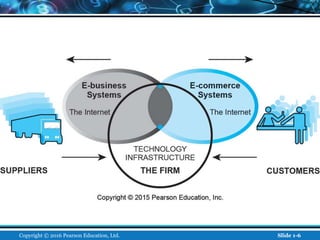
E-commerce vs. E-business
 E-business:
Digital enabling of transactions and
processes within a firm, involving
information systems under firm’s control
Does not include commercial transactions
involving an exchange of value across
organizational boundaries
Copyright © 2016 Pearson Education, Ltd. Slide 1-5
Copyright © 2016 Pearson Education, Ltd. Slide 1-6
Why Study E-commerce?
 E-commerce technology is different, more
powerful than previous technologies
 E-commerce brings fundamental changes to
commerce
 Traditional commerce:
 Consumer as passive targets
 Mass-marketing driven
 Sales-force driven
 Fixed prices
 Information asymmetry
Copyright © 2016 Pearson Education, Ltd. Slide 1-7
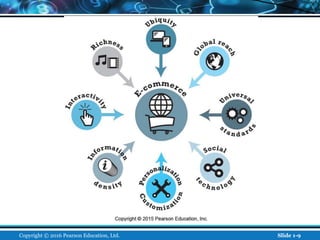
Eight Unique Features of
E-commerce Technology
1. Ubiquity
2. Global reach
3. Universal standards
4. Information richness
5. Interactivity
6. Information density
7. Personalization/customization
8. Social technology
Copyright © 2016 Pearson Education, Ltd. Slide 1-8
Copyright © 2016 Pearson Education, Ltd. Slide 1-9
Web 2.0
 User-centered applications and social
media technologies
User-generated content and communication
Highly interactive, social communities
Large audiences; yet mostly unproven business
models
Examples: Twitter, YouTube, Instagram,
Wikipedia, Tumblr, Uber
Copyright © 2016 Pearson Education, Ltd. Slide 1-10
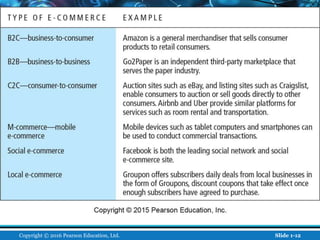
Types of E-commerce
 May be classified by market relationship or technology
 Business-to-Consumer (B2C)
 Business-to-Business (B2B)
 Consumer-to-Consumer (C2C)
 Mobile e-commerce (M-commerce)
 Social e-commerce
 Local e-commerce
Copyright © 2016 Pearson Education, Ltd. Slide 1-11
Copyright © 2016 Pearson Education, Ltd. Slide 1-12
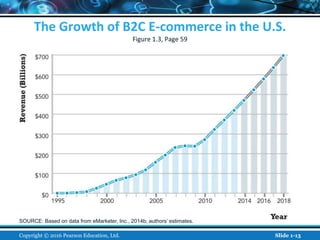
The Growth of B2C E-commerce in the U.S.
Figure 1.3, Page 59
SOURCE: Based on data from eMarketer, Inc., 2014b; authors’ estimates.
Copyright © 2016 Pearson Education, Ltd. Slide 1-13
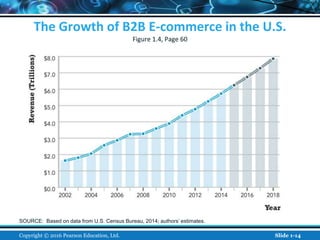
The Growth of B2B E-commerce in the U.S.
Figure 1.4, Page 60
SOURCE: Based on data from U.S. Census Bureau, 2014; authors’ estimates.
Copyright © 2016 Pearson Education, Ltd. Slide 1-14
Copyright © 2016 Pearson Education, Ltd. Slide 1-15
The Internet
 Worldwide network of computer
networks built on common standards
 Created in late 1960s
 Services include the Web, e-mail, file
transfers, and so on
 Can measure growth by number of
Internet hosts with domain names
Copyright © 2016 Pearson Education, Ltd. Slide 1-16
The Web
 Most popular Internet service
 Developed in early 1990s
 Provides access to Web pages
HTML documents that may include text,
graphics, animations, music, videos
 Web content has grown exponentially
 Google reports 60 trillion unique URLs
Copyright © 2016 Pearson Education, Ltd. Slide 1-17
The Mobile Platform
 Most recent development in Internet
infrastructure
 Enables access to the Internet via
wireless networks or cell-phone service
 Mobile devices include
Tablets
Smartphones
Ultra-lightweight laptops
Copyright © 2016 Pearson Education, Ltd. Slide 1-18
Copyright © 2016 Pearson Education, Ltd. Slide 1-19
Understanding E-commerce:
Organizing Themes
 Technology:
 Development and mastery of digital computing and
communications technology
 Business:
 New technologies present businesses with new ways of
organizing production and transacting business
 Society:
 Intellectual property, individual privacy, public welfare
policy
Copyright © 2016 Pearson Education, Ltd. Slide 1-20
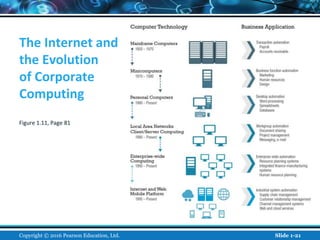
The Internet and
the Evolution
of Corporate
Computing
Figure 1.11, Page 81
Copyright © 2016 Pearson Education, Ltd. Slide 1-21
Academic Disciplines
Concerned with E-commerce
 Technical approach
 Computer science
 Management science
 Information systems
 Behavioral approach
 Information systems
 Economics
 Marketing
 Management
 Finance/accounting
 Sociology
Copyright © 2016 Pearson Education, Ltd. Slide 1-22

Chapter 1 Ecommerce.ppt

  • 1.
    E-commerce 2015 Kenneth C.Laudon Carol Guercio Traver business. technology. society. eleventh edition global edition Copyright © 2016 Pearson Education, Ltd.
  • 2.
    Chapter 1 Introduction toE-commerce Copyright © 2016 Pearson Education, Ltd.
  • 3.
    Class Discussion Class Discussion Pinterest:A Picture Is Worth a Thousand Words  Have you used Pinterest or any other content curation sites? What are your main interests?  Have you purchased anything based on a pin or board on Pinterest or any other curation site?  Why do Pinterest links drive more purchasing than Facebook links? Copyright © 2016 Pearson Education, Ltd. Slide 1-3
  • 4.
    What Is E-commerce? Use of Internet and Web to transact business  More formally: Digitally enabled commercial transactions between and among organizations and individuals Copyright © 2016 Pearson Education, Ltd. Slide 1-4
  • 5.
    E-commerce vs. E-business E-business: Digital enabling of transactions and processes within a firm, involving information systems under firm’s control Does not include commercial transactions involving an exchange of value across organizational boundaries Copyright © 2016 Pearson Education, Ltd. Slide 1-5
  • 6.
    Copyright © 2016Pearson Education, Ltd. Slide 1-6
  • 7.
    Why Study E-commerce? E-commerce technology is different, more powerful than previous technologies  E-commerce brings fundamental changes to commerce  Traditional commerce:  Consumer as passive targets  Mass-marketing driven  Sales-force driven  Fixed prices  Information asymmetry Copyright © 2016 Pearson Education, Ltd. Slide 1-7
  • 8.
    Eight Unique Featuresof E-commerce Technology 1. Ubiquity 2. Global reach 3. Universal standards 4. Information richness 5. Interactivity 6. Information density 7. Personalization/customization 8. Social technology Copyright © 2016 Pearson Education, Ltd. Slide 1-8
  • 9.
    Copyright © 2016Pearson Education, Ltd. Slide 1-9
  • 10.
    Web 2.0  User-centeredapplications and social media technologies User-generated content and communication Highly interactive, social communities Large audiences; yet mostly unproven business models Examples: Twitter, YouTube, Instagram, Wikipedia, Tumblr, Uber Copyright © 2016 Pearson Education, Ltd. Slide 1-10
  • 11.
    Types of E-commerce May be classified by market relationship or technology  Business-to-Consumer (B2C)  Business-to-Business (B2B)  Consumer-to-Consumer (C2C)  Mobile e-commerce (M-commerce)  Social e-commerce  Local e-commerce Copyright © 2016 Pearson Education, Ltd. Slide 1-11
  • 12.
    Copyright © 2016Pearson Education, Ltd. Slide 1-12
  • 13.
    The Growth ofB2C E-commerce in the U.S. Figure 1.3, Page 59 SOURCE: Based on data from eMarketer, Inc., 2014b; authors’ estimates. Copyright © 2016 Pearson Education, Ltd. Slide 1-13
  • 14.
    The Growth ofB2B E-commerce in the U.S. Figure 1.4, Page 60 SOURCE: Based on data from U.S. Census Bureau, 2014; authors’ estimates. Copyright © 2016 Pearson Education, Ltd. Slide 1-14
  • 15.
    Copyright © 2016Pearson Education, Ltd. Slide 1-15
  • 16.
    The Internet  Worldwidenetwork of computer networks built on common standards  Created in late 1960s  Services include the Web, e-mail, file transfers, and so on  Can measure growth by number of Internet hosts with domain names Copyright © 2016 Pearson Education, Ltd. Slide 1-16
  • 17.
    The Web  Mostpopular Internet service  Developed in early 1990s  Provides access to Web pages HTML documents that may include text, graphics, animations, music, videos  Web content has grown exponentially  Google reports 60 trillion unique URLs Copyright © 2016 Pearson Education, Ltd. Slide 1-17
  • 18.
    The Mobile Platform Most recent development in Internet infrastructure  Enables access to the Internet via wireless networks or cell-phone service  Mobile devices include Tablets Smartphones Ultra-lightweight laptops Copyright © 2016 Pearson Education, Ltd. Slide 1-18
  • 19.
    Copyright © 2016Pearson Education, Ltd. Slide 1-19
  • 20.
    Understanding E-commerce: Organizing Themes Technology:  Development and mastery of digital computing and communications technology  Business:  New technologies present businesses with new ways of organizing production and transacting business  Society:  Intellectual property, individual privacy, public welfare policy Copyright © 2016 Pearson Education, Ltd. Slide 1-20
  • 21.
    The Internet and theEvolution of Corporate Computing Figure 1.11, Page 81 Copyright © 2016 Pearson Education, Ltd. Slide 1-21
  • 22.
    Academic Disciplines Concerned withE-commerce  Technical approach  Computer science  Management science  Information systems  Behavioral approach  Information systems  Economics  Marketing  Management  Finance/accounting  Sociology Copyright © 2016 Pearson Education, Ltd. Slide 1-22