Joey R. Miñano
Training and Development
Training
Development
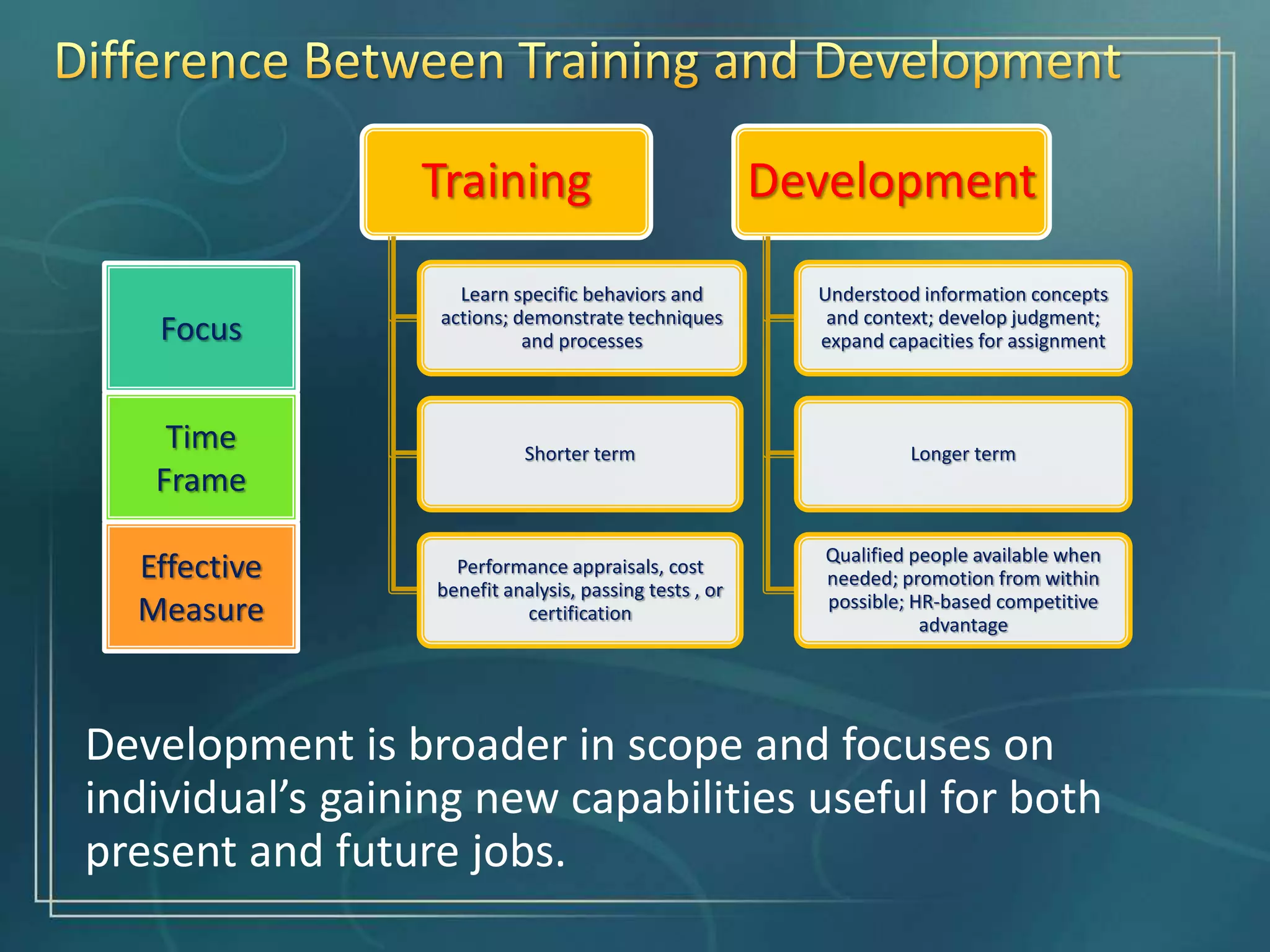
Difference Between Training and
Development
The Need for Training
The Nature of Training
The Importance of Training
Types of Training
The Training Process
Training & Development is a continuous
process in an organization to achieve its
organizational goals by improving the
skills and knowledge of the employees.
The training and development function in
an organization has gained a lot of
importance due to advancement in
technology and changes in market force.
Training is basically a systematic procedure for
transferring technical know-how to the
employees so as to increase their knowledge
and skills for doing particular jobs.
Training usually involves teaching operational or
technical employees how to do their jobs more
effectively and/or efficiently.
Training is a process of teaching a new
employees the basic skills to perform their jobs
- Garry Dessler
Efforts made to improve employee’s ability to
handle a variety of assignment.
Development is a process of preparing
employees for future position and improve their
personal skills to handle the critical situations in
an organization.
Development is generally aimed at helping
managers better understand and solve
problems, make decisions, and capitalize on
opportunities.
Development is often considered a HR function.
Development is broader in scope and focuses on
individual’s gaining new capabilities useful for both
present and future jobs.
Training
Learn specific behaviors and
actions; demonstrate techniques
and processes
Shorter term
Performance appraisals, cost
benefit analysis, passing tests , or
certification
Development
Understood information concepts
and context; develop judgment;
expand capacities for assignment
Longer term
Qualified people available when
needed; promotion from within
possible; HR-based competitive
advantage
Focus
Time
Frame
Effective
Measure
Companies initially used to emphasize only on
production process training i.e. teaching technical skill
required to perform jobs, such as training assembles to
solder wires or teachers to device lesson plans.
however training and development programs and their
objectives change in the 1980s and 1990s.
Employers had to adapt to rapid technological changes,
improve product and service quality, and boost
productivity to stay competitive improving quality
often requires remedial-education training, since
quality-improvement programs assume employees can
use critical thinking skills, produce charts and graphs
and analyze data.
Employees must also use or acquire skills in team
building, decision making, and communication.
As firms become more technologically advance,
employees require training in technological and
computer skills (such as desk top publishing and
computer aided design and manufacturing).
As increased competition has put a premium on better
service, employers have turned increasingly to
customer-service training to provide employees with
the tools and abilities they need to deal more
effectively with customers, such as effective listening
skills.

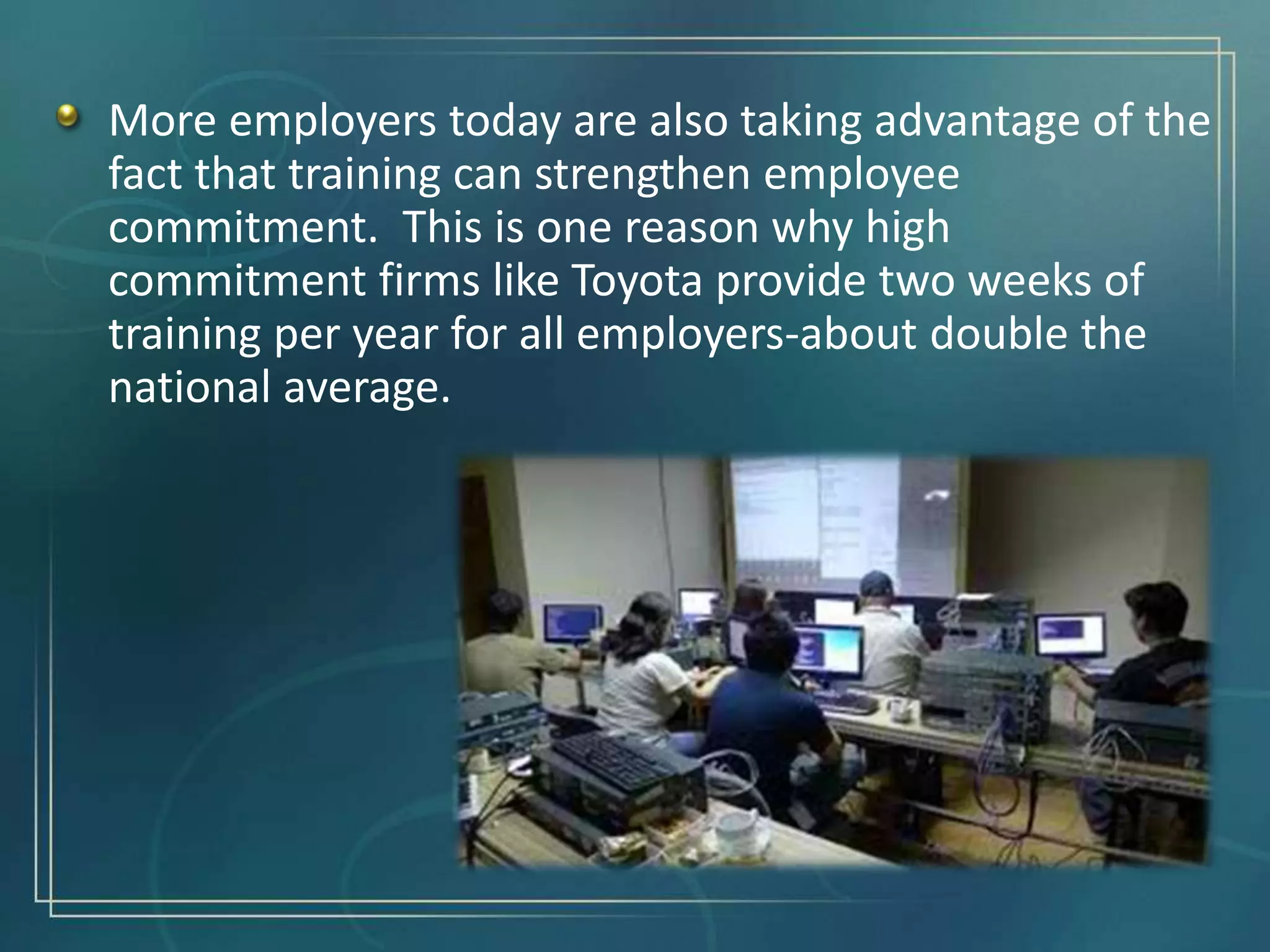
More employers today are also taking advantage of the
fact that training can strengthen employee
commitment. This is one reason why high
commitment firms like Toyota provide two weeks of
training per year for all employers-about double the
national average.
Training usually involves teaching operational or
technical employees how to do their jobs more
effectively and/or efficiently.
Responsibilities for training are generally
assigned to the HR function.
In general, training is intended to help the
organization function more effectively.
Managers must be sure that productivity can be
increased through training and that productivity
gains are possible with existing resources.
Trained workers can work more efficiently.
There will be fewer accidents. As training
improves the knowledge of employees
regarding the use of machines and
equipment.
Wastage is eliminated to a large extent as
they use tools, machines in a proper way.
Training helps an employee to move from
one organization to another easily. He can be
more mobile and pursue career goals easily.
Training makes employees more loyal to an
organization.
They will be less inclined to leave the unit where
there are growth opportunities.
Training enables employees to secure promotions
easily.
They can realize their career goals comfortably.
Economical supervision-as there is less
requirement for supervision for trained
employees.
Uniform procedures-with the help of
training the best available methods can be
standardized and made available to all
employees
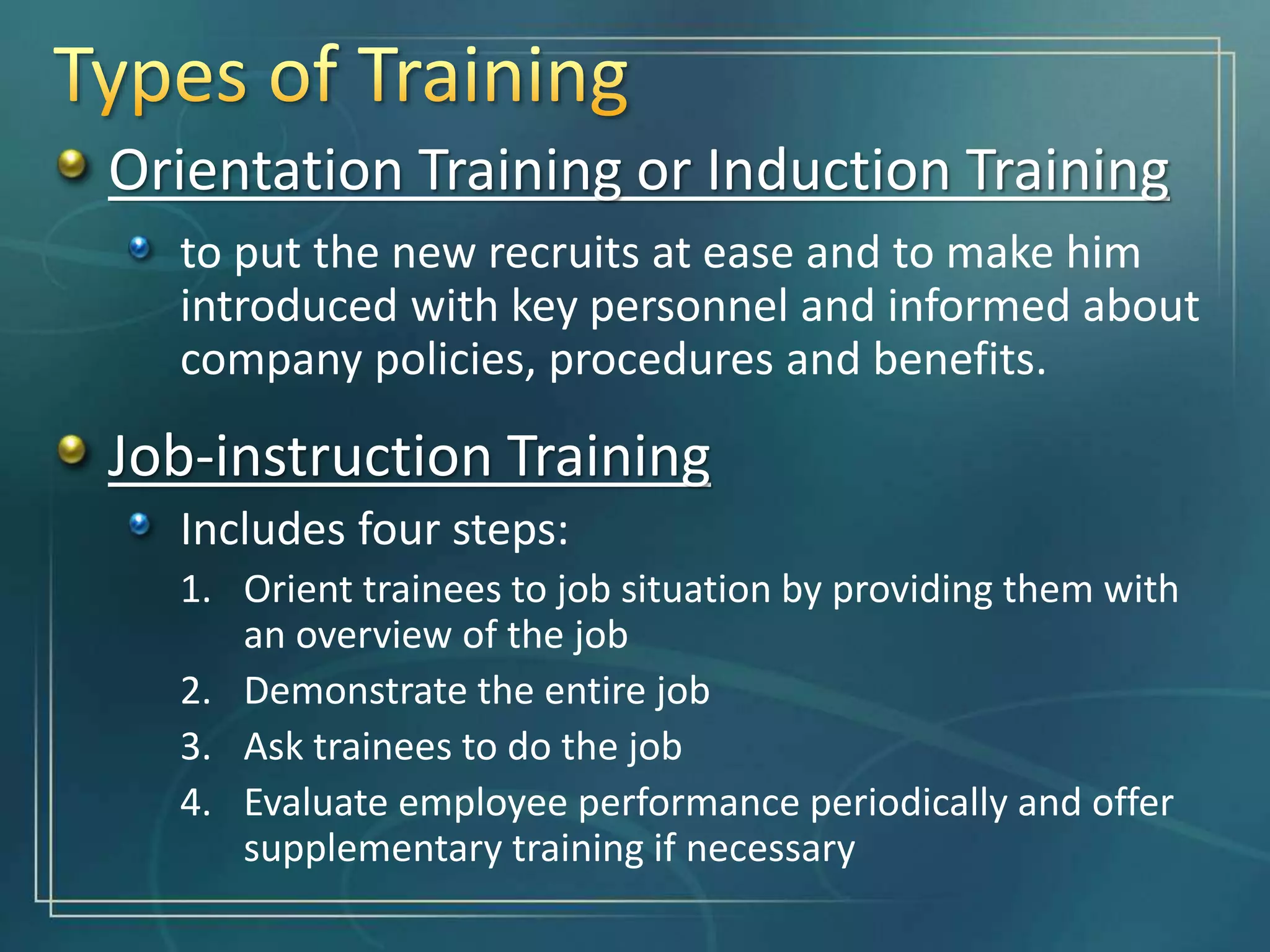
Orientation Training or Induction Training
to put the new recruits at ease and to make him
introduced with key personnel and informed about
company policies, procedures and benefits.
Job-instruction Training
Includes four steps:
1. Orient trainees to job situation by providing them with
an overview of the job
2. Demonstrate the entire job
3. Ask trainees to do the job
4. Evaluate employee performance periodically and offer
supplementary training if necessary
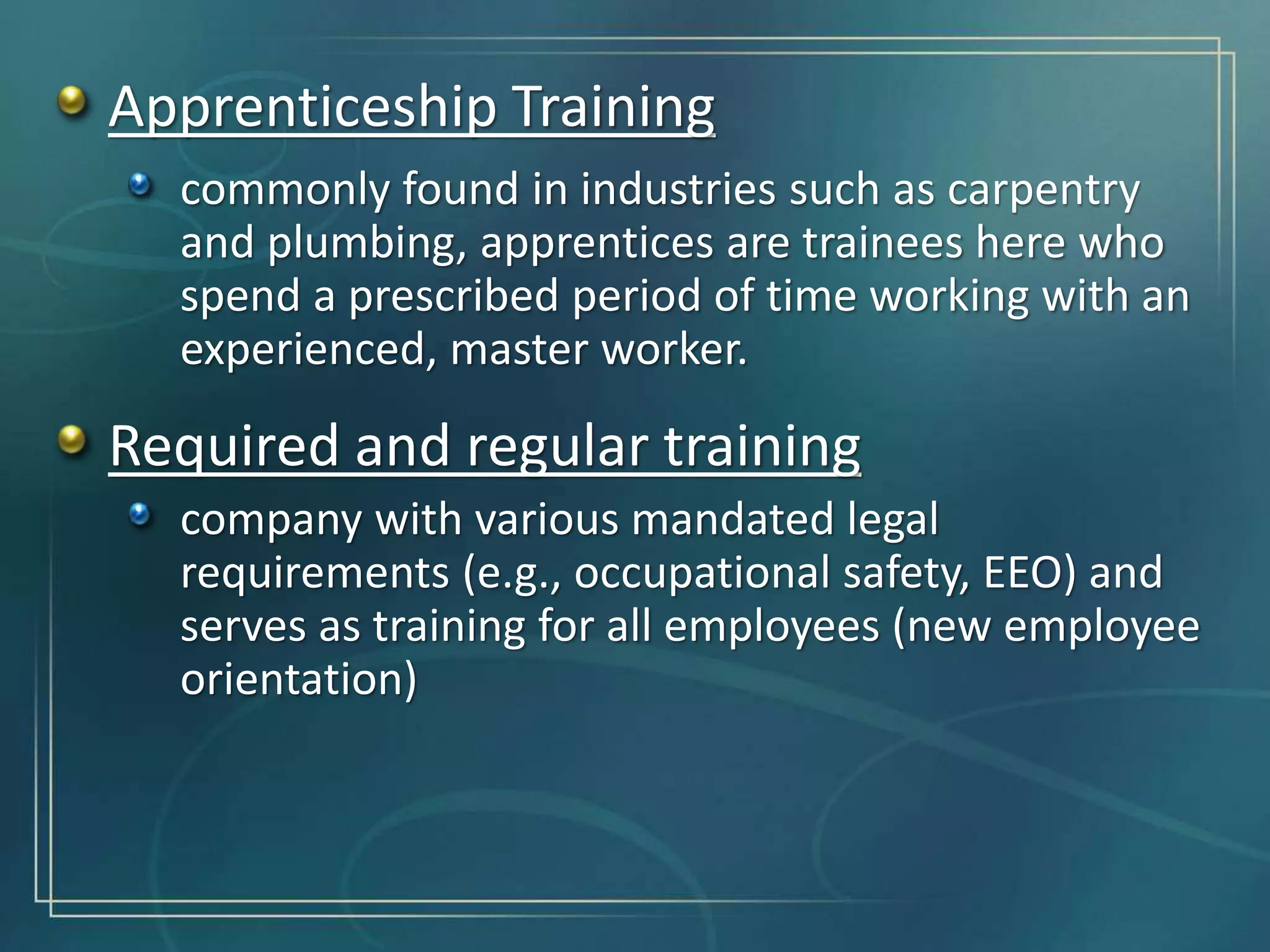
Apprenticeship Training
commonly found in industries such as carpentry
and plumbing, apprentices are trainees here who
spend a prescribed period of time working with an
experienced, master worker.
Required and regular training
company with various mandated legal
requirements (e.g., occupational safety, EEO) and
serves as training for all employees (new employee
orientation)
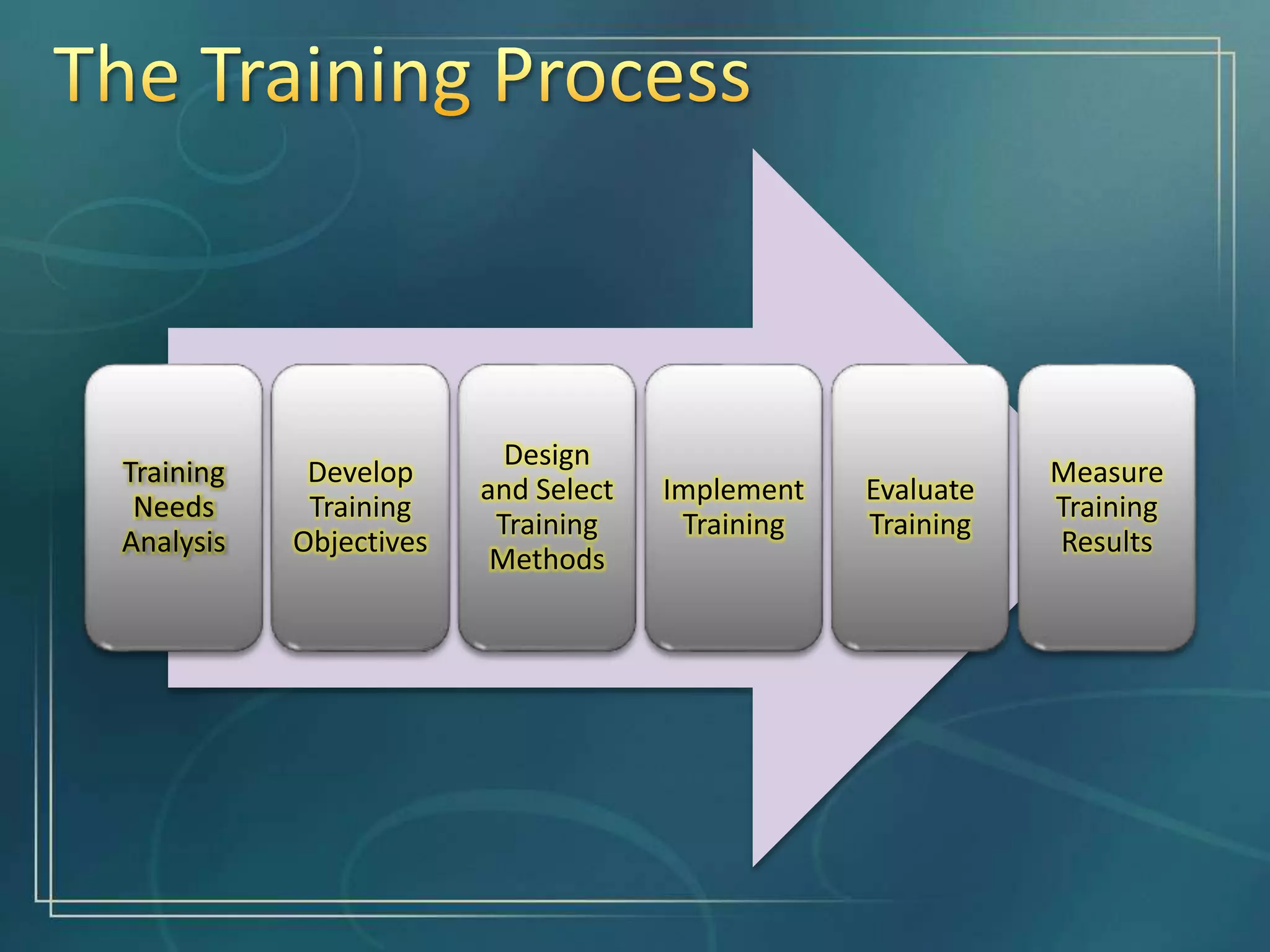
Training
Needs
Analysis
Develop
Training
Objectives
Design
and Select
Training
Methods
Implement
Training
Evaluate
Training
Measure
Training
Results
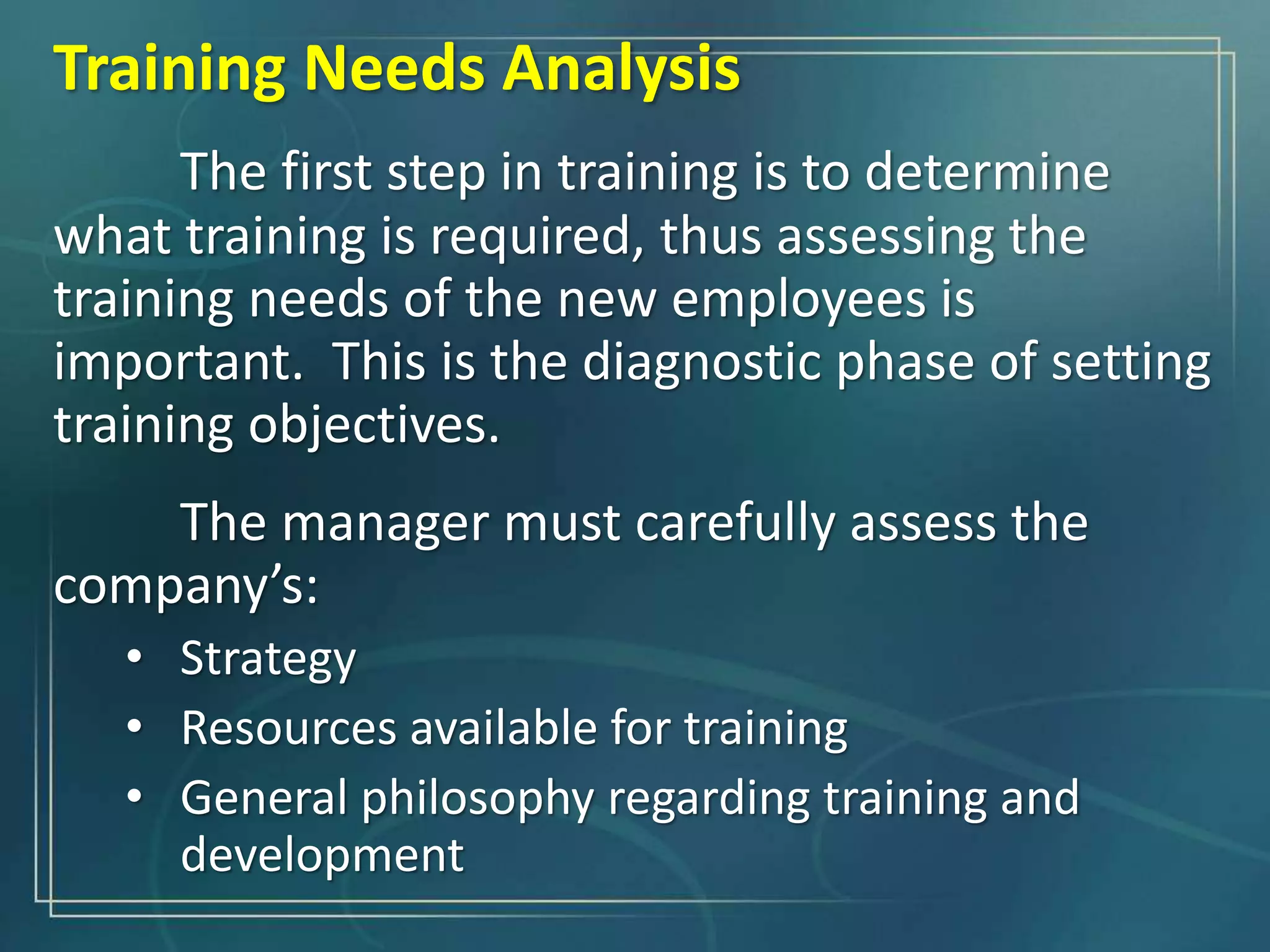
Training Needs Analysis
The first step in training is to determine
what training is required, thus assessing the
training needs of the new employees is
important. This is the diagnostic phase of setting
training objectives.
The manager must carefully assess the
company’s:
• Strategy
• Resources available for training
• General philosophy regarding training and
development
Techniques for Identifying Needs
There are two types of techniques to identify
NEEDS:
1. TASK ANALYSIS
2. PERFORMANCE ANALYSIS
Task Analysis
An analysis of the job’s requirements to determine
the training required.
It is done by TASK ANALYSIS RECORD FORM (tabular
structure) this consolidates information regarding the
job’s required tasks and skills which are helpful in
determining training requirements.
Techniques for Identifying Needs
Performance Analysis
Verifies performance deficiency and determine
whether that deficiency should be rectified through
training or some other means.
The first step is to appraise employees’
performance, since to improve it, first determine person’s
current performance compared to what it should be.
To distinguish between can’t do and won’t do
problems, their specific causes and solutions.
Developing Training Objectives
After analyzing training needs, concrete
measurable training objectives should be set.
Training objective is defined as “A description of
performance you want learners to be able to
exhibit before you consider them competent”.
Objectives specify what the trainee should be
able to accomplish after training.
Goals should be objective, verifiable, and
specific.
Types of Training Objectives
Training objectives are of three types and can be set
as:
Knowledge - Impart cognitive information and
details to trainees.
Skill - Develop behavior changes in how jobs and
task requirement are performed.
Attitude - Create interest in and awareness of the
importance of training.
The success of training should be measured in terms
of objectives set. Objectives serve as a check on
internationalization, or whether the person is able to use
the training.
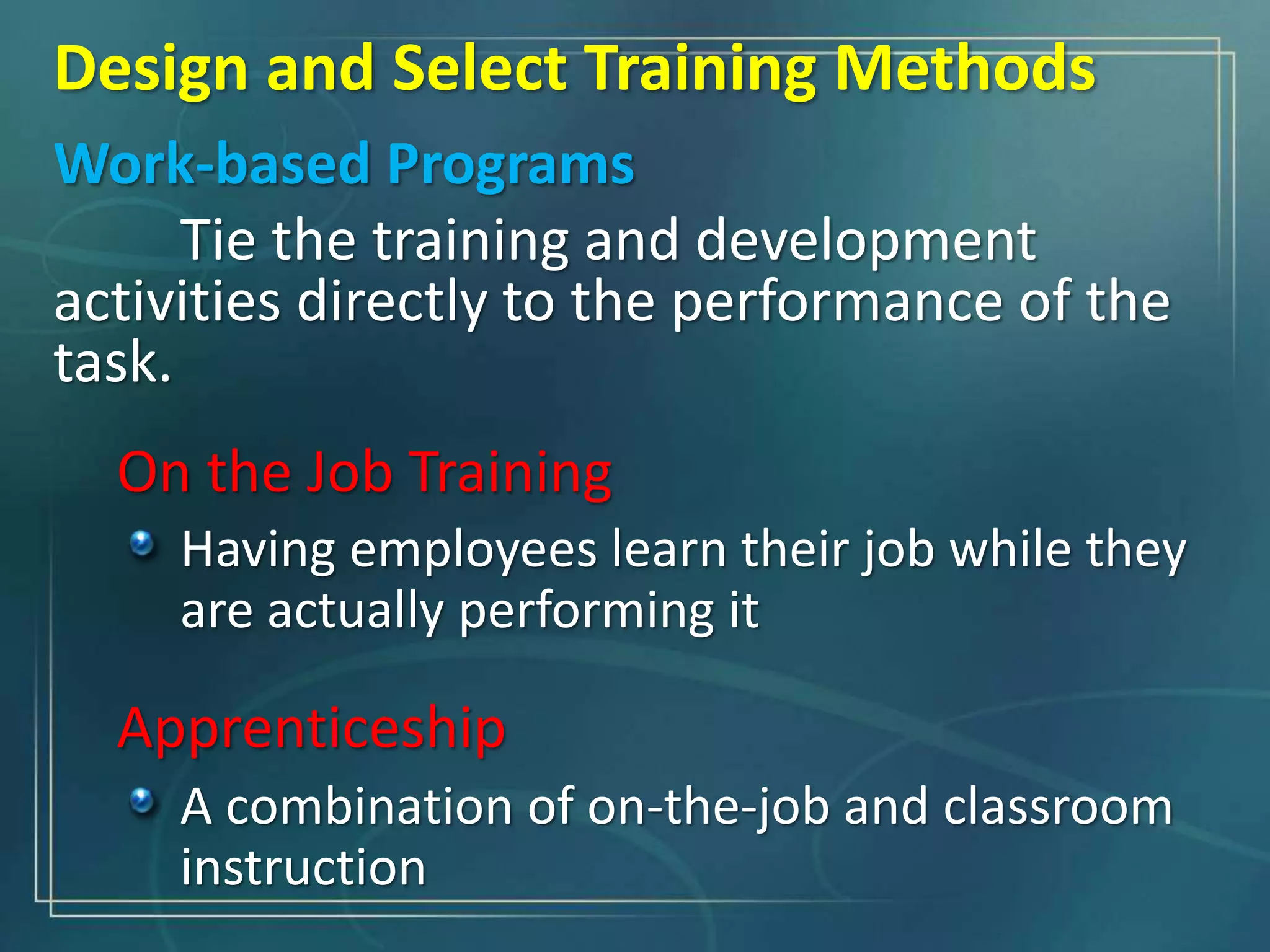
Design and Select Training Methods
Work-based Programs
Tie the training and development
activities directly to the performance of the
task.
On the Job Training
Having employees learn their job while they
are actually performing it
Apprenticeship
A combination of on-the-job and classroom
instruction
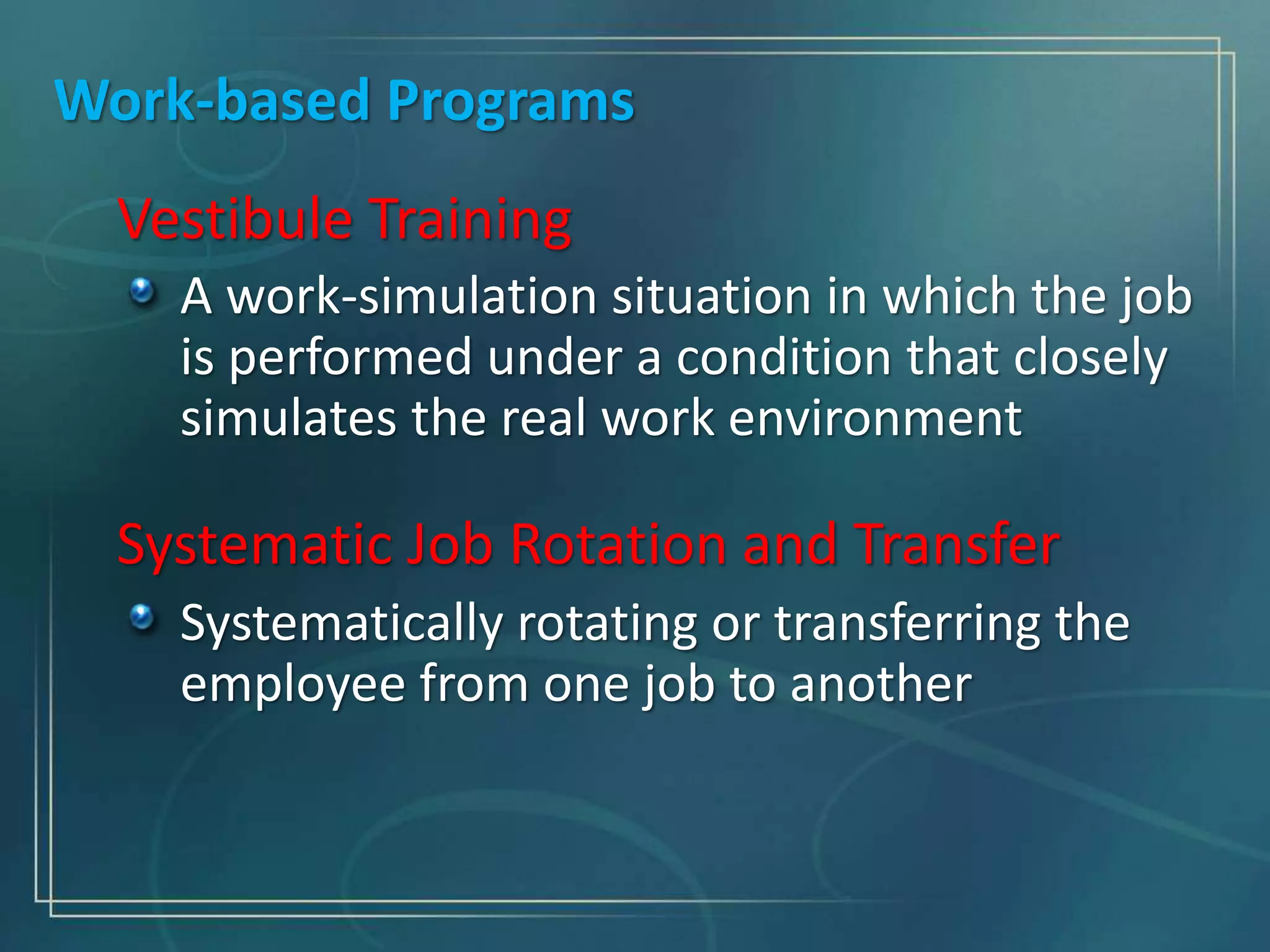
Work-based Programs
Vestibule Training
A work-simulation situation in which the job
is performed under a condition that closely
simulates the real work environment
Systematic Job Rotation and Transfer
Systematically rotating or transferring the
employee from one job to another
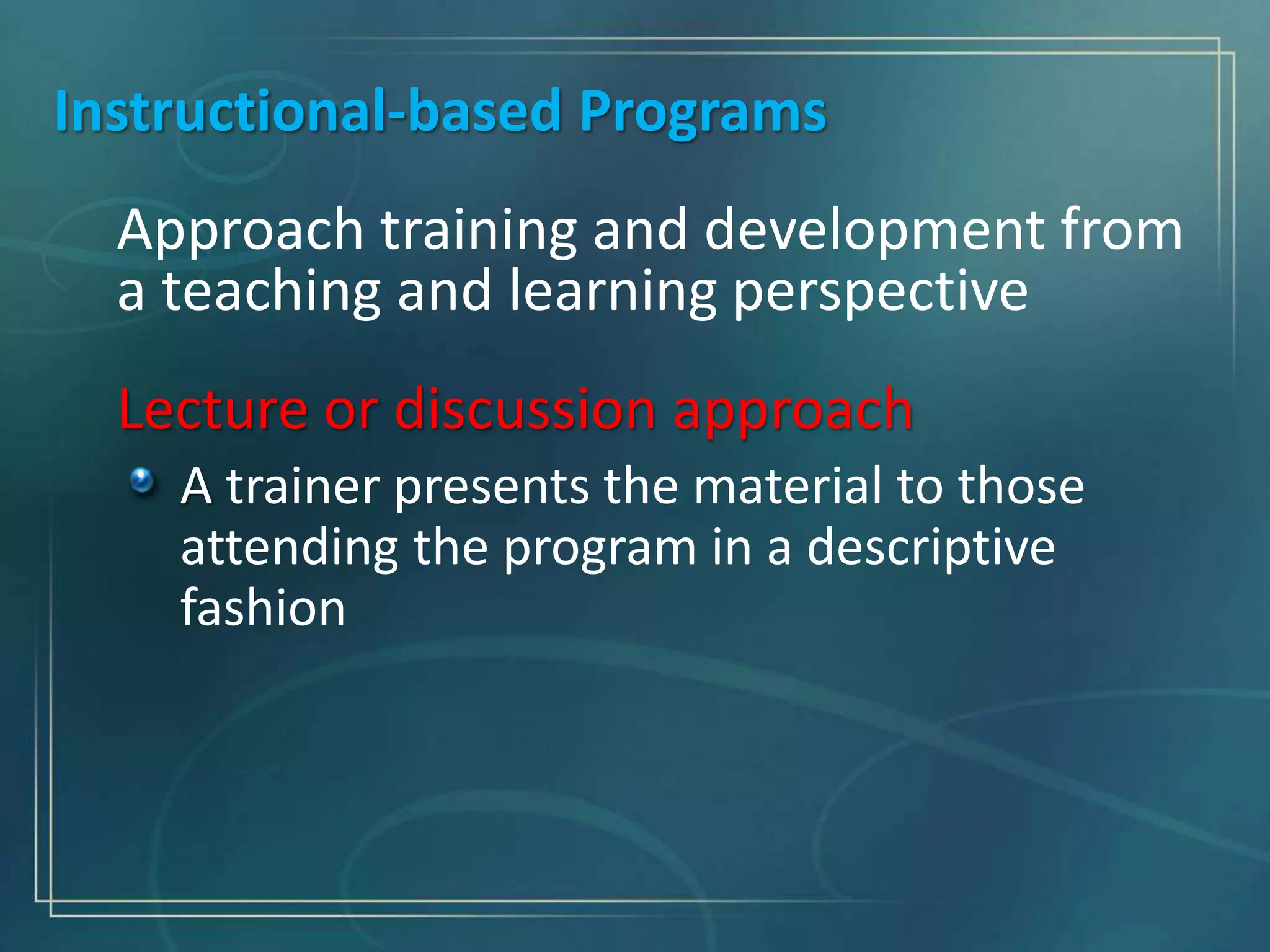
Instructional-based Programs
Approach training and development from
a teaching and learning perspective
Lecture or discussion approach
A trainer presents the material to those
attending the program in a descriptive
fashion
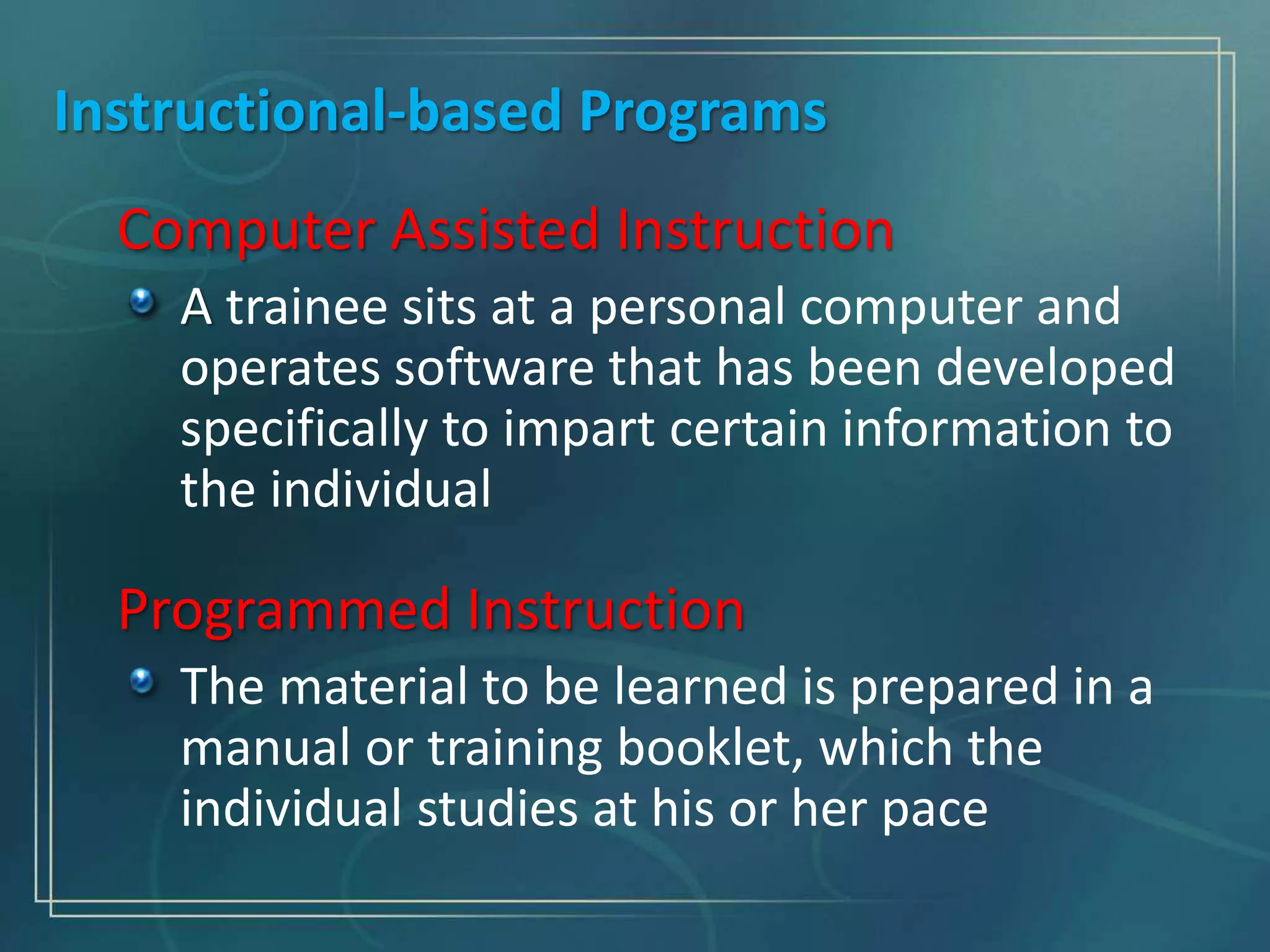
Instructional-based Programs
Computer Assisted Instruction
A trainee sits at a personal computer and
operates software that has been developed
specifically to impart certain information to
the individual
Programmed Instruction
The material to be learned is prepared in a
manual or training booklet, which the
individual studies at his or her pace
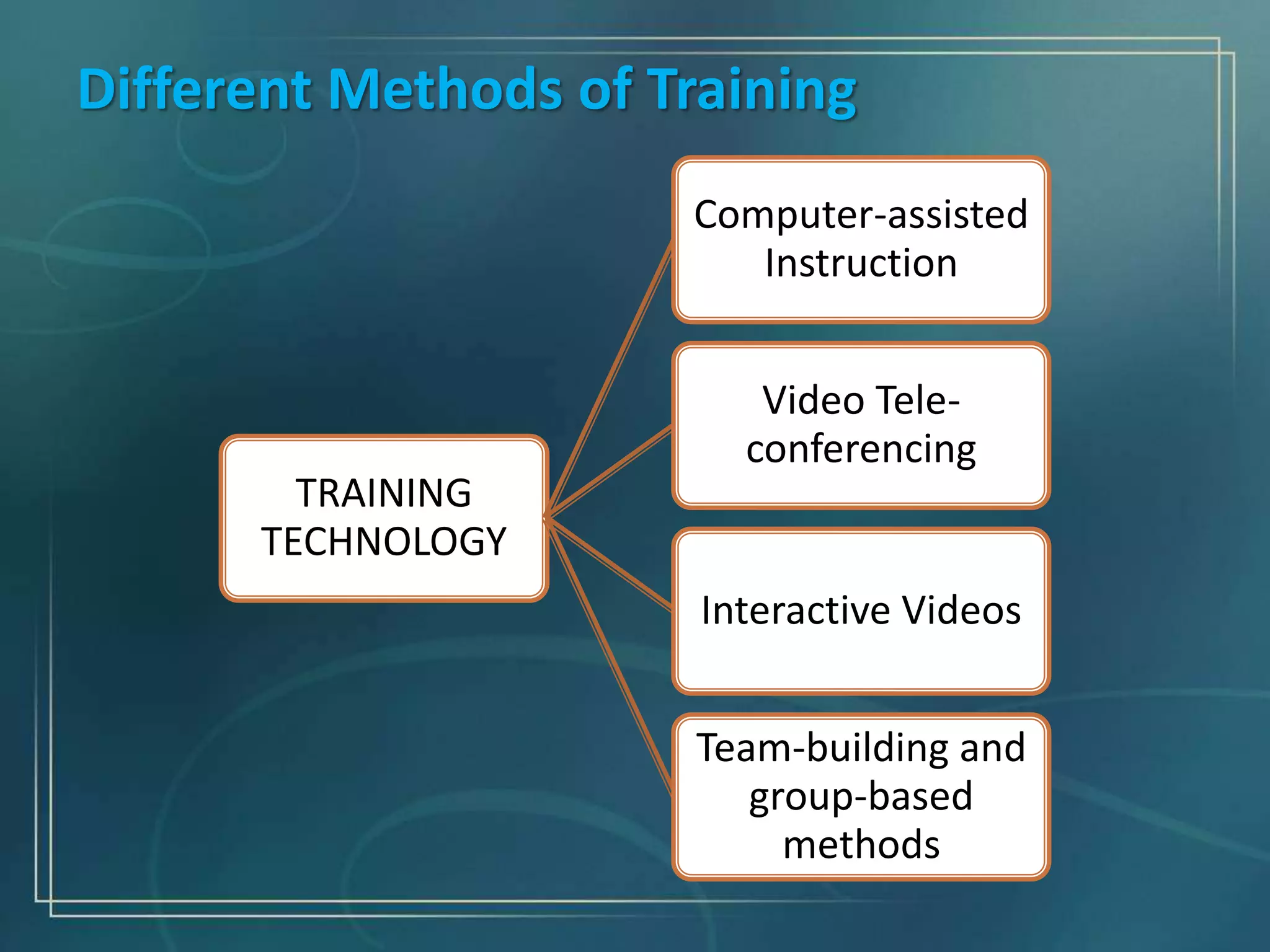
TRAINING
TECHNOLOGY
Computer-assisted
Instruction
Video Tele-
conferencing
Interactive Videos
Team-building and
group-based
methods
Different Methods of Training
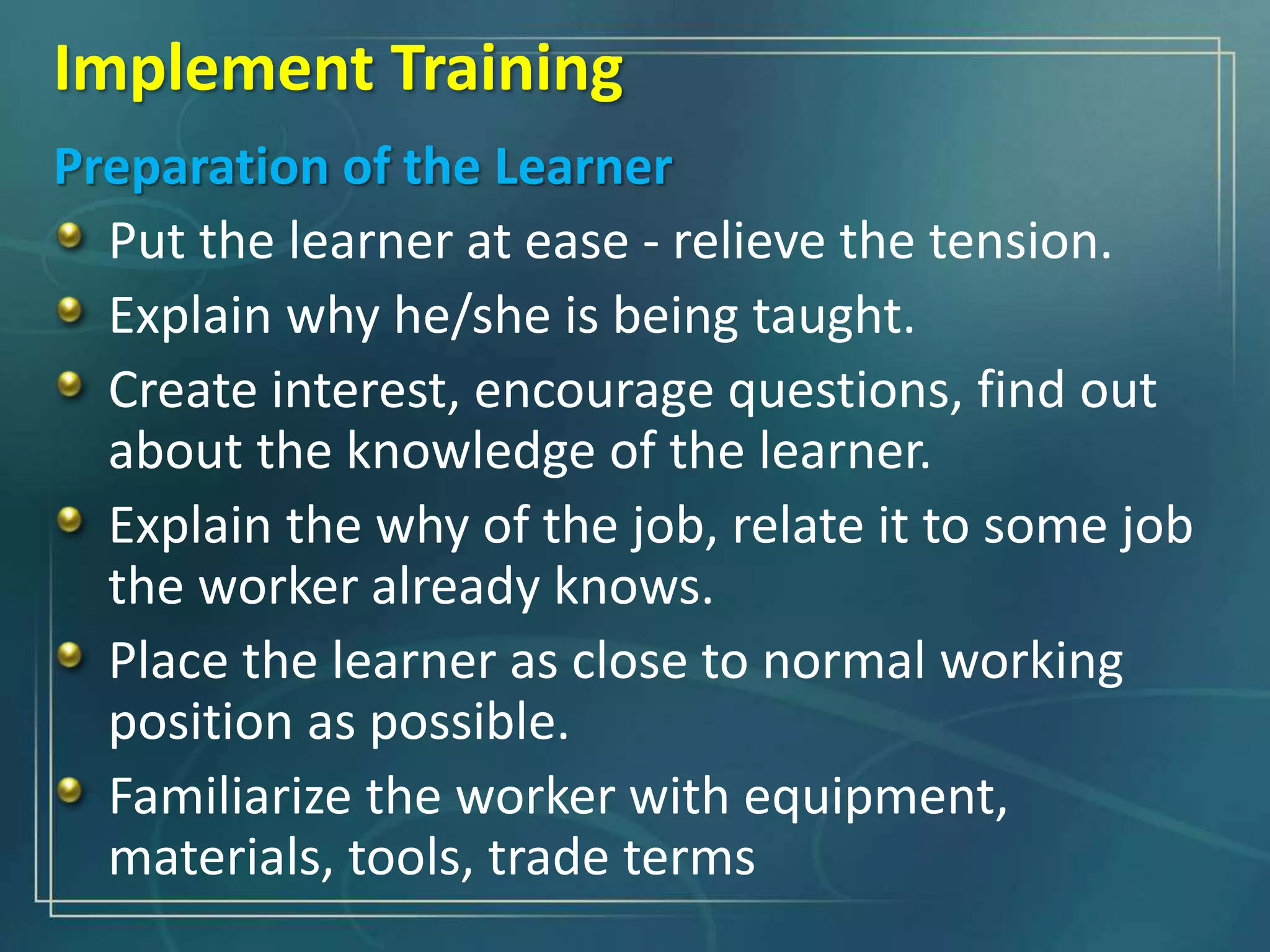
Preparation of the Learner
Put the learner at ease - relieve the tension.
Explain why he/she is being taught.
Create interest, encourage questions, find out
about the knowledge of the learner.
Explain the why of the job, relate it to some job
the worker already knows.
Place the learner as close to normal working
position as possible.
Familiarize the worker with equipment,
materials, tools, trade terms
Implement Training
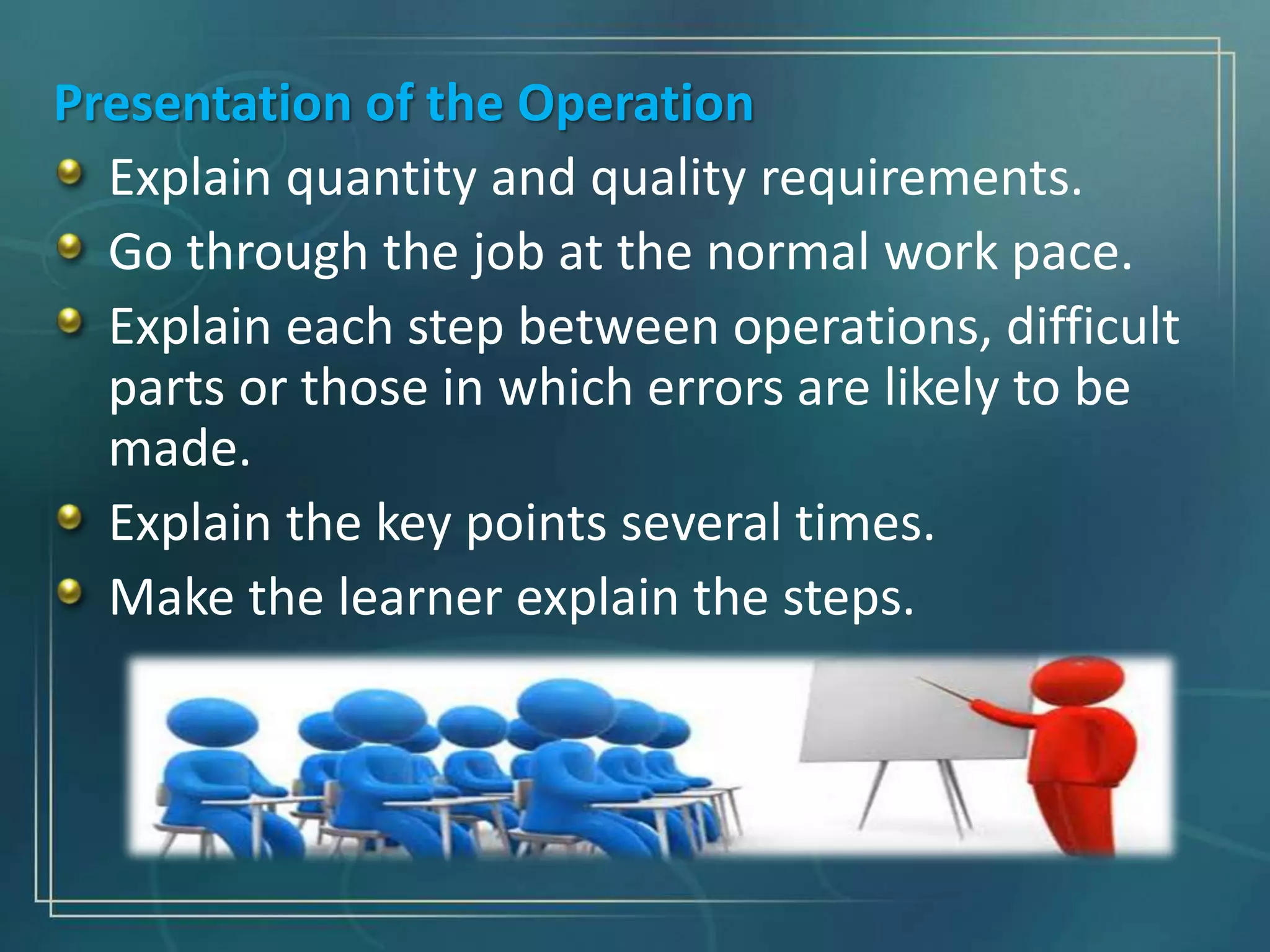
Presentation of the Operation
Explain quantity and quality requirements.
Go through the job at the normal work pace.
Explain each step between operations, difficult
parts or those in which errors are likely to be
made.
Explain the key points several times.
Make the learner explain the steps.
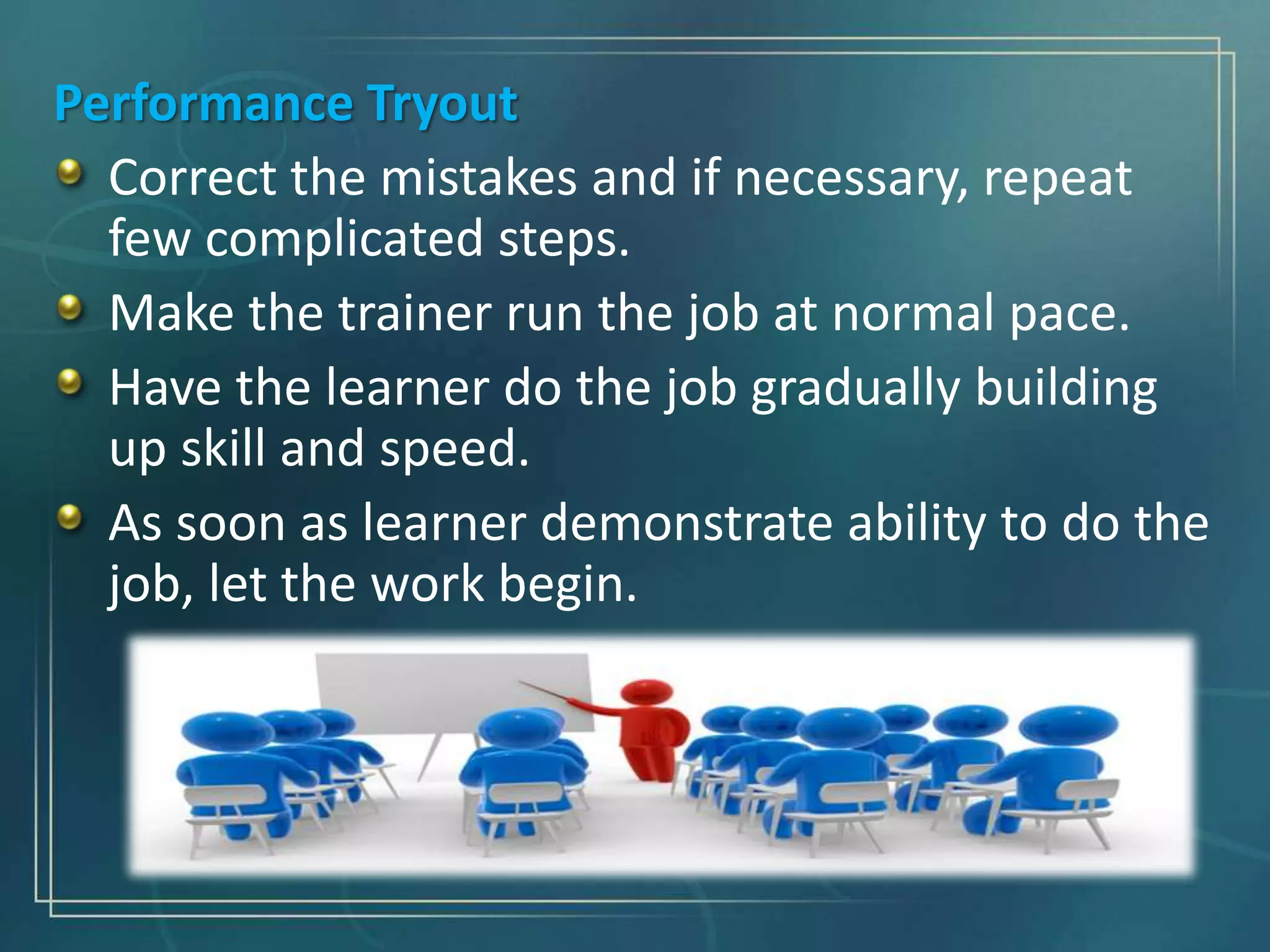
Performance Tryout
Correct the mistakes and if necessary, repeat
few complicated steps.
Make the trainer run the job at normal pace.
Have the learner do the job gradually building
up skill and speed.
As soon as learner demonstrate ability to do the
job, let the work begin.
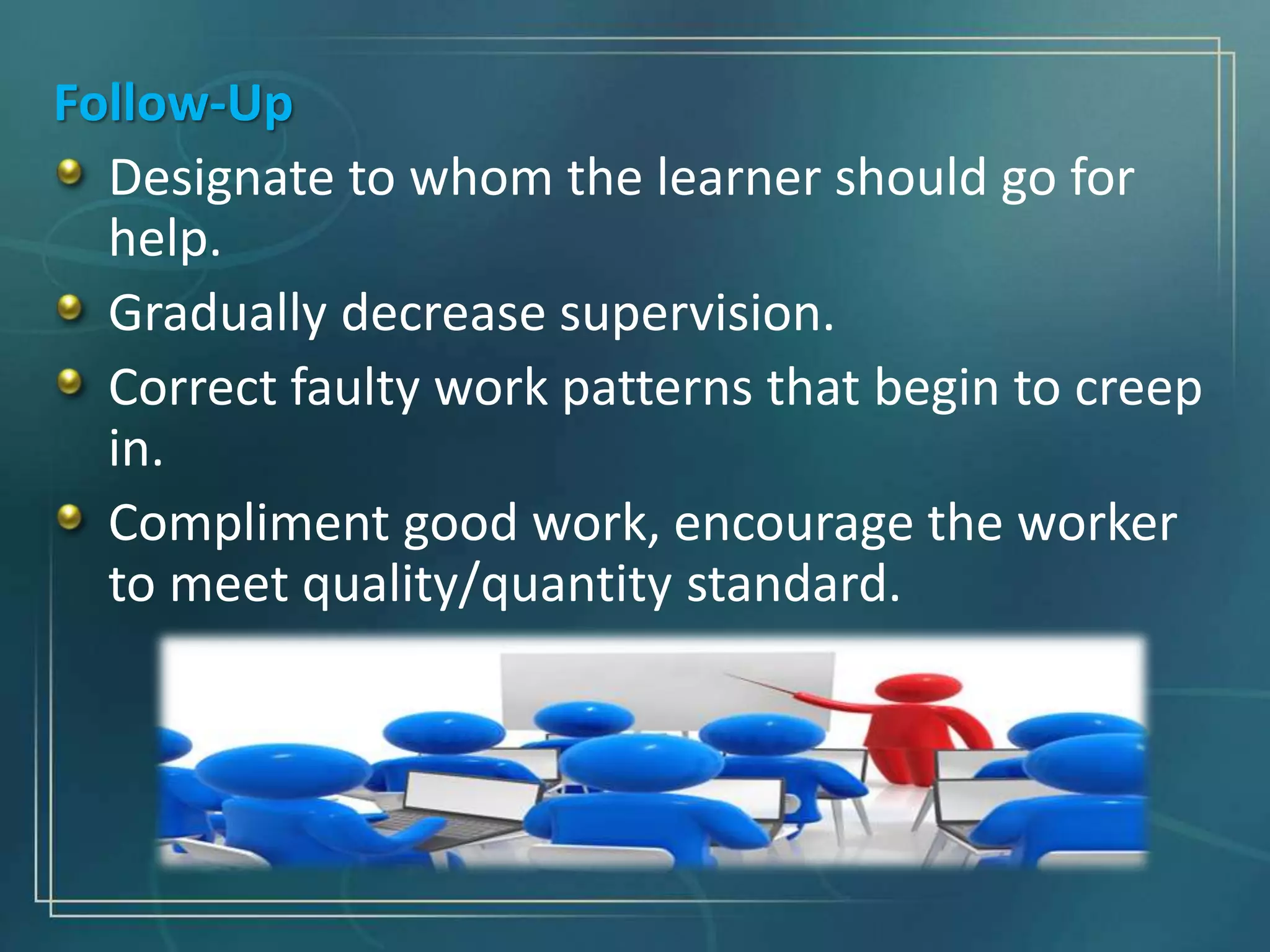
Follow-Up
Designate to whom the learner should go for
help.
Gradually decrease supervision.
Correct faulty work patterns that begin to creep
in.
Compliment good work, encourage the worker
to meet quality/quantity standard.
The penultimate stage in the training strategy is
the evaluation and monitoring of training. It is the
most important and often the most neglected or least
adequately carried out part of the training process.
It is both Simplistic and Complicated.
• Simplistic because monitoring is a process whereby
information is gleaned from trainee and then the course
and the program are amended in the light of these
comments.
• Complicated because there are other ‘stakeholders’ in the
process besides the trainees, i.e. designers of the courses,
the trainers and the sponsors.
Evaluate Training
Methods of Evaluation
Questionnaires (Feedback forms) or ‘happiness sheets’
are common way of eliciting trainee response
programs.
Tests or examinations are common on formal courses
which provide a certificate, e.g. diploma in word
processing skills although end-of-course tests can be
provided after short courses to check the progress of
trainees.
Projects initially seen as learning methods but they can
also be provide valuable information to instructors.
Structured exercises and case studies are opportunities
to apply learned skills and techniques under the
observation of tutors and evaluators.
Tutor reports. It is important to have the opinions of
those who deliver the training. This gives a valuable
assessment from a different perspective.
Interviews of trainees post course or instruction
period. These can be informal or formal, individual or
group or by telephone.
Observation of courses and training by those devising
training strategies in the training department is very
useful and information from these observations can be
compared with trainee responses.
Participation and discussion during training needs
people who are adept at intercepting responses as this
can be highly subjective.
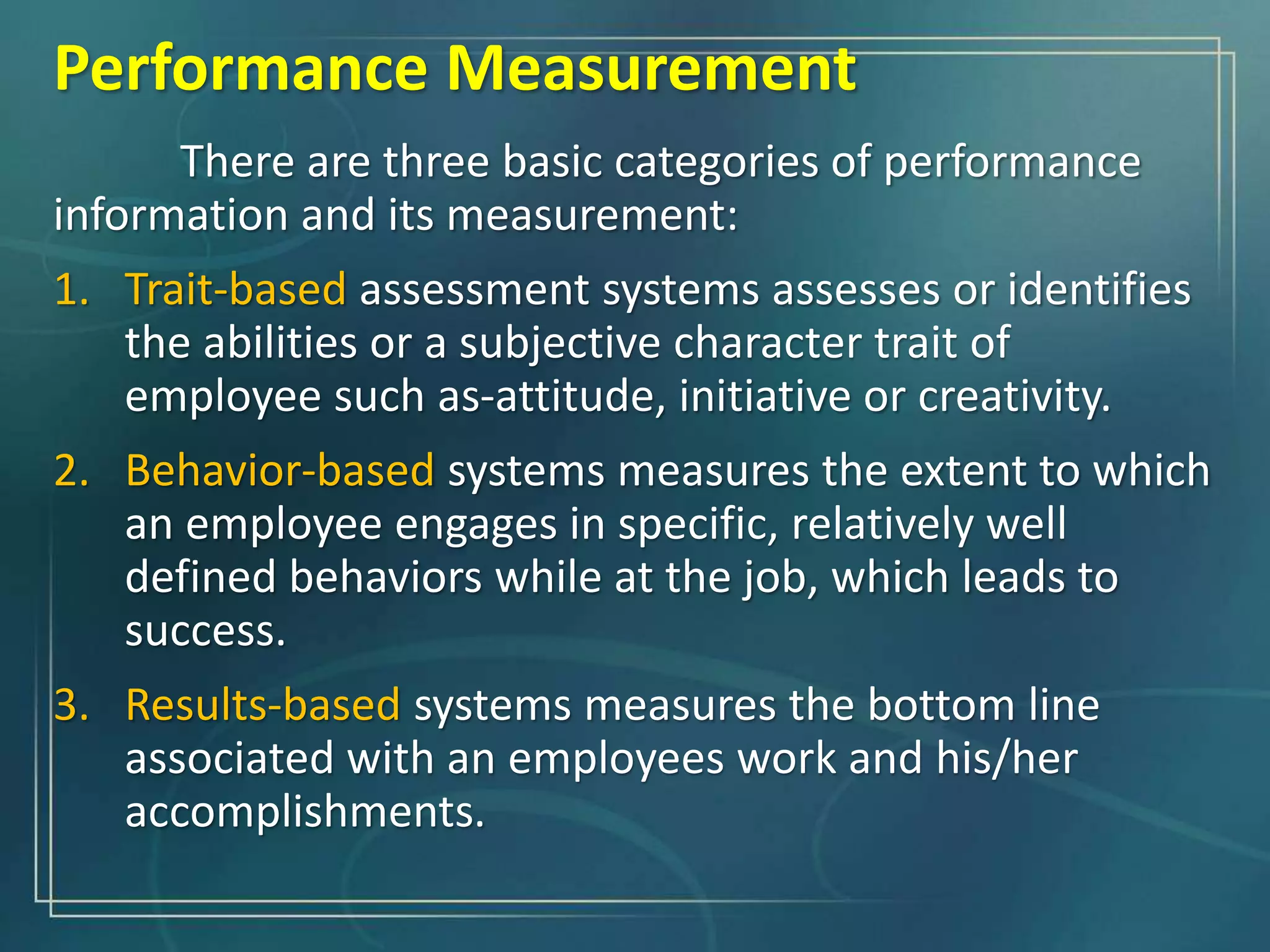
There are three basic categories of performance
information and its measurement:
1. Trait-based assessment systems assesses or identifies
the abilities or a subjective character trait of
employee such as-attitude, initiative or creativity.
2. Behavior-based systems measures the extent to which
an employee engages in specific, relatively well
defined behaviors while at the job, which leads to
success.
3. Results-based systems measures the bottom line
associated with an employees work and his/her
accomplishments.
Performance Measurement
Handbook of Human Resource Management Practices,
9th Edition
- Michael Armstrong
Human Resources And Personnel Management, 3rd
Edition
- K. Ashwathappa
Human Resource Management, 7th Edition
- Gary Dessler
References:
Human Resource Training and Development

Human Resource Training and Development

  • 1.
  • 2.
    Training and Development Training Development DifferenceBetween Training and Development The Need for Training The Nature of Training The Importance of Training Types of Training The Training Process
  • 3.
    Training & Developmentis a continuous process in an organization to achieve its organizational goals by improving the skills and knowledge of the employees. The training and development function in an organization has gained a lot of importance due to advancement in technology and changes in market force.
  • 4.
    Training is basicallya systematic procedure for transferring technical know-how to the employees so as to increase their knowledge and skills for doing particular jobs. Training usually involves teaching operational or technical employees how to do their jobs more effectively and/or efficiently. Training is a process of teaching a new employees the basic skills to perform their jobs - Garry Dessler
  • 5.
    Efforts made toimprove employee’s ability to handle a variety of assignment. Development is a process of preparing employees for future position and improve their personal skills to handle the critical situations in an organization. Development is generally aimed at helping managers better understand and solve problems, make decisions, and capitalize on opportunities. Development is often considered a HR function.
  • 6.
    Development is broaderin scope and focuses on individual’s gaining new capabilities useful for both present and future jobs. Training Learn specific behaviors and actions; demonstrate techniques and processes Shorter term Performance appraisals, cost benefit analysis, passing tests , or certification Development Understood information concepts and context; develop judgment; expand capacities for assignment Longer term Qualified people available when needed; promotion from within possible; HR-based competitive advantage Focus Time Frame Effective Measure
  • 7.
    Companies initially usedto emphasize only on production process training i.e. teaching technical skill required to perform jobs, such as training assembles to solder wires or teachers to device lesson plans. however training and development programs and their objectives change in the 1980s and 1990s. Employers had to adapt to rapid technological changes, improve product and service quality, and boost productivity to stay competitive improving quality often requires remedial-education training, since quality-improvement programs assume employees can use critical thinking skills, produce charts and graphs and analyze data.
  • 8.
    Employees must alsouse or acquire skills in team building, decision making, and communication. As firms become more technologically advance, employees require training in technological and computer skills (such as desk top publishing and computer aided design and manufacturing). As increased competition has put a premium on better service, employers have turned increasingly to customer-service training to provide employees with the tools and abilities they need to deal more effectively with customers, such as effective listening skills.
  • 9.
    More employers todayare also taking advantage of the fact that training can strengthen employee commitment. This is one reason why high commitment firms like Toyota provide two weeks of training per year for all employers-about double the national average.
  • 10.
    Training usually involvesteaching operational or technical employees how to do their jobs more effectively and/or efficiently. Responsibilities for training are generally assigned to the HR function. In general, training is intended to help the organization function more effectively. Managers must be sure that productivity can be increased through training and that productivity gains are possible with existing resources.
  • 11.
    Trained workers canwork more efficiently. There will be fewer accidents. As training improves the knowledge of employees regarding the use of machines and equipment. Wastage is eliminated to a large extent as they use tools, machines in a proper way. Training helps an employee to move from one organization to another easily. He can be more mobile and pursue career goals easily.
  • 12.
    Training makes employeesmore loyal to an organization. They will be less inclined to leave the unit where there are growth opportunities. Training enables employees to secure promotions easily. They can realize their career goals comfortably. Economical supervision-as there is less requirement for supervision for trained employees.
  • 13.
    Uniform procedures-with thehelp of training the best available methods can be standardized and made available to all employees
  • 14.
    Orientation Training orInduction Training to put the new recruits at ease and to make him introduced with key personnel and informed about company policies, procedures and benefits. Job-instruction Training Includes four steps: 1. Orient trainees to job situation by providing them with an overview of the job 2. Demonstrate the entire job 3. Ask trainees to do the job 4. Evaluate employee performance periodically and offer supplementary training if necessary
  • 15.
    Apprenticeship Training commonly foundin industries such as carpentry and plumbing, apprentices are trainees here who spend a prescribed period of time working with an experienced, master worker. Required and regular training company with various mandated legal requirements (e.g., occupational safety, EEO) and serves as training for all employees (new employee orientation)
  • 16.
  • 17.
    Training Needs Analysis Thefirst step in training is to determine what training is required, thus assessing the training needs of the new employees is important. This is the diagnostic phase of setting training objectives. The manager must carefully assess the company’s: • Strategy • Resources available for training • General philosophy regarding training and development
  • 18.
    Techniques for IdentifyingNeeds There are two types of techniques to identify NEEDS: 1. TASK ANALYSIS 2. PERFORMANCE ANALYSIS Task Analysis An analysis of the job’s requirements to determine the training required. It is done by TASK ANALYSIS RECORD FORM (tabular structure) this consolidates information regarding the job’s required tasks and skills which are helpful in determining training requirements.
  • 19.
    Techniques for IdentifyingNeeds Performance Analysis Verifies performance deficiency and determine whether that deficiency should be rectified through training or some other means. The first step is to appraise employees’ performance, since to improve it, first determine person’s current performance compared to what it should be. To distinguish between can’t do and won’t do problems, their specific causes and solutions.
  • 20.
    Developing Training Objectives Afteranalyzing training needs, concrete measurable training objectives should be set. Training objective is defined as “A description of performance you want learners to be able to exhibit before you consider them competent”. Objectives specify what the trainee should be able to accomplish after training. Goals should be objective, verifiable, and specific.
  • 21.
    Types of TrainingObjectives Training objectives are of three types and can be set as: Knowledge - Impart cognitive information and details to trainees. Skill - Develop behavior changes in how jobs and task requirement are performed. Attitude - Create interest in and awareness of the importance of training. The success of training should be measured in terms of objectives set. Objectives serve as a check on internationalization, or whether the person is able to use the training.
  • 22.
    Design and SelectTraining Methods Work-based Programs Tie the training and development activities directly to the performance of the task. On the Job Training Having employees learn their job while they are actually performing it Apprenticeship A combination of on-the-job and classroom instruction
  • 23.
    Work-based Programs Vestibule Training Awork-simulation situation in which the job is performed under a condition that closely simulates the real work environment Systematic Job Rotation and Transfer Systematically rotating or transferring the employee from one job to another
  • 24.
    Instructional-based Programs Approach trainingand development from a teaching and learning perspective Lecture or discussion approach A trainer presents the material to those attending the program in a descriptive fashion
  • 25.
    Instructional-based Programs Computer AssistedInstruction A trainee sits at a personal computer and operates software that has been developed specifically to impart certain information to the individual Programmed Instruction The material to be learned is prepared in a manual or training booklet, which the individual studies at his or her pace
  • 26.
  • 27.
    Preparation of theLearner Put the learner at ease - relieve the tension. Explain why he/she is being taught. Create interest, encourage questions, find out about the knowledge of the learner. Explain the why of the job, relate it to some job the worker already knows. Place the learner as close to normal working position as possible. Familiarize the worker with equipment, materials, tools, trade terms Implement Training
  • 28.
    Presentation of theOperation Explain quantity and quality requirements. Go through the job at the normal work pace. Explain each step between operations, difficult parts or those in which errors are likely to be made. Explain the key points several times. Make the learner explain the steps.
  • 29.
    Performance Tryout Correct themistakes and if necessary, repeat few complicated steps. Make the trainer run the job at normal pace. Have the learner do the job gradually building up skill and speed. As soon as learner demonstrate ability to do the job, let the work begin.
  • 30.
    Follow-Up Designate to whomthe learner should go for help. Gradually decrease supervision. Correct faulty work patterns that begin to creep in. Compliment good work, encourage the worker to meet quality/quantity standard.
  • 31.
    The penultimate stagein the training strategy is the evaluation and monitoring of training. It is the most important and often the most neglected or least adequately carried out part of the training process. It is both Simplistic and Complicated. • Simplistic because monitoring is a process whereby information is gleaned from trainee and then the course and the program are amended in the light of these comments. • Complicated because there are other ‘stakeholders’ in the process besides the trainees, i.e. designers of the courses, the trainers and the sponsors. Evaluate Training
  • 32.
    Methods of Evaluation Questionnaires(Feedback forms) or ‘happiness sheets’ are common way of eliciting trainee response programs. Tests or examinations are common on formal courses which provide a certificate, e.g. diploma in word processing skills although end-of-course tests can be provided after short courses to check the progress of trainees. Projects initially seen as learning methods but they can also be provide valuable information to instructors. Structured exercises and case studies are opportunities to apply learned skills and techniques under the observation of tutors and evaluators.
  • 33.
    Tutor reports. Itis important to have the opinions of those who deliver the training. This gives a valuable assessment from a different perspective. Interviews of trainees post course or instruction period. These can be informal or formal, individual or group or by telephone. Observation of courses and training by those devising training strategies in the training department is very useful and information from these observations can be compared with trainee responses. Participation and discussion during training needs people who are adept at intercepting responses as this can be highly subjective.
  • 34.
    There are threebasic categories of performance information and its measurement: 1. Trait-based assessment systems assesses or identifies the abilities or a subjective character trait of employee such as-attitude, initiative or creativity. 2. Behavior-based systems measures the extent to which an employee engages in specific, relatively well defined behaviors while at the job, which leads to success. 3. Results-based systems measures the bottom line associated with an employees work and his/her accomplishments. Performance Measurement
  • 36.
    Handbook of HumanResource Management Practices, 9th Edition - Michael Armstrong Human Resources And Personnel Management, 3rd Edition - K. Ashwathappa Human Resource Management, 7th Edition - Gary Dessler References: