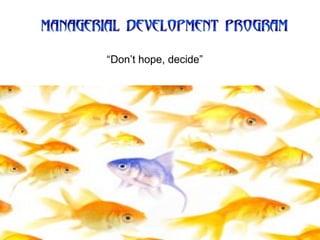

“Don’t hope, decide”
PROGRAM
OBJECTIVES
•
•
•
•
•
•

Nature Vs Nurture
Diversity factors
Being a good communicator
Planning and Goal Setting
What makes an effective Manager
Symbiotic Relationships
DOES ATTITUDE DEFINE BEHAVIOR OR DOES BEHAVIOR DEFINE ATTITUDE?
NATURE VS NURTURE?

“Life is so much better when we shed the victim thinking and simply choose the path of
personal accountability.”
-John G. Miller
Diversity Factors
Primary Dimensions (stable)

•
•
•
•
•
•

Age
Ethnicity
Gender
Physical attributes
Race
Sexual / affection orientation

Secondary Dimensions (changeable)

•
•
•
•
•
•

Educational background
Marital status
Religious beliefs
Health
Work experience
Life Experiences
MARS Model of Individual Behavior
Situational
Situational
factors
factors
Values
Values
Personality
Personality
Perceptions
Perceptions
Emotions
Emotions
Attitudes
Attitudes
Stress
Stress

Motivation
Motivation

Ability
Ability

Role
Role
perceptions
perceptions

Individual
Individual
behavior and
behavior and
results
results
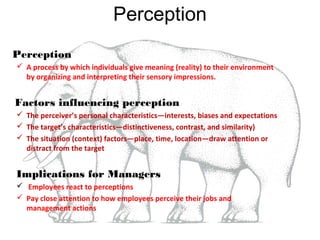
Perception
Perception
 A process by which individuals give meaning (reality) to their environment
by organizing and interpreting their sensory impressions.

Factors influencing perception
 The perceiver’s personal characteristics—interests, biases and expectations
 The target’s characteristics—distinctiveness, contrast, and similarity)
 The situation (context) factors—place, time, location—draw attention or
distract from the target

Implications for Managers
 Employees react to perceptions
 Pay close attention to how employees perceive their jobs and
management actions
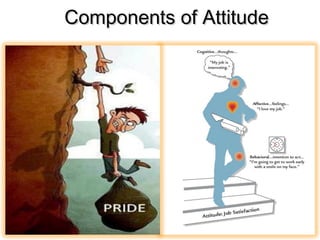
Components of Attitude

Attitude and Aptitude are the 2As which explains the reasons of our
achievement/non achievement of purposeful action
Positive and Negative Emotions
Realization of a GREAT Manager
Affects

Affects

Affects

Affects
Classical Conditioning vs. Operant Conditioning
Classical Conditioning: Ivan Pavlov, a Russian physiologist
• Involves placing a neutral signal before a reflex - Focuses on involuntary, automatic behaviors
(Pavlov's dogs)
Operant Conditioning: First described by B. F. Skinner, an American psychologist
• Involves applying reinforcement or punishment after a behavior and focuses on strengthening or
weakening voluntary behaviors. (Training a dog)
Difference:
• Classical Conditioning: involves making an association between an involuntary response and a
stimulus
• Operant Conditioning: operant conditioning is about making an association between a voluntary
behavior and a consequence.
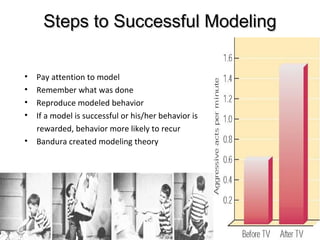
Steps to Successful Modeling
•
•
•
•

Pay attention to model
Remember what was done
Reproduce modeled behavior
If a model is successful or his/her behavior is
rewarded, behavior more likely to recur
• Bandura created modeling theory
Self-Managed Behavioral Principles

•
•
•
•
•
•
•

Choose a target behavior
Record a baseline
Establish goals
Choose reinforces
Record your progress
Reward successes
Adjust your plan as you learn more about your behavior
Giving feedback effectively
Specific
Relevant

Credible

Effective
feedback

Frequent

Timely
Being a Good Communicator

–Key Elements
Dumb Charades
Self Image
What I am?

What I want Others to Think I am?

What I feel Others Think I am?

What I think I am?

What others think I am?

'Whether you think you can, or whether you think you can’t, you’re right!‘ - Henry Ford
EMPTY YOUR CUP

•
•
•
•

Nan-in, a Japanese Zen master during the Meiji era (1868-1912), received a
university professor who came to inquire about Zen.
Nan-in served tea. He poured his visitor’s cup full, and then kept on pouring.
The professor watched the overflow until he no longer could restrain himself. “It is
overfull. No more will go in!”
“Like this cup,” Nan-in said, “you are full of your own opinions and speculations.
How can I show you Zen unless you first empty your cup?”
Activity - Drawing
Don’t let the SUN set on your GOALS
Goal Setting works because…….
•Gives something to aim for…
•Helps focus your time and energy on achieving your goals….
•Provides motivation
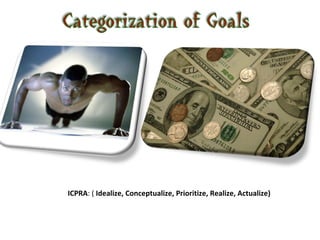
ICPRA: ( Idealize, Conceptualize, Prioritize, Realize, Actualize) ,
Prioritize, Realize,
NASA
•Specific
•Measureable
• Action oriented
•Reasonable
•Time bound
•Ethical, exciting, enjoyable
•Resourced
How good a manager are you?

20- 46

You need to improve your management skills urgently. If you want to be effective
in a leadership role, you must learn how to organize and monitor your team's work.
Now is the time to start developing these skills to increase your team's success!

47 - 73

You're on your way to becoming a good manager. You're doing some things really
well, and these are likely the things you feel comfortable with. Now it's time to work
on the skills that you've been avoiding. Focus on the areas where your score was
low, and figure out what you can do to make the improvements you need

You're doing a great job managing your team. Now you should concentrate on
improving your skills even further. In what areas did you score a bit low? That's
where you can develop improvement goals. Also, think about how you can take
74 - 100 advantage of these skills to reach your career goals

Self- assessment
Understanding team dynamics and encouraging good relationships.
Selecting and developing the right people.
Delegating effectively.
Motivating people.
Managing discipline and dealing with conflict.
Communicating & Avoid micro-management
Planning, making decisions, and problem solving.
Avoiding common managerial mistakes.
Rate Your Job Satisfaction

29
•

Creates a warmer interpersonal climate between your subordinates and you.

•

Gives more performance feedback to subordinates— make it as positive as
possible, given their actual performance.

•

Spends more time helping subordinates learn job skills.

•

Provides more opportunities for subordinates to ask questions.
Listen with
concern
A boss creates fear, a leader confidence. A boss fixes blame, a leader
corrects mistakes. A boss knows all, a leader asks questions. A boss makes
work drudgery, a leader makes it interesting

PLANNER

PROVIDER

PROTECTOR
How Managers create stress for their employees

33
•

Make sure people know what you expect

•

Provide regular feedback

•

Make time for people

•

Focus on the development of people

•

Share the goals & content – Communicate!
Attitude Survey
Psychological Factors Affecting Employee
Behavior

•• Attitudes
Attitudes
•• Personality
Personality
•• Perception
Perception
•• Learning
Learning

•• Employee
Employee
Productivity
Productivity
•• Absenteeism
Absenteeism
•• Turnover
Turnover
•• Organizational
Organizational
Citizenship
Citizenship
•• Job Satisfaction
Job Satisfaction
•• Workplace
Workplace
Misbehavior
Misbehavior
Psychological Factors
• Attitudes
– Evaluative statements—either favorable or unfavorable—concerning
objects, people, or events.

• Components Of An Attitude
– Cognitive component: the beliefs, opinions, knowledge, or
information held by a person.
– Affective component: the emotional or feeling part of an attitude.
– Behavioral component: the intention to behave in a certain way.
The Importance of Attitudes
• Implication for Managers
– Attitudes warn of potential behavioral problems:
• Managers should do things that generate the positive attitudes that
reduce absenteeism and turnover.

– Attitudes influence behaviors of employees:
• Managers should focus on helping employees become more productive
to increase job satisfaction.

– Employees will try to reduce dissonance unless:
• Managers identify the external sources of dissonance.
• Managers provide rewards compensating for the dissonance.
•

Responsibility is the 'ability to respond’

•

Accountability is the 'ability to be brought to a count’
1

Tell the Truth
2

Encourage people to speak the truth to feel empowered
3

Reward Contrarians
4

Practice having Unpleasant Conversations
5

Diversify Information Sources
6

Admit mistakes
7

Build Organizational Support for Transparency
Team Building Exercise
Managers have
subordinates

Leaders have followers

Authoritarian,
transactional style

Charismatic,
transformational style

Work focus

People focus

Seek comfort

Seek risk
“For most leaders, the great challenge is not understanding the practice of
leadership: It is practicing their understanding of leadership.”-Marshall Goldsmith
Focus on Tasks:
•Classify
•Target
•Prioritize
•Collaborate
•Check status
•Track compliance
Focus on Relationships:
•Productivity
•Mutual Understanding
•Self Corrective
Relationship Management

•

Defining a relationship: The coming together of two or more people for their mutual benefit

•
•
•

Types of relationship:
Reasons why we get along together:
Reasons why relationships fail:
What makes an effective relationship?
•

Reciprocity - You support – I support.

•

Skills:
Dynamic listening – listening with intent
Establish Empathy – step into their shoes
Use questions – DON’T MIND READ

•

Relating overtime
Build trust

•

Engage in exchange

It’s not what you say, it’s the way that you say it!
Learn to laugh & smile
•
•
•
•
•
•

Laugh at yourself
laugh at your mistakes
Smile your troubles away
Smile when you meet people
Smile at life
Smile when your low
A vision without a plan is just a dream.
A plan without a vision is just drudgery.
But a vision with a plan can change the world.
Managerial Development Program PPT

Managerial Development Program PPT

  • 1.
  • 2.
    PROGRAM OBJECTIVES • • • • • • Nature Vs Nurture Diversityfactors Being a good communicator Planning and Goal Setting What makes an effective Manager Symbiotic Relationships
  • 3.
    DOES ATTITUDE DEFINEBEHAVIOR OR DOES BEHAVIOR DEFINE ATTITUDE? NATURE VS NURTURE? “Life is so much better when we shed the victim thinking and simply choose the path of personal accountability.” -John G. Miller
  • 4.
    Diversity Factors Primary Dimensions(stable) • • • • • • Age Ethnicity Gender Physical attributes Race Sexual / affection orientation Secondary Dimensions (changeable) • • • • • • Educational background Marital status Religious beliefs Health Work experience Life Experiences
  • 5.
    MARS Model ofIndividual Behavior Situational Situational factors factors Values Values Personality Personality Perceptions Perceptions Emotions Emotions Attitudes Attitudes Stress Stress Motivation Motivation Ability Ability Role Role perceptions perceptions Individual Individual behavior and behavior and results results
  • 6.
    Perception Perception  A processby which individuals give meaning (reality) to their environment by organizing and interpreting their sensory impressions. Factors influencing perception  The perceiver’s personal characteristics—interests, biases and expectations  The target’s characteristics—distinctiveness, contrast, and similarity)  The situation (context) factors—place, time, location—draw attention or distract from the target Implications for Managers  Employees react to perceptions  Pay close attention to how employees perceive their jobs and management actions
  • 7.
    Components of Attitude Attitudeand Aptitude are the 2As which explains the reasons of our achievement/non achievement of purposeful action
  • 8.
  • 9.
    Realization of aGREAT Manager Affects Affects Affects Affects
  • 10.
    Classical Conditioning vs.Operant Conditioning Classical Conditioning: Ivan Pavlov, a Russian physiologist • Involves placing a neutral signal before a reflex - Focuses on involuntary, automatic behaviors (Pavlov's dogs) Operant Conditioning: First described by B. F. Skinner, an American psychologist • Involves applying reinforcement or punishment after a behavior and focuses on strengthening or weakening voluntary behaviors. (Training a dog) Difference: • Classical Conditioning: involves making an association between an involuntary response and a stimulus • Operant Conditioning: operant conditioning is about making an association between a voluntary behavior and a consequence.
  • 11.
    Steps to SuccessfulModeling • • • • Pay attention to model Remember what was done Reproduce modeled behavior If a model is successful or his/her behavior is rewarded, behavior more likely to recur • Bandura created modeling theory
  • 13.
    Self-Managed Behavioral Principles • • • • • • • Choosea target behavior Record a baseline Establish goals Choose reinforces Record your progress Reward successes Adjust your plan as you learn more about your behavior
  • 14.
  • 15.
    Being a GoodCommunicator –Key Elements
  • 16.
  • 17.
    Self Image What Iam? What I want Others to Think I am? What I feel Others Think I am? What I think I am? What others think I am? 'Whether you think you can, or whether you think you can’t, you’re right!‘ - Henry Ford
  • 18.
    EMPTY YOUR CUP • • • • Nan-in,a Japanese Zen master during the Meiji era (1868-1912), received a university professor who came to inquire about Zen. Nan-in served tea. He poured his visitor’s cup full, and then kept on pouring. The professor watched the overflow until he no longer could restrain himself. “It is overfull. No more will go in!” “Like this cup,” Nan-in said, “you are full of your own opinions and speculations. How can I show you Zen unless you first empty your cup?”
  • 19.
  • 20.
    Don’t let theSUN set on your GOALS Goal Setting works because……. •Gives something to aim for… •Helps focus your time and energy on achieving your goals…. •Provides motivation
  • 21.
    ICPRA: ( Idealize,Conceptualize, Prioritize, Realize, Actualize) , Prioritize, Realize,
  • 23.
  • 24.
    •Specific •Measureable • Action oriented •Reasonable •Timebound •Ethical, exciting, enjoyable •Resourced
  • 26.
    How good amanager are you? 20- 46 You need to improve your management skills urgently. If you want to be effective in a leadership role, you must learn how to organize and monitor your team's work. Now is the time to start developing these skills to increase your team's success! 47 - 73 You're on your way to becoming a good manager. You're doing some things really well, and these are likely the things you feel comfortable with. Now it's time to work on the skills that you've been avoiding. Focus on the areas where your score was low, and figure out what you can do to make the improvements you need You're doing a great job managing your team. Now you should concentrate on improving your skills even further. In what areas did you score a bit low? That's where you can develop improvement goals. Also, think about how you can take 74 - 100 advantage of these skills to reach your career goals Self- assessment
  • 27.
    Understanding team dynamicsand encouraging good relationships. Selecting and developing the right people. Delegating effectively. Motivating people. Managing discipline and dealing with conflict. Communicating & Avoid micro-management Planning, making decisions, and problem solving. Avoiding common managerial mistakes.
  • 28.
    Rate Your JobSatisfaction 29
  • 29.
    • Creates a warmerinterpersonal climate between your subordinates and you. • Gives more performance feedback to subordinates— make it as positive as possible, given their actual performance. • Spends more time helping subordinates learn job skills. • Provides more opportunities for subordinates to ask questions.
  • 30.
  • 31.
    A boss createsfear, a leader confidence. A boss fixes blame, a leader corrects mistakes. A boss knows all, a leader asks questions. A boss makes work drudgery, a leader makes it interesting PLANNER PROVIDER PROTECTOR
  • 32.
    How Managers createstress for their employees 33
  • 33.
    • Make sure peopleknow what you expect • Provide regular feedback • Make time for people • Focus on the development of people • Share the goals & content – Communicate!
  • 34.
  • 35.
    Psychological Factors AffectingEmployee Behavior •• Attitudes Attitudes •• Personality Personality •• Perception Perception •• Learning Learning •• Employee Employee Productivity Productivity •• Absenteeism Absenteeism •• Turnover Turnover •• Organizational Organizational Citizenship Citizenship •• Job Satisfaction Job Satisfaction •• Workplace Workplace Misbehavior Misbehavior
  • 36.
    Psychological Factors • Attitudes –Evaluative statements—either favorable or unfavorable—concerning objects, people, or events. • Components Of An Attitude – Cognitive component: the beliefs, opinions, knowledge, or information held by a person. – Affective component: the emotional or feeling part of an attitude. – Behavioral component: the intention to behave in a certain way.
  • 37.
    The Importance ofAttitudes • Implication for Managers – Attitudes warn of potential behavioral problems: • Managers should do things that generate the positive attitudes that reduce absenteeism and turnover. – Attitudes influence behaviors of employees: • Managers should focus on helping employees become more productive to increase job satisfaction. – Employees will try to reduce dissonance unless: • Managers identify the external sources of dissonance. • Managers provide rewards compensating for the dissonance.
  • 38.
    • Responsibility is the'ability to respond’ • Accountability is the 'ability to be brought to a count’
  • 40.
    1 Tell the Truth 2 Encouragepeople to speak the truth to feel empowered 3 Reward Contrarians 4 Practice having Unpleasant Conversations 5 Diversify Information Sources 6 Admit mistakes 7 Build Organizational Support for Transparency
  • 42.
  • 43.
    Managers have subordinates Leaders havefollowers Authoritarian, transactional style Charismatic, transformational style Work focus People focus Seek comfort Seek risk
  • 44.
    “For most leaders,the great challenge is not understanding the practice of leadership: It is practicing their understanding of leadership.”-Marshall Goldsmith
  • 47.
    Focus on Tasks: •Classify •Target •Prioritize •Collaborate •Checkstatus •Track compliance Focus on Relationships: •Productivity •Mutual Understanding •Self Corrective
  • 48.
    Relationship Management • Defining arelationship: The coming together of two or more people for their mutual benefit • • • Types of relationship: Reasons why we get along together: Reasons why relationships fail:
  • 49.
    What makes aneffective relationship? • Reciprocity - You support – I support. • Skills: Dynamic listening – listening with intent Establish Empathy – step into their shoes Use questions – DON’T MIND READ • Relating overtime Build trust • Engage in exchange It’s not what you say, it’s the way that you say it!
  • 50.
    Learn to laugh& smile • • • • • • Laugh at yourself laugh at your mistakes Smile your troubles away Smile when you meet people Smile at life Smile when your low
  • 51.
    A vision withouta plan is just a dream. A plan without a vision is just drudgery. But a vision with a plan can change the world.

Editor's Notes

  • #4 An individual’s self-beliefs and self-evaluations “Who am I?” and “How do I feel about myself?” Guides individual decisions and behavior
  • #10 the key to developing people is to “catch them doing things right.”
  • #21 Without clear goals, how can people know how well they are doing or determine what good performance looks like?
  • #22 Goal Setting works because……. Gives something to aim for… Helps focus your time and energy on achieving your goals….Provides motivation
  • #24 Not putting goals in writing, Being unrealistic, motivations unclear, not having a plan, not taking action
  • #26 Specific- measureable – action oriented – reasonable – time bound – ethical, exciting, enjoyable - resourced
  • #31 Creates a warmer interpersonal climate between your subordinates and you. Gives more performance feedback to subordinates— make it as positive as possible, given their actual performance. Spends more time helping subordinates learn job skills. Provides more opportunities for subordinates to ask questions.