
STAFFING
AS A FUNCTION OF MANAGEMENT
STAFFING
“ The most important resources of an
 organization are its human resources.
  Thus, among the most critical tasks
    of a manager are the selection,
  training, and development of people
   who will best help the organization
 meet its goals.” ( Stoner and Wankel,
                  1987)
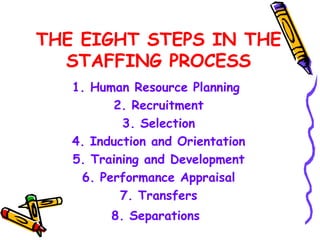
THE EIGHT STEPS IN THE
  STAFFING PROCESS
   1. Human Resource Planning
         2. Recruitment
           3. Selection
   4. Induction and Orientation
   5. Training and Development
    6. Performance Appraisal
           7. Transfers
         8. Separations
THE EIGHT STEPS IN THE
   STAFFING PROCESS
1. Human Resource Planning
   designed to ensure that the
   personnel needs of the organization
   will be constantly and appropriately
   met.
THE EIGHT STEPS IN THE
   STAFFING PROCESS
1. Human Resource Planning
  Such planning is accomplished through analysis of
 Internal factors such as current and expected
  skill needs, vacancies, and departmental
  expansions and reductions
 Factors in the external environment such as the
  labor market, technological changes, changes in
   government policies and regulations
HUMAN RESOURCE PLANNING

       FOUR BASIC STEPS
1.Planning for future needs.
  How many people with what abilities will
  the organization need to remain in
  operation for the foreseeable future?
HUMAN RESOURCE PLANNING

       FOUR BASIC STEPS
2. Planning for future balance
  How many people presently employed
  can be expected to stay with the
  organization?
HUMAN RESOURCE PLANNING

       FOUR BASIC STEPS
3. Planning for recruiting and
  selecting or for laying off.
  How can the organization bring in the
  number of people it will need?
HUMAN RESOURCE PLANNING

       FOUR BASIC STEPS
4. Planning for development
  How should the training and
  movement of individuals within the
  organization be managed so that the
  organization will be assured of a
  continuing supply of experienced and
  capable personnel?
STRATEGIC PLANNING
 (active formulation of a strategy)
• STRATEGY can be defined as the
  “broad program for defining and
  achieving an organization’s objectives
  and implementing its mission.”

• PROGRAM implies an active,
  conscious and rational role played by
          managers in formulating the
          organization’s strategy.
STRATEGIC PLANNING
(active formulation of a strategy)
ORGANIZATION’S GOALS
 a vital component in strategic planning
 provide the enterprise its basic sense
 of direction

“GOALS” includes the organization’s
  purpose, mission, and objectives.
STRATEGIC PLANNING
(active formulation of a strategy)
PURPOSE is its primary role in society, a
 broadly defined aim that it may share
 with many other organizations of its
 type.

MISSION is the unique reason for its
 existence that sets it apart from all
 others. (described in terms of products,
         services, clients)
STRATEGIC PLANNING
(active formulation of a strategy)


MISSION is translated into various
 objectives that it must reach in order
 to achieve its goals.
THE EIGHT STEPS IN THE
   STAFFING PROCESS
2. Recruitment
  concerned with developing a pool of job
  candidates, in line with the human
  resource plan.      The candidates are
  usually located through newspaper and
  professional journal advertisements,
  employment agencies, word of mouth, and

     visits to college and university
RECRUITMENT
 its purpose is to provide a large
 enough group of candidates so that
 the organization will be able to select
 the qualified employees it needs.

       Two Kinds of Recruitment
          General Recruiting
        Specialized Recruiting
Two Kinds of Recruitment
1. General Recruiting
   takes place when the organization needs a
   group of workers of a certain kind
   (ex. Typists)
2. Specialized Recruiting
     occurs when the organization needs
       a particular type of individual, mainly

      for higher­level executives or
      specialists.
RECRUITMENT
JOB DESCRIPTION ­ a written statement
 of the content and location on the
 organizational chart of each job. (title,
 duties and responsibilities)

JOB SPECIFICATION ­ defines the
 background, experience, and personal
 characteristics an individual must have in
 order to perform effectively in the
      position.
THE EIGHT STEPS IN THE
   STAFFING PROCESS
3. Selection
   involves evaluating and choosing
   among job candidates.
   Application forms, resumes,
   interviews, employment and skills
   tests, and reference checks are the

     most commonly used aids in the
SELECTION
               SEVEN STEPS:
1. Application Form
   formally indicates applicant’s desire
   provides the interviewer with the basic
    information needed for the interview
   becomes part of the organization’s personnel
    information
2. Initial Screening Interview used to make
  a quick evaluation of the applicant’s
       suitability for the particular job.
SELECTION
                 SEVEN STEPS:
3. Testing, an organization attempts to
  measure a candidate’s relevant job skills and
  ability to learn on the job.

4. Background Investigation, the truthfulness
  of a candidate’s resume or application form
  will be sought from one or more of the
         candidate’s references or previous
         employers.
SELECTION
                 SEVEN STEPS:
5. In­depth selection interview, designed to
  fill in gaps on the candidate’s application

6. Physical examination, designed to ensure
  that the candidate can perform effectively
  in the position for which he is applying.

          7. Job offer
THE EIGHT STEPS IN THE
   STAFFING PROCESS
4. Induction and Orientation
   designed to help the selected
   individuals fit smoothly into the
   organization. Newcomers are
   introduced to their colleagues,
   acquainted with their responsibilities,
   and informed about the organization’s
   policies and goals.
INDUCTION AND
        ORIENTATION
      THREE TYPES OF INFORMATION
1. General information about the daily work
   routines
2. Review of the organization’s history,
   purpose, operations, and products or
   services, and how the employee’s job
   contributes to the organization’s needs
3. Detailed presentation of the
        organization’s policies, work rules
       and employee benefits.
THE EIGHT STEPS IN THE
   STAFFING PROCESS
5. Training and Development
 aims at increasing the ability of
   individuals and groups to contribute
   to organizational effectiveness.
 designed to improve skills in the
   present job
THE EIGHT STEPS IN THE
   STAFFING PROCESS
5. Training and Development
 designed to educate employees
   beyond the requirements of their
   present position so that they will be
   prepared for promotion and able to
   take a broader view of their role in
   the organization.
TRAINING AND
        DEVELOPMENT
To determine the training needs of
  individuals, the ff. can be used:

1. Performance Appraisal, employee’s
   work is measured against the
   performance standards or objectives
2.     established for his job.
TRAINING AND
        DEVELOPMENT
To determine the training needs of
  individuals, the ff. can be used:

2. Analysis of Job Requirements, skills
   or knowledge specified in the job
     description are examined
TRAINING AND
        DEVELOPMENT
To determine the training needs of
  individuals, the ff. can be used:

3. Organizational Analysis, the
   effectiveness of the organization and
   its success in meeting its goals are
   analyzed to determine where
   differences exist.
TRAINING AND
        DEVELOPMENT
To determine the training needs of
  individuals, the ff. can be used:

4. Survey of human resources, human
  resources are asked to describe what
  problems they are experiencing in their
  work and what actions they believe need to
       be taken to resolve them.
THE EIGHT STEPS IN THE
   STAFFING PROCESS
6. Performance Appraisal
 compares an individual’s job
   performance against standards or
   objectives developed for the
   individual’s position.
PERFORMANCE APPRAISAL
              TWO TYPES
Informal Appraisal, conducted on a day
  to day basis

Systematic Appraisal, occurs
  semiannually or annually on a
     formalized basis
PERFORMANCE APPRAISAL
Four Major Purposes of Systematic Appraisal
1. It lets subordinates know formally how their
   current performance is being rated
2. It identifies those subordinates who deserve
   merit raises
3. It locates those subordinates who require
   additional training
     4. It plays an important role in identifying those
         subordinates who are candidates for
         promotion
PERFORMANCE APPRAISAL
Four Basic Formal Appraisal Approaches
1. Superior’s rating of a subordinate
2. A group of superiors rating a subordinate
   (time­consuming, often dilutes subordinate’s
       feelings of accountability to their immediate
       superior)
   3. A group of peers rating a colleague
   4. Subordinates’ rating of bosses
PERFORMANCE APPRAISAL
              Problems of Appraisal
                  (Meyer, 1960)
­employees who were formally criticized about their
    job performance once or twice a year tended to
    become defensive and resentful, and that their
   performance after the appraisal interview tended
                     to decline.

 PARTICIPATORY APPRAISAL, a manager and an
   individual subordinate should set performance
       goals together and then calculate progress
                 toward those goals.
PERFORMANCE APPRAISAL
Pitfalls Managers Must Avoid in Order
   to Make their Formal and Informal
  Appraisal Programs Effective (Stoner
               and Wankel)

       1. Shifting Standards
            2. Rater Bias
   3. Different Rater Patterns
         4. The Halo Effect
THE EIGHT STEPS IN THE
  STAFFING PROCESS
7. Transfers
   A transfer is a shift of a person from one job,
    organizational level, or location to another.
    Common types of transfers are:
    PROMOTION = a shift to a higher position in
    the hierarchy, usually with added salary, status
    and authority
                 = a significant way to recognize
    superior performance
                 = should be fair, based on merit
    and untainted by favoritism
THE EIGHT STEPS IN THE
  STAFFING PROCESS
7. Transfers

    LATERAL MOVES = a shift from one position
    to another at the same level

    DEMOTIONS = a shift to a lower position in
    the hierarchy
THE EIGHT STEPS IN THE
  STAFFING PROCESS
8. Separations
  may be a resignation, layoff, discharge, or
  retirement.
     Too many separations might signify a
  noncompetitive pay scale; recurrent
  layoffs sometimes result from poor
  integration of production with market
  demand; and too many discharges might
          indicate poor selection or training
  procedures.
Thank You 
RIAH R. BARCELONA
     Reporter

Staffing Process

  • 1.
  • 2.
    STAFFING “ The mostimportant resources of an organization are its human resources. Thus, among the most critical tasks of a manager are the selection, training, and development of people who will best help the organization meet its goals.” ( Stoner and Wankel, 1987)
  • 3.
    THE EIGHT STEPSIN THE STAFFING PROCESS 1. Human Resource Planning 2. Recruitment 3. Selection 4. Induction and Orientation 5. Training and Development 6. Performance Appraisal 7. Transfers 8. Separations
  • 4.
    THE EIGHT STEPSIN THE STAFFING PROCESS 1. Human Resource Planning designed to ensure that the personnel needs of the organization will be constantly and appropriately met.
  • 5.
    THE EIGHT STEPSIN THE STAFFING PROCESS 1. Human Resource Planning Such planning is accomplished through analysis of  Internal factors such as current and expected skill needs, vacancies, and departmental expansions and reductions  Factors in the external environment such as the labor market, technological changes, changes in government policies and regulations
  • 6.
    HUMAN RESOURCE PLANNING FOUR BASIC STEPS 1.Planning for future needs. How many people with what abilities will the organization need to remain in operation for the foreseeable future?
  • 7.
    HUMAN RESOURCE PLANNING FOUR BASIC STEPS 2. Planning for future balance How many people presently employed can be expected to stay with the organization?
  • 8.
    HUMAN RESOURCE PLANNING FOUR BASIC STEPS 3. Planning for recruiting and selecting or for laying off. How can the organization bring in the number of people it will need?
  • 9.
    HUMAN RESOURCE PLANNING FOUR BASIC STEPS 4. Planning for development How should the training and movement of individuals within the organization be managed so that the organization will be assured of a continuing supply of experienced and capable personnel?
  • 10.
    STRATEGIC PLANNING (activeformulation of a strategy) • STRATEGY can be defined as the “broad program for defining and achieving an organization’s objectives and implementing its mission.” • PROGRAM implies an active, conscious and rational role played by managers in formulating the organization’s strategy.
  • 11.
    STRATEGIC PLANNING (active formulationof a strategy) ORGANIZATION’S GOALS  a vital component in strategic planning  provide the enterprise its basic sense of direction “GOALS” includes the organization’s purpose, mission, and objectives.
  • 12.
    STRATEGIC PLANNING (active formulationof a strategy) PURPOSE is its primary role in society, a broadly defined aim that it may share with many other organizations of its type. MISSION is the unique reason for its existence that sets it apart from all others. (described in terms of products, services, clients)
  • 13.
    STRATEGIC PLANNING (active formulationof a strategy) MISSION is translated into various objectives that it must reach in order to achieve its goals.
  • 14.
    THE EIGHT STEPSIN THE STAFFING PROCESS 2. Recruitment concerned with developing a pool of job candidates, in line with the human resource plan. The candidates are usually located through newspaper and professional journal advertisements, employment agencies, word of mouth, and visits to college and university
  • 15.
    RECRUITMENT  its purposeis to provide a large enough group of candidates so that the organization will be able to select the qualified employees it needs. Two Kinds of Recruitment General Recruiting Specialized Recruiting
  • 16.
    Two Kinds ofRecruitment 1. General Recruiting takes place when the organization needs a group of workers of a certain kind (ex. Typists) 2. Specialized Recruiting occurs when the organization needs a particular type of individual, mainly for higher­level executives or specialists.
  • 17.
    RECRUITMENT JOB DESCRIPTION ­a written statement of the content and location on the organizational chart of each job. (title, duties and responsibilities) JOB SPECIFICATION ­ defines the background, experience, and personal characteristics an individual must have in order to perform effectively in the position.
  • 18.
    THE EIGHT STEPSIN THE STAFFING PROCESS 3. Selection involves evaluating and choosing among job candidates. Application forms, resumes, interviews, employment and skills tests, and reference checks are the most commonly used aids in the
  • 19.
    SELECTION SEVEN STEPS: 1. Application Form  formally indicates applicant’s desire  provides the interviewer with the basic information needed for the interview  becomes part of the organization’s personnel information 2. Initial Screening Interview used to make a quick evaluation of the applicant’s suitability for the particular job.
  • 20.
    SELECTION SEVEN STEPS: 3. Testing, an organization attempts to measure a candidate’s relevant job skills and ability to learn on the job. 4. Background Investigation, the truthfulness of a candidate’s resume or application form will be sought from one or more of the candidate’s references or previous employers.
  • 21.
    SELECTION SEVEN STEPS: 5. In­depth selection interview, designed to fill in gaps on the candidate’s application 6. Physical examination, designed to ensure that the candidate can perform effectively in the position for which he is applying. 7. Job offer
  • 22.
    THE EIGHT STEPSIN THE STAFFING PROCESS 4. Induction and Orientation designed to help the selected individuals fit smoothly into the organization. Newcomers are introduced to their colleagues, acquainted with their responsibilities, and informed about the organization’s policies and goals.
  • 23.
    INDUCTION AND ORIENTATION THREE TYPES OF INFORMATION 1. General information about the daily work routines 2. Review of the organization’s history, purpose, operations, and products or services, and how the employee’s job contributes to the organization’s needs 3. Detailed presentation of the organization’s policies, work rules and employee benefits.
  • 24.
    THE EIGHT STEPSIN THE STAFFING PROCESS 5. Training and Development  aims at increasing the ability of individuals and groups to contribute to organizational effectiveness.  designed to improve skills in the present job
  • 25.
    THE EIGHT STEPSIN THE STAFFING PROCESS 5. Training and Development  designed to educate employees beyond the requirements of their present position so that they will be prepared for promotion and able to take a broader view of their role in the organization.
  • 26.
    TRAINING AND DEVELOPMENT To determine the training needs of individuals, the ff. can be used: 1. Performance Appraisal, employee’s work is measured against the performance standards or objectives 2. established for his job.
  • 27.
    TRAINING AND DEVELOPMENT To determine the training needs of individuals, the ff. can be used: 2. Analysis of Job Requirements, skills or knowledge specified in the job description are examined
  • 28.
    TRAINING AND DEVELOPMENT To determine the training needs of individuals, the ff. can be used: 3. Organizational Analysis, the effectiveness of the organization and its success in meeting its goals are analyzed to determine where differences exist.
  • 29.
    TRAINING AND DEVELOPMENT To determine the training needs of individuals, the ff. can be used: 4. Survey of human resources, human resources are asked to describe what problems they are experiencing in their work and what actions they believe need to be taken to resolve them.
  • 30.
    THE EIGHT STEPSIN THE STAFFING PROCESS 6. Performance Appraisal  compares an individual’s job performance against standards or objectives developed for the individual’s position.
  • 31.
    PERFORMANCE APPRAISAL TWO TYPES Informal Appraisal, conducted on a day to day basis Systematic Appraisal, occurs semiannually or annually on a formalized basis
  • 32.
    PERFORMANCE APPRAISAL Four MajorPurposes of Systematic Appraisal 1. It lets subordinates know formally how their current performance is being rated 2. It identifies those subordinates who deserve merit raises 3. It locates those subordinates who require additional training 4. It plays an important role in identifying those subordinates who are candidates for promotion
  • 33.
    PERFORMANCE APPRAISAL Four BasicFormal Appraisal Approaches 1. Superior’s rating of a subordinate 2. A group of superiors rating a subordinate (time­consuming, often dilutes subordinate’s feelings of accountability to their immediate superior) 3. A group of peers rating a colleague 4. Subordinates’ rating of bosses
  • 34.
    PERFORMANCE APPRAISAL Problems of Appraisal (Meyer, 1960) ­employees who were formally criticized about their job performance once or twice a year tended to become defensive and resentful, and that their performance after the appraisal interview tended to decline. PARTICIPATORY APPRAISAL, a manager and an individual subordinate should set performance goals together and then calculate progress toward those goals.
  • 35.
    PERFORMANCE APPRAISAL Pitfalls ManagersMust Avoid in Order to Make their Formal and Informal Appraisal Programs Effective (Stoner and Wankel) 1. Shifting Standards 2. Rater Bias 3. Different Rater Patterns 4. The Halo Effect
  • 36.
    THE EIGHT STEPSIN THE STAFFING PROCESS 7. Transfers  A transfer is a shift of a person from one job, organizational level, or location to another. Common types of transfers are: PROMOTION = a shift to a higher position in the hierarchy, usually with added salary, status and authority = a significant way to recognize superior performance = should be fair, based on merit and untainted by favoritism
  • 37.
    THE EIGHT STEPSIN THE STAFFING PROCESS 7. Transfers LATERAL MOVES = a shift from one position to another at the same level DEMOTIONS = a shift to a lower position in the hierarchy
  • 38.
    THE EIGHT STEPSIN THE STAFFING PROCESS 8. Separations may be a resignation, layoff, discharge, or retirement. Too many separations might signify a noncompetitive pay scale; recurrent layoffs sometimes result from poor integration of production with market demand; and too many discharges might indicate poor selection or training procedures.
  • 39.
    Thank You  RIAHR. BARCELONA Reporter