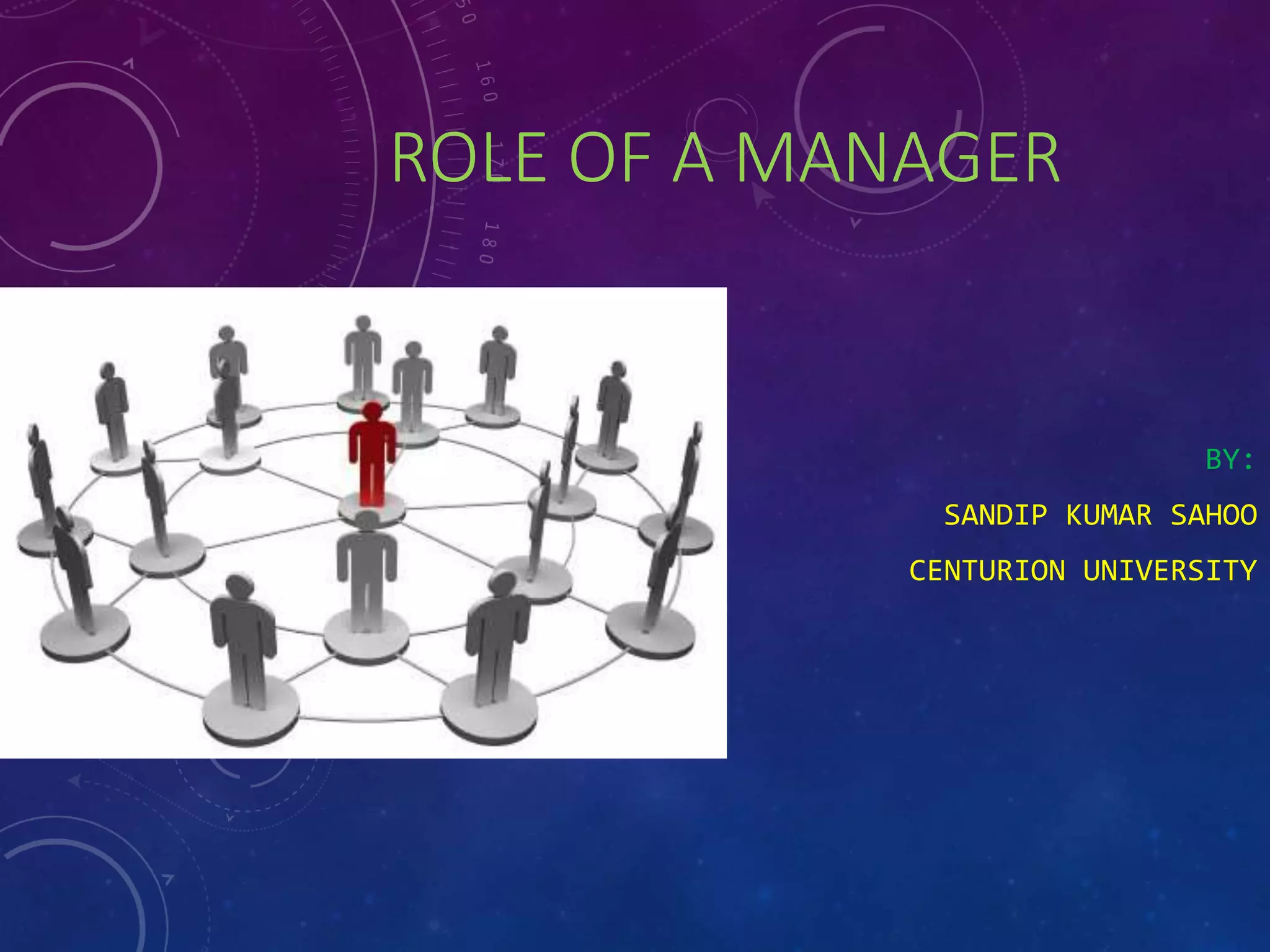
ROLE OF A MANAGER 
BY: 
SANDIP KUMAR SAHOO 
CENTURION UNIVERSITY
MANAGER 
• A person responsible for controlling or administering all or part of a 
company or a similar organization is known as a manager. 
• As an organization evolves and grows, a manager plays an integral part 
in its successful growth. 
• Organizations need to look to a manager that will hold several roles, 
such as leader, negotiator, figurehead, and communicator. 
• In each of these roles, the manager's goal is to help employees 
through the change and evolution of an organization with the least 
number of conflicts and issues as possible.
5 DIFFERENCES BETWEEN A WORKER AND A MANAGER 
Worker 
• Works alone 
• Does the work 
• Like a player in the team 
• Is lead and Managed 
• Responsibility: 
Single 
Manager 
• Works with others 
• Develops 
people/customers 
• Like a coach and a counsel; Pitches 
in as player when needed. 
• Is the Leader/Manager according to 
the condition 
• Responsibility : Various
MANAGEMENT LEVELS 
• In organizations, there are typically three levels of management: top-level, 
middle-level, and first-level. 
• These three main levels of managers form a hierarchy, in which they are 
ranked in order of importance. 
1. TOP-LEVEL MANAGERS: These individuals are at the top one or two levels in 
an organization, and hold titles such as: Chief Executive Officer (CEO), Chief 
Financial Officer (CFO), Chief Operational Officer (COO) etc. 
2. MIDDLE-LEVEL MANAGERS: Middle-level managers, or middle managers, are 
those in the levels below top managers. Middle managers' job titles include: 
General manager, Plant manager, Regional manager, and Divisional manager. 
3. FIRST-LEVEL MANAGERS: First-level managers are also called first-line 
managers or supervisors. These managers have job titles such as: Office 
manager, Shift supervisor, Department manager, Foreperson, Crew leader, 
Store manager.
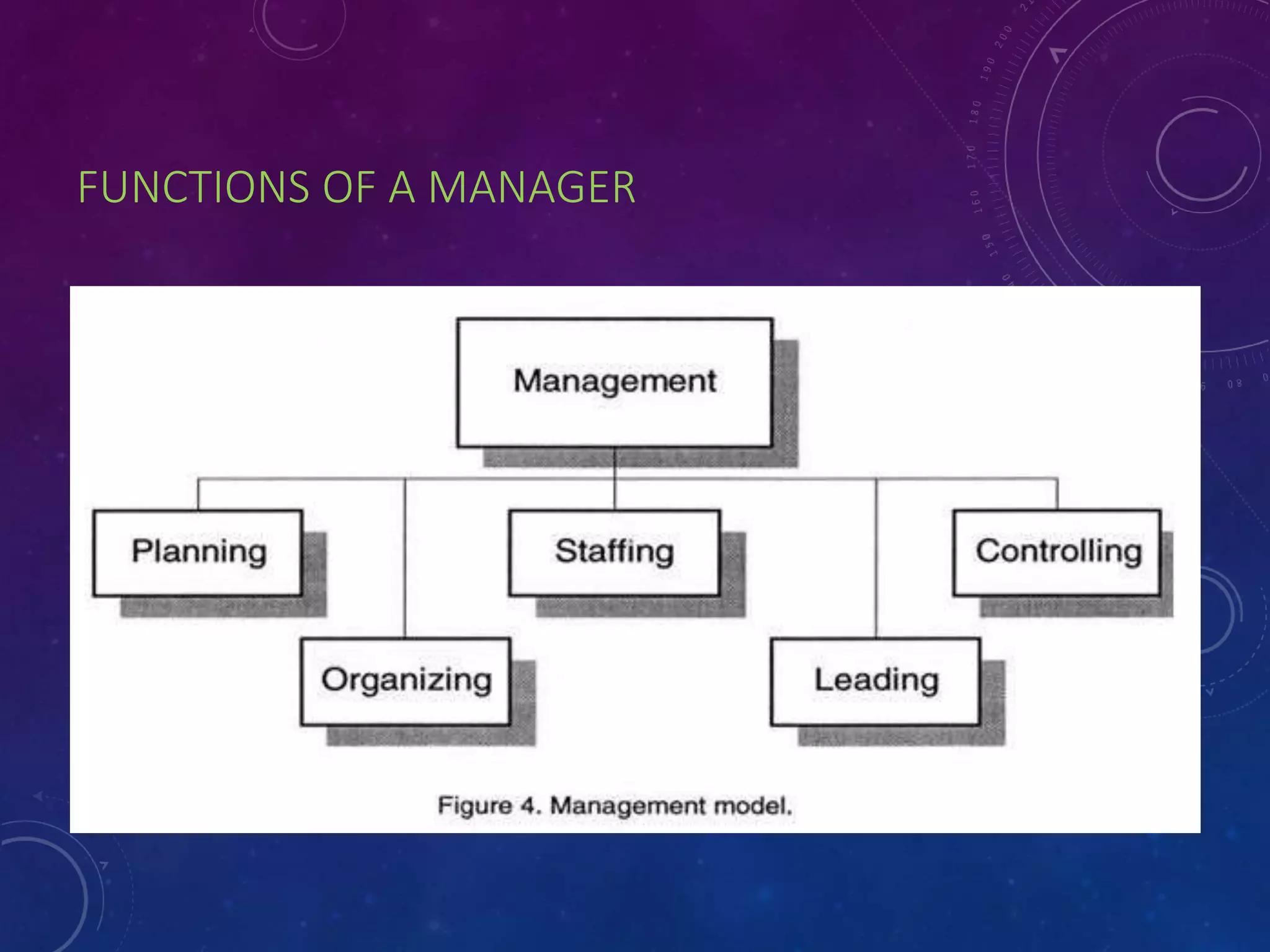
FUNCTIONS OF A MANAGER
FUNCTIONS OF A MANAGER 
1. Planning: This step involves mapping out exactly how to 
achieve a particular goal. 
2. Organizing: Assigning work and granting authority are two 
important elements of organizing. 
3. Staffing: Recruiting, selecting, training, and developing 
employees. 
4. Leading: Motivating, communicating, guiding, and 
encouraging. It requires the manager to coach, assist, and 
problem solve with employees. 
5. Controlling: Continuously checking results against goals and 
take any corrective actions necessary to make sure that his 
area's plans remain on track.
MINTZBERG’S 10 MANAGERIAL ROLES 
 Dr. Henry Mintzberg a prominent management researcher 
conducted a research to find out what are really a manager 
duties or responsibilities. 
 In his research Mintzberg said that what managers do can 
best be described by looking at the roles they play at work. 
 The term management role refers to specific categories 
of managerial behaviour. 
 He identified 10 identified roles of a manager played in 
organization which fall into three basic categories: 
interpersonal roles, informational roles and decisional 
roles.
MINTZBERG’S 10 MANAGERIAL ROLES 
A. INTERPERSONAL ROLES: 
These roles relate to the manager's behaviour and are categorised into 
three types. 
1. FIGUREHEAD: The Manager performs ceremonial and symbolic duties as 
head of the organization. 
2. LEADER: Fosters a proper work atmosphere and motivates and develops 
subordinates. 
3. LIASION: Develops and maintains a network of external contacts to gather 
information.
CONTD. 
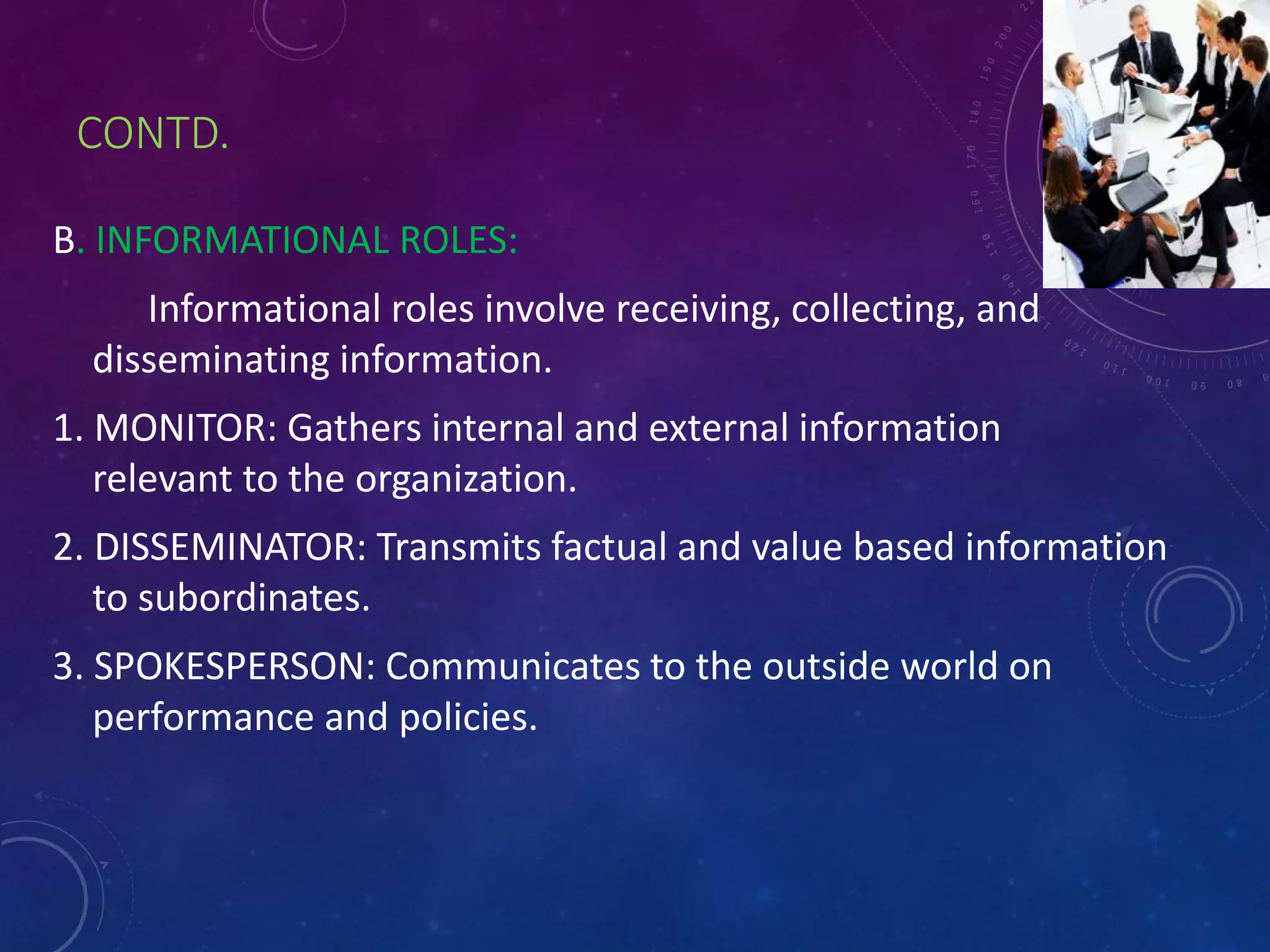
B. INFORMATIONAL ROLES: 
Informational roles involve receiving, collecting, and 
disseminating information. 
1. MONITOR: Gathers internal and external information 
relevant to the organization. 
2. DISSEMINATOR: Transmits factual and value based information 
to subordinates. 
3. SPOKESPERSON: Communicates to the outside world on 
performance and policies.
CONTD. 
C. DECISIONAL ROLES: 
Decisional roles revolved around making choices. Managers’ 
interpersonal role leads to the decisional roles. Information and resources 
that’s collected and gathered by the interpersonal makes a manger able to 
play the decisional roles or responsibilities that his is obligated to. 
1. ENTREPRENEUR: Designs and initiates change in the organization. 
2. DISTURBANCE HANDLER: Deals with unexpected events and operational 
breakdowns. 
3. RESOURCE ALLOCATOR: Controls and authorizes the use of organizational 
resources. 
4. . NEGOTIATOR: Participates in negotiation activities with other 
organizations and individuals.
DIFFERENCE BETWEEN MANAGER AND LEADER 
MANAGER 
• The manager administers. 
• The manager maintains. 
• The manager focuses on systems 
and structure. 
• The manager does things right. 
• Every manager can’t be a good 
leader. 
LEADER 
• The leader innovates. 
• The leader develops. 
• The leader focuses on people. 
• The leader does the right thing. 
• But every leader can be a good 
manager.
CHARACTERISTICS OF A GOOD MANAGER 
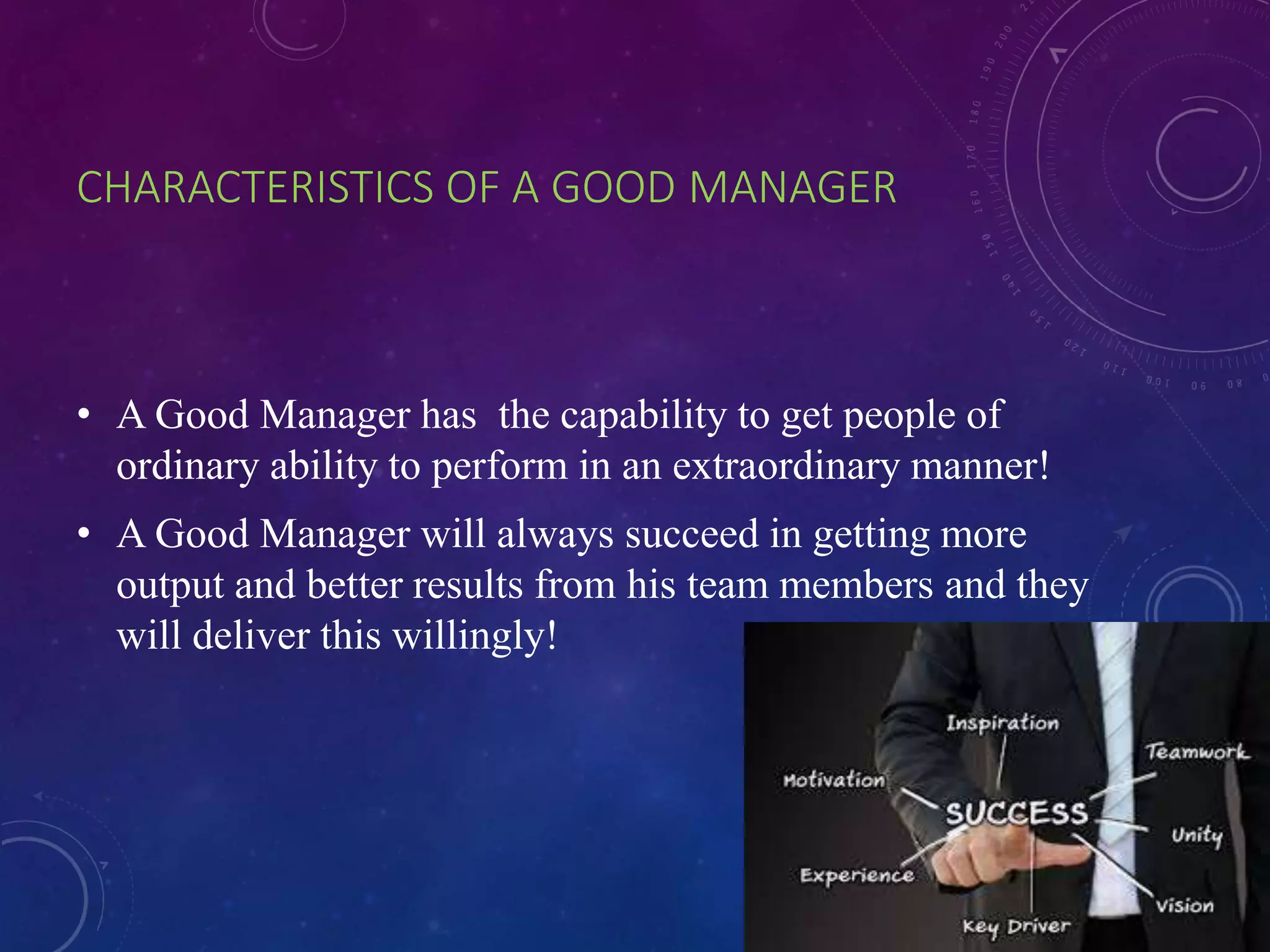
• A Good Manager has the capability to get people of 
ordinary ability to perform in an extraordinary manner! 
• A Good Manager will always succeed in getting more 
output and better results from his team members and they 
will deliver this willingly!
CONCLUSION 
• A manager wears many hats. Not only is a manager a team leader, but 
he or she is also a planner, organizer, cheerleader, coach, problem 
solver, and decision maker — all rolled into one. And these are just a 
few of a manager's roles. 
• In addition, managers' schedules are usually jam‐packed. Whether 
they're busy with employee meetings, unexpected problems, or 
strategy sessions, managers often find little spare time on their 
calendars. 
• Hence a manager can also be called as the root of a company or an 
organization.
ROLE OF A MANAGER

ROLE OF A MANAGER

  • 1.
    ROLE OF AMANAGER BY: SANDIP KUMAR SAHOO CENTURION UNIVERSITY
  • 2.
    MANAGER • Aperson responsible for controlling or administering all or part of a company or a similar organization is known as a manager. • As an organization evolves and grows, a manager plays an integral part in its successful growth. • Organizations need to look to a manager that will hold several roles, such as leader, negotiator, figurehead, and communicator. • In each of these roles, the manager's goal is to help employees through the change and evolution of an organization with the least number of conflicts and issues as possible.
  • 3.
    5 DIFFERENCES BETWEENA WORKER AND A MANAGER Worker • Works alone • Does the work • Like a player in the team • Is lead and Managed • Responsibility: Single Manager • Works with others • Develops people/customers • Like a coach and a counsel; Pitches in as player when needed. • Is the Leader/Manager according to the condition • Responsibility : Various
  • 4.
    MANAGEMENT LEVELS •In organizations, there are typically three levels of management: top-level, middle-level, and first-level. • These three main levels of managers form a hierarchy, in which they are ranked in order of importance. 1. TOP-LEVEL MANAGERS: These individuals are at the top one or two levels in an organization, and hold titles such as: Chief Executive Officer (CEO), Chief Financial Officer (CFO), Chief Operational Officer (COO) etc. 2. MIDDLE-LEVEL MANAGERS: Middle-level managers, or middle managers, are those in the levels below top managers. Middle managers' job titles include: General manager, Plant manager, Regional manager, and Divisional manager. 3. FIRST-LEVEL MANAGERS: First-level managers are also called first-line managers or supervisors. These managers have job titles such as: Office manager, Shift supervisor, Department manager, Foreperson, Crew leader, Store manager.
  • 5.
  • 6.
    FUNCTIONS OF AMANAGER 1. Planning: This step involves mapping out exactly how to achieve a particular goal. 2. Organizing: Assigning work and granting authority are two important elements of organizing. 3. Staffing: Recruiting, selecting, training, and developing employees. 4. Leading: Motivating, communicating, guiding, and encouraging. It requires the manager to coach, assist, and problem solve with employees. 5. Controlling: Continuously checking results against goals and take any corrective actions necessary to make sure that his area's plans remain on track.
  • 7.
    MINTZBERG’S 10 MANAGERIALROLES  Dr. Henry Mintzberg a prominent management researcher conducted a research to find out what are really a manager duties or responsibilities.  In his research Mintzberg said that what managers do can best be described by looking at the roles they play at work.  The term management role refers to specific categories of managerial behaviour.  He identified 10 identified roles of a manager played in organization which fall into three basic categories: interpersonal roles, informational roles and decisional roles.
  • 9.
    MINTZBERG’S 10 MANAGERIALROLES A. INTERPERSONAL ROLES: These roles relate to the manager's behaviour and are categorised into three types. 1. FIGUREHEAD: The Manager performs ceremonial and symbolic duties as head of the organization. 2. LEADER: Fosters a proper work atmosphere and motivates and develops subordinates. 3. LIASION: Develops and maintains a network of external contacts to gather information.
  • 10.
    CONTD. B. INFORMATIONALROLES: Informational roles involve receiving, collecting, and disseminating information. 1. MONITOR: Gathers internal and external information relevant to the organization. 2. DISSEMINATOR: Transmits factual and value based information to subordinates. 3. SPOKESPERSON: Communicates to the outside world on performance and policies.
  • 11.
    CONTD. C. DECISIONALROLES: Decisional roles revolved around making choices. Managers’ interpersonal role leads to the decisional roles. Information and resources that’s collected and gathered by the interpersonal makes a manger able to play the decisional roles or responsibilities that his is obligated to. 1. ENTREPRENEUR: Designs and initiates change in the organization. 2. DISTURBANCE HANDLER: Deals with unexpected events and operational breakdowns. 3. RESOURCE ALLOCATOR: Controls and authorizes the use of organizational resources. 4. . NEGOTIATOR: Participates in negotiation activities with other organizations and individuals.
  • 12.
    DIFFERENCE BETWEEN MANAGERAND LEADER MANAGER • The manager administers. • The manager maintains. • The manager focuses on systems and structure. • The manager does things right. • Every manager can’t be a good leader. LEADER • The leader innovates. • The leader develops. • The leader focuses on people. • The leader does the right thing. • But every leader can be a good manager.
  • 13.
    CHARACTERISTICS OF AGOOD MANAGER • A Good Manager has the capability to get people of ordinary ability to perform in an extraordinary manner! • A Good Manager will always succeed in getting more output and better results from his team members and they will deliver this willingly!
  • 14.
    CONCLUSION • Amanager wears many hats. Not only is a manager a team leader, but he or she is also a planner, organizer, cheerleader, coach, problem solver, and decision maker — all rolled into one. And these are just a few of a manager's roles. • In addition, managers' schedules are usually jam‐packed. Whether they're busy with employee meetings, unexpected problems, or strategy sessions, managers often find little spare time on their calendars. • Hence a manager can also be called as the root of a company or an organization.