Definition
 Intelligence tests attempt to measure your intelligence—that is,
your basic ability to understand the world around you, assimilate
its functioning, and apply this knowledge to enhance the quality of
your life.
 Intelligence tests are psychological tests that are designed to
measure a variety of mental functions, such as reasoning,
comprehension, and judgment.
Purpose
 The goal of intelligence tests is to obtain an idea of the person's
intellectual potential. The tests center around a set of stimuli
designed to yield a score based on the test maker's model of
what makes up intelligence. Intelligence tests are often given as a
part of a battery of tests.
Advantages
 In general, intelligence tests measure a wide variety of human behaviors better
than any other measure that has been developed.
 They allow professionals to have a uniform way of comparing a person's
performance with that of other people who are similar in age.
 These tests also provide information on cultural and biological differences
among people.
 Intelligence tests are excellent predictors of academic achievement and
provide an outline of a person's mental strengths and weaknesses.
 Many times the scores have revealed talents in many people, which have led to
an improvement in their educational opportunities.
 Teachers, parents, and psychologists are able to devise individual curricula that
matches a person's level of development and expectations.
Advantages and Disadvantages of
Intelligence Assessments.
Advantages and Disadvantages of
Intelligence Assessments.
Disadvantages
 Some researchers argue that intelligence tests have serious shortcomings. For
example, many intelligence tests produce a single intelligence score.
 This single score is often inadequate in explaining the multidimensional aspects of
intelligence.
 Another problem with a single score is the fact that individuals with similar
intelligence test scores can vary greatly in their expression of these talents. It is
important to know the person's performance on the various subtests that make up the
overall intelligence test score.
 Knowing the performance on these various scales can influence the understanding
of a person's abilities and how these abilities are expressed. For example, two people
have identical scores on intelligence tests. Although both people have the same test
score, one person may have obtained the score because of strong verbal skills while
the other may have obtained the score because of strong skills in perceiving and
organizing various tasks.
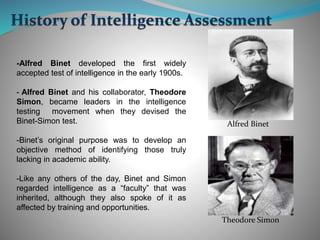
-Alfred Binet developed the first widely
accepted test of intelligence in the early 1900s.
- Alfred Binet and his collaborator, Theodore
Simon, became leaders in the intelligence
testing movement when they devised the
Binet-Simon test.
-Binet’s original purpose was to develop an
objective method of identifying those truly
lacking in academic ability.
-Like any others of the day, Binet and Simon
regarded intelligence as a “faculty” that was
inherited, although they also spoke of it as
affected by training and opportunities.
Alfred Binet
Theodore Simon
Critiques and Controversies of intelligence
testing
The Mismeasure of Man
-A scathing critique book of the intelligence testing movement and the
“reification” of the notion of Intelligence by Stephen Gould(1981).
-Gould argued that theorists such as Spearman mistakenly accorded
general intelligence or g, the status of a true entity because of their
misunderstanding of analytic techniques.
The Bell Curve
-is a highly controversial book by Richard Herrnstein and Charles
Murray, first published in 1994.
-It argues that intelligence is the most dominant factor in the trajectory of
each person's life, and it serves to predict such things as socioeconomic
status and tendencies towards criminal behavior.
The Concept
of
Intelligence
What is Intelligence?
There is no universally accepted definition of intelligence. Its
nature and origin are elusive, creating a long history of
disagreement to which where it was constituted. However,
many definitions of intelligence emphasize the ability to think
abstractly, the ability to learn, and the ability to adapt to the
environment.
The Concept of Intelligence
Reliability and Validity
Reliability
- with regard to psychological tests, reliability refers to the
consistency with which the individuals respond to test stimuli.
There are several ways of evaluating reliability.
1. test-retest reliability – the extent to which an individual makes
similar responses to the same test stimuli on repeated
occasions.
2. equivalent-form reliability – equivalent or parallel forms of the
test are developed to avoid clients rehearsing between testing
occasions or show practice effect.
3. split-half reliability – a test is divide into two halves (usually
odd-numbered items vs. even-numbered items), and
participants’ scores on the two halves are compared.
4. internal-consistency reliability – involves computing the average of
all possible split-half correlations for a given test.
5. interrater or interjudge reliability – with the goal to demonstrate that
independent observers can agree about their ratings or judgments of
some particular aspect of the person’s behavior
The Concept of Intelligence
Validity
-refers to the extent to which an assessment technique measures
what it is suppose to measure.
The Concept of Intelligence
Like reliability there are different forms of validity:
1. Content validity – the degree to which test items adequately
measure all aspects of the construct of interest.
2. Predictive validity – the degree to which test scores can
predict(correlate with) behavior or test scores that are observed
or obtained at some point in the future.
3. Concurrent validity – the extent to which test scores correlate
with scores on other relevant measures administered at the same
time.
4. Construct validity – the extent to which test scores are correlated
with other measures or behaviors in logical and theoretically
consistent way.
Theories
of
Intelligence
Theories of Intelligence
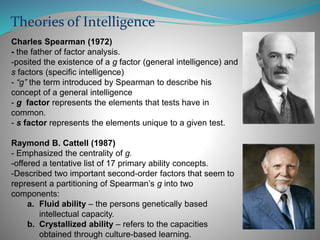
Charles Spearman (1972)
- the father of factor analysis.
-posited the existence of a g factor (general intelligence) and
s factors (specific intelligence)
- “g” the term introduced by Spearman to describe his
concept of a general intelligence
- g factor represents the elements that tests have in
common.
- s factor represents the elements unique to a given test.
Raymond B. Cattell (1987)
- Emphasized the centrality of g.
-offered a tentative list of 17 primary ability concepts.
-Described two important second-order factors that seem to
represent a partitioning of Spearman’s g into two
components:
a. Fluid ability – the persons genetically based
intellectual capacity.
b. Crystallized ability – refers to the capacities
obtained through culture-based learning.
Theories of Intelligence
L. L. Thurstone
- A critic of Spearman’s g.
- Suggested seven clusters of Primary
Mental Abilities: numerical ability ,word
fluency, verbal meaning, perceptual
speed, reasoning, and memory.
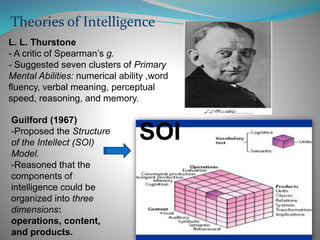
Guilford (1967)
-Proposed the Structure
of the Intellect (SOI)
Model.
-Reasoned that the
components of
intelligence could be
organized into three
dimensions:
operations, content,
and products.
SOI
Theories of Intelligence
Gardner’s Theory of Multiple Intelligences
-The human intellectual competence involves a set of problem-
solving skills that enable the person to resolve problems of difficulties.
Gardner suggest that there is a family of six intelligences: Linguistic,
Musical, Logical-mathematical, Spatial, Bodily-kinesthetic, and
Personal (intrapersonal and interpersonal)
Sternberg’s Triarchic Theory of Intelligence
- Maintains that people function on the basis of three aspects
of Intelligence:
a. Component - refers to analytical thinking; high scores would
characterize the person who is a good test-taker.
b. Experiential – relates to creative thinking and characterizes the
person who can take separate elements of experience and combine
them insightfully.
c. Contextual – is seen in the person who is “street smart”—one who
knows how to play the game and can successfully manipulate the
environment.
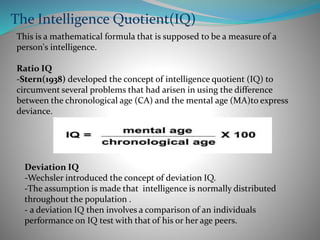
The Intelligence Quotient(IQ)
This is a mathematical formula that is supposed to be a measure of a
person's intelligence.
Ratio IQ
-Stern(1938) developed the concept of intelligence quotient (IQ) to
circumvent several problems that had arisen in using the difference
between the chronological age (CA) and the mental age (MA)to express
deviance.
Deviation IQ
-Wechsler introduced the concept of deviation IQ.
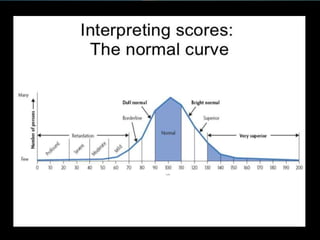
-The assumption is made that intelligence is normally distributed
throughout the population .
- a deviation IQ then involves a comparison of an individuals
performance on IQ test with that of his or her age peers.
The Clinical Assessment of Intelligence
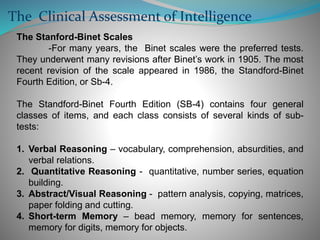
The Stanford-Binet Scales
-For many years, the Binet scales were the preferred tests.
They underwent many revisions after Binet’s work in 1905. The most
recent revision of the scale appeared in 1986, the Standford-Binet
Fourth Edition, or Sb-4.
The Standford-Binet Fourth Edition (SB-4) contains four general
classes of items, and each class consists of several kinds of sub-
tests:
1. Verbal Reasoning – vocabulary, comprehension, absurdities, and
verbal relations.
2. Quantitative Reasoning - quantitative, number series, equation
building.
3. Abstract/Visual Reasoning - pattern analysis, copying, matrices,
paper folding and cutting.
4. Short-term Memory – bead memory, memory for sentences,
memory for digits, memory for objects.
Let’s have a stretch for
5 minutes
The Clinical Assessment of Intelligence
The Wechsler Scales
David Wechsler published the Wechsler-Bellevue
Intelligence Scale in 1939. Subsequent revisions of this test have
become the most widely used techniques to assess intellectual
functioning.
Wechsler Adult Intelligence Scale-Third Edition
- The most recent revision of WAIS that was introduced in 1997
- An adult intelligence test comprised of both verbal scale and a
performance scale, each of which consists of several subtests.
- The WAIS-III yields a verbal IQ, a Performance IQ, and a full scale
IQ, in addition to Index scores
- The seven major IQ: Verbal IQ, Performance IQ, Full Scale IQ,
Verbal Comprehension, Perceptual Organization, Working Memory,
and Processing Speed.
The Clinical Assessment of Intelligence
Following are brief description of the 14 WAIS-III subtests. The First
seven constitute the Verbal Subtests; the other seven are the
Performance subtests.
1. Vocabulary - Here, the examinee must define words that increase
in difficulty.
2. Similarities – This subtest consists of 19 items, and for each one,
the examinee must explain how two objects are alike.
Ex. Space-Time
3. Arithmetic – these 20 items are similar to Arithmetic problems on
most textbooks. The items are administered orally, and the
examinee is not allowed to use paper and pencil.
4. Digit span – This subtest is a measure of short-term memory and
attention. Two sets of digits are read aloud by the examiner. For the
first list, the examinee must repeat the digits in order that they were
read. For the second list, the digits must be repeated backwards.
The Clinical Assessment of Intelligence
5. Information - these 28 items tap knowledge that one would be
expected to have acquired as a result of everyday living and
cultural interactions .
Ex. Who is Confucius?
Where does turpentine come?
6) Comprehension – These 28 items measure common sense and
practical judgment in solving a problem.
7) Letter-Number Sequencing – A combination of numbers and
letters is read, and the examinee must first recall the numbers in
ascending order and then the letters in alphabetical order.
8) Picture Completion – consists of 25 colored cards, each
showing a picture with a part missing. The examinee must
identify the missing part.
5. Digit Symbol-Coding – This code-substitution task requires the
examinee to fill the appropriate code in the blanks under a long
series of numbers, using a key.
6. Block design – The examinee must assemble blocks to match
the designs on a set of cards.
11. Matrix Reasoning – Consists of items that measure visual
information processing and abstract reasoning skills.
12. Picture Arrangement – Several sets of picture must be
arranged in proper sequence to tell a coherent story.
11. Symbol Search – The task is to indicate whether a stimulus
symbol appears in array that is present.
12. Object Assembly – Five puzzles must be assembled. This
subtest requires the ability to visualize a whole from its parts
and to plan ahead, along with a certain degree of visual-motor
coordination.
The Clinical Assessment of Intelligence
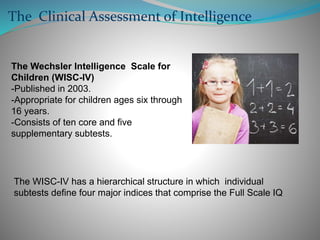
The Wechsler Intelligence Scale for
Children (WISC-IV)
-Published in 2003.
-Appropriate for children ages six through
16 years.
-Consists of ten core and five
supplementary subtests.
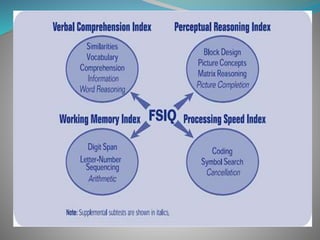
The WISC-IV has a hierarchical structure in which individual
subtests define four major indices that comprise the Full Scale IQ
The Clinical Use of Intelligence Tests
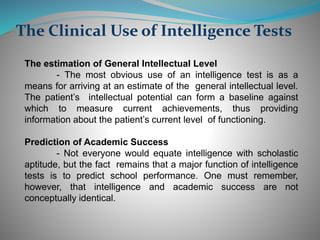
The estimation of General Intellectual Level
- The most obvious use of an intelligence test is as a
means for arriving at an estimate of the general intellectual level.
The patient’s intellectual potential can form a baseline against
which to measure current achievements, thus providing
information about the patient’s current level of functioning.
Prediction of Academic Success
- Not everyone would equate intelligence with scholastic
aptitude, but the fact remains that a major function of intelligence
tests is to predict school performance. One must remember,
however, that intelligence and academic success are not
conceptually identical.
The Clinical Use of Intelligence Tests
The Appraisal of Style
- One of the major values of individual intelligence tests
is that they permit the us to observe the patient or client at work.
Such observations can help us greatly in interpreting IQ.
End of
Chapter 7

Chap 7 assessment of intelligence

  • 2.
    Definition  Intelligence testsattempt to measure your intelligence—that is, your basic ability to understand the world around you, assimilate its functioning, and apply this knowledge to enhance the quality of your life.  Intelligence tests are psychological tests that are designed to measure a variety of mental functions, such as reasoning, comprehension, and judgment. Purpose  The goal of intelligence tests is to obtain an idea of the person's intellectual potential. The tests center around a set of stimuli designed to yield a score based on the test maker's model of what makes up intelligence. Intelligence tests are often given as a part of a battery of tests.
  • 3.
    Advantages  In general,intelligence tests measure a wide variety of human behaviors better than any other measure that has been developed.  They allow professionals to have a uniform way of comparing a person's performance with that of other people who are similar in age.  These tests also provide information on cultural and biological differences among people.  Intelligence tests are excellent predictors of academic achievement and provide an outline of a person's mental strengths and weaknesses.  Many times the scores have revealed talents in many people, which have led to an improvement in their educational opportunities.  Teachers, parents, and psychologists are able to devise individual curricula that matches a person's level of development and expectations. Advantages and Disadvantages of Intelligence Assessments.
  • 4.
    Advantages and Disadvantagesof Intelligence Assessments. Disadvantages  Some researchers argue that intelligence tests have serious shortcomings. For example, many intelligence tests produce a single intelligence score.  This single score is often inadequate in explaining the multidimensional aspects of intelligence.  Another problem with a single score is the fact that individuals with similar intelligence test scores can vary greatly in their expression of these talents. It is important to know the person's performance on the various subtests that make up the overall intelligence test score.  Knowing the performance on these various scales can influence the understanding of a person's abilities and how these abilities are expressed. For example, two people have identical scores on intelligence tests. Although both people have the same test score, one person may have obtained the score because of strong verbal skills while the other may have obtained the score because of strong skills in perceiving and organizing various tasks.
  • 5.
    -Alfred Binet developedthe first widely accepted test of intelligence in the early 1900s. - Alfred Binet and his collaborator, Theodore Simon, became leaders in the intelligence testing movement when they devised the Binet-Simon test. -Binet’s original purpose was to develop an objective method of identifying those truly lacking in academic ability. -Like any others of the day, Binet and Simon regarded intelligence as a “faculty” that was inherited, although they also spoke of it as affected by training and opportunities. Alfred Binet Theodore Simon
  • 6.
    Critiques and Controversiesof intelligence testing The Mismeasure of Man -A scathing critique book of the intelligence testing movement and the “reification” of the notion of Intelligence by Stephen Gould(1981). -Gould argued that theorists such as Spearman mistakenly accorded general intelligence or g, the status of a true entity because of their misunderstanding of analytic techniques. The Bell Curve -is a highly controversial book by Richard Herrnstein and Charles Murray, first published in 1994. -It argues that intelligence is the most dominant factor in the trajectory of each person's life, and it serves to predict such things as socioeconomic status and tendencies towards criminal behavior.
  • 7.
  • 8.
    What is Intelligence? Thereis no universally accepted definition of intelligence. Its nature and origin are elusive, creating a long history of disagreement to which where it was constituted. However, many definitions of intelligence emphasize the ability to think abstractly, the ability to learn, and the ability to adapt to the environment. The Concept of Intelligence
  • 9.
    The Concept ofIntelligence Reliability and Validity Reliability - with regard to psychological tests, reliability refers to the consistency with which the individuals respond to test stimuli. There are several ways of evaluating reliability. 1. test-retest reliability – the extent to which an individual makes similar responses to the same test stimuli on repeated occasions. 2. equivalent-form reliability – equivalent or parallel forms of the test are developed to avoid clients rehearsing between testing occasions or show practice effect. 3. split-half reliability – a test is divide into two halves (usually odd-numbered items vs. even-numbered items), and participants’ scores on the two halves are compared.
  • 10.
    4. internal-consistency reliability– involves computing the average of all possible split-half correlations for a given test. 5. interrater or interjudge reliability – with the goal to demonstrate that independent observers can agree about their ratings or judgments of some particular aspect of the person’s behavior The Concept of Intelligence Validity -refers to the extent to which an assessment technique measures what it is suppose to measure.
  • 11.
    The Concept ofIntelligence Like reliability there are different forms of validity: 1. Content validity – the degree to which test items adequately measure all aspects of the construct of interest. 2. Predictive validity – the degree to which test scores can predict(correlate with) behavior or test scores that are observed or obtained at some point in the future. 3. Concurrent validity – the extent to which test scores correlate with scores on other relevant measures administered at the same time. 4. Construct validity – the extent to which test scores are correlated with other measures or behaviors in logical and theoretically consistent way.
  • 12.
  • 13.
    Theories of Intelligence CharlesSpearman (1972) - the father of factor analysis. -posited the existence of a g factor (general intelligence) and s factors (specific intelligence) - “g” the term introduced by Spearman to describe his concept of a general intelligence - g factor represents the elements that tests have in common. - s factor represents the elements unique to a given test. Raymond B. Cattell (1987) - Emphasized the centrality of g. -offered a tentative list of 17 primary ability concepts. -Described two important second-order factors that seem to represent a partitioning of Spearman’s g into two components: a. Fluid ability – the persons genetically based intellectual capacity. b. Crystallized ability – refers to the capacities obtained through culture-based learning.
  • 14.
    Theories of Intelligence L.L. Thurstone - A critic of Spearman’s g. - Suggested seven clusters of Primary Mental Abilities: numerical ability ,word fluency, verbal meaning, perceptual speed, reasoning, and memory. Guilford (1967) -Proposed the Structure of the Intellect (SOI) Model. -Reasoned that the components of intelligence could be organized into three dimensions: operations, content, and products. SOI
  • 15.
    Theories of Intelligence Gardner’sTheory of Multiple Intelligences -The human intellectual competence involves a set of problem- solving skills that enable the person to resolve problems of difficulties. Gardner suggest that there is a family of six intelligences: Linguistic, Musical, Logical-mathematical, Spatial, Bodily-kinesthetic, and Personal (intrapersonal and interpersonal) Sternberg’s Triarchic Theory of Intelligence - Maintains that people function on the basis of three aspects of Intelligence: a. Component - refers to analytical thinking; high scores would characterize the person who is a good test-taker. b. Experiential – relates to creative thinking and characterizes the person who can take separate elements of experience and combine them insightfully. c. Contextual – is seen in the person who is “street smart”—one who knows how to play the game and can successfully manipulate the environment.
  • 17.
    The Intelligence Quotient(IQ) Thisis a mathematical formula that is supposed to be a measure of a person's intelligence. Ratio IQ -Stern(1938) developed the concept of intelligence quotient (IQ) to circumvent several problems that had arisen in using the difference between the chronological age (CA) and the mental age (MA)to express deviance. Deviation IQ -Wechsler introduced the concept of deviation IQ. -The assumption is made that intelligence is normally distributed throughout the population . - a deviation IQ then involves a comparison of an individuals performance on IQ test with that of his or her age peers.
  • 19.
    The Clinical Assessmentof Intelligence The Stanford-Binet Scales -For many years, the Binet scales were the preferred tests. They underwent many revisions after Binet’s work in 1905. The most recent revision of the scale appeared in 1986, the Standford-Binet Fourth Edition, or Sb-4. The Standford-Binet Fourth Edition (SB-4) contains four general classes of items, and each class consists of several kinds of sub- tests: 1. Verbal Reasoning – vocabulary, comprehension, absurdities, and verbal relations. 2. Quantitative Reasoning - quantitative, number series, equation building. 3. Abstract/Visual Reasoning - pattern analysis, copying, matrices, paper folding and cutting. 4. Short-term Memory – bead memory, memory for sentences, memory for digits, memory for objects.
  • 21.
    Let’s have astretch for 5 minutes
  • 22.
    The Clinical Assessmentof Intelligence The Wechsler Scales David Wechsler published the Wechsler-Bellevue Intelligence Scale in 1939. Subsequent revisions of this test have become the most widely used techniques to assess intellectual functioning. Wechsler Adult Intelligence Scale-Third Edition - The most recent revision of WAIS that was introduced in 1997 - An adult intelligence test comprised of both verbal scale and a performance scale, each of which consists of several subtests. - The WAIS-III yields a verbal IQ, a Performance IQ, and a full scale IQ, in addition to Index scores - The seven major IQ: Verbal IQ, Performance IQ, Full Scale IQ, Verbal Comprehension, Perceptual Organization, Working Memory, and Processing Speed.
  • 23.
    The Clinical Assessmentof Intelligence Following are brief description of the 14 WAIS-III subtests. The First seven constitute the Verbal Subtests; the other seven are the Performance subtests. 1. Vocabulary - Here, the examinee must define words that increase in difficulty. 2. Similarities – This subtest consists of 19 items, and for each one, the examinee must explain how two objects are alike. Ex. Space-Time 3. Arithmetic – these 20 items are similar to Arithmetic problems on most textbooks. The items are administered orally, and the examinee is not allowed to use paper and pencil. 4. Digit span – This subtest is a measure of short-term memory and attention. Two sets of digits are read aloud by the examiner. For the first list, the examinee must repeat the digits in order that they were read. For the second list, the digits must be repeated backwards.
  • 24.
    The Clinical Assessmentof Intelligence 5. Information - these 28 items tap knowledge that one would be expected to have acquired as a result of everyday living and cultural interactions . Ex. Who is Confucius? Where does turpentine come? 6) Comprehension – These 28 items measure common sense and practical judgment in solving a problem. 7) Letter-Number Sequencing – A combination of numbers and letters is read, and the examinee must first recall the numbers in ascending order and then the letters in alphabetical order. 8) Picture Completion – consists of 25 colored cards, each showing a picture with a part missing. The examinee must identify the missing part.
  • 25.
    5. Digit Symbol-Coding– This code-substitution task requires the examinee to fill the appropriate code in the blanks under a long series of numbers, using a key. 6. Block design – The examinee must assemble blocks to match the designs on a set of cards. 11. Matrix Reasoning – Consists of items that measure visual information processing and abstract reasoning skills. 12. Picture Arrangement – Several sets of picture must be arranged in proper sequence to tell a coherent story. 11. Symbol Search – The task is to indicate whether a stimulus symbol appears in array that is present. 12. Object Assembly – Five puzzles must be assembled. This subtest requires the ability to visualize a whole from its parts and to plan ahead, along with a certain degree of visual-motor coordination.
  • 26.
    The Clinical Assessmentof Intelligence The Wechsler Intelligence Scale for Children (WISC-IV) -Published in 2003. -Appropriate for children ages six through 16 years. -Consists of ten core and five supplementary subtests. The WISC-IV has a hierarchical structure in which individual subtests define four major indices that comprise the Full Scale IQ
  • 28.
    The Clinical Useof Intelligence Tests The estimation of General Intellectual Level - The most obvious use of an intelligence test is as a means for arriving at an estimate of the general intellectual level. The patient’s intellectual potential can form a baseline against which to measure current achievements, thus providing information about the patient’s current level of functioning. Prediction of Academic Success - Not everyone would equate intelligence with scholastic aptitude, but the fact remains that a major function of intelligence tests is to predict school performance. One must remember, however, that intelligence and academic success are not conceptually identical.
  • 30.
    The Clinical Useof Intelligence Tests The Appraisal of Style - One of the major values of individual intelligence tests is that they permit the us to observe the patient or client at work. Such observations can help us greatly in interpreting IQ.
  • 31.