INTELLIGENCE
• DEFINITION:
• Intelligence is the capacity to understand the
worlds, think rationally and use resources
effectively when we face challenges.
• EXAMPLE: Students are considered intelligent
if they understand the course material and
able to earn above-average grades.
• OR
• Intelligent is the capacity to learn and behave
adaptively.
• OR
• The ability to benefit from past experience,
acts purposefully, solve problems and adapt to
new situations.
• OR
• Intelligence can be defined as a person’s
cognitive abilities to learn.
• DAVID WESHSLER DEFINED: Intelligence as
The global and aggregate capacity of the
individual
• ‘’TO ACT PURPOSEFULLY
• TO THINK RATIONALLY
• TO DEAL EFFECTIVELY
With the environment’’.
• L.M TERMAN: He defined intelligence as ‘’the
ability to carry on abstract thinking.’’
• ALFRED BINET: Alfred binet defined
intelligence as ‘the ability to judge well,
understand well, and reason well”.
• MEASUREMENT OF INTELLIGENCE TESTS:
• Modern tests of intelligence emphasize the
measurement of mental abilities, such as
reasoning, remembering and imagining. These
abilities were first identified by French
Psychologist Alfred Binet.
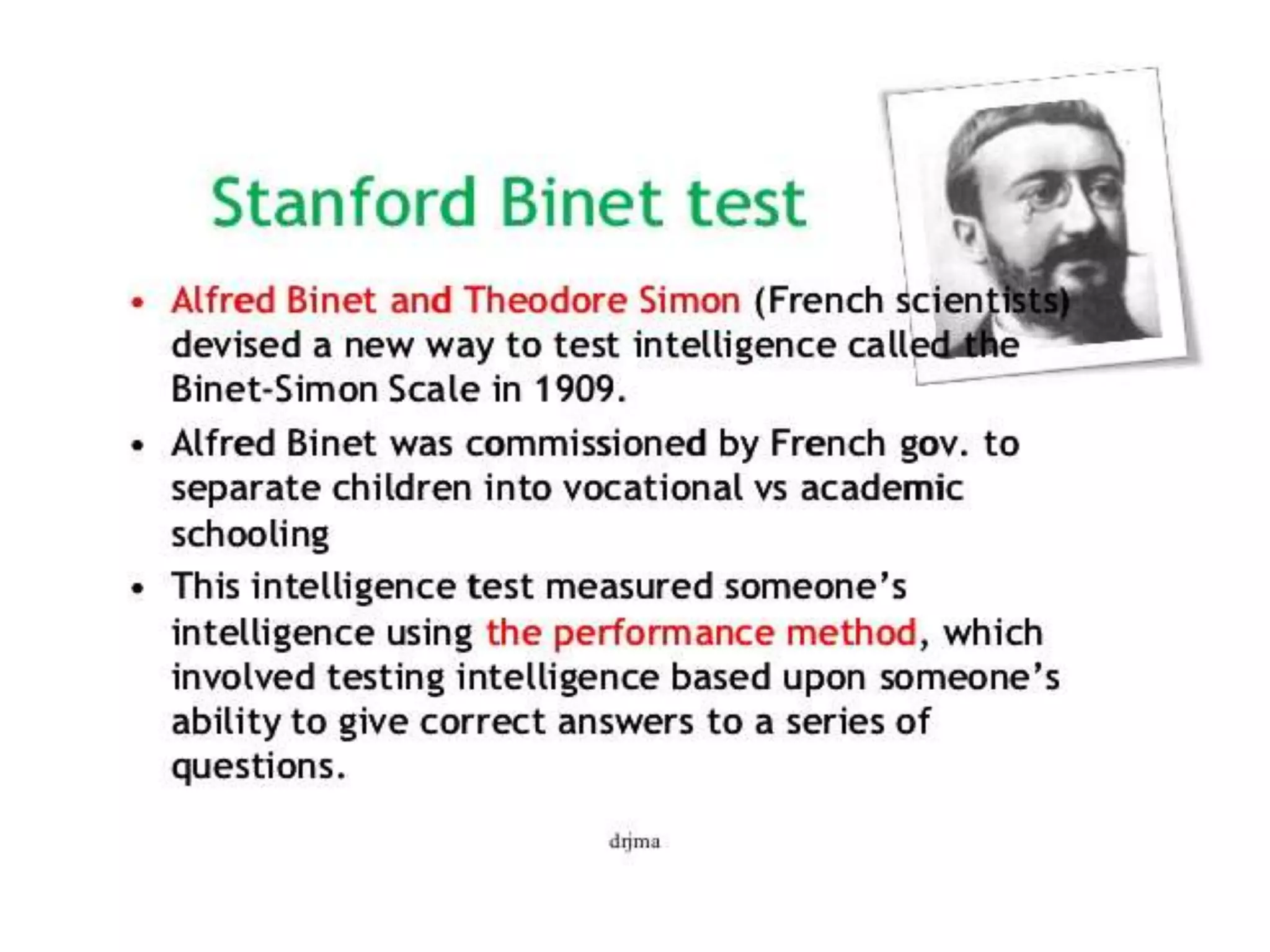
In 1905, Alfred Binet was commissioned by
the French government to devise a test that
would distinguish children of average
intelligence from those who were below
normal. The government wanted to establish
special classes for mentally retarded children.
• BINET TEST: Binet began by presenting tasks
to same age students who had been labeled
“dull” by their teacher. If a task could be
completed by the bright students but not by
the dull ones, he retained the task as a proper
test item, otherwise it was discarded. In the
end he came up with a test that distinguished
between the bright and dull groups, and with
further work, one that distinguished among
the children in different age groups three to
thirteen (3-13) years.
• CONCEPT OF MENTAL AGE: Binet and Simon
also introduced a new scoring concept called
mental age.
• CONCEPT OF INTELLIGENCE QUOTIENT (I.Q):
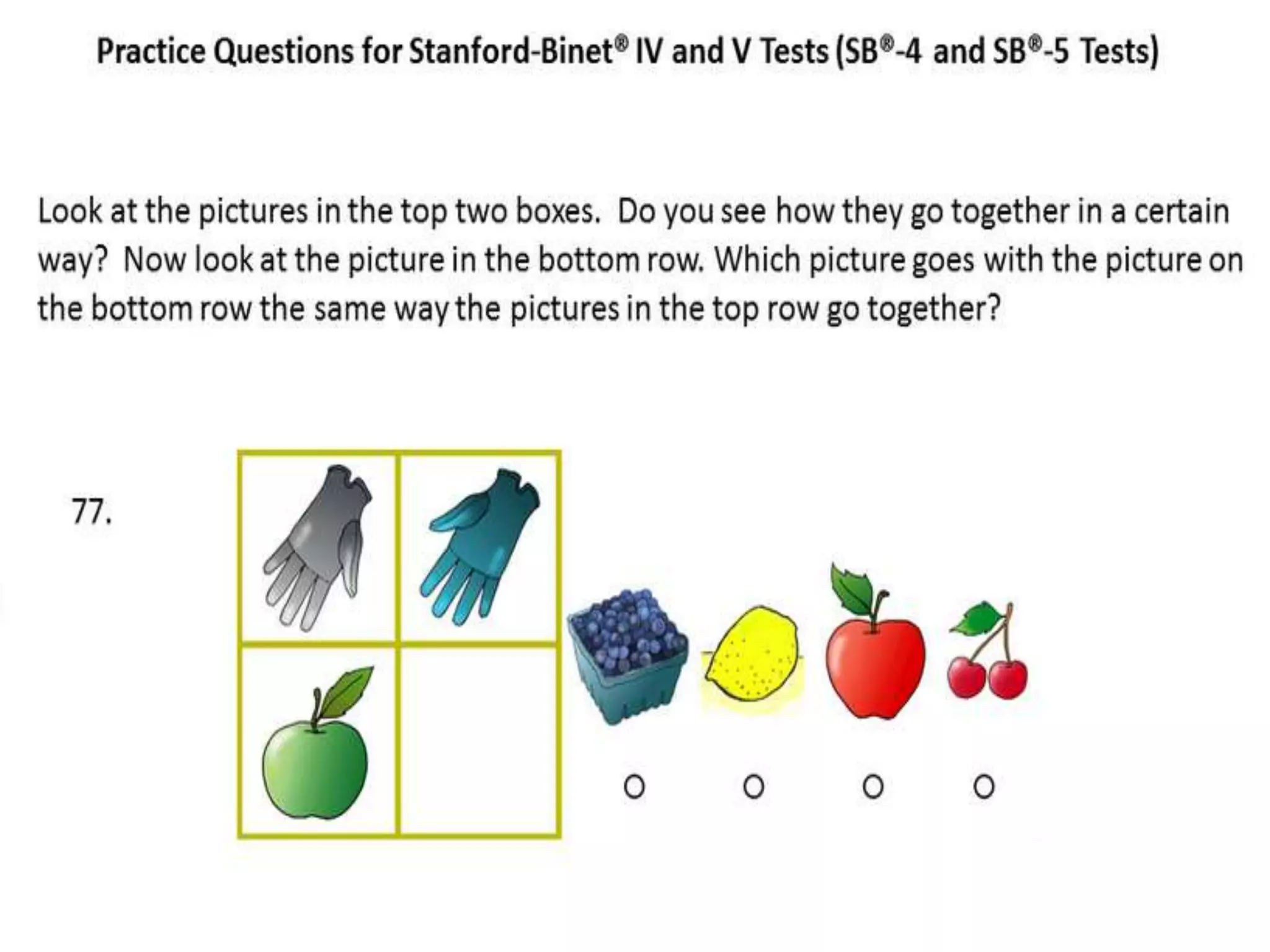
The 1916 Stanford revisions of the Binet scale
introduced a new scoring concept called
Intelligence Quotient (I.Q).
• 2) WECHSLER INTELLIGENCE SCALE:
• The Stanford-Binet is not really appropriate for the
measurement of adult intelligence, its standardization
is inadequate for adults, its age scale format is
meaningless after intelligence maturity has been
reached and its items were originally chosen to be of
interest to children rather than mature people.
Because of these deficiencies, a psychologist named
DAVID WECHSLER developed specifically designed for
use with adults.
• Originally published in 1939, this test was
restandardized and published as the WESHSLER ADULT
INTELLIGENCE SCALE (WAIS) in 1955. It has since
become the most widely used test for testing adults
individually.
• SUBJECT OF WAIS: The items of WAIS are
arranged by subtests by age levels, items of
similar content and format are grouped together.
• In all, WAIS contain eleven subtests, six that are
primarily of verbal content and five that are
called performance tests.
• The verbal subtests emphasized language and
memory skills, the performance subtests, on the
other hand, emphasize motor, discrimination,
and non verbal symbolic skills, performance skills
include picture completion, picture arrangement,
block design etc.
• WISC TEST: In 1949 Wechsler developed the
Wechsler intelligence scale for children, for
use with children of age 5 through 15. And in
1967, he developed the Wechsler preschool
and primary of intelligence (WPPSI) for
children aged 4 to 6.

Intelligence Tests

  • 1.
    INTELLIGENCE • DEFINITION: • Intelligenceis the capacity to understand the worlds, think rationally and use resources effectively when we face challenges. • EXAMPLE: Students are considered intelligent if they understand the course material and able to earn above-average grades.
  • 2.
    • OR • Intelligentis the capacity to learn and behave adaptively. • OR • The ability to benefit from past experience, acts purposefully, solve problems and adapt to new situations. • OR • Intelligence can be defined as a person’s cognitive abilities to learn.
  • 3.
    • DAVID WESHSLERDEFINED: Intelligence as The global and aggregate capacity of the individual • ‘’TO ACT PURPOSEFULLY • TO THINK RATIONALLY • TO DEAL EFFECTIVELY With the environment’’. • L.M TERMAN: He defined intelligence as ‘’the ability to carry on abstract thinking.’’ • ALFRED BINET: Alfred binet defined intelligence as ‘the ability to judge well, understand well, and reason well”.
  • 4.
    • MEASUREMENT OFINTELLIGENCE TESTS: • Modern tests of intelligence emphasize the measurement of mental abilities, such as reasoning, remembering and imagining. These abilities were first identified by French Psychologist Alfred Binet. In 1905, Alfred Binet was commissioned by the French government to devise a test that would distinguish children of average intelligence from those who were below normal. The government wanted to establish special classes for mentally retarded children.
  • 5.
    • BINET TEST:Binet began by presenting tasks to same age students who had been labeled “dull” by their teacher. If a task could be completed by the bright students but not by the dull ones, he retained the task as a proper test item, otherwise it was discarded. In the end he came up with a test that distinguished between the bright and dull groups, and with further work, one that distinguished among the children in different age groups three to thirteen (3-13) years.
  • 13.
    • CONCEPT OFMENTAL AGE: Binet and Simon also introduced a new scoring concept called mental age. • CONCEPT OF INTELLIGENCE QUOTIENT (I.Q): The 1916 Stanford revisions of the Binet scale introduced a new scoring concept called Intelligence Quotient (I.Q).
  • 15.
    • 2) WECHSLERINTELLIGENCE SCALE: • The Stanford-Binet is not really appropriate for the measurement of adult intelligence, its standardization is inadequate for adults, its age scale format is meaningless after intelligence maturity has been reached and its items were originally chosen to be of interest to children rather than mature people. Because of these deficiencies, a psychologist named DAVID WECHSLER developed specifically designed for use with adults. • Originally published in 1939, this test was restandardized and published as the WESHSLER ADULT INTELLIGENCE SCALE (WAIS) in 1955. It has since become the most widely used test for testing adults individually.
  • 16.
    • SUBJECT OFWAIS: The items of WAIS are arranged by subtests by age levels, items of similar content and format are grouped together. • In all, WAIS contain eleven subtests, six that are primarily of verbal content and five that are called performance tests. • The verbal subtests emphasized language and memory skills, the performance subtests, on the other hand, emphasize motor, discrimination, and non verbal symbolic skills, performance skills include picture completion, picture arrangement, block design etc.
  • 17.
    • WISC TEST:In 1949 Wechsler developed the Wechsler intelligence scale for children, for use with children of age 5 through 15. And in 1967, he developed the Wechsler preschool and primary of intelligence (WPPSI) for children aged 4 to 6.