Personality Disorder
The general criteria for personality disorder
specify that an individual’s personality
pattern must deviate significantly from the
expectations of his/her culture as shown in
the styles of thinking about oneself,
others or events; emotional experience
and expression; interpersonal
functioning and or impulse control.
Definition:
• A personality disorder is an enduring pattern of
thinking, feeling and behaving that is relatively
stable over time and particular personality
features must be evident by early adulthood.
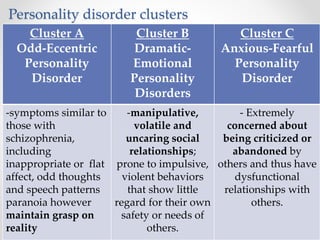
Personality disorder clusters
Cluster A
Odd-Eccentric
Personality
Disorder
Cluster B
Dramatic-
Emotional
Personality
Disorders
Cluster C
Anxious-Fearful
Personality
Disorder
-symptoms similar to
those with
schizophrenia,
including
inappropriate or flat
affect, odd thoughts
and speech patterns
paranoia however
maintain grasp on
reality
-manipulative,
volatile and
uncaring social
relationships;
prone to impulsive,
violent behaviors
that show little
regard for their own
safety or needs of
others.
- Extremely
concerned about
being criticized or
abandoned by
others and thus have
dysfunctional
relationships with
others.
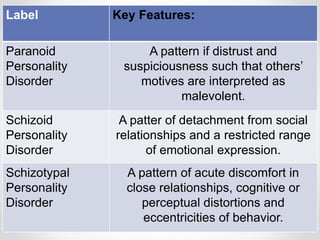
Label Key Features:
Paranoid
Personality
Disorder
A pattern if distrust and
suspiciousness such that others’
motives are interpreted as
malevolent.
Schizoid
Personality
Disorder
A patter of detachment from social
relationships and a restricted range
of emotional expression.
Schizotypal
Personality
Disorder
A pattern of acute discomfort in
close relationships, cognitive or
perceptual distortions and
eccentricities of behavior.
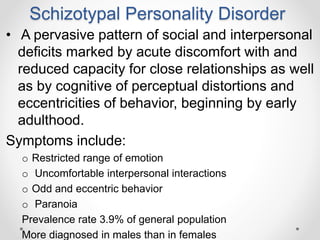
Schizotypal Personality Disorder
• A pervasive pattern of social and interpersonal
deficits marked by acute discomfort with and
reduced capacity for close relationships as well
as by cognitive of perceptual distortions and
eccentricities of behavior, beginning by early
adulthood.
Symptoms include:
o Restricted range of emotion
o Uncomfortable interpersonal interactions
o Odd and eccentric behavior
o Paranoia
Prevalence rate 3.9% of general population
More diagnosed in males than in females
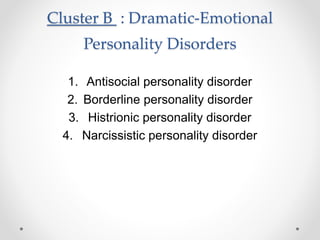
Cluster B : Dramatic-Emotional
Personality Disorders
1. Antisocial personality disorder
2. Borderline personality disorder
3. Histrionic personality disorder
4. Narcissistic personality disorder
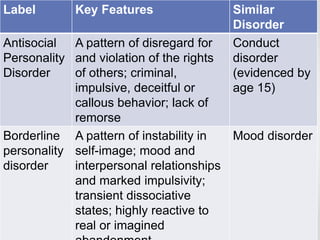
Label Key Features Similar
Disorder
Antisocial
Personality
Disorder
A pattern of disregard for
and violation of the rights
of others; criminal,
impulsive, deceitful or
callous behavior; lack of
remorse
Conduct
disorder
(evidenced by
age 15)
Borderline
personality
disorder
A pattern of instability in
self-image; mood and
interpersonal relationships
and marked impulsivity;
transient dissociative
states; highly reactive to
real or imagined
Mood disorder
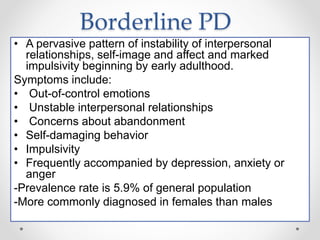
Borderline PD
• A pervasive pattern of instability of interpersonal
relationships, self-image and affect and marked
impulsivity beginning by early adulthood.
Symptoms include:
• Out-of-control emotions
• Unstable interpersonal relationships
• Concerns about abandonment
• Self-damaging behavior
• Impulsivity
• Frequently accompanied by depression, anxiety or
anger
-Prevalence rate is 5.9% of general population
-More commonly diagnosed in females than males
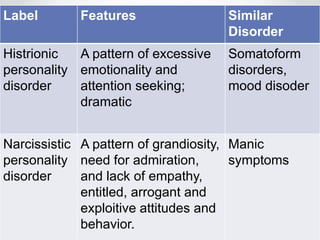
Label Features Similar
Disorder
Histrionic
personality
disorder
A pattern of excessive
emotionality and
attention seeking;
dramatic
Somatoform
disorders,
mood disoder
Narcissistic
personality
disorder
A pattern of grandiosity,
need for admiration,
and lack of empathy,
entitled, arrogant and
exploitive attitudes and
behavior.
Manic
symptoms
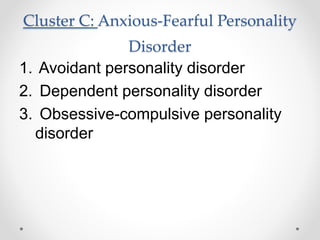
Cluster C: Anxious-Fearful Personality
Disorder
1. Avoidant personality disorder
2. Dependent personality disorder
3. Obsessive-compulsive personality
disorder

Personality disorder

  • 1.
    Personality Disorder The generalcriteria for personality disorder specify that an individual’s personality pattern must deviate significantly from the expectations of his/her culture as shown in the styles of thinking about oneself, others or events; emotional experience and expression; interpersonal functioning and or impulse control.
  • 2.
    Definition: • A personalitydisorder is an enduring pattern of thinking, feeling and behaving that is relatively stable over time and particular personality features must be evident by early adulthood.
  • 3.
    Personality disorder clusters ClusterA Odd-Eccentric Personality Disorder Cluster B Dramatic- Emotional Personality Disorders Cluster C Anxious-Fearful Personality Disorder -symptoms similar to those with schizophrenia, including inappropriate or flat affect, odd thoughts and speech patterns paranoia however maintain grasp on reality -manipulative, volatile and uncaring social relationships; prone to impulsive, violent behaviors that show little regard for their own safety or needs of others. - Extremely concerned about being criticized or abandoned by others and thus have dysfunctional relationships with others.
  • 4.
    Label Key Features: Paranoid Personality Disorder Apattern if distrust and suspiciousness such that others’ motives are interpreted as malevolent. Schizoid Personality Disorder A patter of detachment from social relationships and a restricted range of emotional expression. Schizotypal Personality Disorder A pattern of acute discomfort in close relationships, cognitive or perceptual distortions and eccentricities of behavior.
  • 5.
    Schizotypal Personality Disorder •A pervasive pattern of social and interpersonal deficits marked by acute discomfort with and reduced capacity for close relationships as well as by cognitive of perceptual distortions and eccentricities of behavior, beginning by early adulthood. Symptoms include: o Restricted range of emotion o Uncomfortable interpersonal interactions o Odd and eccentric behavior o Paranoia Prevalence rate 3.9% of general population More diagnosed in males than in females
  • 6.
    Cluster B :Dramatic-Emotional Personality Disorders 1. Antisocial personality disorder 2. Borderline personality disorder 3. Histrionic personality disorder 4. Narcissistic personality disorder
  • 7.
    Label Key FeaturesSimilar Disorder Antisocial Personality Disorder A pattern of disregard for and violation of the rights of others; criminal, impulsive, deceitful or callous behavior; lack of remorse Conduct disorder (evidenced by age 15) Borderline personality disorder A pattern of instability in self-image; mood and interpersonal relationships and marked impulsivity; transient dissociative states; highly reactive to real or imagined Mood disorder
  • 8.
    Borderline PD • Apervasive pattern of instability of interpersonal relationships, self-image and affect and marked impulsivity beginning by early adulthood. Symptoms include: • Out-of-control emotions • Unstable interpersonal relationships • Concerns about abandonment • Self-damaging behavior • Impulsivity • Frequently accompanied by depression, anxiety or anger -Prevalence rate is 5.9% of general population -More commonly diagnosed in females than males
  • 9.
    Label Features Similar Disorder Histrionic personality disorder Apattern of excessive emotionality and attention seeking; dramatic Somatoform disorders, mood disoder Narcissistic personality disorder A pattern of grandiosity, need for admiration, and lack of empathy, entitled, arrogant and exploitive attitudes and behavior. Manic symptoms
  • 10.
    Cluster C: Anxious-FearfulPersonality Disorder 1. Avoidant personality disorder 2. Dependent personality disorder 3. Obsessive-compulsive personality disorder