Intelligence
Brian J. Piper, Ph.D.
Assessing Intelligence
 The Origins of Intelligence Testing
 Modern Tests of Mental Abilities
 Principles of Test Construction


The Dynamics of Intelligence
 Extremes of Intelligence
Assessing Intelligence
  Psychologists define intelligence testing as a
  method for assessing an individual’s mental
aptitudes and comparing them with others using
               numerical scores.
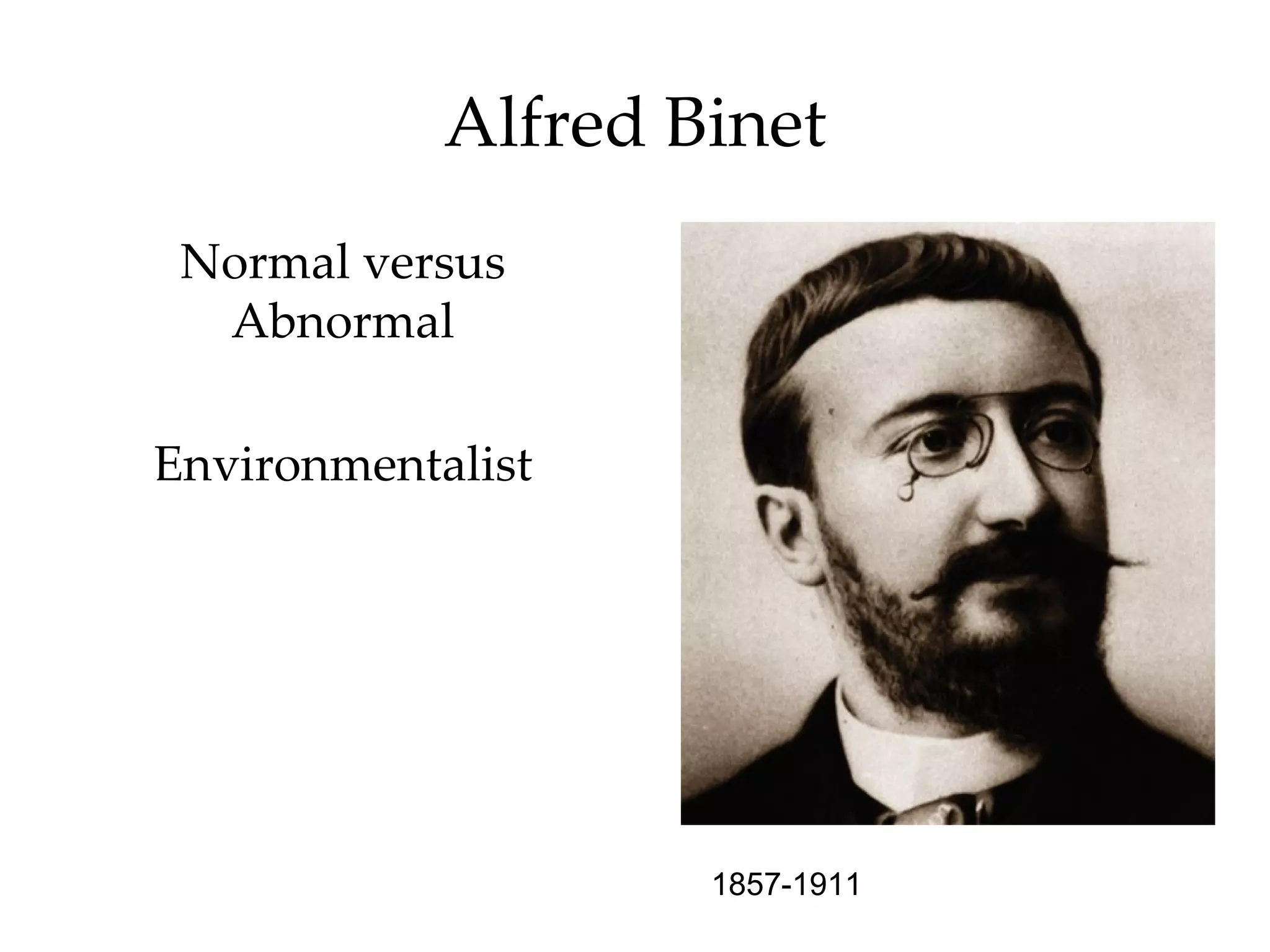
Alfred Binet
  Alfred Binet and his
  colleague Théodore
Simon practiced a more
    modern form of
 intelligence testing by
 developing questions
   that would predict
    children’s future
  progress in the Paris
     school system.
                           1857-1911
Definition of Intelligence
•   "It seems to us that in intelligence there is a fundamental faculty, the
    alteration or the lack of which, is of the utmost importance for practical life.
    This faculty is judgment, otherwise called good sense, practical sense,
    initiative, the faculty of adapting one's self to circumstances. A person may
    be a moron or an imbecile if he is lacking in judgment; but with good
    judgment he can never be either. Indeed the rest of the intellectual faculties
    seem of little importance in comparison with judgment" (Binet & Simon,
    1916, 1973, pp.42-43)
Alfred Binet
 Normal versus
  Abnormal

Environmentalist


                    1857-1911
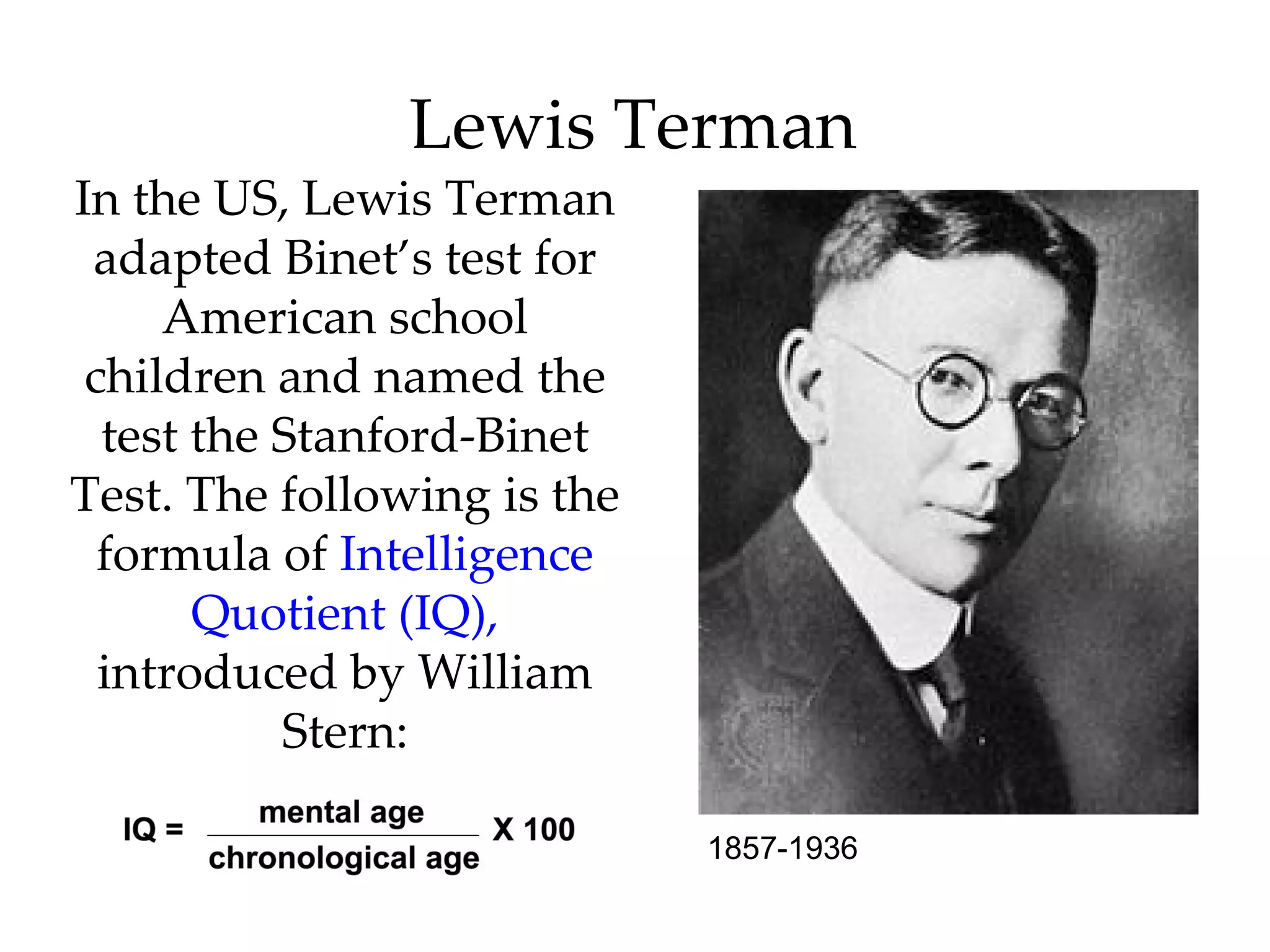
Lewis Terman
In the US, Lewis Terman
 adapted Binet’s test for
     American school
 children and named the
  test the Stanford-Binet
Test. The following is the
  formula of Intelligence
       Quotient (IQ),
  introduced by William
           Stern:

                             1857-1936
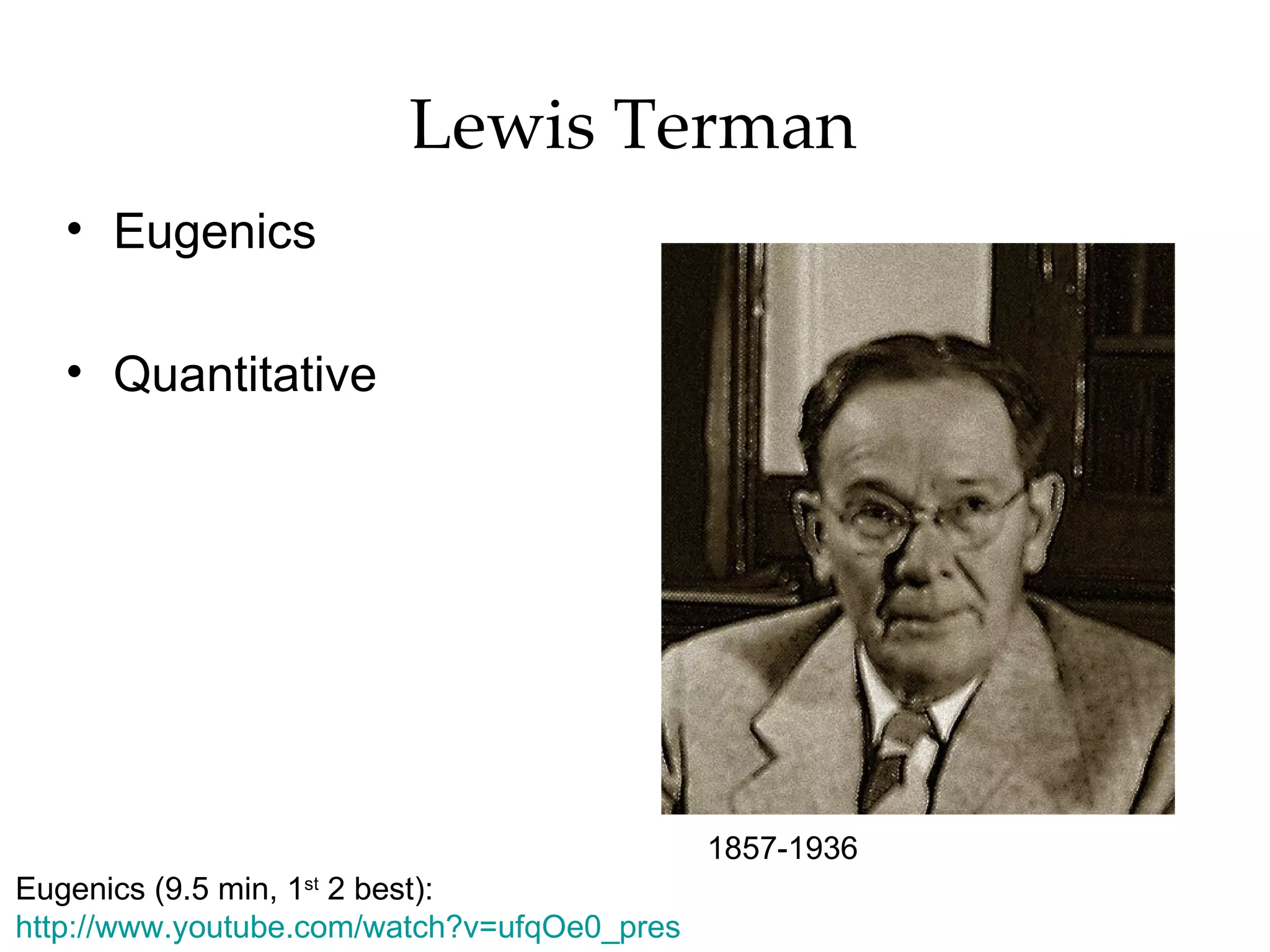
Lewis Terman
   • Eugenics

   • Quantitative


                                             1857-1936
Eugenics (9.5 min, 1st 2 best):
http://www.youtube.com/watch?v=ufqOe0_pres
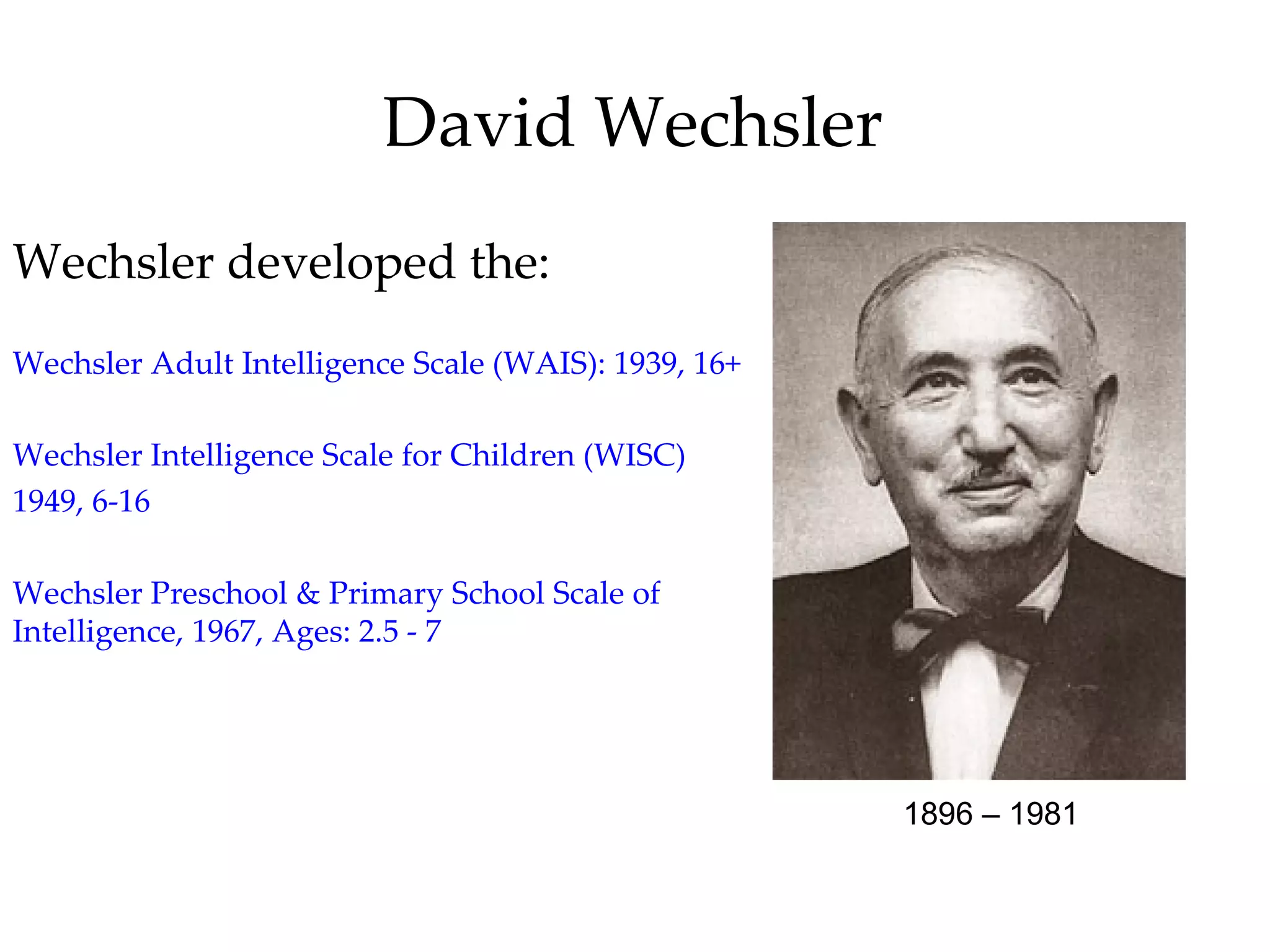
David Wechsler
Wechsler developed the:
Wechsler Adult Intelligence Scale (WAIS): 1939, 16+

Wechsler Intelligence Scale for Children (WISC)
1949, 6-16

Wechsler Preschool & Primary School Scale of
Intelligence, 1967, Ages: 2.5 - 7


                                                      1896 – 1981
Intelligence
• the global capacity to act purposefully, to
  think rationally, and to deal effectively with
  [one's] environment
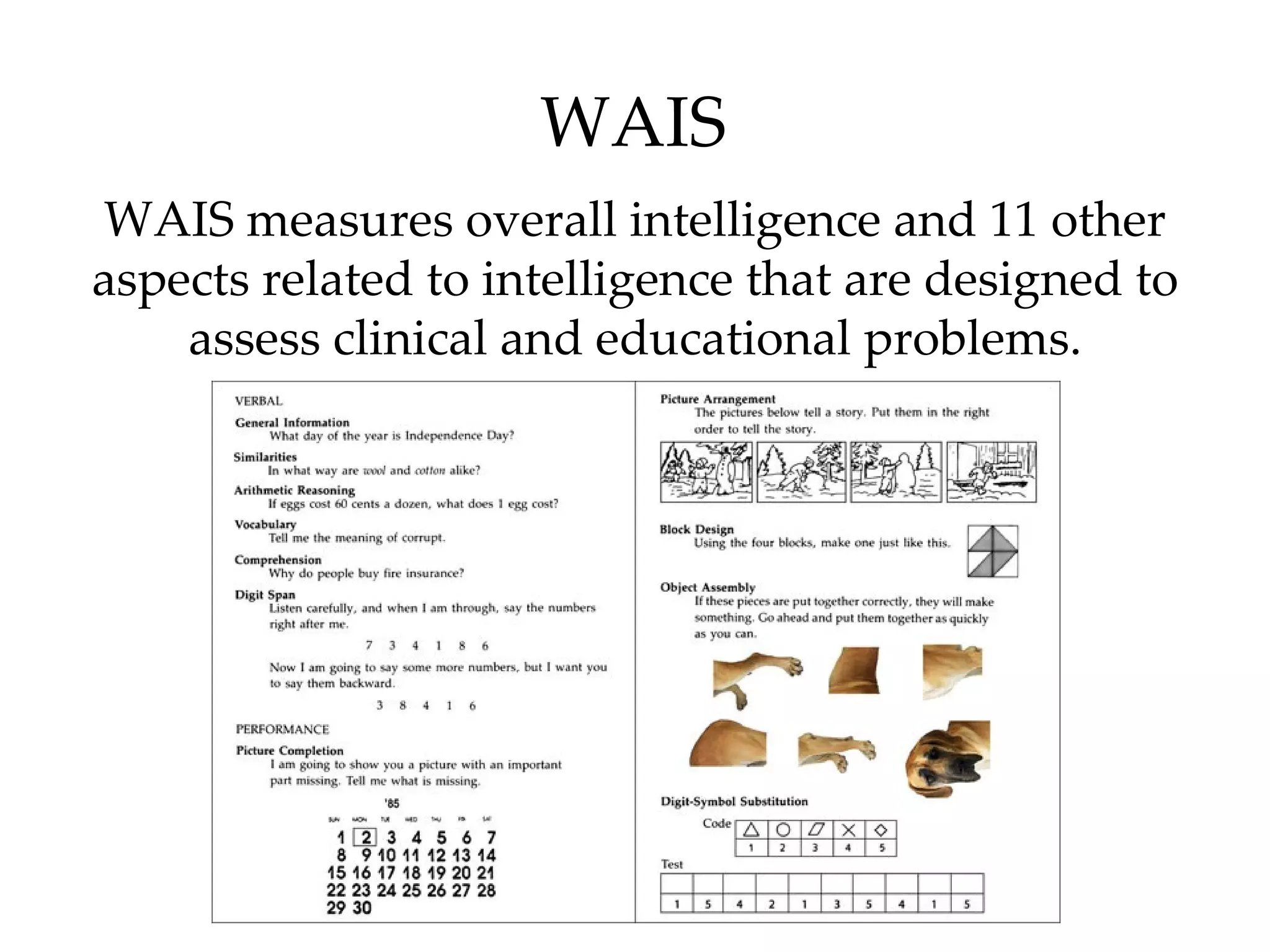
WAIS
WAIS measures overall intelligence and 11 other
aspects related to intelligence that are designed to
    assess clinical and educational problems.
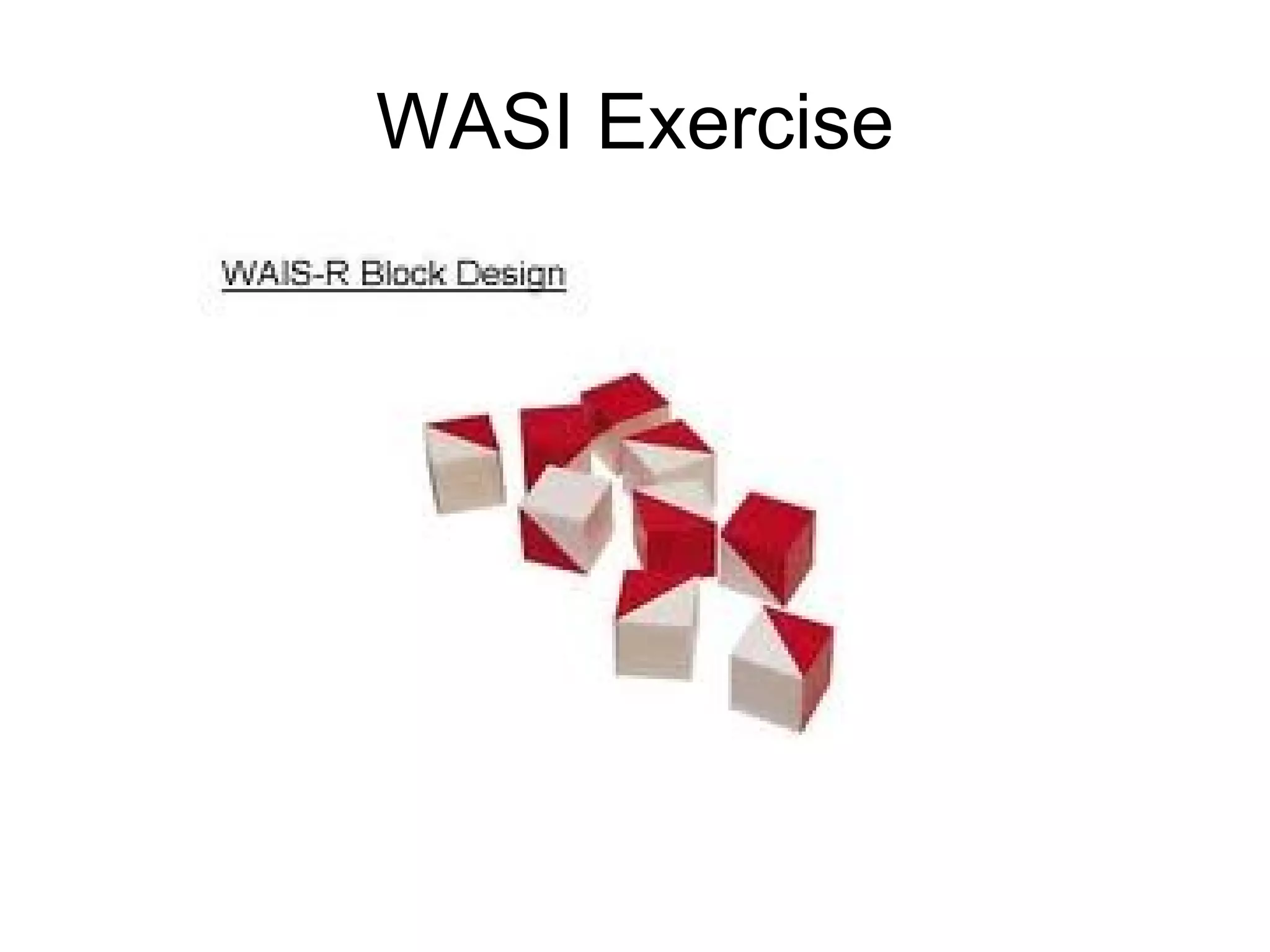
WASI Exercise
Principles of Test Construction

For a psychological test to be acceptable it must
       fulfill the following three criteria:


             1. Standardization
             2. Reliability
             3. Validity
Standardization
Standardizing a test involves administering the test
 to a representative sample of future test takers in
      order to establish a basis for meaningful
                    comparison.

Representative: Age, Ethnicity, Sex
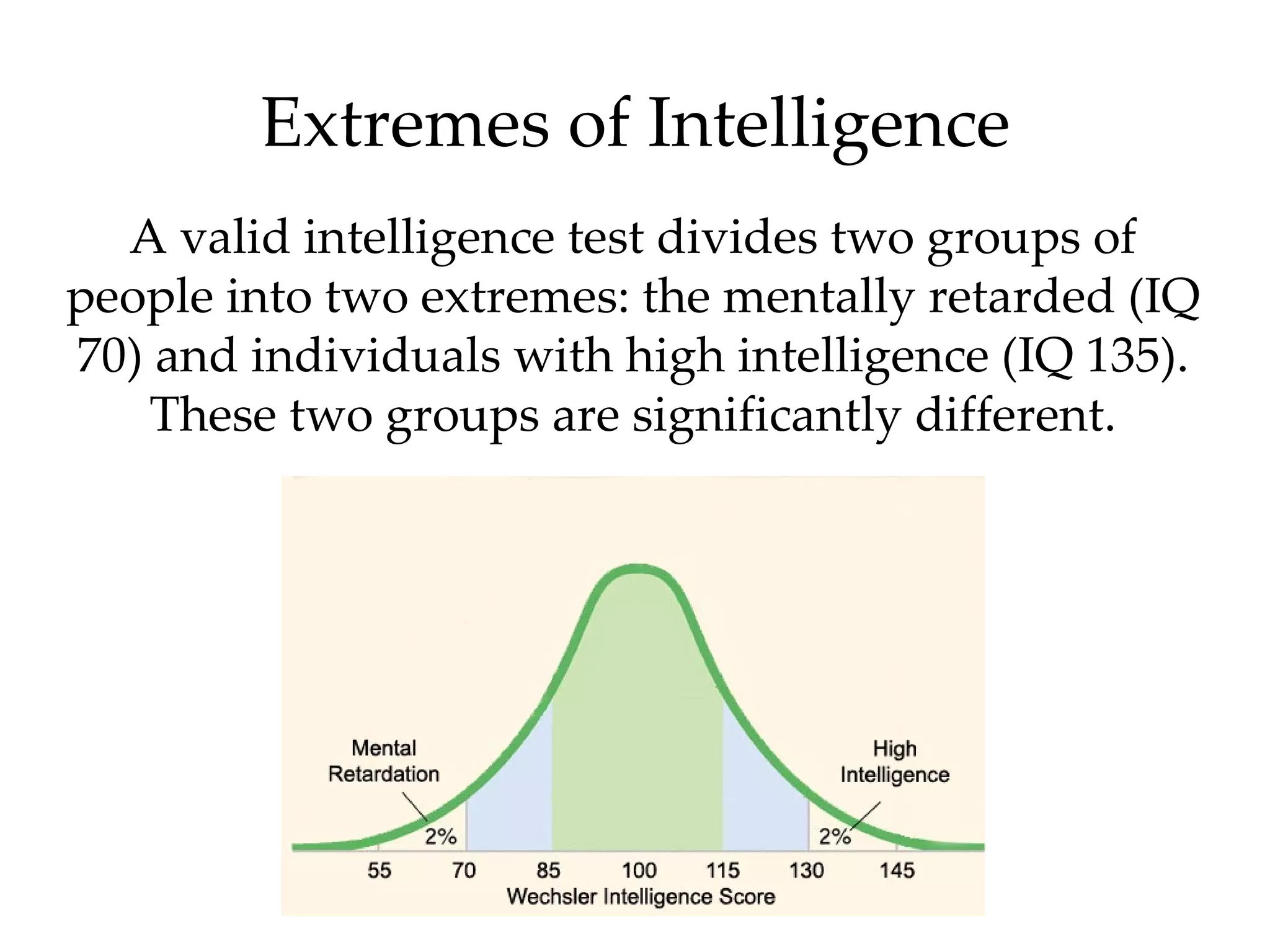
Normal Curve

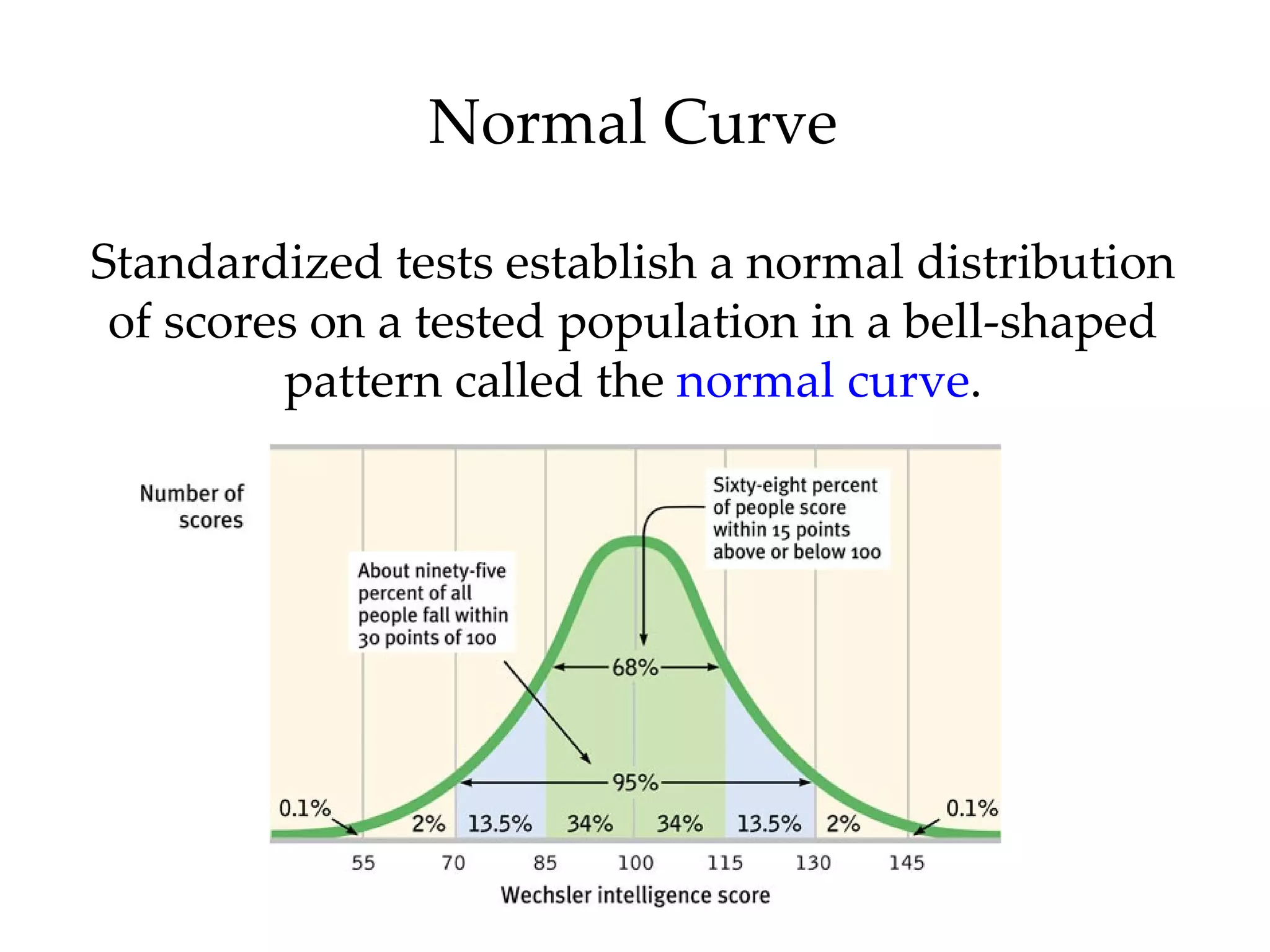
Standardized tests establish a normal distribution
 of scores on a tested population in a bell-shaped
         pattern called the normal curve.
Flynn Effect

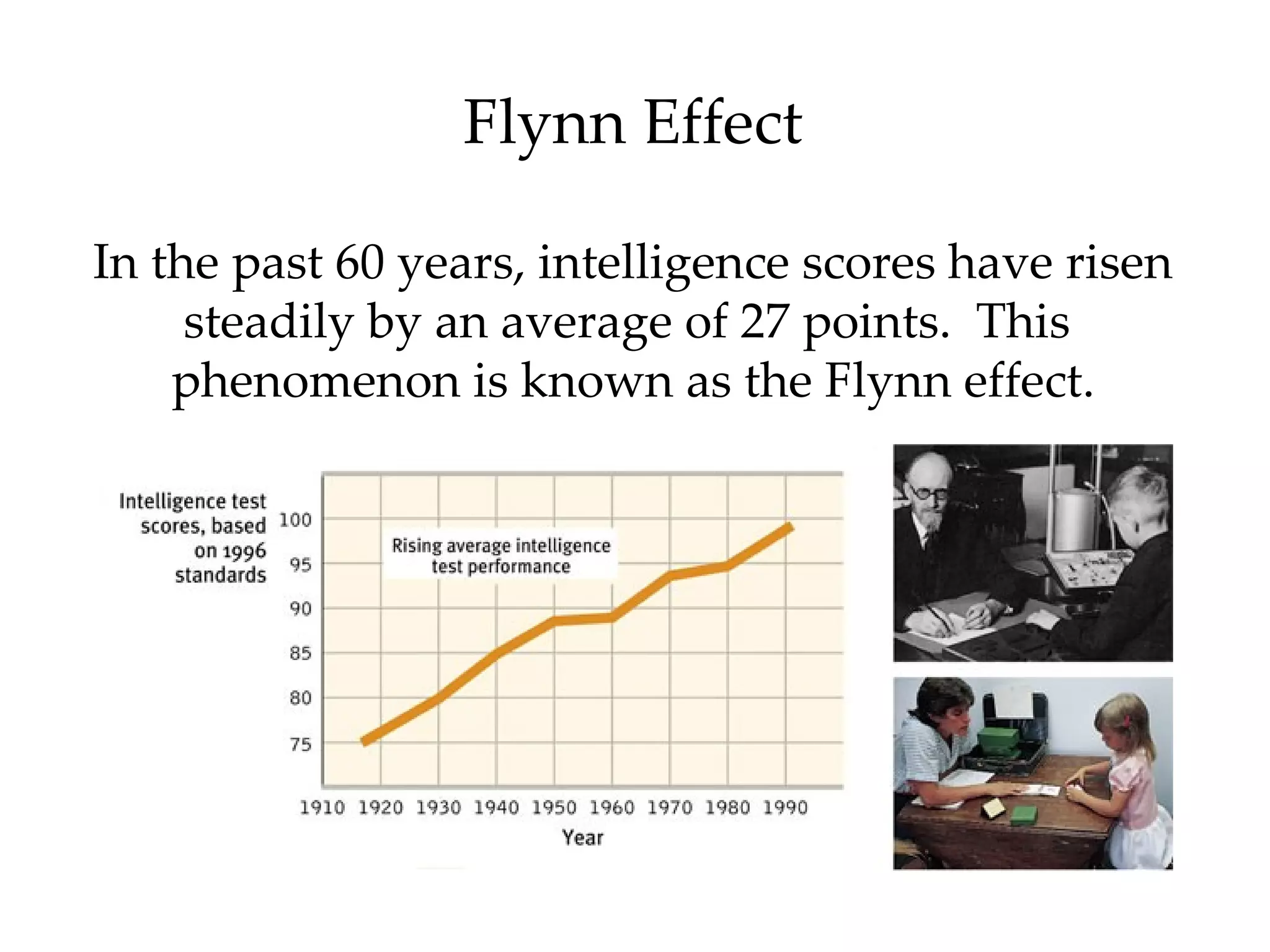
In the past 60 years, intelligence scores have risen
     steadily by an average of 27 points. This
    phenomenon is known as the Flynn effect.
Reliability
A test is reliable when it yields consistent results. To
 establish reliability researchers establish different
                      procedures:

  Split-half Reliability: Dividing the test into two
   equal halves and assessing how consistent the
   scores are.
  Test-Retest Reliability: Using the same test on two
   occasions to measure consistency.
Validity
Validity of a test refers to what the test is supposed
                to measure or predict.


  Content Validity: Refers to the extent a test
   measures a particular behavior or trait.
  Predictive Validity: Refers to the function of a test
   in predicting a particular behavior or trait.
      GRE & GPA
Extremes of Intelligence
  A valid intelligence test divides two groups of
people into two extremes: the mentally retarded (IQ
70) and individuals with high intelligence (IQ 135).
    These two groups are significantly different.
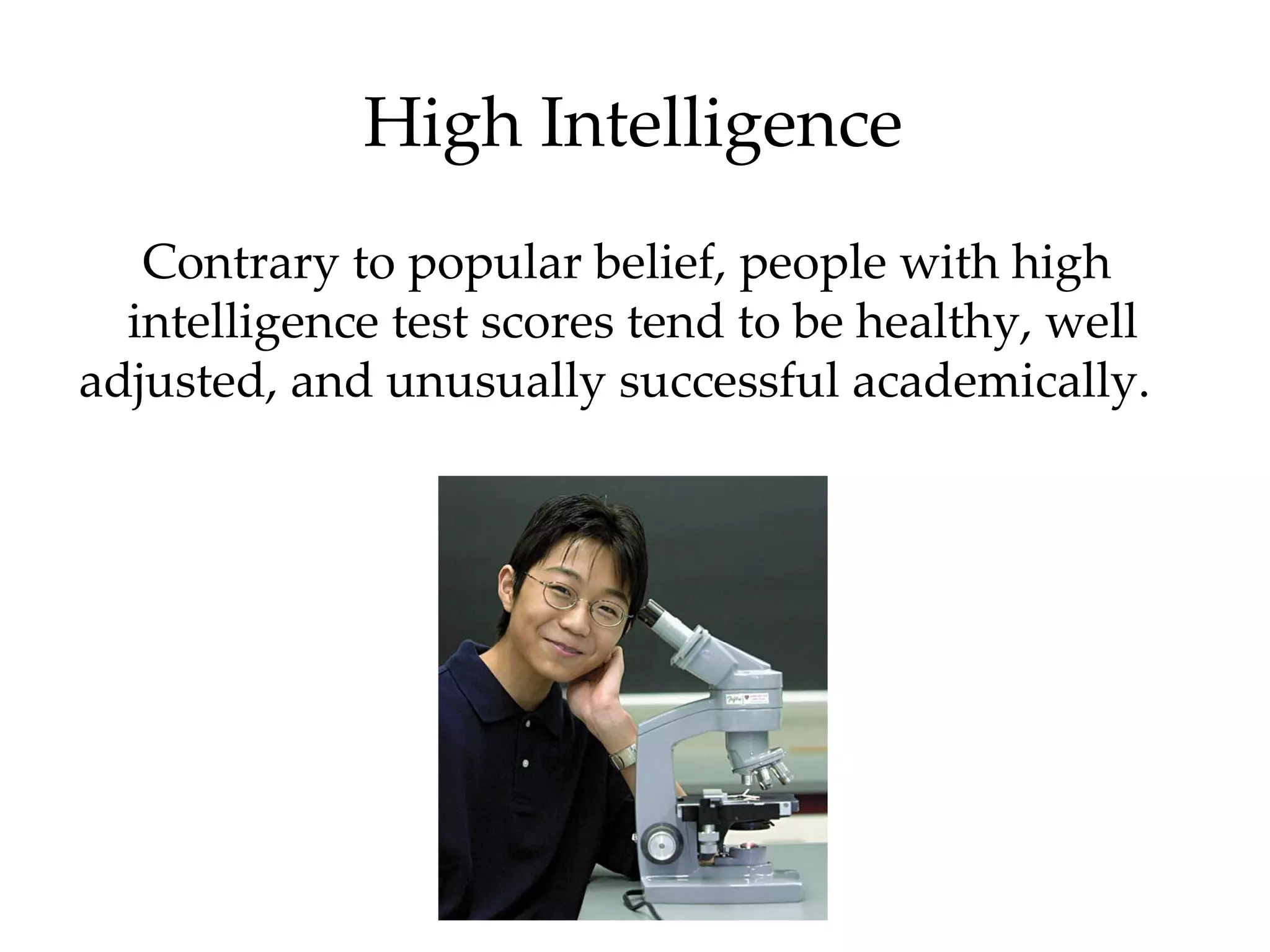
High Intelligence
   Contrary to popular belief, people with high
  intelligence test scores tend to be healthy, well
adjusted, and unusually successful academically.
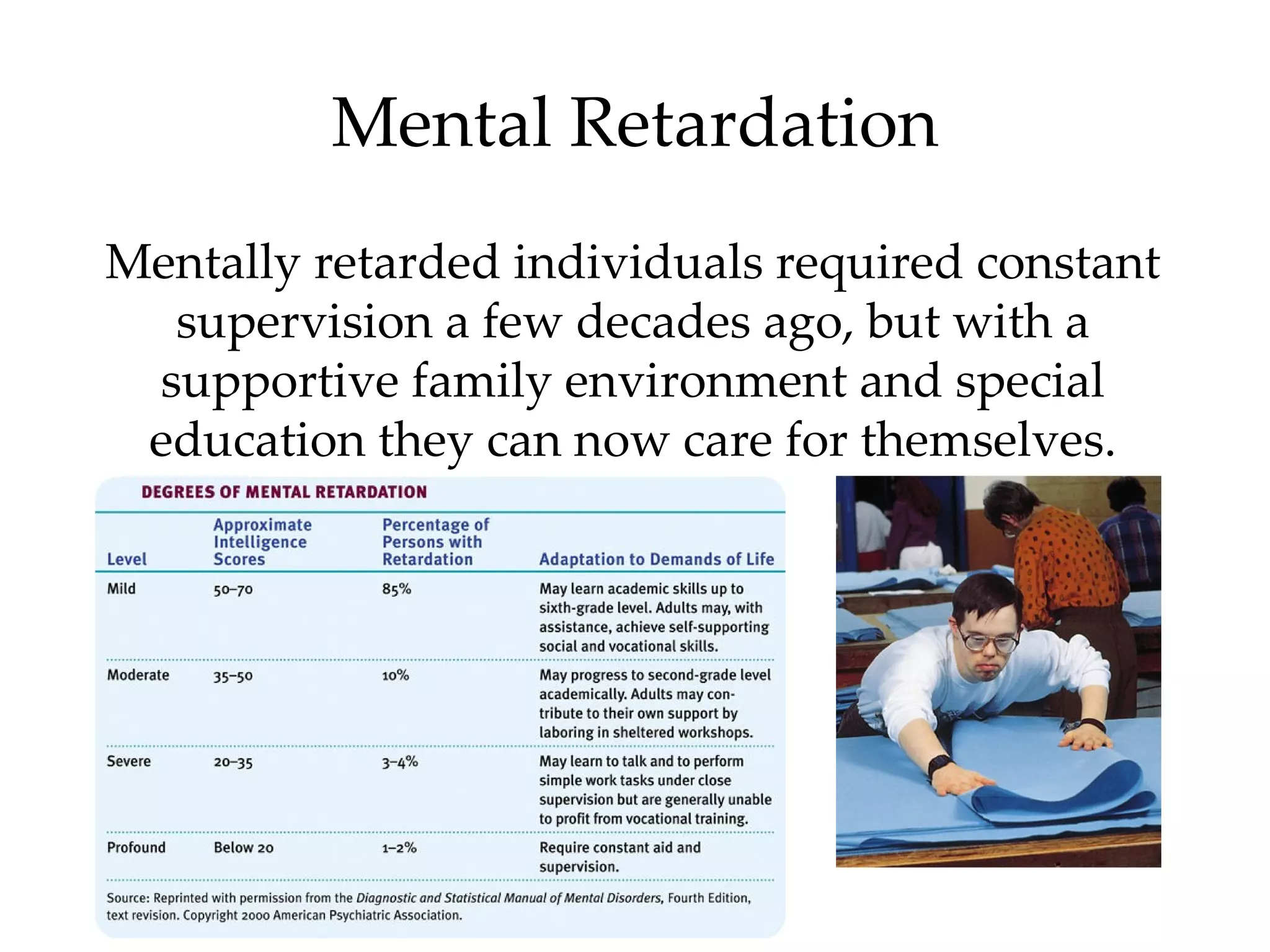
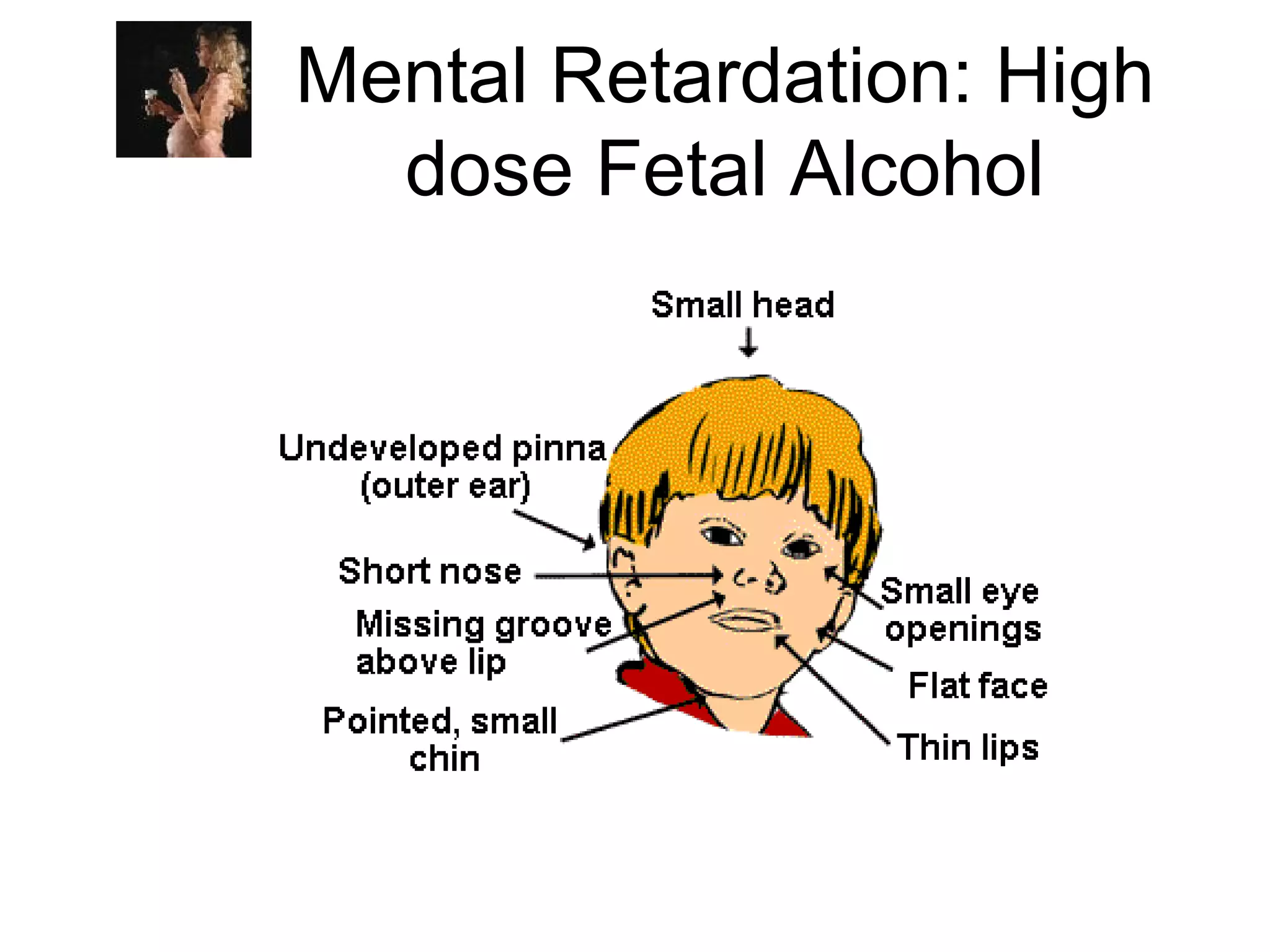
Mental Retardation
Mentally retarded individuals required constant
  supervision a few decades ago, but with a
 supportive family environment and special
 education they can now care for themselves.
Mental Retardation: High
  dose Fetal Alcohol
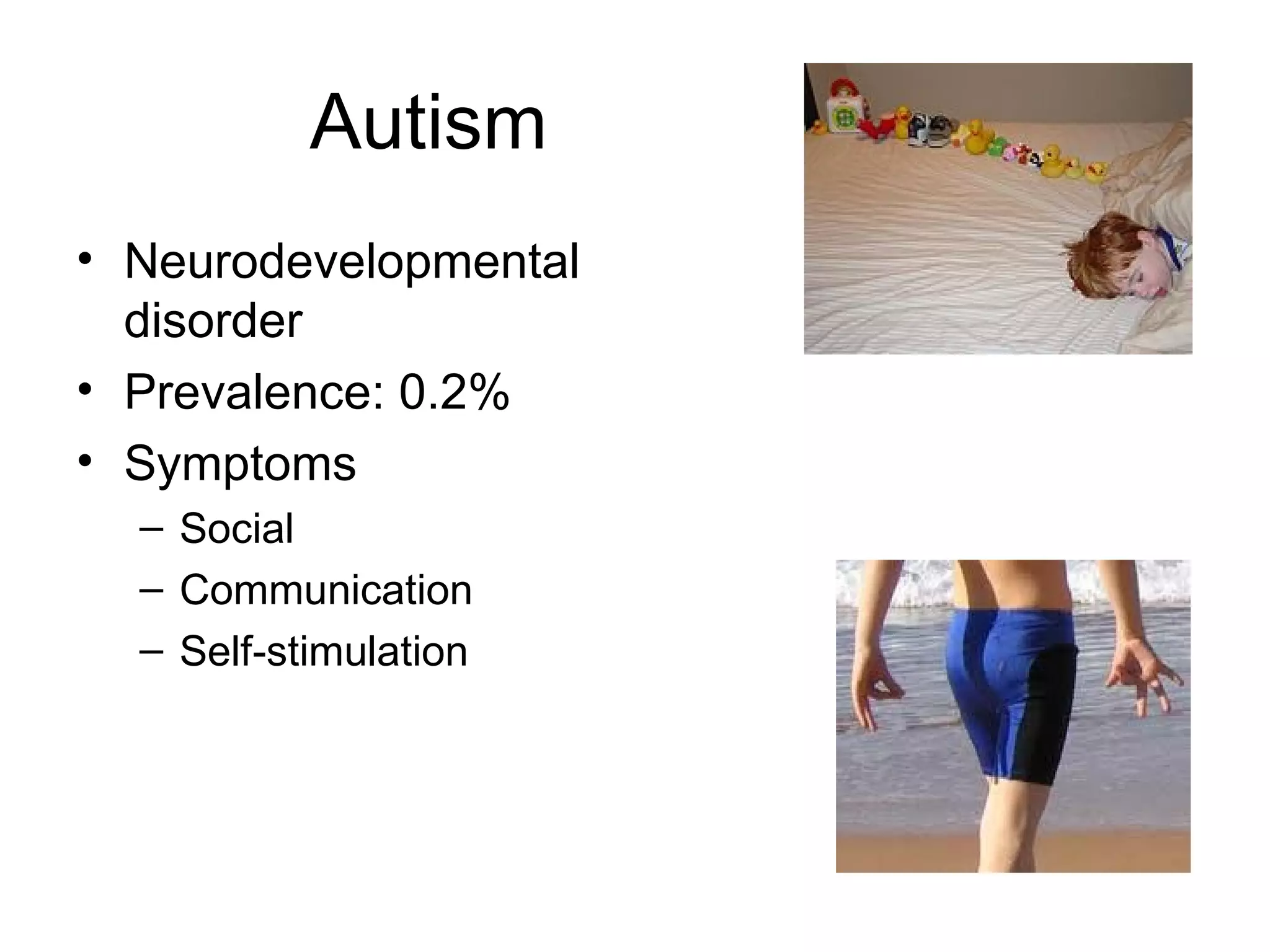
Autism
• Neurodevelopmental
  disorder
• Prevalence: 0.2%
• Symptoms
  – Social
  – Communication
  – Self-stimulation
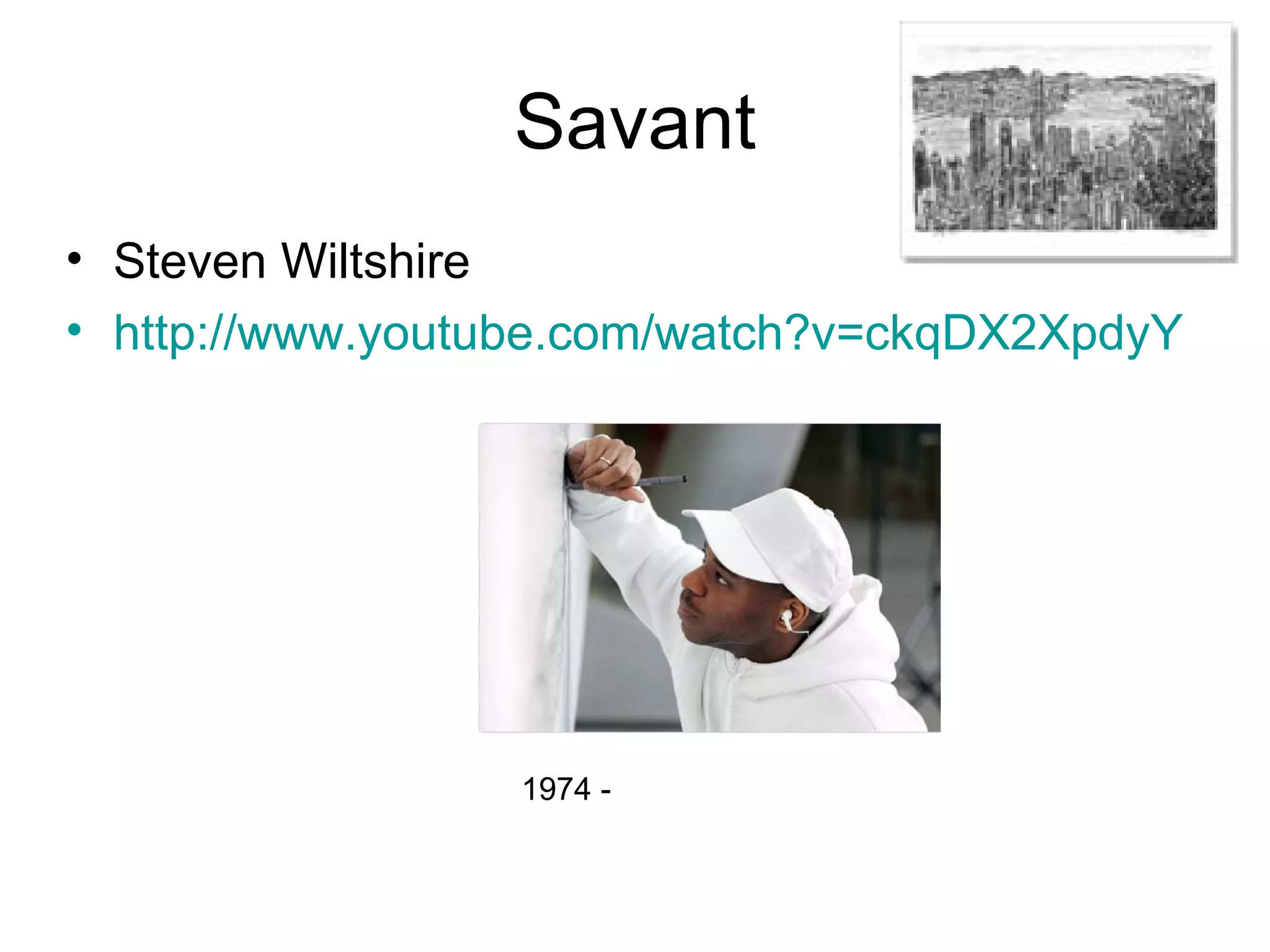
Savant
• Steven Wiltshire
• http://www.youtube.com/watch?v=ckqDX2XpdyY


                 1974 -
Summary
• Intelligence tests have a long history (Binet
  versus Terman)
• Test Characteristics
   – Reliability
   – Validity

Introductory Psychology: Intelligence

  • 1.
  • 2.
    Assessing Intelligence  TheOrigins of Intelligence Testing  Modern Tests of Mental Abilities  Principles of Test Construction The Dynamics of Intelligence  Extremes of Intelligence
  • 3.
    Assessing Intelligence Psychologists define intelligence testing as a method for assessing an individual’s mental aptitudes and comparing them with others using numerical scores.
  • 4.
    Alfred Binet Alfred Binet and his colleague Théodore Simon practiced a more modern form of intelligence testing by developing questions that would predict children’s future progress in the Paris school system. 1857-1911
  • 5.
    Definition of Intelligence • "It seems to us that in intelligence there is a fundamental faculty, the alteration or the lack of which, is of the utmost importance for practical life. This faculty is judgment, otherwise called good sense, practical sense, initiative, the faculty of adapting one's self to circumstances. A person may be a moron or an imbecile if he is lacking in judgment; but with good judgment he can never be either. Indeed the rest of the intellectual faculties seem of little importance in comparison with judgment" (Binet & Simon, 1916, 1973, pp.42-43)
  • 6.
    Alfred Binet Normalversus Abnormal Environmentalist 1857-1911
  • 7.
    Lewis Terman In theUS, Lewis Terman adapted Binet’s test for American school children and named the test the Stanford-Binet Test. The following is the formula of Intelligence Quotient (IQ), introduced by William Stern: 1857-1936
  • 8.
    Lewis Terman • Eugenics • Quantitative 1857-1936 Eugenics (9.5 min, 1st 2 best): http://www.youtube.com/watch?v=ufqOe0_pres
  • 9.
    David Wechsler Wechsler developedthe: Wechsler Adult Intelligence Scale (WAIS): 1939, 16+ Wechsler Intelligence Scale for Children (WISC) 1949, 6-16 Wechsler Preschool & Primary School Scale of Intelligence, 1967, Ages: 2.5 - 7 1896 – 1981
  • 10.
    Intelligence • the globalcapacity to act purposefully, to think rationally, and to deal effectively with [one's] environment
  • 11.
    WAIS WAIS measures overallintelligence and 11 other aspects related to intelligence that are designed to assess clinical and educational problems.
  • 12.
  • 13.
    Principles of TestConstruction For a psychological test to be acceptable it must fulfill the following three criteria: 1. Standardization 2. Reliability 3. Validity
  • 14.
    Standardization Standardizing a testinvolves administering the test to a representative sample of future test takers in order to establish a basis for meaningful comparison. Representative: Age, Ethnicity, Sex
  • 15.
    Normal Curve Standardized testsestablish a normal distribution of scores on a tested population in a bell-shaped pattern called the normal curve.
  • 16.
    Flynn Effect In thepast 60 years, intelligence scores have risen steadily by an average of 27 points. This phenomenon is known as the Flynn effect.
  • 17.
    Reliability A test isreliable when it yields consistent results. To establish reliability researchers establish different procedures:  Split-half Reliability: Dividing the test into two equal halves and assessing how consistent the scores are.  Test-Retest Reliability: Using the same test on two occasions to measure consistency.
  • 18.
    Validity Validity of atest refers to what the test is supposed to measure or predict.  Content Validity: Refers to the extent a test measures a particular behavior or trait.  Predictive Validity: Refers to the function of a test in predicting a particular behavior or trait. GRE & GPA
  • 19.
    Extremes of Intelligence A valid intelligence test divides two groups of people into two extremes: the mentally retarded (IQ 70) and individuals with high intelligence (IQ 135). These two groups are significantly different.
  • 20.
    High Intelligence Contrary to popular belief, people with high intelligence test scores tend to be healthy, well adjusted, and unusually successful academically.
  • 21.
    Mental Retardation Mentally retardedindividuals required constant supervision a few decades ago, but with a supportive family environment and special education they can now care for themselves.
  • 22.
    Mental Retardation: High dose Fetal Alcohol
  • 23.
    Autism • Neurodevelopmental disorder • Prevalence: 0.2% • Symptoms – Social – Communication – Self-stimulation
  • 24.
    Savant • Steven Wiltshire •http://www.youtube.com/watch?v=ckqDX2XpdyY 1974 -
  • 25.
    Summary • Intelligence testshave a long history (Binet versus Terman) • Test Characteristics – Reliability – Validity

Editor's Notes

  • #4 Preview Question 1: When and why were intelligence tests created?
  • #14 Preview Question 2: What’s the difference between aptitude and achievement tests, and how can we develop and evaluate them?
  • #18 Preview Question 3: How stable are intelligence scores over the life span?
  • #20 Preview Question 4: What are the traits of those at the low and high intelligence extremes?