Assessing Intelligence
Intelligence Creativity Psychometrics:  tests & measurements Cognitive approach
Defining intelligence Binet (1916) defined it as the capacity to judge well, to reason well, and to comprehend well Terman (1916) defined it as the capacity to form concepts and grasp their significance Pintner (1921) defined it as the ability of an individual to adapt well to new situations in life
Thorndike (1921) defined it as the power of good responses from the point of view of truth or fact Thurstone (1921) defined it as the capacity to inhibit instinctive response, imagine a different response, and realize the response modification into behavior
Piaget (1972) defined it as referring to the superior forms of organization or equilibrium of cognitive structuring used for adaptation to the to the physical and social environment Sternberg (1985) defined it as the mental capacity to automatize information processing and to emit contextually appropriate behavior in response to novelty .
You can take your pick of definitions but most agree that intelligence has to do with the related capacities of: i.) Learning from experience ii.) Adapting to ones environment Think of a person lacking either  of these, and you pick out people who seem to lack intelligence Note however that very few formal tests of intelligence really demand subjects to do either of these!
Theories of Intelligence Psychometric theories Developmental theories Information processing theories
Psychometric theories Focuses on individual differences in cognitive abilities and causes Based on Spearman two factor theory and Turnstone's multifactor theory The most supported current theory of intelligence is Cattell-Horn-Carrol(1993)
It starts with narrow aspects like reaction time, spatial(non-verbal) scanning ,speech and hearing discrimination. The second aspect is combination of first stratums like fluid, crystallized and visual thinking. Third is combination of second stratums in a form of general intelligence
How do you define “Intelligence”? Theorists use narrow, operational definitions Psychometricians do not claim that what is measured by an intelligence test is a good representation of “real-world” intelligence which is a broader concept Is it useful?
Does “g” exist? One of the longest-running debates in psychology:  global intelligence, a general ability  specific abilities  … ..More a matter of emphasis “ Intelligence is what intelligence tests measure ” Edward Boring
Psychometric approach focuses on how well people perform on standardized mental tests and with what the scores correlate Achievement tests - based on learning Aptitude tests--measure the ability to acquire skills in the future ---the difference is really one of degree and intended use since all are based to some extent on experience with words, objects, etc.
Development theories Focuses on uniformities and interindividual similarities in cognitive growth Actions of assimilation and accommodation on the external world. Assimilation consists of fitting new experiences into preexisting cognitive structure(schemata)
Information-processing theories Focuses on attention and processing speed Sternberg(1982) hypothesized five classes of component process by which brain operates on information and solve problems:  metacomponents ,performance components, acquisition components, retention components and transfer components
Recent approach of Stemberg(1994) Proposed a triarchic theory Componential sub theory –  performance component and knowledge-acquisition Experiential sub theory –  ability to formulate new ideas by combining unrelated factors or information Contextual sub theory -  ability to adapt changing envirnment and to shape the environment
Research psychologists are interested in finding better ways to describe and understand the construct "intelligence".  Traditional tests tended to emphasize analytical reasoning and memory.  Sternberg argues that practical intelligence and creativity need to be included in the construct.
The historical concept is too narrow. It needs to be expanded. 8.  Cognitive  psychologists want to know "how" people solve problems in addition to whether or not they get the right answer (the  psychometric  approach).
Application of intelligence testing Diagnosis of the presence and nature of brain damage Selection, placement and classification of students in higher education, employees in business and industrial organizations, and personnel in military and government dept. Vocational and educational counseling and rehabilitation
Psycho diagnosis of children and adults in clinical and psychiatric contexts Evaluation of the effectiveness of psychological treatments and environmental interventions Research on cognitive abilities and personality
Individual intelligence test Editions of Standford-Binet test Wechsler intelligence test focused on verbal comprehension, processing speed, working memory and perceptual reasoning
Assessing Intelligence Wechsler Adult Intelligence Scale (WAIS) most widely used intelligence test subtests verbal  performance (nonverbal)
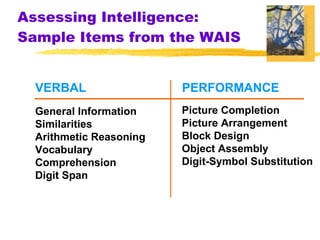
Assessing Intelligence: Sample Items from the WAIS VERBAL General Information  Similarities  Arithmetic Reasoning Vocabulary Comprehension Digit Span PERFORMANCE Picture Completion  Picture Arrangement Block Design Object Assembly Digit-Symbol Substitution
Group intelligence test Cognitive ability test – verbal, quantitative and spatial tests Academic ability test – SAT The ACT Assessment – 215 multiple choice questions based on English, mathematics, reading and science
Assessing Intelligence Standardization defining meaningful scores by comparison with the performance of a pretested “standardization group” Normal Curve   the symmetrical bell-shaped curve that describes the distribution of many physical and psychological attributes most scores fall near the average, and fewer and fewer scores lie near the extremes
The Normal Curve
Assessing Intelligence Reliability the extent to which a test yields consistent results assessed by consistency of scores on: two halves of the test alternate forms of the test retesting Validity the extent to which a test measures or predicts what it is supposed to
Assessing Intelligence Content Validity the extent to which a test samples the behavior that is of interest  driving test that samples driving tasks Criterion behavior (such as college grades) that a test (such as the SAT) is designed to predict the measure used in defining whether the test has predictive validity
Assessing Intelligence Predictive Validity success with which a test predicts the behavior it is designed to predict assessed by computing the correlation between test scores and the criterion behavior also called criterion-related validity
The Dynamics of Intelligence Mental Retardation a condition of limited mental ability indicated by an intelligence score below 70 produces difficulty in adapting to the demands of life varies from mild to profound Down Syndrome retardation and associated physical disorders caused by an extra chromosome in one’s genetic makeup

Introduction To Intelligence

  • 1.
  • 2.
    Intelligence Creativity Psychometrics: tests & measurements Cognitive approach
  • 3.
    Defining intelligence Binet(1916) defined it as the capacity to judge well, to reason well, and to comprehend well Terman (1916) defined it as the capacity to form concepts and grasp their significance Pintner (1921) defined it as the ability of an individual to adapt well to new situations in life
  • 4.
    Thorndike (1921) definedit as the power of good responses from the point of view of truth or fact Thurstone (1921) defined it as the capacity to inhibit instinctive response, imagine a different response, and realize the response modification into behavior
  • 5.
    Piaget (1972) definedit as referring to the superior forms of organization or equilibrium of cognitive structuring used for adaptation to the to the physical and social environment Sternberg (1985) defined it as the mental capacity to automatize information processing and to emit contextually appropriate behavior in response to novelty .
  • 6.
    You can takeyour pick of definitions but most agree that intelligence has to do with the related capacities of: i.) Learning from experience ii.) Adapting to ones environment Think of a person lacking either of these, and you pick out people who seem to lack intelligence Note however that very few formal tests of intelligence really demand subjects to do either of these!
  • 7.
    Theories of IntelligencePsychometric theories Developmental theories Information processing theories
  • 8.
    Psychometric theories Focuseson individual differences in cognitive abilities and causes Based on Spearman two factor theory and Turnstone's multifactor theory The most supported current theory of intelligence is Cattell-Horn-Carrol(1993)
  • 9.
    It starts withnarrow aspects like reaction time, spatial(non-verbal) scanning ,speech and hearing discrimination. The second aspect is combination of first stratums like fluid, crystallized and visual thinking. Third is combination of second stratums in a form of general intelligence
  • 10.
    How do youdefine “Intelligence”? Theorists use narrow, operational definitions Psychometricians do not claim that what is measured by an intelligence test is a good representation of “real-world” intelligence which is a broader concept Is it useful?
  • 11.
    Does “g” exist?One of the longest-running debates in psychology: global intelligence, a general ability specific abilities … ..More a matter of emphasis “ Intelligence is what intelligence tests measure ” Edward Boring
  • 12.
    Psychometric approach focuseson how well people perform on standardized mental tests and with what the scores correlate Achievement tests - based on learning Aptitude tests--measure the ability to acquire skills in the future ---the difference is really one of degree and intended use since all are based to some extent on experience with words, objects, etc.
  • 13.
    Development theories Focuseson uniformities and interindividual similarities in cognitive growth Actions of assimilation and accommodation on the external world. Assimilation consists of fitting new experiences into preexisting cognitive structure(schemata)
  • 14.
    Information-processing theories Focuseson attention and processing speed Sternberg(1982) hypothesized five classes of component process by which brain operates on information and solve problems: metacomponents ,performance components, acquisition components, retention components and transfer components
  • 15.
    Recent approach ofStemberg(1994) Proposed a triarchic theory Componential sub theory – performance component and knowledge-acquisition Experiential sub theory – ability to formulate new ideas by combining unrelated factors or information Contextual sub theory - ability to adapt changing envirnment and to shape the environment
  • 16.
    Research psychologists areinterested in finding better ways to describe and understand the construct "intelligence". Traditional tests tended to emphasize analytical reasoning and memory. Sternberg argues that practical intelligence and creativity need to be included in the construct.
  • 17.
    The historical conceptis too narrow. It needs to be expanded. 8. Cognitive psychologists want to know "how" people solve problems in addition to whether or not they get the right answer (the psychometric approach).
  • 18.
    Application of intelligencetesting Diagnosis of the presence and nature of brain damage Selection, placement and classification of students in higher education, employees in business and industrial organizations, and personnel in military and government dept. Vocational and educational counseling and rehabilitation
  • 19.
    Psycho diagnosis ofchildren and adults in clinical and psychiatric contexts Evaluation of the effectiveness of psychological treatments and environmental interventions Research on cognitive abilities and personality
  • 20.
    Individual intelligence testEditions of Standford-Binet test Wechsler intelligence test focused on verbal comprehension, processing speed, working memory and perceptual reasoning
  • 21.
    Assessing Intelligence WechslerAdult Intelligence Scale (WAIS) most widely used intelligence test subtests verbal performance (nonverbal)
  • 22.
    Assessing Intelligence: SampleItems from the WAIS VERBAL General Information Similarities Arithmetic Reasoning Vocabulary Comprehension Digit Span PERFORMANCE Picture Completion Picture Arrangement Block Design Object Assembly Digit-Symbol Substitution
  • 23.
    Group intelligence testCognitive ability test – verbal, quantitative and spatial tests Academic ability test – SAT The ACT Assessment – 215 multiple choice questions based on English, mathematics, reading and science
  • 24.
    Assessing Intelligence Standardizationdefining meaningful scores by comparison with the performance of a pretested “standardization group” Normal Curve the symmetrical bell-shaped curve that describes the distribution of many physical and psychological attributes most scores fall near the average, and fewer and fewer scores lie near the extremes
  • 25.
  • 26.
    Assessing Intelligence Reliabilitythe extent to which a test yields consistent results assessed by consistency of scores on: two halves of the test alternate forms of the test retesting Validity the extent to which a test measures or predicts what it is supposed to
  • 27.
    Assessing Intelligence ContentValidity the extent to which a test samples the behavior that is of interest driving test that samples driving tasks Criterion behavior (such as college grades) that a test (such as the SAT) is designed to predict the measure used in defining whether the test has predictive validity
  • 28.
    Assessing Intelligence PredictiveValidity success with which a test predicts the behavior it is designed to predict assessed by computing the correlation between test scores and the criterion behavior also called criterion-related validity
  • 29.
    The Dynamics ofIntelligence Mental Retardation a condition of limited mental ability indicated by an intelligence score below 70 produces difficulty in adapting to the demands of life varies from mild to profound Down Syndrome retardation and associated physical disorders caused by an extra chromosome in one’s genetic makeup