INTELLIGENCE
• Intelligence: Intelligence is one of the most difficult
concepts to define. For our discussion of this concept we
will accept two definitions. A theoretical definition
forwarded by David Wechsler which says that intelligence
is the capacity to understand one’s world and one’s
resourcefulness to cope with its challenges. This
definition although impressive has loopholes in it.
• We know that defining concepts operationally helps us
understand abstract concept. One operational definition
for intelligence states “Intelligence is what intelligence
tests measure”.
• Classic Models of Intelligence:
Theoretical models of intelligence are attempts to categorize and
organize cognitive or intellectual abilities into sensible groups.
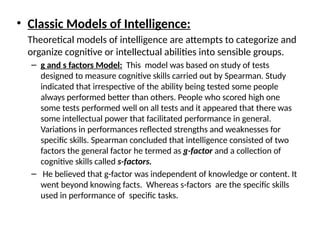
– g and s factors Model: This model was based on study of tests
designed to measure cognitive skills carried out by Spearman. Study
indicated that irrespective of the ability being tested some people
always performed better than others. People who scored high one
some tests performed well on all tests and it appeared that there was
some intellectual power that facilitated performance in general.
Variations in performances reflected strengths and weaknesses for
specific skills. Spearman concluded that intelligence consisted of two
factors the general factor he termed as g-factor and a collection of
cognitive skills called s-factors.
– He believed that g-factor was independent of knowledge or content. It
went beyond knowing facts. Whereas s-factors are the specific skills
used in performance of specific tasks.
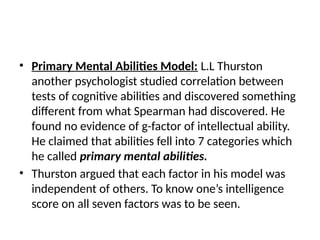
• Primary Mental Abilities Model: L.L Thurston
another psychologist studied correlation between
tests of cognitive abilities and discovered something
different from what Spearman had discovered. He
found no evidence of g-factor of intellectual ability.
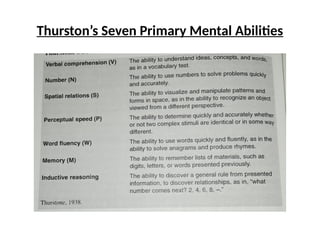
He claimed that abilities fell into 7 categories which
he called primary mental abilities.
• Thurston argued that each factor in his model was
independent of others. To know one’s intelligence
score on all seven factors was to be seen.
Thurston’s Seven Primary Mental Abilities
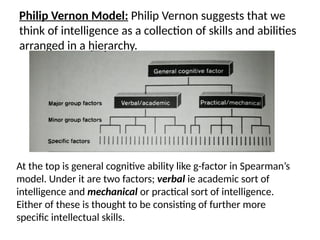
Philip Vernon Model: Philip Vernon suggests that we
think of intelligence as a collection of skills and abilities
arranged in a hierarchy.
At the top is general cognitive ability like g-factor in Spearman’s
model. Under it are two factors; verbal ie academic sort of
intelligence and mechanical or practical sort of intelligence.
Either of these is thought to be consisting of further more
specific intellectual skills.
Contemporary Models of Intelligence:
• The current approach to understanding of intelligence assumes that:
– Intelligence is a multidimensional concept.
– It is active processing of information rather than a thing that some have and
some do not have to some degree.
• Componential Intelligence: Robert Sternberg considers intelligence
as multifaceted and focuses on how one uses intellectual abilities
rather than describing these abilities. He sees one sort of intelligent
behaviour as a reflection of three different processes or components:
– Skills we bring to bear when we set about to solve a problem “just what is
the problem here? How shall I get started. How will I know I have
succeeded.”
– The skills we actually use to solve the problem .
– The techniques and strategies for collecting and assimilating new
information. Being intelligent is demonstrating that one can profit from
experience.
contd…….
• In addition to this view of intelligence he added
two other types:
– Experiential Intelligence: It is related to behaviour that
reflects creative thinking. The extent to which one can
combine elements in new, unusual and useful ways.
– Contextual Intelligence: Commonly called “street
smarts”. People with this type of intelligence are very
good at getting along with others and figuring out how
to “get by” in difficult situations. It is a practical nitty
gritty set of cognitive skills.
• Multiple Intelligences: Proposed by Howard Gardner it
suggests that there are seven different ways (or their
combinations) in which one can display intelligence. He first
acknowledges that there is a scholastic, academic
intelligence. It is made up of:
– Mathematical/logical abilities
– Verbal/linguistic abilities
• To these two he adds:
– Spatial Intelligence
– Musical Intelligence
– Body or Kinesthetic Intelligence
– Interpersonal Intelligence
– Intrapersonal Intelligence
• A person can be successful in life by using one or any of these
intelligences but it will largely depend upon one’s culture.
• Intelligence Across Cultures: The theories and
approaches to intelligence that we discussed are primarily
western in nature as the idea of understanding and
evaluating intelligence originated in west. However,
western ideas about intelligence are not shared by non
western cultures. For example Chinese found five factors
underlying their concept of intelligence:
– A general cognitive factor like Spearman’s g-factor.
– Interpersonal intelligence.
– Intrapersonal intelligence.
– Intellectual self-assertion.
– Intellectual self-effacement.
• As can be seen these are different fro western concept of
intelligence which emphasizes verbal ability, ability to
solve practical problems and social competence.
Psychological Tests of Intelligence
• Testing the Tests: A psychological test is an objective
standardized measure of behaviour.
• Psychological tests measure only a sample of behaviour.
• A psychological test should also be objective. It refers to
the evaluation of the behaviours being measured. It
means that expert interpretation and evaluation across
board should be the same.
• Before using a test for evaluation purposes we need to
three things about it ie reliability, validity and
adequacy of norms.
• Reliability: In psychological testing it is the extent to which a test
measures whatever it measure consistently.
• Validity: In psychological testing it is the extent to which a test
measures what it claims to be measuring. There are different kinds
of validity:
– Face Validity: Items on a test are studied and if they appear to be
covering a wide range of topics related to behaviour being studied the
test is said to have face validity.
– Predictive Validity: When the results of a test predict a behaviour known
to be related to the construct being tested.
– Concurrent Validity: It is demonstrated when a test produces results
which correlate with another well established test in the same area.
– Construct Validity: It involves the results related to a construct predicted
by a theory.
• Adequacy of Norms: In psychological testing scores on test taken by
a large number of persons that can be used for making comparisons
are called adequate norms.
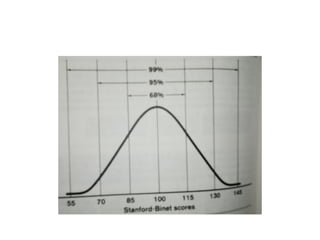
• Stanford –Binet Intelligence scale: Aim was to identify students unable to
benefit from school experience and needed to be placed in remedial
(special) classes. It first appeared in 1905. Has been revised a number of
times.
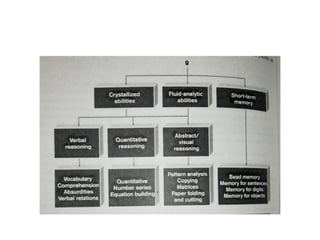
• It is arranged in a three level hierarchical model of cognitive ability.
• The score on this test reflects “g” or general intellectual ability described
as what a person needs when faced with a problem which he/she has not
been taught to solve.
• Underlying the “g” are three second level factors:
– Crystalized Abilities: Skills required for acquiring information about
verbal/quantitative concepts. These are influenced by schooling and
can be called academic ability factor.
– Fluid/Analytic Abilities: Abilities that are required to solve problems
involving figural or non verbal type of information.
– Short Term Memory: These are the items that test one’s ability to
hold information in memory for short terms.
contd……
`
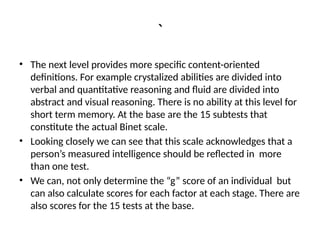
• The next level provides more specific content-oriented
definitions. For example crystalized abilities are divided into
verbal and quantitative reasoning and fluid are divided into
abstract and visual reasoning. There is no ability at this level for
short term memory. At the base are the 15 subtests that
constitute the actual Binet scale.
• Looking closely we can see that this scale acknowledges that a
person’s measured intelligence should be reflected in more
than one test.
• We can, not only determine the “g” score of an individual but
can also calculate scores for each factor at each stage. There are
also scores for the 15 tests at the base.
• Intelligence Quotient: A measure of general intelligence that
results fro dividing one’s mental age by one’s chronological age
and multiplying the result by 100.
• There are however some problems with this concept as it may not
reflect the true level of intelligence of a person.
• Two individuals with equal mental age may not have equal
intelligence.
• Two individuals with same IQ may have different may have
different levels of intelligence.
• Keeping these issues in view presently Deviation IQ is being used
which uses established group norms and allows for comparing
intelligence scores across age groups.
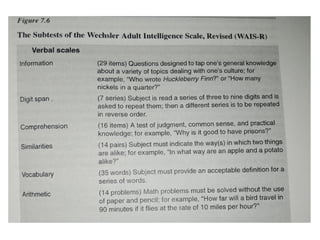
• Wechsler Tests of Intelligence:
– Published in 1919 it was designed to be used for adult
population. It also reduces Binet’s heavy reliance on verbal skills.
– This test is known as Wechsler Adult Intelligence Scale (WAIS).
Presently thee revised version WAIS-R is mostly used.
– WAIS-R covers the age group 16 to74.
– A natural extension is Wechsler Intelligence Scale for Children
known as WISC. It is suitable for ages 6-16.
– The tests developed for ages 4-6 are called Wechsler Pre and
Primary Scale of Intelligence or WPPSI.
– In addition to overall assessment Wechsler gives us an idea of a
person’s strength and weaknesses.
• Note: Individual Tests are criticized for being culturally
biased, for racial discrimination and whether they measure
just academic success or actually intelligence.
• Group Tests of Intelligence: Individual tests like Stanford-Binet
or Wechsler have been generally accepted as useful for
assessment of mental abilities. They are fairly valid and reliable.
• They have the advantage that person administering them can
make first hand observation of the subject and assess him and
his methodology of solving the problem.
• There is also the disadvantage of this process being expensive
and time consuming. Therefore large number of individuals can
not be tested.
• Need for a group test emerged during World War one when the
need for screening the recruits arose in USA. The results were
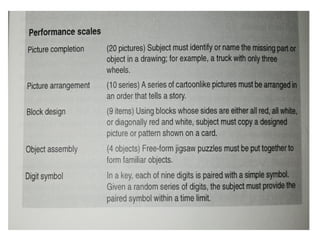
Army Alpha and Army Beta Tests. Alpha Test was a paper pencil
test and could be administered to large number of individuals
simultaneously. Army Beta was developed for illiterate persons
and was a performance test.
• US Army now uses Armed Forces Qualification
Test (AFQT).
• In Pakistan also we use group intelligence tests
both for selection of officers and other ranks.
• Aptitude Tests: These are psychological tests of
cognitive abilities used to predict future
behaviours. Scholastic Aptitude Test (SAT) and
Graduate Record Examination (GRE) are two
popular aptitude tests.
• Gender Differences in Intelligence: Is there a difference
between the IQs of males and females? The answer is no.
Recent studies show that what little differences existed are
diminishing gradually.
– One reason could be that intelligence tests are constructed to
minimize or eliminate such differences.
– However there are signs of differences when it comes to specific
skills like spatial relations.
• Age Differences: We think that we know more when we
grow up. However, factually the average Iqs are not affected
by age differences. Infant and pre school intelligence tests
are poor indicators of intelligence at older age. There are
two approaches to measure the differences caused by age:
contd……
– Cross-Sectional Method: in this persons of different ages are
given tests at the same time. This method suggests that
overall IQ peaks in early twenties, remains stable for about
twenty years and then declines sharply.
– Longitudinal Method: In this method same person is tested at
various stages of life: The results state that intelligence scores
rise gradually till mid fifties and then very slowly decline.
• Probably the answer to this dilemma would be to
examine specific cognitive abilities. They do not decline
at the same rate and some do not decline at all. Verbal
fluency is found to decline after thirty whereas tests of
vocabulary show no decline with age. Slight increase in
general intellectual ability is seen throughout the age
period 18-54.
• Extremes of Intelligence
– Mentally Gifted: There are many ways in which a
person can be gifted.
– United States Office of Education defines
giftedness as a demonstrated achievement or
aptitude for excellence in any of the six areas. The
categories are similar to those proposed by
Gardner’s model:
• Psychomotor Ability: People having outstanding
abilities in behaviours or skills like agility, strength,
speed, quickness, coordination etc.
• Visual and Performing Arts:
Contd……..
– Leadership Abilities: These are valued in every society.
Some individuals are gifted in this area even as children.
Youngsters with these abilities tend to be bright but not
necessarilly smartest in the group.
– Creative or Productive Thinking: The individuals in this
category may or nay not be academically above average.
Scores on this ability are unrelated to measures of general
intelligence. These people can produce unique and different
but useful solutions to problems. Persons gifted in one area
may not be so in other areas.
– Specific Academic Aptitude: These are the people who have
special ability in one or two subjects. May not be outstanding
in other subjects.
– Intellectually Gifted: Inclusion in this group is based on scores
on a general intelligence test. People with IQ score of 130 or
above are included in it.
• Mental Retardaation: Intelligence as
measured by intelligence tests is used to
confirm the suspected cases of retardation.
Like mentally gifted there is more to
retardation than IQ alone.
– Definition: Sub-average general intellectual
functioning which originated during development
period and is associated with impairment in
adaptive behaviour.
– Cutoff for mental retardation is normally taken to
be 70. IQs between 70 & 85 are considered
borderline.
• IQ 50-69: Mildly retarded about 85% of all
retardation cases.
• IQ 35-49: Moderately mentally retarded.
About 12 % of all cases of retardation.
• IQ 20-34: Severely retarded. About 8% of all
cases.
• IQ less than 19: Profoundly mentally retarded.
Less than 1% of total retardation cases.
• What is a Problem ?: A discrepancy between
one’s present state and one’s goal state with
no apparent way to get from one to other.
– In situations in which path to goal attainment is
not clear a problem exists and you need to engage
in problem solving activity.
– A problem has three componnts.
• Initial State: The situation as it is or is perceived to
exists at the moment.
• Goal State: It is the situatio as the problem solver
would like it to be or the end product.
• Routes or Strategies:For getting from initial state to
goal state.
• Well Defined and Ill defined Problems:
– Well Defined Problems: These are the problems in
which both the initial state and end state are clearly
defined. We know what is the current situation. What is
the goal and we may know some of the ways of
reaching there.
– Ill Defined Problems: In these problems the starting
situation is not clear and also the ideal situation can not
be defined or identified. These problems usually involve
a large number of variables which are difficult to define
and control.
• Problem Representation:
– Put it in some form that allows us to think about it in
familiar terms.
– We need to represent the problem in our minds so
that initial state and goal state are clear to us.
– We also need to know any restrictions that may be
involved.
– Faulty representation creates blocks and hampers
progress.
– Eliminate nonessential information.
– Try to relate to already solved similar problems.
– Develop a strategy to move from representation to
solution.
• Problem Soving Strategies:
– Strategy: In problem solving strategy is a
systematic plan for generating possible solutions
that can be tested to see if they are correct.
• Main advantage of a cognitive strategies is that they
permit the problem solver to exercise some degree of
control over the task .
– Types of Strategies: Out of a number of
strategies we will consider only two.
• Alogrithm: A problem solving strategy in which all
possible solutions are generated and tested until an
acceptable solution appears. It is sometimes called a
generate-test strategy.
• Heuristic Strategy:It is an informal, economical
yet reasonable method of testing problem
solutions without the guarantee of success.
• Heuristics are usually much less time
consuming than algorithm strategies and lead
searches for goals in a logical, sensible way.
• Heuristic strategy is a means-ends analysis a
strategy in which one always keeps the final
goal in mind but first works towards reaching
sub goals.
• Barriers to Effective Problem Solving: It
is often impossible to solve problems without
relying on your memory. Solving problems
effectively requires that we use our memories,
however, sometimes the previous experiences
and their memories create hurdles in the way
of solving problems. For example:
– Mental Set &Functional fixedness:
• Mental Set: A mental set is a predisposed way to
perceive or respond to something; an expectation. It is a
kind of cognitive predisposition. We may have or
develop dispositions that interfere with problem solving
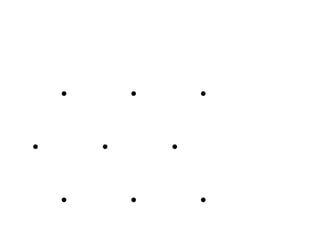
. . .
. . .
. . .
• Mental sets do not always interfere. They can be facilitating
also.
• Mental sets may lead to less efficient strategies.
• Functional Fixedness:A type of mental set that interferes with
the problem solving involving the inability to discover a new
use for an object because of prior experience with that object.
– Biased Heuristics and Decision Making: For most of
the life problems we are provided with possibilities of
which we must select the correct or the best alternative.
Problem solving involves past experiences to devise
strategies for problem solving. Sometimes these heuristic
strategies because of perceptions of past experiences
create a barrier to problem solving. Some of these are:
Contd…
– Availibility Heuristic: It is the assumption that
what comes to mind readily must be more common
or probable than what does not come to mind.
– Representative Heuristic: It is the assumption
that judgment made about a very typical member
of some category will hold for all members of that
category.
– Positive Test Strategy: It is the heuristic of
sticking with an acceptable decision or solution
even if better ones may exist.
• Overcoming Barriers With Creative Prroblem
Solving: In the context of problem solving
creative means more than unusual, rare or
different. It involve reorganization of problem
elements. It is at the stage of problem
representation that the creativity is most
noticeable .
• There is virtually no correlation between
intelligence and creative problem solving.
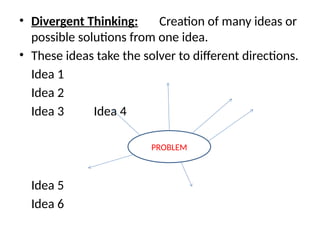
• Divergent Thinking: Creation of many ideas or
possible solutions from one idea.
• These ideas take the solver to different directions.
Idea 1
Idea 2
Idea 3 Idea 4
Idea 5
Idea 6
PROBLEM
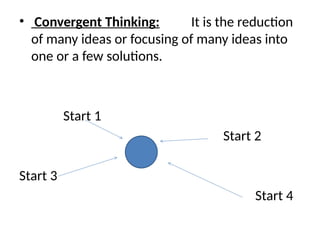
• Convergent Thinking: It is the reduction
of many ideas or focusing of many ideas into
one or a few solutions.
Start 1
Start 2
Start 3
Start 4

Learn about intelligence in Psychology.pptx

  • 1.
  • 5.
    • Intelligence: Intelligenceis one of the most difficult concepts to define. For our discussion of this concept we will accept two definitions. A theoretical definition forwarded by David Wechsler which says that intelligence is the capacity to understand one’s world and one’s resourcefulness to cope with its challenges. This definition although impressive has loopholes in it. • We know that defining concepts operationally helps us understand abstract concept. One operational definition for intelligence states “Intelligence is what intelligence tests measure”.
  • 6.
    • Classic Modelsof Intelligence: Theoretical models of intelligence are attempts to categorize and organize cognitive or intellectual abilities into sensible groups. – g and s factors Model: This model was based on study of tests designed to measure cognitive skills carried out by Spearman. Study indicated that irrespective of the ability being tested some people always performed better than others. People who scored high one some tests performed well on all tests and it appeared that there was some intellectual power that facilitated performance in general. Variations in performances reflected strengths and weaknesses for specific skills. Spearman concluded that intelligence consisted of two factors the general factor he termed as g-factor and a collection of cognitive skills called s-factors. – He believed that g-factor was independent of knowledge or content. It went beyond knowing facts. Whereas s-factors are the specific skills used in performance of specific tasks.
  • 7.
    • Primary MentalAbilities Model: L.L Thurston another psychologist studied correlation between tests of cognitive abilities and discovered something different from what Spearman had discovered. He found no evidence of g-factor of intellectual ability. He claimed that abilities fell into 7 categories which he called primary mental abilities. • Thurston argued that each factor in his model was independent of others. To know one’s intelligence score on all seven factors was to be seen.
  • 8.
  • 9.
    Philip Vernon Model:Philip Vernon suggests that we think of intelligence as a collection of skills and abilities arranged in a hierarchy. At the top is general cognitive ability like g-factor in Spearman’s model. Under it are two factors; verbal ie academic sort of intelligence and mechanical or practical sort of intelligence. Either of these is thought to be consisting of further more specific intellectual skills.
  • 10.
    Contemporary Models ofIntelligence: • The current approach to understanding of intelligence assumes that: – Intelligence is a multidimensional concept. – It is active processing of information rather than a thing that some have and some do not have to some degree. • Componential Intelligence: Robert Sternberg considers intelligence as multifaceted and focuses on how one uses intellectual abilities rather than describing these abilities. He sees one sort of intelligent behaviour as a reflection of three different processes or components: – Skills we bring to bear when we set about to solve a problem “just what is the problem here? How shall I get started. How will I know I have succeeded.” – The skills we actually use to solve the problem . – The techniques and strategies for collecting and assimilating new information. Being intelligent is demonstrating that one can profit from experience. contd…….
  • 11.
    • In additionto this view of intelligence he added two other types: – Experiential Intelligence: It is related to behaviour that reflects creative thinking. The extent to which one can combine elements in new, unusual and useful ways. – Contextual Intelligence: Commonly called “street smarts”. People with this type of intelligence are very good at getting along with others and figuring out how to “get by” in difficult situations. It is a practical nitty gritty set of cognitive skills.
  • 12.
    • Multiple Intelligences:Proposed by Howard Gardner it suggests that there are seven different ways (or their combinations) in which one can display intelligence. He first acknowledges that there is a scholastic, academic intelligence. It is made up of: – Mathematical/logical abilities – Verbal/linguistic abilities • To these two he adds: – Spatial Intelligence – Musical Intelligence – Body or Kinesthetic Intelligence – Interpersonal Intelligence – Intrapersonal Intelligence • A person can be successful in life by using one or any of these intelligences but it will largely depend upon one’s culture.
  • 13.
    • Intelligence AcrossCultures: The theories and approaches to intelligence that we discussed are primarily western in nature as the idea of understanding and evaluating intelligence originated in west. However, western ideas about intelligence are not shared by non western cultures. For example Chinese found five factors underlying their concept of intelligence: – A general cognitive factor like Spearman’s g-factor. – Interpersonal intelligence. – Intrapersonal intelligence. – Intellectual self-assertion. – Intellectual self-effacement. • As can be seen these are different fro western concept of intelligence which emphasizes verbal ability, ability to solve practical problems and social competence.
  • 14.
    Psychological Tests ofIntelligence • Testing the Tests: A psychological test is an objective standardized measure of behaviour. • Psychological tests measure only a sample of behaviour. • A psychological test should also be objective. It refers to the evaluation of the behaviours being measured. It means that expert interpretation and evaluation across board should be the same. • Before using a test for evaluation purposes we need to three things about it ie reliability, validity and adequacy of norms.
  • 15.
    • Reliability: Inpsychological testing it is the extent to which a test measures whatever it measure consistently. • Validity: In psychological testing it is the extent to which a test measures what it claims to be measuring. There are different kinds of validity: – Face Validity: Items on a test are studied and if they appear to be covering a wide range of topics related to behaviour being studied the test is said to have face validity. – Predictive Validity: When the results of a test predict a behaviour known to be related to the construct being tested. – Concurrent Validity: It is demonstrated when a test produces results which correlate with another well established test in the same area. – Construct Validity: It involves the results related to a construct predicted by a theory. • Adequacy of Norms: In psychological testing scores on test taken by a large number of persons that can be used for making comparisons are called adequate norms.
  • 16.
    • Stanford –BinetIntelligence scale: Aim was to identify students unable to benefit from school experience and needed to be placed in remedial (special) classes. It first appeared in 1905. Has been revised a number of times. • It is arranged in a three level hierarchical model of cognitive ability. • The score on this test reflects “g” or general intellectual ability described as what a person needs when faced with a problem which he/she has not been taught to solve. • Underlying the “g” are three second level factors: – Crystalized Abilities: Skills required for acquiring information about verbal/quantitative concepts. These are influenced by schooling and can be called academic ability factor. – Fluid/Analytic Abilities: Abilities that are required to solve problems involving figural or non verbal type of information. – Short Term Memory: These are the items that test one’s ability to hold information in memory for short terms. contd……
  • 18.
    ` • The nextlevel provides more specific content-oriented definitions. For example crystalized abilities are divided into verbal and quantitative reasoning and fluid are divided into abstract and visual reasoning. There is no ability at this level for short term memory. At the base are the 15 subtests that constitute the actual Binet scale. • Looking closely we can see that this scale acknowledges that a person’s measured intelligence should be reflected in more than one test. • We can, not only determine the “g” score of an individual but can also calculate scores for each factor at each stage. There are also scores for the 15 tests at the base.
  • 20.
    • Intelligence Quotient:A measure of general intelligence that results fro dividing one’s mental age by one’s chronological age and multiplying the result by 100. • There are however some problems with this concept as it may not reflect the true level of intelligence of a person. • Two individuals with equal mental age may not have equal intelligence. • Two individuals with same IQ may have different may have different levels of intelligence. • Keeping these issues in view presently Deviation IQ is being used which uses established group norms and allows for comparing intelligence scores across age groups.
  • 21.
    • Wechsler Testsof Intelligence: – Published in 1919 it was designed to be used for adult population. It also reduces Binet’s heavy reliance on verbal skills. – This test is known as Wechsler Adult Intelligence Scale (WAIS). Presently thee revised version WAIS-R is mostly used. – WAIS-R covers the age group 16 to74. – A natural extension is Wechsler Intelligence Scale for Children known as WISC. It is suitable for ages 6-16. – The tests developed for ages 4-6 are called Wechsler Pre and Primary Scale of Intelligence or WPPSI. – In addition to overall assessment Wechsler gives us an idea of a person’s strength and weaknesses. • Note: Individual Tests are criticized for being culturally biased, for racial discrimination and whether they measure just academic success or actually intelligence.
  • 24.
    • Group Testsof Intelligence: Individual tests like Stanford-Binet or Wechsler have been generally accepted as useful for assessment of mental abilities. They are fairly valid and reliable. • They have the advantage that person administering them can make first hand observation of the subject and assess him and his methodology of solving the problem. • There is also the disadvantage of this process being expensive and time consuming. Therefore large number of individuals can not be tested. • Need for a group test emerged during World War one when the need for screening the recruits arose in USA. The results were Army Alpha and Army Beta Tests. Alpha Test was a paper pencil test and could be administered to large number of individuals simultaneously. Army Beta was developed for illiterate persons and was a performance test.
  • 25.
    • US Armynow uses Armed Forces Qualification Test (AFQT). • In Pakistan also we use group intelligence tests both for selection of officers and other ranks. • Aptitude Tests: These are psychological tests of cognitive abilities used to predict future behaviours. Scholastic Aptitude Test (SAT) and Graduate Record Examination (GRE) are two popular aptitude tests.
  • 26.
    • Gender Differencesin Intelligence: Is there a difference between the IQs of males and females? The answer is no. Recent studies show that what little differences existed are diminishing gradually. – One reason could be that intelligence tests are constructed to minimize or eliminate such differences. – However there are signs of differences when it comes to specific skills like spatial relations. • Age Differences: We think that we know more when we grow up. However, factually the average Iqs are not affected by age differences. Infant and pre school intelligence tests are poor indicators of intelligence at older age. There are two approaches to measure the differences caused by age: contd……
  • 27.
    – Cross-Sectional Method:in this persons of different ages are given tests at the same time. This method suggests that overall IQ peaks in early twenties, remains stable for about twenty years and then declines sharply. – Longitudinal Method: In this method same person is tested at various stages of life: The results state that intelligence scores rise gradually till mid fifties and then very slowly decline. • Probably the answer to this dilemma would be to examine specific cognitive abilities. They do not decline at the same rate and some do not decline at all. Verbal fluency is found to decline after thirty whereas tests of vocabulary show no decline with age. Slight increase in general intellectual ability is seen throughout the age period 18-54.
  • 28.
    • Extremes ofIntelligence – Mentally Gifted: There are many ways in which a person can be gifted. – United States Office of Education defines giftedness as a demonstrated achievement or aptitude for excellence in any of the six areas. The categories are similar to those proposed by Gardner’s model: • Psychomotor Ability: People having outstanding abilities in behaviours or skills like agility, strength, speed, quickness, coordination etc. • Visual and Performing Arts: Contd……..
  • 29.
    – Leadership Abilities:These are valued in every society. Some individuals are gifted in this area even as children. Youngsters with these abilities tend to be bright but not necessarilly smartest in the group. – Creative or Productive Thinking: The individuals in this category may or nay not be academically above average. Scores on this ability are unrelated to measures of general intelligence. These people can produce unique and different but useful solutions to problems. Persons gifted in one area may not be so in other areas. – Specific Academic Aptitude: These are the people who have special ability in one or two subjects. May not be outstanding in other subjects. – Intellectually Gifted: Inclusion in this group is based on scores on a general intelligence test. People with IQ score of 130 or above are included in it.
  • 30.
    • Mental Retardaation:Intelligence as measured by intelligence tests is used to confirm the suspected cases of retardation. Like mentally gifted there is more to retardation than IQ alone. – Definition: Sub-average general intellectual functioning which originated during development period and is associated with impairment in adaptive behaviour. – Cutoff for mental retardation is normally taken to be 70. IQs between 70 & 85 are considered borderline.
  • 31.
    • IQ 50-69:Mildly retarded about 85% of all retardation cases. • IQ 35-49: Moderately mentally retarded. About 12 % of all cases of retardation. • IQ 20-34: Severely retarded. About 8% of all cases. • IQ less than 19: Profoundly mentally retarded. Less than 1% of total retardation cases.
  • 33.
    • What isa Problem ?: A discrepancy between one’s present state and one’s goal state with no apparent way to get from one to other. – In situations in which path to goal attainment is not clear a problem exists and you need to engage in problem solving activity. – A problem has three componnts. • Initial State: The situation as it is or is perceived to exists at the moment. • Goal State: It is the situatio as the problem solver would like it to be or the end product. • Routes or Strategies:For getting from initial state to goal state.
  • 34.
    • Well Definedand Ill defined Problems: – Well Defined Problems: These are the problems in which both the initial state and end state are clearly defined. We know what is the current situation. What is the goal and we may know some of the ways of reaching there. – Ill Defined Problems: In these problems the starting situation is not clear and also the ideal situation can not be defined or identified. These problems usually involve a large number of variables which are difficult to define and control.
  • 37.
    • Problem Representation: –Put it in some form that allows us to think about it in familiar terms. – We need to represent the problem in our minds so that initial state and goal state are clear to us. – We also need to know any restrictions that may be involved. – Faulty representation creates blocks and hampers progress. – Eliminate nonessential information. – Try to relate to already solved similar problems. – Develop a strategy to move from representation to solution.
  • 38.
    • Problem SovingStrategies: – Strategy: In problem solving strategy is a systematic plan for generating possible solutions that can be tested to see if they are correct. • Main advantage of a cognitive strategies is that they permit the problem solver to exercise some degree of control over the task . – Types of Strategies: Out of a number of strategies we will consider only two. • Alogrithm: A problem solving strategy in which all possible solutions are generated and tested until an acceptable solution appears. It is sometimes called a generate-test strategy.
  • 39.
    • Heuristic Strategy:Itis an informal, economical yet reasonable method of testing problem solutions without the guarantee of success. • Heuristics are usually much less time consuming than algorithm strategies and lead searches for goals in a logical, sensible way. • Heuristic strategy is a means-ends analysis a strategy in which one always keeps the final goal in mind but first works towards reaching sub goals.
  • 40.
    • Barriers toEffective Problem Solving: It is often impossible to solve problems without relying on your memory. Solving problems effectively requires that we use our memories, however, sometimes the previous experiences and their memories create hurdles in the way of solving problems. For example: – Mental Set &Functional fixedness: • Mental Set: A mental set is a predisposed way to perceive or respond to something; an expectation. It is a kind of cognitive predisposition. We may have or develop dispositions that interfere with problem solving
  • 41.
    . . . .. . . . .
  • 42.
    • Mental setsdo not always interfere. They can be facilitating also. • Mental sets may lead to less efficient strategies. • Functional Fixedness:A type of mental set that interferes with the problem solving involving the inability to discover a new use for an object because of prior experience with that object. – Biased Heuristics and Decision Making: For most of the life problems we are provided with possibilities of which we must select the correct or the best alternative. Problem solving involves past experiences to devise strategies for problem solving. Sometimes these heuristic strategies because of perceptions of past experiences create a barrier to problem solving. Some of these are: Contd…
  • 43.
    – Availibility Heuristic:It is the assumption that what comes to mind readily must be more common or probable than what does not come to mind. – Representative Heuristic: It is the assumption that judgment made about a very typical member of some category will hold for all members of that category. – Positive Test Strategy: It is the heuristic of sticking with an acceptable decision or solution even if better ones may exist.
  • 44.
    • Overcoming BarriersWith Creative Prroblem Solving: In the context of problem solving creative means more than unusual, rare or different. It involve reorganization of problem elements. It is at the stage of problem representation that the creativity is most noticeable . • There is virtually no correlation between intelligence and creative problem solving.
  • 45.
    • Divergent Thinking:Creation of many ideas or possible solutions from one idea. • These ideas take the solver to different directions. Idea 1 Idea 2 Idea 3 Idea 4 Idea 5 Idea 6 PROBLEM
  • 46.
    • Convergent Thinking:It is the reduction of many ideas or focusing of many ideas into one or a few solutions. Start 1 Start 2 Start 3 Start 4