INTELLIGENCE Chapter 11
Definition: “Intelligence is the capacity to understand the world and the resourcefulness to cope with its challenges…” David Wechsler It’s the ability to acquire knowledge…
KEY POINTS FOR INTELLIGENCE: “ Ability to learn”  This does not necessarily mean speed of learning “ Ability to think effectively” There can be many operational definitions for “effective” “ Ability to adapt to the environment” Environments are different:  imagine New York City versus Papua, New Guinea KEEP AN OPEN MIND!  THE GENERAL PUBLIC HAS MANY MISCONCPETIONS ABOUT INTELLIGENCE AND IQ !
Achievement: Refers to knowledge and skills gained from experience and hard work (one’s efforts).
Intelligence: Refers to the innate cognitive ability that allows for the acquisition of experience.  Grades in school do not define intelligence!
Factor Theories of Intelligence: I.  Dr. Charles Spearman a “factor”:  one to a hundred or  more mental abilities
Factor Theories of Intelligence: “ g” stands for “general intelligence” and is considered to be the cluster of “factors” or behaviors/abilities we associate with intelligence Ex. Broad reasoning and problem solving abilities
Factor Theories of Intelligence: “ s” stands for “specific factors” that account for specific abilities Ex. Business sense or poetry
Factor Theories of Intelligence: “factor analysis” a statistical technique that finds relationships among large quantities of items, like items on an intelligence test.  Items that “cluster” are called “factors” and we expect to find certain “clusters” in intelligent people and a lack of these “clusters” or parts to the cluster in less intelligent people.
Crystallized Intelligence Ability to apply previously acquired knowledge to current problems Found in older people and includes knowledge, experience, and wisdom Fluid Intelligence Ability to deal with novel problem-solving situations for which personal experience does not provide a solution Includes speed of reasoning and a mental flexibility more common among younger people
PSYCHOMETRICS The statistical study of psychological tests Tries to identify and measure the abilities that underlie individual differences in performance.
Factor Theories of Intelligence: II. Dr. Louis Thurstone  (disagrees with Spearman) 9 specific “factors” = “Primary Mental  Abilities” Visual Abilities ** Spatial Abilities Perceptual Speed Numerical Ability Verbal Meaning Memory Word Fluency Deductive Reasoning** Inductive Reasoning **not listed text
Factor Theories of Intelligence: II. Dr. Louis Thurstone  Cont. Thurstone gave 56 different tests Didn’t rank on a single g scale But still supports a g factor by showing tendency to cluster
Theory of Multiple Intelligences: III. Dr. Howard Gardner (supports Thurstone) Language (verbal) Logical-Mathematical Spatial-relations skills Bodily-kinesthetic (movement) Musical Talent Inter-personal Skills Intra-personal Skills **Naturalist **Existential (ponders larger questions of life/death/existence) Relatively independent of one another **2 that are not always addressed
Savant Syndrome: Limited mental ability but excels at a specific skill (art, math, etc.  ) Referred to often as an “Island of Brilliance”
Triarchic Theory: *The Information Processing View Dr. Robert Sternberg (agrees with Gardner but for larger groups) Tri = 3 CONTEXTual… EXPERIENtial… COMPONENTial…
Triarchic Theory…: Contextual – the context in which a person finds himself…the environmental setting.  Intelligent behavior permits people to adapt to the demands of their environment. **Practical, everyday situations
Triarchic Theory…: Experiential -  the adaptation of new(novel) situations to previous experiences and the quickness of processing new information. (rapid information processing = high level cognitive abilities) **Creative
Triarchic Theory…: Componential (Analytical) Meta-components  -  (“meta” prefix always signifies our own awareness of something) so “meta-components” means our own awareness of how we process components of information Performance Components  – the mental operations used to perform information processing (solving problems) like how to encode for memory and make quick comparisons Knowledge-acquisition components – encoding, elaborative rehearsal, comparing similarities and differences, relating new info to old, etc. (Studying!) **Academic, problem-solving
MEASUREMENTS OF INTELLIGENCE Alfred BINET and Theodore Simon Early 1900’s Created 1 st  Intelligence Test to identify school children unable to benefit from traditional schooling (the Binet-Simon Scale) *Child’s mental Age *Practical guide for identifying those needing special help
MEASUREMENTS OF INTELLIGENCE Changed and refined at Stanford University by Dr. Louis Terman Became Stanford-Binet Intelligence Scale (SBIS) Currently being used today SBIS first used a ratio to indicate mental age vs. chronological age This ratio is represented by the IQ score IQ – Short for “Intelligence Quotient” A “quotient” is a number;  IQ is only a score measuring abilities that can be measured.  There are many abilities that we have no current way to measure!
MEASUREMENTS OF INTELLIGENCE 1912 –  German Psychologist Dr. Wilhelm Stern Developed the formula for determining IQ A ratio between mental age (MA – the cognitive level) and the chronological age (CA – the actual years of age currently) then multiplied by 100 MA = Mental Age CA = Chronological Age Ex.  12 year old who performs on tests at the level of most 18 year olds, would have a CA of 12 and a MA of 18, an this ratio multiplied by 100 produces an IQ score of 150…clearly above average.
MEASUREMENTS OF INTELLIGENCE Average IQ was established by giving thousands of test to thousands of people.  The vast majority of 8 yr. olds performed to a certain level on the test, vast majority of 12 yr. olds performed to a certain level…etc.  Therefore, that score that the vast majority performed at for an age level became “100”, and therefore an IQ of 100 is considered average. ** Really, now it is no longer a real quotient because scores relate to an Average performance of those of the same age
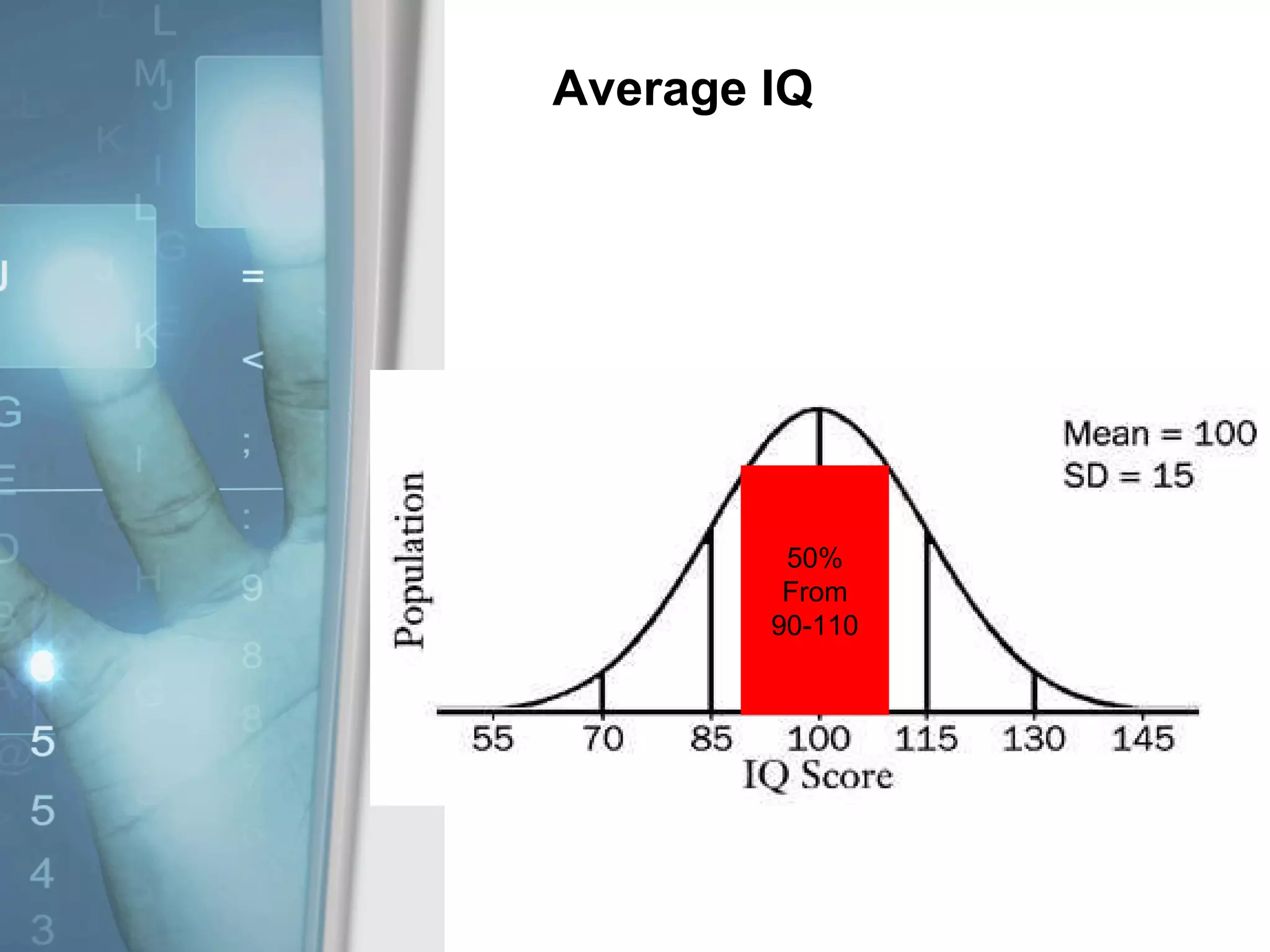
Average IQ Average IQ is 100 50% of total population has an IQ score between 90 and 110. 1% of population has an IQ above 145.  Genius is generally 180 or above Highest Recorded IQ is 230
Average IQ 50% From 90-110
FYI Studies now on how IQ tests (really all tests) may be CULTURALLY and or GENDER BIASED.  This could throw off results and give false readings and scores. **Australian IQ Test **Chitlin IQ Test (on NiceNet)
Modern Measurements of Intelligence David Wechsler  (Romanian) Wechsler’s Adult Intelligence Scale (WAIS) WAIS-III is Most widely used intelligence test in U.S. 11 subtests Separate verbal and performance scores Wechsler’s Intelligence Scale for Children (WISC) Developed later Currently using the WISC-IV
FLYNN EFFECT New Zealand researcher James Flynn (1987) Much of world’s population is scoring progressively higher approx. 3 pts higher per decade Reasons unclear, but some possibilities are: Better nutrition Increased Height More complex learning environments Technological advances Basketball theory**

Chp 11 Intelli

  • 1.
  • 2.
    Definition: “Intelligence isthe capacity to understand the world and the resourcefulness to cope with its challenges…” David Wechsler It’s the ability to acquire knowledge…
  • 3.
    KEY POINTS FORINTELLIGENCE: “ Ability to learn” This does not necessarily mean speed of learning “ Ability to think effectively” There can be many operational definitions for “effective” “ Ability to adapt to the environment” Environments are different: imagine New York City versus Papua, New Guinea KEEP AN OPEN MIND! THE GENERAL PUBLIC HAS MANY MISCONCPETIONS ABOUT INTELLIGENCE AND IQ !
  • 4.
    Achievement: Refers toknowledge and skills gained from experience and hard work (one’s efforts).
  • 5.
    Intelligence: Refers tothe innate cognitive ability that allows for the acquisition of experience. Grades in school do not define intelligence!
  • 6.
    Factor Theories ofIntelligence: I. Dr. Charles Spearman a “factor”: one to a hundred or more mental abilities
  • 7.
    Factor Theories ofIntelligence: “ g” stands for “general intelligence” and is considered to be the cluster of “factors” or behaviors/abilities we associate with intelligence Ex. Broad reasoning and problem solving abilities
  • 8.
    Factor Theories ofIntelligence: “ s” stands for “specific factors” that account for specific abilities Ex. Business sense or poetry
  • 9.
    Factor Theories ofIntelligence: “factor analysis” a statistical technique that finds relationships among large quantities of items, like items on an intelligence test. Items that “cluster” are called “factors” and we expect to find certain “clusters” in intelligent people and a lack of these “clusters” or parts to the cluster in less intelligent people.
  • 10.
    Crystallized Intelligence Abilityto apply previously acquired knowledge to current problems Found in older people and includes knowledge, experience, and wisdom Fluid Intelligence Ability to deal with novel problem-solving situations for which personal experience does not provide a solution Includes speed of reasoning and a mental flexibility more common among younger people
  • 11.
    PSYCHOMETRICS The statisticalstudy of psychological tests Tries to identify and measure the abilities that underlie individual differences in performance.
  • 12.
    Factor Theories ofIntelligence: II. Dr. Louis Thurstone (disagrees with Spearman) 9 specific “factors” = “Primary Mental Abilities” Visual Abilities ** Spatial Abilities Perceptual Speed Numerical Ability Verbal Meaning Memory Word Fluency Deductive Reasoning** Inductive Reasoning **not listed text
  • 13.
    Factor Theories ofIntelligence: II. Dr. Louis Thurstone Cont. Thurstone gave 56 different tests Didn’t rank on a single g scale But still supports a g factor by showing tendency to cluster
  • 14.
    Theory of MultipleIntelligences: III. Dr. Howard Gardner (supports Thurstone) Language (verbal) Logical-Mathematical Spatial-relations skills Bodily-kinesthetic (movement) Musical Talent Inter-personal Skills Intra-personal Skills **Naturalist **Existential (ponders larger questions of life/death/existence) Relatively independent of one another **2 that are not always addressed
  • 15.
    Savant Syndrome: Limitedmental ability but excels at a specific skill (art, math, etc. ) Referred to often as an “Island of Brilliance”
  • 16.
    Triarchic Theory: *TheInformation Processing View Dr. Robert Sternberg (agrees with Gardner but for larger groups) Tri = 3 CONTEXTual… EXPERIENtial… COMPONENTial…
  • 17.
    Triarchic Theory…: Contextual– the context in which a person finds himself…the environmental setting. Intelligent behavior permits people to adapt to the demands of their environment. **Practical, everyday situations
  • 18.
    Triarchic Theory…: Experiential- the adaptation of new(novel) situations to previous experiences and the quickness of processing new information. (rapid information processing = high level cognitive abilities) **Creative
  • 19.
    Triarchic Theory…: Componential(Analytical) Meta-components - (“meta” prefix always signifies our own awareness of something) so “meta-components” means our own awareness of how we process components of information Performance Components – the mental operations used to perform information processing (solving problems) like how to encode for memory and make quick comparisons Knowledge-acquisition components – encoding, elaborative rehearsal, comparing similarities and differences, relating new info to old, etc. (Studying!) **Academic, problem-solving
  • 20.
    MEASUREMENTS OF INTELLIGENCEAlfred BINET and Theodore Simon Early 1900’s Created 1 st Intelligence Test to identify school children unable to benefit from traditional schooling (the Binet-Simon Scale) *Child’s mental Age *Practical guide for identifying those needing special help
  • 21.
    MEASUREMENTS OF INTELLIGENCEChanged and refined at Stanford University by Dr. Louis Terman Became Stanford-Binet Intelligence Scale (SBIS) Currently being used today SBIS first used a ratio to indicate mental age vs. chronological age This ratio is represented by the IQ score IQ – Short for “Intelligence Quotient” A “quotient” is a number; IQ is only a score measuring abilities that can be measured. There are many abilities that we have no current way to measure!
  • 22.
    MEASUREMENTS OF INTELLIGENCE1912 – German Psychologist Dr. Wilhelm Stern Developed the formula for determining IQ A ratio between mental age (MA – the cognitive level) and the chronological age (CA – the actual years of age currently) then multiplied by 100 MA = Mental Age CA = Chronological Age Ex. 12 year old who performs on tests at the level of most 18 year olds, would have a CA of 12 and a MA of 18, an this ratio multiplied by 100 produces an IQ score of 150…clearly above average.
  • 23.
    MEASUREMENTS OF INTELLIGENCEAverage IQ was established by giving thousands of test to thousands of people. The vast majority of 8 yr. olds performed to a certain level on the test, vast majority of 12 yr. olds performed to a certain level…etc. Therefore, that score that the vast majority performed at for an age level became “100”, and therefore an IQ of 100 is considered average. ** Really, now it is no longer a real quotient because scores relate to an Average performance of those of the same age
  • 24.
    Average IQ AverageIQ is 100 50% of total population has an IQ score between 90 and 110. 1% of population has an IQ above 145. Genius is generally 180 or above Highest Recorded IQ is 230
  • 25.
    Average IQ 50%From 90-110
  • 26.
    FYI Studies nowon how IQ tests (really all tests) may be CULTURALLY and or GENDER BIASED. This could throw off results and give false readings and scores. **Australian IQ Test **Chitlin IQ Test (on NiceNet)
  • 27.
    Modern Measurements ofIntelligence David Wechsler (Romanian) Wechsler’s Adult Intelligence Scale (WAIS) WAIS-III is Most widely used intelligence test in U.S. 11 subtests Separate verbal and performance scores Wechsler’s Intelligence Scale for Children (WISC) Developed later Currently using the WISC-IV
  • 28.
    FLYNN EFFECT NewZealand researcher James Flynn (1987) Much of world’s population is scoring progressively higher approx. 3 pts higher per decade Reasons unclear, but some possibilities are: Better nutrition Increased Height More complex learning environments Technological advances Basketball theory**