CASE
PRESENTATION
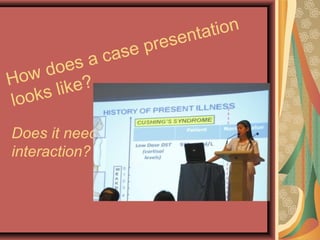
How does a case presentation
looks like?
Does it need to be one-on-one
interaction?
PURPOSECase Presentation is the process of
communicating the result of the
assessment done by the clinician.
Through this case presentation,
client will be screened if there are
evidences of underlying physical,
mental and psychological
dysfunction of the client to
provide bases for a full clinical
diagnosis and possible therapeutic
interventions that will be
discussed and formulated
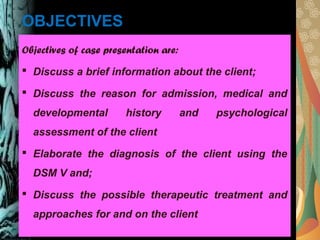
OBJECTIVES
Objectives of case presentation are:
 Discuss a brief information about the client;
 Discuss the reason for admission, medical and
developmental history and psychological
assessment of the client
 Elaborate the diagnosis of the client using the
DSM V and;
 Discuss the possible therapeutic treatment and
approaches for and on the client
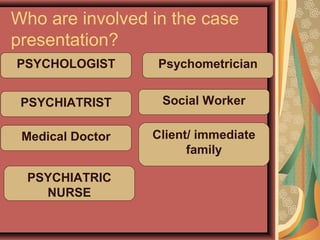
Who are involved in the case
presentation?
PSYCHOLOGIST
PSYCHIATRIST
PSYCHIATRIC
NURSE
Psychometrician
Social Worker
Client/ immediate
family
Medical Doctor
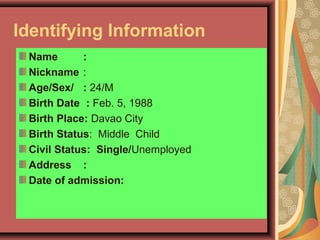
Identifying Information
Name :
Nickname :
Age/Sex/ : 24/M
Birth Date : Feb. 5, 1988
Birth Place: Davao City
Birth Status: Middle Child
Civil Status: Single/Unemployed
Address :
Date of admission:
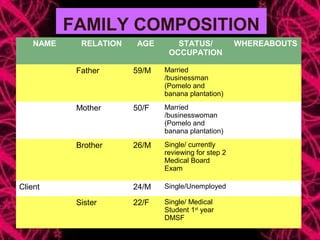
FAMILY COMPOSITION
NAME RELATION AGE STATUS/
OCCUPATION
WHEREABOUTS
Father 59/M Married
/businessman
(Pomelo and
banana plantation)
Mother 50/F Married
/businesswoman
(Pomelo and
banana plantation)
Brother 26/M Single/ currently
reviewing for step 2
Medical Board
Exam
Client 24/M Single/Unemployed
Sister 22/F Single/ Medical
Student 1st
year
DMSF
History of Present Illness
Presents how the client get into his current
situation.
It asks when did it started? How did it
started? What are the cause?
PSYCHOSOCIAL
HISTORY
Presenting Problem
As perceived by the Significant
Others
How the family members see his
situation?
The loved one’s point of view
Presenting Problem
As perceived by the Significant Others
After discharge, the client went back into
smoking and using drugs. He manifested
hostility, aggression, verbal abusiveness,
insomnia, hallucinations, and elevated mood
eventually until behavior became
unmanageable. Besides, he attempted to
overdose himself with clonazepam after the
prescription was left by his father under his
responsibility. Family then decided to readmit
the client for re-evaluation and further treatment.
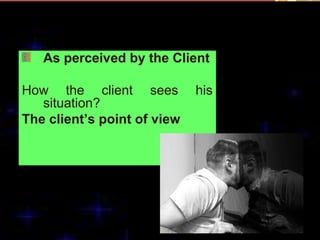
As perceived by the Client
How the client sees his
situation?
The client’s point of view
FAMILY HISTORY
Roles played
Life style
Disciplinary practices
Challenges experienced
Like other families, they also experienced
troubles, challenges, and turmoil:
FAMILY DESCRIPTION
FATHER
MOTHER
SIBLINGS
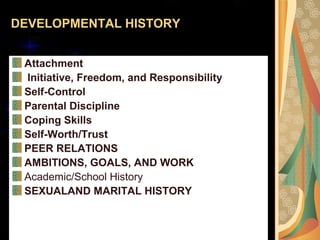
DEVELOPMENTAL HISTORY
Attachment
Initiative, Freedom, and Responsibility
Self-Control
Parental Discipline
Coping Skills
Self-Worth/Trust
PEER RELATIONS
AMBITIONS, GOALS, AND WORK
Academic/School History
SEXUALAND MARITAL HISTORY
Client encountered major problems
in his life:
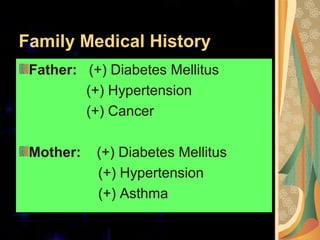
Family Medical History
Father: (+) Diabetes Mellitus
(+) Hypertension
(+) Cancer
Mother: (+) Diabetes Mellitus
(+) Hypertension
(+) Asthma
MEDICAL HISTORY
PRENATAL
BIRTH
INFANCY AND CHILDHOOD
Mental Status Exam (Sept. 12, 2012)
A. GENERAL APPEARANCE
Pt. came wearing dark blue shirt, black shorts, a
pair of slippers, fairly groomed and with haggard
looking face
B. GENERAL MOBILITY
Posture and Gait was normal, with distant facial
expression.
C. BEHAVIOR
Had good eye to eye contact upon interview and was
listening
attentively with the questions.
D. DOCTOR-PATIENT INTERACTION
He was cooperative all throughout the interview
and with a warm quality
of responses.
E. STREAM OF TALK
AJ was spontaneous and able to give relevant
responses to the questions although
with flight of ideas at times. Accessibility was
good.
F. EMOTIONAL STATE AND REACTION
With euthymic mood, appropriate affect,
depersonalization and homicidal were
not apparent although suicidal potential was present (with
history of OD prior to admission).
G. THOUGHT CONTENT
Hallucination were not apparent upon interview but
according to father patient
was yelling all to himself alone (1 day prior to admission).
Delusions, ideas of
reference, De’javu and jaimais vu were not apparent but
client was pre-occupied
about overdosing 30 tablets of Clonazepam prior to
admission.
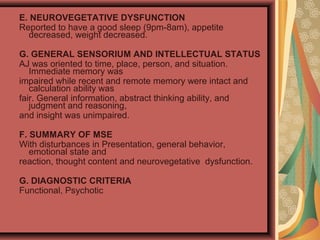
E. NEUROVEGETATIVE DYSFUNCTION
Reported to have a good sleep (9pm-8am), appetite
decreased, weight decreased.
G. GENERAL SENSORIUM AND INTELLECTUAL STATUS
AJ was oriented to time, place, person, and situation.
Immediate memory was
impaired while recent and remote memory were intact and
calculation ability was
fair. General information, abstract thinking ability, and
judgment and reasoning,
and insight was unimpaired.
F. SUMMARY OF MSE
With disturbances in Presentation, general behavior,
emotional state and
reaction, thought content and neurovegetative dysfunction.
G. DIAGNOSTIC CRITERIA
Functional, Psychotic
of
AJ
PSYCHOLOGICAL TEST
EVALUATION
Purpose for Evaluation:
To determine the intellectual capacity,
personality dynamics and
psychological adjustment of the
Subject as part of a comprehensive
case study and clinical diagnosis.
Psychological Tests Administered:
Raven’s Standard Progressive Matrices
Projective Drawings: Draw-a-Person (DAP) and
House-Tree Person (HTP)
SACHS Sentence Completion Test
Minnesota Multiphasic Personality Inventory -2
(MMPI-2)
Millon™ Clinical Multiaxial Inventory-III (MCMI-III)
DATE ADMINISTERED:
July 26-31, 2012; September 19, 2012
Test Results and Interpretation:
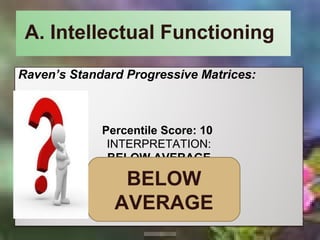
Raven’s Standard Progressive Matrices:
Percentile Score: 10
INTERPRETATION:
BELOW AVERAGE
A. Intellectual Functioning
BELOW
AVERAGE
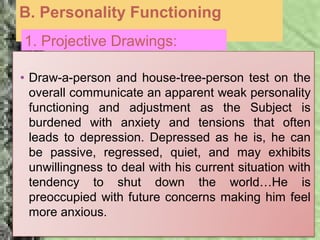
B. Personality Functioning
1. Projective Drawings:
• Draw-a-person and house-tree-person test on the
overall communicate an apparent weak personality
functioning and adjustment as the Subject is
burdened with anxiety and tensions that often
leads to depression. Depressed as he is, he can
be passive, regressed, quiet, and may exhibits
unwillingness to deal with his current situation with
tendency to shut down the world…He is
preoccupied with future concerns making him feel
more anxious.
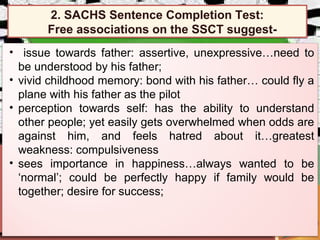
• issue towards father: assertive, unexpressive…need to
be understood by his father;
• vivid childhood memory: bond with his father… could fly a
plane with his father as the pilot
• perception towards self: has the ability to understand
other people; yet easily gets overwhelmed when odds are
against him, and feels hatred about it…greatest
weakness: compulsiveness
• sees importance in happiness…always wanted to be
‘normal’; could be perfectly happy if family would be
together; desire for success;
2. SACHS Sentence Completion Test:
Free associations on the SSCT suggest-
2. SACHS Sentence Completion Test:
Free associations on the SSCT suggest-
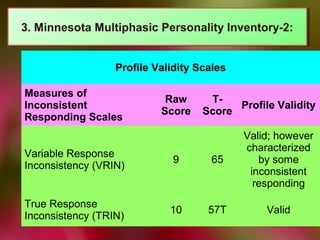
3. Minnesota Multiphasic Personality Inventory-2:3. Minnesota Multiphasic Personality Inventory-2:
Profile Validity Scales
Measures of
Inconsistent
Responding Scales
Raw
Score
T-
Score
Profile Validity
Variable Response
Inconsistency (VRIN)
9 65
Valid; however
characterized
by some
inconsistent
responding
True Response
Inconsistency (TRIN)
10 57T Valid
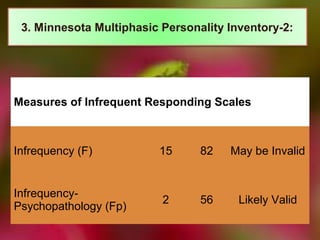
3. Minnesota Multiphasic Personality Inventory-2:
Measures of Infrequent Responding Scales
Infrequency (F) 15 82 May be Invalid
Infrequency-
Psychopathology (Fp)
2 56 Likely Valid
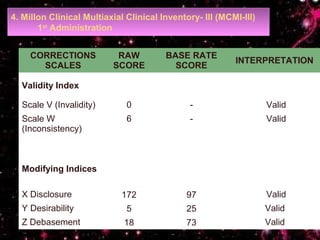
4. Millon Clinical Multiaxial Clinical Inventory- III (MCMI-III)
1st
Administration
CORRECTIONS
SCALES
RAW
SCORE
BASE RATE
SCORE
INTERPRETATION
Validity Index
Scale V (Invalidity) 0 - Valid
Scale W
(Inconsistency)
6 - Valid
Modifying Indices
X Disclosure 172 97 Valid
Y Desirability 5 25 Valid
Z Debasement 18 73 Valid
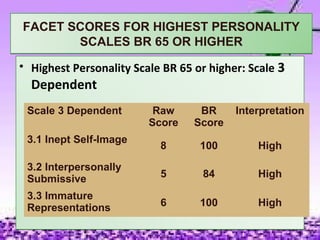
FACET SCORES FOR HIGHEST PERSONALITY
SCALES BR 65 OR HIGHER
• Highest Personality Scale BR 65 or higher: Scale 3
Dependent
Scale 3 Dependent Raw
Score
BR
Score
Interpretation
3.1 Inept Self-Image
8 100 High
3.2 Interpersonally
Submissive 5 84 High
3.3 Immature
Representations 6 100 High
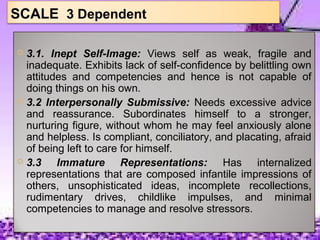
SCALE 3 Dependent
 3.1. Inept Self-Image: Views self as weak, fragile and
inadequate. Exhibits lack of self-confidence by belittling own
attitudes and competencies and hence is not capable of
doing things on his own.
 3.2 Interpersonally Submissive: Needs excessive advice
and reassurance. Subordinates himself to a stronger,
nurturing figure, without whom he may feel anxiously alone
and helpless. Is compliant, conciliatory, and placating, afraid
of being left to care for himself.
 3.3 Immature Representations: Has internalized
representations that are composed infantile impressions of
others, unsophisticated ideas, incomplete recollections,
rudimentary drives, childlike impulses, and minimal
competencies to manage and resolve stressors.
MCMI-III 2nd
Administration
September 19, 2012
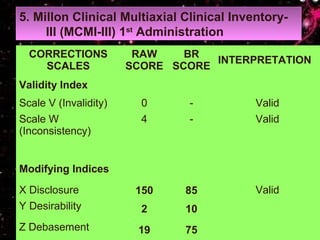
5. Millon Clinical Multiaxial Clinical Inventory-
III (MCMI-III) 1st
Administration
CORRECTIONS
SCALES
RAW
SCORE
BR
SCORE
INTERPRETATION
Validity Index
Scale V (Invalidity) 0 - Valid
Scale W
(Inconsistency)
4 - Valid
Modifying Indices
X Disclosure 150 85 Valid
Y Desirability 2 10
Z Debasement 19 75
DIAGNOSTIC IMPRESSIONDIAGNOSTIC IMPRESSION
Significant family problems and other feelings of
dissatisfaction with close relationships are evident.
There are also substance abuse problems on top
of Subject’s intense emotional distress
characterized by depression, anxiety and other
schizoid trends accompanied by bizarre sensory
experiences and suicidal ideation which are
incapacitating and quite alarming, more so, as this
is greatly affecting Subject’s intellectual
functioning as gleaned from a BA score on
Raven’s SPM.
Significant family problems and other feelings of
dissatisfaction with close relationships are evident.
There are also substance abuse problems on top
of Subject’s intense emotional distress
characterized by depression, anxiety and other
schizoid trends accompanied by bizarre sensory
experiences and suicidal ideation which are
incapacitating and quite alarming, more so, as this
is greatly affecting Subject’s intellectual
functioning as gleaned from a BA score on
Raven’s SPM.
DIAGNOSTIC IMPRESSION
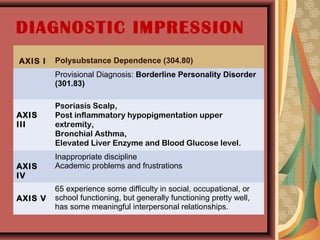
AXIS I Polysubstance Dependence (304.80)
Provisional Diagnosis: Borderline Personality Disorder
(301.83)
AXIS
III
Psoriasis Scalp,
Post inflammatory hypopigmentation upper
extremity,
Bronchial Asthma,
Elevated Liver Enzyme and Blood Glucose level.
AXIS
IV
Inappropriate discipline
Academic problems and frustrations
AXIS V
65 experience some difficulty in social, occupational, or
school functioning, but generally functioning pretty well,
has some meaningful interpersonal relationships.
AXIS I
304.80 Polysubstance Dependence
This diagnosis is reserved for behavior during the
same 12-month period in which the person was
repeatedly using at least three groups of
substances (not including caffeine and nicotine),
but no single substance predominated. Further,
during this period, the Dependence criteria were
met for substances as a group but not for any
specific substance. For example, a diagnosis of
Polysubstance Dependence would apply to an
individual who, during the same 12-month period,
missed. work because of his heavy use of alcohol,
continued to use cocaine despite experiencing
severe depressions after nights of heavy
consumption, and was repeatedly unable to stay
within his self-imposed limits regarding his use of
codeine. -PRESENT
AXIS II
Diagnostic criteria for 301.83 Borderline Personality
Disorder
A pervasive pattern of instability of interpersonal
relationships, self-image, and affects, and marked
impulsivity beginning by early adulthood and present in
a variety of contexts, as indicated by five (or more) of
the following:
(1) frantic efforts to avoid real or imagined
abandonment. Note: Do not include suicidal or self-
mutilating behavior covered in Criterion S.- PRESENT
(2) a pattern of unstable and intense interpersonal
relationships characterized by alternating between
extremes of idealization and devaluation
(3) identity disturbance: markedly and persistently
unstable se lf-image or sense of self
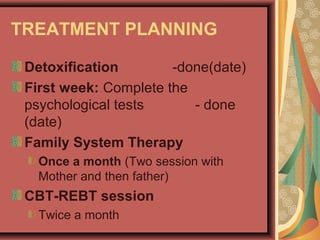
TREATMENT PLANNING
Detoxification -done(date)
First week: Complete the
psychological tests - done
(date)
Family System Therapy
Once a month (Two session with
Mother and then father)
CBT-REBT session
Twice a month
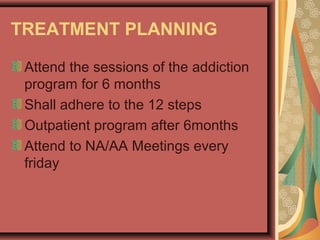
TREATMENT PLANNING
Attend the sessions of the addiction
program for 6 months
Shall adhere to the 12 steps
Outpatient program after 6months
Attend to NA/AA Meetings every
friday

Case presentation

  • 1.
  • 2.
    How does acase presentation looks like? Does it need to be one-on-one interaction?
  • 3.
    PURPOSECase Presentation isthe process of communicating the result of the assessment done by the clinician. Through this case presentation, client will be screened if there are evidences of underlying physical, mental and psychological dysfunction of the client to provide bases for a full clinical diagnosis and possible therapeutic interventions that will be discussed and formulated
  • 4.
    OBJECTIVES Objectives of casepresentation are:  Discuss a brief information about the client;  Discuss the reason for admission, medical and developmental history and psychological assessment of the client  Elaborate the diagnosis of the client using the DSM V and;  Discuss the possible therapeutic treatment and approaches for and on the client
  • 5.
    Who are involvedin the case presentation? PSYCHOLOGIST PSYCHIATRIST PSYCHIATRIC NURSE Psychometrician Social Worker Client/ immediate family Medical Doctor
  • 6.
    Identifying Information Name : Nickname: Age/Sex/ : 24/M Birth Date : Feb. 5, 1988 Birth Place: Davao City Birth Status: Middle Child Civil Status: Single/Unemployed Address : Date of admission:
  • 7.
    FAMILY COMPOSITION NAME RELATIONAGE STATUS/ OCCUPATION WHEREABOUTS Father 59/M Married /businessman (Pomelo and banana plantation) Mother 50/F Married /businesswoman (Pomelo and banana plantation) Brother 26/M Single/ currently reviewing for step 2 Medical Board Exam Client 24/M Single/Unemployed Sister 22/F Single/ Medical Student 1st year DMSF
  • 8.
    History of PresentIllness Presents how the client get into his current situation. It asks when did it started? How did it started? What are the cause?
  • 9.
  • 10.
    Presenting Problem As perceivedby the Significant Others How the family members see his situation? The loved one’s point of view
  • 11.
    Presenting Problem As perceivedby the Significant Others After discharge, the client went back into smoking and using drugs. He manifested hostility, aggression, verbal abusiveness, insomnia, hallucinations, and elevated mood eventually until behavior became unmanageable. Besides, he attempted to overdose himself with clonazepam after the prescription was left by his father under his responsibility. Family then decided to readmit the client for re-evaluation and further treatment.
  • 12.
    As perceived bythe Client How the client sees his situation? The client’s point of view
  • 13.
    FAMILY HISTORY Roles played Lifestyle Disciplinary practices Challenges experienced
  • 14.
    Like other families,they also experienced troubles, challenges, and turmoil:
  • 15.
  • 16.
    DEVELOPMENTAL HISTORY Attachment Initiative, Freedom,and Responsibility Self-Control Parental Discipline Coping Skills Self-Worth/Trust PEER RELATIONS AMBITIONS, GOALS, AND WORK Academic/School History SEXUALAND MARITAL HISTORY
  • 17.
    Client encountered majorproblems in his life:
  • 18.
    Family Medical History Father:(+) Diabetes Mellitus (+) Hypertension (+) Cancer Mother: (+) Diabetes Mellitus (+) Hypertension (+) Asthma
  • 19.
  • 20.
    Mental Status Exam(Sept. 12, 2012) A. GENERAL APPEARANCE Pt. came wearing dark blue shirt, black shorts, a pair of slippers, fairly groomed and with haggard looking face B. GENERAL MOBILITY Posture and Gait was normal, with distant facial expression. C. BEHAVIOR Had good eye to eye contact upon interview and was listening attentively with the questions.
  • 21.
    D. DOCTOR-PATIENT INTERACTION Hewas cooperative all throughout the interview and with a warm quality of responses. E. STREAM OF TALK AJ was spontaneous and able to give relevant responses to the questions although with flight of ideas at times. Accessibility was good.
  • 22.
    F. EMOTIONAL STATEAND REACTION With euthymic mood, appropriate affect, depersonalization and homicidal were not apparent although suicidal potential was present (with history of OD prior to admission). G. THOUGHT CONTENT Hallucination were not apparent upon interview but according to father patient was yelling all to himself alone (1 day prior to admission). Delusions, ideas of reference, De’javu and jaimais vu were not apparent but client was pre-occupied about overdosing 30 tablets of Clonazepam prior to admission.
  • 23.
    E. NEUROVEGETATIVE DYSFUNCTION Reportedto have a good sleep (9pm-8am), appetite decreased, weight decreased. G. GENERAL SENSORIUM AND INTELLECTUAL STATUS AJ was oriented to time, place, person, and situation. Immediate memory was impaired while recent and remote memory were intact and calculation ability was fair. General information, abstract thinking ability, and judgment and reasoning, and insight was unimpaired. F. SUMMARY OF MSE With disturbances in Presentation, general behavior, emotional state and reaction, thought content and neurovegetative dysfunction. G. DIAGNOSTIC CRITERIA Functional, Psychotic
  • 24.
  • 25.
    Purpose for Evaluation: Todetermine the intellectual capacity, personality dynamics and psychological adjustment of the Subject as part of a comprehensive case study and clinical diagnosis.
  • 26.
    Psychological Tests Administered: Raven’sStandard Progressive Matrices Projective Drawings: Draw-a-Person (DAP) and House-Tree Person (HTP) SACHS Sentence Completion Test Minnesota Multiphasic Personality Inventory -2 (MMPI-2) Millon™ Clinical Multiaxial Inventory-III (MCMI-III) DATE ADMINISTERED: July 26-31, 2012; September 19, 2012
  • 27.
    Test Results andInterpretation: Raven’s Standard Progressive Matrices: Percentile Score: 10 INTERPRETATION: BELOW AVERAGE A. Intellectual Functioning BELOW AVERAGE
  • 28.
    B. Personality Functioning 1.Projective Drawings: • Draw-a-person and house-tree-person test on the overall communicate an apparent weak personality functioning and adjustment as the Subject is burdened with anxiety and tensions that often leads to depression. Depressed as he is, he can be passive, regressed, quiet, and may exhibits unwillingness to deal with his current situation with tendency to shut down the world…He is preoccupied with future concerns making him feel more anxious.
  • 29.
    • issue towardsfather: assertive, unexpressive…need to be understood by his father; • vivid childhood memory: bond with his father… could fly a plane with his father as the pilot • perception towards self: has the ability to understand other people; yet easily gets overwhelmed when odds are against him, and feels hatred about it…greatest weakness: compulsiveness • sees importance in happiness…always wanted to be ‘normal’; could be perfectly happy if family would be together; desire for success; 2. SACHS Sentence Completion Test: Free associations on the SSCT suggest- 2. SACHS Sentence Completion Test: Free associations on the SSCT suggest-
  • 30.
    3. Minnesota MultiphasicPersonality Inventory-2:3. Minnesota Multiphasic Personality Inventory-2: Profile Validity Scales Measures of Inconsistent Responding Scales Raw Score T- Score Profile Validity Variable Response Inconsistency (VRIN) 9 65 Valid; however characterized by some inconsistent responding True Response Inconsistency (TRIN) 10 57T Valid
  • 31.
    3. Minnesota MultiphasicPersonality Inventory-2: Measures of Infrequent Responding Scales Infrequency (F) 15 82 May be Invalid Infrequency- Psychopathology (Fp) 2 56 Likely Valid
  • 32.
    4. Millon ClinicalMultiaxial Clinical Inventory- III (MCMI-III) 1st Administration CORRECTIONS SCALES RAW SCORE BASE RATE SCORE INTERPRETATION Validity Index Scale V (Invalidity) 0 - Valid Scale W (Inconsistency) 6 - Valid Modifying Indices X Disclosure 172 97 Valid Y Desirability 5 25 Valid Z Debasement 18 73 Valid
  • 33.
    FACET SCORES FORHIGHEST PERSONALITY SCALES BR 65 OR HIGHER • Highest Personality Scale BR 65 or higher: Scale 3 Dependent Scale 3 Dependent Raw Score BR Score Interpretation 3.1 Inept Self-Image 8 100 High 3.2 Interpersonally Submissive 5 84 High 3.3 Immature Representations 6 100 High
  • 34.
    SCALE 3 Dependent 3.1. Inept Self-Image: Views self as weak, fragile and inadequate. Exhibits lack of self-confidence by belittling own attitudes and competencies and hence is not capable of doing things on his own.  3.2 Interpersonally Submissive: Needs excessive advice and reassurance. Subordinates himself to a stronger, nurturing figure, without whom he may feel anxiously alone and helpless. Is compliant, conciliatory, and placating, afraid of being left to care for himself.  3.3 Immature Representations: Has internalized representations that are composed infantile impressions of others, unsophisticated ideas, incomplete recollections, rudimentary drives, childlike impulses, and minimal competencies to manage and resolve stressors.
  • 35.
  • 36.
    5. Millon ClinicalMultiaxial Clinical Inventory- III (MCMI-III) 1st Administration CORRECTIONS SCALES RAW SCORE BR SCORE INTERPRETATION Validity Index Scale V (Invalidity) 0 - Valid Scale W (Inconsistency) 4 - Valid Modifying Indices X Disclosure 150 85 Valid Y Desirability 2 10 Z Debasement 19 75
  • 37.
    DIAGNOSTIC IMPRESSIONDIAGNOSTIC IMPRESSION Significantfamily problems and other feelings of dissatisfaction with close relationships are evident. There are also substance abuse problems on top of Subject’s intense emotional distress characterized by depression, anxiety and other schizoid trends accompanied by bizarre sensory experiences and suicidal ideation which are incapacitating and quite alarming, more so, as this is greatly affecting Subject’s intellectual functioning as gleaned from a BA score on Raven’s SPM. Significant family problems and other feelings of dissatisfaction with close relationships are evident. There are also substance abuse problems on top of Subject’s intense emotional distress characterized by depression, anxiety and other schizoid trends accompanied by bizarre sensory experiences and suicidal ideation which are incapacitating and quite alarming, more so, as this is greatly affecting Subject’s intellectual functioning as gleaned from a BA score on Raven’s SPM.
  • 39.
    DIAGNOSTIC IMPRESSION AXIS IPolysubstance Dependence (304.80) Provisional Diagnosis: Borderline Personality Disorder (301.83) AXIS III Psoriasis Scalp, Post inflammatory hypopigmentation upper extremity, Bronchial Asthma, Elevated Liver Enzyme and Blood Glucose level. AXIS IV Inappropriate discipline Academic problems and frustrations AXIS V 65 experience some difficulty in social, occupational, or school functioning, but generally functioning pretty well, has some meaningful interpersonal relationships.
  • 40.
    AXIS I 304.80 PolysubstanceDependence This diagnosis is reserved for behavior during the same 12-month period in which the person was repeatedly using at least three groups of substances (not including caffeine and nicotine), but no single substance predominated. Further, during this period, the Dependence criteria were met for substances as a group but not for any specific substance. For example, a diagnosis of Polysubstance Dependence would apply to an individual who, during the same 12-month period, missed. work because of his heavy use of alcohol, continued to use cocaine despite experiencing severe depressions after nights of heavy consumption, and was repeatedly unable to stay within his self-imposed limits regarding his use of codeine. -PRESENT
  • 41.
    AXIS II Diagnostic criteriafor 301.83 Borderline Personality Disorder A pervasive pattern of instability of interpersonal relationships, self-image, and affects, and marked impulsivity beginning by early adulthood and present in a variety of contexts, as indicated by five (or more) of the following: (1) frantic efforts to avoid real or imagined abandonment. Note: Do not include suicidal or self- mutilating behavior covered in Criterion S.- PRESENT (2) a pattern of unstable and intense interpersonal relationships characterized by alternating between extremes of idealization and devaluation (3) identity disturbance: markedly and persistently unstable se lf-image or sense of self
  • 42.
    TREATMENT PLANNING Detoxification -done(date) Firstweek: Complete the psychological tests - done (date) Family System Therapy Once a month (Two session with Mother and then father) CBT-REBT session Twice a month
  • 43.
    TREATMENT PLANNING Attend thesessions of the addiction program for 6 months Shall adhere to the 12 steps Outpatient program after 6months Attend to NA/AA Meetings every friday