Ms. Anubha Rastogi
Astt. Prof, Vidya School Of Business
2015-16
Personnel Planning & Recruitment
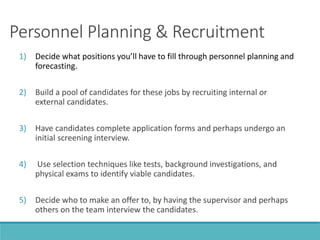
1) Decide what positions you’ll have to fill through personnel planning and
forecasting.
2) Build a pool of candidates for these jobs by recruiting internal or
external candidates.
3) Have candidates complete application forms and perhaps undergo an
initial screening interview.
4) Use selection techniques like tests, background investigations, and
physical exams to identify viable candidates.
5) Decide who to make an offer to, by having the supervisor and perhaps
others on the team interview the candidates.

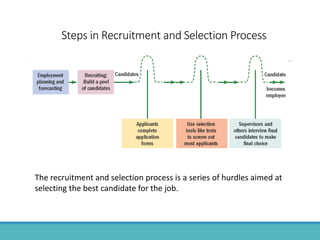
Steps in Recruitment and Selection Process
The recruitment and selection process is a series of hurdles aimed at
selecting the best candidate for the job.
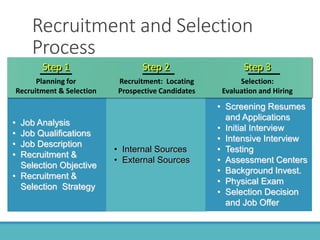
Recruitment and Selection
Process
• Job Analysis
• Job Qualifications
• Job Description
• Recruitment &
Selection Objective
• Recruitment &
Selection Strategy
• Internal Sources
• External Sources
• Screening Resumes
and Applications
• Initial Interview
• Intensive Interview
• Testing
• Assessment Centers
• Background Invest.
• Physical Exam
• Selection Decision
and Job Offer
Planning for
Recruitment & Selection
Step 1
Recruitment: Locating
Prospective Candidates
Step 2
Selection:
Evaluation and Hiring
Step 3
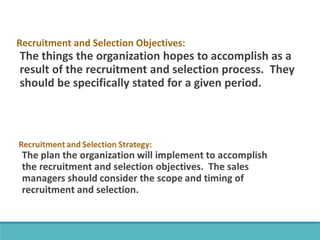
Recruitment and Selection Objectives:
The things the organization hopes to accomplish as a
result of the recruitment and selection process. They
should be specifically stated for a given period.
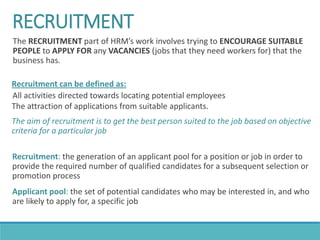
RECRUITMENT
The RECRUITMENT part of HRM’s work involves trying to ENCOURAGE SUITABLE
PEOPLE to APPLY FOR any VACANCIES (jobs that they need workers for) that the
business has.
Recruitment can be defined as:
All activities directed towards locating potential employees
The attraction of applications from suitable applicants.
The aim of recruitment is to get the best person suited to the job based on objective
criteria for a particular job
Recruitment: the generation of an applicant pool for a position or job in order to
provide the required number of qualified candidates for a subsequent selection or
promotion process
Applicant pool: the set of potential candidates who may be interested in, and who
are likely to apply for, a specific job
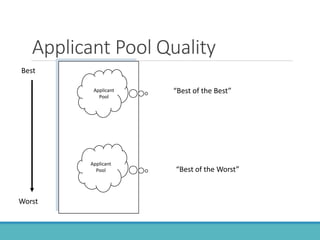
Applicant Pool Quality
Best
Worst
Applicant
Pool
“Best of the Best”
“Best of the Worst”
Applicant
Pool
Rules Of Recrutiment And Selection
Commonality
Openess
Competitiveness
Legality
Non-discrimination
Constancy of criteria
Neutrality
Objectivism
Transparency
Personal data security
Acting without delay
The breadth and quality of the process
The size of the labour pool and the location of jobs
Offered pay and benefits
Job quality and requirements of the position
Organizational image
Elements Influencing Effectiveness Of
Recruitment:
Constraints & Challenges Of
Recruitment
1. Poor Image
2. Unattractive Job
3. Conservative Internal Policies
4. Limited Budgetary approach
5. Restrictive policies of Gov.
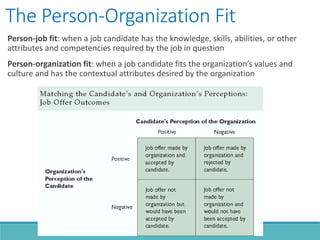
Person-job fit: when a job candidate has the knowledge, skills, abilities, or other
attributes and competencies required by the job in question
Person-organization fit: when a job candidate fits the organization’s values and
culture and has the contextual attributes desired by the organization
The Person-Organization Fit
Purpose of Recruitment
Increase pool of potential job candidates
Increase success rate of the selection process
Make ensure the right people is selected against vacant position (minimizing probability
of leaving organization in case of selection of wrong or misfit candidate)
Meeting legal and social obligation of workforce composition
Identify and encouraging potential candidates/job applicants
Evaluating the effectiveness of available sources and techniques of recruitment
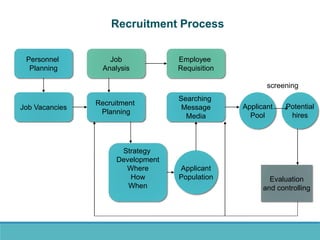
Recruitment Process
Potential
hires
Personnel
Planning
Job Vacancies
Job
Analysis
Recruitment
Planning
Employee
Requisition
Searching
Message
Media
Strategy
Development
Where
How
When
Applicant
Population
Applicant
Pool
Evaluation
and controlling
screening
RECRUITMENT PROCESS
The steps in the recruitment process are to:
Identify the job vacancy
Carry out a job analysis
Prepare a Job Description
Prepare a Person Specification
Advertise the job
Sent out application forms
JOB ANALYSIS
Job analysis involves finding out everything about
what a job involves by identifying the following:
Tasks to be completed in the job
Responsibilities of the job
Technology that is used in the job
Knowledge needed to carry out the job
Skills needed to carry out the job
Level of initiative needed from staff
ADVERTISE THE JOB
Candidates cannot apply for a job unless they know it
exists and this is where advertising comes in. The
information for the advert will be taken from the Job
Description and Person Specification.
A job vacancy can be advertised:
INTERNALLY eg by email or a poster on a staff noticeboard (this
results in existing staff being promoted which will create another
vacancy)
EXTERNALLY eg in a local or national newspaper, on the business
website, via a social networking site, via a recruitment agency or
at a Job Centre (this results in a new member of staff being
found)
RECEIVE APPLICATIONS
Applications can be received in 2 ways:
By a candidate completing an APPLICATION FORM
(either on paper or on-line)
By a candidate sending a copy of their CV (Curriculum
Vitae)
Businesses may prefer the Application Form as all
candidates answer the same questions in the
same order, which makes it easier for them to
compare each candidate’s application.
INFORMATION ON APPLICATION FORM/CV
Information collected by either method should contain
details of each applicant’s:
Personal details eg name and contact details
Qualifications and skills
Previous work experience
Reasons why they want the job/feel suited to the job
Specific questions relating to the job
A personal statement
Referee’s contact details
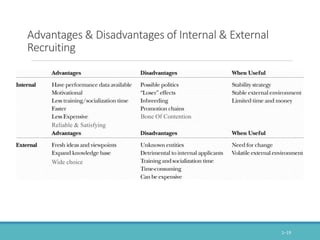
Advantages & Disadvantages of Internal & External
Recruiting
1–19
Bone Of Contention
Reliable & Satisfying
Wide choice
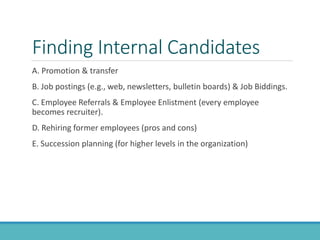
Finding Internal Candidates
A. Promotion & transfer
B. Job postings (e.g., web, newsletters, bulletin boards) & Job Biddings.
C. Employee Referrals & Employee Enlistment (every employee
becomes recruiter).
D. Rehiring former employees (pros and cons)
E. Succession planning (for higher levels in the organization)
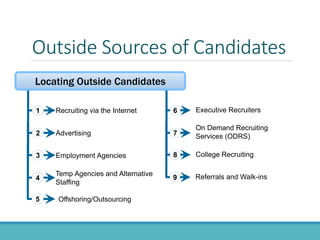
Outside Sources of Candidates
1
2
3
4
5
Advertising
Recruiting via the Internet
Employment Agencies
Temp Agencies and Alternative
Staffing
Offshoring/Outsourcing
6
7
8
9
On Demand Recruiting
Services (ODRS)
Executive Recruiters
College Recruiting
Referrals and Walk-ins
Locating Outside Candidates
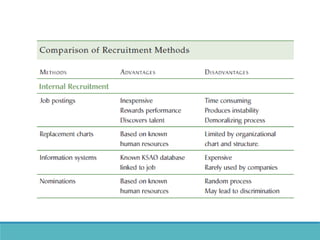
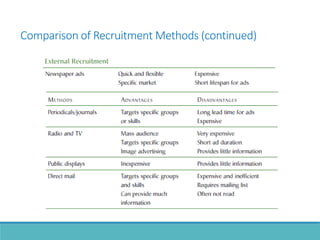
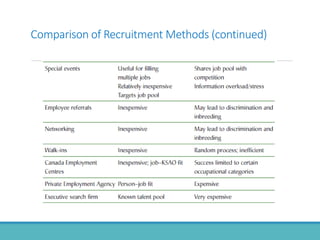
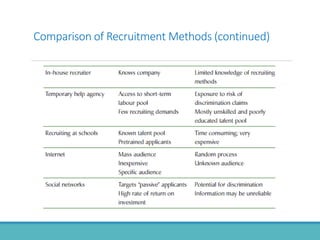
Comparison of Recruitment Methods (continued)
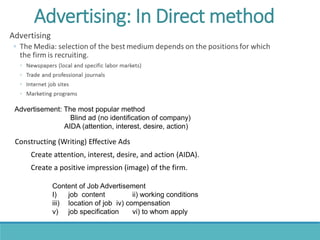
Advertisement: The most popular method
Blind ad (no identification of company)
AIDA (attention, interest, desire, action)
Content of Job Advertisement
I) job content ii) working conditions
iii) location of job iv) compensation
v) job specification vi) to whom apply
Constructing (Writing) Effective Ads
Create attention, interest, desire, and action (AIDA).
Create a positive impression (image) of the firm.
Advertising: In Direct method
Other Methods
A) private employment Search Firms
B) Employment Exchanges
C) Gate Hiring & Contracting
D) Unsolicited Applications / Walk-ins
E) Internet recruiting
F) Raiding
G) Nepotism: Hiring relatives.
◦ Does your organization have a policy on nepotism?
◦ May be discriminatory.
◦ Must ensure individuals are not in supervisory positions managing their own relatives.
◦ May create issues of favoritism.
Recruiting via the Internet
Advantages
◦ Cost-effective way to publicize job openings
◦ More applicants attracted over a longer period
◦ Immediate applicant responses
◦ Online prescreening of applicants
◦ Links to other job search sites
◦ Automation of applicant tracking and evaluation
Disadvantages
◦ Exclusion of older and minority workers
◦ Unqualified applicants overload the system
◦ Personal information privacy concerns of applicants
Employee Referrals and Walk-
ins
Employee Referrals
◦ Referring employees become stakeholders.
◦ Referral is a cost-effective recruitment program.
◦ Referral can speed up diversifying the workforce.
◦ Relying on referrals may be discriminatory.
Walk-ins
◦ Seek employment through a personal direct approach to the employer.
◦ Courteous treatment of any applicant is a good business practice.
Outside Sources of Candidates
Executive recruiters (headhunters)
◦ Special employment agencies retained by employers to seek out top-
management talent for their clients.
◦ Contingent-based recruiters collect a fee for their services when a successful hire is completed.
◦ Retained executive searchers are paid regardless of the outcome of the recruitment process.
◦ Internet technology and specialization trends are changing how candidates
are attracted and how searches are conducted.
Outside Sources of Candidates
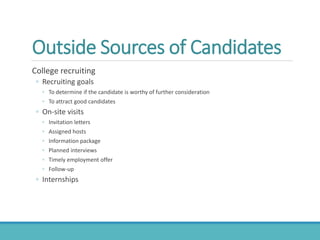
College recruiting
◦ Recruiting goals
◦ To determine if the candidate is worthy of further consideration
◦ To attract good candidates
◦ On-site visits
◦ Invitation letters
◦ Assigned hosts
◦ Information package
◦ Planned interviews
◦ Timely employment offer
◦ Follow-up
◦ Internships
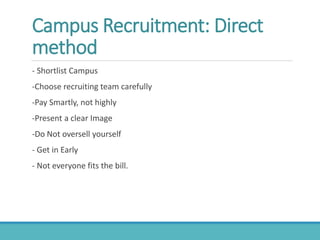
Campus Recruitment: Direct
method
- Shortlist Campus
-Choose recruiting team carefully
-Pay Smartly, not highly
-Present a clear Image
-Do Not oversell yourself
- Get in Early
- Not everyone fits the bill.
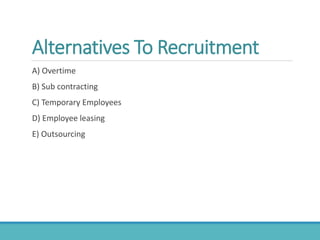
Alternatives To Recruitment
A) Overtime
B) Sub contracting
C) Temporary Employees
D) Employee leasing
E) Outsourcing
Temp Agencies and Alternative
Staffing
Benefits of Temps
◦ Paid only when working
◦ More productive
◦ No recruitment, screening,
and payroll administration
costs
Costs of Temps
◦ Fees paid to temp agencies
◦ Lack of commitment to firm
Offshoring/Outsourcing
White-Collar and Other Jobs
Specific issues in outsourcing jobs abroad
◦ Political and military instability
◦ Likelihood of cultural misunderstandings
◦ Customers’ security and privacy concerns
◦ Foreign contracts, liability, and legal concerns
◦ Special training of foreign employees
◦ Costs associated with companies supplying foreign workers
Measuring Recruiting Effectiveness
What to measure and how to measure
◦ How many qualified applicants were attracted from each recruitment source?
◦ Assessing both the quantity and the quality of the applicants produced by a source.
High performance recruiting
◦ Applying best-practices management techniques to recruiting.
◦ Using a benchmarks-oriented approach to analyzing and measuring the effectiveness of recruiting
efforts such as employee referrals.
Evaluation and Controlling
- Recruitment process is very expensive and crucial
- Salaries of recruiters
- Time spent on preparing job analysis data
- Cost of overtime and outsourcing during vacancies unfilled
- Cost of recruiting
Evaluation of Recruitment Process
- Number of suitable candidates
- Number of application received
- Performance and retention of selected candidate
- Cost of process and time lapsed
- Image Projected
Time Lapse Data
Yield Ratio
Surveys & Studies
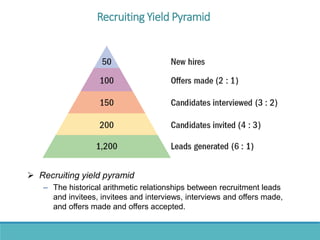
Recruiting Yield Pyramid
 Recruiting yield pyramid
– The historical arithmetic relationships between recruitment leads
and invitees, invitees and interviews, interviews and offers made,
and offers made and offers accepted.
SCREENING
~ Preliminary Application
~ Test of deselection
~ Screening Interviews
-There is no definite number of applicants that should be
interviewed. The decision will depend on:
-the number of applicants,
-the quality of their applications,
-the number & type of jobs available, and
-the amount of time available.
Selection
Selection
◦ The process that managers use to determine the relative qualifications of job
applicants and their potential for performing well in a particular job.
~ Identify the best candidates from those that have applied
~ Draw up a short list
~ Interview the candidates on the short list
~ Carry out testing of the candidates
~ Check the candidates references
~ Select the best person for the job
SELECTION PROCESS
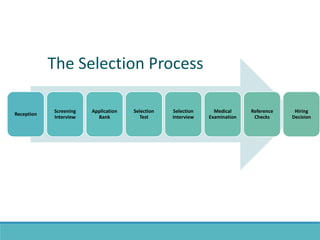
Reception
Screening
Interview
Application
Bank
Selection
Test
Selection
Interview
Medical
Examination
Reference
Checks
Hiring
Decision
The Selection Process
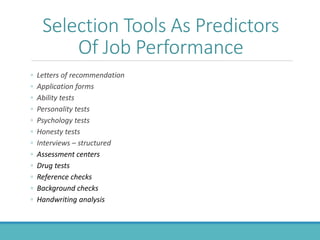
Selection Tools As Predictors
Of Job Performance
◦ Letters of recommendation
◦ Application forms
◦ Ability tests
◦ Personality tests
◦ Psychology tests
◦ Honesty tests
◦ Interviews – structured
◦ Assessment centers
◦ Drug tests
◦ Reference checks
◦ Background checks
◦ Handwriting analysis
Selection Testing
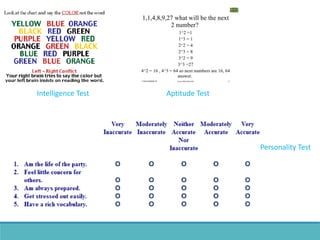
Intelligence Test
Aptitude Test
Personality Test (PIP) [Projective, Interest, Preference]
Achievement Test
Simulation Test
Assessment Centre [ In-basket, Leaderless Group Discussion, Business
Games]
Graphology Test [Handwriting Test]
Polygraph Test [Lie Detector Test]
Integrity Test
Intelligence Test Aptitude Test
Personality Test
An in-basket test or an in-basket exercise is a test used by companies and governments
in hiring and promoting employees. During the test, job applicants receive a number of
mails, telephone calls, documents and memos. They then have a limited period of
time to set priorities, organize their working schedule accordingly and respond to mail
and phone calls.
It also helps in acquainting employees about their job where a number of problems
are kept in the "in basket "(usually kept on the desk of the employee). The worker has
to look at the problems which could also be complaints from different employees and
simultaneously deal with those problems. As the employee solves these problem,
he/she transfers them to the "out-basket".
In basket exercises are often part of Assessment centers that are comprehensive multi-
day assessments involving a variety of simulation exercises and tests, typically used to
identify management talent.
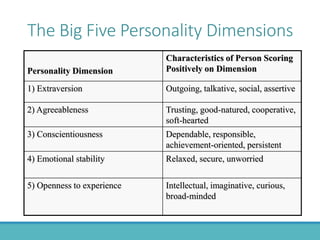
The Big Five Personality Dimensions
Personality Dimension
Characteristics of Person Scoring
Positively on Dimension
1) Extraversion Outgoing, talkative, social, assertive
2) Agreeableness Trusting, good-natured, cooperative,
soft-hearted
3) Conscientiousness Dependable, responsible,
achievement-oriented, persistent
4) Emotional stability Relaxed, secure, unworried
5) Openness to experience Intellectual, imaginative, curious,
broad-minded
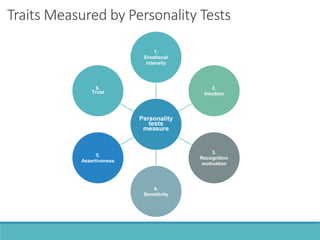
Traits Measured by Personality Tests
Personality
tests
measure
1.
Emotional
intensity
2.
Intuition
3.
Recognition
motivation
4.
Sensitivity
5.
Assertiveness
6.
Trust
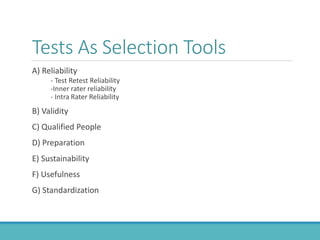
Tests As Selection Tools
A) Reliability
- Test Retest Reliability
-Inner rater reliability
- Intra Rater Reliability
B) Validity
C) Qualified People
D) Preparation
E) Sustainability
F) Usefulness
G) Standardization
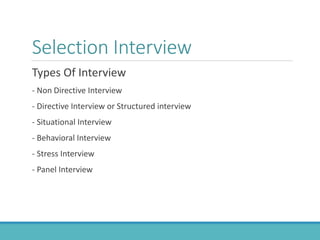
Selection Interview
Types Of Interview
- Non Directive Interview
- Directive Interview or Structured interview
- Situational Interview
- Behavioral Interview
- Stress Interview
- Panel Interview
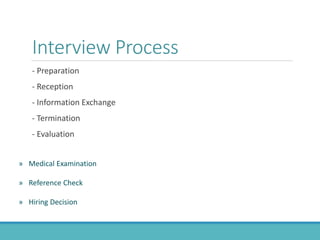
Interview Process
- Preparation
- Reception
- Information Exchange
- Termination
- Evaluation
» Medical Examination
» Reference Check
» Hiring Decision
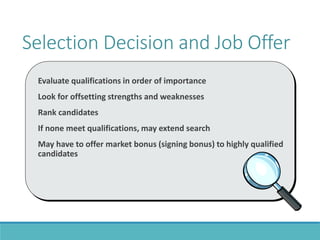
Selection Decision and Job Offer
Evaluate qualifications in order of importance
Look for offsetting strengths and weaknesses
Rank candidates
If none meet qualifications, may extend search
May have to offer market bonus (signing bonus) to highly qualified
candidates
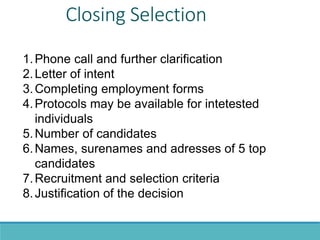
Closing Selection
1.Phone call and further clarification
2.Letter of intent
3.Completing employment forms
4.Protocols may be available for intetested
individuals
5.Number of candidates
6.Names, surenames and adresses of 5 top
candidates
7.Recruitment and selection criteria
8.Justification of the decision
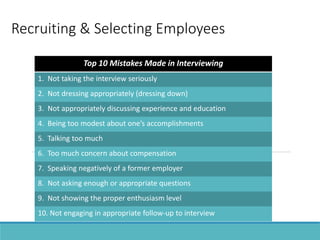
Recruiting & Selecting Employees
Top 10 Mistakes Made in Interviewing
1. Not taking the interview seriously
2. Not dressing appropriately (dressing down)
3. Not appropriately discussing experience and education
4. Being too modest about one’s accomplishments
5. Talking too much
6. Too much concern about compensation
7. Speaking negatively of a former employer
8. Not asking enough or appropriate questions
9. Not showing the proper enthusiasm level
10. Not engaging in appropriate follow-up to interview
Post Selection Strategies
-Making the Job Offer;
- An offer of employment may be made either verbally or in writing;
- Typically a verbal offer is made first, followed by a written offer once the
applicant accepts;
- The offer remains such until such time as the applicants [unconditionally]
accepts (either verbally or in writing);
- Note that the job advertisement is not a job offer, rather an invitation to
apply for employment;
- Employment offers should not be made during or immediately after the
employment interview;
- When making offers, employers should ensure they do not make any
statements that are misleading or deceptive (possible breaches of s31 of Sch 2 of the
Competition & Consumer Act 2010);
Post Selection Strategies
-Acceptance of the Job Offer;
- Ensure that the offer & acceptance of the Job Offer occur in a structured &
professional manner;
- Ensure that both parties clearly understand their respective rights &
obligations;
- A legally binding contract is made when the person whom the offer is made,
accepts that offer without qualification;
- Prior to that, it’s still an offer, which can be negotiated & modified;
- Offers are generally made & accepted verbally (hastens the process);
- Following the acceptance the official appointment letter is provided detailing
the terms & conditions of employment;
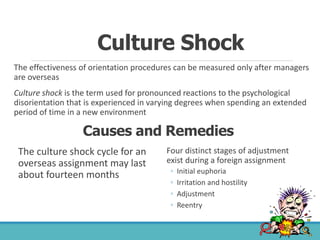
Culture Shock
The effectiveness of orientation procedures can be measured only after managers
are overseas
Culture shock is the term used for pronounced reactions to the psychological
disorientation that is experienced in varying degrees when spending an extended
period of time in a new environment
55
Causes and Remedies
The culture shock cycle for an
overseas assignment may last
about fourteen months
Four distinct stages of adjustment
exist during a foreign assignment
◦ Initial euphoria
◦ Irritation and hostility
◦ Adjustment
◦ Reentry
Staffing: Recruitment and Selection

Staffing: Recruitment and Selection

  • 1.
    Ms. Anubha Rastogi Astt.Prof, Vidya School Of Business 2015-16
  • 2.
    Personnel Planning &Recruitment 1) Decide what positions you’ll have to fill through personnel planning and forecasting. 2) Build a pool of candidates for these jobs by recruiting internal or external candidates. 3) Have candidates complete application forms and perhaps undergo an initial screening interview. 4) Use selection techniques like tests, background investigations, and physical exams to identify viable candidates. 5) Decide who to make an offer to, by having the supervisor and perhaps others on the team interview the candidates.
  • 3.
    Steps in Recruitmentand Selection Process The recruitment and selection process is a series of hurdles aimed at selecting the best candidate for the job.
  • 4.
    Recruitment and Selection Process •Job Analysis • Job Qualifications • Job Description • Recruitment & Selection Objective • Recruitment & Selection Strategy • Internal Sources • External Sources • Screening Resumes and Applications • Initial Interview • Intensive Interview • Testing • Assessment Centers • Background Invest. • Physical Exam • Selection Decision and Job Offer Planning for Recruitment & Selection Step 1 Recruitment: Locating Prospective Candidates Step 2 Selection: Evaluation and Hiring Step 3
  • 5.
    Recruitment and SelectionObjectives: The things the organization hopes to accomplish as a result of the recruitment and selection process. They should be specifically stated for a given period.
  • 6.
    RECRUITMENT The RECRUITMENT partof HRM’s work involves trying to ENCOURAGE SUITABLE PEOPLE to APPLY FOR any VACANCIES (jobs that they need workers for) that the business has. Recruitment can be defined as: All activities directed towards locating potential employees The attraction of applications from suitable applicants. The aim of recruitment is to get the best person suited to the job based on objective criteria for a particular job Recruitment: the generation of an applicant pool for a position or job in order to provide the required number of qualified candidates for a subsequent selection or promotion process Applicant pool: the set of potential candidates who may be interested in, and who are likely to apply for, a specific job
  • 7.
    Applicant Pool Quality Best Worst Applicant Pool “Bestof the Best” “Best of the Worst” Applicant Pool
  • 8.
    Rules Of RecrutimentAnd Selection Commonality Openess Competitiveness Legality Non-discrimination Constancy of criteria Neutrality Objectivism Transparency Personal data security Acting without delay
  • 9.
    The breadth andquality of the process The size of the labour pool and the location of jobs Offered pay and benefits Job quality and requirements of the position Organizational image Elements Influencing Effectiveness Of Recruitment:
  • 10.
    Constraints & ChallengesOf Recruitment 1. Poor Image 2. Unattractive Job 3. Conservative Internal Policies 4. Limited Budgetary approach 5. Restrictive policies of Gov.
  • 11.
    Person-job fit: whena job candidate has the knowledge, skills, abilities, or other attributes and competencies required by the job in question Person-organization fit: when a job candidate fits the organization’s values and culture and has the contextual attributes desired by the organization The Person-Organization Fit
  • 12.
    Purpose of Recruitment Increasepool of potential job candidates Increase success rate of the selection process Make ensure the right people is selected against vacant position (minimizing probability of leaving organization in case of selection of wrong or misfit candidate) Meeting legal and social obligation of workforce composition Identify and encouraging potential candidates/job applicants Evaluating the effectiveness of available sources and techniques of recruitment
  • 13.
  • 14.
    RECRUITMENT PROCESS The stepsin the recruitment process are to: Identify the job vacancy Carry out a job analysis Prepare a Job Description Prepare a Person Specification Advertise the job Sent out application forms
  • 15.
    JOB ANALYSIS Job analysisinvolves finding out everything about what a job involves by identifying the following: Tasks to be completed in the job Responsibilities of the job Technology that is used in the job Knowledge needed to carry out the job Skills needed to carry out the job Level of initiative needed from staff
  • 16.
    ADVERTISE THE JOB Candidatescannot apply for a job unless they know it exists and this is where advertising comes in. The information for the advert will be taken from the Job Description and Person Specification. A job vacancy can be advertised: INTERNALLY eg by email or a poster on a staff noticeboard (this results in existing staff being promoted which will create another vacancy) EXTERNALLY eg in a local or national newspaper, on the business website, via a social networking site, via a recruitment agency or at a Job Centre (this results in a new member of staff being found)
  • 17.
    RECEIVE APPLICATIONS Applications canbe received in 2 ways: By a candidate completing an APPLICATION FORM (either on paper or on-line) By a candidate sending a copy of their CV (Curriculum Vitae) Businesses may prefer the Application Form as all candidates answer the same questions in the same order, which makes it easier for them to compare each candidate’s application.
  • 18.
    INFORMATION ON APPLICATIONFORM/CV Information collected by either method should contain details of each applicant’s: Personal details eg name and contact details Qualifications and skills Previous work experience Reasons why they want the job/feel suited to the job Specific questions relating to the job A personal statement Referee’s contact details
  • 19.
    Advantages & Disadvantagesof Internal & External Recruiting 1–19 Bone Of Contention Reliable & Satisfying Wide choice
  • 20.
    Finding Internal Candidates A.Promotion & transfer B. Job postings (e.g., web, newsletters, bulletin boards) & Job Biddings. C. Employee Referrals & Employee Enlistment (every employee becomes recruiter). D. Rehiring former employees (pros and cons) E. Succession planning (for higher levels in the organization)
  • 21.
    Outside Sources ofCandidates 1 2 3 4 5 Advertising Recruiting via the Internet Employment Agencies Temp Agencies and Alternative Staffing Offshoring/Outsourcing 6 7 8 9 On Demand Recruiting Services (ODRS) Executive Recruiters College Recruiting Referrals and Walk-ins Locating Outside Candidates
  • 23.
    Comparison of RecruitmentMethods (continued)
  • 24.
    Comparison of RecruitmentMethods (continued)
  • 25.
    Comparison of RecruitmentMethods (continued)
  • 26.
    Advertisement: The mostpopular method Blind ad (no identification of company) AIDA (attention, interest, desire, action) Content of Job Advertisement I) job content ii) working conditions iii) location of job iv) compensation v) job specification vi) to whom apply Constructing (Writing) Effective Ads Create attention, interest, desire, and action (AIDA). Create a positive impression (image) of the firm. Advertising: In Direct method
  • 27.
    Other Methods A) privateemployment Search Firms B) Employment Exchanges C) Gate Hiring & Contracting D) Unsolicited Applications / Walk-ins E) Internet recruiting F) Raiding G) Nepotism: Hiring relatives. ◦ Does your organization have a policy on nepotism? ◦ May be discriminatory. ◦ Must ensure individuals are not in supervisory positions managing their own relatives. ◦ May create issues of favoritism.

  • 28.
    Recruiting via theInternet Advantages ◦ Cost-effective way to publicize job openings ◦ More applicants attracted over a longer period ◦ Immediate applicant responses ◦ Online prescreening of applicants ◦ Links to other job search sites ◦ Automation of applicant tracking and evaluation Disadvantages ◦ Exclusion of older and minority workers ◦ Unqualified applicants overload the system ◦ Personal information privacy concerns of applicants
  • 29.
    Employee Referrals andWalk- ins Employee Referrals ◦ Referring employees become stakeholders. ◦ Referral is a cost-effective recruitment program. ◦ Referral can speed up diversifying the workforce. ◦ Relying on referrals may be discriminatory. Walk-ins ◦ Seek employment through a personal direct approach to the employer. ◦ Courteous treatment of any applicant is a good business practice.
  • 30.
    Outside Sources ofCandidates Executive recruiters (headhunters) ◦ Special employment agencies retained by employers to seek out top- management talent for their clients. ◦ Contingent-based recruiters collect a fee for their services when a successful hire is completed. ◦ Retained executive searchers are paid regardless of the outcome of the recruitment process. ◦ Internet technology and specialization trends are changing how candidates are attracted and how searches are conducted.
  • 31.
    Outside Sources ofCandidates College recruiting ◦ Recruiting goals ◦ To determine if the candidate is worthy of further consideration ◦ To attract good candidates ◦ On-site visits ◦ Invitation letters ◦ Assigned hosts ◦ Information package ◦ Planned interviews ◦ Timely employment offer ◦ Follow-up ◦ Internships
  • 32.
    Campus Recruitment: Direct method -Shortlist Campus -Choose recruiting team carefully -Pay Smartly, not highly -Present a clear Image -Do Not oversell yourself - Get in Early - Not everyone fits the bill.
  • 33.
    Alternatives To Recruitment A)Overtime B) Sub contracting C) Temporary Employees D) Employee leasing E) Outsourcing
  • 34.
    Temp Agencies andAlternative Staffing Benefits of Temps ◦ Paid only when working ◦ More productive ◦ No recruitment, screening, and payroll administration costs Costs of Temps ◦ Fees paid to temp agencies ◦ Lack of commitment to firm
  • 35.
    Offshoring/Outsourcing White-Collar and OtherJobs Specific issues in outsourcing jobs abroad ◦ Political and military instability ◦ Likelihood of cultural misunderstandings ◦ Customers’ security and privacy concerns ◦ Foreign contracts, liability, and legal concerns ◦ Special training of foreign employees ◦ Costs associated with companies supplying foreign workers
  • 36.
    Measuring Recruiting Effectiveness Whatto measure and how to measure ◦ How many qualified applicants were attracted from each recruitment source? ◦ Assessing both the quantity and the quality of the applicants produced by a source. High performance recruiting ◦ Applying best-practices management techniques to recruiting. ◦ Using a benchmarks-oriented approach to analyzing and measuring the effectiveness of recruiting efforts such as employee referrals. Evaluation and Controlling - Recruitment process is very expensive and crucial - Salaries of recruiters - Time spent on preparing job analysis data - Cost of overtime and outsourcing during vacancies unfilled - Cost of recruiting Evaluation of Recruitment Process - Number of suitable candidates - Number of application received - Performance and retention of selected candidate - Cost of process and time lapsed - Image Projected Time Lapse Data Yield Ratio Surveys & Studies
  • 37.
    Recruiting Yield Pyramid Recruiting yield pyramid – The historical arithmetic relationships between recruitment leads and invitees, invitees and interviews, interviews and offers made, and offers made and offers accepted.
  • 38.
    SCREENING ~ Preliminary Application ~Test of deselection ~ Screening Interviews -There is no definite number of applicants that should be interviewed. The decision will depend on: -the number of applicants, -the quality of their applications, -the number & type of jobs available, and -the amount of time available.
  • 39.
    Selection Selection ◦ The processthat managers use to determine the relative qualifications of job applicants and their potential for performing well in a particular job. ~ Identify the best candidates from those that have applied ~ Draw up a short list ~ Interview the candidates on the short list ~ Carry out testing of the candidates ~ Check the candidates references ~ Select the best person for the job SELECTION PROCESS
  • 40.
  • 41.
    Selection Tools AsPredictors Of Job Performance ◦ Letters of recommendation ◦ Application forms ◦ Ability tests ◦ Personality tests ◦ Psychology tests ◦ Honesty tests ◦ Interviews – structured ◦ Assessment centers ◦ Drug tests ◦ Reference checks ◦ Background checks ◦ Handwriting analysis
  • 42.
    Selection Testing Intelligence Test AptitudeTest Personality Test (PIP) [Projective, Interest, Preference] Achievement Test Simulation Test Assessment Centre [ In-basket, Leaderless Group Discussion, Business Games] Graphology Test [Handwriting Test] Polygraph Test [Lie Detector Test] Integrity Test
  • 43.
    Intelligence Test AptitudeTest Personality Test
  • 44.
    An in-basket testor an in-basket exercise is a test used by companies and governments in hiring and promoting employees. During the test, job applicants receive a number of mails, telephone calls, documents and memos. They then have a limited period of time to set priorities, organize their working schedule accordingly and respond to mail and phone calls. It also helps in acquainting employees about their job where a number of problems are kept in the "in basket "(usually kept on the desk of the employee). The worker has to look at the problems which could also be complaints from different employees and simultaneously deal with those problems. As the employee solves these problem, he/she transfers them to the "out-basket". In basket exercises are often part of Assessment centers that are comprehensive multi- day assessments involving a variety of simulation exercises and tests, typically used to identify management talent.
  • 45.
    The Big FivePersonality Dimensions Personality Dimension Characteristics of Person Scoring Positively on Dimension 1) Extraversion Outgoing, talkative, social, assertive 2) Agreeableness Trusting, good-natured, cooperative, soft-hearted 3) Conscientiousness Dependable, responsible, achievement-oriented, persistent 4) Emotional stability Relaxed, secure, unworried 5) Openness to experience Intellectual, imaginative, curious, broad-minded
  • 46.
    Traits Measured byPersonality Tests Personality tests measure 1. Emotional intensity 2. Intuition 3. Recognition motivation 4. Sensitivity 5. Assertiveness 6. Trust
  • 47.
    Tests As SelectionTools A) Reliability - Test Retest Reliability -Inner rater reliability - Intra Rater Reliability B) Validity C) Qualified People D) Preparation E) Sustainability F) Usefulness G) Standardization
  • 48.
    Selection Interview Types OfInterview - Non Directive Interview - Directive Interview or Structured interview - Situational Interview - Behavioral Interview - Stress Interview - Panel Interview
  • 49.
    Interview Process - Preparation -Reception - Information Exchange - Termination - Evaluation » Medical Examination » Reference Check » Hiring Decision
  • 50.
    Selection Decision andJob Offer Evaluate qualifications in order of importance Look for offsetting strengths and weaknesses Rank candidates If none meet qualifications, may extend search May have to offer market bonus (signing bonus) to highly qualified candidates
  • 51.
    Closing Selection 1.Phone calland further clarification 2.Letter of intent 3.Completing employment forms 4.Protocols may be available for intetested individuals 5.Number of candidates 6.Names, surenames and adresses of 5 top candidates 7.Recruitment and selection criteria 8.Justification of the decision
  • 52.
    Recruiting & SelectingEmployees Top 10 Mistakes Made in Interviewing 1. Not taking the interview seriously 2. Not dressing appropriately (dressing down) 3. Not appropriately discussing experience and education 4. Being too modest about one’s accomplishments 5. Talking too much 6. Too much concern about compensation 7. Speaking negatively of a former employer 8. Not asking enough or appropriate questions 9. Not showing the proper enthusiasm level 10. Not engaging in appropriate follow-up to interview
  • 53.
    Post Selection Strategies -Makingthe Job Offer; - An offer of employment may be made either verbally or in writing; - Typically a verbal offer is made first, followed by a written offer once the applicant accepts; - The offer remains such until such time as the applicants [unconditionally] accepts (either verbally or in writing); - Note that the job advertisement is not a job offer, rather an invitation to apply for employment; - Employment offers should not be made during or immediately after the employment interview; - When making offers, employers should ensure they do not make any statements that are misleading or deceptive (possible breaches of s31 of Sch 2 of the Competition & Consumer Act 2010);
  • 54.
    Post Selection Strategies -Acceptanceof the Job Offer; - Ensure that the offer & acceptance of the Job Offer occur in a structured & professional manner; - Ensure that both parties clearly understand their respective rights & obligations; - A legally binding contract is made when the person whom the offer is made, accepts that offer without qualification; - Prior to that, it’s still an offer, which can be negotiated & modified; - Offers are generally made & accepted verbally (hastens the process); - Following the acceptance the official appointment letter is provided detailing the terms & conditions of employment;
  • 55.
    Culture Shock The effectivenessof orientation procedures can be measured only after managers are overseas Culture shock is the term used for pronounced reactions to the psychological disorientation that is experienced in varying degrees when spending an extended period of time in a new environment 55 Causes and Remedies The culture shock cycle for an overseas assignment may last about fourteen months Four distinct stages of adjustment exist during a foreign assignment ◦ Initial euphoria ◦ Irritation and hostility ◦ Adjustment ◦ Reentry