DISSOCIATIVE
DISORDERS AND
SOMATIC SYMPTOM
DISORDER
Diagnoses of Dissociative
Disorders
 Dissociative Amnesia
 Depersonalization/Derealization disorder
 Dissociative Identity Disorder
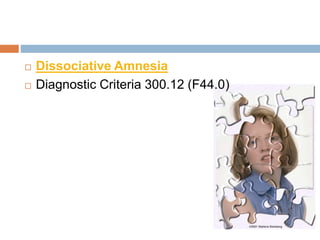
 Dissociative Amnesia
 Diagnostic Criteria 300.12 (F44.0)
A. An inability to recall important
autobiographical information, usually of a
traumatic or stressful nature, that is inconsistent
with ordinary forgetting.
Note: Dissociative amnesia most often consists
of localized or selective amnesia for a specific
event or events; or generalized amnesia for
identity and life history.
B. The symptoms cause clinically significant
distress or impairment in social, occupational, or
other important areas of functioning.
C. The disturbance is not attributable to the
physiological effects of a substance (e.g., alcohol
or other drug of abuse, a medication) or a
neurological or other medical condition (e.g.,
partial complex seizures, transient global
amnesia, sequelae of a closed head injury/
traumatic brain injury, other neurological
condition).
D. The disturbance is not better explained by
dissociative identity disorder, posttraumatic stress
disorder, acute stress disorder, somatic symptom
disorder, or major or mild neurocognitive disorder.
Coding note: The code for dissociative
amnesia without dissociative fugue is 300.12
(F44.0). The code for dissociative amnesia with
dissociative fugue is 300.13 (F44.1).
Specify if ;
 300.13 (F44.1) With dissociative fugue:
Apparently purposeful travel or bewildered
wandering that is associated with amnesia
for identity or for other important
autobiographical information.
 Depersonalization/Derealization
Disorder
 Diagnostic Criteria 300.6 (F48.1)
A. The presence of persistent or recurrent
experiences of depersonalization, derealization, or
both:
1. Depersonalization: Experiences of unreality,
detachment, or being an outside observer with
respect to one’s thoughts, feelings, sensations,
body, or actions (e.g., perceptual alterations,
distorted sense of time, unreal or absent self,
emotional and/ or physical numbing).
2. Derealization: Experiences of unreality or
detachment with respect to surroundings (e.g.,
individuals or objects are experienced as unreal,
dreamlike, foggy, lifeless, or visually distorted).
B. During the depersonalization or derealization
experiences, reality testing remains intact.
C. The symptoms cause clinically significant distress
or impairment in social, occupational, or other
important areas of functioning.
D. The disturbance is not attributable to the
physiological effects of a substance (e.g., a drug of
abuse, medication) or another medical condition (e.g.,
seizures).
E. The disturbance is not better explained by
another mental disorder, such as schizophrenia,
panic disorder, major depressive disorder, acute stress
disorder, posttraumatic stress disorder, or another
dissociative disorder.
 Dissociative Identity Disorder
 Diagnostic Criteria 300.14 (F44.81)
 A. Disruption of identity characterized by two or more
distinct personality states, which may be described
in some cultures as an experience of possession. The
disruption in identity involves marked discontinuity
in sense of self and sense of agency, accompanied
by related alterations in affect, behavior,
consciousness, memory, perception, cognition, and/or
sensory-motor functioning. These signs and
symptoms may be observed by others or reported by
the individual.
 B. Recurrent gaps in the recall of everyday events,
important personal information, and/or traumatic
events that are inconsistent with ordinary forgetting.
C. The symptoms cause clinically significant
distress or impairment in social, occupational,
or other important areas of functioning.
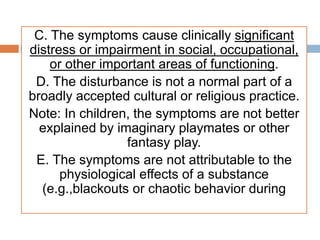
D. The disturbance is not a normal part of a
broadly accepted cultural or religious practice.
Note: In children, the symptoms are not better
explained by imaginary playmates or other
fantasy play.
E. The symptoms are not attributable to the
physiological effects of a substance
(e.g.,blackouts or chaotic behavior during
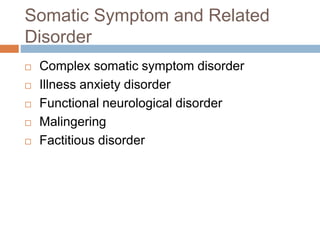
Somatic Symptom and Related
Disorder
 Complex somatic symptom disorder
 Illness anxiety disorder
 Functional neurological disorder
 Malingering
 Factitious disorder
Somatic Symptom Disorder
Diagnostic Criteria 300.82 (F45.1)
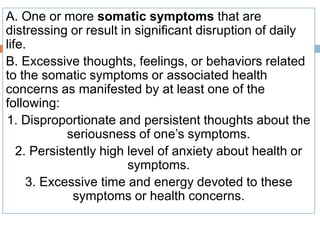
A. One or more somatic symptoms that are
distressing or result in significant disruption of daily
life.
B. Excessive thoughts, feelings, or behaviors related
to the somatic symptoms or associated health
concerns as manifested by at least one of the
following:
1. Disproportionate and persistent thoughts about the
seriousness of one’s symptoms.
2. Persistently high level of anxiety about health or
symptoms.
3. Excessive time and energy devoted to these
symptoms or health concerns.
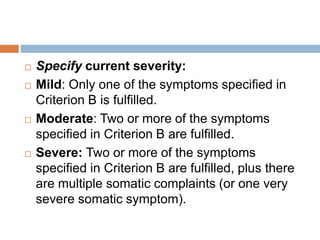
 Specify current severity:
 Mild: Only one of the symptoms specified in
Criterion B is fulfilled.
 Moderate: Two or more of the symptoms
specified in Criterion B are fulfilled.
 Severe: Two or more of the symptoms
specified in Criterion B are fulfilled, plus there
are multiple somatic complaints (or one very
severe somatic symptom).
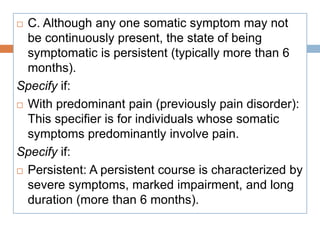
 C. Although any one somatic symptom may not
be continuously present, the state of being
symptomatic is persistent (typically more than 6
months).
Specify if:
 With predominant pain (previously pain disorder):
This specifier is for individuals whose somatic
symptoms predominantly involve pain.
Specify if:
 Persistent: A persistent course is characterized by
severe symptoms, marked impairment, and long
duration (more than 6 months).
Illness Anxiety Disorder (Hypochondriasis)
Diagnostic Criteria 300.7 (F45.21)
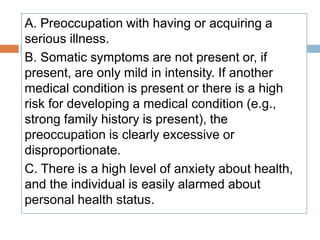
A. Preoccupation with having or acquiring a
serious illness.
B. Somatic symptoms are not present or, if
present, are only mild in intensity. If another
medical condition is present or there is a high
risk for developing a medical condition (e.g.,
strong family history is present), the
preoccupation is clearly excessive or
disproportionate.
C. There is a high level of anxiety about health,
and the individual is easily alarmed about
personal health status.
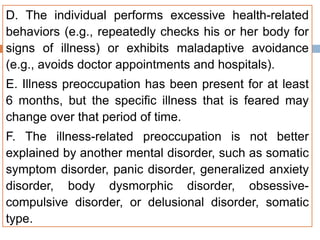
D. The individual performs excessive health-related
behaviors (e.g., repeatedly checks his or her body for
signs of illness) or exhibits maladaptive avoidance
(e.g., avoids doctor appointments and hospitals).
E. Illness preoccupation has been present for at least
6 months, but the specific illness that is feared may
change over that period of time.
F. The illness-related preoccupation is not better
explained by another mental disorder, such as somatic
symptom disorder, panic disorder, generalized anxiety
disorder, body dysmorphic disorder, obsessive-
compulsive disorder, or delusional disorder, somatic
type.
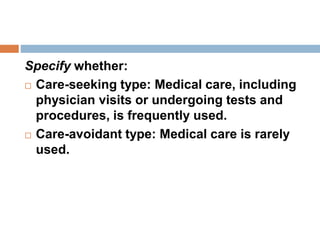
Specify whether:
 Care-seeking type: Medical care, including
physician visits or undergoing tests and
procedures, is frequently used.
 Care-avoidant type: Medical care is rarely
used.
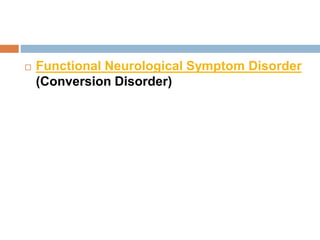
 Functional Neurological Symptom Disorder
(Conversion Disorder)
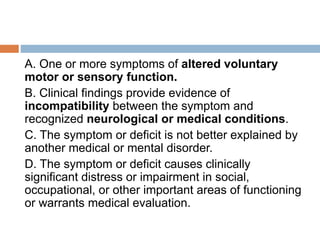
A. One or more symptoms of altered voluntary
motor or sensory function.
B. Clinical findings provide evidence of
incompatibility between the symptom and
recognized neurological or medical conditions.
C. The symptom or deficit is not better explained by
another medical or mental disorder.
D. The symptom or deficit causes clinically
significant distress or impairment in social,
occupational, or other important areas of functioning
or warrants medical evaluation.
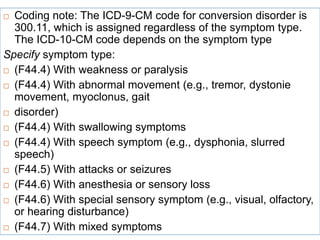
 Coding note: The ICD-9-CM code for conversion disorder is
300.11, which is assigned regardless of the symptom type.
The ICD-10-CM code depends on the symptom type
Specify symptom type:
 (F44.4) With weakness or paralysis
 (F44.4) With abnormal movement (e.g., tremor, dystonie
movement, myoclonus, gait
 disorder)
 (F44.4) With swallowing symptoms
 (F44.4) With speech symptom (e.g., dysphonia, slurred
speech)
 (F44.5) With attacks or seizures
 (F44.6) With anesthesia or sensory loss
 (F44.6) With special sensory symptom (e.g., visual, olfactory,
or hearing disturbance)
 (F44.7) With mixed symptoms
 Factitious Disorder
 Diagnostic Criteria 300.19 (F68.10)
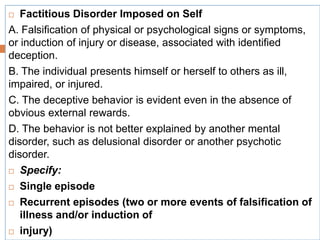
 Factitious Disorder Imposed on Self
A. Falsification of physical or psychological signs or symptoms,
or induction of injury or disease, associated with identified
deception.
B. The individual presents himself or herself to others as ill,
impaired, or injured.
C. The deceptive behavior is evident even in the absence of
obvious external rewards.
D. The behavior is not better explained by another mental
disorder, such as delusional disorder or another psychotic
disorder.
 Specify:
 Single episode
 Recurrent episodes (two or more events of falsification of
illness and/or induction of
 injury)
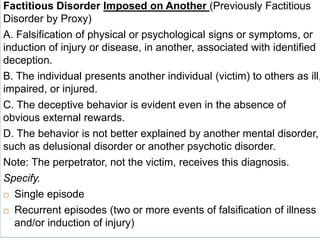
Factitious Disorder Imposed on Another (Previously Factitious
Disorder by Proxy)
A. Falsification of physical or psychological signs or symptoms, or
induction of injury or disease, in another, associated with identified
deception.
B. The individual presents another individual (victim) to others as ill,
impaired, or injured.
C. The deceptive behavior is evident even in the absence of
obvious external rewards.
D. The behavior is not better explained by another mental disorder,
such as delusional disorder or another psychotic disorder.
Note: The perpetrator, not the victim, receives this diagnosis.
Specify.
 Single episode
 Recurrent episodes (two or more events of falsification of illness
and/or induction of injury)
28Comer, Abnormal Psychology, 7e
Factitious Disorder
 Munchausen syndrome is the extreme and
long-term form of factitious disorder
 In Munchausen syndrome by proxy, a
related disorder, parents make up or produce
physical illnesses in their children
 Other Specified Somatic Symptom andRelated Disorder 300.89
(F45.8)
This category applies to presentations in which symptoms characteristic of a
somatic symptom and related disorder that cause clinically significant distress
or impairment in social, occupational, or other important areas of functioning
predominate but do not meet the full criteria for any of the disorders in the
somatic symptom and related disorders diagnostic class.
Examples of presentations that can be specified using the “other specified”
designation include the following:
1. Brief somatic symptom disorder: Duration of symptoms is
less than 6 months.
2. Brief illness anxiety disorder: Duration of symptoms is less
than 6 months.
3. Illness anxiety disorder without excessive health-related
behaviors: Criterion D for illness anxiety disorder is not met.
4. Pseudocyesis: A false belief of being pregnant that is
associated with objective signs and reported symptoms of
pregnancy.
Malingering
 Intentionally faking psychological or somatic
symptoms to gain from those symptoms

Dissociative disorders and somatic symptom disorder

  • 1.
  • 2.
    Diagnoses of Dissociative Disorders Dissociative Amnesia  Depersonalization/Derealization disorder  Dissociative Identity Disorder
  • 3.
     Dissociative Amnesia Diagnostic Criteria 300.12 (F44.0)
  • 4.
    A. An inabilityto recall important autobiographical information, usually of a traumatic or stressful nature, that is inconsistent with ordinary forgetting. Note: Dissociative amnesia most often consists of localized or selective amnesia for a specific event or events; or generalized amnesia for identity and life history. B. The symptoms cause clinically significant distress or impairment in social, occupational, or other important areas of functioning.
  • 5.
    C. The disturbanceis not attributable to the physiological effects of a substance (e.g., alcohol or other drug of abuse, a medication) or a neurological or other medical condition (e.g., partial complex seizures, transient global amnesia, sequelae of a closed head injury/ traumatic brain injury, other neurological condition). D. The disturbance is not better explained by dissociative identity disorder, posttraumatic stress disorder, acute stress disorder, somatic symptom disorder, or major or mild neurocognitive disorder.
  • 6.
    Coding note: Thecode for dissociative amnesia without dissociative fugue is 300.12 (F44.0). The code for dissociative amnesia with dissociative fugue is 300.13 (F44.1). Specify if ;  300.13 (F44.1) With dissociative fugue: Apparently purposeful travel or bewildered wandering that is associated with amnesia for identity or for other important autobiographical information.
  • 7.
  • 8.
    A. The presenceof persistent or recurrent experiences of depersonalization, derealization, or both: 1. Depersonalization: Experiences of unreality, detachment, or being an outside observer with respect to one’s thoughts, feelings, sensations, body, or actions (e.g., perceptual alterations, distorted sense of time, unreal or absent self, emotional and/ or physical numbing). 2. Derealization: Experiences of unreality or detachment with respect to surroundings (e.g., individuals or objects are experienced as unreal, dreamlike, foggy, lifeless, or visually distorted).
  • 9.
    B. During thedepersonalization or derealization experiences, reality testing remains intact. C. The symptoms cause clinically significant distress or impairment in social, occupational, or other important areas of functioning. D. The disturbance is not attributable to the physiological effects of a substance (e.g., a drug of abuse, medication) or another medical condition (e.g., seizures). E. The disturbance is not better explained by another mental disorder, such as schizophrenia, panic disorder, major depressive disorder, acute stress disorder, posttraumatic stress disorder, or another dissociative disorder.
  • 10.
     Dissociative IdentityDisorder  Diagnostic Criteria 300.14 (F44.81)
  • 11.
     A. Disruptionof identity characterized by two or more distinct personality states, which may be described in some cultures as an experience of possession. The disruption in identity involves marked discontinuity in sense of self and sense of agency, accompanied by related alterations in affect, behavior, consciousness, memory, perception, cognition, and/or sensory-motor functioning. These signs and symptoms may be observed by others or reported by the individual.  B. Recurrent gaps in the recall of everyday events, important personal information, and/or traumatic events that are inconsistent with ordinary forgetting.
  • 12.
    C. The symptomscause clinically significant distress or impairment in social, occupational, or other important areas of functioning. D. The disturbance is not a normal part of a broadly accepted cultural or religious practice. Note: In children, the symptoms are not better explained by imaginary playmates or other fantasy play. E. The symptoms are not attributable to the physiological effects of a substance (e.g.,blackouts or chaotic behavior during
  • 13.
    Somatic Symptom andRelated Disorder  Complex somatic symptom disorder  Illness anxiety disorder  Functional neurological disorder  Malingering  Factitious disorder
  • 14.
    Somatic Symptom Disorder DiagnosticCriteria 300.82 (F45.1)
  • 15.
    A. One ormore somatic symptoms that are distressing or result in significant disruption of daily life. B. Excessive thoughts, feelings, or behaviors related to the somatic symptoms or associated health concerns as manifested by at least one of the following: 1. Disproportionate and persistent thoughts about the seriousness of one’s symptoms. 2. Persistently high level of anxiety about health or symptoms. 3. Excessive time and energy devoted to these symptoms or health concerns.
  • 16.
     Specify currentseverity:  Mild: Only one of the symptoms specified in Criterion B is fulfilled.  Moderate: Two or more of the symptoms specified in Criterion B are fulfilled.  Severe: Two or more of the symptoms specified in Criterion B are fulfilled, plus there are multiple somatic complaints (or one very severe somatic symptom).
  • 17.
     C. Althoughany one somatic symptom may not be continuously present, the state of being symptomatic is persistent (typically more than 6 months). Specify if:  With predominant pain (previously pain disorder): This specifier is for individuals whose somatic symptoms predominantly involve pain. Specify if:  Persistent: A persistent course is characterized by severe symptoms, marked impairment, and long duration (more than 6 months).
  • 18.
    Illness Anxiety Disorder(Hypochondriasis) Diagnostic Criteria 300.7 (F45.21)
  • 19.
    A. Preoccupation withhaving or acquiring a serious illness. B. Somatic symptoms are not present or, if present, are only mild in intensity. If another medical condition is present or there is a high risk for developing a medical condition (e.g., strong family history is present), the preoccupation is clearly excessive or disproportionate. C. There is a high level of anxiety about health, and the individual is easily alarmed about personal health status.
  • 20.
    D. The individualperforms excessive health-related behaviors (e.g., repeatedly checks his or her body for signs of illness) or exhibits maladaptive avoidance (e.g., avoids doctor appointments and hospitals). E. Illness preoccupation has been present for at least 6 months, but the specific illness that is feared may change over that period of time. F. The illness-related preoccupation is not better explained by another mental disorder, such as somatic symptom disorder, panic disorder, generalized anxiety disorder, body dysmorphic disorder, obsessive- compulsive disorder, or delusional disorder, somatic type.
  • 21.
    Specify whether:  Care-seekingtype: Medical care, including physician visits or undergoing tests and procedures, is frequently used.  Care-avoidant type: Medical care is rarely used.
  • 22.
     Functional NeurologicalSymptom Disorder (Conversion Disorder)
  • 23.
    A. One ormore symptoms of altered voluntary motor or sensory function. B. Clinical findings provide evidence of incompatibility between the symptom and recognized neurological or medical conditions. C. The symptom or deficit is not better explained by another medical or mental disorder. D. The symptom or deficit causes clinically significant distress or impairment in social, occupational, or other important areas of functioning or warrants medical evaluation.
  • 24.
     Coding note:The ICD-9-CM code for conversion disorder is 300.11, which is assigned regardless of the symptom type. The ICD-10-CM code depends on the symptom type Specify symptom type:  (F44.4) With weakness or paralysis  (F44.4) With abnormal movement (e.g., tremor, dystonie movement, myoclonus, gait  disorder)  (F44.4) With swallowing symptoms  (F44.4) With speech symptom (e.g., dysphonia, slurred speech)  (F44.5) With attacks or seizures  (F44.6) With anesthesia or sensory loss  (F44.6) With special sensory symptom (e.g., visual, olfactory, or hearing disturbance)  (F44.7) With mixed symptoms
  • 25.
     Factitious Disorder Diagnostic Criteria 300.19 (F68.10)
  • 26.
     Factitious DisorderImposed on Self A. Falsification of physical or psychological signs or symptoms, or induction of injury or disease, associated with identified deception. B. The individual presents himself or herself to others as ill, impaired, or injured. C. The deceptive behavior is evident even in the absence of obvious external rewards. D. The behavior is not better explained by another mental disorder, such as delusional disorder or another psychotic disorder.  Specify:  Single episode  Recurrent episodes (two or more events of falsification of illness and/or induction of  injury)
  • 27.
    Factitious Disorder Imposedon Another (Previously Factitious Disorder by Proxy) A. Falsification of physical or psychological signs or symptoms, or induction of injury or disease, in another, associated with identified deception. B. The individual presents another individual (victim) to others as ill, impaired, or injured. C. The deceptive behavior is evident even in the absence of obvious external rewards. D. The behavior is not better explained by another mental disorder, such as delusional disorder or another psychotic disorder. Note: The perpetrator, not the victim, receives this diagnosis. Specify.  Single episode  Recurrent episodes (two or more events of falsification of illness and/or induction of injury)
  • 28.
    28Comer, Abnormal Psychology,7e Factitious Disorder  Munchausen syndrome is the extreme and long-term form of factitious disorder  In Munchausen syndrome by proxy, a related disorder, parents make up or produce physical illnesses in their children
  • 29.
     Other SpecifiedSomatic Symptom andRelated Disorder 300.89 (F45.8) This category applies to presentations in which symptoms characteristic of a somatic symptom and related disorder that cause clinically significant distress or impairment in social, occupational, or other important areas of functioning predominate but do not meet the full criteria for any of the disorders in the somatic symptom and related disorders diagnostic class. Examples of presentations that can be specified using the “other specified” designation include the following: 1. Brief somatic symptom disorder: Duration of symptoms is less than 6 months. 2. Brief illness anxiety disorder: Duration of symptoms is less than 6 months. 3. Illness anxiety disorder without excessive health-related behaviors: Criterion D for illness anxiety disorder is not met. 4. Pseudocyesis: A false belief of being pregnant that is associated with objective signs and reported symptoms of pregnancy.
  • 30.
    Malingering  Intentionally fakingpsychological or somatic symptoms to gain from those symptoms

Editor's Notes

  • #5 Localized amnesia, a failure to recall events during a circumscribed period of time, is the most common form of dissociative amnesia. Localized amnesia may be broader than amnesia for a single traumatic event (e.g., months or years associated with child abuse or intense combat). In selective amnesia, the individual can recall some, but not all, of the events during a circumscribed period of time. Thus, the individual may remember part of a traumatic event but not other parts. Some individuals report both localized and selective amnesias. Generalized amnesia, a complete loss of memory for one's life history, is rare. Individuals with generalized amnesia may forget personal identity. a) Anterograde amnesia Anterograde amnesia happens as a result of brain trauma that involves the hippocampus, fornix, or mammillary bodies. Here the patient is unable to recollect events, that occur after the onset of the amnesia, for more than a few minutes. In other words, in these patients, recent events are not transferred to long-termmemory. For example the patient is unable to recollect what his colleague’s name is or what he had for breakfast or which movie he saw the day before.  Although the person''s intelligence, personality and judgment is intact he may have trouble in retaining his job because his day- to- day functional memory is poor. This can be devastating to the person and to his family. However, with the use of memory aids the affected person can, more or less, lead a useful life. b) Retrograde amnesia In this form of amnesia the affected individual will be unable to recollect events that occurred before the amnesia set in. The condition is caused either by disease or a brain injury especially in areas linked with episodic memory—the hippocampus and the median temporal lobes.  Memory is poorest regarding events that occurred just before amnesia set in. Early memories are comparatively safe with memory decline building up to the event. No cure has yet been found for this condition.