ECOSYSTEM & ECOLOGY
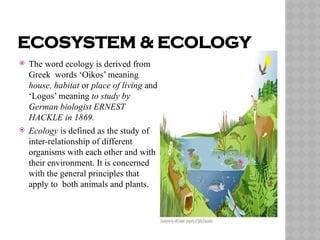
The word ecology is derived from
Greek words ‘Oikos’ meaning
house, habitat or place of living and
‘Logos’ meaning to study by
German biologist ERNEST
HACKLE in 1869.
Ecology is defined as the study of
inter-relationship of different
organisms with each other and with
their environment. It is concerned
with the general principles that
apply to both animals and plants.
2.
ECOSYSTEM
The termEcosystem was first
proposed by A.G. Tansley in
1935. he defined it as “the system
resulting from the interaction of
all the living and non living
factors of the Environment.
An ecosystem is a self regulating
group of biotic communities of
species interacting with one
another and with non living
environment (abiotic
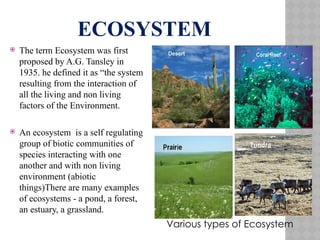
things)There are many examples
of ecosystems - a pond, a forest,
an estuary, a grassland.
Various types of Ecosystem
3.
TYPES OF ECOSYSTEM
1.Natural Ecosystems : These
operate under natural
conditions without any major
interference by man.
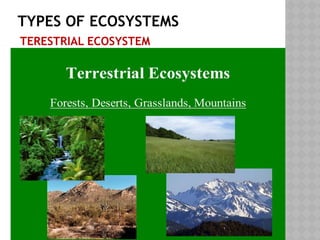
i. Terrestrial Ecosystem :
Forest, grassland, desert,
etc.
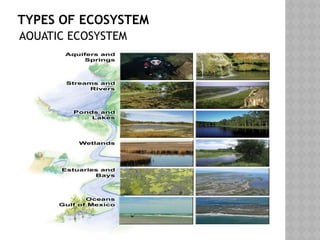
ii. Aquatic Ecosystem :
a. Fresh water : Lotic
(running water like spring,
stream, or rivers) or Lentic
(standing water as lake,
pond, pools, etc.)
b. Marine water : Such as
deep bodies as ocean or
shallow ones as Sea or an
estuary.
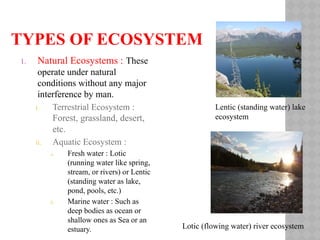
Lentic (standing water) lake
ecosystem
Lotic (flowing water) river ecosystem
4.
TYPES OF ECOSYSTEM
2.Artificial (Man
Engineered) Ecosystems :
These are maintained
artificially by man where
by addition of energy and
planned manipulation,
natural balance is
disturbed regularly e.g.,
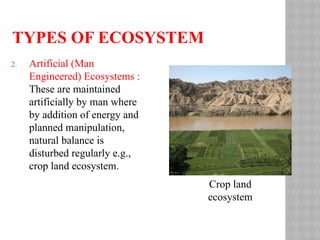
crop land ecosystem.
Crop land
ecosystem
COMPONENTS OF ECOSYSTEM
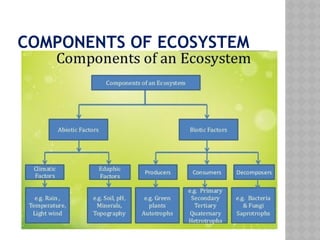
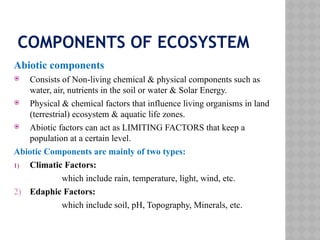
Abioticcomponents
Consists of Non-living chemical & physical components such as
water, air, nutrients in the soil or water & Solar Energy.
Physical & chemical factors that influence living organisms in land
(terrestrial) ecosystem & aquatic life zones.
Abiotic factors can act as LIMITING FACTORS that keep a
population at a certain level.
Abiotic Components are mainly of two types:
1) Climatic Factors:
which include rain, temperature, light, wind, etc.
2) Edaphic Factors:
which include soil, pH, Topography, Minerals, etc.
7.
COMPONENTS OF ECOSYSTEM
Bioticcomponents:
• All the living things present in an ecosystem are
forms the biotic components. These living
organisms have different nutritional environment.
• These are made up of biological components
consisting of living and dead like plants, animals
and microorganisms.
8.
COMPONENTS OF ECOSYSTEM
TheMajor Biotic Components of
Ecosystem :
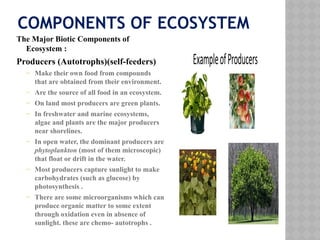
Producers (Autotrophs)(self-feeders)
– Make their own food from compounds
that are obtained from their environment.
– Are the source of all food in an ecosystem.
– On land most producers are green plants.
– In freshwater and marine ecosystems,
algae and plants are the major producers
near shorelines.
– In open water, the dominant producers are
phytoplankton (most of them microscopic)
that float or drift in the water.
– Most producers capture sunlight to make
carbohydrates (such as glucose) by
photosynthesis .
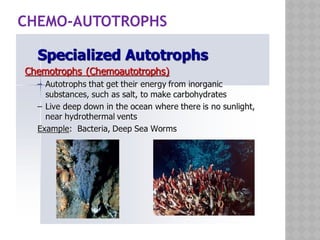
– There are some microorganisms which can
produce organic matter to some extent
through oxidation even in absence of
sunlight. these are chemo- autotrophs .
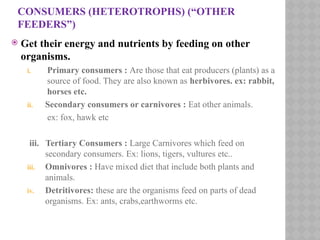
CONSUMERS (HETEROTROPHS) (“OTHER
FEEDERS”)
Get their energy and nutrients by feeding on other
organisms.
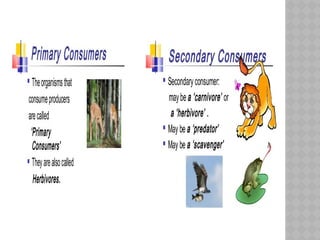
i. Primary consumers : Are those that eat producers (plants) as a
source of food. They are also known as herbivores. ex: rabbit,
horses etc.
ii. Secondary consumers or carnivores : Eat other animals.
ex: fox, hawk etc
iii. Tertiary Consumers : Large Carnivores which feed on
secondary consumers. Ex: lions, tigers, vultures etc..
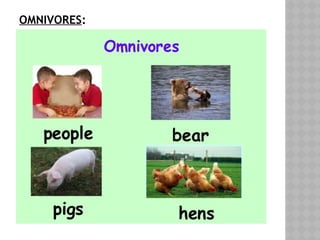
iii. Omnivores : Have mixed diet that include both plants and
animals.
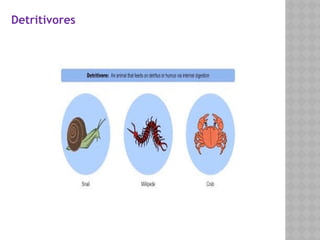
iv. Detritivores: these are the organisms feed on parts of dead
organisms. Ex: ants, crabs,earthworms etc.
FOOD CHAIN& FOODWEB
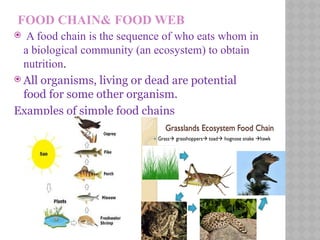
A food chain is the sequence of who eats whom in
a biological community (an ecosystem) to obtain
nutrition.
All organisms, living or dead are potential
food for some other organism.
Examples of simple food chains
15.
FOOD CHAINS
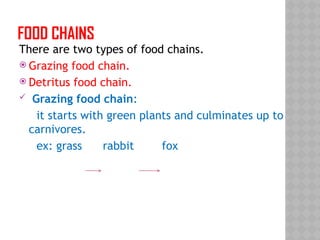
There aretwo types of food chains.
Grazing food chain.
Detritus food chain.
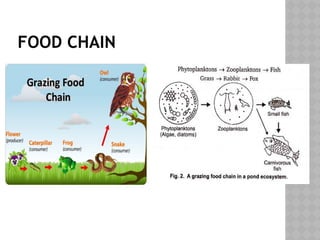
Grazing food chain:
it starts with green plants and culminates up to
carnivores.
ex: grass rabbit fox
FOOD CHAIN
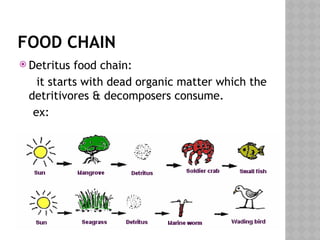
Detritusfood chain:
it starts with dead organic matter which the
detritivores & decomposers consume.
ex:
18.
FOOD CHAIN
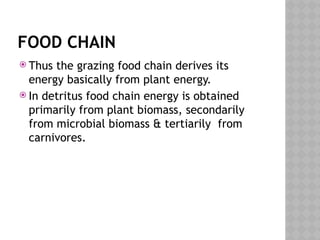
Thusthe grazing food chain derives its
energy basically from plant energy.
In detritus food chain energy is obtained
primarily from plant biomass, secondarily
from microbial biomass & tertiarily from
carnivores.
19.
FOOD WEB
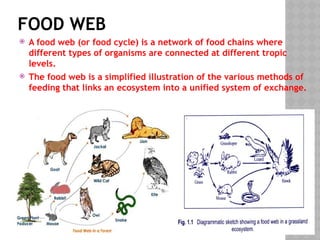
Afood web (or food cycle) is a network of food chains where
different types of organisms are connected at different tropic
levels.
The food web is a simplified illustration of the various methods of
feeding that links an ecosystem into a unified system of exchange.
20.
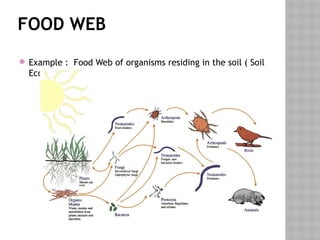
FOOD WEB
Example: Food Web of organisms residing in the soil ( Soil
Ecosystem)
21.
SIGNIFICANCE OF FOODWEB
&FOOD CHAIN
Food chains & food webs play a very
significant role in ecosystem in terms of
energy flow & nutrient cycle.
Food chains helps in maintaining ecological
balance.
Food chains show biological magnification or
biomagnification of chemicals.
22.
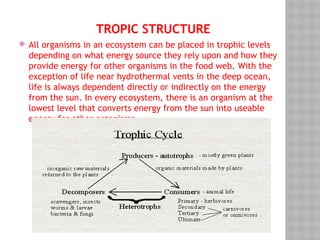
TROPIC STRUCTURE
Allorganisms in an ecosystem can be placed in trophic levels
depending on what energy source they rely upon and how they
provide energy for other organisms in the food web. With the
exception of life near hydrothermal vents in the deep ocean,
life is always dependent directly or indirectly on the energy
from the sun. In every ecosystem, there is an organism at the
lowest level that converts energy from the sun into useable
energy for other organisms.
23.
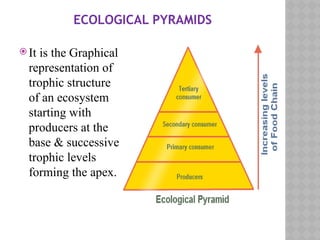
ECOLOGICAL PYRAMIDS
Itis the Graphical
representation of
trophic structure
of an ecosystem
starting with
producers at the
base & successive
trophic levels
forming the apex.
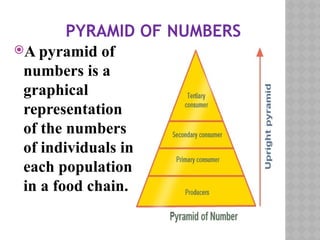
PYRAMID OF NUMBERS
Apyramid of
numbers is a
graphical
representation
of the numbers
of individuals in
each population
in a food chain.
26.
PYRAMID OF NUMBERS
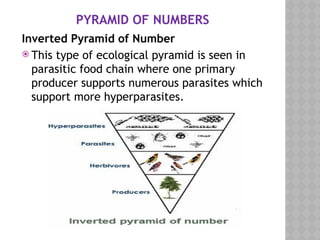
InvertedPyramid of Number
This type of ecological pyramid is seen in
parasitic food chain where one primary
producer supports numerous parasites which
support more hyperparasites.
27.
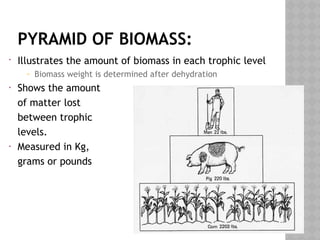
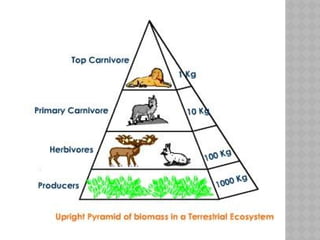
PYRAMID OF BIOMASS:
•Illustrates the amount of biomass in each trophic level
– Biomass weight is determined after dehydration
• Shows the amount
of matter lost
between trophic
levels.
• Measured in Kg,
grams or pounds
29.
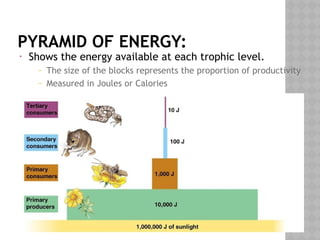
PYRAMID OF ENERGY:
•Shows the energy available at each trophic level.
– The size of the blocks represents the proportion of productivity
– Measured in Joules or Calories
30.
ENERGY FLOW INAN
ECOSYSTEM
Flow of energy in an ecosystem is takes
place through food chain which keeps
ecosystem going.
This energy flow is unidirectional or one-
way flow and follows laws of
thermodynamics.
Ist law of thermodynamics.
IInd law of thermodynamics.
THERE ARE TWOMAIN TYPES OF
ECOLOGICAL SUCCESSION
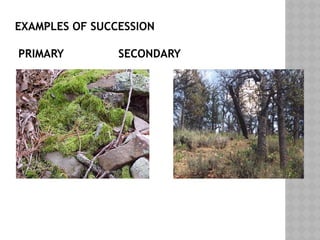
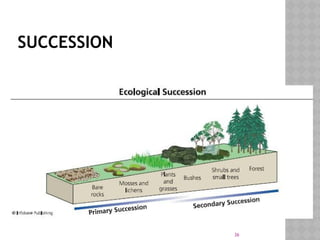
Primary Succession: The process of creating life
in an area where no life previously existed.
Secondary Succession: The process of re-
stabilization that follows a disturbance in an
area where life has formed an ecosystem.
SECONDARY SUCCESSION
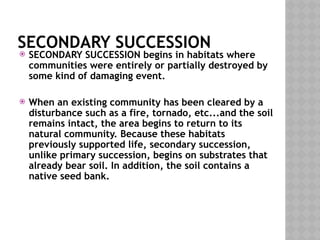
SECONDARYSUCCESSION begins in habitats where
communities were entirely or partially destroyed by
some kind of damaging event.
When an existing community has been cleared by a
disturbance such as a fire, tornado, etc...and the soil
remains intact, the area begins to return to its
natural community. Because these habitats
previously supported life, secondary succession,
unlike primary succession, begins on substrates that
already bear soil. In addition, the soil contains a
native seed bank.
35.
35
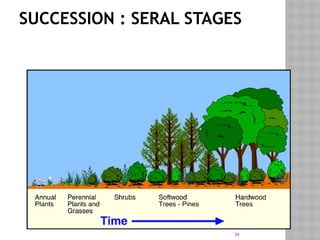
ECOLOGICAL SUCESSION
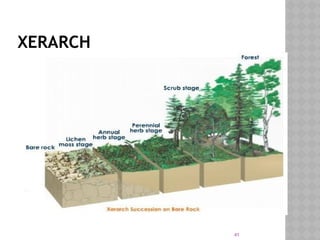
Wholesequence of communities which are transitory
are known as Seral Stages
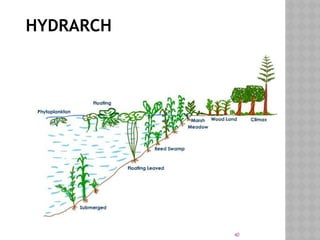
Ecological Succession starting from different
Substrata or areas are named differently:
Hydrach / Hydrosere – starting from water or pond
Mesarch- Starting from adequate moist area
Xerach/Xerosere – Starting in dry area or areas with less moisture
They Can also be of following types:
Lithosere- Starting on bare Rock
Psammosere- Starting on sand
Halosere- Starting on saline soil
37
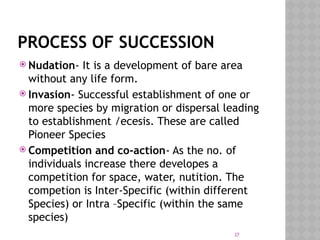
PROCESS OF SUCCESSION
Nudation- It is a development of bare area
without any life form.
Invasion- Successful establishment of one or
more species by migration or dispersal leading
to establishment /ecesis. These are called
Pioneer Species
Competition and co-action- As the no. of
individuals increase there developes a
competition for space, water, nutition. The
competion is Inter-Specific (within different
Species) or Intra –Specific (within the same
species)
38.
38
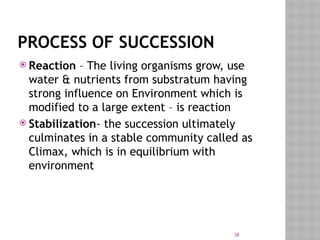
PROCESS OF SUCCESSION
Reaction – The living organisms grow, use
water & nutrients from substratum having
strong influence on Environment which is
modified to a large extent – is reaction
Stabilization- the succession ultimately
culminates in a stable community called as
Climax, which is in equilibrium with
environment
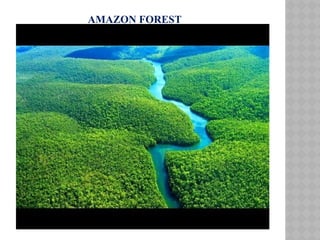
FOREST ECOSYSTEM
A forestecosystem is a terrestrial unit of
Biotic things (plants, animals and
microorganisms), all interacting among
themselves and with the Abiotic things(soil,
climate, water and light) in which they live.
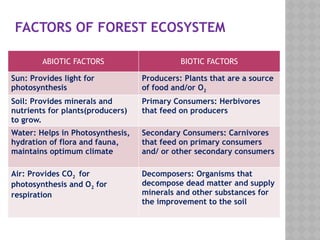
FACTORS OF FORESTECOSYSTEM
ABIOTIC FACTORS BIOTIC FACTORS
Sun: Provides light for
photosynthesis
Producers: Plants that are a source
of food and/or O2
Soil: Provides minerals and
nutrients for plants(producers)
to grow.
Primary Consumers: Herbivores
that feed on producers
Water: Helps in Photosynthesis,
hydration of flora and fauna,
maintains optimum climate
Secondary Consumers: Carnivores
that feed on primary consumers
and/ or other secondary consumers
Air: Provides CO2 for
photosynthesis and O2 for
respiration
Decomposers: Organisms that
decompose dead matter and supply
minerals and other substances for
the improvement to the soil
DECIDUOUS FORESTS
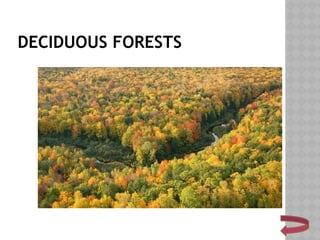
Treeshere have large, flat leaves that drop off in the
fall and new leaves grow in spring
Leaves change colour with the seasons
These grow in places with hot, wet summers and
cool, dry winters.
Ex: Satpura range , A.P, Telangana, Maharashtra
etc.
TROPICAL RAINFOREST
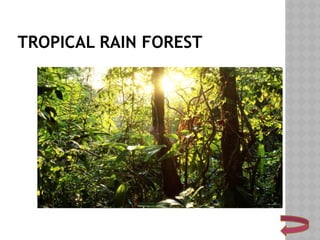
Thesetrees grow in places that are hot
and wet all year.
Trees are very tall and leaves are always
green.
ex: forests in andaman-nicobar islands,
aravali forests etc.
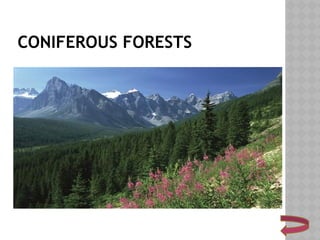
CONIFEROUS FOREST
Growsin places with very cold winters and cool
summers
The leaves look like needles so they don’t need
much water
Seeds grow in cones
Get less rain than all the other forests
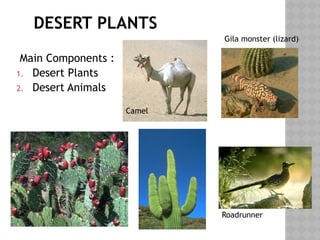
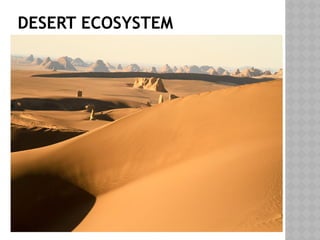
DESERT – ECOSYSTEM
They occur in regions where evaporation exceeds
precipitation (rainfall, snow, etc.)
Mainly two kinds of deserts:
Hot deserts
Cold deserts
Hot deserts
Temperatures are very warm all year round
The summers are very hot
Cold deserts
Short, warm summers
Long, cold winters
Found in places near the north and south poles
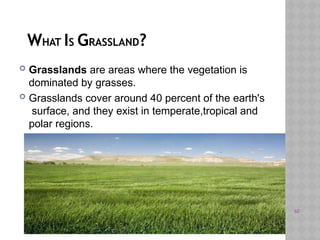
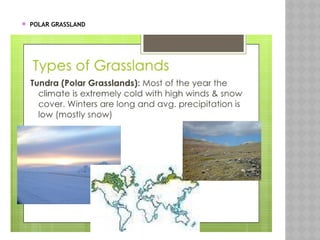
WHAT IS GRASSLAND?
Grasslands are areas where the vegetation is
dominated by grasses.
Grasslands cover around 40 percent of the earth's
surface, and they exist in temperate,tropical and
polar regions.
60
61.
WHAT IS GRASSLANDECO-SYSTEM?
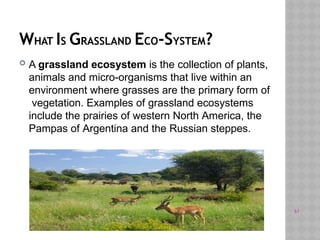
A grassland ecosystem is the collection of plants,
animals and micro-organisms that live within an
environment where grasses are the primary form of
vegetation. Examples of grassland ecosystems
include the prairies of western North America, the
Pampas of Argentina and the Russian steppes.
61
62.
TYPES OF GRASSLANDIN INDIA
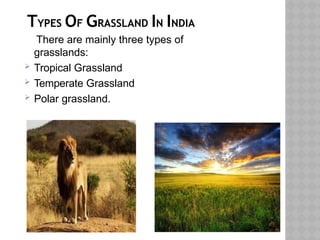
There are mainly three types of
grasslands:
Tropical Grassland
Temperate Grassland
Polar grassland.
.
63.
TROPICAL GRASSLAND
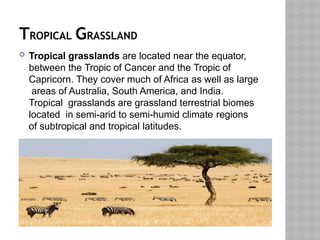
Tropicalgrasslands are located near the equator,
between the Tropic of Cancer and the Tropic of
Capricorn. They cover much of Africa as well as large
areas of Australia, South America, and India.
Tropical grasslands are grassland terrestrial biomes
located in semi-arid to semi-humid climate regions
of subtropical and tropical latitudes.
.
64.
TEMPERATE GRASSLAND
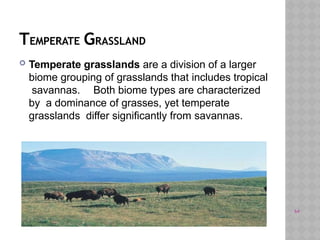
Temperategrasslands are a division of a larger
biome grouping of grasslands that includes tropical
savannas. Both biome types are characterized
by a dominance of grasses, yet temperate
grasslands differ significantly from savannas.
64
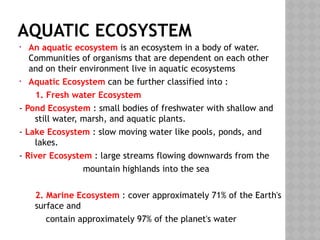
AQUATIC ECOSYSTEM
• Anaquatic ecosystem is an ecosystem in a body of water.
Communities of organisms that are dependent on each other
and on their environment live in aquatic ecosystems
• Aquatic Ecosystem can be further classified into :
1. Fresh water Ecosystem
- Pond Ecosystem : small bodies of freshwater with shallow and
still water, marsh, and aquatic plants.
- Lake Ecosystem : slow moving water like pools, ponds, and
lakes.
- River Ecosystem : large streams flowing downwards from the
mountain highlands into the sea
2. Marine Ecosystem : cover approximately 71% of the Earth's
surface and
contain approximately 97% of the planet's water
68
POND ECOSYSTEM
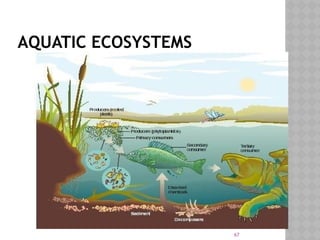
Producersare of following type
Macrophytes: these are large rooted plants,
which include partly or completely submerged
hydrophytes, e.g. : Hydrilla, Trapha, Typha.
Phytoplankton: These are minute floating or
submerged lower plants e.g.: algae.
Consumers: They are heterotrophs which
depends for their nutrition on the organic food
manufactured by producers.
69.
69
Primary Consumers:
Benthos: These are animals associated with living
plants , detrivores and some other microorganisms
Zooplanktons: These are chiefly rotifers, protozoans, they
feed on phytoplankton
Secondary Consumers: They are the Carnivores which
feed on herbivores, these are chiefly insect and fish,
most insects & water beetles, they feed on zooplanktons.
Tertiary Consumers: These are some large fish as game
fish, turtles, which feed on small fish and thus become
tertiary consumers.
Decomposers: They are also known as micro-consumers.
They decompose dead organic matter of both producers
and animal to simple form. Thus they play an important
role in the return of minerals again to the pond
ecosystem, they are chiefly bacteria, & fungi.
70.
70
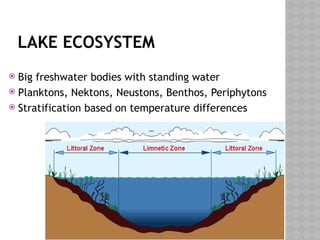
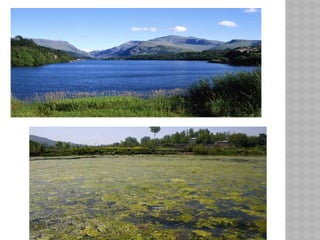
LAKE ECOSYSTEM
Bigfreshwater bodies with standing water
Planktons, Nektons, Neustons, Benthos, Periphytons
Stratification based on temperature differences
72
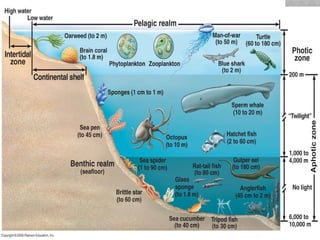
OCEAN ECOSYSTEMS
OceanEcosystem are more stable than pond
ecosystem, they occupy 70 % of the earth
surface.
Abiotic Components: Dissolved oxygen, light,
temperature, minerals.
Biotic Components:
Producers: These are autotrophs and are
also known Primary producers. They are
mainly, some microscopic algae (phyto-
planktons) besides them there are mainly,
seaweeds, as brown and red algae also
contribute to primary production.
73.
73
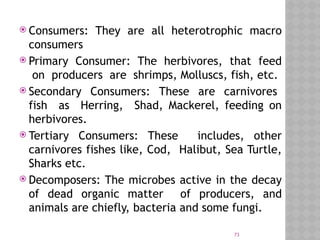
Consumers: Theyare all heterotrophic macro
consumers
Primary Consumer: The herbivores, that feed
on producers are shrimps, Molluscs, fish, etc.
Secondary Consumers: These are carnivores
fish as Herring, Shad, Mackerel, feeding on
herbivores.
Tertiary Consumers: These includes, other
carnivores fishes like, Cod, Halibut, Sea Turtle,
Sharks etc.
Decomposers: The microbes active in the decay
of dead organic matter of producers, and
animals are chiefly, bacteria and some fungi.
76
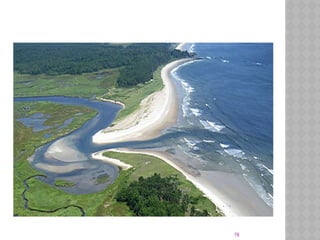
ESTUARINE ECOSYSTEMS
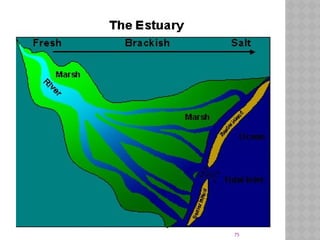
Anestuary is a partially enclosed body of
water along the coast where fresh water from
river and streams meet and mix with salt water
from oceans. This Ecosystems are considered as
most fertile ecosystem.
Abiotic Components: Nutrients such as phosphorus
and nitrogen, temperature, light, salinity, pH.
This ecosystem experience wide daily and
seasonal fluctuations in temperature and Salinity
level because of variation in freshwater in flow.
77.
77
Biotic Components:
Producers: Phytoplankton's - these micro-organisms
manufacture food by photosynthesis and absorb nutrients
such as phosphorous and nitrogen, besides them, mangroves,
sea grass, weeds, and salt marshes.
Consumers: Primary consumers, Zooplanktons that feed on
Phytoplankton, besides them some small microorganisms that
feed on producers.
Secondary Consumer: Include worms, shellfish, small fish,
feeding on Zooplanktons
Tertiary Consumer : Fishes, turtles, crabs, starfishes feeding on
secondary consumers.
Decomposers: Fungi & Bacteria are the chief microbes active in
decay of dead organic matter.