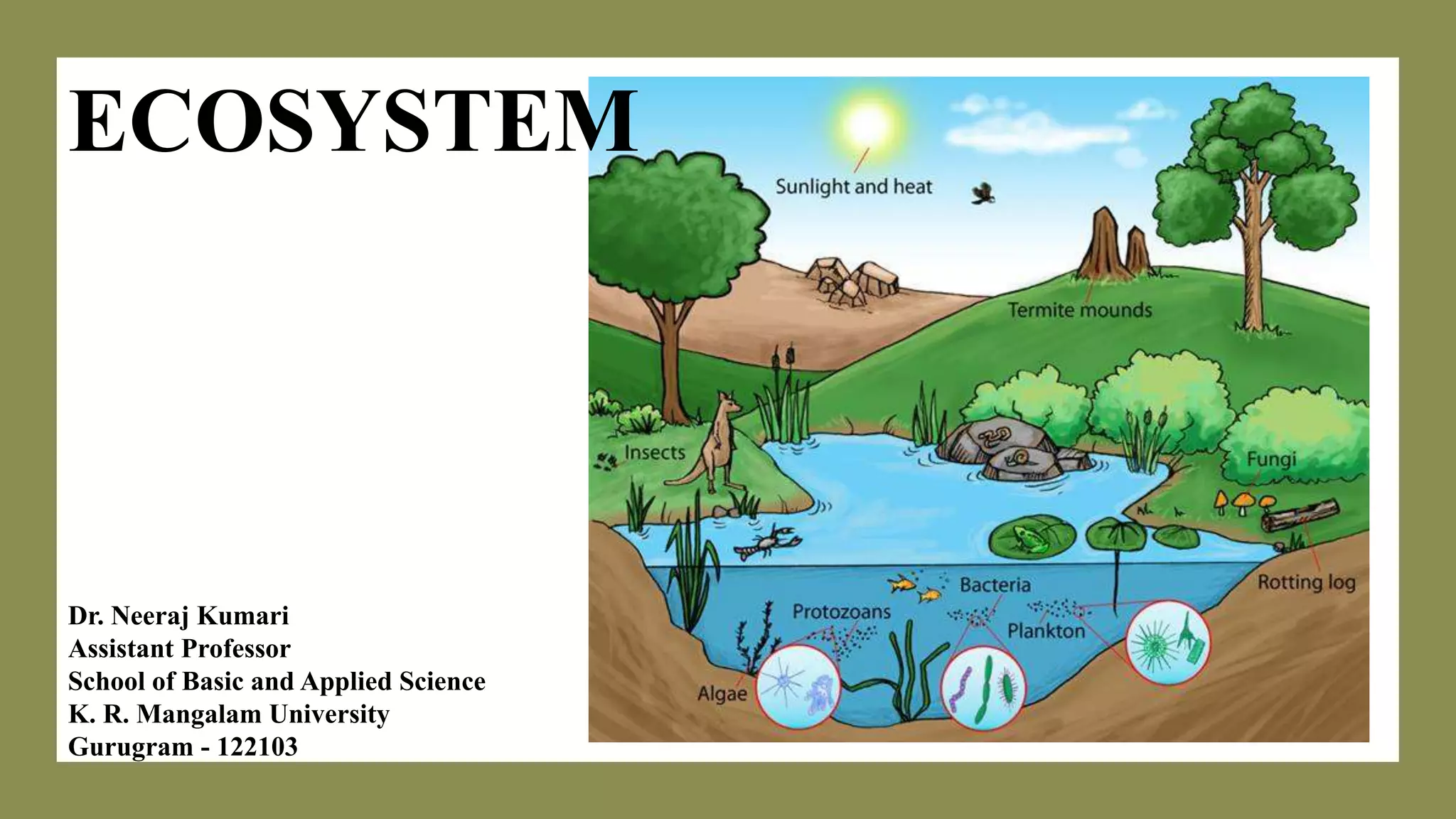
ECOSYSTEM
Dr. Neeraj Kumari
Assistant Professor
School of Basic and Applied Science
K. R. Mangalam University
Gurugram - 122103
History:
 The term Ecology was coined by Earnst Haeckel in 1869.
 Derived from the Greek words Oikos- home + logos- study.
 Ecology deals with the study of organisms in their natural home interacting with their surroundings.
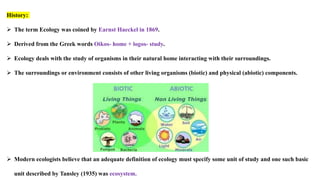
 The surroundings or environment consists of other living organisms (biotic) and physical (abiotic) components.
 Modern ecologists believe that an adequate definition of ecology must specify some unit of study and one such basic
unit described by Tansley (1935) was ecosystem.
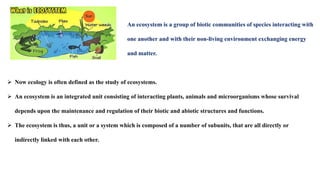
An ecosystem is a group of biotic communities of species interacting with
one another and with their non-living environment exchanging energy
and matter.
 Now ecology is often defined as the study of ecosystems.
 An ecosystem is an integrated unit consisting of interacting plants, animals and microorganisms whose survival
depends upon the maintenance and regulation of their biotic and abiotic structures and functions.
 The ecosystem is thus, a unit or a system which is composed of a number of subunits, that are all directly or
indirectly linked with each other.
ECOSYSTEM CHARACTERISTICS :
Ecosystems show large variations in their size, structure, composition etc.
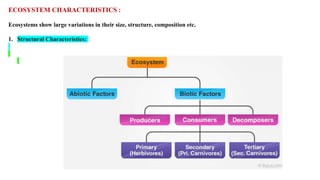
1. Structural Characteristics:
a) Biotic structure:
 The plants, animals and microorganisms.
 These organisms have different nutritional behavior and status in the ecosystems
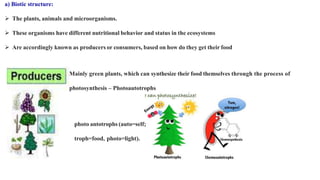
 Are accordingly known as producers or consumers, based on how do they get their food
Mainly green plants, which can synthesize their food themselves through the process of
photosynthesis – Photoautotrophs
photo antotrophs (auto=self;
troph=food, photo=light).
 Some microorganismswhichcan produce organic matter to some extent through oxidation of certain chemicals in the
absence of sunlight.
 They are knownas chemosynthetic organisms or chemo-antotrophs.
 For instance in the ocean depths, where there is no sunlight, chemoautotrophic sulphur bacteria make use of the heat
generated by the decay of radioactive
 elements present in the earths core and released in ocean³s depths.
 They use this heat toconvert dissolved hydrogen sulphide (H2S) and carbon dioxide (CO2) into organic compounds.
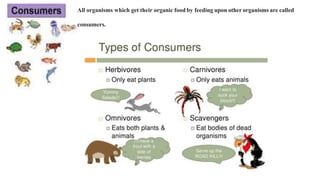
All organisms which get their organic food by feeding upon other organisms are called
consumers.
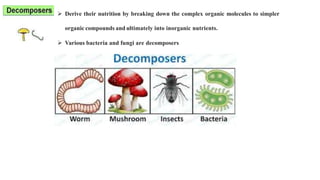
 Derive their nutrition by breaking down the complex organic molecules to simpler
organic compounds and ultimately into inorganic nutrients.
 Various bacteria and fungi are decomposers
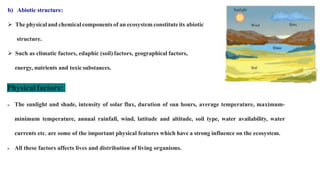
b) Abiotic structure:
 The physicaland chemical componentsof an ecosystem constituteits abiotic
structure.
 Such as climatic factors, edaphic (soil) factors, geographical factors,
energy, nutrients and toxicsubstances.
Physicalfactors:
 The sunlight and shade, intensity of solar flux, duration of sun hours, average temperature, maximum-
minimum temperature, annual rainfall, wind, latitude and altitude, soil type, water availability, water
currents etc. are some of the important physical features which have a strong influence on the ecosystem.
 All these factors affects lives and distribution of living organisms.
Chemical factors:
Availability of major essential nutrients like carbon, nitrogen, phosphorus, potassium, hydrogen, oxygen and sulphur,
level of toxic substances, salts causing salinity and various organic substances present in the soil or water largely influence
the functioning of the ecosystem.
TROPHIC STRUCTURE:
 It is pattern of movement of energy and matter through ecosystem.
 It is the result of compressing a community food web into a series of trophic level.
 The producers and consumers are arranged in the ecosystem in a definite manner and their interaction along with
population size are expressed together as trophic structure.
 Each food level is known as trophic Level and
 the amount of living matter at each trophic level at a given time is known as standing crop or standing biomass.
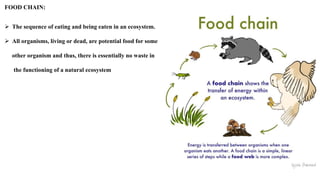
FOOD CHAIN:
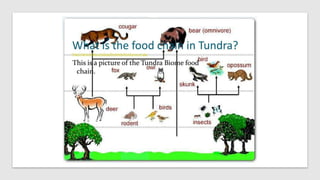
 The sequence of eating and being eaten in an ecosystem.
 All organisms, living or dead, are potential food for some
other organism and thus, there is essentially no waste in
the functioning of a natural ecosystem
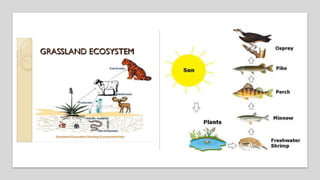
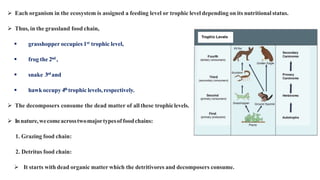
 Each organism in the ecosystem is assigned a feeding level or trophic level depending on its nutritionalstatus.
 Thus, in the grassland food chain,
 grasshopper occupies 1st trophic level,
 frog the 2nd ,
 snake 3rd and
 hawkoccupy 4thtrophic levels,respectively.
 The decomposers consume the dead matter of all these trophiclevels.
 Innature,wecomeacrosstwomajortypesof foodchains:
1. Grazing food chain:
2. Detritus food chain:
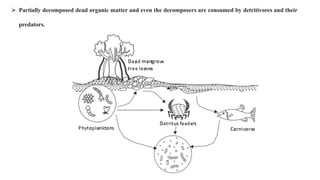
 It starts with dead organic matter which the detritivores and decomposers consume.
 Partially decomposed dead organic matter and even the decomposers are consumed by detritivores and their
predators.
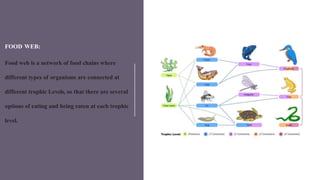
FOOD WEB:
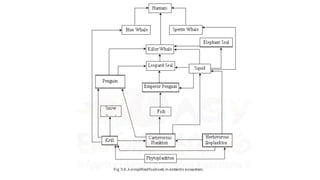
Food web is a network of food chains where
different types of organisms are connected at
different trophic Levels, so that there are several
options of eating and being eaten at each trophic
level.
Significance of food chains and food webs:
1. Food chains and food webs play a very significant role in the ecosystem because the two most important functions of
energy flow and nutrient cycling take place through them.
2. The food chains also help in maintaining and regulating the population size of different animals and thus, help
maintain the ecological balance.
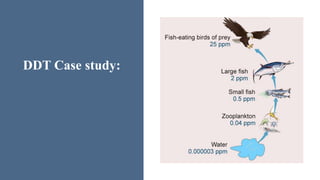
3. Food chains show a unique property of biological magnification of some chemicals.
4. There are several pesticides, heavy metals and other chemicals which are non-biodegradable in nature. Such
chemicals are not decomposed by microorganisms and they keep on passing from one trophic level to another. And,
at each successive trophic level, they keep on increasing in concentration. This phenomenon is known as
biomagnification or biological magnification.
DDT Case study:
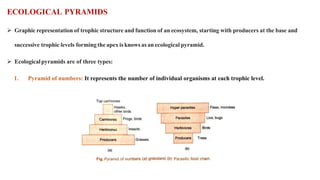
ECOLOGICAL PYRAMIDS
 Graphic representation of trophic structure and function of an ecosystem, starting with producers at the base and
successive trophic levels forming the apex is knows as an ecological pyramid.
 Ecologicalpyramids are of three types:
1. Pyramid of numbers: It represents the number of individual organisms at each trophic level.
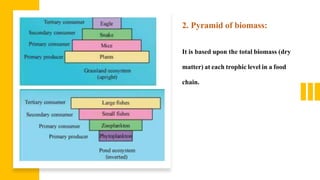
2. Pyramid of biomass:
It is based upon the total biomass (dry
matter) at each trophic level in a food
chain.
 The pyramid of biomass in a forest is upright in contrast to its pyramid of numbers.
 This is because the producers (trees) accumulate a huge biomass while the consumers total biomass feeding on
them declines at higher trophic levels, resulting in broad base and narrowing top.
 The pond ecosystem shows an inverted pyramid of biomass.
 The total biomass of producers (phytoplanktons) is much less as compared to herbivores (zooplanktons,
insects), Carnivores (Small fish) and tertiary carnivores (big fish). Thus the pyramid takes an inverted shape
with narrow base and broad apex.
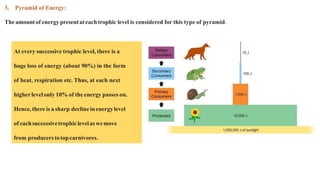
3. Pyramid of Energy:
Theamountof energypresentateachtrophic level is considered for this type of pyramid.
At every successive trophic level, there is a
huge loss of energy (about 90%) in the form
of heat, respiration etc. Thus, at each next
higher levelonly 10% of the energy passes on.
Hence,there is a sharp declineinenergylevel
of eachsuccessivetrophiclevelaswemove
from producerstotopcarnivores.
ECOLOGICAL SUCCESSION
 An ecosystem is not static in nature.
 It is dynamic and changes its structure as well as function with time and quite interestingly, these changes are
very orderly and can be predicted.
 It is observed that one type of a community is totally replaced by another type of community over a period of time
and simultaneously several changes also occur. This process is known as ecologicalsuccession.
 Ecological succession is defined as an orderly process of changes in the community structure and function with
time mediated through modifications in the physical environment and ultimately culminating in a stabilized
ecosystem known as climax.
 The whole sequence of communities which are transitory are known as Seral stages or seres whereas the
community establishing first of all in the area is called a pioneer community.
Ecological successions starting on different types of areas or substrata are named differently as follows:
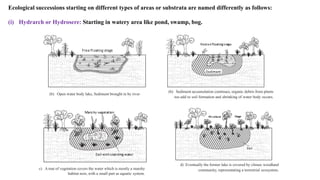
(i) Hydrarch or Hydrosere: Starting in watery area like pond, swamp, bog.
d) Eventually the former lake is covered by climax woodland
community, representating a terrestrial ecosystem.c) A mat of vegetation covers the water which is mostly a marshy
habitat now, with a small part as aquatic system.
(b) Sediment accumulation continues, organic debris from plants
too add to soil formation and shrinking of water body occurs.
(b) Open water body lake, Sediment brought in by river
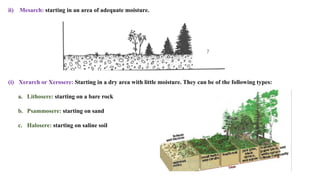
ii) Mesarch: starting in an area of adequate moisture.
(i) Xerarch or Xerosere: Starting in a dry area with little moisture. They can be of the following types:
a. Lithosere: starting on a bare rock
b. Psammosere: starting on sand
c. Halosere: starting on saline soil
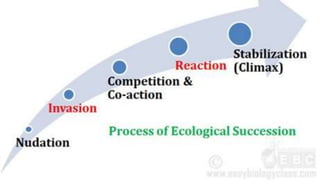
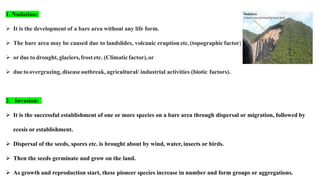
1. Nudation:
 It is the development of a bare area without any life form.
 The bare area may be caused due to landslides, volcanic eruption etc.(topographic factor),
 ordue to drought, glaciers,frost etc. (Climaticfactor),or
 duetoovergrazing,diseaseoutbreak,agricultural/ industrial activities (biotic factors).
2. Invasion:
 It is the successful establishment of one or more species on a bare area through dispersal or migration, followed by
ecesis or establishment.
 Dispersal of the seeds, spores etc. is brought about by wind, water, insects or birds.
 Then the seeds germinate and grow on the land.
 As growth and reproduction start, these pioneer species increase in number and form groups or aggregations.
3. Competition and coaction:
 As the number of individuals grows there is competition,
 both inter-specific (between different species) and
 intra-specific (within the same species), forspace, water and nutrition.
 They influence each other in a number of ways, known as coaction.
4. Reaction:
 The living organisms grow, use water and nutrients from the substratum, and in turn, they have a
strong influence on the environment which is modified to a large extent and this is known as reaction.
 The modifications are very often such that they become unsuitable for the existing species and favor
some new species, which replace them. Thus, reaction leads to several seral communities
5. Stabilization:
Thesuccessionultimatelyculminatesinamore or less stable community called climax which is in equilibrium with the
environment

Ecosystem

  • 1.
    ECOSYSTEM Dr. Neeraj Kumari AssistantProfessor School of Basic and Applied Science K. R. Mangalam University Gurugram - 122103
  • 2.
    History:  The termEcology was coined by Earnst Haeckel in 1869.  Derived from the Greek words Oikos- home + logos- study.  Ecology deals with the study of organisms in their natural home interacting with their surroundings.  The surroundings or environment consists of other living organisms (biotic) and physical (abiotic) components.  Modern ecologists believe that an adequate definition of ecology must specify some unit of study and one such basic unit described by Tansley (1935) was ecosystem.
  • 3.
    An ecosystem isa group of biotic communities of species interacting with one another and with their non-living environment exchanging energy and matter.  Now ecology is often defined as the study of ecosystems.  An ecosystem is an integrated unit consisting of interacting plants, animals and microorganisms whose survival depends upon the maintenance and regulation of their biotic and abiotic structures and functions.  The ecosystem is thus, a unit or a system which is composed of a number of subunits, that are all directly or indirectly linked with each other.
  • 4.
    ECOSYSTEM CHARACTERISTICS : Ecosystemsshow large variations in their size, structure, composition etc. 1. Structural Characteristics:
  • 5.
    a) Biotic structure: The plants, animals and microorganisms.  These organisms have different nutritional behavior and status in the ecosystems  Are accordingly known as producers or consumers, based on how do they get their food Mainly green plants, which can synthesize their food themselves through the process of photosynthesis – Photoautotrophs photo antotrophs (auto=self; troph=food, photo=light).
  • 6.
     Some microorganismswhichcanproduce organic matter to some extent through oxidation of certain chemicals in the absence of sunlight.  They are knownas chemosynthetic organisms or chemo-antotrophs.  For instance in the ocean depths, where there is no sunlight, chemoautotrophic sulphur bacteria make use of the heat generated by the decay of radioactive  elements present in the earths core and released in ocean³s depths.  They use this heat toconvert dissolved hydrogen sulphide (H2S) and carbon dioxide (CO2) into organic compounds.
  • 7.
    All organisms whichget their organic food by feeding upon other organisms are called consumers.
  • 8.
     Derive theirnutrition by breaking down the complex organic molecules to simpler organic compounds and ultimately into inorganic nutrients.  Various bacteria and fungi are decomposers
  • 9.
    b) Abiotic structure: The physicaland chemical componentsof an ecosystem constituteits abiotic structure.  Such as climatic factors, edaphic (soil) factors, geographical factors, energy, nutrients and toxicsubstances. Physicalfactors:  The sunlight and shade, intensity of solar flux, duration of sun hours, average temperature, maximum- minimum temperature, annual rainfall, wind, latitude and altitude, soil type, water availability, water currents etc. are some of the important physical features which have a strong influence on the ecosystem.  All these factors affects lives and distribution of living organisms.
  • 10.
    Chemical factors: Availability ofmajor essential nutrients like carbon, nitrogen, phosphorus, potassium, hydrogen, oxygen and sulphur, level of toxic substances, salts causing salinity and various organic substances present in the soil or water largely influence the functioning of the ecosystem. TROPHIC STRUCTURE:  It is pattern of movement of energy and matter through ecosystem.  It is the result of compressing a community food web into a series of trophic level.  The producers and consumers are arranged in the ecosystem in a definite manner and their interaction along with population size are expressed together as trophic structure.  Each food level is known as trophic Level and  the amount of living matter at each trophic level at a given time is known as standing crop or standing biomass.
  • 11.
    FOOD CHAIN:  Thesequence of eating and being eaten in an ecosystem.  All organisms, living or dead, are potential food for some other organism and thus, there is essentially no waste in the functioning of a natural ecosystem
  • 14.
     Each organismin the ecosystem is assigned a feeding level or trophic level depending on its nutritionalstatus.  Thus, in the grassland food chain,  grasshopper occupies 1st trophic level,  frog the 2nd ,  snake 3rd and  hawkoccupy 4thtrophic levels,respectively.  The decomposers consume the dead matter of all these trophiclevels.  Innature,wecomeacrosstwomajortypesof foodchains: 1. Grazing food chain: 2. Detritus food chain:  It starts with dead organic matter which the detritivores and decomposers consume.
  • 15.
     Partially decomposeddead organic matter and even the decomposers are consumed by detritivores and their predators.
  • 16.
    FOOD WEB: Food webis a network of food chains where different types of organisms are connected at different trophic Levels, so that there are several options of eating and being eaten at each trophic level.
  • 18.
    Significance of foodchains and food webs: 1. Food chains and food webs play a very significant role in the ecosystem because the two most important functions of energy flow and nutrient cycling take place through them. 2. The food chains also help in maintaining and regulating the population size of different animals and thus, help maintain the ecological balance. 3. Food chains show a unique property of biological magnification of some chemicals. 4. There are several pesticides, heavy metals and other chemicals which are non-biodegradable in nature. Such chemicals are not decomposed by microorganisms and they keep on passing from one trophic level to another. And, at each successive trophic level, they keep on increasing in concentration. This phenomenon is known as biomagnification or biological magnification.
  • 19.
  • 20.
    ECOLOGICAL PYRAMIDS  Graphicrepresentation of trophic structure and function of an ecosystem, starting with producers at the base and successive trophic levels forming the apex is knows as an ecological pyramid.  Ecologicalpyramids are of three types: 1. Pyramid of numbers: It represents the number of individual organisms at each trophic level.
  • 21.
    2. Pyramid ofbiomass: It is based upon the total biomass (dry matter) at each trophic level in a food chain.
  • 22.
     The pyramidof biomass in a forest is upright in contrast to its pyramid of numbers.  This is because the producers (trees) accumulate a huge biomass while the consumers total biomass feeding on them declines at higher trophic levels, resulting in broad base and narrowing top.  The pond ecosystem shows an inverted pyramid of biomass.  The total biomass of producers (phytoplanktons) is much less as compared to herbivores (zooplanktons, insects), Carnivores (Small fish) and tertiary carnivores (big fish). Thus the pyramid takes an inverted shape with narrow base and broad apex.
  • 23.
    3. Pyramid ofEnergy: Theamountof energypresentateachtrophic level is considered for this type of pyramid. At every successive trophic level, there is a huge loss of energy (about 90%) in the form of heat, respiration etc. Thus, at each next higher levelonly 10% of the energy passes on. Hence,there is a sharp declineinenergylevel of eachsuccessivetrophiclevelaswemove from producerstotopcarnivores.
  • 24.
    ECOLOGICAL SUCCESSION  Anecosystem is not static in nature.  It is dynamic and changes its structure as well as function with time and quite interestingly, these changes are very orderly and can be predicted.  It is observed that one type of a community is totally replaced by another type of community over a period of time and simultaneously several changes also occur. This process is known as ecologicalsuccession.  Ecological succession is defined as an orderly process of changes in the community structure and function with time mediated through modifications in the physical environment and ultimately culminating in a stabilized ecosystem known as climax.  The whole sequence of communities which are transitory are known as Seral stages or seres whereas the community establishing first of all in the area is called a pioneer community.
  • 25.
    Ecological successions startingon different types of areas or substrata are named differently as follows: (i) Hydrarch or Hydrosere: Starting in watery area like pond, swamp, bog. d) Eventually the former lake is covered by climax woodland community, representating a terrestrial ecosystem.c) A mat of vegetation covers the water which is mostly a marshy habitat now, with a small part as aquatic system. (b) Sediment accumulation continues, organic debris from plants too add to soil formation and shrinking of water body occurs. (b) Open water body lake, Sediment brought in by river
  • 26.
    ii) Mesarch: startingin an area of adequate moisture. (i) Xerarch or Xerosere: Starting in a dry area with little moisture. They can be of the following types: a. Lithosere: starting on a bare rock b. Psammosere: starting on sand c. Halosere: starting on saline soil
  • 28.
    1. Nudation:  Itis the development of a bare area without any life form.  The bare area may be caused due to landslides, volcanic eruption etc.(topographic factor),  ordue to drought, glaciers,frost etc. (Climaticfactor),or  duetoovergrazing,diseaseoutbreak,agricultural/ industrial activities (biotic factors). 2. Invasion:  It is the successful establishment of one or more species on a bare area through dispersal or migration, followed by ecesis or establishment.  Dispersal of the seeds, spores etc. is brought about by wind, water, insects or birds.  Then the seeds germinate and grow on the land.  As growth and reproduction start, these pioneer species increase in number and form groups or aggregations.
  • 29.
    3. Competition andcoaction:  As the number of individuals grows there is competition,  both inter-specific (between different species) and  intra-specific (within the same species), forspace, water and nutrition.  They influence each other in a number of ways, known as coaction. 4. Reaction:  The living organisms grow, use water and nutrients from the substratum, and in turn, they have a strong influence on the environment which is modified to a large extent and this is known as reaction.  The modifications are very often such that they become unsuitable for the existing species and favor some new species, which replace them. Thus, reaction leads to several seral communities
  • 30.
    5. Stabilization: Thesuccessionultimatelyculminatesinamore orless stable community called climax which is in equilibrium with the environment