

Raymond C. Baldonado
Biogeochemical Cycles
• Nutrients and water are essential for
ecosystems to continue functioning
• Living organisms need 30-40 elements for
normal development
• The chemical elements or nutrients flow from
the nonliving to the living and back to the
nonliving components of the ecosystem in a
more or less cyclic path
Biogeochemical Cycles
• Nutrients that are required by organisms,
primarily autotrophs, may be classified into:
1. Macronutrients- are required in relatively
large amounts and they include:
 Carbon, Hydrogen, Oxygen, Nitrogen,
Potassium, Calcium, Magnesium and Sulfur
and Phosphorus
Biogeochemical Cycles
2. Micronutrients- are required in small
quantities, among the are:
 Iron, Manganese Copper, Zinc, Boron, Sodium
and so on
• These nutrients have to cycle in ecosystems
because the continued functioning and
maintenance of an ecosystem depends on the
supply and circulation of these nutrients
Biogeochemical Cycles
Biogeochemical cycles have two basic types:
1. Gaseous Nutrient Cycle- the main source of
nutrients are the atmosphere and the oceans.
The gases which are most important for life
are nitrogen, oxygen and carbon dioxide
These three gases in stable quantities of 78%,
21% and 0.03%, respectively
Example: Nitrogen, Oxygen and Carbon Cycles
Biogeochemical Cycles
2. Sedimentary Nutrient Cycle- the main sources
are soil, rocks and minerals
The mineral elements that living organisms
require come initially from inorganic sources
Mineral salts come directly from the Earth’s
crust through weathering
Example: Sulfur Cycle, Phosphorus Cycle
Biogeochemical Cycles
• Both Gaseous and Sedimentary Nutrient
Cycles involve biological and non biological
processes
• Both are driven by the flow of energy through
the ecosystem
• Both are tied to Water/Hydrologic Cycle
CARBON CYCLE
Carbon Cycle
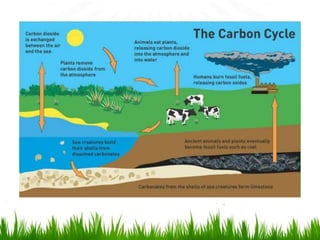
• Carbon is the basic building block element of
large molecules necessary for life
The source of carbon for plants is the carbon
dioxide in the atmosphere and dissolved
carbon dioxide in water
Carbon also occurs in the earth’s crust as
carbonate rocks such as limestone
Volcanos can return carbon dioxide to the air
and water during eruptions
Carbon Cycle
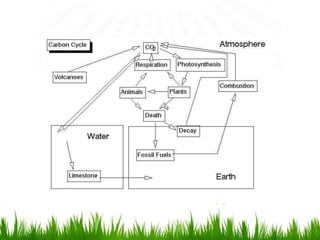
 The carbon is converted from carbon dioxide into
sugars by green plants and into organic molecules by
photosynthesis
 From there the carbon is transferred through ingestion
along the food chains to herbivores and carnivores
 At each stage part of the carbon stored in the complex
food molecules is broken down through respiration to
release energy and carbon is cycled back as carbon
dioxide to the air and water
 The remaining carbon is returned to the air and water
when an organisms die and decay
OXYGEN CYCLE
Oxygen cycle
• It is the most important element of the human
body, makes up about 65% of the mass of the
human body
• The three main reservoirs are the air,
ecosystems and Earth’s crust
• The main driving factor of the oxygen cycle is
the process of photosynthesis
• The oxygen cycle is interconnected with the
carbon dioxide
Oxygen cycle
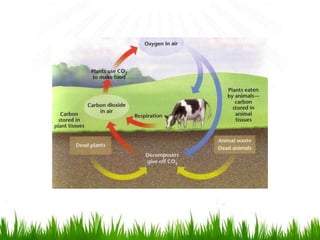
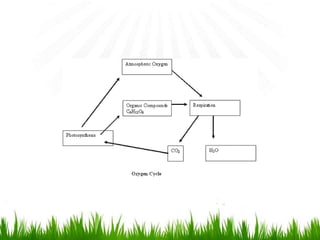
The autotrophs uses carbon dioxide, water
and sunlight to produce food and releases
oxygen to the atmosphere
The animals then breathe in the oxygen and
breathe out carbon dioxide that is needed
again by the plants in manufacturing food
Decaying matters release carbon dioxide that
also used by the plants for photosynthetic
process
NITROGEN CYCLE
Nitrogen Cycle
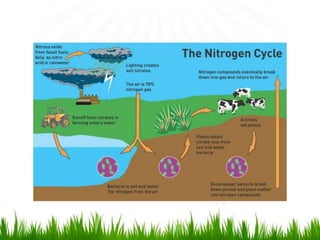
• Nitrogen is an important element because it is
a constituent of some biological molecules
Most of the nitrogen in living organisms does
not enter directly from the atmosphere.
Instead, the nitrogen fixing bacteria in the
soil, algae in water and in roots of leguminous
plants converted the gaseous nitrogen into
nitrates, some are fixed by lightning
Nitrogen Cycle
These nitrate salts dissolve in soil water and are
absorbed by plants and converted into nucleic
acids and proteins
When animals (herbivores) feed on these plants,
some nitrogen is passed to the animals and
eventually to other animals (carnivores)
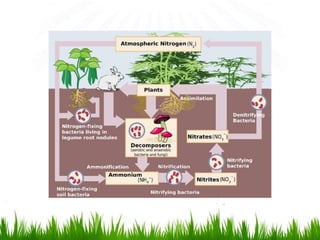
When the organisms die their nitrogen is
converted to ammonia gas and soluble
ammonium salts by saprotrophic fungi and
bacteria
Nitrogen Cycle
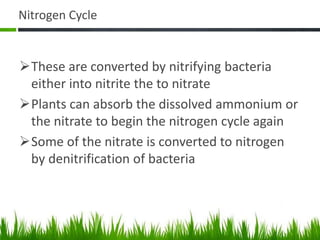
These are converted by nitrifying bacteria
either into nitrite the to nitrate
Plants can absorb the dissolved ammonium or
the nitrate to begin the nitrogen cycle again
Some of the nitrate is converted to nitrogen
by denitrification of bacteria
Nitrogen Cycle
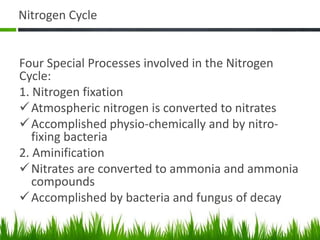
Four Special Processes involved in the Nitrogen
Cycle:
1. Nitrogen fixation
Atmospheric nitrogen is converted to nitrates
Accomplished physio-chemically and by nitro-
fixing bacteria
2. Aminification
Nitrates are converted to ammonia and ammonia
compounds
Accomplished by bacteria and fungus of decay
Nitrogen Cycle
• Four Special Processes involved in the Nitrogen
Cycle:
3. Nitrification
Ammonia compounds and ammonia are
converted to nitrates
Accomplished by nitrite and nitrate bacteria
4. Denitrification
Nitrates are converted to atmospheric nitrogen
Accomplished by denitrifying bacteria
SULFUR CYCLE
Sulfur Cycle
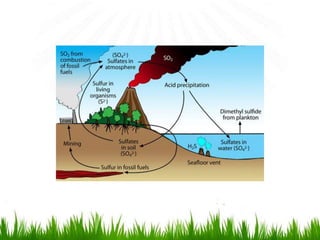
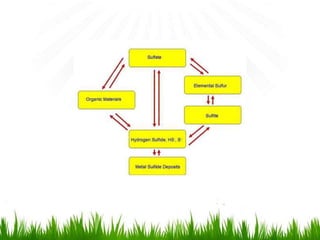
• Sulfur has both gaseous and sedimentary
phases
• Sedimentary sulfur comes from the weathering
of rocks, runoff and decomposition of organic
matter
• Gaseous sulfur are from decomposition of
organic matter, evaporation of oceans and
volcanic eruptions
Sulfur Cycle
A significant portion of the sulfur released to
the atmosphere is a by-product of the burning
of fossil fuels
Sulfur enters the atmosphere mostly as
hydrogen sulfide, which quickly oxidizes to
sulfur dioxide
Sulfur dioxide reacts with moisture in the
atmosphere to form sulfuric acid, carried to
Earth in precipitation
Sulfur Cycle
Plants incorporate it into sulfur-bearing amino
acids
Consumption, excretion and death carry sulfur
back to soil and aquatic sediments, where
bacteria release it in inorganic form
PHOSPHORUS CYCLE
Phosphorus Cycle
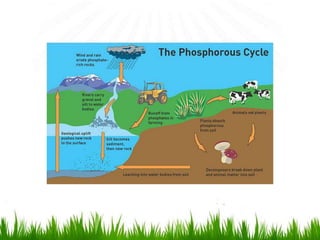
• In living organisms phosphorus is an
important component of nucleic acids, cell
membranes, teeth and bones
• This cycle is interesting because unlike the
previous cycles, it lacks an atmospheric
component
• The major reservoir is sedimentary rock in the
earth’s crust
Phosphorus Cycle
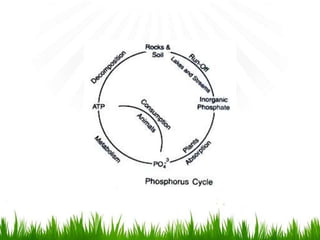
Phosphorus is absorbed by plants from the
soil as dihydrogenphosphate or
hydrogenphosphate
It is then passed to animals, that is, herbivores
and then carnivores.
It is eventually returned to the soil, rivers and
oceans as animal excretion or through
decomposition after death
Biogeochemical Cycles are
Interconnected
Biogeochemical Cycles are Linked
• The nutrients that cycle are all components of
living organisms, constituents of organic matter
• The stoichiometric relationships among various
elements involved in plant processes related to
carbon uptake and plant growth have an
important influence on the cycling of nutrients in
ecosystems
• Interconnection of different biogeochemical
cycles may always lead to equilibrium state within
the biosphere
Energy Flow in the Ecosystem
Energy
• Energy is a very mysterious concept
• It is involved in every single event in the
universe from the humans to photons
• Energy is everywhere
• Energy never appears from or disappears into
nothing
• Energy can always be counted for
Energy Concept
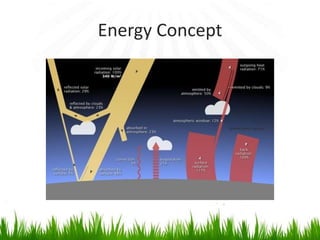
• Earth is an open system
• For life to exist, the earth must constantly receive
inputs of energy from the sun and make outputs
of heat energy
• Energy from the sun maintains all of the life
processes in the earth ecosystem
• Only 50% of the sunlight reaching the earth’s
upper atmosphere to earth’s surface
• Heat from the earth is constantly rising and
passing to outer space
Energy Concept
Energy Flow
 In every ecosystem, the main source of energy is the
sunlight or solar radiation
 Light energy enters the ecosystem when it is absorbed
by plants
 It is the passed through the ecosystem as food plants
for animals that consume each other
 Energy absorbed and transferred through the
ecosystem in this way is eventually converted into heat
 This heat, which is exactly equivalent to the solar input,
finally leaves the ecosystem and is lost in space
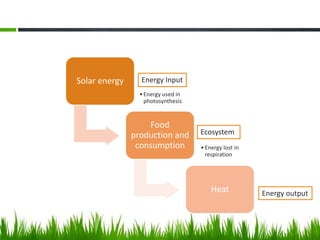
Solar energy
•Energy used in
photosynthesis
Food
production and
consumption •Energy lost in
respiration
Heat
Energy Input
Ecosystem
Energy output
Energy Flow
All energy are controlled by two very general
laws: Two Laws of Thermodynamics
1. First Law of Thermodynamics
• States that energy can be transformed from one
form to another but can never be created nor
destroyed
2. Second Law of Thermodynamics
• States that each time energy is transformed, it
tends to go to from a more organized and
concentrated form to a less organized and more
dispersed form
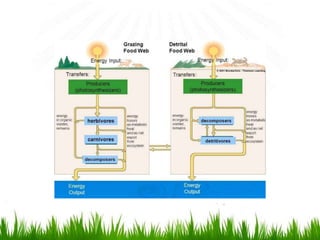
Food Chains
• Through this process, food energy flow in
ecosystem
Two Major Food Chains:
1. Grazing food chain- is where energy is passed
through living organisms and is represented as:
Plant—Animal--Animal
2. Detritus food chain- is where energy is passed
from dead organisms or organic matter to
decomposers and is represented as:
Dead matter--Decomposer
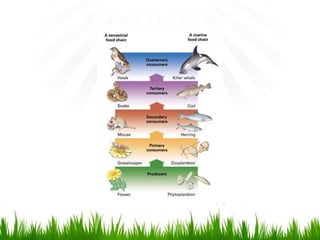
Trophic Levels
• In ecosystem, organisms that obtain food from
plants by the same number of steps are said to
belong to same trophic level
Green plants occupy the first trophic level
Herbivores are in the second trophic level
Carnivores are in the third trophic level
Tertiary consumers are in fourth trophic level
Decomposers can belong to any trophic level
depending on their food sources
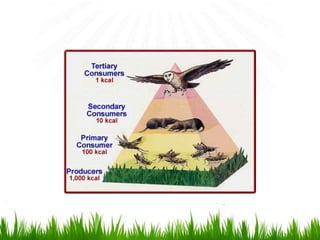
Ecological Energy Pyramid
• Pyramid of energy shows the flow of energy in
the trophic levels
• It is always upright, that is, it can never be
inverted because of the Second Law of
Thermodynamics about transformation or
transfer of energy
• There can never be the same amount or more
energy flowing or being passed from a lower
trophic level to the next upper trophic level
Human Implication to:
Water Cycle
Biogeochemical Cycle
Energy Flow
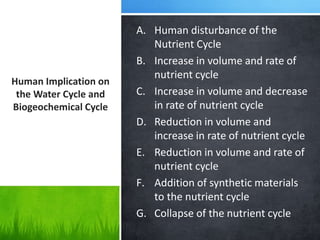
Human Implication on
the Water Cycle and
Biogeochemical Cycle
A. Human disturbance of the
Nutrient Cycle
B. Increase in volume and rate of
nutrient cycle
C. Increase in volume and decrease
in rate of nutrient cycle
D. Reduction in volume and
increase in rate of nutrient cycle
E. Reduction in volume and rate of
nutrient cycle
F. Addition of synthetic materials
to the nutrient cycle
G. Collapse of the nutrient cycle
Roles of Water in
Biogeochemical
Cycles
1. Dissolved nutrients are carried
from the earth’s surface either into
the ground or into the ocean
2. Atmospheric nutrients are often
brought to the earth’s surface in
rainwater
3. Nutrients held in rocks are
gradually released by weathering
accomplished by rain, by erosion
through flowing water and by
freezing and defrosting ice
4. Nutrients are usually dissolved in
water when they are absorbed into
the roots of plants
5. Water is critical in accomplishing
the various chemical changes that
nutrients undertake as they pass
thru the bio phase of their cycle
1. Keeps the earth warm enough
so that chemical reactions are
possible
2. Makes it possible for living
organisms to carry on their vital
processes
3. Powers the atmospheric,
geological and water cycles
4. Energy is needed by the plants
to pump water and
consequently to extract
dissolved nutrients from the soil
5. Bacteria require considerable
amount of energy to carry out
their vital processes and thereby
change nutrients from one form
to another
Functions of Energy
Flow in Facilitating
Biogeochemical Cycles
1. The effect of humans on net
primary productivity is generally
to reduce the productivity of
wild system and to increase that
of cultivated system
2. Energy intensification in
cropping has been accompanied
by a substitution of fossil fuels
for human and animal power
3. In forest system, there is a
varying relationship between
crop maturity and economic
return
Human Implication to
Energy Flow
Biogeochemical Cycles

Biogeochemical Cycles

  • 1.
  • 2.
    Biogeochemical Cycles • Nutrientsand water are essential for ecosystems to continue functioning • Living organisms need 30-40 elements for normal development • The chemical elements or nutrients flow from the nonliving to the living and back to the nonliving components of the ecosystem in a more or less cyclic path
  • 3.
    Biogeochemical Cycles • Nutrientsthat are required by organisms, primarily autotrophs, may be classified into: 1. Macronutrients- are required in relatively large amounts and they include:  Carbon, Hydrogen, Oxygen, Nitrogen, Potassium, Calcium, Magnesium and Sulfur and Phosphorus
  • 4.
    Biogeochemical Cycles 2. Micronutrients-are required in small quantities, among the are:  Iron, Manganese Copper, Zinc, Boron, Sodium and so on • These nutrients have to cycle in ecosystems because the continued functioning and maintenance of an ecosystem depends on the supply and circulation of these nutrients
  • 5.
    Biogeochemical Cycles Biogeochemical cycleshave two basic types: 1. Gaseous Nutrient Cycle- the main source of nutrients are the atmosphere and the oceans. The gases which are most important for life are nitrogen, oxygen and carbon dioxide These three gases in stable quantities of 78%, 21% and 0.03%, respectively Example: Nitrogen, Oxygen and Carbon Cycles
  • 6.
    Biogeochemical Cycles 2. SedimentaryNutrient Cycle- the main sources are soil, rocks and minerals The mineral elements that living organisms require come initially from inorganic sources Mineral salts come directly from the Earth’s crust through weathering Example: Sulfur Cycle, Phosphorus Cycle
  • 7.
    Biogeochemical Cycles • BothGaseous and Sedimentary Nutrient Cycles involve biological and non biological processes • Both are driven by the flow of energy through the ecosystem • Both are tied to Water/Hydrologic Cycle
  • 8.
  • 9.
    Carbon Cycle • Carbonis the basic building block element of large molecules necessary for life The source of carbon for plants is the carbon dioxide in the atmosphere and dissolved carbon dioxide in water Carbon also occurs in the earth’s crust as carbonate rocks such as limestone Volcanos can return carbon dioxide to the air and water during eruptions
  • 10.
    Carbon Cycle  Thecarbon is converted from carbon dioxide into sugars by green plants and into organic molecules by photosynthesis  From there the carbon is transferred through ingestion along the food chains to herbivores and carnivores  At each stage part of the carbon stored in the complex food molecules is broken down through respiration to release energy and carbon is cycled back as carbon dioxide to the air and water  The remaining carbon is returned to the air and water when an organisms die and decay
  • 13.
  • 14.
    Oxygen cycle • Itis the most important element of the human body, makes up about 65% of the mass of the human body • The three main reservoirs are the air, ecosystems and Earth’s crust • The main driving factor of the oxygen cycle is the process of photosynthesis • The oxygen cycle is interconnected with the carbon dioxide
  • 15.
    Oxygen cycle The autotrophsuses carbon dioxide, water and sunlight to produce food and releases oxygen to the atmosphere The animals then breathe in the oxygen and breathe out carbon dioxide that is needed again by the plants in manufacturing food Decaying matters release carbon dioxide that also used by the plants for photosynthetic process
  • 18.
  • 19.
    Nitrogen Cycle • Nitrogenis an important element because it is a constituent of some biological molecules Most of the nitrogen in living organisms does not enter directly from the atmosphere. Instead, the nitrogen fixing bacteria in the soil, algae in water and in roots of leguminous plants converted the gaseous nitrogen into nitrates, some are fixed by lightning
  • 20.
    Nitrogen Cycle These nitratesalts dissolve in soil water and are absorbed by plants and converted into nucleic acids and proteins When animals (herbivores) feed on these plants, some nitrogen is passed to the animals and eventually to other animals (carnivores) When the organisms die their nitrogen is converted to ammonia gas and soluble ammonium salts by saprotrophic fungi and bacteria
  • 21.
    Nitrogen Cycle These areconverted by nitrifying bacteria either into nitrite the to nitrate Plants can absorb the dissolved ammonium or the nitrate to begin the nitrogen cycle again Some of the nitrate is converted to nitrogen by denitrification of bacteria
  • 24.
    Nitrogen Cycle Four SpecialProcesses involved in the Nitrogen Cycle: 1. Nitrogen fixation Atmospheric nitrogen is converted to nitrates Accomplished physio-chemically and by nitro- fixing bacteria 2. Aminification Nitrates are converted to ammonia and ammonia compounds Accomplished by bacteria and fungus of decay
  • 25.
    Nitrogen Cycle • FourSpecial Processes involved in the Nitrogen Cycle: 3. Nitrification Ammonia compounds and ammonia are converted to nitrates Accomplished by nitrite and nitrate bacteria 4. Denitrification Nitrates are converted to atmospheric nitrogen Accomplished by denitrifying bacteria
  • 26.
  • 27.
    Sulfur Cycle • Sulfurhas both gaseous and sedimentary phases • Sedimentary sulfur comes from the weathering of rocks, runoff and decomposition of organic matter • Gaseous sulfur are from decomposition of organic matter, evaporation of oceans and volcanic eruptions
  • 28.
    Sulfur Cycle A significantportion of the sulfur released to the atmosphere is a by-product of the burning of fossil fuels Sulfur enters the atmosphere mostly as hydrogen sulfide, which quickly oxidizes to sulfur dioxide Sulfur dioxide reacts with moisture in the atmosphere to form sulfuric acid, carried to Earth in precipitation
  • 29.
    Sulfur Cycle Plants incorporateit into sulfur-bearing amino acids Consumption, excretion and death carry sulfur back to soil and aquatic sediments, where bacteria release it in inorganic form
  • 32.
  • 33.
    Phosphorus Cycle • Inliving organisms phosphorus is an important component of nucleic acids, cell membranes, teeth and bones • This cycle is interesting because unlike the previous cycles, it lacks an atmospheric component • The major reservoir is sedimentary rock in the earth’s crust
  • 34.
    Phosphorus Cycle Phosphorus isabsorbed by plants from the soil as dihydrogenphosphate or hydrogenphosphate It is then passed to animals, that is, herbivores and then carnivores. It is eventually returned to the soil, rivers and oceans as animal excretion or through decomposition after death
  • 37.
  • 38.
    Biogeochemical Cycles areLinked • The nutrients that cycle are all components of living organisms, constituents of organic matter • The stoichiometric relationships among various elements involved in plant processes related to carbon uptake and plant growth have an important influence on the cycling of nutrients in ecosystems • Interconnection of different biogeochemical cycles may always lead to equilibrium state within the biosphere
  • 40.
    Energy Flow inthe Ecosystem
  • 41.
    Energy • Energy isa very mysterious concept • It is involved in every single event in the universe from the humans to photons • Energy is everywhere • Energy never appears from or disappears into nothing • Energy can always be counted for
  • 42.
    Energy Concept • Earthis an open system • For life to exist, the earth must constantly receive inputs of energy from the sun and make outputs of heat energy • Energy from the sun maintains all of the life processes in the earth ecosystem • Only 50% of the sunlight reaching the earth’s upper atmosphere to earth’s surface • Heat from the earth is constantly rising and passing to outer space
  • 43.
  • 44.
    Energy Flow  Inevery ecosystem, the main source of energy is the sunlight or solar radiation  Light energy enters the ecosystem when it is absorbed by plants  It is the passed through the ecosystem as food plants for animals that consume each other  Energy absorbed and transferred through the ecosystem in this way is eventually converted into heat  This heat, which is exactly equivalent to the solar input, finally leaves the ecosystem and is lost in space
  • 45.
    Solar energy •Energy usedin photosynthesis Food production and consumption •Energy lost in respiration Heat Energy Input Ecosystem Energy output
  • 46.
    Energy Flow All energyare controlled by two very general laws: Two Laws of Thermodynamics 1. First Law of Thermodynamics • States that energy can be transformed from one form to another but can never be created nor destroyed 2. Second Law of Thermodynamics • States that each time energy is transformed, it tends to go to from a more organized and concentrated form to a less organized and more dispersed form
  • 47.
    Food Chains • Throughthis process, food energy flow in ecosystem Two Major Food Chains: 1. Grazing food chain- is where energy is passed through living organisms and is represented as: Plant—Animal--Animal 2. Detritus food chain- is where energy is passed from dead organisms or organic matter to decomposers and is represented as: Dead matter--Decomposer
  • 49.
    Trophic Levels • Inecosystem, organisms that obtain food from plants by the same number of steps are said to belong to same trophic level Green plants occupy the first trophic level Herbivores are in the second trophic level Carnivores are in the third trophic level Tertiary consumers are in fourth trophic level Decomposers can belong to any trophic level depending on their food sources
  • 51.
    Ecological Energy Pyramid •Pyramid of energy shows the flow of energy in the trophic levels • It is always upright, that is, it can never be inverted because of the Second Law of Thermodynamics about transformation or transfer of energy • There can never be the same amount or more energy flowing or being passed from a lower trophic level to the next upper trophic level
  • 53.
    Human Implication to: WaterCycle Biogeochemical Cycle Energy Flow
  • 54.
    Human Implication on theWater Cycle and Biogeochemical Cycle A. Human disturbance of the Nutrient Cycle B. Increase in volume and rate of nutrient cycle C. Increase in volume and decrease in rate of nutrient cycle D. Reduction in volume and increase in rate of nutrient cycle E. Reduction in volume and rate of nutrient cycle F. Addition of synthetic materials to the nutrient cycle G. Collapse of the nutrient cycle
  • 55.
    Roles of Waterin Biogeochemical Cycles 1. Dissolved nutrients are carried from the earth’s surface either into the ground or into the ocean 2. Atmospheric nutrients are often brought to the earth’s surface in rainwater 3. Nutrients held in rocks are gradually released by weathering accomplished by rain, by erosion through flowing water and by freezing and defrosting ice 4. Nutrients are usually dissolved in water when they are absorbed into the roots of plants 5. Water is critical in accomplishing the various chemical changes that nutrients undertake as they pass thru the bio phase of their cycle
  • 56.
    1. Keeps theearth warm enough so that chemical reactions are possible 2. Makes it possible for living organisms to carry on their vital processes 3. Powers the atmospheric, geological and water cycles 4. Energy is needed by the plants to pump water and consequently to extract dissolved nutrients from the soil 5. Bacteria require considerable amount of energy to carry out their vital processes and thereby change nutrients from one form to another Functions of Energy Flow in Facilitating Biogeochemical Cycles
  • 57.
    1. The effectof humans on net primary productivity is generally to reduce the productivity of wild system and to increase that of cultivated system 2. Energy intensification in cropping has been accompanied by a substitution of fossil fuels for human and animal power 3. In forest system, there is a varying relationship between crop maturity and economic return Human Implication to Energy Flow

Editor's Notes

  • #2 This presentation demonstrates the new capabilities of PowerPoint and it is best viewed in Slide Show. These slides are designed to give you great ideas for the presentations you’ll create in PowerPoint 2010! For more sample templates, click the File tab, and then on the New tab, click Sample Templates.