CARBON CYCLE
CONTENTS 
• Introduction 
• Carbon Cycle 
• Procedure 
Photosynthesis 
Respiration 
Weathering of rocks 
Auto and factory emissons 
• Imbalance of Carbon Cycle 
• Effect of excess CO2 on plants 
• Effect of excess CO2 on humans 
• Effect of excess CO2 on global warming
CARBON CYCLE 
The carbon cycle is the biogeochemical cycle by which carbon is 
exchanged among the biosphere, 
pedosphere, geosphere, hydrosphere, and atmosphere of the 
Earth. 
Along with the nitrogen cycle and the water cycle, the carbon 
cycle comprises a sequence of events that are key to making 
the Earth capable of sustaining life; it describes the movement 
of carbon as it is recycled and reused throughout the biosphere.
GLOBAL CARBON BUDGET 
The global carbon budget is the balance of the 
exchanges (incomes and losses) of carbon between 
the carbon reservoirs or between one specific loop 
(e.g., atmosphere ↔ biosphere) of the carbon cycle. 
An examination of the carbon budget of a pool or 
reservoir can provide information about 
whether the pool or reservoir is functioning as a 
source or sink for carbon dioxide.
PROCEDURE 
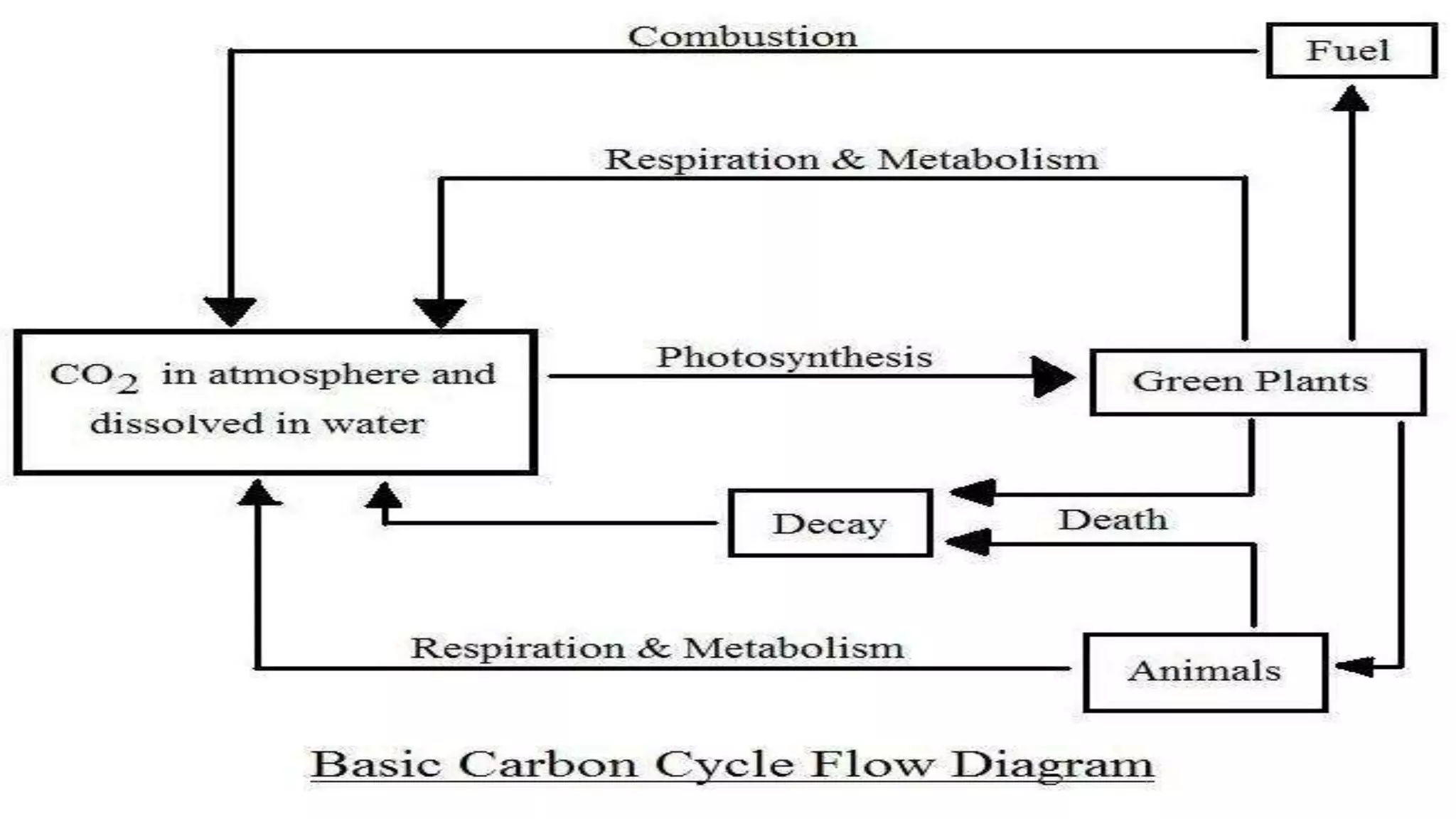
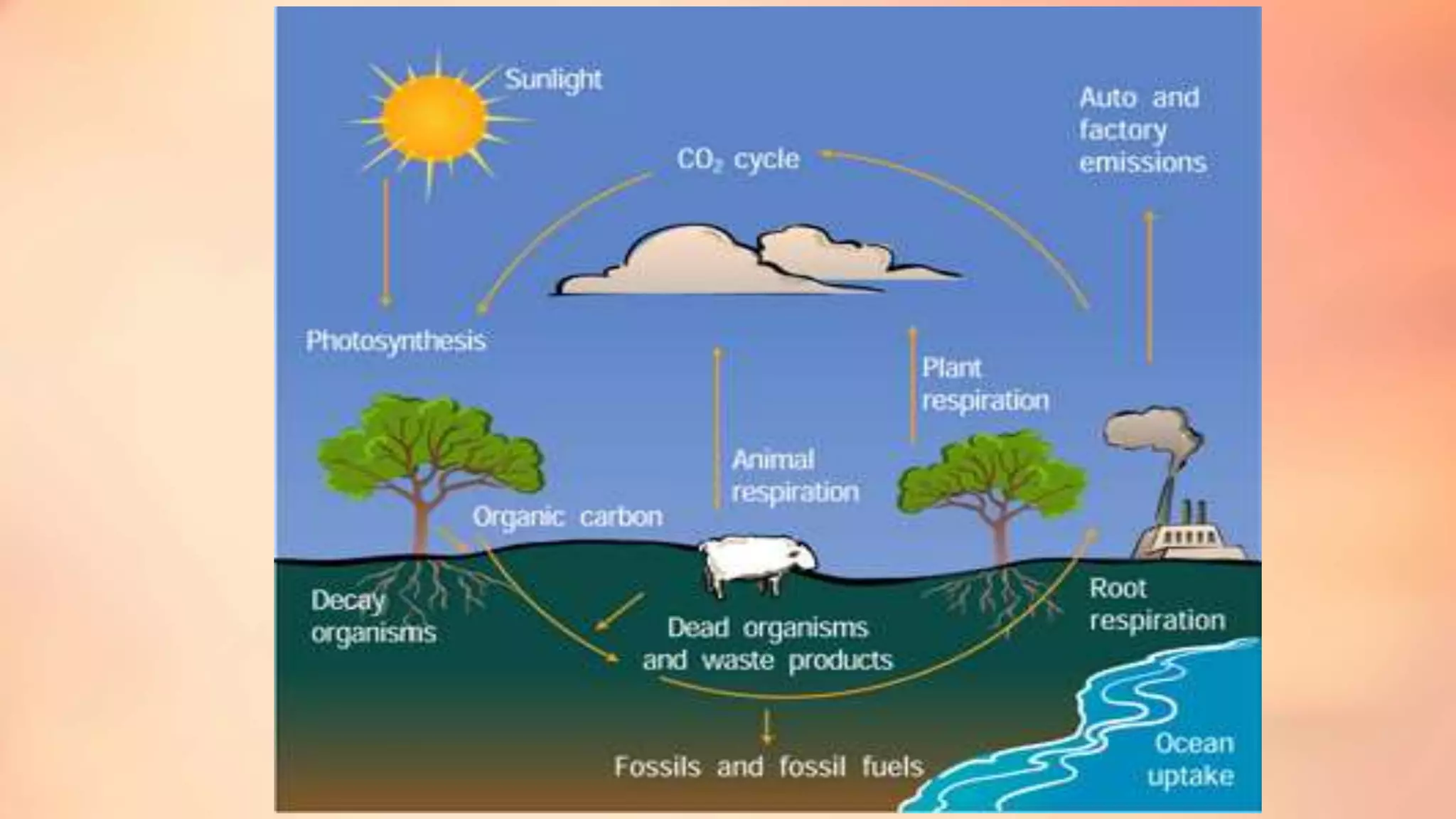
Plants use carbon dioxide and sunlight to make their own food 
and grow. The carbon becomes part of the plant. Plants that die 
and are buried may turn into fossil fuels made of carbon like coal 
and oil over millions of years. When humans burn fossil fuels, 
most of the carbon quickly enters the atmosphere as carbon 
dioxide. 
Photosynthesis: 
Plants and photosynthetic algae and bacteria use energy from 
sunlight to combine carbon dioxide (C02) from the atmosphere 
with water (H2O) to form carbohydrates. These carbohydrates 
store energy. Oxygen (O2) is a byproduct that is released into the 
atmosphere. This process is known as photosynthesis. 
carbon dioxide + water + sunlight -> carbohydrate + 
oxygenCO2 + H2O + sunlight -> CH2O + O2
Respiration: 
Plants (and photosynthetic algae and bacteria) then use some of 
the stored carbohydrates as an energy source to carry out their 
life functions. Some of the carbohydrates remain as biomass (the 
bulk of the plant, etc.). Consumers such as animals, fungi, and 
bacteria get their energy from this excess biomass either while 
living or dead and decaying. Oxygen from the atmosphere is 
combined with carbohydrates to liberate the stored energy. 
Water and carbon dioxide are byproducts. 
oxygen + carbohydrate -> energy + water + carbohydrateO2 + 
CH2O -> energy + H2O + CO2
Weathering: 
•Carbon dioxide and the other atmospheric gases dissolve in 
surface waters. Dissolved gases are in equilibrium with the gas in 
the atmosphere. 
•Carbon dioxide reacts with water in solution to form the weak 
acid, carbonic acid. Carbonic acid disassociates into hydrogen 
ions and bicarbonate ions. The hydrogen ions and water react 
with most common minerals (silicates and carbonates) altering 
the minerals. 
•The products of weathering are predominantly clays (a 
group of silicate minerals) and soluble ions such as calcium, 
iron, sodium, and potassium. Bicarbonate ions also remain in 
solution; a remnant of the carbonic acid that was used to weather 
the rocks.
Auto and factory emissions: 
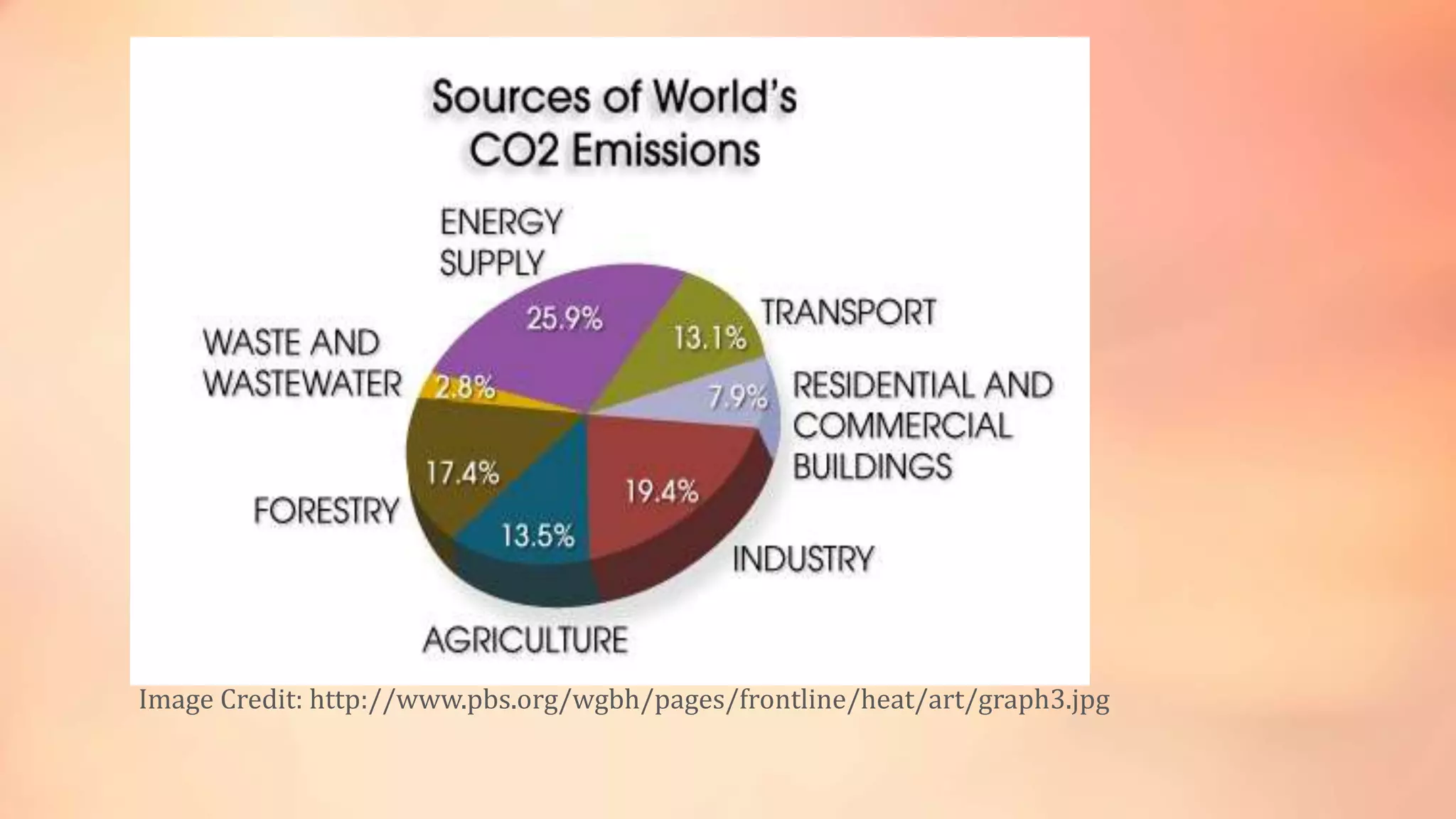
•Aside from these natural processes, carbon dioxide is also emitted through 
the combustion or burning of fossil fuels such as coal, oil, and natural gas. 
•Combustion occurs when vehicles are driven as well as when power plants 
and industrial plants are utilized. Combustion, otherwise known as burning, 
is the greatest source of carbon dioxide emissions globally. 
• Typically, fossil fuels are burnt for electricity generation in homes and 
buildings, industrial uses, as well as transportation. 
•Petroleum is the largest share of domestic energy demands. Second is 
coal, followed by natural gas (EPA, 2006). 
• Electricity generation is the largest problem in relation to using 
petroleum as fuel, rivaled followed closely by industrial processes that use 
petroleum as fuel as well.
Image Credit: http://www.pbs.org/wgbh/pages/frontline/heat/art/graph3.jpg
IMBALANCE IN CARBON CYCLE 
•In addition to the carbon dioxide emissions that result from industrial 
processes, deforestation is a serious environmental threat in terms of carbon 
dioxide emissions. 
•Carbon is naturally removed from the atmosphere to be stored in oceans and 
the soil surrounding the roots of many plants. Areas where carbon is 
stored are otherwise known as carbon “sinks.” 
• Forested areas are large carbon sinks because enormous amounts of 
carbon dioxide are naturally stored in the soil, a result of 
photosynthesis. Because of this, logging is not encouraged as an eco-friendly 
practice, whether a small number of trees are cut down or a large number.
•When a large group of trees is removed at once, either deliberately by logging or 
accidently in a forest fire, it is titled as deforestation. When this occurs, carbon 
dioxide is released from the soil at rates that are damaging to the 
environment because there are no longer any trees to contain the carbon dioxide. 
•Technically defined as the “permanent removal of standing forests,” by the EPA, 
following the destruction of a forest, typically, a large number of trees are not 
planted. 
•This lack of growth throws off the equilibrium of the environment, causing massive 
CO2 emissions though no photosynthesis is occurring in order to utilize the carbon 
dioxide or trees to store it, thus making deforestation extremely problematic. 
•Normally, forested areas are not precarious because the decomposition that occurs 
naturally results in the slow release of carbon dioxide. However, in the case of a 
forest fire or mass logging, carbon dioxide is released at an alarmingly high 
rate, contributing significantly to the greenhouse effect with the 
increase. Overall, deforestation is a large contributor to carbon dioxide emissions 
globally.
This photo depicts a forest fire in Afghanistan, which has lost over 70% of its’ 
forests due to deforestation.
Effect of CO2 increase on plants 
•Elevated CO2 leads to changes in the chemical composition of plant tissues. 
•Due to increased photosynthetic activity, leaf nonstructural 
carbohydrates (sugars and starches) per unit leaf area increase on 
average by 30–40% under FACE elevated CO2 (Ainsworth 2008; Ainsworth & 
Long 2005). 
•Leaf nitrogen concentrations in plant tissues typically decrease in FACE 
under elevated CO2, with nitrogen per unit leaf mass decreasing on average by 
13% (Ainsworth & Long 2005). 
•This decrease in tissue nitrogen is likely due to several factors: dilution of 
nitrogen from increased carbohydrate concentrations; decreased uptake of 
minerals from the soil, as stomatal conductance decreases and plants 
take up less water (Taub & Wang 2008); and decreases in the rate of 
assimilation of nitrate into organic compounds (Bloom et al. 2010).
Effect of CO2 increase on 
humans 
•Carbon dioxide is a toxic gas which is odourless and colourless. 
Rising levels of carbon dioxide affect the human body. 
•Hypercapnia , is a condition where there is too much carbon 
dioxide (CO2) in the blood. Carbon dioxide is a gaseous product of 
the body's metabolism and is normally expelled through 
the lungs. 
•Hypercapnia normally triggers a reflex which increases 
breathing and access to oxygen, such as arousal and turning 
the head during sleep. A failure of this reflex can be fatal, as 
in sudden infant death syndrome.
Contribution of CO2 in Global 
Warming 
•Carbon dioxide doesn't absorb the energy from the sun i.e.<4000 nm, but it does 
absorb some of the heat energy released from the earth i.e. >4000 nm. 
•So this leads to Green house effect , carbon dioxide lets the light energy in, but 
doesn't let all of the heat energy out, similar to a greenhouse. 
•Currently, the amount of carbon dioxide in the atmosphere is increasing at the rate 
of about one part per million per year. 
•If this continues, some meteorologists expect that the average temperature of 
the earth will increase by about 2.5 degrees Celsius. This doesn't sound like 
much, but it could be enough to cause glaciers to melt, which would cause coastal 
flooding.
Carbon cycle

Carbon cycle

  • 1.
  • 2.
    CONTENTS • Introduction • Carbon Cycle • Procedure Photosynthesis Respiration Weathering of rocks Auto and factory emissons • Imbalance of Carbon Cycle • Effect of excess CO2 on plants • Effect of excess CO2 on humans • Effect of excess CO2 on global warming
  • 3.
    CARBON CYCLE Thecarbon cycle is the biogeochemical cycle by which carbon is exchanged among the biosphere, pedosphere, geosphere, hydrosphere, and atmosphere of the Earth. Along with the nitrogen cycle and the water cycle, the carbon cycle comprises a sequence of events that are key to making the Earth capable of sustaining life; it describes the movement of carbon as it is recycled and reused throughout the biosphere.
  • 6.
    GLOBAL CARBON BUDGET The global carbon budget is the balance of the exchanges (incomes and losses) of carbon between the carbon reservoirs or between one specific loop (e.g., atmosphere ↔ biosphere) of the carbon cycle. An examination of the carbon budget of a pool or reservoir can provide information about whether the pool or reservoir is functioning as a source or sink for carbon dioxide.
  • 7.
    PROCEDURE Plants usecarbon dioxide and sunlight to make their own food and grow. The carbon becomes part of the plant. Plants that die and are buried may turn into fossil fuels made of carbon like coal and oil over millions of years. When humans burn fossil fuels, most of the carbon quickly enters the atmosphere as carbon dioxide. Photosynthesis: Plants and photosynthetic algae and bacteria use energy from sunlight to combine carbon dioxide (C02) from the atmosphere with water (H2O) to form carbohydrates. These carbohydrates store energy. Oxygen (O2) is a byproduct that is released into the atmosphere. This process is known as photosynthesis. carbon dioxide + water + sunlight -> carbohydrate + oxygenCO2 + H2O + sunlight -> CH2O + O2
  • 8.
    Respiration: Plants (andphotosynthetic algae and bacteria) then use some of the stored carbohydrates as an energy source to carry out their life functions. Some of the carbohydrates remain as biomass (the bulk of the plant, etc.). Consumers such as animals, fungi, and bacteria get their energy from this excess biomass either while living or dead and decaying. Oxygen from the atmosphere is combined with carbohydrates to liberate the stored energy. Water and carbon dioxide are byproducts. oxygen + carbohydrate -> energy + water + carbohydrateO2 + CH2O -> energy + H2O + CO2
  • 9.
    Weathering: •Carbon dioxideand the other atmospheric gases dissolve in surface waters. Dissolved gases are in equilibrium with the gas in the atmosphere. •Carbon dioxide reacts with water in solution to form the weak acid, carbonic acid. Carbonic acid disassociates into hydrogen ions and bicarbonate ions. The hydrogen ions and water react with most common minerals (silicates and carbonates) altering the minerals. •The products of weathering are predominantly clays (a group of silicate minerals) and soluble ions such as calcium, iron, sodium, and potassium. Bicarbonate ions also remain in solution; a remnant of the carbonic acid that was used to weather the rocks.
  • 10.
    Auto and factoryemissions: •Aside from these natural processes, carbon dioxide is also emitted through the combustion or burning of fossil fuels such as coal, oil, and natural gas. •Combustion occurs when vehicles are driven as well as when power plants and industrial plants are utilized. Combustion, otherwise known as burning, is the greatest source of carbon dioxide emissions globally. • Typically, fossil fuels are burnt for electricity generation in homes and buildings, industrial uses, as well as transportation. •Petroleum is the largest share of domestic energy demands. Second is coal, followed by natural gas (EPA, 2006). • Electricity generation is the largest problem in relation to using petroleum as fuel, rivaled followed closely by industrial processes that use petroleum as fuel as well.
  • 11.
  • 12.
    IMBALANCE IN CARBONCYCLE •In addition to the carbon dioxide emissions that result from industrial processes, deforestation is a serious environmental threat in terms of carbon dioxide emissions. •Carbon is naturally removed from the atmosphere to be stored in oceans and the soil surrounding the roots of many plants. Areas where carbon is stored are otherwise known as carbon “sinks.” • Forested areas are large carbon sinks because enormous amounts of carbon dioxide are naturally stored in the soil, a result of photosynthesis. Because of this, logging is not encouraged as an eco-friendly practice, whether a small number of trees are cut down or a large number.
  • 13.
    •When a largegroup of trees is removed at once, either deliberately by logging or accidently in a forest fire, it is titled as deforestation. When this occurs, carbon dioxide is released from the soil at rates that are damaging to the environment because there are no longer any trees to contain the carbon dioxide. •Technically defined as the “permanent removal of standing forests,” by the EPA, following the destruction of a forest, typically, a large number of trees are not planted. •This lack of growth throws off the equilibrium of the environment, causing massive CO2 emissions though no photosynthesis is occurring in order to utilize the carbon dioxide or trees to store it, thus making deforestation extremely problematic. •Normally, forested areas are not precarious because the decomposition that occurs naturally results in the slow release of carbon dioxide. However, in the case of a forest fire or mass logging, carbon dioxide is released at an alarmingly high rate, contributing significantly to the greenhouse effect with the increase. Overall, deforestation is a large contributor to carbon dioxide emissions globally.
  • 14.
    This photo depictsa forest fire in Afghanistan, which has lost over 70% of its’ forests due to deforestation.
  • 15.
    Effect of CO2increase on plants •Elevated CO2 leads to changes in the chemical composition of plant tissues. •Due to increased photosynthetic activity, leaf nonstructural carbohydrates (sugars and starches) per unit leaf area increase on average by 30–40% under FACE elevated CO2 (Ainsworth 2008; Ainsworth & Long 2005). •Leaf nitrogen concentrations in plant tissues typically decrease in FACE under elevated CO2, with nitrogen per unit leaf mass decreasing on average by 13% (Ainsworth & Long 2005). •This decrease in tissue nitrogen is likely due to several factors: dilution of nitrogen from increased carbohydrate concentrations; decreased uptake of minerals from the soil, as stomatal conductance decreases and plants take up less water (Taub & Wang 2008); and decreases in the rate of assimilation of nitrate into organic compounds (Bloom et al. 2010).
  • 16.
    Effect of CO2increase on humans •Carbon dioxide is a toxic gas which is odourless and colourless. Rising levels of carbon dioxide affect the human body. •Hypercapnia , is a condition where there is too much carbon dioxide (CO2) in the blood. Carbon dioxide is a gaseous product of the body's metabolism and is normally expelled through the lungs. •Hypercapnia normally triggers a reflex which increases breathing and access to oxygen, such as arousal and turning the head during sleep. A failure of this reflex can be fatal, as in sudden infant death syndrome.
  • 17.
    Contribution of CO2in Global Warming •Carbon dioxide doesn't absorb the energy from the sun i.e.<4000 nm, but it does absorb some of the heat energy released from the earth i.e. >4000 nm. •So this leads to Green house effect , carbon dioxide lets the light energy in, but doesn't let all of the heat energy out, similar to a greenhouse. •Currently, the amount of carbon dioxide in the atmosphere is increasing at the rate of about one part per million per year. •If this continues, some meteorologists expect that the average temperature of the earth will increase by about 2.5 degrees Celsius. This doesn't sound like much, but it could be enough to cause glaciers to melt, which would cause coastal flooding.