Ch 3.8: Mechanical & Electrical Vibrations
Two important areas of application for second order linear
equations with constant coefficients are in modeling
mechanical and electrical oscillations.
We will study the motion of a mass on a spring in detail.
An understanding of the behavior of this simple system is the
first step in investigation of more complex vibrating systems.
Spring – Mass System
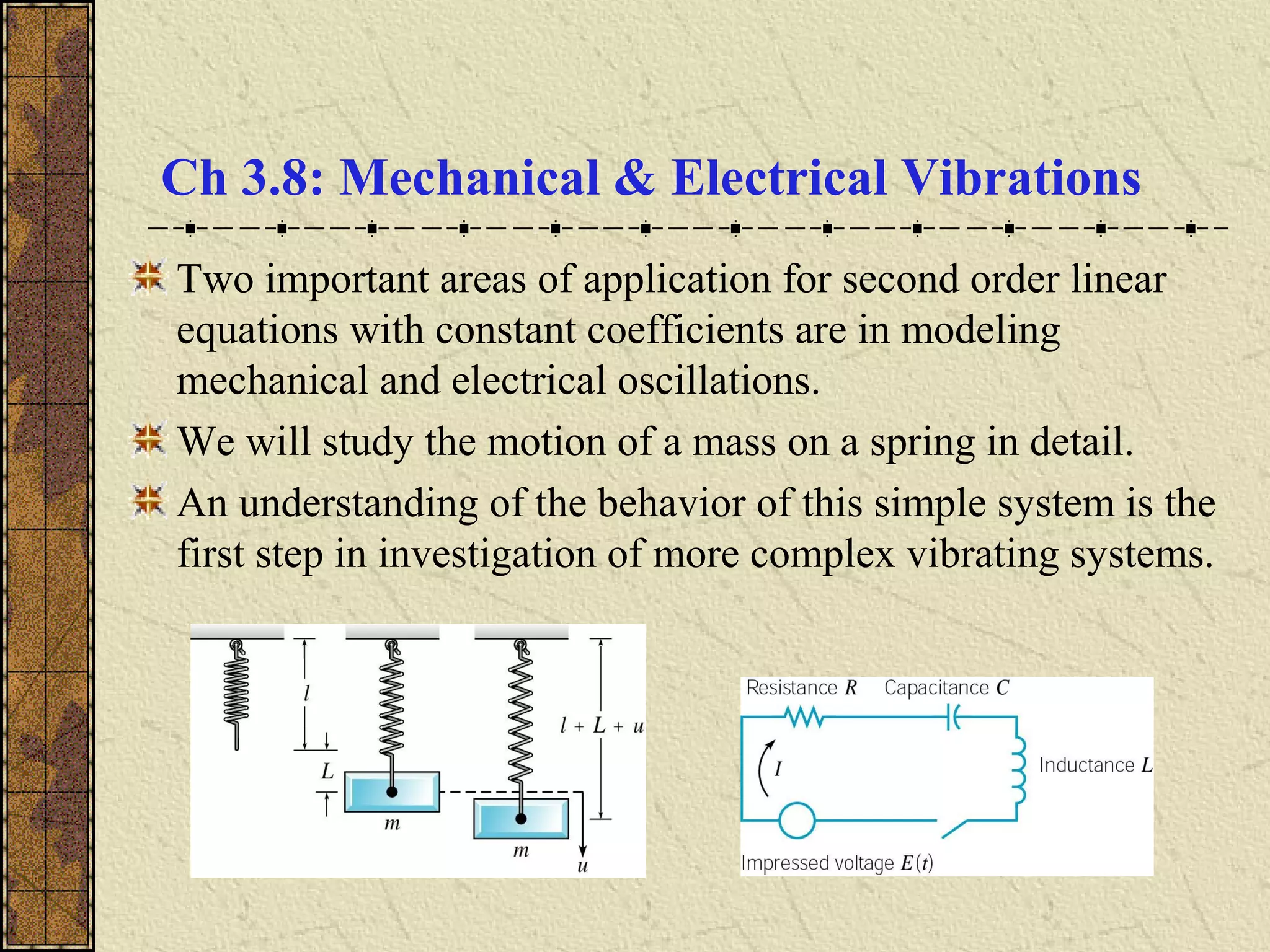
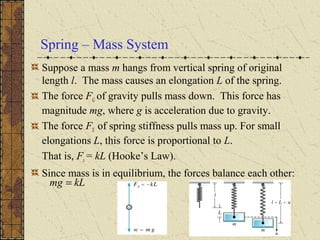
Suppose a mass m hangs from vertical spring of original
length l. The mass causes an elongation L of the spring.
The force FG of gravity pulls mass down. This force has
magnitude mg, where g is acceleration due to gravity.
The force FS of spring stiffness pulls mass up. For small
elongations L, this force is proportional to L.
That is, Fs = kL (Hooke’s Law).
Since mass is in equilibrium, the forces balance each other:
kLmg =
Spring Model
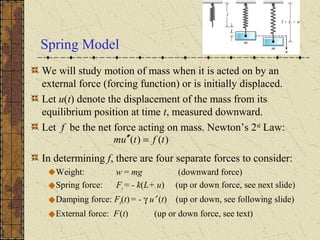
We will study motion of mass when it is acted on by an
external force (forcing function) or is initially displaced.
Let u(t) denote the displacement of the mass from its
equilibrium position at time t, measured downward.
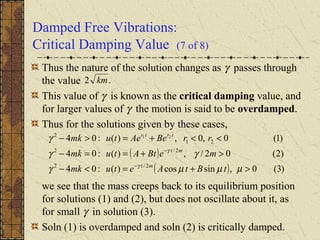
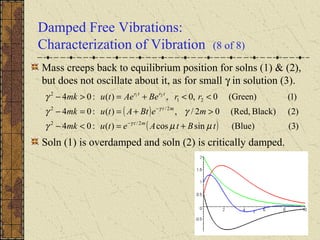
Let f be the net force acting on mass. Newton’s 2nd
Law:
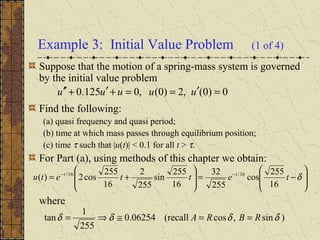
In determining f, there are four separate forces to consider:
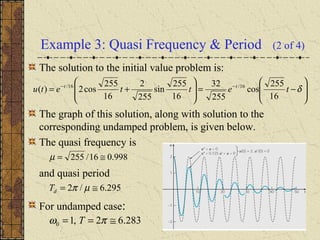
Weight: w = mg (downward force)
Spring force: Fs = - k(L+ u) (up or down force, see next slide)
Damping force: Fd(t) = - γ u′ (t) (up or down, see following slide)
External force: F(t) (up or down force, see text)
)()( tftum =′′
Spring Model:
Spring Force Details
The spring force Fs acts to restore spring to natural position,
and is proportional to L + u. If L + u > 0, then spring is
extended and the spring force acts upward. In this case
If L + u < 0, then spring is compressed a distance of |L + u|,
and the spring force acts downward. In this case
In either case,
)( uLkFs +−=
( )[ ] ( )uLkuLkuLkFs +−=+−=+=
)( uLkFs +−=
Spring Model:
Damping Force Details
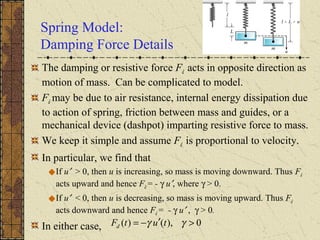
The damping or resistive force Fd acts in opposite direction as
motion of mass. Can be complicated to model.
Fd may be due to air resistance, internal energy dissipation due
to action of spring, friction between mass and guides, or a
mechanical device (dashpot) imparting resistive force to mass.
We keep it simple and assume Fd is proportional to velocity.
In particular, we find that
If u′ > 0, then u is increasing, so mass is moving downward. Thus Fd
acts upward and hence Fd = - γ u′, where γ > 0.
If u′ < 0, then u is decreasing, so mass is moving upward. Thus Fd
acts downward and hence Fd = - γ u′ , γ > 0.
In either case, 0),()( >′−= γγ tutFd
Spring Model:
Differential Equation
Taking into account these forces, Newton’s Law becomes:
Recalling that mg = kL, this equation reduces to
where the constants m, γ, and k are positive.
We can prescribe initial conditions also:
It follows from Theorem 3.2.1 that there is a unique solution
to this initial value problem. Physically, if mass is set in
motion with a given initial displacement and velocity, then
its position is uniquely determined at all future times.
[ ] )()()(
)()()()(
tFtutuLkmg
tFtFtFmgtum ds
+′−+−=
+++=′′
γ
)()()()( tFtkututum =+′+′′ γ
00 )0(,)0( vuuu =′=
Example 1:
Find Coefficients (1 of 2)
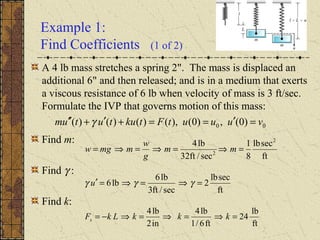
A 4 lb mass stretches a spring 2". The mass is displaced an
additional 6" and then released; and is in a medium that exerts
a viscous resistance of 6 lb when velocity of mass is 3 ft/sec.
Formulate the IVP that governs motion of this mass:
Find m:
Find γ :
Find k:
ft
seclb
8
1
sec/ft32
lb4 2
2
=⇒=⇒=⇒= mm
g
w
mmgw
ft
seclb
2
sec/ft3
lb6
lb6 =⇒=⇒=′ γγγ u
ft
lb
24
ft6/1
lb4
in2
lb4
=⇒=⇒=⇒−= kkkLkFs
00 )0(,)0(),()()()( vuuutFtkututum =′==+′+′′ γ
Example 1: Find IVP (2 of 2)
Thus our differential equation becomes
and hence the initial value problem can be written as
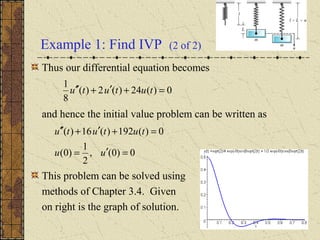
This problem can be solved using
methods of Chapter 3.4. Given
on right is the graph of solution.
0)(24)(2)(
8
1
=+′+′′ tututu
0)0(,
2
1
)0(
0)(192)(16)(
=′=
=+′+′′
uu
tututu
Spring Model:
Undamped Free Vibrations (1 of 4)
Recall our differential equation for spring motion:
Suppose there is no external driving force and no damping.
Then F(t) = 0 and γ = 0, and our equation becomes
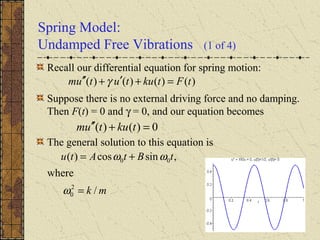
The general solution to this equation is
0)()( =+′′ tkutum
)()()()( tFtkututum =+′+′′ γ
mk
tBtAtu
/
where
,sincos)(
2
0
00
=
+=
ω
ωω
Spring Model:
Undamped Free Vibrations (2 of 4)
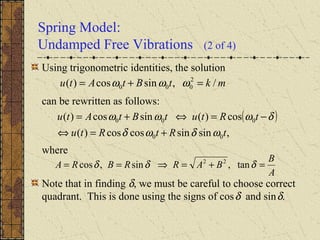
Using trigonometric identities, the solution
can be rewritten as follows:
where
Note that in finding δ, we must be careful to choose correct
quadrant. This is done using the signs of cosδ and sinδ.
mktBtAtu /,sincos)( 2
000 =+= ωωω
( )
,sinsincoscos)(
cos)(sincos)(
00
000
tRtRtu
tRtutBtAtu
ωδωδ
δωωω
+=⇔
−=⇔+=
A
B
BARRBRA =+=⇒== δδδ tan,sin,cos 22
Spring Model:
Undamped Free Vibrations (3 of 4)
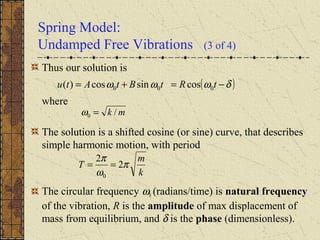
Thus our solution is
where
The solution is a shifted cosine (or sine) curve, that describes
simple harmonic motion, with period
The circular frequency ω0 (radians/time) is natural frequency
of the vibration, R is the amplitude of max displacement of
mass from equilibrium, and δ is the phase (dimensionless).
( )δωωω −=+= tRtBtAtu 000 cossincos)(
k
m
T π
ω
π
2
2
0
==
mk /0 =ω
Spring Model:
Undamped Free Vibrations (4 of 4)
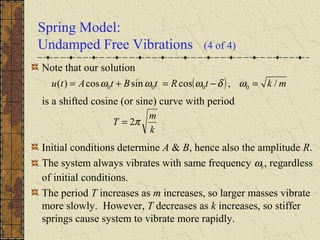
Note that our solution
is a shifted cosine (or sine) curve with period
Initial conditions determine A & B, hence also the amplitude R.
The system always vibrates with same frequency ω0, regardless
of initial conditions.
The period T increases as m increases, so larger masses vibrate
more slowly. However, T decreases as k increases, so stiffer
springs cause system to vibrate more rapidly.
( ) mktRtBtAtu /,cossincos)( 0000 =−=+= ωδωωω
k
m
T π2=
Example 2: Find IVP (1 of 3)
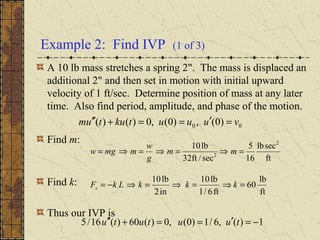
A 10 lb mass stretches a spring 2". The mass is displaced an
additional 2" and then set in motion with initial upward
velocity of 1 ft/sec. Determine position of mass at any later
time. Also find period, amplitude, and phase of the motion.
Find m:
Find k:
Thus our IVP is
ft
seclb
16
5
sec/ft32
lb10 2
2
=⇒=⇒=⇒= mm
g
w
mmgw
ft
lb
60
ft6/1
lb10
in2
lb10
=⇒=⇒=⇒−= kkkLkFs
1)(,6/1)0(,0)(60)(16/5 −=′==+′′ tuututu
00 )0(,)0(,0)()( vuuutkutum =′==+′′
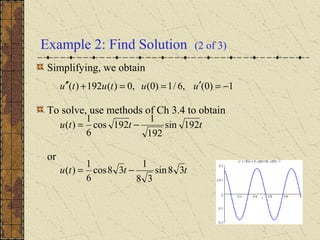
Example 2: Find Solution (2 of 3)
Simplifying, we obtain
To solve, use methods of Ch 3.4 to obtain
or
1)0(,6/1)0(,0)(192)( −=′==+′′ uututu
tttu 192sin
192
1
192cos
6
1
)( −=
tttu 38sin
38
1
38cos
6
1
)( −=
Example 2:
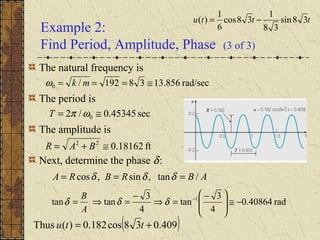
Find Period, Amplitude, Phase (3 of 3)
The natural frequency is
The period is
The amplitude is
Next, determine the phase δ:
tttu 38sin
38
1
38cos
6
1
)( −=
rad/sec856.1338192/0 ≅=== mkω
sec45345.0/2 0 ≅= ωπT
ft18162.022
≅+= BAR
rad40864.0
4
3
tan
4
3
tantan 1
−≅






 −
=⇒
−
=⇒= −
δδδ
A
B
ABRBRA /tan,sin,cos === δδδ
( )409.038cos182.0)(Thus += ttu
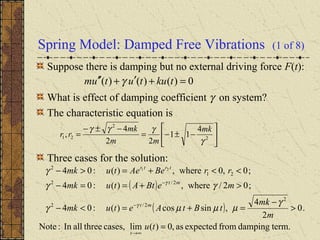
Spring Model: Damped Free Vibrations (1 of 8)
Suppose there is damping but no external driving force F(t):
What is effect of damping coefficient γ on system?
The characteristic equation is
Three cases for the solution:
0)()()( =+′+′′ tkututum γ






−±−=
−±−
= 2
2
21
4
11
22
4
,
γ
γγγ mk
mm
mk
rr
( )
( )
term.dampingfromexpectedas,0)(limcases,threeallIn:Note
.0
2
4
,sincos)(:04
;02/where,)(:04
;0,0where,)(:04
2
2/2
2/2
21
2 21
=
>
−
=+=<−
>+==−
<<+=>−
∞→
−
−
tu
m
mk
tBtAetumk
meBtAtumk
rrBeAetumk
t
mt
mt
trtr
γ
µµµγ
γγ
γ
γ
γ
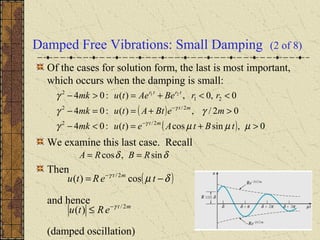
Damped Free Vibrations: Small Damping (2 of 8)
Of the cases for solution form, the last is most important,
which occurs when the damping is small:
We examine this last case. Recall
Then
and hence
(damped oscillation)
( )
( ) 0,sincos)(:04
02/,)(:04
0,0,)(:04
2/2
2/2
21
2 21
>+=<−
>+==−
<<+=>−
−
−
µµµγ
γγ
γ
γ
γ
tBtAetumk
meBtAtumk
rrBeAetumk
mt
mt
trtr
δδ sin,cos RBRA ==
( )δµγ
−= −
teRtu mt
cos)( 2/
mt
eRtu 2/
)( γ−
≤
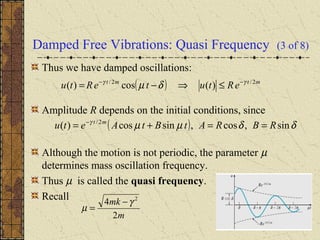
Damped Free Vibrations: Quasi Frequency (3 of 8)
Thus we have damped oscillations:
Amplitude R depends on the initial conditions, since
Although the motion is not periodic, the parameter µ
determines mass oscillation frequency.
Thus µ is called the quasi frequency.
Recall
( ) δδµµγ
sin,cos,sincos)( 2/
RBRAtBtAetu mt
==+= −
( ) mtmt
eRtuteRtu 2/2/
)(cos)( γγ
δµ −−
≤⇒−=
m
mk
2
4 2
γ
µ
−
=
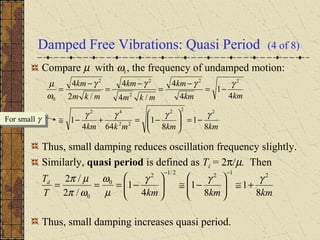
Damped Free Vibrations: Quasi Period (4 of 8)
Compare µ with ω0 , the frequency of undamped motion:
Thus, small damping reduces oscillation frequency slightly.
Similarly, quasi period is defined as Td = 2π/µ. Then
Thus, small damping increases quasi period.
kmkmmkkm
kmkm
km
mkm
km
mkm
km
8
1
8
1
644
1
4
1
4
4
/4
4
/2
4
222
22
42
22
2
22
0
γγγγ
γγγγ
ω
µ
−=





−=+−≅
−=
−
=
−
=
−
=
For small γFor small γ
kmkmkmT
Td
8
1
8
1
4
1
/2
/2 2122/12
0
0
γγγ
µ
ω
ωπ
µπ
+≅





−≅





−===
−−
Damped Free Vibrations:
Neglecting Damping for Small γ 2
/4km (5 of 8)
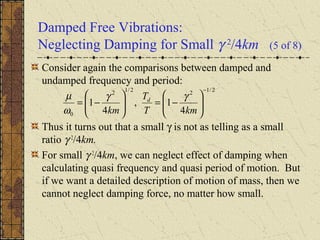
Consider again the comparisons between damped and
undamped frequency and period:
Thus it turns out that a small γ is not as telling as a small
ratio γ 2
/4km.
For small γ 2
/4km, we can neglect effect of damping when
calculating quasi frequency and quasi period of motion. But
if we want a detailed description of motion of mass, then we
cannot neglect damping force, no matter how small.
2/122/12
0 4
1,
4
1
−






−=





−=
kmT
T
km
d γγ
ω
µ
Damped Free Vibrations:
Frequency, Period (6 of 8)
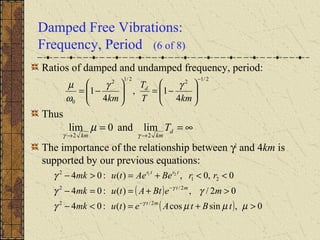
Ratios of damped and undamped frequency, period:
Thus
The importance of the relationship between γ2
and 4km is
supported by our previous equations:
2/122/12
0 4
1,
4
1
−






−=





−=
kmT
T
km
d γγ
ω
µ
∞==
→→
d
kmkm
T
22
limand0lim
γγ
µ
( )
( ) 0,sincos)(:04
02/,)(:04
0,0,)(:04
2/2
2/2
21
2 21
>+=<−
>+==−
<<+=>−
−
−
µµµγ
γγ
γ
γ
γ
tBtAetumk
meBtAtumk
rrBeAetumk
mt
mt
trtr
Damped Free Vibrations:
Critical Damping Value (7 of 8)
Thus the nature of the solution changes as γ passes through
the value
This value of γ is known as the critical damping value, and
for larger values of γ the motion is said to be overdamped.
Thus for the solutions given by these cases,
we see that the mass creeps back to its equilibrium position
for solutions (1) and (2), but does not oscillate about it, as
for small γ in solution (3).
Soln (1) is overdamped and soln (2) is critically damped.
.2 km
( )
( ) )3(0,sincos)(:04
)2(02/,)(:04
)1(0,0,)(:04
2/2
2/2
21
2 21
>+=<−
>+==−
<<+=>−
−
−
µµµγ
γγ
γ
γ
γ
tBtAetumk
meBtAtumk
rrBeAetumk
mt
mt
trtr
Damped Free Vibrations:
Characterization of Vibration (8 of 8)
Mass creeps back to equilibrium position for solns (1) & (2),
but does not oscillate about it, as for small γ in solution (3).
Soln (1) is overdamped and soln (2) is critically damped.
( )
( ) )3((Blue)sincos)(:04
)2(Black)(Red,02/,)(:04
)1((Green)0,0,)(:04
2/2
2/2
21
2 21
tBtAetumk
meBtAtumk
rrBeAetumk
mt
mt
trtr
µµγ
γγ
γ
γ
γ
+=<−
>+==−
<<+=>−
−
−
Example 3: Initial Value Problem (1 of 4)
Suppose that the motion of a spring-mass system is governed
by the initial value problem
Find the following:
(a) quasi frequency and quasi period;
(b) time at which mass passes through equilibrium position;
(c) time τ such that |u(t)| < 0.1 for all t > τ.
For Part (a), using methods of this chapter we obtain:
where
0)0(,2)0(,0125.0 =′==+′+′′ uuuuu








−=







+= −−
δtettetu tt
16
255
cos
255
32
16
255
sin
255
2
16
255
cos2)( 16/16/
)sin,cos(recall06254.0
255
1
tan δδδδ RBRA ==≅⇒=
Example 3: Quasi Frequency & Period (2 of 4)
The solution to the initial value problem is:
The graph of this solution, along with solution to the
corresponding undamped problem, is given below.
The quasi frequency is
and quasi period
For undamped case:








−=







+= −−
δtettetu tt
16
255
cos
255
32
16
255
sin
255
2
16
255
cos2)( 16/16/
998.016/255 ≅=µ
295.6/2 ≅= µπdT
283.62,10 ≅== πω T
Example 3: Quasi Frequency & Period (3 of 4)
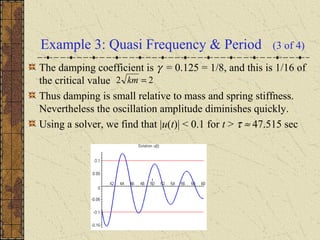
The damping coefficient is γ = 0.125 = 1/8, and this is 1/16 of
the critical value
Thus damping is small relative to mass and spring stiffness.
Nevertheless the oscillation amplitude diminishes quickly.
Using a solver, we find that |u(t)| < 0.1 for t > τ ≈ 47.515 sec
22 =km
Example 3: Quasi Frequency & Period (4 of 4)
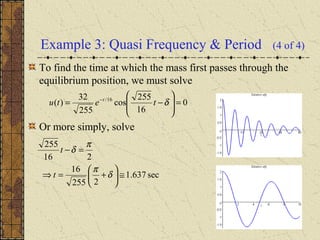
To find the time at which the mass first passes through the
equilibrium position, we must solve
Or more simply, solve
0
16
255
cos
255
32
)( 16/
=







−= −
δtetu t
sec637.1
2255
16
216
255
≅





+=⇒
=−
δ
π
π
δ
t
t
Electric Circuits
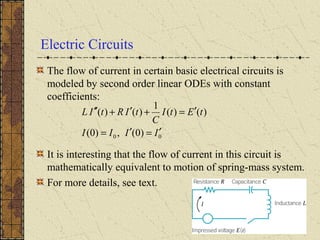
The flow of current in certain basic electrical circuits is
modeled by second order linear ODEs with constant
coefficients:
It is interesting that the flow of current in this circuit is
mathematically equivalent to motion of spring-mass system.
For more details, see text.
00 )0(,)0(
)()(
1
)()(
IIII
tEtI
C
tIRtIL
′=′=
′=+′+′′

Ch03 8

  • 1.
    Ch 3.8: Mechanical& Electrical Vibrations Two important areas of application for second order linear equations with constant coefficients are in modeling mechanical and electrical oscillations. We will study the motion of a mass on a spring in detail. An understanding of the behavior of this simple system is the first step in investigation of more complex vibrating systems.
  • 2.
    Spring – MassSystem Suppose a mass m hangs from vertical spring of original length l. The mass causes an elongation L of the spring. The force FG of gravity pulls mass down. This force has magnitude mg, where g is acceleration due to gravity. The force FS of spring stiffness pulls mass up. For small elongations L, this force is proportional to L. That is, Fs = kL (Hooke’s Law). Since mass is in equilibrium, the forces balance each other: kLmg =
  • 3.
    Spring Model We willstudy motion of mass when it is acted on by an external force (forcing function) or is initially displaced. Let u(t) denote the displacement of the mass from its equilibrium position at time t, measured downward. Let f be the net force acting on mass. Newton’s 2nd Law: In determining f, there are four separate forces to consider: Weight: w = mg (downward force) Spring force: Fs = - k(L+ u) (up or down force, see next slide) Damping force: Fd(t) = - γ u′ (t) (up or down, see following slide) External force: F(t) (up or down force, see text) )()( tftum =′′
  • 4.
    Spring Model: Spring ForceDetails The spring force Fs acts to restore spring to natural position, and is proportional to L + u. If L + u > 0, then spring is extended and the spring force acts upward. In this case If L + u < 0, then spring is compressed a distance of |L + u|, and the spring force acts downward. In this case In either case, )( uLkFs +−= ( )[ ] ( )uLkuLkuLkFs +−=+−=+= )( uLkFs +−=
  • 5.
    Spring Model: Damping ForceDetails The damping or resistive force Fd acts in opposite direction as motion of mass. Can be complicated to model. Fd may be due to air resistance, internal energy dissipation due to action of spring, friction between mass and guides, or a mechanical device (dashpot) imparting resistive force to mass. We keep it simple and assume Fd is proportional to velocity. In particular, we find that If u′ > 0, then u is increasing, so mass is moving downward. Thus Fd acts upward and hence Fd = - γ u′, where γ > 0. If u′ < 0, then u is decreasing, so mass is moving upward. Thus Fd acts downward and hence Fd = - γ u′ , γ > 0. In either case, 0),()( >′−= γγ tutFd
  • 6.
    Spring Model: Differential Equation Takinginto account these forces, Newton’s Law becomes: Recalling that mg = kL, this equation reduces to where the constants m, γ, and k are positive. We can prescribe initial conditions also: It follows from Theorem 3.2.1 that there is a unique solution to this initial value problem. Physically, if mass is set in motion with a given initial displacement and velocity, then its position is uniquely determined at all future times. [ ] )()()( )()()()( tFtutuLkmg tFtFtFmgtum ds +′−+−= +++=′′ γ )()()()( tFtkututum =+′+′′ γ 00 )0(,)0( vuuu =′=
  • 7.
    Example 1: Find Coefficients(1 of 2) A 4 lb mass stretches a spring 2". The mass is displaced an additional 6" and then released; and is in a medium that exerts a viscous resistance of 6 lb when velocity of mass is 3 ft/sec. Formulate the IVP that governs motion of this mass: Find m: Find γ : Find k: ft seclb 8 1 sec/ft32 lb4 2 2 =⇒=⇒=⇒= mm g w mmgw ft seclb 2 sec/ft3 lb6 lb6 =⇒=⇒=′ γγγ u ft lb 24 ft6/1 lb4 in2 lb4 =⇒=⇒=⇒−= kkkLkFs 00 )0(,)0(),()()()( vuuutFtkututum =′==+′+′′ γ
  • 8.
    Example 1: FindIVP (2 of 2) Thus our differential equation becomes and hence the initial value problem can be written as This problem can be solved using methods of Chapter 3.4. Given on right is the graph of solution. 0)(24)(2)( 8 1 =+′+′′ tututu 0)0(, 2 1 )0( 0)(192)(16)( =′= =+′+′′ uu tututu
  • 9.
    Spring Model: Undamped FreeVibrations (1 of 4) Recall our differential equation for spring motion: Suppose there is no external driving force and no damping. Then F(t) = 0 and γ = 0, and our equation becomes The general solution to this equation is 0)()( =+′′ tkutum )()()()( tFtkututum =+′+′′ γ mk tBtAtu / where ,sincos)( 2 0 00 = += ω ωω
  • 10.
    Spring Model: Undamped FreeVibrations (2 of 4) Using trigonometric identities, the solution can be rewritten as follows: where Note that in finding δ, we must be careful to choose correct quadrant. This is done using the signs of cosδ and sinδ. mktBtAtu /,sincos)( 2 000 =+= ωωω ( ) ,sinsincoscos)( cos)(sincos)( 00 000 tRtRtu tRtutBtAtu ωδωδ δωωω +=⇔ −=⇔+= A B BARRBRA =+=⇒== δδδ tan,sin,cos 22
  • 11.
    Spring Model: Undamped FreeVibrations (3 of 4) Thus our solution is where The solution is a shifted cosine (or sine) curve, that describes simple harmonic motion, with period The circular frequency ω0 (radians/time) is natural frequency of the vibration, R is the amplitude of max displacement of mass from equilibrium, and δ is the phase (dimensionless). ( )δωωω −=+= tRtBtAtu 000 cossincos)( k m T π ω π 2 2 0 == mk /0 =ω
  • 12.
    Spring Model: Undamped FreeVibrations (4 of 4) Note that our solution is a shifted cosine (or sine) curve with period Initial conditions determine A & B, hence also the amplitude R. The system always vibrates with same frequency ω0, regardless of initial conditions. The period T increases as m increases, so larger masses vibrate more slowly. However, T decreases as k increases, so stiffer springs cause system to vibrate more rapidly. ( ) mktRtBtAtu /,cossincos)( 0000 =−=+= ωδωωω k m T π2=
  • 13.
    Example 2: FindIVP (1 of 3) A 10 lb mass stretches a spring 2". The mass is displaced an additional 2" and then set in motion with initial upward velocity of 1 ft/sec. Determine position of mass at any later time. Also find period, amplitude, and phase of the motion. Find m: Find k: Thus our IVP is ft seclb 16 5 sec/ft32 lb10 2 2 =⇒=⇒=⇒= mm g w mmgw ft lb 60 ft6/1 lb10 in2 lb10 =⇒=⇒=⇒−= kkkLkFs 1)(,6/1)0(,0)(60)(16/5 −=′==+′′ tuututu 00 )0(,)0(,0)()( vuuutkutum =′==+′′
  • 14.
    Example 2: FindSolution (2 of 3) Simplifying, we obtain To solve, use methods of Ch 3.4 to obtain or 1)0(,6/1)0(,0)(192)( −=′==+′′ uututu tttu 192sin 192 1 192cos 6 1 )( −= tttu 38sin 38 1 38cos 6 1 )( −=
  • 15.
    Example 2: Find Period,Amplitude, Phase (3 of 3) The natural frequency is The period is The amplitude is Next, determine the phase δ: tttu 38sin 38 1 38cos 6 1 )( −= rad/sec856.1338192/0 ≅=== mkω sec45345.0/2 0 ≅= ωπT ft18162.022 ≅+= BAR rad40864.0 4 3 tan 4 3 tantan 1 −≅        − =⇒ − =⇒= − δδδ A B ABRBRA /tan,sin,cos === δδδ ( )409.038cos182.0)(Thus += ttu
  • 16.
    Spring Model: DampedFree Vibrations (1 of 8) Suppose there is damping but no external driving force F(t): What is effect of damping coefficient γ on system? The characteristic equation is Three cases for the solution: 0)()()( =+′+′′ tkututum γ       −±−= −±− = 2 2 21 4 11 22 4 , γ γγγ mk mm mk rr ( ) ( ) term.dampingfromexpectedas,0)(limcases,threeallIn:Note .0 2 4 ,sincos)(:04 ;02/where,)(:04 ;0,0where,)(:04 2 2/2 2/2 21 2 21 = > − =+=<− >+==− <<+=>− ∞→ − − tu m mk tBtAetumk meBtAtumk rrBeAetumk t mt mt trtr γ µµµγ γγ γ γ γ
  • 17.
    Damped Free Vibrations:Small Damping (2 of 8) Of the cases for solution form, the last is most important, which occurs when the damping is small: We examine this last case. Recall Then and hence (damped oscillation) ( ) ( ) 0,sincos)(:04 02/,)(:04 0,0,)(:04 2/2 2/2 21 2 21 >+=<− >+==− <<+=>− − − µµµγ γγ γ γ γ tBtAetumk meBtAtumk rrBeAetumk mt mt trtr δδ sin,cos RBRA == ( )δµγ −= − teRtu mt cos)( 2/ mt eRtu 2/ )( γ− ≤
  • 18.
    Damped Free Vibrations:Quasi Frequency (3 of 8) Thus we have damped oscillations: Amplitude R depends on the initial conditions, since Although the motion is not periodic, the parameter µ determines mass oscillation frequency. Thus µ is called the quasi frequency. Recall ( ) δδµµγ sin,cos,sincos)( 2/ RBRAtBtAetu mt ==+= − ( ) mtmt eRtuteRtu 2/2/ )(cos)( γγ δµ −− ≤⇒−= m mk 2 4 2 γ µ − =
  • 19.
    Damped Free Vibrations:Quasi Period (4 of 8) Compare µ with ω0 , the frequency of undamped motion: Thus, small damping reduces oscillation frequency slightly. Similarly, quasi period is defined as Td = 2π/µ. Then Thus, small damping increases quasi period. kmkmmkkm kmkm km mkm km mkm km 8 1 8 1 644 1 4 1 4 4 /4 4 /2 4 222 22 42 22 2 22 0 γγγγ γγγγ ω µ −=      −=+−≅ −= − = − = − = For small γFor small γ kmkmkmT Td 8 1 8 1 4 1 /2 /2 2122/12 0 0 γγγ µ ω ωπ µπ +≅      −≅      −=== −−
  • 20.
    Damped Free Vibrations: NeglectingDamping for Small γ 2 /4km (5 of 8) Consider again the comparisons between damped and undamped frequency and period: Thus it turns out that a small γ is not as telling as a small ratio γ 2 /4km. For small γ 2 /4km, we can neglect effect of damping when calculating quasi frequency and quasi period of motion. But if we want a detailed description of motion of mass, then we cannot neglect damping force, no matter how small. 2/122/12 0 4 1, 4 1 −       −=      −= kmT T km d γγ ω µ
  • 21.
    Damped Free Vibrations: Frequency,Period (6 of 8) Ratios of damped and undamped frequency, period: Thus The importance of the relationship between γ2 and 4km is supported by our previous equations: 2/122/12 0 4 1, 4 1 −       −=      −= kmT T km d γγ ω µ ∞== →→ d kmkm T 22 limand0lim γγ µ ( ) ( ) 0,sincos)(:04 02/,)(:04 0,0,)(:04 2/2 2/2 21 2 21 >+=<− >+==− <<+=>− − − µµµγ γγ γ γ γ tBtAetumk meBtAtumk rrBeAetumk mt mt trtr
  • 22.
    Damped Free Vibrations: CriticalDamping Value (7 of 8) Thus the nature of the solution changes as γ passes through the value This value of γ is known as the critical damping value, and for larger values of γ the motion is said to be overdamped. Thus for the solutions given by these cases, we see that the mass creeps back to its equilibrium position for solutions (1) and (2), but does not oscillate about it, as for small γ in solution (3). Soln (1) is overdamped and soln (2) is critically damped. .2 km ( ) ( ) )3(0,sincos)(:04 )2(02/,)(:04 )1(0,0,)(:04 2/2 2/2 21 2 21 >+=<− >+==− <<+=>− − − µµµγ γγ γ γ γ tBtAetumk meBtAtumk rrBeAetumk mt mt trtr
  • 23.
    Damped Free Vibrations: Characterizationof Vibration (8 of 8) Mass creeps back to equilibrium position for solns (1) & (2), but does not oscillate about it, as for small γ in solution (3). Soln (1) is overdamped and soln (2) is critically damped. ( ) ( ) )3((Blue)sincos)(:04 )2(Black)(Red,02/,)(:04 )1((Green)0,0,)(:04 2/2 2/2 21 2 21 tBtAetumk meBtAtumk rrBeAetumk mt mt trtr µµγ γγ γ γ γ +=<− >+==− <<+=>− − −
  • 24.
    Example 3: InitialValue Problem (1 of 4) Suppose that the motion of a spring-mass system is governed by the initial value problem Find the following: (a) quasi frequency and quasi period; (b) time at which mass passes through equilibrium position; (c) time τ such that |u(t)| < 0.1 for all t > τ. For Part (a), using methods of this chapter we obtain: where 0)0(,2)0(,0125.0 =′==+′+′′ uuuuu         −=        += −− δtettetu tt 16 255 cos 255 32 16 255 sin 255 2 16 255 cos2)( 16/16/ )sin,cos(recall06254.0 255 1 tan δδδδ RBRA ==≅⇒=
  • 25.
    Example 3: QuasiFrequency & Period (2 of 4) The solution to the initial value problem is: The graph of this solution, along with solution to the corresponding undamped problem, is given below. The quasi frequency is and quasi period For undamped case:         −=        += −− δtettetu tt 16 255 cos 255 32 16 255 sin 255 2 16 255 cos2)( 16/16/ 998.016/255 ≅=µ 295.6/2 ≅= µπdT 283.62,10 ≅== πω T
  • 26.
    Example 3: QuasiFrequency & Period (3 of 4) The damping coefficient is γ = 0.125 = 1/8, and this is 1/16 of the critical value Thus damping is small relative to mass and spring stiffness. Nevertheless the oscillation amplitude diminishes quickly. Using a solver, we find that |u(t)| < 0.1 for t > τ ≈ 47.515 sec 22 =km
  • 27.
    Example 3: QuasiFrequency & Period (4 of 4) To find the time at which the mass first passes through the equilibrium position, we must solve Or more simply, solve 0 16 255 cos 255 32 )( 16/ =        −= − δtetu t sec637.1 2255 16 216 255 ≅      +=⇒ =− δ π π δ t t
  • 28.
    Electric Circuits The flowof current in certain basic electrical circuits is modeled by second order linear ODEs with constant coefficients: It is interesting that the flow of current in this circuit is mathematically equivalent to motion of spring-mass system. For more details, see text. 00 )0(,)0( )()( 1 )()( IIII tEtI C tIRtIL ′=′= ′=+′+′′