Ch 5.4: Regular Singular Points
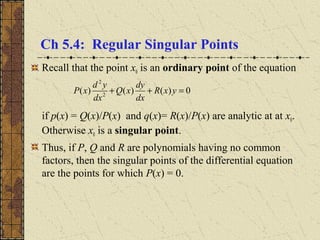
Recall that the point x0 is an ordinary point of the equation
if p(x) = Q(x)/P(x) and q(x)= R(x)/P(x) are analytic at at x0.
Otherwise x0 is a singular point.
Thus, if P, Q and R are polynomials having no common
factors, then the singular points of the differential equation
are the points for which P(x) = 0.
0)()()( 2
2
=++ yxR
dx
dy
xQ
dx
yd
xP
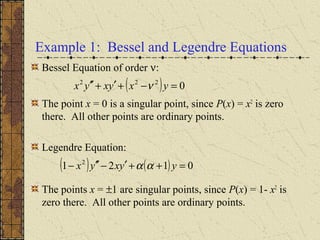
Example 1: Bessel and Legendre Equations
Bessel Equation of order ν:
The point x = 0 is a singular point, since P(x) = x2
is zero
there. All other points are ordinary points.
Legendre Equation:
The points x = ±1 are singular points, since P(x) = 1- x2
is
zero there. All other points are ordinary points.
( ) 0222
=−+′+′′ yxyxyx ν
( ) ( ) 0121 2
=++′−′′− yyxyx αα
Solution Behavior and Singular Points
If we attempt to use the methods of the preceding two
sections to solve the differential equation in a neighborhood
of a singular point x0, we will find that these methods fail.
This is because the solution may not be analytic at x0, and
hence will not have a Taylor series expansion about x0.
Instead, we must use a more general series expansion.
A differential equation may only have a few singular points,
but solution behavior near these singular points is important.
For example, solutions often become unbounded or
experience rapid changes in magnitude near a singular point.
Also, geometric singularities in a physical problem, such as
corners or sharp edges, may lead to singular points in the
corresponding differential equation.
Numerical Methods and Singular Points
As an alternative to analytical methods, we could consider
using numerical methods, which are discussed in Chapter 8.
However, numerical methods are not well suited for the study
of solutions near singular points.
When a numerical method is used, it helps to combine with it
the analytical methods of this chapter in order to examine the
behavior of solutions near singular points.
Solution Behavior Near Singular Points
Thus without more information about Q/P and R/P in the
neighborhood of a singular point x0, it may be impossible to
describe solution behavior near x0.
It may be that there are two linearly independent solutions
that remain bounded as x → x0; or there may be only one,
with the other becoming unbounded as x → x0; or they may
both become unbounded as x → x0.
If a solution becomes unbounded, then we may want to know
if y → ∞ in the same manner as (x - x0)-1
or |x - x0|-½
, or in some
other manner.
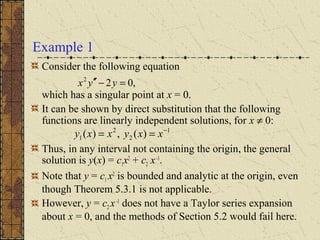
Example 1
Consider the following equation
which has a singular point at x = 0.
It can be shown by direct substitution that the following
functions are linearly independent solutions, for x ≠ 0:
Thus, in any interval not containing the origin, the general
solution is y(x) = c1x2
+ c2 x-1
.
Note that y = c1 x2
is bounded and analytic at the origin, even
though Theorem 5.3.1 is not applicable.
However, y = c2 x-1
does not have a Taylor series expansion
about x = 0, and the methods of Section 5.2 would fail here.
1
2
2
1 )(,)( −
== xxyxxy
,022
=−′′ yyx
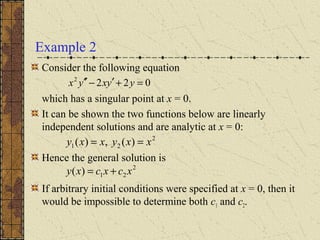
Example 2
Consider the following equation
which has a singular point at x = 0.
It can be shown the two functions below are linearly
independent solutions and are analytic at x = 0:
Hence the general solution is
If arbitrary initial conditions were specified at x = 0, then it
would be impossible to determine both c1 and c2.
0222
=+′−′′ yyxyx
2
21 )(,)( xxyxxy ==
2
21)( xcxcxy +=
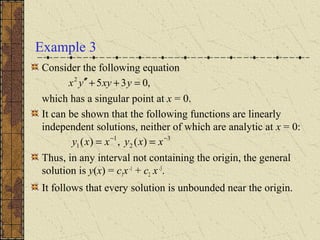
Example 3
Consider the following equation
which has a singular point at x = 0.
It can be shown that the following functions are linearly
independent solutions, neither of which are analytic at x = 0:
Thus, in any interval not containing the origin, the general
solution is y(x) = c1x-1
+ c2 x-3
.
It follows that every solution is unbounded near the origin.
3
2
1
1 )(,)( −−
== xxyxxy
,0352
=++′′ yxyyx
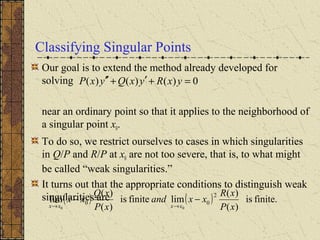
Classifying Singular Points
Our goal is to extend the method already developed for
solving
near an ordinary point so that it applies to the neighborhood of
a singular point x0.
To do so, we restrict ourselves to cases in which singularities
in Q/P and R/P at x0 are not too severe, that is, to what might
be called “weak singularities.”
It turns out that the appropriate conditions to distinguish weak
singularities are
0)()()( =+′+′′ yxRyxQyxP
( ) ( ) finite.is
)(
)(
limfiniteis
)(
)(
lim
2
00
00 xP
xR
xxand
xP
xQ
xx
xxxx
−−
→→
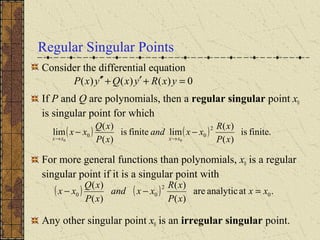
Regular Singular Points
Consider the differential equation
If P and Q are polynomials, then a regular singular point x0
is singular point for which
For more general functions than polynomials, x0 is a regular
singular point if it is a singular point with
Any other singular point x0 is an irregular singular point.
( ) ( ) finite.is
)(
)(
limfiniteis
)(
)(
lim
2
00
00 xP
xR
xxand
xP
xQ
xx
xxxx
−−
→→
( ) ( ) .atanalyticare
)(
)(
)(
)(
0
2
00 xx
xP
xR
xxand
xP
xQ
xx =−−
0)()()( =+′+′′ yxRyxQyxP
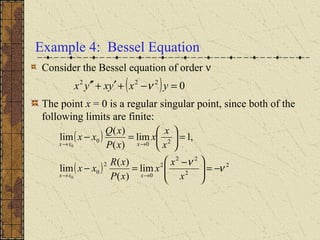
Example 4: Bessel Equation
Consider the Bessel equation of order ν
The point x = 0 is a regular singular point, since both of the
following limits are finite:
( ) 0222
=−+′+′′ yxyxyx ν
( )
( ) 2
2
22
2
0
2
0
20
0
lim
)(
)(
lim
,1lim
)(
)(
lim
0
0
ν
ν
−=




 −
=−
=





=−
→→
→→
x
x
x
xP
xR
xx
x
x
x
xP
xQ
xx
xxx
xxx
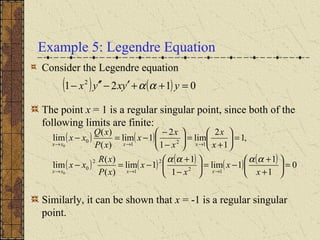
Example 5: Legendre Equation
Consider the Legendre equation
The point x = 1 is a regular singular point, since both of the
following limits are finite:
Similarly, it can be shown that x = -1 is a regular singular
point.
( ) ( ) 0121 2
=++′−′′− yyxyx αα
( ) ( )
( ) ( ) ( ) ( ) ( ) 0
1
1
1lim
1
1
1lim
)(
)(
lim
,1
1
2
lim
1
2
1lim
)(
)(
lim
12
2
1
2
0
121
0
0
0
=





+
+
−=





−
+
−=−
=





+
=





−
−
−=−
→→→
→→→
x
x
x
x
xP
xR
xx
x
x
x
x
x
xP
xQ
xx
xxxx
xxxx
αααα
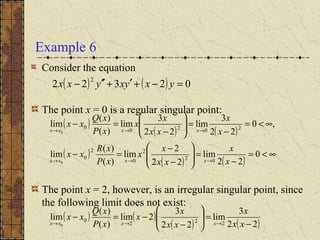
Example 6
Consider the equation
The point x = 0 is a regular singular point:
The point x = 2, however, is an irregular singular point, since
the following limit does not exist:
( ) ( ) 02322
2
=−+′+′′− yxyxyxx
( )
( ) ( )
( )
( ) ( )
∞<=
−
=





−
−
=−
∞<=
−
=





−
=−
→→→
→→→
0
22
lim
22
2
lim
)(
)(
lim
,0
22
3
lim
22
3
lim
)(
)(
lim
02
2
0
2
0
2020
0
0
0
x
x
xx
x
x
xP
xR
xx
x
x
xx
x
x
xP
xQ
xx
xxxx
xxxx
( ) ( )
( ) ( )22
3
lim
22
3
2lim
)(
)(
lim
222
0
0 −
=





−
−=−
→→→ xx
x
xx
x
x
xP
xQ
xx
xxxx
Example 7: Nonpolynomial Coefficients (1 of 2)
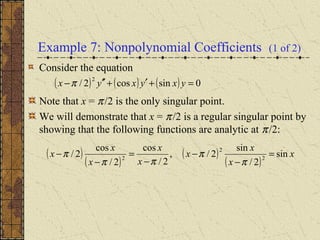
Consider the equation
Note that x = π/2 is the only singular point.
We will demonstrate that x = π/2 is a regular singular point by
showing that the following functions are analytic at π/2:
( ) ( ) ( ) 0sincos2/
2
=+′+′′− yxyxyx π
( )
( )
( )
( )
x
x
x
x
x
x
x
x
x sin
2/
sin
2/,
2/
cos
2/
cos
2/ 2
2
2
=
−
−
−
=
−
−
π
π
ππ
π
Example 7: Regular Singular Point (2 of 2)
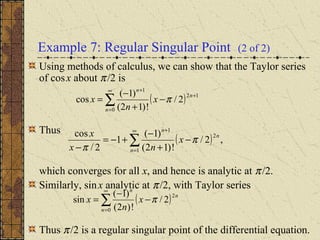
Using methods of calculus, we can show that the Taylor series
of cosx about π/2 is
Thus
which converges for all x, and hence is analytic at π/2.
Similarly, sinx analytic at π/2, with Taylor series
Thus π/2 is a regular singular point of the differential equation.
( )∑
∞
=
+
+
−
+
−
=
0
12
1
2/
!)12(
)1(
cos
n
n
n
x
n
x π
( ) ,2/
!)12(
)1(
1
2/
cos
1
2
1
∑
∞
=
+
−
+
−
+−=
− n
n
n
x
nx
x
π
π
( )∑
∞
=
−
−
=
0
2
2/
!)2(
)1(
sin
n
n
n
x
n
x π

Ch05 4

  • 1.
    Ch 5.4: RegularSingular Points Recall that the point x0 is an ordinary point of the equation if p(x) = Q(x)/P(x) and q(x)= R(x)/P(x) are analytic at at x0. Otherwise x0 is a singular point. Thus, if P, Q and R are polynomials having no common factors, then the singular points of the differential equation are the points for which P(x) = 0. 0)()()( 2 2 =++ yxR dx dy xQ dx yd xP
  • 2.
    Example 1: Besseland Legendre Equations Bessel Equation of order ν: The point x = 0 is a singular point, since P(x) = x2 is zero there. All other points are ordinary points. Legendre Equation: The points x = ±1 are singular points, since P(x) = 1- x2 is zero there. All other points are ordinary points. ( ) 0222 =−+′+′′ yxyxyx ν ( ) ( ) 0121 2 =++′−′′− yyxyx αα
  • 3.
    Solution Behavior andSingular Points If we attempt to use the methods of the preceding two sections to solve the differential equation in a neighborhood of a singular point x0, we will find that these methods fail. This is because the solution may not be analytic at x0, and hence will not have a Taylor series expansion about x0. Instead, we must use a more general series expansion. A differential equation may only have a few singular points, but solution behavior near these singular points is important. For example, solutions often become unbounded or experience rapid changes in magnitude near a singular point. Also, geometric singularities in a physical problem, such as corners or sharp edges, may lead to singular points in the corresponding differential equation.
  • 4.
    Numerical Methods andSingular Points As an alternative to analytical methods, we could consider using numerical methods, which are discussed in Chapter 8. However, numerical methods are not well suited for the study of solutions near singular points. When a numerical method is used, it helps to combine with it the analytical methods of this chapter in order to examine the behavior of solutions near singular points.
  • 5.
    Solution Behavior NearSingular Points Thus without more information about Q/P and R/P in the neighborhood of a singular point x0, it may be impossible to describe solution behavior near x0. It may be that there are two linearly independent solutions that remain bounded as x → x0; or there may be only one, with the other becoming unbounded as x → x0; or they may both become unbounded as x → x0. If a solution becomes unbounded, then we may want to know if y → ∞ in the same manner as (x - x0)-1 or |x - x0|-½ , or in some other manner.
  • 6.
    Example 1 Consider thefollowing equation which has a singular point at x = 0. It can be shown by direct substitution that the following functions are linearly independent solutions, for x ≠ 0: Thus, in any interval not containing the origin, the general solution is y(x) = c1x2 + c2 x-1 . Note that y = c1 x2 is bounded and analytic at the origin, even though Theorem 5.3.1 is not applicable. However, y = c2 x-1 does not have a Taylor series expansion about x = 0, and the methods of Section 5.2 would fail here. 1 2 2 1 )(,)( − == xxyxxy ,022 =−′′ yyx
  • 7.
    Example 2 Consider thefollowing equation which has a singular point at x = 0. It can be shown the two functions below are linearly independent solutions and are analytic at x = 0: Hence the general solution is If arbitrary initial conditions were specified at x = 0, then it would be impossible to determine both c1 and c2. 0222 =+′−′′ yyxyx 2 21 )(,)( xxyxxy == 2 21)( xcxcxy +=
  • 8.
    Example 3 Consider thefollowing equation which has a singular point at x = 0. It can be shown that the following functions are linearly independent solutions, neither of which are analytic at x = 0: Thus, in any interval not containing the origin, the general solution is y(x) = c1x-1 + c2 x-3 . It follows that every solution is unbounded near the origin. 3 2 1 1 )(,)( −− == xxyxxy ,0352 =++′′ yxyyx
  • 9.
    Classifying Singular Points Ourgoal is to extend the method already developed for solving near an ordinary point so that it applies to the neighborhood of a singular point x0. To do so, we restrict ourselves to cases in which singularities in Q/P and R/P at x0 are not too severe, that is, to what might be called “weak singularities.” It turns out that the appropriate conditions to distinguish weak singularities are 0)()()( =+′+′′ yxRyxQyxP ( ) ( ) finite.is )( )( limfiniteis )( )( lim 2 00 00 xP xR xxand xP xQ xx xxxx −− →→
  • 10.
    Regular Singular Points Considerthe differential equation If P and Q are polynomials, then a regular singular point x0 is singular point for which For more general functions than polynomials, x0 is a regular singular point if it is a singular point with Any other singular point x0 is an irregular singular point. ( ) ( ) finite.is )( )( limfiniteis )( )( lim 2 00 00 xP xR xxand xP xQ xx xxxx −− →→ ( ) ( ) .atanalyticare )( )( )( )( 0 2 00 xx xP xR xxand xP xQ xx =−− 0)()()( =+′+′′ yxRyxQyxP
  • 11.
    Example 4: BesselEquation Consider the Bessel equation of order ν The point x = 0 is a regular singular point, since both of the following limits are finite: ( ) 0222 =−+′+′′ yxyxyx ν ( ) ( ) 2 2 22 2 0 2 0 20 0 lim )( )( lim ,1lim )( )( lim 0 0 ν ν −=      − =− =      =− →→ →→ x x x xP xR xx x x x xP xQ xx xxx xxx
  • 12.
    Example 5: LegendreEquation Consider the Legendre equation The point x = 1 is a regular singular point, since both of the following limits are finite: Similarly, it can be shown that x = -1 is a regular singular point. ( ) ( ) 0121 2 =++′−′′− yyxyx αα ( ) ( ) ( ) ( ) ( ) ( ) ( ) 0 1 1 1lim 1 1 1lim )( )( lim ,1 1 2 lim 1 2 1lim )( )( lim 12 2 1 2 0 121 0 0 0 =      + + −=      − + −=− =      + =      − − −=− →→→ →→→ x x x x xP xR xx x x x x x xP xQ xx xxxx xxxx αααα
  • 13.
    Example 6 Consider theequation The point x = 0 is a regular singular point: The point x = 2, however, is an irregular singular point, since the following limit does not exist: ( ) ( ) 02322 2 =−+′+′′− yxyxyxx ( ) ( ) ( ) ( ) ( ) ( ) ∞<= − =      − − =− ∞<= − =      − =− →→→ →→→ 0 22 lim 22 2 lim )( )( lim ,0 22 3 lim 22 3 lim )( )( lim 02 2 0 2 0 2020 0 0 0 x x xx x x xP xR xx x x xx x x xP xQ xx xxxx xxxx ( ) ( ) ( ) ( )22 3 lim 22 3 2lim )( )( lim 222 0 0 − =      − −=− →→→ xx x xx x x xP xQ xx xxxx
  • 14.
    Example 7: NonpolynomialCoefficients (1 of 2) Consider the equation Note that x = π/2 is the only singular point. We will demonstrate that x = π/2 is a regular singular point by showing that the following functions are analytic at π/2: ( ) ( ) ( ) 0sincos2/ 2 =+′+′′− yxyxyx π ( ) ( ) ( ) ( ) x x x x x x x x x sin 2/ sin 2/, 2/ cos 2/ cos 2/ 2 2 2 = − − − = − − π π ππ π
  • 15.
    Example 7: RegularSingular Point (2 of 2) Using methods of calculus, we can show that the Taylor series of cosx about π/2 is Thus which converges for all x, and hence is analytic at π/2. Similarly, sinx analytic at π/2, with Taylor series Thus π/2 is a regular singular point of the differential equation. ( )∑ ∞ = + + − + − = 0 12 1 2/ !)12( )1( cos n n n x n x π ( ) ,2/ !)12( )1( 1 2/ cos 1 2 1 ∑ ∞ = + − + − +−= − n n n x nx x π π ( )∑ ∞ = − − = 0 2 2/ !)2( )1( sin n n n x n x π