Ch 7.6: Complex Eigenvalues
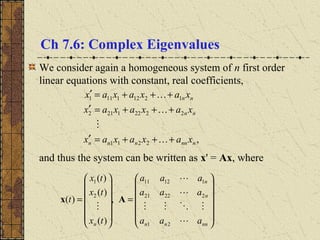
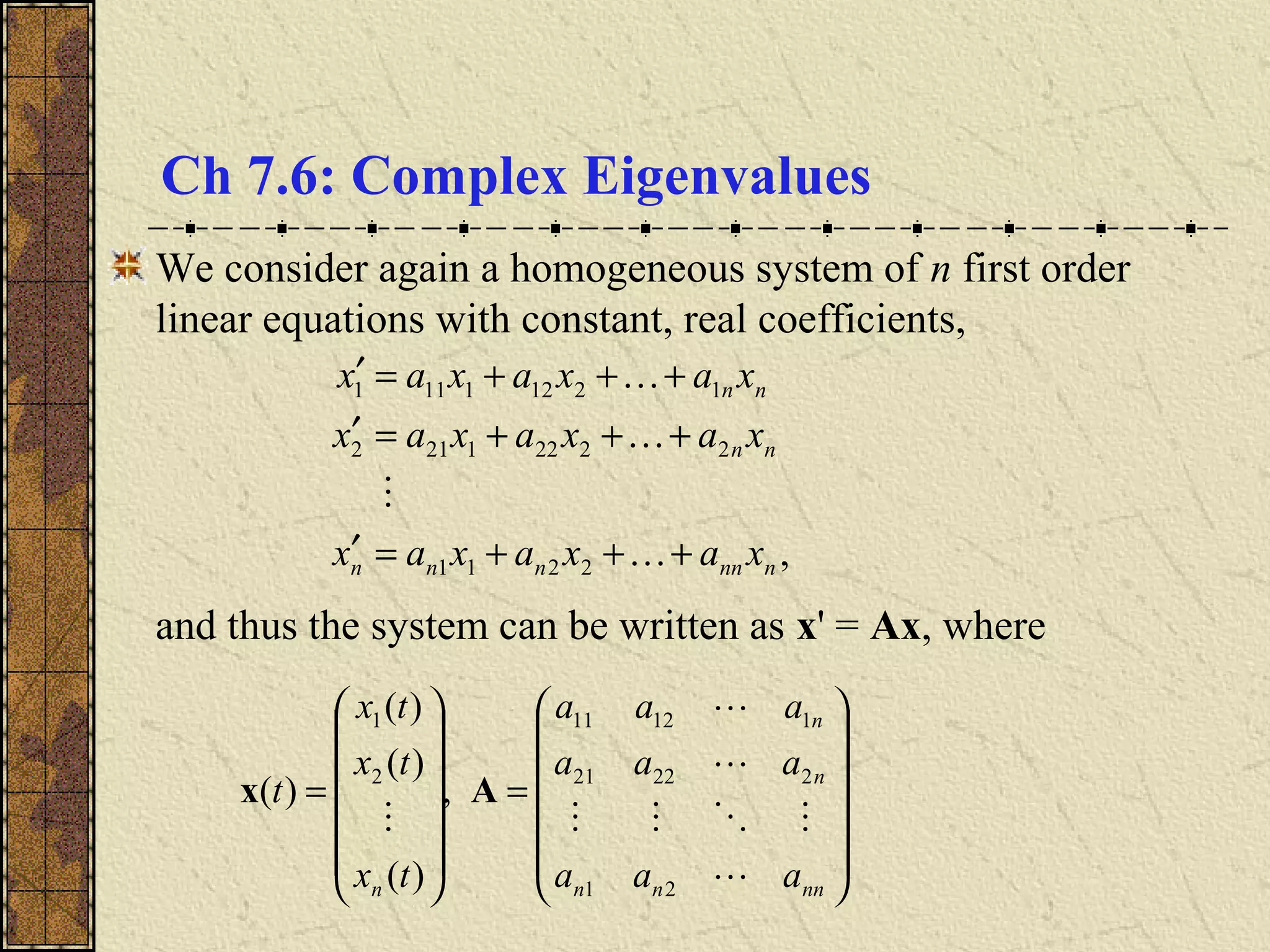
We consider again a homogeneous system of n first order
linear equations with constant, real coefficients,
and thus the system can be written as x' = Ax, where
,2211
22221212
12121111
nnnnnn
nn
nn
xaxaxax
xaxaxax
xaxaxax
+++=′
+++=′
+++=′


















=














=
nnnn
n
n
n aaa
aaa
aaa
tx
tx
tx
t





21
22221
11211
2
1
,
)(
)(
)(
)( Ax
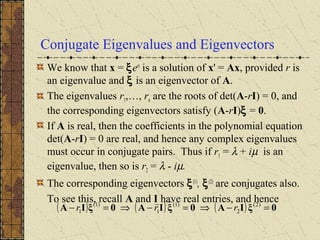
Conjugate Eigenvalues and Eigenvectors
We know that x = ξert
is a solution of x' = Ax, provided r is
an eigenvalue and ξ is an eigenvector of A.
The eigenvalues r1,…, rn are the roots of det(A-rI) = 0, and
the corresponding eigenvectors satisfy (A-rI)ξ = 0.
If A is real, then the coefficients in the polynomial equation
det(A-rI) = 0 are real, and hence any complex eigenvalues
must occur in conjugate pairs. Thus if r1 = λ + iµ is an
eigenvalue, then so is r2 = λ - iµ.
The corresponding eigenvectors ξ(1)
, ξ(2)
are conjugates also.
To see this, recall A and I have real entries, and hence
( ) ( ) ( ) 0ξIA0ξIA0ξIA =−⇒=−⇒=− )2(
2
)1(
1
)1(
1 rrr
Conjugate Solutions
It follows from the previous slide that the solutions
corresponding to these eigenvalues and eigenvectors are
conjugates conjugates as well, since
)1()1()2()2( 22
xξξx === trtr
ee
trtr
ee 21 )2()2()1()1(
, ξxξx ==
Real-Valued Solutions
Thus for complex conjugate eigenvalues r1 and r2,the
corresponding solutions x(1)
and x(2)
are conjugates also.
To obtain real-valued solutions, use real and imaginary
parts of either x(1)
or x(2)
. To see this, let ξ(1)
= a + ib. Then
where
are real valued solutions of x' = Ax, and can be shown to be
linearly independent.
( )
( ) ( )
( ) ( )
)()(
cossinsincos
sincos)1()1(
tit
ttiette
titeie
tt
tti
vu
baba
baξx
+=
++−=
++== +
µµµµ
µµ
λλ
λµλ
( ) ( ),cossin)(,sincos)( ttetttet tt
µµµµ λλ
bavbau +=−=
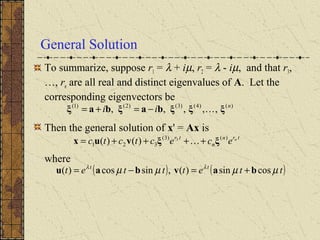
General Solution
To summarize, suppose r1 = λ + iµ, r2 = λ - iµ, and that r3,
…, rn are all real and distinct eigenvalues of A. Let the
corresponding eigenvectors be
Then the general solution of x' = Ax is
where
trn
n
tr n
ecectctc )()3(
321
3
)()( ξξvux ++++= 
)()4()3()2()1(
,,,,, n
ii ξξξbaξbaξ −=+=
( ) ( )ttetttet tt
µµµµ λλ
cossin)(,sincos)( bavbau +=−=
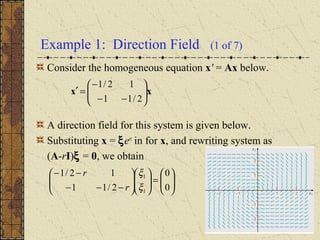
Example 1: Direction Field (1 of 7)
Consider the homogeneous equation x' = Ax below.
A direction field for this system is given below.
Substituting x = ξert
in for x, and rewriting system as
(A-rI)ξ = 0, we obtain
xx 





−−
−
=′
2/11
12/1






=











−−−
−−
0
0
2/11
12/1
1
1
ξ
ξ
r
r
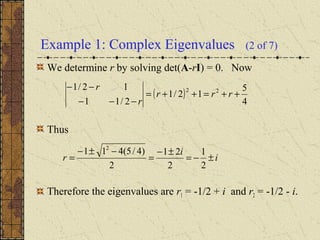
Example 1: Complex Eigenvalues (2 of 7)
We determine r by solving det(A-rI) = 0. Now
Thus
Therefore the eigenvalues are r1 = -1/2 + i and r2 = -1/2 - i.
( )
4
5
12/1
2/11
12/1 22
++=++=
−−−
−−
rrr
r
r
i
i
r ±−=
±−
=
−±−
=
2
1
2
21
2
)4/5(411 2
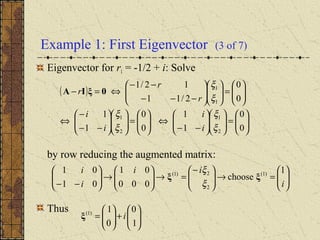
Example 1: First Eigenvector (3 of 7)
Eigenvector for r1 = -1/2 + i: Solve
by row reducing the augmented matrix:
Thus
( )






=











−−
⇔





=











−−
−
⇔






=











−−−
−−
⇔=−
0
0
1
1
0
0
1
1
0
0
2/11
12/1
2
1
2
1
1
1
ξ
ξ
ξ
ξ
ξ
ξ
i
i
i
i
r
r
r 0ξIA






=→




−
=→





→





−− i
ii
i
i 1
choose
000
01
01
01 )1(
2
2)1(
ξξ
ξ
ξ






+





=
1
0
0
1)1(
iξ
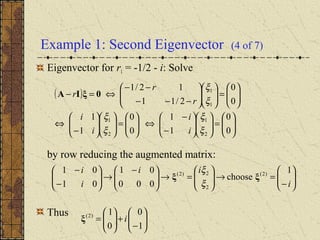
Example 1: Second Eigenvector (4 of 7)
Eigenvector for r1 = -1/2 - i: Solve
by row reducing the augmented matrix:
Thus
( )






=











−
−
⇔





=











−
⇔






=











−−−
−−
⇔=−
0
0
1
1
0
0
1
1
0
0
2/11
12/1
2
1
2
1
1
1
ξ
ξ
ξ
ξ
ξ
ξ
i
i
i
i
r
r
r 0ξIA






−
=→





=→




 −
→





−
−
i
ii
i
i 1
choose
000
01
01
01 )2(
2
2)2(
ξξ
ξ
ξ






−
+





=
1
0
0
1)2(
iξ
Example 1: General Solution (5 of 7)
The corresponding solutions x = ξert
of x' = Ax are
The Wronskian of these two solutions is
Thus u(t) and v(t) are real-valued fundamental solutions of
x' = Ax, with general solution x = c1u + c2v.






=











+





=






−
=











−





=
−−
−−
t
t
ettet
t
t
ettet
tt
tt
cos
sin
cos
1
0
sin
0
1
)(
sin
cos
sin
1
0
cos
0
1
)(
2/2/
2/2/
v
u
[ ] 0
cossin
sincos
)(, 2/2/
2/2/
)2()1(
≠=
−
= −
−−
−−
t
tt
tt
e
tete
tete
tW xx
Example 1: Phase Plane (6 of 7)
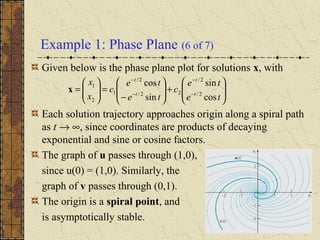
Given below is the phase plane plot for solutions x, with
Each solution trajectory approaches origin along a spiral path
as t → ∞, since coordinates are products of decaying
exponential and sine or cosine factors.
The graph of u passes through (1,0),
since u(0) = (1,0). Similarly, the
graph of v passes through (0,1).
The origin is a spiral point, and
is asymptotically stable.








+







−
=





= −
−
−
−
te
te
c
te
te
c
x
x
t
t
t
t
cos
sin
sin
cos
2/
2/
22/
2/
1
2
1
x
Example 1: Time Plots (7 of 7)
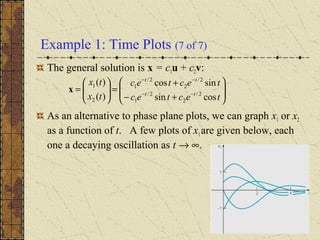
The general solution is x = c1u + c2v:
As an alternative to phase plane plots, we can graph x1 or x2
as a function of t. A few plots of x1are given below, each
one a decaying oscillation as t → ∞.








+−
+
=





= −−
−−
tectec
tectec
tx
tx
tt
tt
cossin
sincos
)(
)(
2/
2
2/
1
2/
2
2/
1
2
1
x
Spiral Points, Centers,
Eigenvalues, and Trajectories
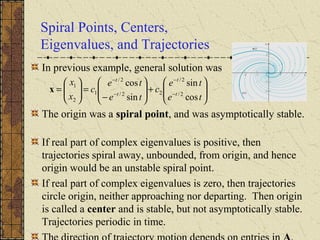
In previous example, general solution was
The origin was a spiral point, and was asymptotically stable.
If real part of complex eigenvalues is positive, then
trajectories spiral away, unbounded, from origin, and hence
origin would be an unstable spiral point.
If real part of complex eigenvalues is zero, then trajectories
circle origin, neither approaching nor departing. Then origin
is called a center and is stable, but not asymptotically stable.
Trajectories periodic in time.








+







−
=





= −
−
−
−
te
te
c
te
te
c
x
x
t
t
t
t
cos
sin
sin
cos
2/
2/
22/
2/
1
2
1
x
Example 2:
Second Order System with Parameter (1 of 2)
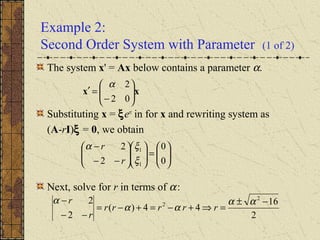
The system x' = Ax below contains a parameter α.
Substituting x = ξert
in for x and rewriting system as
(A-rI)ξ = 0, we obtain
Next, solve for r in terms of α:
xx 





−
=′
02
2α






=











−−
−
0
0
2
2
1
1
ξ
ξα
r
r
2
16
44)(
2
2 2
2 −±
=⇒+−=+−=
−−
− αα
αα
α
rrrrr
r
r
Example 2:
Eigenvalue Analysis (2 of 2)
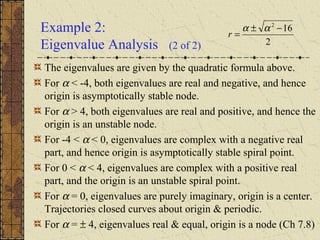
The eigenvalues are given by the quadratic formula above.
For α < -4, both eigenvalues are real and negative, and hence
origin is asymptotically stable node.
For α > 4, both eigenvalues are real and positive, and hence the
origin is an unstable node.
For -4 < α < 0, eigenvalues are complex with a negative real
part, and hence origin is asymptotically stable spiral point.
For 0 < α < 4, eigenvalues are complex with a positive real
part, and the origin is an unstable spiral point.
For α = 0, eigenvalues are purely imaginary, origin is a center.
Trajectories closed curves about origin & periodic.
For α = ± 4, eigenvalues real & equal, origin is a node (Ch 7.8)
2
162
−±
=
αα
r
Second Order Solution Behavior and
Eigenvalues: Three Main Cases
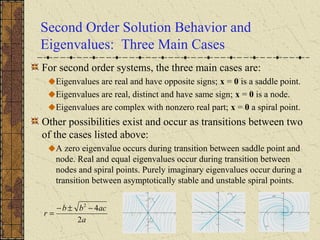
For second order systems, the three main cases are:
Eigenvalues are real and have opposite signs; x = 0 is a saddle point.
Eigenvalues are real, distinct and have same sign; x = 0 is a node.
Eigenvalues are complex with nonzero real part; x = 0 a spiral point.
Other possibilities exist and occur as transitions between two
of the cases listed above:
A zero eigenvalue occurs during transition between saddle point and
node. Real and equal eigenvalues occur during transition between
nodes and spiral points. Purely imaginary eigenvalues occur during a
transition between asymptotically stable and unstable spiral points.
a
acbb
r
2
42
−±−
=

Ch07 6

  • 1.
    Ch 7.6: ComplexEigenvalues We consider again a homogeneous system of n first order linear equations with constant, real coefficients, and thus the system can be written as x' = Ax, where ,2211 22221212 12121111 nnnnnn nn nn xaxaxax xaxaxax xaxaxax +++=′ +++=′ +++=′                   =               = nnnn n n n aaa aaa aaa tx tx tx t      21 22221 11211 2 1 , )( )( )( )( Ax
  • 2.
    Conjugate Eigenvalues andEigenvectors We know that x = ξert is a solution of x' = Ax, provided r is an eigenvalue and ξ is an eigenvector of A. The eigenvalues r1,…, rn are the roots of det(A-rI) = 0, and the corresponding eigenvectors satisfy (A-rI)ξ = 0. If A is real, then the coefficients in the polynomial equation det(A-rI) = 0 are real, and hence any complex eigenvalues must occur in conjugate pairs. Thus if r1 = λ + iµ is an eigenvalue, then so is r2 = λ - iµ. The corresponding eigenvectors ξ(1) , ξ(2) are conjugates also. To see this, recall A and I have real entries, and hence ( ) ( ) ( ) 0ξIA0ξIA0ξIA =−⇒=−⇒=− )2( 2 )1( 1 )1( 1 rrr
  • 3.
    Conjugate Solutions It followsfrom the previous slide that the solutions corresponding to these eigenvalues and eigenvectors are conjugates conjugates as well, since )1()1()2()2( 22 xξξx === trtr ee trtr ee 21 )2()2()1()1( , ξxξx ==
  • 4.
    Real-Valued Solutions Thus forcomplex conjugate eigenvalues r1 and r2,the corresponding solutions x(1) and x(2) are conjugates also. To obtain real-valued solutions, use real and imaginary parts of either x(1) or x(2) . To see this, let ξ(1) = a + ib. Then where are real valued solutions of x' = Ax, and can be shown to be linearly independent. ( ) ( ) ( ) ( ) ( ) )()( cossinsincos sincos)1()1( tit ttiette titeie tt tti vu baba baξx += ++−= ++== + µµµµ µµ λλ λµλ ( ) ( ),cossin)(,sincos)( ttetttet tt µµµµ λλ bavbau +=−=
  • 5.
    General Solution To summarize,suppose r1 = λ + iµ, r2 = λ - iµ, and that r3, …, rn are all real and distinct eigenvalues of A. Let the corresponding eigenvectors be Then the general solution of x' = Ax is where trn n tr n ecectctc )()3( 321 3 )()( ξξvux ++++=  )()4()3()2()1( ,,,,, n ii ξξξbaξbaξ −=+= ( ) ( )ttetttet tt µµµµ λλ cossin)(,sincos)( bavbau +=−=
  • 6.
    Example 1: DirectionField (1 of 7) Consider the homogeneous equation x' = Ax below. A direction field for this system is given below. Substituting x = ξert in for x, and rewriting system as (A-rI)ξ = 0, we obtain xx       −− − =′ 2/11 12/1       =            −−− −− 0 0 2/11 12/1 1 1 ξ ξ r r
  • 7.
    Example 1: ComplexEigenvalues (2 of 7) We determine r by solving det(A-rI) = 0. Now Thus Therefore the eigenvalues are r1 = -1/2 + i and r2 = -1/2 - i. ( ) 4 5 12/1 2/11 12/1 22 ++=++= −−− −− rrr r r i i r ±−= ±− = −±− = 2 1 2 21 2 )4/5(411 2
  • 8.
    Example 1: FirstEigenvector (3 of 7) Eigenvector for r1 = -1/2 + i: Solve by row reducing the augmented matrix: Thus ( )       =            −− ⇔      =            −− − ⇔       =            −−− −− ⇔=− 0 0 1 1 0 0 1 1 0 0 2/11 12/1 2 1 2 1 1 1 ξ ξ ξ ξ ξ ξ i i i i r r r 0ξIA       =→     − =→      →      −− i ii i i 1 choose 000 01 01 01 )1( 2 2)1( ξξ ξ ξ       +      = 1 0 0 1)1( iξ
  • 9.
    Example 1: SecondEigenvector (4 of 7) Eigenvector for r1 = -1/2 - i: Solve by row reducing the augmented matrix: Thus ( )       =            − − ⇔      =            − ⇔       =            −−− −− ⇔=− 0 0 1 1 0 0 1 1 0 0 2/11 12/1 2 1 2 1 1 1 ξ ξ ξ ξ ξ ξ i i i i r r r 0ξIA       − =→      =→      − →      − − i ii i i 1 choose 000 01 01 01 )2( 2 2)2( ξξ ξ ξ       − +      = 1 0 0 1)2( iξ
  • 10.
    Example 1: GeneralSolution (5 of 7) The corresponding solutions x = ξert of x' = Ax are The Wronskian of these two solutions is Thus u(t) and v(t) are real-valued fundamental solutions of x' = Ax, with general solution x = c1u + c2v.       =            +      =       − =            −      = −− −− t t ettet t t ettet tt tt cos sin cos 1 0 sin 0 1 )( sin cos sin 1 0 cos 0 1 )( 2/2/ 2/2/ v u [ ] 0 cossin sincos )(, 2/2/ 2/2/ )2()1( ≠= − = − −− −− t tt tt e tete tete tW xx
  • 11.
    Example 1: PhasePlane (6 of 7) Given below is the phase plane plot for solutions x, with Each solution trajectory approaches origin along a spiral path as t → ∞, since coordinates are products of decaying exponential and sine or cosine factors. The graph of u passes through (1,0), since u(0) = (1,0). Similarly, the graph of v passes through (0,1). The origin is a spiral point, and is asymptotically stable.         +        − =      = − − − − te te c te te c x x t t t t cos sin sin cos 2/ 2/ 22/ 2/ 1 2 1 x
  • 12.
    Example 1: TimePlots (7 of 7) The general solution is x = c1u + c2v: As an alternative to phase plane plots, we can graph x1 or x2 as a function of t. A few plots of x1are given below, each one a decaying oscillation as t → ∞.         +− + =      = −− −− tectec tectec tx tx tt tt cossin sincos )( )( 2/ 2 2/ 1 2/ 2 2/ 1 2 1 x
  • 13.
    Spiral Points, Centers, Eigenvalues,and Trajectories In previous example, general solution was The origin was a spiral point, and was asymptotically stable. If real part of complex eigenvalues is positive, then trajectories spiral away, unbounded, from origin, and hence origin would be an unstable spiral point. If real part of complex eigenvalues is zero, then trajectories circle origin, neither approaching nor departing. Then origin is called a center and is stable, but not asymptotically stable. Trajectories periodic in time.         +        − =      = − − − − te te c te te c x x t t t t cos sin sin cos 2/ 2/ 22/ 2/ 1 2 1 x
  • 14.
    Example 2: Second OrderSystem with Parameter (1 of 2) The system x' = Ax below contains a parameter α. Substituting x = ξert in for x and rewriting system as (A-rI)ξ = 0, we obtain Next, solve for r in terms of α: xx       − =′ 02 2α       =            −− − 0 0 2 2 1 1 ξ ξα r r 2 16 44)( 2 2 2 2 −± =⇒+−=+−= −− − αα αα α rrrrr r r
  • 15.
    Example 2: Eigenvalue Analysis(2 of 2) The eigenvalues are given by the quadratic formula above. For α < -4, both eigenvalues are real and negative, and hence origin is asymptotically stable node. For α > 4, both eigenvalues are real and positive, and hence the origin is an unstable node. For -4 < α < 0, eigenvalues are complex with a negative real part, and hence origin is asymptotically stable spiral point. For 0 < α < 4, eigenvalues are complex with a positive real part, and the origin is an unstable spiral point. For α = 0, eigenvalues are purely imaginary, origin is a center. Trajectories closed curves about origin & periodic. For α = ± 4, eigenvalues real & equal, origin is a node (Ch 7.8) 2 162 −± = αα r
  • 16.
    Second Order SolutionBehavior and Eigenvalues: Three Main Cases For second order systems, the three main cases are: Eigenvalues are real and have opposite signs; x = 0 is a saddle point. Eigenvalues are real, distinct and have same sign; x = 0 is a node. Eigenvalues are complex with nonzero real part; x = 0 a spiral point. Other possibilities exist and occur as transitions between two of the cases listed above: A zero eigenvalue occurs during transition between saddle point and node. Real and equal eigenvalues occur during transition between nodes and spiral points. Purely imaginary eigenvalues occur during a transition between asymptotically stable and unstable spiral points. a acbb r 2 42 −±− =