Finding
Eigenvectors
Some Examples
General Information
 Eigenvalues are used to find eigenvectors.
 The sum of the eigenvalues is called the trace.
 The product of the eigenvalues is the
determinant of the matrix.
 An EIGENVECTOR of an n x n matrix A is a
vector such that , where v is the
eigenvector.
Av v


Eigenvectors
 An eigenvector is a direction for a matrix.
 What is important about an eigenvector is
its direction.
 Every square matrix has at least one
eigenvector.
 An n x n matrix should have n linearly
independent eigenvectors.
Homogeneous Linear Systems
Distinct Eigenvalues
1 2 3
1 0 1
0 1 0 gives, after solving det ( ) 0, 1, 0, 2
1 0 1
X X A I
   
 
 
     
 
 
 
1 0 1 0 1 0 1 0
Consider 0. 0 0 1 0 0 0 1 0 0
1 0 1 0 0 0 0 0
A I
 
   
   
    
   
   
   
Note 0 (second row) and 0 .
-1
If 1, one eigenvector is 0 .
1
-1
The generalized eigenvector may be written 0 , .
1
y x z x z
z
s s
    
 
 
  
 
 
 
 

 
 
 
Distinct Eigenvalues (cont)
For
so that x=0 (row 3), z=0 (row 1), y can be anything.
If y=1, one eigenvector is
The generalized eigenvector may be written
0 0 1 0
1, 0 0 0 0 0
1 0 0 0
A I
 
 
 
     
 
 
0
1
0
 
 
 
 
 
0
1 ,
0
r r
 
 

 
 
 
Distinct Eigenvalues (cont)
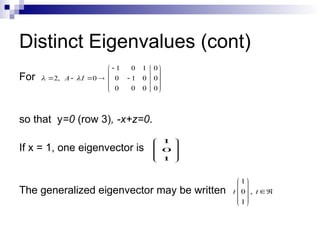
For
so that y=0 (row 3), -x+z=0.
If x = 1, one eigenvector is
The generalized eigenvector may be written
1 0 1 0
2, 0 0 1 0 0
0 0 0 0
A I
 

 
 
    
 
 
 
1
0
1
 
 
 
 
 
1
0 ,
1
t t
 
 

 
 
 
Solution-Distinct Eigenvalues
 The general solution may be written
OR
2
1 2 3
1 0 1
0 1 0
1 0 1
t t
y c c e c e

     
     
  
     
     
     
2
1
2
2
3
1 0
0 0
1 0
t
t
t
e c
Y e c
e c
 
  
  
  
 
 
 
 
Complex Eigenvalues
For 1
4 0 1
0 6 0 , after solving det ( ) 0, 6, 4 2
4 0 4
2 0 1 0
For = 6, 0 0 0 0 0
0 0 4 0
0 (row 3), 0, can be anything.
0
If 1, one eigenvector is 1
0
X X A I i
A I
z x y
y
  
 
 
 
     
 
 

 

 
 
    
 

 
 
 
 
  
 
 
Complex Eigenvalues (cont)
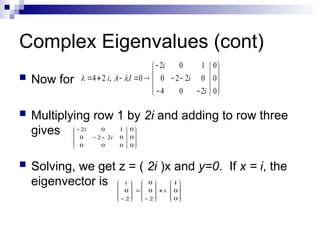
 Now for
 Multiplying row 1 by 2i and adding to row three
gives
 Solving, we get z = ( 2i )x and y=0. If x = i, the
eigenvector is
2 0 1 0
4 2 , 0 0 2 2 0 0
4 0 2 0
i
i A I i
i
 

 
 
      
 
 
 
 
2 0 1 0
0 2 2 0 0
0 0 0 0
i
i

 
 
 
 
 
 
0 1
0 0 0
2 2 0
i
i
     
     
 
     
     
 
     
Complex Eigenvalues (cont)
 The eigenvector was written with a real part
and a complex part:
 Let be the real part and be the imaginary
part.
 The eigenvectors corresponding to the
complex conjugate pair of eigenvalues may be
written:
0 1
0 0 0
2 2 0
i
i
     
     
 
     
     
 
     
1
B 2
B
1 1 2
2 2 1
( cos sin )
( cos sin )
t
t
X B t B t e
X B t B t e


 
 
 
 
Complex Eigenvalues (cont)
 Don’t forget Euler’s Formula:
 For the eigenvectors are
4 2i
  
4 t
1
4 t
2
0 1
0 cos 2 0 sin 2
2 0
1 0
0 cos 2 0 sin 2
0 2
X t t e
X t t e
 
   
 
   
 
 
   
   
 

   
 
 
   
 
   
 
 
   
   
 

   
 
cos sin
i
e i

 
 
Complex Eigenvalues (cont)
 The solution for the given system is
6 t 4 t 4 t
1 2 3
0 sin 2 cos2
1 0 0
0 2cos2 2sin 2
t t
X c e c e c e
t t

     
     
  
     
     
 
     
Repeated Eigenvalues
 Solving the
characteristic
equation, we find that
 Note that there is a
repeated eigenvalue.
3 2 4
2 +2
4 2 3
dx
x y z
dt
dy
x z
dt
dz
x y z
dt
  

  
1 2 3
8, 1, 1
  
  
Repeated Eigenvalues (cont)
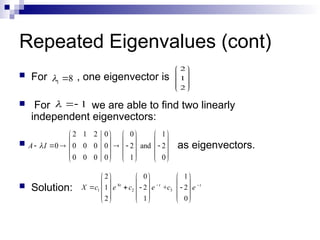
 For , one eigenvector is
 For we are able to find two linearly
independent eigenvectors:
 as eigenvectors.
 Solution:
1 8
 
2
1
2
 
 
 
 
 
1
 
2 1 2 0 0 1
0 0 0 0 0 2 and 2
0 0 0 0 1 0
A I

     
     
     
     
     
     
8
1 2 3
2 0 1
1 2 + 2
2 1 0
t t t
X c e c e c e
 
     
     
   
     
     
     
Repeated Eigenvalues (cont)
 What happens if it is not possible to find two
linearly independent eigenvectors when there
is a repeated eigenvalue?
 As an example, consider an eigenvalue of
multiplicity two with only one eigenvalue
associated with this value. A second solution
of the form may be found
with K and P the required eigenvectors.
t t
2
X Kte Pe
 
 
Repeated Eigenvectors (cont)
 K must be an eigenvector of the matrix A
associated with the eigenvalue. To find the
second solution, we need to solve
 This process may be extended if necessary.
For example, if an eigenvalue has multiplicity
three and one eigenvalue, K, has been found,
then solve and
( )
A I P K

 
( )
A I P K

  ( )
A I Q P

 
An Example of Repeated Eigenvalues
1 0 0
0 3 1
0 1 1
X X
 
 
 
 

 
1 2 3
1, 2, 2
  
  
1
For 1, an eigenvector is 0
0

 
 
  
 
 
An Example of Repeated Eigenvalues
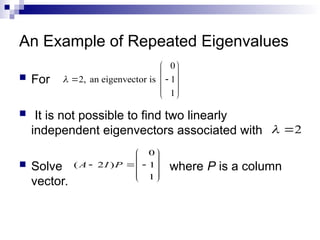
 For
 It is not possible to find two linearly
independent eigenvectors associated with
 Solve where P is a column
vector.
0
2, an eigenvector is 1
1

 
 
 
 
 
 
2
 
0
( 2 ) 1
1
A I P
 
 
  
 
 
 
An Example of Repeated Eigenvalues
 With
 P=
 The solution is
 NOTE THE FORM OF THE SOLUTION.
0 1 0 0 0
( 2 ) 1 0 1 1 1
1 0 1 1 1
x
A I P y
z

       
       
     
       
       
 
       
0
1
0
 
 

 
 
 
2 2 2
1 2 3
1 0 0 0
0 1 1 1
0 1 1 0
t t t t
X c e c e c te e
 
       
 
       
      
 
       
       
 
       
 

Lecture 2 -Eigenvectors in mechatronic.ppt

  • 1.
  • 2.
    General Information  Eigenvaluesare used to find eigenvectors.  The sum of the eigenvalues is called the trace.  The product of the eigenvalues is the determinant of the matrix.  An EIGENVECTOR of an n x n matrix A is a vector such that , where v is the eigenvector. Av v  
  • 3.
    Eigenvectors  An eigenvectoris a direction for a matrix.  What is important about an eigenvector is its direction.  Every square matrix has at least one eigenvector.  An n x n matrix should have n linearly independent eigenvectors.
  • 4.
    Homogeneous Linear Systems DistinctEigenvalues 1 2 3 1 0 1 0 1 0 gives, after solving det ( ) 0, 1, 0, 2 1 0 1 X X A I                     1 0 1 0 1 0 1 0 Consider 0. 0 0 1 0 0 0 1 0 0 1 0 1 0 0 0 0 0 A I                            Note 0 (second row) and 0 . -1 If 1, one eigenvector is 0 . 1 -1 The generalized eigenvector may be written 0 , . 1 y x z x z z s s                           
  • 5.
    Distinct Eigenvalues (cont) For sothat x=0 (row 3), z=0 (row 1), y can be anything. If y=1, one eigenvector is The generalized eigenvector may be written 0 0 1 0 1, 0 0 0 0 0 1 0 0 0 A I                 0 1 0           0 1 , 0 r r           
  • 6.
    Distinct Eigenvalues (cont) For sothat y=0 (row 3), -x+z=0. If x = 1, one eigenvector is The generalized eigenvector may be written 1 0 1 0 2, 0 0 1 0 0 0 0 0 0 A I                   1 0 1           1 0 , 1 t t           
  • 7.
    Solution-Distinct Eigenvalues  Thegeneral solution may be written OR 2 1 2 3 1 0 1 0 1 0 1 0 1 t t y c c e c e                                   2 1 2 2 3 1 0 0 0 1 0 t t t e c Y e c e c                   
  • 8.
    Complex Eigenvalues For 1 40 1 0 6 0 , after solving det ( ) 0, 6, 4 2 4 0 4 2 0 1 0 For = 6, 0 0 0 0 0 0 0 4 0 0 (row 3), 0, can be anything. 0 If 1, one eigenvector is 1 0 X X A I i A I z x y y                                                  
  • 9.
    Complex Eigenvalues (cont) Now for  Multiplying row 1 by 2i and adding to row three gives  Solving, we get z = ( 2i )x and y=0. If x = i, the eigenvector is 2 0 1 0 4 2 , 0 0 2 2 0 0 4 0 2 0 i i A I i i                       2 0 1 0 0 2 2 0 0 0 0 0 0 i i              0 1 0 0 0 2 2 0 i i                                  
  • 10.
    Complex Eigenvalues (cont) The eigenvector was written with a real part and a complex part:  Let be the real part and be the imaginary part.  The eigenvectors corresponding to the complex conjugate pair of eigenvalues may be written: 0 1 0 0 0 2 2 0 i i                                   1 B 2 B 1 1 2 2 2 1 ( cos sin ) ( cos sin ) t t X B t B t e X B t B t e          
  • 11.
    Complex Eigenvalues (cont) Don’t forget Euler’s Formula:  For the eigenvectors are 4 2i    4 t 1 4 t 2 0 1 0 cos 2 0 sin 2 2 0 1 0 0 cos 2 0 sin 2 0 2 X t t e X t t e                                                                   cos sin i e i     
  • 12.
    Complex Eigenvalues (cont) The solution for the given system is 6 t 4 t 4 t 1 2 3 0 sin 2 cos2 1 0 0 0 2cos2 2sin 2 t t X c e c e c e t t                                    
  • 13.
    Repeated Eigenvalues  Solvingthe characteristic equation, we find that  Note that there is a repeated eigenvalue. 3 2 4 2 +2 4 2 3 dx x y z dt dy x z dt dz x y z dt        1 2 3 8, 1, 1      
  • 14.
    Repeated Eigenvalues (cont) For , one eigenvector is  For we are able to find two linearly independent eigenvectors:  as eigenvectors.  Solution: 1 8   2 1 2           1   2 1 2 0 0 1 0 0 0 0 0 2 and 2 0 0 0 0 1 0 A I                                      8 1 2 3 2 0 1 1 2 + 2 2 1 0 t t t X c e c e c e                                    
  • 15.
    Repeated Eigenvalues (cont) What happens if it is not possible to find two linearly independent eigenvectors when there is a repeated eigenvalue?  As an example, consider an eigenvalue of multiplicity two with only one eigenvalue associated with this value. A second solution of the form may be found with K and P the required eigenvectors. t t 2 X Kte Pe    
  • 16.
    Repeated Eigenvectors (cont) K must be an eigenvector of the matrix A associated with the eigenvalue. To find the second solution, we need to solve  This process may be extended if necessary. For example, if an eigenvalue has multiplicity three and one eigenvalue, K, has been found, then solve and ( ) A I P K    ( ) A I P K    ( ) A I Q P   
  • 17.
    An Example ofRepeated Eigenvalues 1 0 0 0 3 1 0 1 1 X X            1 2 3 1, 2, 2       1 For 1, an eigenvector is 0 0            
  • 18.
    An Example ofRepeated Eigenvalues  For  It is not possible to find two linearly independent eigenvectors associated with  Solve where P is a column vector. 0 2, an eigenvector is 1 1              2   0 ( 2 ) 1 1 A I P             
  • 19.
    An Example ofRepeated Eigenvalues  With  P=  The solution is  NOTE THE FORM OF THE SOLUTION. 0 1 0 0 0 ( 2 ) 1 0 1 1 1 1 0 1 1 1 x A I P y z                                                  0 1 0            2 2 2 1 2 3 1 0 0 0 0 1 1 1 0 1 1 0 t t t t X c e c e c te e                                                         