Ch 7.5: Homogeneous Linear Systems with
Constant Coefficients
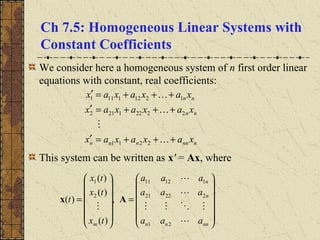
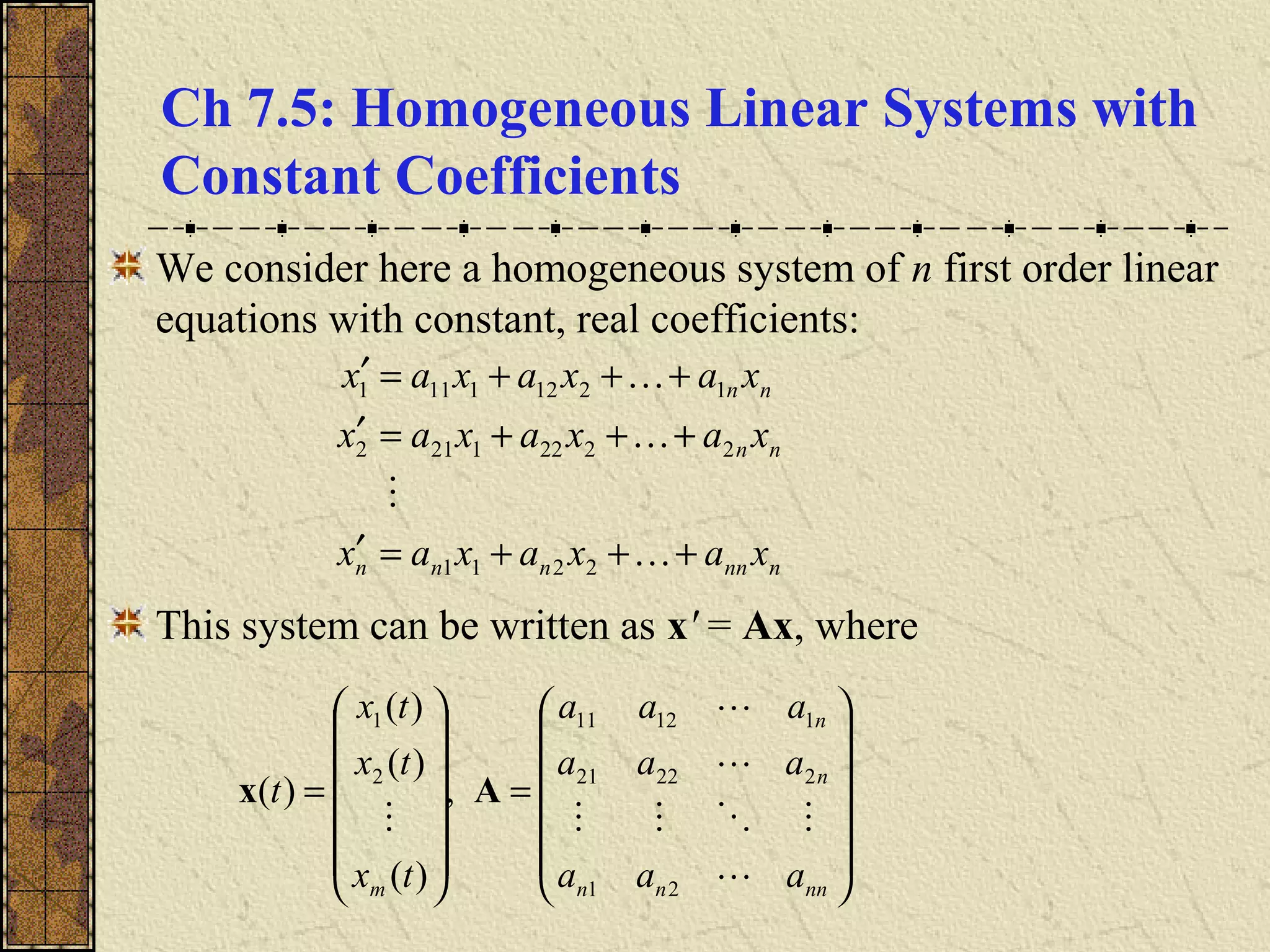
We consider here a homogeneous system of n first order linear
equations with constant, real coefficients:
This system can be written as x' = Ax, where
nnnnnn
nn
nn
xaxaxax
xaxaxax
xaxaxax
+++=′
+++=′
+++=′




2211
22221212
12121111














=














=
nnnn
n
n
m aaa
aaa
aaa
tx
tx
tx
t





21
22221
11211
2
1
,
)(
)(
)(
)( Ax
Equilibrium Solutions
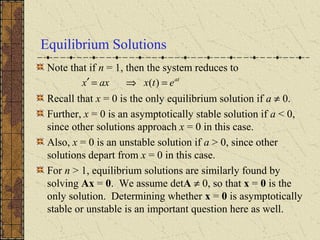
Note that if n = 1, then the system reduces to
Recall that x = 0 is the only equilibrium solution if a ≠ 0.
Further, x = 0 is an asymptotically stable solution if a < 0,
since other solutions approach x = 0 in this case.
Also, x = 0 is an unstable solution if a > 0, since other
solutions depart from x = 0 in this case.
For n > 1, equilibrium solutions are similarly found by
solving Ax = 0. We assume detA ≠ 0, so that x = 0 is the
only solution. Determining whether x = 0 is asymptotically
stable or unstable is an important question here as well.
at
etxaxx =⇒=′ )(
Phase Plane
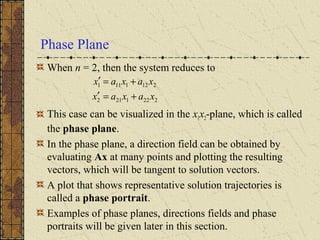
When n = 2, then the system reduces to
This case can be visualized in the x1x2-plane, which is called
the phase plane.
In the phase plane, a direction field can be obtained by
evaluating Ax at many points and plotting the resulting
vectors, which will be tangent to solution vectors.
A plot that shows representative solution trajectories is
called a phase portrait.
Examples of phase planes, directions fields and phase
portraits will be given later in this section.
2221212
2121111
xaxax
xaxax
+=′
+=′
Solving Homogeneous System
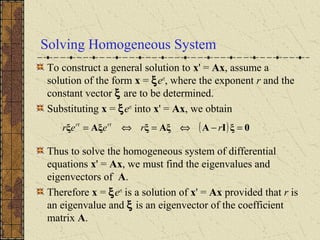
To construct a general solution to x' = Ax, assume a
solution of the form x = ξert
, where the exponent r and the
constant vector ξ are to be determined.
Substituting x = ξert
into x' = Ax, we obtain
Thus to solve the homogeneous system of differential
equations x' = Ax, we must find the eigenvalues and
eigenvectors of A.
Therefore x = ξert
is a solution of x' = Ax provided that r is
an eigenvalue and ξ is an eigenvector of the coefficient
matrix A.
( ) 0ξIAAξξAξξ =−⇔=⇔= rreer rtrt
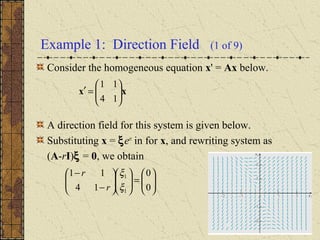
Example 1: Direction Field (1 of 9)
Consider the homogeneous equation x' = Ax below.
A direction field for this system is given below.
Substituting x = ξert
in for x, and rewriting system as
(A-rI)ξ = 0, we obtain
xx 





=′
14
11






=











−
−
0
0
14
11
1
1
ξ
ξ
r
r
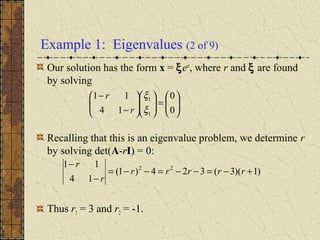
Example 1: Eigenvalues (2 of 9)
Our solution has the form x = ξert
, where r and ξ are found
by solving
Recalling that this is an eigenvalue problem, we determine r
by solving det(A-rI) = 0:
Thus r1 = 3 and r2 = -1.






=











−
−
0
0
14
11
1
1
ξ
ξ
r
r
)1)(3(324)1(
14
11 22
+−=−−=−−=
−
−
rrrrr
r
r
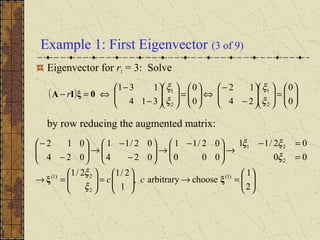
Example 1: First Eigenvector (3 of 9)
Eigenvector for r1 = 3: Solve
by row reducing the augmented matrix:
( ) 





=











−
−
⇔





=











−
−
⇔=−
0
0
24
12
0
0
314
131
2
1
2
1
ξ
ξ
ξ
ξ
0ξIA r






=→





=





=→
=
=−
→




 −
→





−
−
→





−
−
2
1
choosearbitrary,
1
2/12/1
00
02/11
000
02/11
024
02/11
024
012
)1(
2
2)1(
2
21
ξξ cc
ξ
ξ
ξ
ξξ
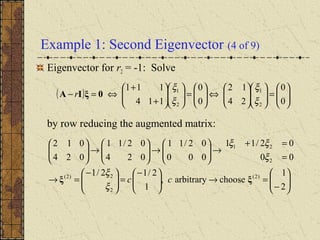
Example 1: Second Eigenvector (4 of 9)
Eigenvector for r2 = -1: Solve
by row reducing the augmented matrix:
( ) 





=











⇔





=











+
+
⇔=−
0
0
24
12
0
0
114
111
2
1
2
1
ξ
ξ
ξ
ξ
0ξIA r






−
=→




−
=




−
=→
=
=+
→





→





→





2
1
choosearbitrary,
1
2/12/1
00
02/11
000
02/11
024
02/11
024
012
)2(
2
2)2(
2
21
ξξ cc
ξ
ξ
ξ
ξξ
Example 1: General Solution (5 of 9)
The corresponding solutions x = ξert
of x' = Ax are
The Wronskian of these two solutions is
Thus x(1)
and x(2)
are fundamental solutions, and the general
solution of x' = Ax is
tt
etet −






−
=





=
2
1
)(,
2
1
)( )2(3)1(
xx
[ ] 04
22
)(, 2
3
3
)2()1(
≠−=
−
= −
−
−
t
tt
tt
e
ee
ee
tW xx
tt
ecec
tctct
−






−
+





=
+=
2
1
2
1
)()()(
2
3
1
)2(
2
)1(
1 xxx
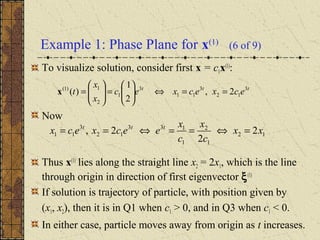
Example 1: Phase Plane for x(1)
(6 of 9)
To visualize solution, consider first x = c1x(1)
:
Now
Thus x(1)
lies along the straight line x2 = 2x1, which is the line
through origin in direction of first eigenvector ξ(1)
If solution is trajectory of particle, with position given by
(x1, x2), then it is in Q1 when c1 > 0, and in Q3 when c1 < 0.
In either case, particle moves away from origin as t increases.
ttt
ecxecxec
x
x
t 3
12
3
11
3
1
2
1)1(
2,
2
1
)( ==⇔





=





=x
12
1
2
1
133
12
3
11 2
2
2, xx
c
x
c
x
eecxecx ttt
=⇔==⇔==
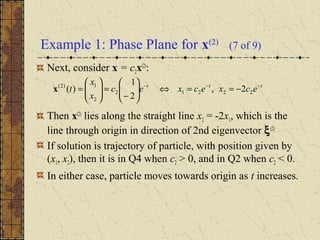
Example 1: Phase Plane for x(2)
(7 of 9)
Next, consider x = c2x(2)
:
Then x(2)
lies along the straight line x2 = -2x1, which is the
line through origin in direction of 2nd eigenvector ξ(2)
If solution is trajectory of particle, with position given by
(x1, x2), then it is in Q4 when c2 > 0, and in Q2 when c2 < 0.
In either case, particle moves towards origin as t increases.
ttt
ecxecxec
x
x
t −−−
−==⇔





−
=





= 22212
2
1)2(
2,
2
1
)(x
Example 1:
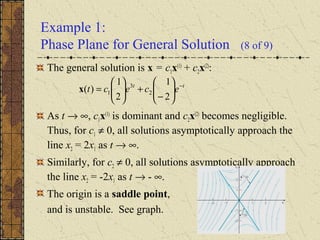
Phase Plane for General Solution (8 of 9)
The general solution is x = c1x(1)
+ c2x(2)
:
As t → ∞, c1x(1)
is dominant and c2x(2)
becomes negligible.
Thus, for c1 ≠ 0, all solutions asymptotically approach the
line x2 = 2x1 as t → ∞.
Similarly, for c2 ≠ 0, all solutions asymptotically approach
the line x2 = -2x1 as t → - ∞.
The origin is a saddle point,
and is unstable. See graph.
tt
ecect −






−
+





=
2
1
2
1
)( 2
3
1x
Example 1:
Time Plots for General Solution (9 of 9)
The general solution is x = c1x(1)
+ c2x(2)
:
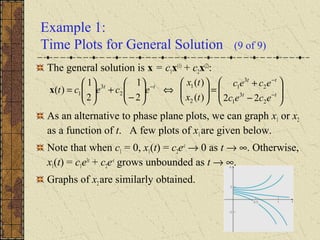
As an alternative to phase plane plots, we can graph x1 or x2
as a function of t. A few plots of x1are given below.
Note that when c1 = 0, x1(t) = c2e-t
→ 0 as t → ∞. Otherwise,
x1(t) = c1e3t
+ c2e-t
grows unbounded as t → ∞.
Graphs of x2are similarly obtained.








−
+
=





⇔





−
+





= −
−
−
tt
tt
tt
ecec
ecec
tx
tx
ecect
2
3
1
2
3
1
2
1
2
3
1
22)(
)(
2
1
2
1
)(x
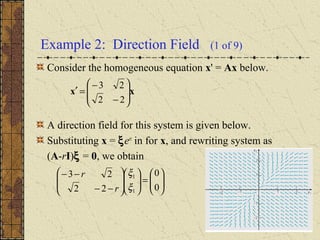
Example 2: Direction Field (1 of 9)
Consider the homogeneous equation x' = Ax below.
A direction field for this system is given below.
Substituting x = ξert
in for x, and rewriting system as
(A-rI)ξ = 0, we obtain
xx 







−
−
=′
22
23






=













−−
−−
0
0
22
23
1
1
ξ
ξ
r
r
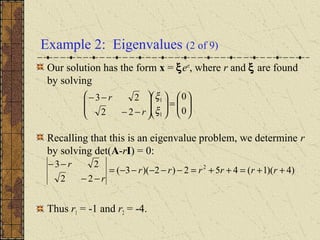
Example 2: Eigenvalues (2 of 9)
Our solution has the form x = ξert
, where r and ξ are found
by solving
Recalling that this is an eigenvalue problem, we determine r
by solving det(A-rI) = 0:
Thus r1 = -1 and r2 = -4.
)4)(1(452)2)(3(
22
23 2
++=++=−−−−−=
−−
−−
rrrrrr
r
r






=













−−
−−
0
0
22
23
1
1
ξ
ξ
r
r
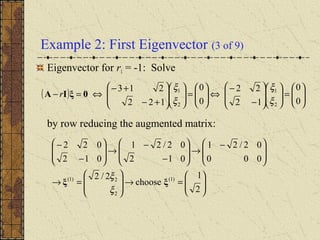
Example 2: First Eigenvector (3 of 9)
Eigenvector for r1 = -1: Solve
by row reducing the augmented matrix:
( ) 





=













−
−
⇔





=













+−
+−
⇔=−
0
0
12
22
0
0
122
213
2
1
2
1
ξ
ξ
ξ
ξ
0ξIA r






=→







=→







 −
→







−
−
→







−
−
2
1
choose
2/2
000
02/21
012
02/21
012
022
)1(
2
2)1(
ξξ
ξ
ξ
Example 2: Second Eigenvector (4 of 9)
Eigenvector for r2 = -4: Solve
by row reducing the augmented matrix:
( ) 





=













⇔





=













+−
+−
⇔=−
0
0
22
21
0
0
422
243
2
1
2
1
ξ
ξ
ξ
ξ
0ξIA r







−
=→







−
=→







→







1
2
choose
2
000
021
022
021
)2(
2
2)2(
ξ
ξ
ξ
ξ
Example 2: General Solution (5 of 9)
The corresponding solutions x = ξert
of x' = Ax are
The Wronskian of these two solutions is
Thus x(1)
and x(2)
are fundamental solutions, and the general
solution of x' = Ax is
tt
etet 4)2()1(
1
2
)(,
2
1
)( −−







−
=





= xx
[ ] 03
2
2
)(, 5
4
4
)2()1(
≠=
−
= −
−−
−−
t
tt
tt
e
ee
ee
tW xx
tt
ecec
tctct
4
21
)2(
2
)1(
1
1
2
2
1
)()()(
−−







−
+





=
+= xxx
Example 2: Phase Plane for x(1)
(6 of 9)
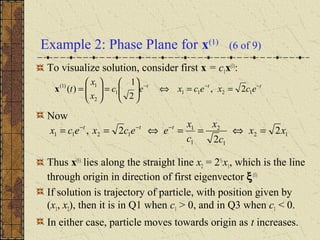
To visualize solution, consider first x = c1x(1)
:
Now
Thus x(1)
lies along the straight line x2 = 2½
x1, which is the line
through origin in direction of first eigenvector ξ(1)
If solution is trajectory of particle, with position given by
(x1, x2), then it is in Q1 when c1 > 0, and in Q3 when c1 < 0.
In either case, particle moves towards origin as t increases.
ttt
ecxecxec
x
x
t −−−
==⇔





=





= 12111
2
1)1(
2,
2
1
)(x
12
1
2
1
1
1211 2
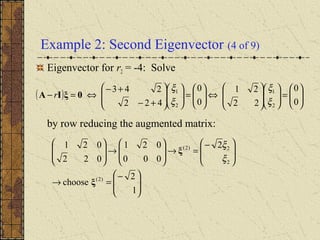
2
2, xx
c
x
c
x
eecxecx ttt
=⇔==⇔== −−−
Example 2: Phase Plane for x(2)
(7 of 9)
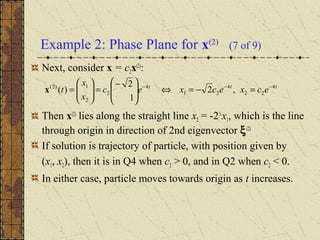
Next, consider x = c2x(2)
:
Then x(2)
lies along the straight line x2 = -2½
x1, which is the line
through origin in direction of 2nd eigenvector ξ(2)
If solution is trajectory of particle, with position given by
(x1, x2), then it is in Q4 when c2 > 0, and in Q2 when c2 < 0.
In either case, particle moves towards origin as t increases.
ttt
ecxecxec
x
x
t 4
22
4
21
4
2
2
1)2(
,2
1
2
)( −−−
=−=⇔






−
=





=x
Example 2:
Phase Plane for General Solution (8 of 9)
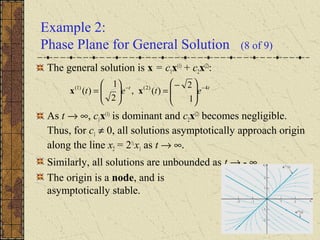
The general solution is x = c1x(1)
+ c2x(2)
:
As t → ∞, c1x(1)
is dominant and c2x(2)
becomes negligible.
Thus, for c1 ≠ 0, all solutions asymptotically approach origin
along the line x2 = 2½
x1 as t → ∞.
Similarly, all solutions are unbounded as t → - ∞.
The origin is a node, and is
asymptotically stable.
tt
etet 4)2()1(
1
2
)(,
2
1
)( −−







−
=





= xx
Example 2:
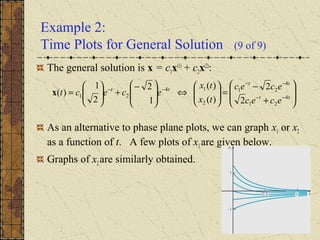
Time Plots for General Solution (9 of 9)
The general solution is x = c1x(1)
+ c2x(2)
:
As an alternative to phase plane plots, we can graph x1 or x2
as a function of t. A few plots of x1are given below.
Graphs of x2are similarly obtained.








+
−
=





⇔






−
+





= −−
−−
−−
tt
tt
tt
ecec
ecec
tx
tx
ecect 4
21
4
21
2
14
21
2
2
)(
)(
1
2
2
1
)(x
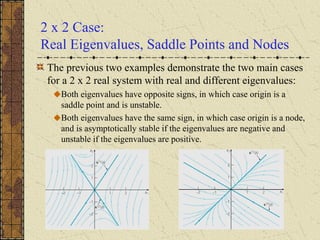
2 x 2 Case:
Real Eigenvalues, Saddle Points and Nodes
The previous two examples demonstrate the two main cases
for a 2 x 2 real system with real and different eigenvalues:
Both eigenvalues have opposite signs, in which case origin is a
saddle point and is unstable.
Both eigenvalues have the same sign, in which case origin is a node,
and is asymptotically stable if the eigenvalues are negative and
unstable if the eigenvalues are positive.
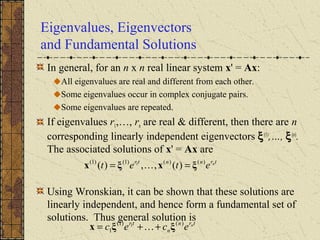
Eigenvalues, Eigenvectors
and Fundamental Solutions
In general, for an n x n real linear system x' = Ax:
All eigenvalues are real and different from each other.
Some eigenvalues occur in complex conjugate pairs.
Some eigenvalues are repeated.
If eigenvalues r1,…, rn are real & different, then there are n
corresponding linearly independent eigenvectors ξ(1)
,…, ξ(n)
.
The associated solutions of x' = Ax are
Using Wronskian, it can be shown that these solutions are
linearly independent, and hence form a fundamental set of
solutions. Thus general solution is
trnntr n
etet )()()1()1(
)(,,)( 1
ξxξx == 
trn
n
tr n
ecec )()1(
1
1
ξξx ++= 
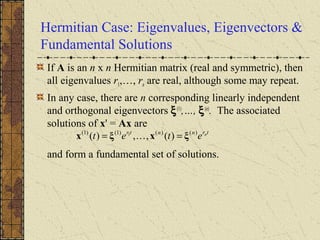
Hermitian Case: Eigenvalues, Eigenvectors &
Fundamental Solutions
If A is an n x n Hermitian matrix (real and symmetric), then
all eigenvalues r1,…, rn are real, although some may repeat.
In any case, there are n corresponding linearly independent
and orthogonal eigenvectors ξ(1)
,…, ξ(n)
. The associated
solutions of x' = Ax are
and form a fundamental set of solutions.
trnntr n
etet )()()1()1(
)(,,)( 1
ξxξx == 
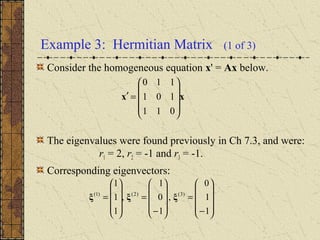
Example 3: Hermitian Matrix (1 of 3)
Consider the homogeneous equation x' = Ax below.
The eigenvalues were found previously in Ch 7.3, and were:
r1 = 2, r2 = -1 and r3 = -1.
Corresponding eigenvectors:
xx










=′
011
101
110










−
=










−
=










=
1
1
0
,
1
0
1
,
1
1
1
)3()2()1(
ξξξ
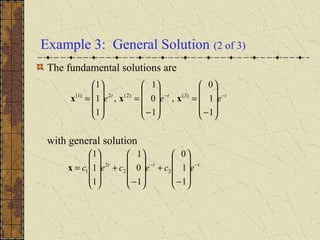
Example 3: General Solution (2 of 3)
The fundamental solutions are
with general solution
ttt
eee −−










−
=










−
=










=
1
1
0
,
1
0
1
,
1
1
1
)3()2(2)1(
xxx
ttt
ececec −−










−
+










−
+










=
1
1
0
1
0
1
1
1
1
32
2
1x
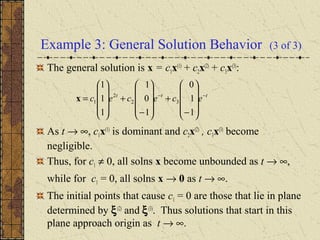
Example 3: General Solution Behavior (3 of 3)
The general solution is x = c1x(1)
+ c2x(2)
+ c3x(3)
:
As t → ∞, c1x(1)
is dominant and c2x(2)
, c3x(3)
become
negligible.
Thus, for c1 ≠ 0, all solns x become unbounded as t → ∞,
while for c1 = 0, all solns x → 0 as t → ∞.
The initial points that cause c1 = 0 are those that lie in plane
determined by ξ(2)
and ξ(3)
. Thus solutions that start in this
plane approach origin as t → ∞.
ttt
ececec −−










−
+










−
+










=
1
1
0
1
0
1
1
1
1
32
2
1x
Complex Eigenvalues and Fundamental Solns
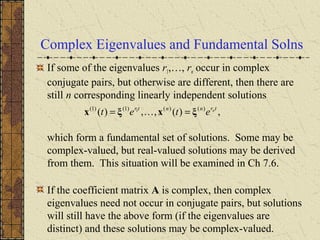
If some of the eigenvalues r1,…, rn occur in complex
conjugate pairs, but otherwise are different, then there are
still n corresponding linearly independent solutions
which form a fundamental set of solutions. Some may be
complex-valued, but real-valued solutions may be derived
from them. This situation will be examined in Ch 7.6.
If the coefficient matrix A is complex, then complex
eigenvalues need not occur in conjugate pairs, but solutions
will still have the above form (if the eigenvalues are
distinct) and these solutions may be complex-valued.
,)(,,)( )()()1()1( 1 trnntr n
etet ξxξx == 
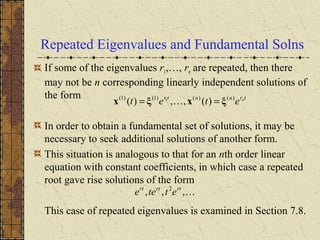
Repeated Eigenvalues and Fundamental Solns
If some of the eigenvalues r1,…, rn are repeated, then there
may not be n corresponding linearly independent solutions of
the form
In order to obtain a fundamental set of solutions, it may be
necessary to seek additional solutions of another form.
This situation is analogous to that for an nth order linear
equation with constant coefficients, in which case a repeated
root gave rise solutions of the form
This case of repeated eigenvalues is examined in Section 7.8.
trnntr n
etet )()()1()1(
)(,,)( 1
ξxξx == 
,,, 2 rtrtrt
ettee

Ch07 5

  • 1.
    Ch 7.5: HomogeneousLinear Systems with Constant Coefficients We consider here a homogeneous system of n first order linear equations with constant, real coefficients: This system can be written as x' = Ax, where nnnnnn nn nn xaxaxax xaxaxax xaxaxax +++=′ +++=′ +++=′     2211 22221212 12121111               =               = nnnn n n m aaa aaa aaa tx tx tx t      21 22221 11211 2 1 , )( )( )( )( Ax
  • 2.
    Equilibrium Solutions Note thatif n = 1, then the system reduces to Recall that x = 0 is the only equilibrium solution if a ≠ 0. Further, x = 0 is an asymptotically stable solution if a < 0, since other solutions approach x = 0 in this case. Also, x = 0 is an unstable solution if a > 0, since other solutions depart from x = 0 in this case. For n > 1, equilibrium solutions are similarly found by solving Ax = 0. We assume detA ≠ 0, so that x = 0 is the only solution. Determining whether x = 0 is asymptotically stable or unstable is an important question here as well. at etxaxx =⇒=′ )(
  • 3.
    Phase Plane When n= 2, then the system reduces to This case can be visualized in the x1x2-plane, which is called the phase plane. In the phase plane, a direction field can be obtained by evaluating Ax at many points and plotting the resulting vectors, which will be tangent to solution vectors. A plot that shows representative solution trajectories is called a phase portrait. Examples of phase planes, directions fields and phase portraits will be given later in this section. 2221212 2121111 xaxax xaxax +=′ +=′
  • 4.
    Solving Homogeneous System Toconstruct a general solution to x' = Ax, assume a solution of the form x = ξert , where the exponent r and the constant vector ξ are to be determined. Substituting x = ξert into x' = Ax, we obtain Thus to solve the homogeneous system of differential equations x' = Ax, we must find the eigenvalues and eigenvectors of A. Therefore x = ξert is a solution of x' = Ax provided that r is an eigenvalue and ξ is an eigenvector of the coefficient matrix A. ( ) 0ξIAAξξAξξ =−⇔=⇔= rreer rtrt
  • 5.
    Example 1: DirectionField (1 of 9) Consider the homogeneous equation x' = Ax below. A direction field for this system is given below. Substituting x = ξert in for x, and rewriting system as (A-rI)ξ = 0, we obtain xx       =′ 14 11       =            − − 0 0 14 11 1 1 ξ ξ r r
  • 6.
    Example 1: Eigenvalues(2 of 9) Our solution has the form x = ξert , where r and ξ are found by solving Recalling that this is an eigenvalue problem, we determine r by solving det(A-rI) = 0: Thus r1 = 3 and r2 = -1.       =            − − 0 0 14 11 1 1 ξ ξ r r )1)(3(324)1( 14 11 22 +−=−−=−−= − − rrrrr r r
  • 7.
    Example 1: FirstEigenvector (3 of 9) Eigenvector for r1 = 3: Solve by row reducing the augmented matrix: ( )       =            − − ⇔      =            − − ⇔=− 0 0 24 12 0 0 314 131 2 1 2 1 ξ ξ ξ ξ 0ξIA r       =→      =      =→ = =− →      − →      − − →      − − 2 1 choosearbitrary, 1 2/12/1 00 02/11 000 02/11 024 02/11 024 012 )1( 2 2)1( 2 21 ξξ cc ξ ξ ξ ξξ
  • 8.
    Example 1: SecondEigenvector (4 of 9) Eigenvector for r2 = -1: Solve by row reducing the augmented matrix: ( )       =            ⇔      =            + + ⇔=− 0 0 24 12 0 0 114 111 2 1 2 1 ξ ξ ξ ξ 0ξIA r       − =→     − =     − =→ = =+ →      →      →      2 1 choosearbitrary, 1 2/12/1 00 02/11 000 02/11 024 02/11 024 012 )2( 2 2)2( 2 21 ξξ cc ξ ξ ξ ξξ
  • 9.
    Example 1: GeneralSolution (5 of 9) The corresponding solutions x = ξert of x' = Ax are The Wronskian of these two solutions is Thus x(1) and x(2) are fundamental solutions, and the general solution of x' = Ax is tt etet −       − =      = 2 1 )(, 2 1 )( )2(3)1( xx [ ] 04 22 )(, 2 3 3 )2()1( ≠−= − = − − − t tt tt e ee ee tW xx tt ecec tctct −       − +      = += 2 1 2 1 )()()( 2 3 1 )2( 2 )1( 1 xxx
  • 10.
    Example 1: PhasePlane for x(1) (6 of 9) To visualize solution, consider first x = c1x(1) : Now Thus x(1) lies along the straight line x2 = 2x1, which is the line through origin in direction of first eigenvector ξ(1) If solution is trajectory of particle, with position given by (x1, x2), then it is in Q1 when c1 > 0, and in Q3 when c1 < 0. In either case, particle moves away from origin as t increases. ttt ecxecxec x x t 3 12 3 11 3 1 2 1)1( 2, 2 1 )( ==⇔      =      =x 12 1 2 1 133 12 3 11 2 2 2, xx c x c x eecxecx ttt =⇔==⇔==
  • 11.
    Example 1: PhasePlane for x(2) (7 of 9) Next, consider x = c2x(2) : Then x(2) lies along the straight line x2 = -2x1, which is the line through origin in direction of 2nd eigenvector ξ(2) If solution is trajectory of particle, with position given by (x1, x2), then it is in Q4 when c2 > 0, and in Q2 when c2 < 0. In either case, particle moves towards origin as t increases. ttt ecxecxec x x t −−− −==⇔      − =      = 22212 2 1)2( 2, 2 1 )(x
  • 12.
    Example 1: Phase Planefor General Solution (8 of 9) The general solution is x = c1x(1) + c2x(2) : As t → ∞, c1x(1) is dominant and c2x(2) becomes negligible. Thus, for c1 ≠ 0, all solutions asymptotically approach the line x2 = 2x1 as t → ∞. Similarly, for c2 ≠ 0, all solutions asymptotically approach the line x2 = -2x1 as t → - ∞. The origin is a saddle point, and is unstable. See graph. tt ecect −       − +      = 2 1 2 1 )( 2 3 1x
  • 13.
    Example 1: Time Plotsfor General Solution (9 of 9) The general solution is x = c1x(1) + c2x(2) : As an alternative to phase plane plots, we can graph x1 or x2 as a function of t. A few plots of x1are given below. Note that when c1 = 0, x1(t) = c2e-t → 0 as t → ∞. Otherwise, x1(t) = c1e3t + c2e-t grows unbounded as t → ∞. Graphs of x2are similarly obtained.         − + =      ⇔      − +      = − − − tt tt tt ecec ecec tx tx ecect 2 3 1 2 3 1 2 1 2 3 1 22)( )( 2 1 2 1 )(x
  • 14.
    Example 2: DirectionField (1 of 9) Consider the homogeneous equation x' = Ax below. A direction field for this system is given below. Substituting x = ξert in for x, and rewriting system as (A-rI)ξ = 0, we obtain xx         − − =′ 22 23       =              −− −− 0 0 22 23 1 1 ξ ξ r r
  • 15.
    Example 2: Eigenvalues(2 of 9) Our solution has the form x = ξert , where r and ξ are found by solving Recalling that this is an eigenvalue problem, we determine r by solving det(A-rI) = 0: Thus r1 = -1 and r2 = -4. )4)(1(452)2)(3( 22 23 2 ++=++=−−−−−= −− −− rrrrrr r r       =              −− −− 0 0 22 23 1 1 ξ ξ r r
  • 16.
    Example 2: FirstEigenvector (3 of 9) Eigenvector for r1 = -1: Solve by row reducing the augmented matrix: ( )       =              − − ⇔      =              +− +− ⇔=− 0 0 12 22 0 0 122 213 2 1 2 1 ξ ξ ξ ξ 0ξIA r       =→        =→         − →        − − →        − − 2 1 choose 2/2 000 02/21 012 02/21 012 022 )1( 2 2)1( ξξ ξ ξ
  • 17.
    Example 2: SecondEigenvector (4 of 9) Eigenvector for r2 = -4: Solve by row reducing the augmented matrix: ( )       =              ⇔      =              +− +− ⇔=− 0 0 22 21 0 0 422 243 2 1 2 1 ξ ξ ξ ξ 0ξIA r        − =→        − =→        →        1 2 choose 2 000 021 022 021 )2( 2 2)2( ξ ξ ξ ξ
  • 18.
    Example 2: GeneralSolution (5 of 9) The corresponding solutions x = ξert of x' = Ax are The Wronskian of these two solutions is Thus x(1) and x(2) are fundamental solutions, and the general solution of x' = Ax is tt etet 4)2()1( 1 2 )(, 2 1 )( −−        − =      = xx [ ] 03 2 2 )(, 5 4 4 )2()1( ≠= − = − −− −− t tt tt e ee ee tW xx tt ecec tctct 4 21 )2( 2 )1( 1 1 2 2 1 )()()( −−        − +      = += xxx
  • 19.
    Example 2: PhasePlane for x(1) (6 of 9) To visualize solution, consider first x = c1x(1) : Now Thus x(1) lies along the straight line x2 = 2½ x1, which is the line through origin in direction of first eigenvector ξ(1) If solution is trajectory of particle, with position given by (x1, x2), then it is in Q1 when c1 > 0, and in Q3 when c1 < 0. In either case, particle moves towards origin as t increases. ttt ecxecxec x x t −−− ==⇔      =      = 12111 2 1)1( 2, 2 1 )(x 12 1 2 1 1 1211 2 2 2, xx c x c x eecxecx ttt =⇔==⇔== −−−
  • 20.
    Example 2: PhasePlane for x(2) (7 of 9) Next, consider x = c2x(2) : Then x(2) lies along the straight line x2 = -2½ x1, which is the line through origin in direction of 2nd eigenvector ξ(2) If solution is trajectory of particle, with position given by (x1, x2), then it is in Q4 when c2 > 0, and in Q2 when c2 < 0. In either case, particle moves towards origin as t increases. ttt ecxecxec x x t 4 22 4 21 4 2 2 1)2( ,2 1 2 )( −−− =−=⇔       − =      =x
  • 21.
    Example 2: Phase Planefor General Solution (8 of 9) The general solution is x = c1x(1) + c2x(2) : As t → ∞, c1x(1) is dominant and c2x(2) becomes negligible. Thus, for c1 ≠ 0, all solutions asymptotically approach origin along the line x2 = 2½ x1 as t → ∞. Similarly, all solutions are unbounded as t → - ∞. The origin is a node, and is asymptotically stable. tt etet 4)2()1( 1 2 )(, 2 1 )( −−        − =      = xx
  • 22.
    Example 2: Time Plotsfor General Solution (9 of 9) The general solution is x = c1x(1) + c2x(2) : As an alternative to phase plane plots, we can graph x1 or x2 as a function of t. A few plots of x1are given below. Graphs of x2are similarly obtained.         + − =      ⇔       − +      = −− −− −− tt tt tt ecec ecec tx tx ecect 4 21 4 21 2 14 21 2 2 )( )( 1 2 2 1 )(x
  • 23.
    2 x 2Case: Real Eigenvalues, Saddle Points and Nodes The previous two examples demonstrate the two main cases for a 2 x 2 real system with real and different eigenvalues: Both eigenvalues have opposite signs, in which case origin is a saddle point and is unstable. Both eigenvalues have the same sign, in which case origin is a node, and is asymptotically stable if the eigenvalues are negative and unstable if the eigenvalues are positive.
  • 24.
    Eigenvalues, Eigenvectors and FundamentalSolutions In general, for an n x n real linear system x' = Ax: All eigenvalues are real and different from each other. Some eigenvalues occur in complex conjugate pairs. Some eigenvalues are repeated. If eigenvalues r1,…, rn are real & different, then there are n corresponding linearly independent eigenvectors ξ(1) ,…, ξ(n) . The associated solutions of x' = Ax are Using Wronskian, it can be shown that these solutions are linearly independent, and hence form a fundamental set of solutions. Thus general solution is trnntr n etet )()()1()1( )(,,)( 1 ξxξx ==  trn n tr n ecec )()1( 1 1 ξξx ++= 
  • 25.
    Hermitian Case: Eigenvalues,Eigenvectors & Fundamental Solutions If A is an n x n Hermitian matrix (real and symmetric), then all eigenvalues r1,…, rn are real, although some may repeat. In any case, there are n corresponding linearly independent and orthogonal eigenvectors ξ(1) ,…, ξ(n) . The associated solutions of x' = Ax are and form a fundamental set of solutions. trnntr n etet )()()1()1( )(,,)( 1 ξxξx == 
  • 26.
    Example 3: HermitianMatrix (1 of 3) Consider the homogeneous equation x' = Ax below. The eigenvalues were found previously in Ch 7.3, and were: r1 = 2, r2 = -1 and r3 = -1. Corresponding eigenvectors: xx           =′ 011 101 110           − =           − =           = 1 1 0 , 1 0 1 , 1 1 1 )3()2()1( ξξξ
  • 27.
    Example 3: GeneralSolution (2 of 3) The fundamental solutions are with general solution ttt eee −−           − =           − =           = 1 1 0 , 1 0 1 , 1 1 1 )3()2(2)1( xxx ttt ececec −−           − +           − +           = 1 1 0 1 0 1 1 1 1 32 2 1x
  • 28.
    Example 3: GeneralSolution Behavior (3 of 3) The general solution is x = c1x(1) + c2x(2) + c3x(3) : As t → ∞, c1x(1) is dominant and c2x(2) , c3x(3) become negligible. Thus, for c1 ≠ 0, all solns x become unbounded as t → ∞, while for c1 = 0, all solns x → 0 as t → ∞. The initial points that cause c1 = 0 are those that lie in plane determined by ξ(2) and ξ(3) . Thus solutions that start in this plane approach origin as t → ∞. ttt ececec −−           − +           − +           = 1 1 0 1 0 1 1 1 1 32 2 1x
  • 29.
    Complex Eigenvalues andFundamental Solns If some of the eigenvalues r1,…, rn occur in complex conjugate pairs, but otherwise are different, then there are still n corresponding linearly independent solutions which form a fundamental set of solutions. Some may be complex-valued, but real-valued solutions may be derived from them. This situation will be examined in Ch 7.6. If the coefficient matrix A is complex, then complex eigenvalues need not occur in conjugate pairs, but solutions will still have the above form (if the eigenvalues are distinct) and these solutions may be complex-valued. ,)(,,)( )()()1()1( 1 trnntr n etet ξxξx == 
  • 30.
    Repeated Eigenvalues andFundamental Solns If some of the eigenvalues r1,…, rn are repeated, then there may not be n corresponding linearly independent solutions of the form In order to obtain a fundamental set of solutions, it may be necessary to seek additional solutions of another form. This situation is analogous to that for an nth order linear equation with constant coefficients, in which case a repeated root gave rise solutions of the form This case of repeated eigenvalues is examined in Section 7.8. trnntr n etet )()()1()1( )(,,)( 1 ξxξx ==  ,,, 2 rtrtrt ettee