Operations Research
“
”
CES Activity On LLP and Transportation
Problems
Made By :- ADITYA ARORA
Roll No. :- 0141mba009
Class :- MBA 3A
Linear Programming
Problems
Graphic Method
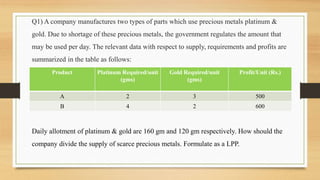
Product Platinum Required/unit
(gms)
Gold Required/unit
(gms)
Profit/Unit (Rs.)
A 2 3 500
B 4 2 600
Q1) A company manufactures two types of parts which use precious metals platinum &
gold. Due to shortage of these precious metals, the government regulates the amount that
may be used per day. The relevant data with respect to supply, requirements and profits are
summarized in the table as follows:
Daily allotment of platinum & gold are 160 gm and 120 gm respectively. How should the
company divide the supply of scarce precious metals. Formulate as a LPP.
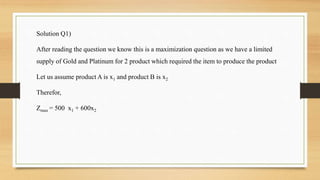
Solution Q1)
After reading the question we know this is a maximization question as we have a limited
supply of Gold and Platinum for 2 product which required the item to produce the product
Let us assume product A is x1 and product B is x2
Therefor,
Zmax = 500 x1 + 600x2
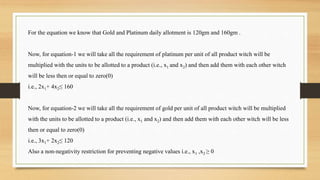
For the equation we know that Gold and Platinum daily allotment is 120gm and 160gm .
Now, for equation-1 we will take all the requirement of platinum per unit of all product witch will be
multiplied with the units to be allotted to a product (i.e., x1 and x2) and then add them with each other witch
will be less then or equal to zero(0)
i.e., 2x1+ 4x2≤ 160
Now, for equation-2 we will take all the requirement of gold per unit of all product witch will be multiplied
with the units to be allotted to a product (i.e., x1 and x2) and then add them with each other witch will be less
then or equal to zero(0)
i.e., 3x1+ 2x2≤ 120
Also a non-negativity restriction for preventing negative values i.e., x1 ,x2 ≥ 0
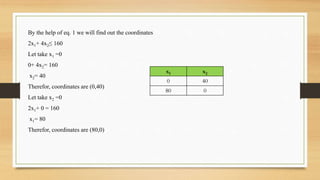
By the help of eq. 1 we will find out the coordinates
2x1+ 4x2≤ 160
Let take x1 =0
0+ 4x2= 160
x2= 40
Therefor, coordinates are (0,40)
Let take x2 =0
2x1+ 0 = 160
x1= 80
Therefor, coordinates are (80,0)
x1 x2
0 40
80 0
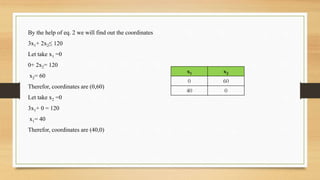
By the help of eq. 2 we will find out the coordinates
3x1+ 2x2≤ 120
Let take x1 =0
0+ 2x2= 120
x2= 60
Therefor, coordinates are (0,60)
Let take x2 =0
3x1+ 0 = 120
x1= 40
Therefor, coordinates are (40,0)
x1 x2
0 60
40 0
0
10
20
30
40
50
60
70
0 10 20 30 40 50 60 70 80 90
A
B
C
FEASIBLE AREA
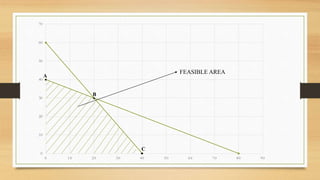
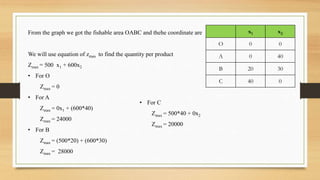
From the graph we got the fishable area OABC and thehe coordinate are
We will use equation of zmax to find the quantity per product
Zmax = 500 x1 + 600x2
• For O
Zmax = 0
• For A
Zmax = 0x1 + (600*40)
Zmax = 24000
• For B
Zmax = (500*20) + (600*30)
Zmax = 28000
x1 x2
O 0 0
A 0 40
B 20 30
C 40 0
• For C
Zmax = 500*40 + 0x2
Zmax = 20000
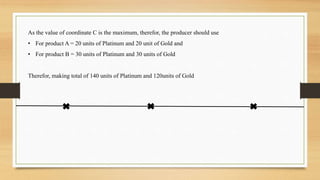
As the value of coordinate C is the maximum, therefor, the producer should use
• For product A = 20 units of Platinum and 20 unit of Gold and
• For product B = 30 units of Platinum and 30 units of Gold
Therefor, making total of 140 units of Platinum and 120units of Gold
Any Questions
Relating To LLP
Transportation Problem
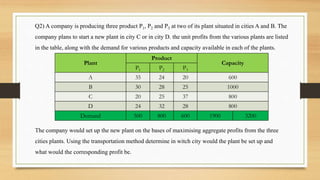
Q2) A company is producing three product P1, P2 and P3 at two of its plant situated in cities A and B. The
company plans to start a new plant in city C or in city D. the unit profits from the various plants are listed
in the table, along with the demand for various products and capacity available in each of the plants.
Plant
Product
Capacity
P1 P2 P3
A 35 24 20 600
B 30 28 25 1000
C 20 25 37 800
D 24 32 28 800
Demand 500 800 600 1900 3200
The company would set up the new plant on the bases of maximising aggregate profits from the three
cities plants. Using the transportation method determine in witch city would the plant be set up and
what would the corresponding profit be.
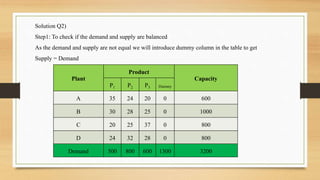
Solution Q2)
Step1: To check if the demand and supply are balanced
As the demand and supply are not equal we will introduce dummy column in the table to get
Supply = Demand
Plant
Product
Capacity
P1 P2 P3 Dummy
A 35 24 20 0 600
B 30 28 25 0 1000
C 20 25 37 0 800
D 24 32 28 0 800
Demand 500 800 600 1300 3200
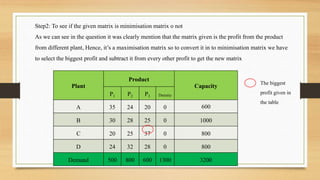
Step2: To see if the given matrix is minimisation matrix o not
As we can see in the question it was clearly mention that the matrix given is the profit from the product
from different plant, Hence, it’s a maximisation matrix so to convert it in to minimisation matrix we have
to select the biggest profit and subtract it from every other profit to get the new matrix
Plant
Product
Capacity
P1 P2 P3 Dummy
A 35 24 20 0 600
B 30 28 25 0 1000
C 20 25 37 0 800
D 24 32 28 0 800
Demand 500 800 600 1300 3200
The biggest
profit given in
the table
Plant
Product
Capacity
P1 P2 P3 Dummy
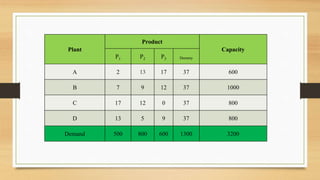
A 2 13 17 37 600
B 7 9 12 37 1000
C 17 12 0 37 800
D 13 5 9 37 800
Demand 500 800 600 1300 3200
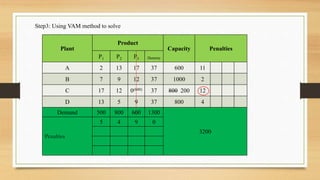
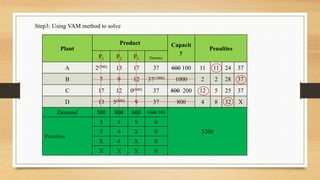
Step3: Using VAM method to solve
Plant
Product
Capacity Penalties
P1 P2 P3 Dummy
A 2 13 17 37 600 11
B 7 9 12 37 1000 2
C 17 12 0(600) 37 800 200 12
D 13 5 9 37 800 4
Demand 500 800 600 1300
3200
Penalties
5 4 9 0
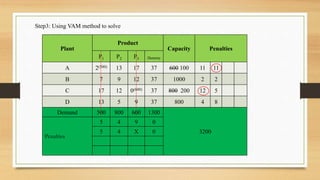
Step3: Using VAM method to solve
Plant
Product
Capacity Penalties
P1 P2 P3 Dummy
A 2(500) 13 17 37 600 100 11 11
B 7 9 12 37 1000 2 2
C 17 12 0(600) 37 800 200 12 5
D 13 5 9 37 800 4 8
Demand 500 800 600 1300
3200
Penalties
5 4 9 0
5 4 X 0
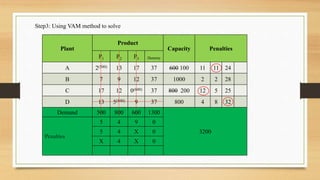
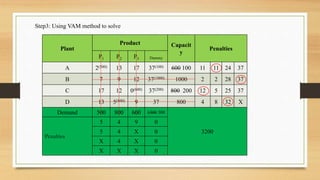
Step3: Using VAM method to solve
Plant
Product
Capacity Penalties
P1 P2 P3 Dummy
A 2(500) 13 17 37 600 100 11 11 24
B 7 9 12 37 1000 2 2 28
C 17 12 0(600) 37 800 200 12 5 25
D 13 5(800) 9 37 800 4 8 32
Demand 500 800 600 1300
3200
Penalties
5 4 9 0
5 4 X 0
X 4 X 0
Step3: Using VAM method to solve
Plant
Product Capacit
y
Penalties
P1 P2 P3 Dummy
A 2(500) 13 17 37 600 100 11 11 24 37
B 7 9 12 37(1000) 1000 2 2 28 37
C 17 12 0(600) 37 800 200 12 5 25 37
D 13 5(800) 9 37 800 4 8 32 X
Demand 500 800 600 1300 300
3200
Penalties
5 4 9 0
5 4 X 0
X 4 X 0
X X X 0
Step3: Using VAM method to solve
Plant
Product Capacit
y
Penalties
P1 P2 P3 Dummy
A 2(500) 13 17 37(100) 600 100 11 11 24 37
B 7 9 12 37(1000) 1000 2 2 28 37
C 17 12 0(600) 37(200) 800 200 12 5 25 37
D 13 5(800) 9 37 800 4 8 32 X
Demand 500 800 600 1300 300
3200
Penalties
5 4 9 0
5 4 X 0
X 4 X 0
X X X 0
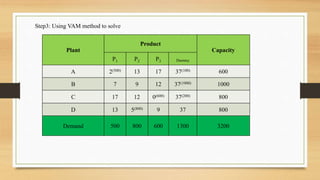
Step3: Using VAM method to solve
Plant
Product
Capacity
P1 P2 P3 Dummy
A 2(500) 13 17 37(100) 600
B 7 9 12 37(1000) 1000
C 17 12 0(600) 37(200) 800
D 13 5(800) 9 37 800
Demand 500 800 600 1300 3200
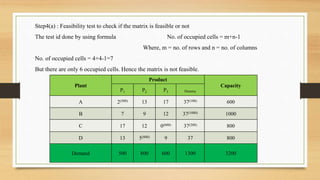
Step4(a) : Feasibility test to check if the matrix is feasible or not
The test id done by using formula No. of occupied cells = m+n-1
Where, m = no. of rows and n = no. of columns
No. of occupied cells = 4+4-1=7
But there are only 6 occupied cells. Hence the matrix is not feasible.
Plant
Product
Capacity
P1 P2 P3 Dummy
A 2(500) 13 17 37(100) 600
B 7 9 12 37(1000) 1000
C 17 12 0(600) 37(200) 800
D 13 5(800) 9 37 800
Demand 500 800 600 1300 3200
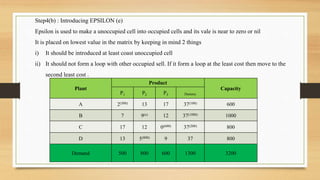
Step4(b) : Introducing EPSILON (e)
Epsilon is used to make a unoccupied cell into occupied cells and its vale is near to zero or nil
It is placed on lowest value in the matrix by keeping in mind 2 things
i) It should be introduced at least coast unoccupied cell
ii) It should not form a loop with other occupied sell. If it form a loop at the least cost then move to the
second least cost .
Plant
Product
Capacity
P1 P2 P3 Dummy
A 2(500) 13 17 37(100) 600
B 7 9(e) 12 37(1000) 1000
C 17 12 0(600) 37(200) 800
D 13 5(800) 9 37 800
Demand 500 800 600 1300 3200
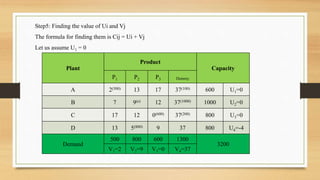
Step5: Finding the value of Ui and Vj
The formula for finding them is Cij = Ui + Vj
Let us assume U1 = 0
Plant
Product
Capacity
P1 P2 P3 Dummy
A 2(500) 13 17 37(100) 600 U1=0
B 7 9(e) 12 37(1000) 1000 U2=0
C 17 12 0(600) 37(200) 800 U3=0
D 13 5(800) 9 37 800 U4=-4
Demand
500 800 600 1300
3200
V1=2 V2=9 V3=0 V4=37
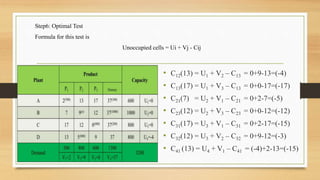
Step6: Optimal Test
Formula for this test is
Unoccupied cells = Ui + Vj - Cij
• C12(13) = U1 + V2 – C13 = 0+9-13=(-4)
• C13(17) = U1 + V3 – C13 = 0+0-17=(-17)
• C21(7) = U2 + V1 – C21 = 0+2-7=(-5)
• C23(12) = U2 + V3 – C23 = 0+0-12=(-12)
• C31(17) = U3 + V1 – C31 = 0+2-17=(-15)
• C32(12) = U3 + V2 – C32 = 0+9-12=(-3)
• C41 (13) = U4 + V1 – C41 = (-4)+2-13=(-15)
Step6: Optimal Test
Formula for this test is
Unoccupied cells = Ui + Vj - Cij
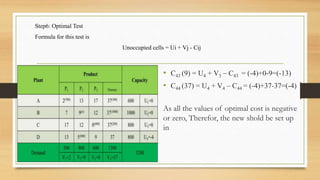
• C43 (9) = U4 + V3 – C43 = (-4)+0-9=(-13)
• C44 (37) = U4 + V4 – C44 = (-4)+37-37=(-4)
As all the values of optimal cost is negative
or zero, Therefor, the new shold be set up
in
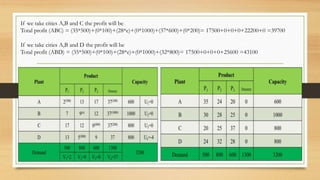
If we take cities A,B and C the profit will be
Total profit (ABC) = (35*500)+(0*100)+(28*e)+(0*1000)+(37*600)+(0*200)= 17500+0+0+0+22200+0 =39700
If we take cities A,B and D the profit will be
Total profit (ABD) = (35*500)+(0*100)+(28*e)+(0*1000)+(32*800)= 17500+0+0+0+25600 =43100
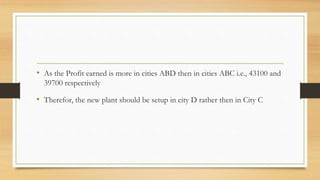
• As the Profit earned is more in cities ABD then in cities ABC i.e., 43100 and
39700 respectively
• Therefor, the new plant should be setup in city D rather then in City C
Thank You
Any Questions

LLP and Transportation problems solution

  • 1.
  • 2.
    “ ” CES Activity OnLLP and Transportation Problems Made By :- ADITYA ARORA Roll No. :- 0141mba009 Class :- MBA 3A
  • 3.
  • 4.
    Product Platinum Required/unit (gms) GoldRequired/unit (gms) Profit/Unit (Rs.) A 2 3 500 B 4 2 600 Q1) A company manufactures two types of parts which use precious metals platinum & gold. Due to shortage of these precious metals, the government regulates the amount that may be used per day. The relevant data with respect to supply, requirements and profits are summarized in the table as follows: Daily allotment of platinum & gold are 160 gm and 120 gm respectively. How should the company divide the supply of scarce precious metals. Formulate as a LPP.
  • 5.
    Solution Q1) After readingthe question we know this is a maximization question as we have a limited supply of Gold and Platinum for 2 product which required the item to produce the product Let us assume product A is x1 and product B is x2 Therefor, Zmax = 500 x1 + 600x2
  • 6.
    For the equationwe know that Gold and Platinum daily allotment is 120gm and 160gm . Now, for equation-1 we will take all the requirement of platinum per unit of all product witch will be multiplied with the units to be allotted to a product (i.e., x1 and x2) and then add them with each other witch will be less then or equal to zero(0) i.e., 2x1+ 4x2≤ 160 Now, for equation-2 we will take all the requirement of gold per unit of all product witch will be multiplied with the units to be allotted to a product (i.e., x1 and x2) and then add them with each other witch will be less then or equal to zero(0) i.e., 3x1+ 2x2≤ 120 Also a non-negativity restriction for preventing negative values i.e., x1 ,x2 ≥ 0
  • 7.
    By the helpof eq. 1 we will find out the coordinates 2x1+ 4x2≤ 160 Let take x1 =0 0+ 4x2= 160 x2= 40 Therefor, coordinates are (0,40) Let take x2 =0 2x1+ 0 = 160 x1= 80 Therefor, coordinates are (80,0) x1 x2 0 40 80 0
  • 8.
    By the helpof eq. 2 we will find out the coordinates 3x1+ 2x2≤ 120 Let take x1 =0 0+ 2x2= 120 x2= 60 Therefor, coordinates are (0,60) Let take x2 =0 3x1+ 0 = 120 x1= 40 Therefor, coordinates are (40,0) x1 x2 0 60 40 0
  • 9.
    0 10 20 30 40 50 60 70 0 10 2030 40 50 60 70 80 90 A B C FEASIBLE AREA
  • 10.
    From the graphwe got the fishable area OABC and thehe coordinate are We will use equation of zmax to find the quantity per product Zmax = 500 x1 + 600x2 • For O Zmax = 0 • For A Zmax = 0x1 + (600*40) Zmax = 24000 • For B Zmax = (500*20) + (600*30) Zmax = 28000 x1 x2 O 0 0 A 0 40 B 20 30 C 40 0 • For C Zmax = 500*40 + 0x2 Zmax = 20000
  • 11.
    As the valueof coordinate C is the maximum, therefor, the producer should use • For product A = 20 units of Platinum and 20 unit of Gold and • For product B = 30 units of Platinum and 30 units of Gold Therefor, making total of 140 units of Platinum and 120units of Gold
  • 12.
  • 13.
  • 14.
    Q2) A companyis producing three product P1, P2 and P3 at two of its plant situated in cities A and B. The company plans to start a new plant in city C or in city D. the unit profits from the various plants are listed in the table, along with the demand for various products and capacity available in each of the plants. Plant Product Capacity P1 P2 P3 A 35 24 20 600 B 30 28 25 1000 C 20 25 37 800 D 24 32 28 800 Demand 500 800 600 1900 3200 The company would set up the new plant on the bases of maximising aggregate profits from the three cities plants. Using the transportation method determine in witch city would the plant be set up and what would the corresponding profit be.
  • 15.
    Solution Q2) Step1: Tocheck if the demand and supply are balanced As the demand and supply are not equal we will introduce dummy column in the table to get Supply = Demand Plant Product Capacity P1 P2 P3 Dummy A 35 24 20 0 600 B 30 28 25 0 1000 C 20 25 37 0 800 D 24 32 28 0 800 Demand 500 800 600 1300 3200
  • 16.
    Step2: To seeif the given matrix is minimisation matrix o not As we can see in the question it was clearly mention that the matrix given is the profit from the product from different plant, Hence, it’s a maximisation matrix so to convert it in to minimisation matrix we have to select the biggest profit and subtract it from every other profit to get the new matrix Plant Product Capacity P1 P2 P3 Dummy A 35 24 20 0 600 B 30 28 25 0 1000 C 20 25 37 0 800 D 24 32 28 0 800 Demand 500 800 600 1300 3200 The biggest profit given in the table
  • 17.
    Plant Product Capacity P1 P2 P3Dummy A 2 13 17 37 600 B 7 9 12 37 1000 C 17 12 0 37 800 D 13 5 9 37 800 Demand 500 800 600 1300 3200
  • 18.
    Step3: Using VAMmethod to solve Plant Product Capacity Penalties P1 P2 P3 Dummy A 2 13 17 37 600 11 B 7 9 12 37 1000 2 C 17 12 0(600) 37 800 200 12 D 13 5 9 37 800 4 Demand 500 800 600 1300 3200 Penalties 5 4 9 0
  • 19.
    Step3: Using VAMmethod to solve Plant Product Capacity Penalties P1 P2 P3 Dummy A 2(500) 13 17 37 600 100 11 11 B 7 9 12 37 1000 2 2 C 17 12 0(600) 37 800 200 12 5 D 13 5 9 37 800 4 8 Demand 500 800 600 1300 3200 Penalties 5 4 9 0 5 4 X 0
  • 20.
    Step3: Using VAMmethod to solve Plant Product Capacity Penalties P1 P2 P3 Dummy A 2(500) 13 17 37 600 100 11 11 24 B 7 9 12 37 1000 2 2 28 C 17 12 0(600) 37 800 200 12 5 25 D 13 5(800) 9 37 800 4 8 32 Demand 500 800 600 1300 3200 Penalties 5 4 9 0 5 4 X 0 X 4 X 0
  • 21.
    Step3: Using VAMmethod to solve Plant Product Capacit y Penalties P1 P2 P3 Dummy A 2(500) 13 17 37 600 100 11 11 24 37 B 7 9 12 37(1000) 1000 2 2 28 37 C 17 12 0(600) 37 800 200 12 5 25 37 D 13 5(800) 9 37 800 4 8 32 X Demand 500 800 600 1300 300 3200 Penalties 5 4 9 0 5 4 X 0 X 4 X 0 X X X 0
  • 22.
    Step3: Using VAMmethod to solve Plant Product Capacit y Penalties P1 P2 P3 Dummy A 2(500) 13 17 37(100) 600 100 11 11 24 37 B 7 9 12 37(1000) 1000 2 2 28 37 C 17 12 0(600) 37(200) 800 200 12 5 25 37 D 13 5(800) 9 37 800 4 8 32 X Demand 500 800 600 1300 300 3200 Penalties 5 4 9 0 5 4 X 0 X 4 X 0 X X X 0
  • 23.
    Step3: Using VAMmethod to solve Plant Product Capacity P1 P2 P3 Dummy A 2(500) 13 17 37(100) 600 B 7 9 12 37(1000) 1000 C 17 12 0(600) 37(200) 800 D 13 5(800) 9 37 800 Demand 500 800 600 1300 3200
  • 24.
    Step4(a) : Feasibilitytest to check if the matrix is feasible or not The test id done by using formula No. of occupied cells = m+n-1 Where, m = no. of rows and n = no. of columns No. of occupied cells = 4+4-1=7 But there are only 6 occupied cells. Hence the matrix is not feasible. Plant Product Capacity P1 P2 P3 Dummy A 2(500) 13 17 37(100) 600 B 7 9 12 37(1000) 1000 C 17 12 0(600) 37(200) 800 D 13 5(800) 9 37 800 Demand 500 800 600 1300 3200
  • 25.
    Step4(b) : IntroducingEPSILON (e) Epsilon is used to make a unoccupied cell into occupied cells and its vale is near to zero or nil It is placed on lowest value in the matrix by keeping in mind 2 things i) It should be introduced at least coast unoccupied cell ii) It should not form a loop with other occupied sell. If it form a loop at the least cost then move to the second least cost . Plant Product Capacity P1 P2 P3 Dummy A 2(500) 13 17 37(100) 600 B 7 9(e) 12 37(1000) 1000 C 17 12 0(600) 37(200) 800 D 13 5(800) 9 37 800 Demand 500 800 600 1300 3200
  • 26.
    Step5: Finding thevalue of Ui and Vj The formula for finding them is Cij = Ui + Vj Let us assume U1 = 0 Plant Product Capacity P1 P2 P3 Dummy A 2(500) 13 17 37(100) 600 U1=0 B 7 9(e) 12 37(1000) 1000 U2=0 C 17 12 0(600) 37(200) 800 U3=0 D 13 5(800) 9 37 800 U4=-4 Demand 500 800 600 1300 3200 V1=2 V2=9 V3=0 V4=37
  • 27.
    Step6: Optimal Test Formulafor this test is Unoccupied cells = Ui + Vj - Cij • C12(13) = U1 + V2 – C13 = 0+9-13=(-4) • C13(17) = U1 + V3 – C13 = 0+0-17=(-17) • C21(7) = U2 + V1 – C21 = 0+2-7=(-5) • C23(12) = U2 + V3 – C23 = 0+0-12=(-12) • C31(17) = U3 + V1 – C31 = 0+2-17=(-15) • C32(12) = U3 + V2 – C32 = 0+9-12=(-3) • C41 (13) = U4 + V1 – C41 = (-4)+2-13=(-15)
  • 28.
    Step6: Optimal Test Formulafor this test is Unoccupied cells = Ui + Vj - Cij • C43 (9) = U4 + V3 – C43 = (-4)+0-9=(-13) • C44 (37) = U4 + V4 – C44 = (-4)+37-37=(-4) As all the values of optimal cost is negative or zero, Therefor, the new shold be set up in
  • 29.
    If we takecities A,B and C the profit will be Total profit (ABC) = (35*500)+(0*100)+(28*e)+(0*1000)+(37*600)+(0*200)= 17500+0+0+0+22200+0 =39700 If we take cities A,B and D the profit will be Total profit (ABD) = (35*500)+(0*100)+(28*e)+(0*1000)+(32*800)= 17500+0+0+0+25600 =43100
  • 30.
    • As theProfit earned is more in cities ABD then in cities ABC i.e., 43100 and 39700 respectively • Therefor, the new plant should be setup in city D rather then in City C
  • 31.