Operations Research
CHAPTER 07 - THE TWO PHASE SIMPLEX METHOD
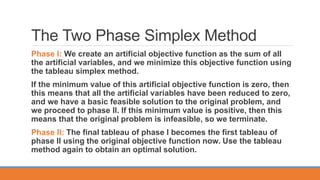
The Two Phase Simplex Method
Phase I: We create an artificial objective function as the sum of all
the artificial variables, and we minimize this objective function using
the tableau simplex method.
If the minimum value of this artificial objective function is zero, then
this means that all the artificial variables have been reduced to zero,
and we have a basic feasible solution to the original problem, and
we proceed to phase II. If this minimum value is positive, then this
means that the original problem is infeasible, so we terminate.
Phase II: The final tableau of phase I becomes the first tableau of
phase II using the original objective function now. Use the tableau
method again to obtain an optimal solution.
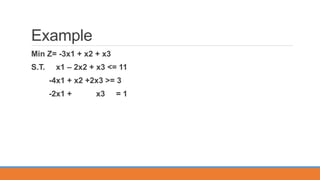
Example
Min Z= -3x1 + x2 + x3
S.T. x1 – 2x2 + x3 <= 11
-4x1 + x2 +2x3 >= 3
-2x1 + x3 = 1
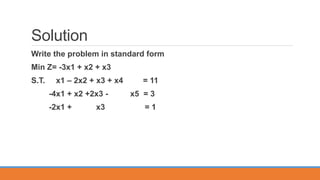
Solution
Write the problem in standard form
Min Z= -3x1 + x2 + x3
S.T. x1 – 2x2 + x3 + x4 = 11
-4x1 + x2 +2x3 - x5 = 3
-2x1 + x3 = 1
Solution
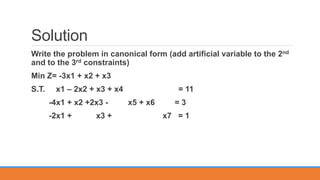
Write the problem in canonical form (add artificial variable to the 2nd
and to the 3rd constraints)
Min Z= -3x1 + x2 + x3
S.T. x1 – 2x2 + x3 + x4 = 11
-4x1 + x2 +2x3 - x5 + x6 = 3
-2x1 + x3 + x7 = 1
Solution
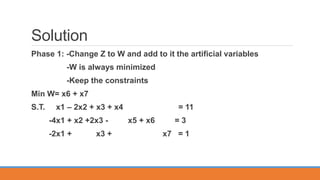
Phase 1: -Change Z to W and add to it the artificial variables
-W is always minimized
-Keep the constraints
Min W= x6 + x7
S.T. x1 – 2x2 + x3 + x4 = 11
-4x1 + x2 +2x3 - x5 + x6 = 3
-2x1 + x3 + x7 = 1
Solution
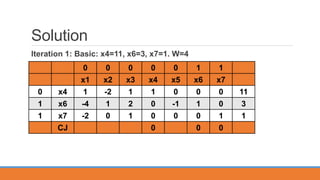
Iteration 1: Basic: x4=11, x6=3, x7=1. W=4
0 0 0 0 0 1 1
x1 x2 x3 x4 x5 x6 x7
0 x4 1 -2 1 1 0 0 0 11
1 x6 -4 1 2 0 -1 1 0 3
1 x7 -2 0 1 0 0 0 1 1
CJ 0 0 0
Solution
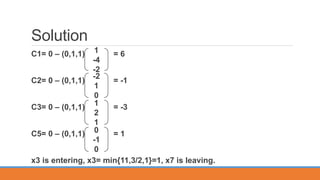
C1= 0 – (0,1,1) = 6
C2= 0 – (0,1,1) = -1
C3= 0 – (0,1,1) = -3
C5= 0 – (0,1,1) = 1
x3 is entering, x3= min{11,3/2,1}=1, x7 is leaving.
1
-4
-2
-2
1
0
1
2
1
0
-1
0
Solution
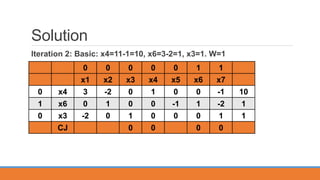
Iteration 2: Basic: x4=11-1=10, x6=3-2=1, x3=1. W=1
0 0 0 0 0 1 1
x1 x2 x3 x4 x5 x6 x7
0 x4 3 -2 0 1 0 0 -1 10
1 x6 0 1 0 0 -1 1 -2 1
0 x3 -2 0 1 0 0 0 1 1
CJ 0 0 0 0
Solution
C1= 0 – (0,1,1) = 0
C2= 0 – (0,1,1) = -1
C5= 0 – (0,1,1) = 1
x2 is entering, x2= min{-5,1,inf.}=1, x6 is leaving.
Basic: x4=12, x2=1, x3=1. W=0 [End of phase 1 because W is zero].
3
0
-2
-2
1
0
0
-1
0
Solution
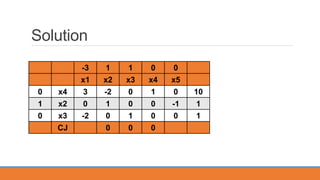
Phase 2: -Change W to Z and remove the artificial variables
-The same last table but remove the artificial variables
columns
Solution
-3 1 1 0 0
x1 x2 x3 x4 x5
0 x4 3 -2 0 1 0 10
1 x2 0 1 0 0 -1 1
0 x3 -2 0 1 0 0 1
CJ 0 0 0
Solution
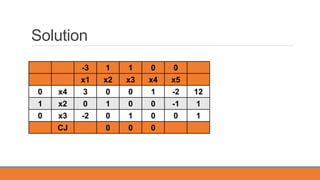
-3 1 1 0 0
x1 x2 x3 x4 x5
0 x4 3 0 0 1 -2 12
1 x2 0 1 0 0 -1 1
0 x3 -2 0 1 0 0 1
CJ 0 0 0
Solution
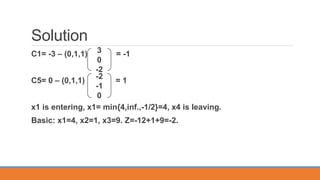
C1= -3 – (0,1,1) = -1
C5= 0 – (0,1,1) = 1
x1 is entering, x1= min{4,inf.,-1/2}=4, x4 is leaving.
Basic: x1=4, x2=1, x3=9. Z=-12+1+9=-2.
3
0
-2
-2
-1
0
Solution
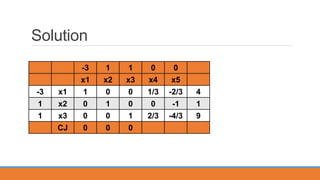
-3 1 1 0 0
x1 x2 x3 x4 x5
-3 x1 1 0 0 1/3 -2/3 4
1 x2 0 1 0 0 -1 1
1 x3 0 0 1 2/3 -4/3 9
CJ 0 0 0
Solution
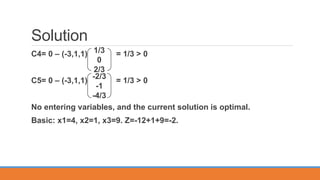
C4= 0 – (-3,1,1) = 1/3 > 0
C5= 0 – (-3,1,1) = 1/3 > 0
No entering variables, and the current solution is optimal.
Basic: x1=4, x2=1, x3=9. Z=-12+1+9=-2.
1/3
0
2/3
-2/3
-1
-4/3

the two phase method - operations research

  • 1.
    Operations Research CHAPTER 07- THE TWO PHASE SIMPLEX METHOD
  • 2.
    The Two PhaseSimplex Method Phase I: We create an artificial objective function as the sum of all the artificial variables, and we minimize this objective function using the tableau simplex method. If the minimum value of this artificial objective function is zero, then this means that all the artificial variables have been reduced to zero, and we have a basic feasible solution to the original problem, and we proceed to phase II. If this minimum value is positive, then this means that the original problem is infeasible, so we terminate. Phase II: The final tableau of phase I becomes the first tableau of phase II using the original objective function now. Use the tableau method again to obtain an optimal solution.
  • 3.
    Example Min Z= -3x1+ x2 + x3 S.T. x1 – 2x2 + x3 <= 11 -4x1 + x2 +2x3 >= 3 -2x1 + x3 = 1
  • 4.
    Solution Write the problemin standard form Min Z= -3x1 + x2 + x3 S.T. x1 – 2x2 + x3 + x4 = 11 -4x1 + x2 +2x3 - x5 = 3 -2x1 + x3 = 1
  • 5.
    Solution Write the problemin canonical form (add artificial variable to the 2nd and to the 3rd constraints) Min Z= -3x1 + x2 + x3 S.T. x1 – 2x2 + x3 + x4 = 11 -4x1 + x2 +2x3 - x5 + x6 = 3 -2x1 + x3 + x7 = 1
  • 6.
    Solution Phase 1: -ChangeZ to W and add to it the artificial variables -W is always minimized -Keep the constraints Min W= x6 + x7 S.T. x1 – 2x2 + x3 + x4 = 11 -4x1 + x2 +2x3 - x5 + x6 = 3 -2x1 + x3 + x7 = 1
  • 7.
    Solution Iteration 1: Basic:x4=11, x6=3, x7=1. W=4 0 0 0 0 0 1 1 x1 x2 x3 x4 x5 x6 x7 0 x4 1 -2 1 1 0 0 0 11 1 x6 -4 1 2 0 -1 1 0 3 1 x7 -2 0 1 0 0 0 1 1 CJ 0 0 0
  • 8.
    Solution C1= 0 –(0,1,1) = 6 C2= 0 – (0,1,1) = -1 C3= 0 – (0,1,1) = -3 C5= 0 – (0,1,1) = 1 x3 is entering, x3= min{11,3/2,1}=1, x7 is leaving. 1 -4 -2 -2 1 0 1 2 1 0 -1 0
  • 9.
    Solution Iteration 2: Basic:x4=11-1=10, x6=3-2=1, x3=1. W=1 0 0 0 0 0 1 1 x1 x2 x3 x4 x5 x6 x7 0 x4 3 -2 0 1 0 0 -1 10 1 x6 0 1 0 0 -1 1 -2 1 0 x3 -2 0 1 0 0 0 1 1 CJ 0 0 0 0
  • 10.
    Solution C1= 0 –(0,1,1) = 0 C2= 0 – (0,1,1) = -1 C5= 0 – (0,1,1) = 1 x2 is entering, x2= min{-5,1,inf.}=1, x6 is leaving. Basic: x4=12, x2=1, x3=1. W=0 [End of phase 1 because W is zero]. 3 0 -2 -2 1 0 0 -1 0
  • 11.
    Solution Phase 2: -ChangeW to Z and remove the artificial variables -The same last table but remove the artificial variables columns
  • 12.
    Solution -3 1 10 0 x1 x2 x3 x4 x5 0 x4 3 -2 0 1 0 10 1 x2 0 1 0 0 -1 1 0 x3 -2 0 1 0 0 1 CJ 0 0 0
  • 13.
    Solution -3 1 10 0 x1 x2 x3 x4 x5 0 x4 3 0 0 1 -2 12 1 x2 0 1 0 0 -1 1 0 x3 -2 0 1 0 0 1 CJ 0 0 0
  • 14.
    Solution C1= -3 –(0,1,1) = -1 C5= 0 – (0,1,1) = 1 x1 is entering, x1= min{4,inf.,-1/2}=4, x4 is leaving. Basic: x1=4, x2=1, x3=9. Z=-12+1+9=-2. 3 0 -2 -2 -1 0
  • 15.
    Solution -3 1 10 0 x1 x2 x3 x4 x5 -3 x1 1 0 0 1/3 -2/3 4 1 x2 0 1 0 0 -1 1 1 x3 0 0 1 2/3 -4/3 9 CJ 0 0 0
  • 16.
    Solution C4= 0 –(-3,1,1) = 1/3 > 0 C5= 0 – (-3,1,1) = 1/3 > 0 No entering variables, and the current solution is optimal. Basic: x1=4, x2=1, x3=9. Z=-12+1+9=-2. 1/3 0 2/3 -2/3 -1 -4/3