CENTRIFUGATION
SUBMITTED BY-
1.Marzeea Ahmad Raka
2.Mir Tasnia Noshin
3.Suraiya Ahmed
4.Isfat Hasan Tomal
5.Nusrat Alam Mou
6.Atikur Rahman Nyeem
CONTENTS
 Definition of centrifugation
 History
 Principle of centrifugation
 Classification
 Operation
 Construction
 Application in Pharmaceutical industry
 Advantages & disadvantages
 Safety measures
 importance
 Summary
WHAT IS CENTRIFUGATION?
Centrifugation is one of the most important and widely applied
research cellular techniques in bio-chemistry and molecular biology,
pharmacy and in medicine.
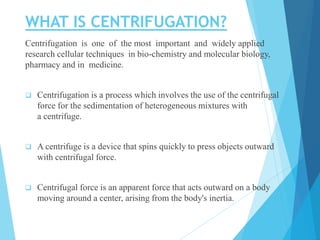
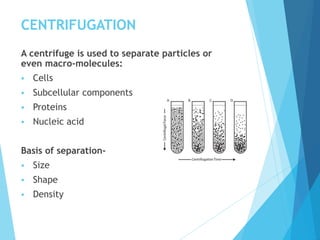
 Centrifugation is a process which involves the use of the centrifugal
force for the sedimentation of heterogeneous mixtures with
a centrifuge.
 A centrifuge is a device that spins quickly to press objects outward
with centrifugal force.
 Centrifugal force is an apparent force that acts outward on a body
moving around a center, arising from the body's inertia.
CENTRIFUGATION
A centrifuge is used to separate particles or
even macro-molecules:
 Cells
 Subcellular components
 Proteins
 Nucleic acid
Basis of separation-
 Size
 Shape
 Density
HISTORY
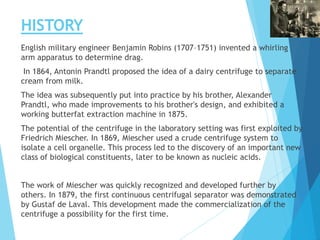
English military engineer Benjamin Robins (1707–1751) invented a whirling
arm apparatus to determine drag.
In 1864, Antonin Prandtl proposed the idea of a dairy centrifuge to separate
cream from milk.
The idea was subsequently put into practice by his brother, Alexander
Prandtl, who made improvements to his brother's design, and exhibited a
working butterfat extraction machine in 1875.
The potential of the centrifuge in the laboratory setting was first exploited by
Friedrich Miescher. In 1869, Miescher used a crude centrifuge system to
isolate a cell organelle. This process led to the discovery of an important new
class of biological constituents, later to be known as nucleic acids.
The work of Miescher was quickly recognized and developed further by
others. In 1879, the first continuous centrifugal separator was demonstrated
by Gustaf de Laval. This development made the commercialization of the
centrifuge a possibility for the first time.
PRINCIPLE OF CENTRIFUGATION
Methodology-
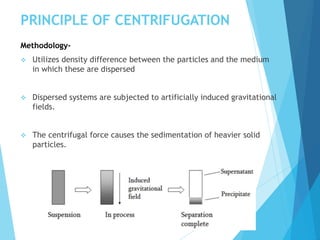
 Utilizes density difference between the particles and the medium
in which these are dispersed
 Dispersed systems are subjected to artificially induced gravitational
fields.
 The centrifugal force causes the sedimentation of heavier solid
particles.
PRINCIPLE OF CENTRIFUGATION
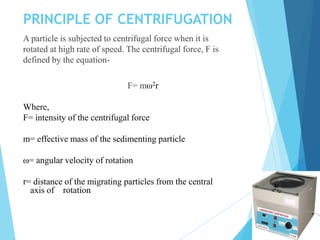
A particle is subjected to centrifugal force when it is
rotated at high rate of speed. The centrifugal force, F is
defined by the equation-
F= mω2r
Where,
F= intensity of the centrifugal force
m= effective mass of the sedimenting particle
ω= angular velocity of rotation
r= distance of the migrating particles from the central
axis of rotation
PRINCIPLE OF CENTRIFUGATION
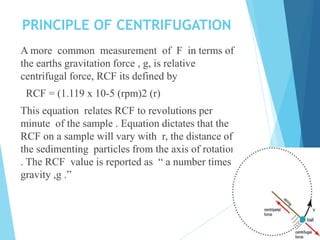
A more common measurement of F in terms of
the earths gravitation force , g, is relative
centrifugal force, RCF its defined by
RCF = (1.119 x 10⁻⁵ (rpm)2 (r)
This equation relates RCF to revolutions per
minute of the sample . Equation dictates that the
RCF on a sample will vary with r, the distance of
the sedimenting particles from the axis of rotation
. The RCF value is reported as “ a number times
gravity ,g .”
CLASSIFICATION OF CENTRIFUGATION
TYPES OF CENTRIFUGATION
Depend on the basis of :
-speed
-temperature
CONTINUED…….
There are various types of
centrifugation:
1.Differential Centrifugation
2. Isopycnic Centrifugation
3. Sucrose Gradient Centrifugation
4. Ultracentrifuges
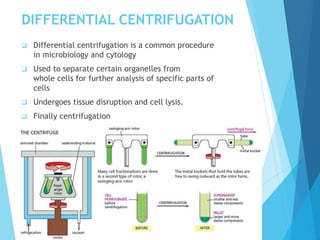
DIFFERENTIAL CENTRIFUGATION
 Differential centrifugation is a common procedure
in microbiology and cytology
 Used to separate certain organelles from
whole cells for further analysis of specific parts of
cells
 Undergoes tissue disruption and cell lysis.
 Finally centrifugation
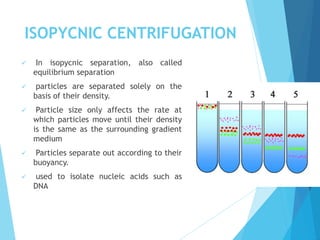
ISOPYCNIC CENTRIFUGATION
 In isopycnic separation, also called
equilibrium separation
 particles are separated solely on the
basis of their density.
 Particle size only affects the rate at
which particles move until their density
is the same as the surrounding gradient
medium
 Particles separate out according to their
buoyancy.
 used to isolate nucleic acids such as
DNA
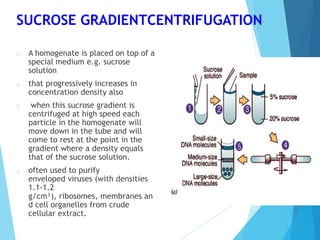
SUCROSE GRADIENTCENTRIFUGATION
o A homogenate is placed on top of a
special medium e.g. sucrose
solution
o that progressively increases in
concentration density also
o when this sucrose gradient is
centrifuged at high speed each
particle in the homogenate will
move down in the tube and will
come to rest at the point in the
gradient where a density equals
that of the sucrose solution.
o often used to purify
enveloped viruses (with densities
1.1-1.2
g/cm³), ribosomes, membranes an
d cell organelles from crude
cellular extract.
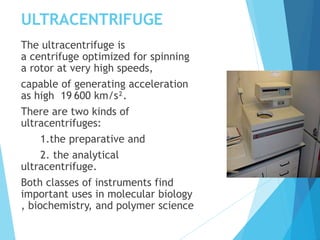
ULTRACENTRIFUGE
The ultracentrifuge is
a centrifuge optimized for spinning
a rotor at very high speeds,
capable of generating acceleration
as high 19 600 km/s².
There are two kinds of
ultracentrifuges:
1.the preparative and
2. the analytical
ultracentrifuge.
Both classes of instruments find
important uses in molecular biology
, biochemistry, and polymer science
LABORATORY CENTRIFUGES
There are different types of laboratory
centrifuges:
 Micro Centrifuges
 Clinical Centrifuges
 Multipurpose High-Speed Centrifuges
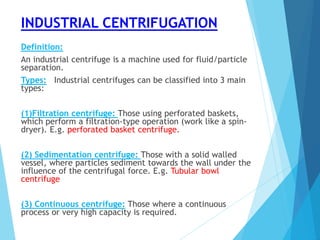
INDUSTRIAL CENTRIFUGATION
Definition:
An industrial centrifuge is a machine used for fluid/particle
separation.
Types: Industrial centrifuges can be classified into 3 main
types:
(1)Filtration centrifuge: Those using perforated baskets,
which perform a filtration-type operation (work like a spin-
dryer). E.g. perforated basket centrifuge.
(2) Sedimentation centrifuge: Those with a solid walled
vessel, where particles sediment towards the wall under the
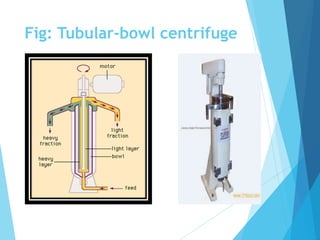
influence of the centrifugal force. E.g. Tubular bowl
centrifuge
(3) Continuous centrifuge: Those where a continuous
process or very high capacity is required.
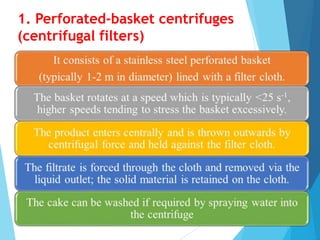
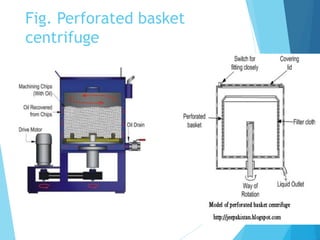
1. Perforated-basket centrifuges
(centrifugal filters)
Fig. Perforated basket
centrifuge
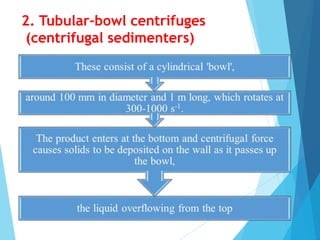
2. Tubular-bowl centrifuges
(centrifugal sedimenters)
Fig: Tubular-bowl centrifuge
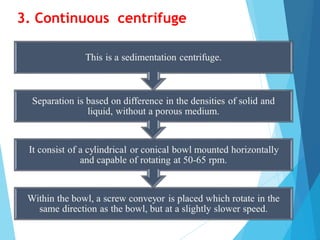
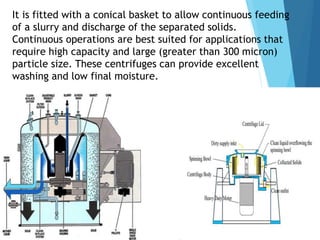
3. Continuous centrifuge
It is fitted with a conical basket to allow continuous feeding
of a slurry and discharge of the separated solids.
Continuous operations are best suited for applications that
require high capacity and large (greater than 300 micron)
particle size. These centrifuges can provide excellent
washing and low final moisture.
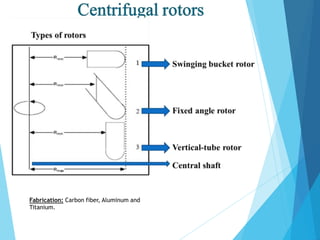
Fabrication: Carbon fiber, Aluminum and
Titanium.
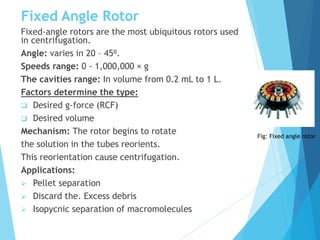
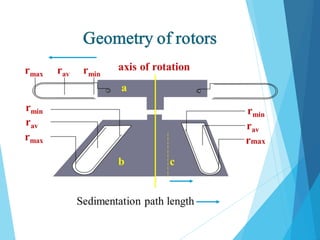
Fixed Angle Rotor
Fixed-angle rotors are the most ubiquitous rotors used
in centrifugation.
Angle: varies in 20 – 45⁰.
Speeds range: 0 - 1,000,000 × g
The cavities range: In volume from 0.2 mL to 1 L.
Factors determine the type:
 Desired g-force (RCF)
 Desired volume
Mechanism: The rotor begins to rotate
the solution in the tubes reorients.
This reorientation cause centrifugation.
Applications:
 Pellet separation
 Discard the. Excess debris
 Isopycnic separation of macromolecules
Fig: Fixed angle rotor
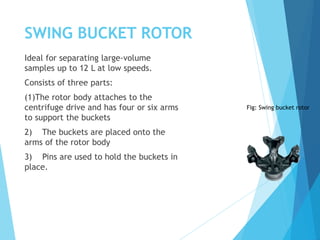
SWING BUCKET ROTOR
Ideal for separating large-volume
samples up to 12 L at low speeds.
Consists of three parts:
(1)The rotor body attaches to the
centrifuge drive and has four or six arms
to support the buckets
2) The buckets are placed onto the
arms of the rotor body
3) Pins are used to hold the buckets in
place.
Fig: Swing bucket rotor
MECHANISM
 Sample tubes are loaded into individual
buckets that hang vertically while the rotor is
at rest.
 When the rotor begins to rotate the buckets
swing out to a horizontal position. The longer
path length permits better separation of
individual particle types from a mixture.
 However, this rotor is relatively inefficient
for pelleting.
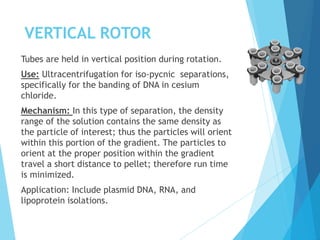
VERTICAL ROTOR
Tubes are held in vertical position during rotation.
Use: Ultracentrifugation for iso-pycnic separations,
specifically for the banding of DNA in cesium
chloride.
Mechanism: In this type of separation, the density
range of the solution contains the same density as
the particle of interest; thus the particles will orient
within this portion of the gradient. The particles to
orient at the proper position within the gradient
travel a short distance to pellet; therefore run time
is minimized.
Application: Include plasmid DNA, RNA, and
lipoprotein isolations.
ROTOR CARE
 Proper rotor care is essential for ensuring safety and
longevity. In addition to reducing the risk of accidents,
regular rotor maintenance can save time and money and
greatly extend rotor life span. All the rotors must be
protected by rinse, disinfectant and must be sterilize.
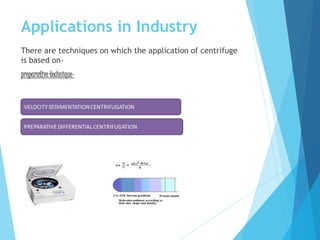
Applications in Industry
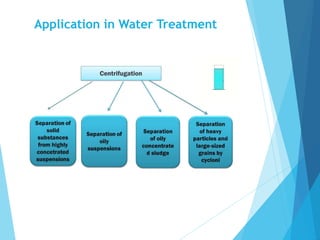
There are techniques on which the application of centrifuge
is based on-
preparative technique-
Application in Water Treatment
Pharmaceutical Industrial
Application
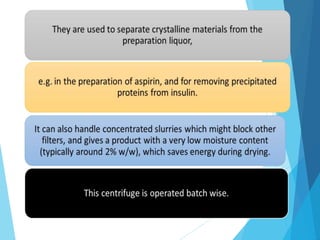
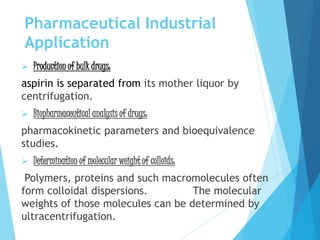
 Production of bulk drugs:
aspirin is separated from its mother liquor by
centrifugation.
 Biopharmaceutical analysis of drugs:
pharmacokinetic parameters and bioequivalence
studies.
 Determination of molecular weight of colloids:
Polymers, proteins and such macromolecules often
form colloidal dispersions. The molecular
weights of those molecules can be determined by
ultracentrifugation.
Pharmaceutical Industrial
Application
 Evaluation of suspensions and emulsions:
Centrifugation method is used as a rapid empirical test
parameter for the evaluation of suspension and emulsion.
 Production of biological products:
a) Separation of blood cells.
b) Purification of insulin by selectively
precipitating other fraction of proteins.
c) Separation of most of the proteinaceous drugs
and macromolecules.
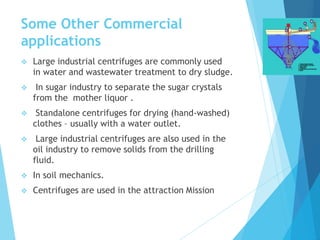
Some Other Commercial
applications
 Large industrial centrifuges are commonly used
in water and wastewater treatment to dry sludge.
 In sugar industry to separate the sugar crystals
from the mother liquor .
 Standalone centrifuges for drying (hand-washed)
clothes – usually with a water outlet.
 Large industrial centrifuges are also used in the
oil industry to remove solids from the drilling
fluid.
 In soil mechanics.
 Centrifuges are used in the attraction Mission
ADVANTAGES AND
DISADVANTAGES:
Advantages:
 Centrifuges have a clean appearance and have little to no odor
problems.
 Not only is the device easy to install and fast at starting up
and shutting down, but also only requires a small area for
operation.
 They can be selected for different applications. .
 The device is simple to operate .
 Centrifuge has more process flexibility and higher levels of
performance.
DISADVANTAGES:
 The machine can be very noisy and can
cause vibration.
 The device has a high-energy consumption
due to high G-forces.
 High initial capital costs
SAFETY MEASURES
 A centrifuge user should strictly observe the following
precautions :
 Manufacturer’s manual should be strictly followed.
 Rotor should be stored in proper containers.
 Attention should be given to imbalance detectors.
 Rotor speed should not exceed the assigned speed.
 Lid of the rotor chamber should remain locked during
operation.
 To avoid the rotor failure, manufactures instructions
regarding rotor care and use should always be
followed.
SUMMARY
 The centrifugation is a modern & easy
technique of separation and sedimentation on
the basis of shape, size and density of
macromolecules and other particles.
 In the centrifugation there are different types
of forces are applied like as centrifugal force,
gravitational force and centripetal force etc.
and also different types of rotors are to be
used that is; Swinging Bucket Rotor and fixed
angle rotors at different RPM/RCF.
IMPORTANCE
Centrifugation play an important
role in both biological sectors as
well as industrial sectors.
In biological sector:
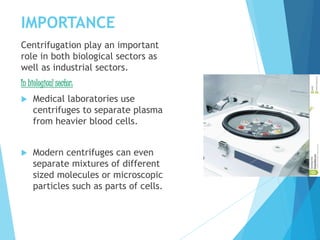
 Medical laboratories use
centrifuges to separate plasma
from heavier blood cells.
 Modern centrifuges can even
separate mixtures of different
sized molecules or microscopic
particles such as parts of cells.
Continued…..
In Industrial Sector:
 Cream separation from milk.
 Separating textiles
 Separating particles from an air flow using
cyclonic separation
 Clarification and stabilization of wine
 Centrifugation is the most common method
used for uranium enrichment.
REFERENCES
http://www.labmanager.com/lab-product/2010/05/evolution-of-the-lab-
centrifuge?fw1pk=2#.Viz08yskqxn
http://www.westernstates.com/continuous-centrifuges
https://en.wikipedia.org/wiki/Centrifuge
https://en.wikipedia.org/wiki/Differential_centrifugation
http://cellbiologyolm.stevegallik.org/node/74
 D. Rickwood and J. M. Graham (2001); Biological Centrifugation,
Springer Verlag; ISBN: 0387915761.
 D. Rickwood, T. Ford, J. Steensgaard (1994): John Wiley & Son Ltd.
ISBN: 0471942715.
 T. C. Ford and J. M. Graham (1991): An Introduction to Centrifugation,
BIOS Scientific Publishers, Ltd. ISBN 1 872748 40 6.
 http://www.thermoscientific.com/content/dam/tfs/LPG/LED/LED%20
Documents/Third-
Party%20Papers/Centrifuges/Centrifuge%20Rotors/Ultracentrifuge%20R
otors/D20940~.pdf
Centrifugation

Centrifugation

  • 1.
    CENTRIFUGATION SUBMITTED BY- 1.Marzeea AhmadRaka 2.Mir Tasnia Noshin 3.Suraiya Ahmed 4.Isfat Hasan Tomal 5.Nusrat Alam Mou 6.Atikur Rahman Nyeem
  • 2.
    CONTENTS  Definition ofcentrifugation  History  Principle of centrifugation  Classification  Operation  Construction  Application in Pharmaceutical industry  Advantages & disadvantages  Safety measures  importance  Summary
  • 3.
    WHAT IS CENTRIFUGATION? Centrifugationis one of the most important and widely applied research cellular techniques in bio-chemistry and molecular biology, pharmacy and in medicine.  Centrifugation is a process which involves the use of the centrifugal force for the sedimentation of heterogeneous mixtures with a centrifuge.  A centrifuge is a device that spins quickly to press objects outward with centrifugal force.  Centrifugal force is an apparent force that acts outward on a body moving around a center, arising from the body's inertia.
  • 4.
    CENTRIFUGATION A centrifuge isused to separate particles or even macro-molecules:  Cells  Subcellular components  Proteins  Nucleic acid Basis of separation-  Size  Shape  Density
  • 5.
    HISTORY English military engineerBenjamin Robins (1707–1751) invented a whirling arm apparatus to determine drag. In 1864, Antonin Prandtl proposed the idea of a dairy centrifuge to separate cream from milk. The idea was subsequently put into practice by his brother, Alexander Prandtl, who made improvements to his brother's design, and exhibited a working butterfat extraction machine in 1875. The potential of the centrifuge in the laboratory setting was first exploited by Friedrich Miescher. In 1869, Miescher used a crude centrifuge system to isolate a cell organelle. This process led to the discovery of an important new class of biological constituents, later to be known as nucleic acids. The work of Miescher was quickly recognized and developed further by others. In 1879, the first continuous centrifugal separator was demonstrated by Gustaf de Laval. This development made the commercialization of the centrifuge a possibility for the first time.
  • 6.
    PRINCIPLE OF CENTRIFUGATION Methodology- Utilizes density difference between the particles and the medium in which these are dispersed  Dispersed systems are subjected to artificially induced gravitational fields.  The centrifugal force causes the sedimentation of heavier solid particles.
  • 7.
    PRINCIPLE OF CENTRIFUGATION Aparticle is subjected to centrifugal force when it is rotated at high rate of speed. The centrifugal force, F is defined by the equation- F= mω2r Where, F= intensity of the centrifugal force m= effective mass of the sedimenting particle ω= angular velocity of rotation r= distance of the migrating particles from the central axis of rotation
  • 8.
    PRINCIPLE OF CENTRIFUGATION Amore common measurement of F in terms of the earths gravitation force , g, is relative centrifugal force, RCF its defined by RCF = (1.119 x 10⁻⁵ (rpm)2 (r) This equation relates RCF to revolutions per minute of the sample . Equation dictates that the RCF on a sample will vary with r, the distance of the sedimenting particles from the axis of rotation . The RCF value is reported as “ a number times gravity ,g .”
  • 9.
  • 10.
    TYPES OF CENTRIFUGATION Dependon the basis of : -speed -temperature
  • 11.
    CONTINUED……. There are varioustypes of centrifugation: 1.Differential Centrifugation 2. Isopycnic Centrifugation 3. Sucrose Gradient Centrifugation 4. Ultracentrifuges
  • 12.
    DIFFERENTIAL CENTRIFUGATION  Differentialcentrifugation is a common procedure in microbiology and cytology  Used to separate certain organelles from whole cells for further analysis of specific parts of cells  Undergoes tissue disruption and cell lysis.  Finally centrifugation
  • 13.
    ISOPYCNIC CENTRIFUGATION  Inisopycnic separation, also called equilibrium separation  particles are separated solely on the basis of their density.  Particle size only affects the rate at which particles move until their density is the same as the surrounding gradient medium  Particles separate out according to their buoyancy.  used to isolate nucleic acids such as DNA
  • 14.
    SUCROSE GRADIENTCENTRIFUGATION o Ahomogenate is placed on top of a special medium e.g. sucrose solution o that progressively increases in concentration density also o when this sucrose gradient is centrifuged at high speed each particle in the homogenate will move down in the tube and will come to rest at the point in the gradient where a density equals that of the sucrose solution. o often used to purify enveloped viruses (with densities 1.1-1.2 g/cm³), ribosomes, membranes an d cell organelles from crude cellular extract.
  • 15.
    ULTRACENTRIFUGE The ultracentrifuge is acentrifuge optimized for spinning a rotor at very high speeds, capable of generating acceleration as high 19 600 km/s². There are two kinds of ultracentrifuges: 1.the preparative and 2. the analytical ultracentrifuge. Both classes of instruments find important uses in molecular biology , biochemistry, and polymer science
  • 16.
    LABORATORY CENTRIFUGES There aredifferent types of laboratory centrifuges:  Micro Centrifuges  Clinical Centrifuges  Multipurpose High-Speed Centrifuges
  • 17.
    INDUSTRIAL CENTRIFUGATION Definition: An industrialcentrifuge is a machine used for fluid/particle separation. Types: Industrial centrifuges can be classified into 3 main types: (1)Filtration centrifuge: Those using perforated baskets, which perform a filtration-type operation (work like a spin- dryer). E.g. perforated basket centrifuge. (2) Sedimentation centrifuge: Those with a solid walled vessel, where particles sediment towards the wall under the influence of the centrifugal force. E.g. Tubular bowl centrifuge (3) Continuous centrifuge: Those where a continuous process or very high capacity is required.
  • 18.
  • 19.
  • 21.
  • 22.
  • 24.
  • 25.
    It is fittedwith a conical basket to allow continuous feeding of a slurry and discharge of the separated solids. Continuous operations are best suited for applications that require high capacity and large (greater than 300 micron) particle size. These centrifuges can provide excellent washing and low final moisture.
  • 26.
    Fabrication: Carbon fiber,Aluminum and Titanium.
  • 27.
    Fixed Angle Rotor Fixed-anglerotors are the most ubiquitous rotors used in centrifugation. Angle: varies in 20 – 45⁰. Speeds range: 0 - 1,000,000 × g The cavities range: In volume from 0.2 mL to 1 L. Factors determine the type:  Desired g-force (RCF)  Desired volume Mechanism: The rotor begins to rotate the solution in the tubes reorients. This reorientation cause centrifugation. Applications:  Pellet separation  Discard the. Excess debris  Isopycnic separation of macromolecules Fig: Fixed angle rotor
  • 28.
    SWING BUCKET ROTOR Idealfor separating large-volume samples up to 12 L at low speeds. Consists of three parts: (1)The rotor body attaches to the centrifuge drive and has four or six arms to support the buckets 2) The buckets are placed onto the arms of the rotor body 3) Pins are used to hold the buckets in place. Fig: Swing bucket rotor
  • 29.
    MECHANISM  Sample tubesare loaded into individual buckets that hang vertically while the rotor is at rest.  When the rotor begins to rotate the buckets swing out to a horizontal position. The longer path length permits better separation of individual particle types from a mixture.  However, this rotor is relatively inefficient for pelleting.
  • 30.
    VERTICAL ROTOR Tubes areheld in vertical position during rotation. Use: Ultracentrifugation for iso-pycnic separations, specifically for the banding of DNA in cesium chloride. Mechanism: In this type of separation, the density range of the solution contains the same density as the particle of interest; thus the particles will orient within this portion of the gradient. The particles to orient at the proper position within the gradient travel a short distance to pellet; therefore run time is minimized. Application: Include plasmid DNA, RNA, and lipoprotein isolations.
  • 32.
    ROTOR CARE  Properrotor care is essential for ensuring safety and longevity. In addition to reducing the risk of accidents, regular rotor maintenance can save time and money and greatly extend rotor life span. All the rotors must be protected by rinse, disinfectant and must be sterilize.
  • 33.
    Applications in Industry Thereare techniques on which the application of centrifuge is based on- preparative technique-
  • 34.
  • 35.
    Pharmaceutical Industrial Application  Productionof bulk drugs: aspirin is separated from its mother liquor by centrifugation.  Biopharmaceutical analysis of drugs: pharmacokinetic parameters and bioequivalence studies.  Determination of molecular weight of colloids: Polymers, proteins and such macromolecules often form colloidal dispersions. The molecular weights of those molecules can be determined by ultracentrifugation.
  • 36.
    Pharmaceutical Industrial Application  Evaluationof suspensions and emulsions: Centrifugation method is used as a rapid empirical test parameter for the evaluation of suspension and emulsion.  Production of biological products: a) Separation of blood cells. b) Purification of insulin by selectively precipitating other fraction of proteins. c) Separation of most of the proteinaceous drugs and macromolecules.
  • 37.
    Some Other Commercial applications Large industrial centrifuges are commonly used in water and wastewater treatment to dry sludge.  In sugar industry to separate the sugar crystals from the mother liquor .  Standalone centrifuges for drying (hand-washed) clothes – usually with a water outlet.  Large industrial centrifuges are also used in the oil industry to remove solids from the drilling fluid.  In soil mechanics.  Centrifuges are used in the attraction Mission
  • 38.
    ADVANTAGES AND DISADVANTAGES: Advantages:  Centrifugeshave a clean appearance and have little to no odor problems.  Not only is the device easy to install and fast at starting up and shutting down, but also only requires a small area for operation.  They can be selected for different applications. .  The device is simple to operate .  Centrifuge has more process flexibility and higher levels of performance.
  • 39.
    DISADVANTAGES:  The machinecan be very noisy and can cause vibration.  The device has a high-energy consumption due to high G-forces.  High initial capital costs
  • 40.
    SAFETY MEASURES  Acentrifuge user should strictly observe the following precautions :  Manufacturer’s manual should be strictly followed.  Rotor should be stored in proper containers.  Attention should be given to imbalance detectors.  Rotor speed should not exceed the assigned speed.  Lid of the rotor chamber should remain locked during operation.  To avoid the rotor failure, manufactures instructions regarding rotor care and use should always be followed.
  • 41.
    SUMMARY  The centrifugationis a modern & easy technique of separation and sedimentation on the basis of shape, size and density of macromolecules and other particles.  In the centrifugation there are different types of forces are applied like as centrifugal force, gravitational force and centripetal force etc. and also different types of rotors are to be used that is; Swinging Bucket Rotor and fixed angle rotors at different RPM/RCF.
  • 42.
    IMPORTANCE Centrifugation play animportant role in both biological sectors as well as industrial sectors. In biological sector:  Medical laboratories use centrifuges to separate plasma from heavier blood cells.  Modern centrifuges can even separate mixtures of different sized molecules or microscopic particles such as parts of cells.
  • 43.
    Continued….. In Industrial Sector: Cream separation from milk.  Separating textiles  Separating particles from an air flow using cyclonic separation  Clarification and stabilization of wine  Centrifugation is the most common method used for uranium enrichment.
  • 44.
    REFERENCES http://www.labmanager.com/lab-product/2010/05/evolution-of-the-lab- centrifuge?fw1pk=2#.Viz08yskqxn http://www.westernstates.com/continuous-centrifuges https://en.wikipedia.org/wiki/Centrifuge https://en.wikipedia.org/wiki/Differential_centrifugation http://cellbiologyolm.stevegallik.org/node/74  D. Rickwoodand J. M. Graham (2001); Biological Centrifugation, Springer Verlag; ISBN: 0387915761.  D. Rickwood, T. Ford, J. Steensgaard (1994): John Wiley & Son Ltd. ISBN: 0471942715.  T. C. Ford and J. M. Graham (1991): An Introduction to Centrifugation, BIOS Scientific Publishers, Ltd. ISBN 1 872748 40 6.  http://www.thermoscientific.com/content/dam/tfs/LPG/LED/LED%20 Documents/Third- Party%20Papers/Centrifuges/Centrifuge%20Rotors/Ultracentrifuge%20R otors/D20940~.pdf