NISHANTKUMAR
M.Sc. (BIOTECHNOLOGY) 1ST
SEMESTER
DEPARTMENT OF
BIOTECHNOLOGY (CAMPUS)
C.C.S. UNIVERSITY, MEERUT
Centrifugation
Introductio
nCentrifugation is the separation technique
commonly used in clinical and research
laboratories.
A centrifugation is a sepration process
which uses the action of centrifugal force
for the sedimentation of heterozygous
mixtures.
More dense components of the mixture
move away from the axis of the centrifuge
Principl
eParticles which differ in density, size or shape,
sediment at different rates in a centrifugal field.
The particles will tend to sediment under the influence
of gravity.
If the particles suspended in a liquid are so small or
have a density so close to that of the liquid, then the
force of gravity fails to sediment the particles into a
separate layer.
So the basis of centrifugation techniques is to exert a
larger force than the gravitational force to enhance
the effective sedimentation force for the separating
Contd
…In centrifugation, the particles are normally
suspended in a specific liquid medium, held in
tubes, which are located in a rotor.
The rotor is positioned centrally on the drive
shaft of the centrifuge.
Particles which differ in density, shape or size
can be separated since they sediment at
different rates in the centrifugal field, each
particle sedimenting at a rate which is
proportional to the applied centrifugal field.
Relative centrifugal force
(RCF)The usual expression of RPM (revolution per minute)
gives only the centrifugation speed and does not
express the centrifugal force.
A better expression of forces generated by centrifuge is
RCF which is calculated by considering the speed of
rotation (RPM), and the radius from the center of
rotation.
RCF is expressed as some number times gravity.
RCF = 42
rev min-1
2
r
3600 x 980g
NOTE: RCF always acts from inward to outward direction.
Centrifug
eThe equipment used to perform
centrifugation is called centrifuge.
The basic centrifuge consists of two
components:
i. Electric motor: with drive shaft to spin the
sample and
ii. Rotor: to hold tubes or other containers of
the sample.
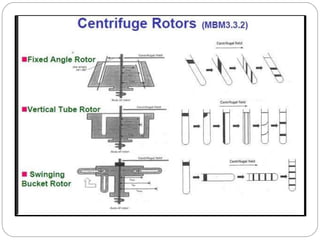
• The rotors can be of three types:
1.Fixed angle rotor
2.Vertical tube rotor
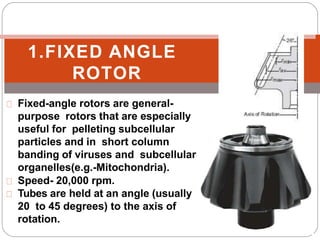
1.FIXED ANGLE
ROTOR
Fixed-angle rotors are general-
purpose rotors that are especially
useful for pelleting subcellular
particles and in short column
banding of viruses and subcellular
organelles(e.g.-Mitochondria).
Speed- 20,000 rpm.
Tubes are held at an angle (usually
20 to 45 degrees) to the axis of
rotation.
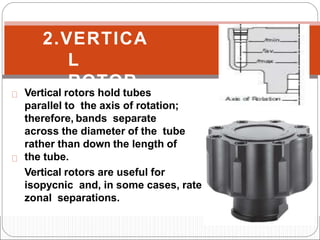
2.VERTICA
L
ROTOR
Vertical rotors hold tubes
parallel to the axis of rotation;
therefore, bands separate
across the diameter of the tube
rather than down the length of
the tube.
Vertical rotors are useful for
isopycnic and, in some cases, rate
zonal separations.
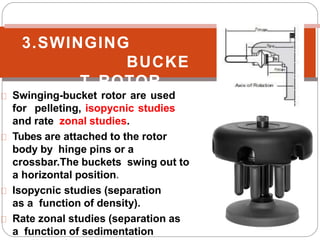
3.SWINGING
BUCKE
T ROTOR
Swinging-bucket rotor are used
for pelleting, isopycnic studies
and rate zonal studies.
Tubes are attached to the rotor
body by hinge pins or a
crossbar.The buckets swing out to
a horizontal position.
Isopycnic studies (separation
as a function of density).
Rate zonal studies (separation as
a function of sedimentation
Rotor
Balance
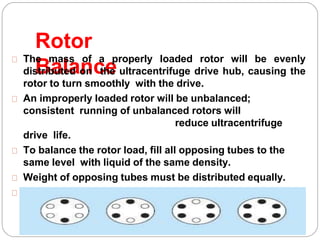
The mass of a properly loaded rotor will be evenly
distributed on the ultracentrifuge drive hub, causing the
rotor to turn smoothly with the drive.
An improperly loaded rotor will be unbalanced;
consistent running of unbalanced rotors will
reduce ultracentrifuge
drive life.
To balance the rotor load, fill all opposing tubes to the
same level with liquid of the same density.
Weight of opposing tubes must be distributed equally.
Place tubes in the rotor symmetrically.
Types of
centrifugation
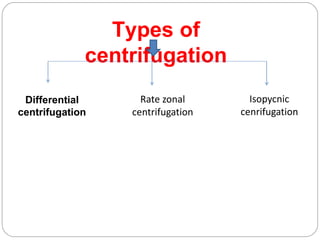
Differential
centrifugation
Rate zonal
centrifugation
Isopycnic
cenrifugation
1.Differential
centrifugation• In differential centrifugation, sepration is achieved on
the basis of size of particles.
•Differential centrifugation is used for the study of
subcellular organelles , tissues or cells and used to
seprate certain organelles from whole cells for further
analysis.
2.Rate zonal
centrifugation
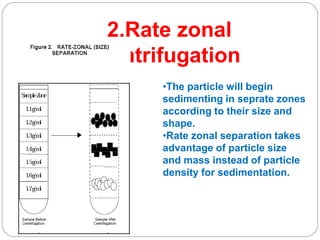
•The particle will begin
sedimenting in seprate zones
according to their size and
shape.
•Rate zonal separation takes
advantage of particle size
and mass instead of particle
density for sedimentation.
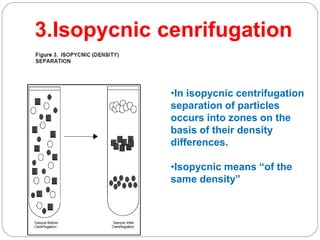
3.Isopycnic cenrifugation
•In isopycnic centrifugation
separation of particles
occurs into zones on the
basis of their density
differences.
•Isopycnic means “of the
same density”
Types of
Centrifuge
1. Small bench centrifuges
(Low speed centrifuges)
2. High speed centrifuges
3. Ultra-centrifuge
Applications of
centrifugeThe centrifuge is used in a laboratory for various
purposes such as-
i.The separation of serum or plasma from red blood
cells.
ii.Separation of sediment in urine.
iii.Separation of protein free filtrate.
iv.Washing of red blood cells by
normal saline.
v. Separation of antigen bound fraction or
antibody bound fraction from the free
fraction in immunoassays.
Care of Centrifuges and
RotorsCarefully read the operating manual or receive proper
instructions before use any centrifuge.
Select the proper operating conditions on the instrument.
Check the rotor chamber for cleanliness and for damage.
Select the proper rotor. Many sizes and types are available.
Be sure the rotor is clean and undamaged.
Filled centrifuge tubes or bottles should be weighed
carefully and balanced before centrifugation.
Rotor manufactures provide a max. allowable speed limit
for each rotor. Do nor exceed that limit.
Keep an accurate record of centrifuge and rotor use.
If an unusual noise or vibration develops during
centrifugation, immediately turn the centrifuge off.
Carefully clean the rotor chamber and rotor after
centrifugation.
Centrifugation

Centrifugation

  • 1.
    NISHANTKUMAR M.Sc. (BIOTECHNOLOGY) 1ST SEMESTER DEPARTMENTOF BIOTECHNOLOGY (CAMPUS) C.C.S. UNIVERSITY, MEERUT Centrifugation
  • 2.
    Introductio nCentrifugation is theseparation technique commonly used in clinical and research laboratories. A centrifugation is a sepration process which uses the action of centrifugal force for the sedimentation of heterozygous mixtures. More dense components of the mixture move away from the axis of the centrifuge
  • 3.
    Principl eParticles which differin density, size or shape, sediment at different rates in a centrifugal field. The particles will tend to sediment under the influence of gravity. If the particles suspended in a liquid are so small or have a density so close to that of the liquid, then the force of gravity fails to sediment the particles into a separate layer. So the basis of centrifugation techniques is to exert a larger force than the gravitational force to enhance the effective sedimentation force for the separating
  • 4.
    Contd …In centrifugation, theparticles are normally suspended in a specific liquid medium, held in tubes, which are located in a rotor. The rotor is positioned centrally on the drive shaft of the centrifuge. Particles which differ in density, shape or size can be separated since they sediment at different rates in the centrifugal field, each particle sedimenting at a rate which is proportional to the applied centrifugal field.
  • 5.
    Relative centrifugal force (RCF)Theusual expression of RPM (revolution per minute) gives only the centrifugation speed and does not express the centrifugal force. A better expression of forces generated by centrifuge is RCF which is calculated by considering the speed of rotation (RPM), and the radius from the center of rotation. RCF is expressed as some number times gravity. RCF = 42 rev min-1 2 r 3600 x 980g NOTE: RCF always acts from inward to outward direction.
  • 6.
    Centrifug eThe equipment usedto perform centrifugation is called centrifuge. The basic centrifuge consists of two components: i. Electric motor: with drive shaft to spin the sample and ii. Rotor: to hold tubes or other containers of the sample. • The rotors can be of three types: 1.Fixed angle rotor 2.Vertical tube rotor
  • 7.
    1.FIXED ANGLE ROTOR Fixed-angle rotorsare general- purpose rotors that are especially useful for pelleting subcellular particles and in short column banding of viruses and subcellular organelles(e.g.-Mitochondria). Speed- 20,000 rpm. Tubes are held at an angle (usually 20 to 45 degrees) to the axis of rotation.
  • 8.
    2.VERTICA L ROTOR Vertical rotors holdtubes parallel to the axis of rotation; therefore, bands separate across the diameter of the tube rather than down the length of the tube. Vertical rotors are useful for isopycnic and, in some cases, rate zonal separations.
  • 9.
    3.SWINGING BUCKE T ROTOR Swinging-bucket rotorare used for pelleting, isopycnic studies and rate zonal studies. Tubes are attached to the rotor body by hinge pins or a crossbar.The buckets swing out to a horizontal position. Isopycnic studies (separation as a function of density). Rate zonal studies (separation as a function of sedimentation
  • 11.
    Rotor Balance The mass ofa properly loaded rotor will be evenly distributed on the ultracentrifuge drive hub, causing the rotor to turn smoothly with the drive. An improperly loaded rotor will be unbalanced; consistent running of unbalanced rotors will reduce ultracentrifuge drive life. To balance the rotor load, fill all opposing tubes to the same level with liquid of the same density. Weight of opposing tubes must be distributed equally. Place tubes in the rotor symmetrically.
  • 12.
  • 13.
    1.Differential centrifugation• In differentialcentrifugation, sepration is achieved on the basis of size of particles. •Differential centrifugation is used for the study of subcellular organelles , tissues or cells and used to seprate certain organelles from whole cells for further analysis.
  • 14.
    2.Rate zonal centrifugation •The particlewill begin sedimenting in seprate zones according to their size and shape. •Rate zonal separation takes advantage of particle size and mass instead of particle density for sedimentation.
  • 15.
    3.Isopycnic cenrifugation •In isopycniccentrifugation separation of particles occurs into zones on the basis of their density differences. •Isopycnic means “of the same density”
  • 16.
    Types of Centrifuge 1. Smallbench centrifuges (Low speed centrifuges) 2. High speed centrifuges 3. Ultra-centrifuge
  • 17.
    Applications of centrifugeThe centrifugeis used in a laboratory for various purposes such as- i.The separation of serum or plasma from red blood cells. ii.Separation of sediment in urine. iii.Separation of protein free filtrate. iv.Washing of red blood cells by normal saline. v. Separation of antigen bound fraction or antibody bound fraction from the free fraction in immunoassays.
  • 18.
    Care of Centrifugesand RotorsCarefully read the operating manual or receive proper instructions before use any centrifuge. Select the proper operating conditions on the instrument. Check the rotor chamber for cleanliness and for damage. Select the proper rotor. Many sizes and types are available. Be sure the rotor is clean and undamaged. Filled centrifuge tubes or bottles should be weighed carefully and balanced before centrifugation. Rotor manufactures provide a max. allowable speed limit for each rotor. Do nor exceed that limit. Keep an accurate record of centrifuge and rotor use. If an unusual noise or vibration develops during centrifugation, immediately turn the centrifuge off. Carefully clean the rotor chamber and rotor after centrifugation.