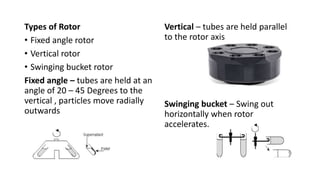
Centrifugation uses centrifugal force to separate components of a mixture based on density. During centrifugation, denser components move outward toward the centrifuge wall and less dense components move inward toward the rotor center. A centrifuge machine generates centrifugal force by rapidly spinning samples in tubes or bottles. Common types of centrifugation include density gradient centrifugation, differential centrifugation, and ultracentrifugation, which separate molecules and particles based on differences in size, density, and sedimentation rate. Factors like density, temperature, rotation speed, and centrifugal force determine how effectively centrifugation separates components.


![Cells and Organs of immune system [Autosaved].pptx](https://cdn.slidesharecdn.com/ss_thumbnails/cellsandorgansofimmunesystemautosaved-260123152717-ea0cb261-thumbnail.jpg?width=640&height=640&fit=bounds)


