preencoded.png
SUBMITTED TO: Dr. JYOTI PRAKASH SAHOO
BY: DURGADATTA SAHOO
REG.NO.: 2403060028
ROLL NO.:MBT24004
M.SC BIOTECHNOLOGY
SUBJECT.: BIO-INSTUMENTATION AND BIO-TECHNIQUES
FACULTY OF AGRICULTURE AND ALLIED SCIENCES
CV RAMAN GLOBAL UNIVERSITY, BHUBANESWAR, ODISHA
Centrifugation: A Sedimentation
Technique
01
preencoded.png
Centrifugation: A
Sedimentation
Technique
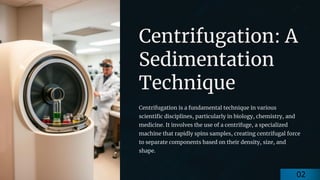
Centrifugation is a fundamental technique in various
scientific disciplines, particularly in biology, chemistry, and
medicine. It involves the use of a centrifuge, a specialized
machine that rapidly spins samples, creating centrifugal force
to separate components based on their density, size, and
shape.
02
preencoded.png
Principle of Centrifugation
A body moving in a circular motion with an angular velocity ω (omega) is subjected to a centrifugal force (F)
acting in out ward direction. This helps in throughing the heavier particle to the outerside of the body.
F=mω²r
Where; F=centrifugal force ω=angular velocity r=distance from the centre of rotation to the particle
ω²r=centrifugal acceleration
Factors Influencing Sedimentation
• Density
• Size
• Shape
• Centrifugal force
Applications of Centrifugation
• Cell fractionation
• Protein purification
• Blood component separation
• DNA/RNA isolation
03
preencoded.png
Types of Centrifuge
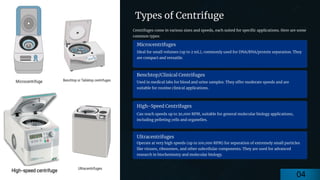
Centrifuges come in various sizes and speeds, each suited for specific applications. Here are some
common types:
Microcentrifuges
Ideal for small volumes (up to 2 mL), commonly used for DNA/RNA/protein separation. They
are compact and versatile.
Benchtop/Clinical Centrifuges
Used in medical labs for blood and urine samples. They offer moderate speeds and are
suitable for routine clinical applications.
High-Speed Centrifuges
Can reach speeds up to 30,000 RPM, suitable for general molecular biology applications,
including pelleting cells and organelles.
Ultracentrifuges
Operate at very high speeds (up to 100,000 RPM) for separation of extremely small particles
like viruses, ribosomes, and other subcellular components. They are used for advanced
research in biochemistry and molecular biology.
04
preencoded.png
The Power of Relative Centrifugal Field (RCF)
The Relative Centrifugal Field (RCF) refers to the immense force exerted on particles during centrifugation, far exceeding the Earth's gravity. This
g-force accelerates the sedimentation of particles based on their size and density, allowing for rapid and efficient separation. By spinning a vessel,
centrifugation generates a centrifugal force that pushes particles away from the rotation axis, with RCF expressed as a multiple of the Earth's
gravitational force.
The higher the RCF, the faster the particles will sediment, enabling researchers to isolate and purify cellular components, macromolecules, and
other materials with remarkable precision and speed. This powerful technique is essential in fields ranging from cell biology to environmental
science , revolutionizing our understanding of the microscopic world..
Relationship between RCF, revolutions per minute and radius of rotation
The RCF generated by a rotor depends on the speed of the rotor in revolutions per minute (rpm) and the radius of rotation (i.e. the distance from
the axis of rotation). The equations that permit calculation of the RCF from a known. rpm and radius of rotation is:
RCF = rw²/g
where, r is the radius in cm, g is the gravitational acceleration ( cm /sec^ 2 ) and is the angular velocity.
RCF = 1.12 xrx (rpm) x 10^-5
05
preencoded.png
Sedimentation Cofficient
The sedimentation coefficient is the ratio of a velocity to the centrifugal acceleration. The sedi- mentation coefficient (s) has units of second. A
sedimentation coefficient of 1 * 10 ^ - 13 second is defined as one Svedberg, S, ( 15 = 10 ^ - 13 second). This unit is named for The Svedberg, a pioneer in
the field of centrifugation.
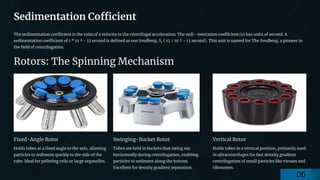
Rotors: The Spinning Mechanism
Fixed-Angle Rotor
Holds tubes at a fixed angle to the axis, allowing
particles to sediment quickly to the side of the
tube. Ideal for pelleting cells or large organelles.
Swinging-Bucket Rotor
Tubes are held in buckets that swing out
horizontally during centrifugation, enabling
particles to sediment along the bottom.
Excellent for density gradient separation.
Vertical Rotor
Holds tubes in a vertical position, primarily used
in ultracentrifuges for fast density gradient
centrifugation of small particles like viruses and
ribosomes.
06
preencoded.png
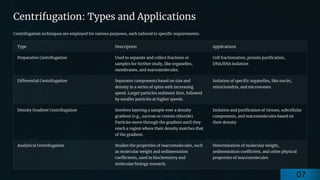
Centrifugation: Types and Applications
Centrifugation techniques are employed for various purposes, each tailored to specific requirements:
Type Description Applications
Preparative Centrifugation Used to separate and collect fractions or
samples for further study, like organelles,
membranes, and macromolecules.
Cell fractionation, protein purification,
DNA/RNA isolation
Differential Centrifugation Separates components based on size and
density in a series of spins with increasing
speed. Larger particles sediment first, followed
by smaller particles at higher speeds.
Isolation of specific organelles, like nuclei,
mitochondria, and microsomes
Density Gradient Centrifugation Involves layering a sample over a density
gradient (e.g., sucrose or cesium chloride).
Particles move through the gradient until they
reach a region where their density matches that
of the gradient.
Isolation and purification of viruses, subcellular
components, and macromolecules based on
their density
Analytical Centrifugation Studies the properties of macromolecules, such
as molecular weight and sedimentation
coefficients, used in biochemistry and
molecular biology research.
Determination of molecular weight,
sedimentation coefficient, and other physical
properties of macromolecules
07
preencoded.png
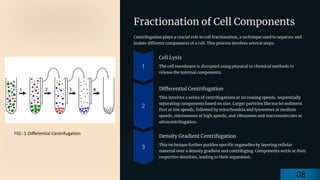
Fractionation of Cell Components
Centrifugation plays a crucial role in cell fractionation, a technique used to separate and
isolate different components of a cell. This process involves several steps:
Cell Lysis
The cell membrane is disrupted using physical or chemical methods to
release the internal components.
Differential Centrifugation
This involves a series of centrifugations at increasing speeds, sequentially
separating components based on size. Larger particles like nuclei sediment
first at low speeds, followed by mitochondria and lysosomes at medium
speeds, microsomes at high speeds, and ribosomes and macromolecules at
ultracentrifugation.
Density Gradient Centrifugation
This technique further purifies specific organelles by layering cellular
material over a density gradient and centrifuging. Components settle at their
respective densities, leading to their separation.
08
FIG:-1.Differential Centrifugation
preencoded.png
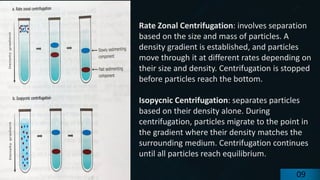
Rate Zonal Centrifugation: involves separation
based on the size and mass of particles. A
density gradient is established, and particles
move through it at different rates depending on
their size and density. Centrifugation is stopped
before particles reach the bottom.
Isopycnic Centrifugation: separates particles
based on their density alone. During
centrifugation, particles migrate to the point in
the gradient where their density matches the
surrounding medium. Centrifugation continues
until all particles reach equilibrium.
09
preencoded.png
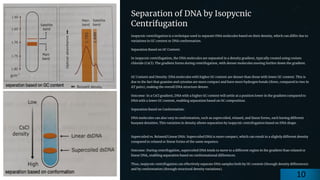
Separation of DNA by Isopycnic
Centrifugation
Isopycnic centrifugation is a technique used to separate DNA molecules based on their density, which can differ due to
variations in GC content or DNA conformation.
Separation Based on GC Content:
In isopycnic centrifugation, the DNA molecules are separated in a density gradient, typically created using cesium
chloride (CsCl). The gradient forms during centrifugation, with denser molecules moving further down the gradient.
GC Content and Density: DNA molecules with higher GC content are denser than those with lower GC content. This is
due to the fact that guanine and cytosine are more compact and have more hydrogen bonds (three, compared to two in
AT pairs), making the overall DNA structure denser.
Outcome: In a CsCl gradient, DNA with a higher GC content will settle at a position lower in the gradient compared to
DNA with a lower GC content, enabling separation based on GC composition.
Separation Based on Conformation:
DNA molecules can also vary in conformation, such as supercoiled, relaxed, and linear forms, each having different
buoyant densities. This variation in density allows separation by isopycnic centrifugation based on DNA shape.
Supercoiled vs. Relaxed/Linear DNA: Supercoiled DNA is more compact, which can result in a slightly different density
compared to relaxed or linear forms of the same sequence.
Outcome: During centrifugation, supercoiled DNA tends to move to a different region in the gradient than relaxed or
linear DNA, enabling separation based on conformational differences.
Thus, isopycnic centrifugation can effectively separate DNA samples both by GC content (through density differences)
and by conformation (through structural density variations).
10
preencoded.png
The Significance of Centrifugation in
Research
Centrifugation is a powerful and versatile technique that has revolutionized scientific research. It allows scientists
to isolate and study specific components of cells, molecules, and other materials. This has led to breakthroughs in
various fields, including:
• Cell Biology
• Biochemistry
• Molecular Biology
• Medicine
• Pharmacology
• Environmental Science
From studying the structure and function of organelles to developing new drugs and therapies, centrifugation
continues to be a vital tool in advancing our understanding of the world around us.
11
preencoded.png
A centrifuge is a versatile and essential device widely used across various fields, including
scientific research, medicine, and industrial applications. Its ability to separate
components based on density through centrifugal force makes it invaluable for tasks such
as separating blood components, purifying biological samples, and processing industrial
materials. The design and operation of centrifuges have evolved significantly, incorporating
advanced technologies to enhance efficiency, precision, and safety.
CONCLUSION
12
preencoded.png
REFERENCE
Tang, D., Duan, Z., Liu, L., Jia, Z., Lang, L., & Tan, Y. (2023). Design and Application of Portable Centrifuge
Inspired by a Hand-Powered Spinning Top. Micromachines, 14(10), 1968.
https://doi.org/10.3390/mi14101968
Haque, M. E., Marriott, L., Naeem, N., Henry, T., Conde, A. J., & Kersaudy-Kerhoas, M. (2022). A low-cost, open-
source centrifuge adaptor for separating large volume clinical blood samples. PloS one, 17(7), e0266769.
https://doi.org/10.1371/journal.pone.0266769
13
preencoded.png
14

Centrifugation A Sedimentation Technique

  • 1.
    preencoded.png SUBMITTED TO: Dr.JYOTI PRAKASH SAHOO BY: DURGADATTA SAHOO REG.NO.: 2403060028 ROLL NO.:MBT24004 M.SC BIOTECHNOLOGY SUBJECT.: BIO-INSTUMENTATION AND BIO-TECHNIQUES FACULTY OF AGRICULTURE AND ALLIED SCIENCES CV RAMAN GLOBAL UNIVERSITY, BHUBANESWAR, ODISHA Centrifugation: A Sedimentation Technique 01
  • 2.
    preencoded.png Centrifugation: A Sedimentation Technique Centrifugation isa fundamental technique in various scientific disciplines, particularly in biology, chemistry, and medicine. It involves the use of a centrifuge, a specialized machine that rapidly spins samples, creating centrifugal force to separate components based on their density, size, and shape. 02
  • 3.
    preencoded.png Principle of Centrifugation Abody moving in a circular motion with an angular velocity ω (omega) is subjected to a centrifugal force (F) acting in out ward direction. This helps in throughing the heavier particle to the outerside of the body. F=mω²r Where; F=centrifugal force ω=angular velocity r=distance from the centre of rotation to the particle ω²r=centrifugal acceleration Factors Influencing Sedimentation • Density • Size • Shape • Centrifugal force Applications of Centrifugation • Cell fractionation • Protein purification • Blood component separation • DNA/RNA isolation 03
  • 4.
    preencoded.png Types of Centrifuge Centrifugescome in various sizes and speeds, each suited for specific applications. Here are some common types: Microcentrifuges Ideal for small volumes (up to 2 mL), commonly used for DNA/RNA/protein separation. They are compact and versatile. Benchtop/Clinical Centrifuges Used in medical labs for blood and urine samples. They offer moderate speeds and are suitable for routine clinical applications. High-Speed Centrifuges Can reach speeds up to 30,000 RPM, suitable for general molecular biology applications, including pelleting cells and organelles. Ultracentrifuges Operate at very high speeds (up to 100,000 RPM) for separation of extremely small particles like viruses, ribosomes, and other subcellular components. They are used for advanced research in biochemistry and molecular biology. 04
  • 5.
    preencoded.png The Power ofRelative Centrifugal Field (RCF) The Relative Centrifugal Field (RCF) refers to the immense force exerted on particles during centrifugation, far exceeding the Earth's gravity. This g-force accelerates the sedimentation of particles based on their size and density, allowing for rapid and efficient separation. By spinning a vessel, centrifugation generates a centrifugal force that pushes particles away from the rotation axis, with RCF expressed as a multiple of the Earth's gravitational force. The higher the RCF, the faster the particles will sediment, enabling researchers to isolate and purify cellular components, macromolecules, and other materials with remarkable precision and speed. This powerful technique is essential in fields ranging from cell biology to environmental science , revolutionizing our understanding of the microscopic world.. Relationship between RCF, revolutions per minute and radius of rotation The RCF generated by a rotor depends on the speed of the rotor in revolutions per minute (rpm) and the radius of rotation (i.e. the distance from the axis of rotation). The equations that permit calculation of the RCF from a known. rpm and radius of rotation is: RCF = rw²/g where, r is the radius in cm, g is the gravitational acceleration ( cm /sec^ 2 ) and is the angular velocity. RCF = 1.12 xrx (rpm) x 10^-5 05
  • 6.
    preencoded.png Sedimentation Cofficient The sedimentationcoefficient is the ratio of a velocity to the centrifugal acceleration. The sedi- mentation coefficient (s) has units of second. A sedimentation coefficient of 1 * 10 ^ - 13 second is defined as one Svedberg, S, ( 15 = 10 ^ - 13 second). This unit is named for The Svedberg, a pioneer in the field of centrifugation. Rotors: The Spinning Mechanism Fixed-Angle Rotor Holds tubes at a fixed angle to the axis, allowing particles to sediment quickly to the side of the tube. Ideal for pelleting cells or large organelles. Swinging-Bucket Rotor Tubes are held in buckets that swing out horizontally during centrifugation, enabling particles to sediment along the bottom. Excellent for density gradient separation. Vertical Rotor Holds tubes in a vertical position, primarily used in ultracentrifuges for fast density gradient centrifugation of small particles like viruses and ribosomes. 06
  • 7.
    preencoded.png Centrifugation: Types andApplications Centrifugation techniques are employed for various purposes, each tailored to specific requirements: Type Description Applications Preparative Centrifugation Used to separate and collect fractions or samples for further study, like organelles, membranes, and macromolecules. Cell fractionation, protein purification, DNA/RNA isolation Differential Centrifugation Separates components based on size and density in a series of spins with increasing speed. Larger particles sediment first, followed by smaller particles at higher speeds. Isolation of specific organelles, like nuclei, mitochondria, and microsomes Density Gradient Centrifugation Involves layering a sample over a density gradient (e.g., sucrose or cesium chloride). Particles move through the gradient until they reach a region where their density matches that of the gradient. Isolation and purification of viruses, subcellular components, and macromolecules based on their density Analytical Centrifugation Studies the properties of macromolecules, such as molecular weight and sedimentation coefficients, used in biochemistry and molecular biology research. Determination of molecular weight, sedimentation coefficient, and other physical properties of macromolecules 07
  • 8.
    preencoded.png Fractionation of CellComponents Centrifugation plays a crucial role in cell fractionation, a technique used to separate and isolate different components of a cell. This process involves several steps: Cell Lysis The cell membrane is disrupted using physical or chemical methods to release the internal components. Differential Centrifugation This involves a series of centrifugations at increasing speeds, sequentially separating components based on size. Larger particles like nuclei sediment first at low speeds, followed by mitochondria and lysosomes at medium speeds, microsomes at high speeds, and ribosomes and macromolecules at ultracentrifugation. Density Gradient Centrifugation This technique further purifies specific organelles by layering cellular material over a density gradient and centrifuging. Components settle at their respective densities, leading to their separation. 08 FIG:-1.Differential Centrifugation
  • 9.
    preencoded.png Rate Zonal Centrifugation:involves separation based on the size and mass of particles. A density gradient is established, and particles move through it at different rates depending on their size and density. Centrifugation is stopped before particles reach the bottom. Isopycnic Centrifugation: separates particles based on their density alone. During centrifugation, particles migrate to the point in the gradient where their density matches the surrounding medium. Centrifugation continues until all particles reach equilibrium. 09
  • 10.
    preencoded.png Separation of DNAby Isopycnic Centrifugation Isopycnic centrifugation is a technique used to separate DNA molecules based on their density, which can differ due to variations in GC content or DNA conformation. Separation Based on GC Content: In isopycnic centrifugation, the DNA molecules are separated in a density gradient, typically created using cesium chloride (CsCl). The gradient forms during centrifugation, with denser molecules moving further down the gradient. GC Content and Density: DNA molecules with higher GC content are denser than those with lower GC content. This is due to the fact that guanine and cytosine are more compact and have more hydrogen bonds (three, compared to two in AT pairs), making the overall DNA structure denser. Outcome: In a CsCl gradient, DNA with a higher GC content will settle at a position lower in the gradient compared to DNA with a lower GC content, enabling separation based on GC composition. Separation Based on Conformation: DNA molecules can also vary in conformation, such as supercoiled, relaxed, and linear forms, each having different buoyant densities. This variation in density allows separation by isopycnic centrifugation based on DNA shape. Supercoiled vs. Relaxed/Linear DNA: Supercoiled DNA is more compact, which can result in a slightly different density compared to relaxed or linear forms of the same sequence. Outcome: During centrifugation, supercoiled DNA tends to move to a different region in the gradient than relaxed or linear DNA, enabling separation based on conformational differences. Thus, isopycnic centrifugation can effectively separate DNA samples both by GC content (through density differences) and by conformation (through structural density variations). 10
  • 11.
    preencoded.png The Significance ofCentrifugation in Research Centrifugation is a powerful and versatile technique that has revolutionized scientific research. It allows scientists to isolate and study specific components of cells, molecules, and other materials. This has led to breakthroughs in various fields, including: • Cell Biology • Biochemistry • Molecular Biology • Medicine • Pharmacology • Environmental Science From studying the structure and function of organelles to developing new drugs and therapies, centrifugation continues to be a vital tool in advancing our understanding of the world around us. 11
  • 12.
    preencoded.png A centrifuge isa versatile and essential device widely used across various fields, including scientific research, medicine, and industrial applications. Its ability to separate components based on density through centrifugal force makes it invaluable for tasks such as separating blood components, purifying biological samples, and processing industrial materials. The design and operation of centrifuges have evolved significantly, incorporating advanced technologies to enhance efficiency, precision, and safety. CONCLUSION 12
  • 13.
    preencoded.png REFERENCE Tang, D., Duan,Z., Liu, L., Jia, Z., Lang, L., & Tan, Y. (2023). Design and Application of Portable Centrifuge Inspired by a Hand-Powered Spinning Top. Micromachines, 14(10), 1968. https://doi.org/10.3390/mi14101968 Haque, M. E., Marriott, L., Naeem, N., Henry, T., Conde, A. J., & Kersaudy-Kerhoas, M. (2022). A low-cost, open- source centrifuge adaptor for separating large volume clinical blood samples. PloS one, 17(7), e0266769. https://doi.org/10.1371/journal.pone.0266769 13
  • 14.