PRESENTED BY-
SURAIYA AHMED
ID# 132 0916 046
A PRESENTATION ON
CEFALOTIN
1
INTRODUCTION
STRUCTURAL CHEMISTRY
CHEMICAL & PHYSICAL PROPERTIES
DOSE & FREQUENCY
DOSAGE FORM
INDICATIONS
PHARMACOKINETICS
M/A
PHARMACODYNAMICS
PHARMACOECONOMICS
INTERACTIONS
SIDE EFFECTS
PRECAUTION
CONTRAINDICATION
INCOMPATIBILITY
PACKAGING & STORAGE
OBJECTIVES
2
Cefalotin, also called cephalothin, is a
semisynthetic first generation cephalosporin
antibiotic.
It is administered parenterally (mainly
intravenously).
Active against gram-positive organisms but
limited activity against gram-negative bacteria.
INTRODUCTION
3
IUPAC Name: (6R,7R)-3-(acetyloxymethyl)-8-
oxo-7-[(2-thiophen-2-ylacetyl)amino]-5-thia-1-
azabicyclo[4.2.0]oct-2-ene-2-carboxylic acid.
Chemical Names: Cephalothin; Cefalotin;
Cefalothin; Cephalotin; Cefalotine; Keflin.
Brand Names:
 Averon-1®
 Cemastin®
 Coaxin®
 Keflin®
 Seffin®
4
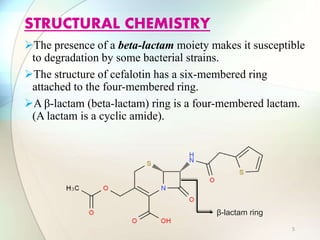
The presence of a beta-lactam moiety makes it susceptible
to degradation by some bacterial strains.
The structure of cefalotin has a six-membered ring
attached to the four-membered ring.
A β-lactam (beta-lactam) ring is a four-membered lactam.
(A lactam is a cyclic amide).
STRUCTURAL CHEMISTRY
β-lactam ring
5
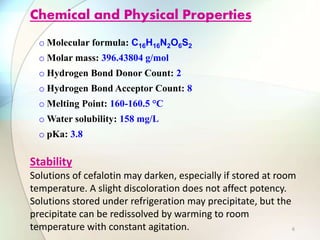
o Molecular formula: C16H16N2O6S2
o Molar mass: 396.43804 g/mol
o Hydrogen Bond Donor Count: 2
o Hydrogen Bond Acceptor Count: 8
o Melting Point: 160-160.5 °C
o Water solubility: 158 mg/L
o pKa: 3.8
Chemical and Physical Properties
Stability
Solutions of cefalotin may darken, especially if stored at room
temperature. A slight discoloration does not affect potency.
Solutions stored under refrigeration may precipitate, but the
precipitate can be redissolved by warming to room
temperature with constant agitation. 6
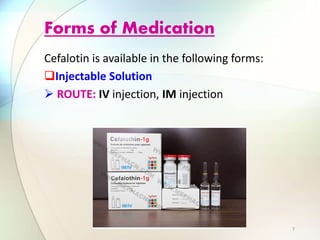
Cefalotin is available in the following forms:
Injectable Solution
 ROUTE: IV injection, IM injection
Forms of Medication
7
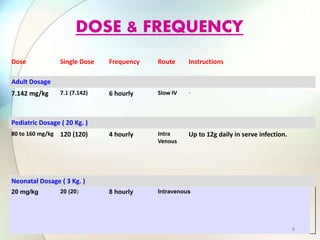
Dose Single Dose Frequency Route Instructions
Adult Dosage
7.142 mg/kg 7.1 (7.142) 6 hourly Slow IV -
Pediatric Dosage ( 20 Kg. )
80 to 160 mg/kg 120 (120) 4 hourly Intra
Venous
Up to 12g daily in serve infection.
Neonatal Dosage ( 3 Kg. )
20 mg/kg 20 (20) 8 hourly Intravenous
DOSE & FREQUENCY
8
First-generation cephalosporins are mainly
active predominantly against Gram-positive
bacteria.
Cephalothin is used in the treatment of
infections caused by Gram positive organisms
like pneumococci, Streptococcus Viridians,
Staphylococcus Aureus.
Also active against gram negative organisms
like E.coli, Klebsiella pneumoniae and Proteus
mirabilis.
INDICATIONS
9
• Bone and joint infection
• Surgical infections
• CVS infections
• Genitourinary tract infections
• Respiratory tract infections
• Soft tissue and skin infections
• Cellulitis
• Endocarditis
• Alternative drug of choice in Peritonitis, Septic
abortion, Surgical prophylaxis.
Cefalotin is used to prevent-
10
Absorption: Cefalotin is not well absorbed from
GI tract, but it is rapidly absorbed from the site
of injection.
Volume of distribution: 0.26 l/kg
Plasma protien binding: 65-80%
Metabolism: Hepatic.
Renal Excretion: >65%
Plasma half life: 35 minutes.
Toxicity: Rat intravenous LD50 is 4000 mg/kg.
Pharmacokinetics
11
The bactericidal activity of cefalotin results from
the inhibition of cell wall synthesis via affinity for
penicillin-binding proteins (PBPs).
Like penicillin and other cephalosporins, cefalotin
works by disrupting the last stage of bacterial cell
wall synthesis, leading to autolysis of the bacteria
cells by autolytic enzymes such as the autolysins.
Some bacteria gain the ability to produce beta-
lactamases, which can degrade the beta-lactam
moiety present in penicillins and cephalosporins,
and can thus be resistant to those drugs.
M/A OF CEFALOTIN
12
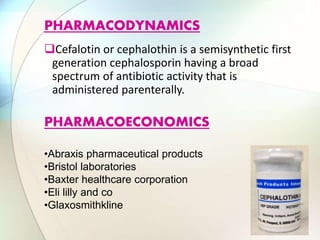
Cefalotin or cephalothin is a semisynthetic first
generation cephalosporin having a broad
spectrum of antibiotic activity that is
administered parenterally.
PHARMACODYNAMICS
PHARMACOECONOMICS
•Abraxis pharmaceutical products
•Bristol laboratories
•Baxter healthcare corporation
•Eli lilly and co
•Glaxosmithkline
13
Drug Interactions
Calcium Gluconate
Diphenhydramine
Frusemide or Furosemide
Penicillamine
Probenecid (increases the blood level of Cefalotin)
Amikacin (Increases the risk of nephrotoxicity)
INTERACTIONS
•Renal Dysfunction
•Colitis
•Dialysis
•Sodium restriction
Disease Interactions
14
Local reactions: Swelling, redness, or pain at the injection
site may occur.
Hypersensitivity: Hypersensitivity reactions occur in up to
15% of patients with a history of penicillin allergy.
Manifestations may include-
• Urticarial or maculopapular rash
• Bronchospasm
• Fever
• Anaphylaxis, including severe hypotension and cardiac
arrest
Renal: Nephrotoxicity & Renal insufficiency
SIDE EFFECTS
15
Hematologic:
thrombocytopenia, hemolytic anemia, and rare cases
of pancytopenia.
Gastrointestinal: Diarrhea, nausea and vomiting.
Warning / Precautions
Cephalothin should be used with caution in patients
with impaired kidney or liver function, patients with
aspirin hypersensitivity, because it may cause allergic
reactions (including bronchial asthma).
Precaution to be taken during renal disease and in
Gastro-intestinal diseases (especially colitis, enteritis)
16
Cephalothin is contraindicated in pregnancy, lactation,
hypersensitivity and in pseudomembranous colitis.
Drug should not be given to Pediatrics and patients
suffering from Kidney dysfunction.
CONTRAINDICATION
Cefalotin and Pregnancy
The FDA categorizes medications based on safety for use
during pregnancy. Five categories - A, B, C, D, and X, are
used to classify the possible risks to an unborn baby when
a medication is taken during pregnancy.
Cefalotin falls into category B
17
Adrenaline,
amikacin,
aminophylline,
calcium chloride,
calcium gluconate,
chlorpromazine,
diphenhydramine,
erythromycin,
gentamicin,
hyaluronidase,
kanamycin,
INCOMPATIBILITY
 lignocaine,
 metoclopramide,
 oxytocin,
 penicillin G,
 phenobarbitone,
 phenytoin,
 phytomenadione,
 prochlorperazine,
 ranitidine,
 ticarciliin.
18
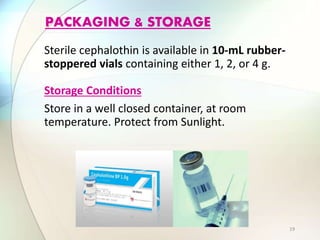
Sterile cephalothin is available in 10-mL rubber-
stoppered vials containing either 1, 2, or 4 g.
Storage Conditions
Store in a well closed container, at room
temperature. Protect from Sunlight.
PACKAGING & STORAGE
19
http://www.rxwiki.com/cefalotin
http://www.drugbank.ca/drugs/DB00456
http://www.webmd.com/drugs/2/drug-19324/cephalothin-
injection/details#interactions
https://pubchem.ncbi.nlm.nih.gov/compound/cephalothin
#section=Formulations-Preparations
http://druginfosys.com/Drug.aspx?drugCode=150&drugNa
me=Cephalothin%20(Na)&type=1
http://www.webhealthcentre.com/drugix/Cephalothin_DI0
033.aspx#Interactions
http://en.wikipedia.org/wiki/Cefalotin
RRFERENCES
20
THANK YOU!
21

Cefalotin ppt

  • 1.
    PRESENTED BY- SURAIYA AHMED ID#132 0916 046 A PRESENTATION ON CEFALOTIN 1
  • 2.
    INTRODUCTION STRUCTURAL CHEMISTRY CHEMICAL &PHYSICAL PROPERTIES DOSE & FREQUENCY DOSAGE FORM INDICATIONS PHARMACOKINETICS M/A PHARMACODYNAMICS PHARMACOECONOMICS INTERACTIONS SIDE EFFECTS PRECAUTION CONTRAINDICATION INCOMPATIBILITY PACKAGING & STORAGE OBJECTIVES 2
  • 3.
    Cefalotin, also calledcephalothin, is a semisynthetic first generation cephalosporin antibiotic. It is administered parenterally (mainly intravenously). Active against gram-positive organisms but limited activity against gram-negative bacteria. INTRODUCTION 3
  • 4.
    IUPAC Name: (6R,7R)-3-(acetyloxymethyl)-8- oxo-7-[(2-thiophen-2-ylacetyl)amino]-5-thia-1- azabicyclo[4.2.0]oct-2-ene-2-carboxylicacid. Chemical Names: Cephalothin; Cefalotin; Cefalothin; Cephalotin; Cefalotine; Keflin. Brand Names:  Averon-1®  Cemastin®  Coaxin®  Keflin®  Seffin® 4
  • 5.
    The presence ofa beta-lactam moiety makes it susceptible to degradation by some bacterial strains. The structure of cefalotin has a six-membered ring attached to the four-membered ring. A β-lactam (beta-lactam) ring is a four-membered lactam. (A lactam is a cyclic amide). STRUCTURAL CHEMISTRY β-lactam ring 5
  • 6.
    o Molecular formula:C16H16N2O6S2 o Molar mass: 396.43804 g/mol o Hydrogen Bond Donor Count: 2 o Hydrogen Bond Acceptor Count: 8 o Melting Point: 160-160.5 °C o Water solubility: 158 mg/L o pKa: 3.8 Chemical and Physical Properties Stability Solutions of cefalotin may darken, especially if stored at room temperature. A slight discoloration does not affect potency. Solutions stored under refrigeration may precipitate, but the precipitate can be redissolved by warming to room temperature with constant agitation. 6
  • 7.
    Cefalotin is availablein the following forms: Injectable Solution  ROUTE: IV injection, IM injection Forms of Medication 7
  • 8.
    Dose Single DoseFrequency Route Instructions Adult Dosage 7.142 mg/kg 7.1 (7.142) 6 hourly Slow IV - Pediatric Dosage ( 20 Kg. ) 80 to 160 mg/kg 120 (120) 4 hourly Intra Venous Up to 12g daily in serve infection. Neonatal Dosage ( 3 Kg. ) 20 mg/kg 20 (20) 8 hourly Intravenous DOSE & FREQUENCY 8
  • 9.
    First-generation cephalosporins aremainly active predominantly against Gram-positive bacteria. Cephalothin is used in the treatment of infections caused by Gram positive organisms like pneumococci, Streptococcus Viridians, Staphylococcus Aureus. Also active against gram negative organisms like E.coli, Klebsiella pneumoniae and Proteus mirabilis. INDICATIONS 9
  • 10.
    • Bone andjoint infection • Surgical infections • CVS infections • Genitourinary tract infections • Respiratory tract infections • Soft tissue and skin infections • Cellulitis • Endocarditis • Alternative drug of choice in Peritonitis, Septic abortion, Surgical prophylaxis. Cefalotin is used to prevent- 10
  • 11.
    Absorption: Cefalotin isnot well absorbed from GI tract, but it is rapidly absorbed from the site of injection. Volume of distribution: 0.26 l/kg Plasma protien binding: 65-80% Metabolism: Hepatic. Renal Excretion: >65% Plasma half life: 35 minutes. Toxicity: Rat intravenous LD50 is 4000 mg/kg. Pharmacokinetics 11
  • 12.
    The bactericidal activityof cefalotin results from the inhibition of cell wall synthesis via affinity for penicillin-binding proteins (PBPs). Like penicillin and other cephalosporins, cefalotin works by disrupting the last stage of bacterial cell wall synthesis, leading to autolysis of the bacteria cells by autolytic enzymes such as the autolysins. Some bacteria gain the ability to produce beta- lactamases, which can degrade the beta-lactam moiety present in penicillins and cephalosporins, and can thus be resistant to those drugs. M/A OF CEFALOTIN 12
  • 13.
    Cefalotin or cephalothinis a semisynthetic first generation cephalosporin having a broad spectrum of antibiotic activity that is administered parenterally. PHARMACODYNAMICS PHARMACOECONOMICS •Abraxis pharmaceutical products •Bristol laboratories •Baxter healthcare corporation •Eli lilly and co •Glaxosmithkline 13
  • 14.
    Drug Interactions Calcium Gluconate Diphenhydramine Frusemideor Furosemide Penicillamine Probenecid (increases the blood level of Cefalotin) Amikacin (Increases the risk of nephrotoxicity) INTERACTIONS •Renal Dysfunction •Colitis •Dialysis •Sodium restriction Disease Interactions 14
  • 15.
    Local reactions: Swelling,redness, or pain at the injection site may occur. Hypersensitivity: Hypersensitivity reactions occur in up to 15% of patients with a history of penicillin allergy. Manifestations may include- • Urticarial or maculopapular rash • Bronchospasm • Fever • Anaphylaxis, including severe hypotension and cardiac arrest Renal: Nephrotoxicity & Renal insufficiency SIDE EFFECTS 15
  • 16.
    Hematologic: thrombocytopenia, hemolytic anemia,and rare cases of pancytopenia. Gastrointestinal: Diarrhea, nausea and vomiting. Warning / Precautions Cephalothin should be used with caution in patients with impaired kidney or liver function, patients with aspirin hypersensitivity, because it may cause allergic reactions (including bronchial asthma). Precaution to be taken during renal disease and in Gastro-intestinal diseases (especially colitis, enteritis) 16
  • 17.
    Cephalothin is contraindicatedin pregnancy, lactation, hypersensitivity and in pseudomembranous colitis. Drug should not be given to Pediatrics and patients suffering from Kidney dysfunction. CONTRAINDICATION Cefalotin and Pregnancy The FDA categorizes medications based on safety for use during pregnancy. Five categories - A, B, C, D, and X, are used to classify the possible risks to an unborn baby when a medication is taken during pregnancy. Cefalotin falls into category B 17
  • 18.
    Adrenaline, amikacin, aminophylline, calcium chloride, calcium gluconate, chlorpromazine, diphenhydramine, erythromycin, gentamicin, hyaluronidase, kanamycin, INCOMPATIBILITY lignocaine,  metoclopramide,  oxytocin,  penicillin G,  phenobarbitone,  phenytoin,  phytomenadione,  prochlorperazine,  ranitidine,  ticarciliin. 18
  • 19.
    Sterile cephalothin isavailable in 10-mL rubber- stoppered vials containing either 1, 2, or 4 g. Storage Conditions Store in a well closed container, at room temperature. Protect from Sunlight. PACKAGING & STORAGE 19
  • 20.
  • 21.