Cellular Respiration and 
Fermentation 
Learning Goals:  
After completing these laboratory experiments you will be able to: 
1.  Describe in detail the process of glycolysis. 
2.  Compare and contrast anaerobic and aerobic metabolism of glucose. 
3.  Design experiments to determine effective substrates for metabolic processes.  
 
Introduction 
  All living organisms require an input of energy for their basic needs.  Energy is 
used for the synthesis of biomolecules, maintaining osmotic gradients, and movement.  
The chemical changes and processes that occur in living cells are called metabolism.  
Metabolic activity usually results in the production of and/or uptake of a gas; for 
example, carbon dioxide evolution in fermenting organisms and oxygen uptake in 
respiring organisms. 
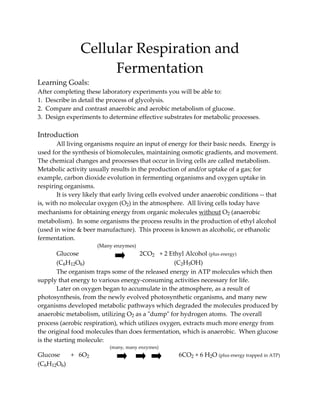
  It is very likely that early living cells evolved under anaerobic conditions ‐‐ that 
is, with no molecular oxygen (O2) in the atmosphere.  All living cells today have 
mechanisms for obtaining energy from organic molecules without O2 (anaerobic 
metabolism).  In some organisms the process results in the production of ethyl alcohol 
(used in wine & beer manufacture).  This process is known as alcoholic, or ethanolic 
fermentation. 
                                    (Many enzymes)  
  Glucose                               2CO2    + 2 Ethyl Alcohol (plus energy) 
  (C6H12O6)                                       (C2H5OH) 
  The organism traps some of the released energy in ATP molecules which then 
supply that energy to various energy‐consuming activities necessary for life. 
  Later on oxygen began to accumulate in the atmosphere, as a result of 
photosynthesis, from the newly evolved photosynthetic organisms, and many new 
organisms developed metabolic pathways which degraded the molecules produced by 
anaerobic metabolism, utilizing O2 as a ʺdumpʺ for hydrogen atoms.  The overall 
process (aerobic respiration), which utilizes oxygen, extracts much more energy from 
the original food molecules than does fermentation, which is anaerobic.  When glucose 
is the starting molecule: 
                                              (many, many enzymes) 
Glucose       +   6O2                  6CO2 + 6 H2O (plus energy trapped in ATP) 
(C6H12O6) 
Procedure: Effect of pH on the Rate of Fermentation in Yeast.   
  In this lab exercise, you will study the effect of pH on the rate of the overall 
process of anaerobic fermentation, using a solution of glucose and yeast organisms in 
various buffers each with a different pH.  As a measure of the rate of the reaction, you 
will be measuring the amount of CO2 produced. 
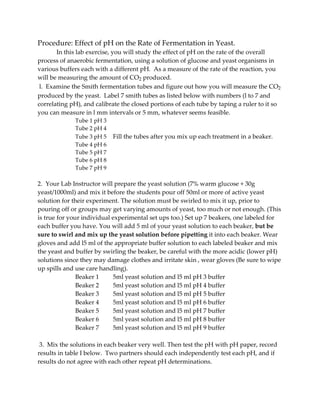
l.  Examine the Smith fermentation tubes and figure out how you will measure the CO2 
produced by the yeast.  Label 7 smith tubes as listed below with numbers (l to 7 and 
correlating pH), and calibrate the closed portions of each tube by taping a ruler to it so 
you can measure in l mm intervals or 5 mm, whatever seems feasible.       
    Tube 1 pH 3  
    Tube 2 pH 4  
    Tube 3 pH 5  Fill the tubes after you mix up each treatment in a beaker. 
    Tube 4 pH 6  
    Tube 5 pH 7    
    Tube 6 pH 8    
    Tube 7 pH 9    
   
2.  Your Lab Instructor will prepare the yeast solution (7% warm glucose + 30g 
yeast/1000ml) and mix it before the students pour off 50ml or more of active yeast 
solution for their experiment. The solution must be swirled to mix it up, prior to 
pouring off or groups may get varying amounts of yeast, too much or not enough. (This 
is true for your individual experimental set ups too.) Set up 7 beakers, one labeled for 
each buffer you have. You will add 5 ml of your yeast solution to each beaker, but be 
sure to swirl and mix up the yeast solution before pipetting it into each beaker. Wear 
gloves and add l5 ml of the appropriate buffer solution to each labeled beaker and mix 
the yeast and buffer by swirling the beaker, be careful with the more acidic (lower pH) 
solutions since they may damage clothes and irritate skin , wear gloves (Be sure to wipe 
up spills and use care handling). 
    Beaker 1   5ml yeast solution and l5 ml pH 3 buffer 
    Beaker 2   5ml yeast solution and l5 ml pH 4 buffer 
    Beaker 3  5ml yeast solution and l5 ml pH 5 buffer 
    Beaker 4   5ml yeast solution and l5 ml pH 6 buffer 
    Beaker 5   5ml yeast solution and l5 ml pH 7 buffer 
    Beaker 6  5ml yeast solution and l5 ml pH 8 buffer 
    Beaker 7   5ml yeast solution and l5 ml pH 9 buffer 
 
 3.  Mix the solutions in each beaker very well. Then test the pH with pH paper, record 
results in table I below.  Two partners should each independently test each pH, and if 
results do not agree with each other repeat pH determinations. 
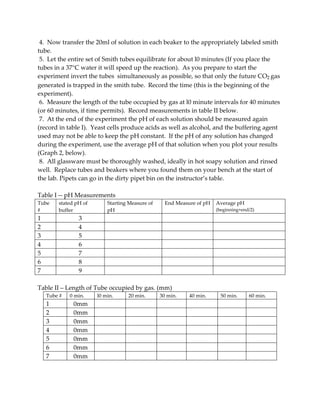
 4.  Now transfer the 20ml of solution in each beaker to the appropriately labeled smith 
tube.   
 5.  Let the entire set of Smith tubes equilibrate for about l0 minutes (If you place the 
tubes in a 37°C water it will speed up the reaction).  As you prepare to start the 
experiment invert the tubes  simultaneously as possible, so that only the future CO2 gas 
generated is trapped in the smith tube.  Record the time (this is the beginning of the 
experiment).   
 6.  Measure the length of the tube occupied by gas at l0 minute intervals for 40 minutes 
(or 60 minutes, if time permits).  Record measurements in table II below. 
 7.  At the end of the experiment the pH of each solution should be measured again 
(record in table I).  Yeast cells produce acids as well as alcohol, and the buffering agent 
used may not be able to keep the pH constant.  If the pH of any solution has changed 
during the experiment, use the average pH of that solution when you plot your results 
(Graph 2, below). 
 8.  All glassware must be thoroughly washed, ideally in hot soapy solution and rinsed 
well.  Replace tubes and beakers where you found them on your bench at the start of 
the lab. Pipets can go in the dirty pipet bin on the instructor’s table.  
 
Table I ‐‐ pH Measurements                                
Tube 
# 
stated pH of 
buffer 
Starting Measure of 
pH  
End Measure of pH Average pH 
(beginning+end/2) 
1  3       
2  4       
3  5       
4  6       
5  7       
6  8       
7  9       
 
Table II – Length of Tube occupied by gas. (mm) 
Tube #   0 min.    l0 min.  20 min.  30 min.  40 min.  50 min.  60 min.  
1  0mm             
2  0mm             
3  0mm             
4  0mm             
5  0mm             
6  0mm             
7  0mm             
 
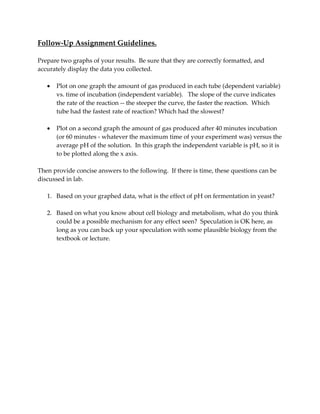
Follow‐Up Assignment Guidelines.     
 
Prepare two graphs of your results.  Be sure that they are correctly formatted, and 
accurately display the data you collected.   
 
• Plot on one graph the amount of gas produced in each tube (dependent variable) 
vs. time of incubation (independent variable).   The slope of the curve indicates 
the rate of the reaction ‐‐ the steeper the curve, the faster the reaction.  Which 
tube had the fastest rate of reaction? Which had the slowest? 
 
• Plot on a second graph the amount of gas produced after 40 minutes incubation 
(or 60 minutes ‐ whatever the maximum time of your experiment was) versus the 
average pH of the solution.  In this graph the independent variable is pH, so it is 
to be plotted along the x axis. 
 
Then provide concise answers to the following.  If there is time, these questions can be 
discussed in lab. 
 
1. Based on your graphed data, what is the effect of pH on fermentation in yeast? 
 
2. Based on what you know about cell biology and metabolism, what do you think 
could be a possible mechanism for any effect seen?  Speculation is OK here, as 
long as you can back up your speculation with some plausible biology from the 
textbook or lecture. 


Cellular respiration and fermentation