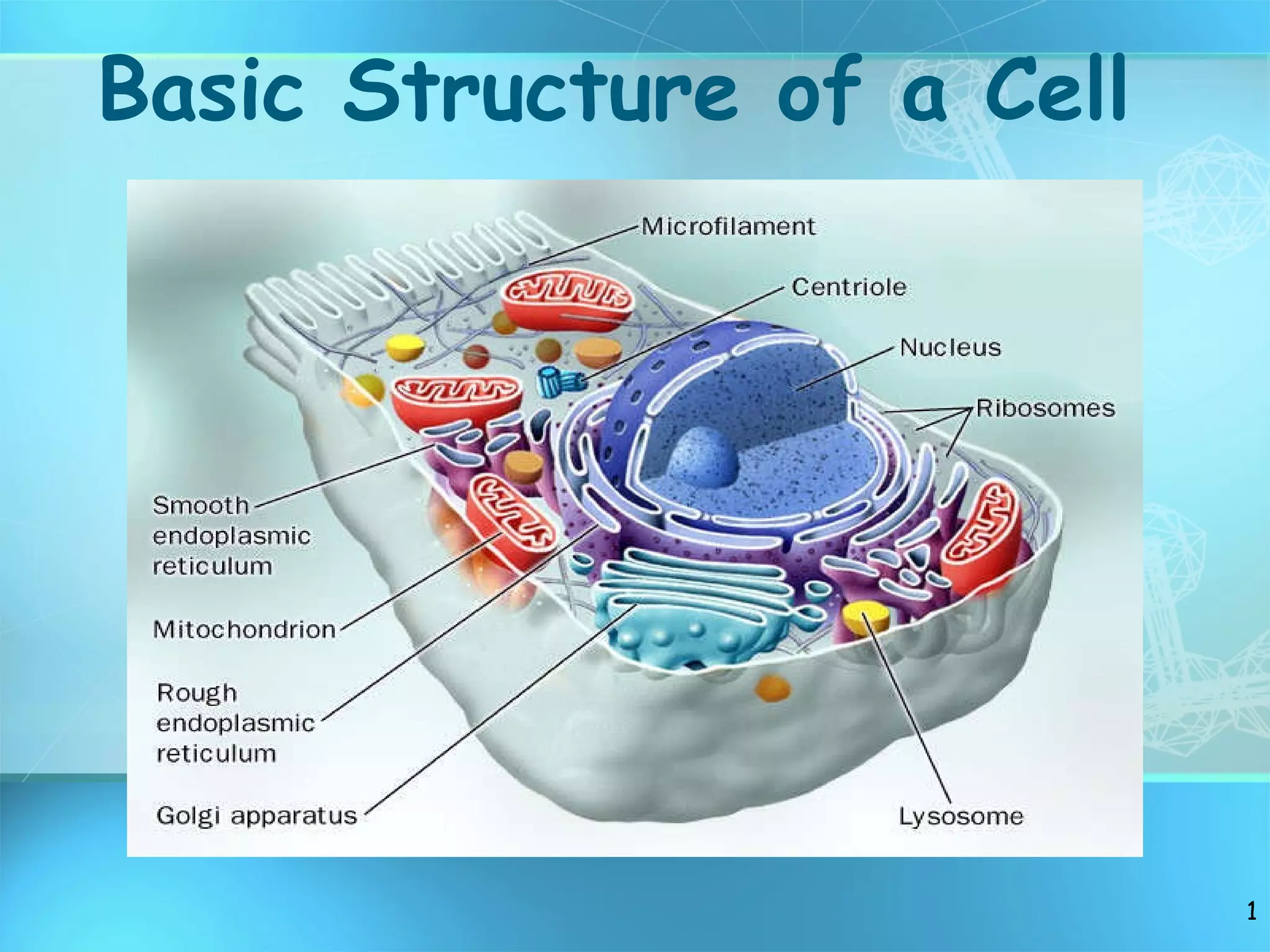
Basic Structure of a Cell
Review Facts About Living Things
What Are the Main Characteristics of organisms? Made of  CELLS Require  ENERGY  (food) REPRODUCE  (species) Maintain  HOMEOSTASIS ORGANIZED RESPOND  to environment GROW  and  DEVELOP EXCHANGE  materials with surroundings (water, wastes, gases)
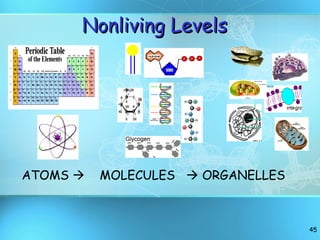
LEVELS OF ORGANIZATION Nonliving Levels: ATOM  (element) MOLECULE  (compounds like carbohydrates & proteins) ORGANELLES  (nucleus, ER, Golgi …)
LEVELS OF ORGANIZATION Living Levels: CELL  (makes up ALL organisms) TISSUE  (cells working together ORGAN  (heart, brain, stomach …) ORGAN SYSTEMS  (respiratory, circulatory …) ORGANISM
LEVELS OF ORGANIZATION Living Levels continued: POPULATION  (one species in an area) COMMUNITY  (several populations in an area ECOSYSTEM  (forest, prairie …) BIOME  (Tundra, Tropical Rain forest…) BIOSPHERE  (all living and nonliving things on Earth)
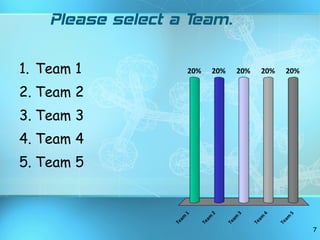
Please select a Team. Team 1 Team 2 Team 3 Team 4 Team 5
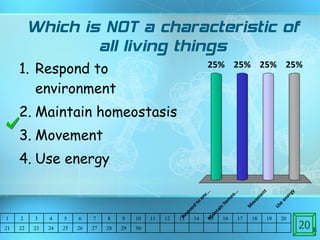
Which is NOT a characteristic of all living things Respond to environment Maintain homeostasis Movement Use energy 1 2 3 4 5 6 7 8 9 10 11 12 13 14 15 16 17 18 19 20 21 22 23 24 25 26 27 28 29 30 20
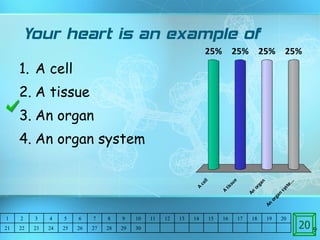
Your heart is an example of A cell A tissue An organ An organ system 20 1 2 3 4 5 6 7 8 9 10 11 12 13 14 15 16 17 18 19 20 21 22 23 24 25 26 27 28 29 30
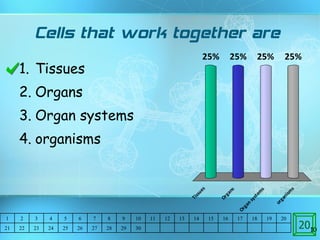
Cells that work together are Tissues  Organs Organ systems organisms 20 1 2 3 4 5 6 7 8 9 10 11 12 13 14 15 16 17 18 19 20 21 22 23 24 25 26 27 28 29 30
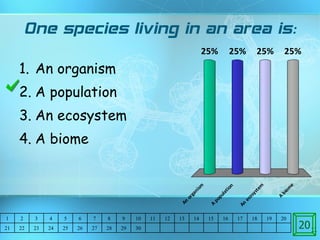
One species living in an area is: An organism A population An ecosystem A biome 20 1 2 3 4 5 6 7 8 9 10 11 12 13 14 15 16 17 18 19 20 21 22 23 24 25 26 27 28 29 30
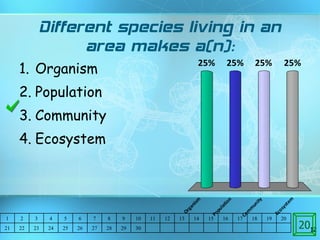
Different species living in an area makes a(n): Organism Population Community Ecosystem 20 1 2 3 4 5 6 7 8 9 10 11 12 13 14 15 16 17 18 19 20 21 22 23 24 25 26 27 28 29 30
Team Scores 0 Team 1 0 Team 2 0 Team 3 0 Team 4 0 Team 5
Team MVP Points Team Participant 0 Team Participant 0 Team Participant 0 Team Participant 0 Team Participant 0 Team Participant 0 Team Participant 0 Team Participant 0 Team Participant 0 Team Participant 0 Team Participant
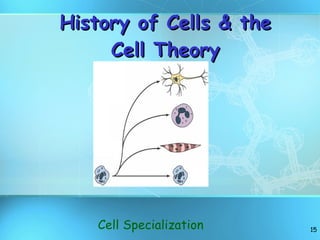
History of Cells & the Cell Theory Cell Specialization
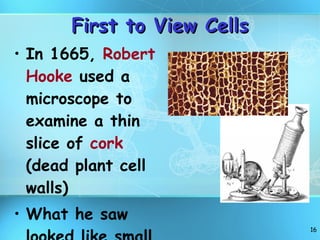
First to View Cells In 1665,  Robert Hooke  used a microscope to  examine a thin slice of  cork  (dead plant cell walls) What he saw looked like small boxes
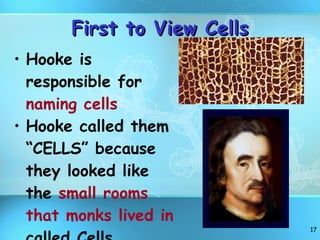
First to View Cells Hooke is responsible for  naming cells Hooke called them “CELLS” because they looked like the  small rooms that monks lived in  called Cells
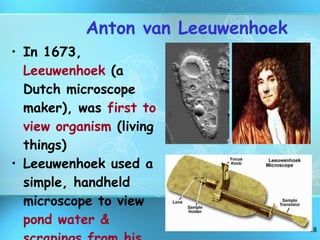
Anton van Leeuwenhoek In 1673,  Leeuwenhoek  (a Dutch microscope maker), was  first to view organism  (living things) Leeuwenhoek used a simple, handheld microscope to view  pond water & scrapings from his teeth
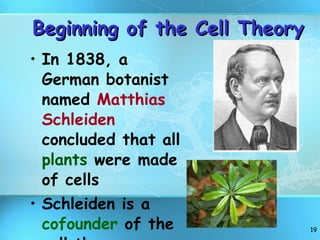
Beginning of the Cell Theory In 1838, a German botanist named  Matthias Schleiden  concluded that all  plants  were made of cells Schleiden is a  cofounder  of the cell theory
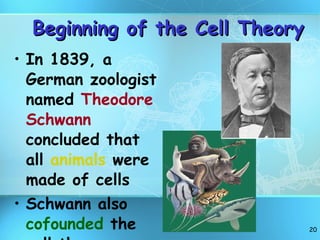
Beginning of the Cell Theory In 1839, a German zoologist named  Theodore Schwann  concluded that all  animals  were made of cells Schwann also  cofounded  the cell theory
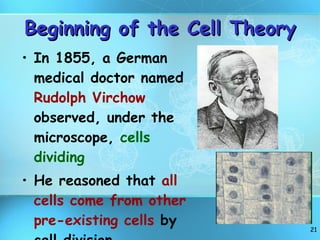
Beginning of the Cell Theory In 1855, a German medical doctor named  Rudolph Virchow  observed, under the microscope,  cells dividing He reasoned that  all cells come from other pre-existing cells  by cell division
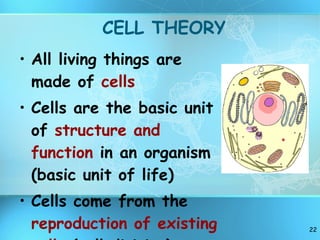
CELL THEORY All living things are made of  cells Cells are the basic unit of  structure and function  in an organism (basic unit of life) Cells come from the  reproduction of existing cells  (cell division)
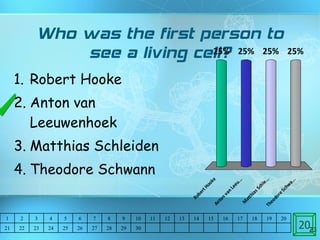
Who was the first person to see a living cell? Robert Hooke Anton van Leeuwenhoek Matthias Schleiden Theodore Schwann 20 1 2 3 4 5 6 7 8 9 10 11 12 13 14 15 16 17 18 19 20 21 22 23 24 25 26 27 28 29 30
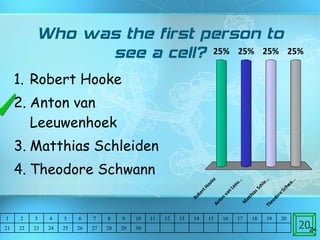
Who was the first person to see a cell? Robert Hooke Anton van Leeuwenhoek Matthias Schleiden Theodore Schwann 20 1 2 3 4 5 6 7 8 9 10 11 12 13 14 15 16 17 18 19 20 21 22 23 24 25 26 27 28 29 30
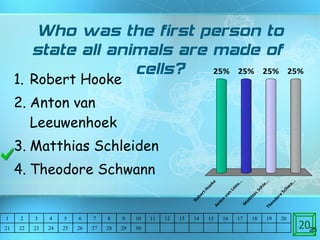
Who was the first person to state all animals are made of  cells? Robert Hooke Anton van Leeuwenhoek Matthias Schleiden Theodore Schwann 20 1 2 3 4 5 6 7 8 9 10 11 12 13 14 15 16 17 18 19 20 21 22 23 24 25 26 27 28 29 30
Team MVP Points Team Participant 0 Team Participant 0 Team Participant 0 Team Participant 0 Team Participant 0 Team Participant 0 Team Participant 0 Team Participant 0 Team Participant 0 Team Participant 0 Team Participant
Team Scores 0 Team 1 0 Team 2 0 Team 3 0 Team 4 0 Team 5
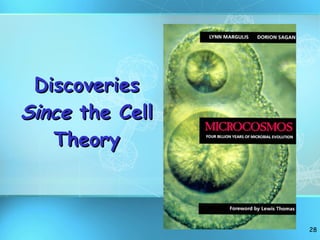
Discoveries  Since  the Cell Theory
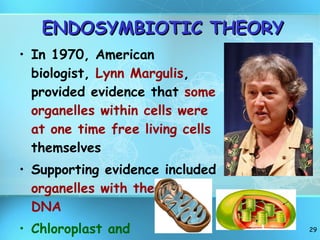
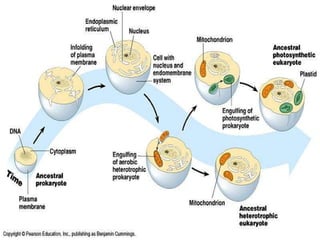
ENDOSYMBIOTIC THEORY In 1970, American biologist,  Lynn Margulis , provided evidence that  some organelles within cells were at one time free living cells  themselves Supporting evidence included  organelles with their own DNA Chloroplast and Mitochondria
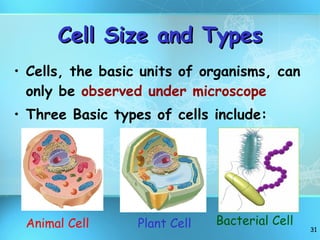
Cell Size and Types Cells, the basic units of organisms, can only be  observed under microscope Three Basic types of cells include: Animal Cell Plant Cell Bacterial Cell
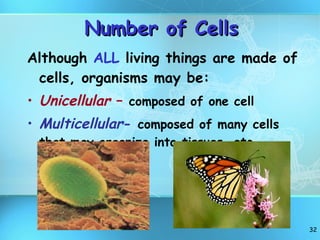
Number of Cells Although  ALL  living things are made of cells, organisms may be: Unicellular  –  composed of one cell Multicellular -  composed of many cells that may organize into tissues, etc.
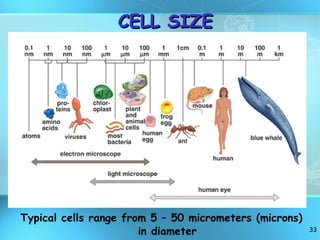
CELL SIZE Typical cells range from 5 – 50 micrometers (microns) in diameter
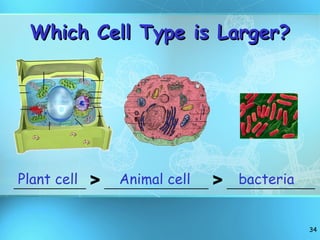
Which Cell Type is Larger? _________  >  _____________  >  ___________ Plant cell Animal cell bacteria
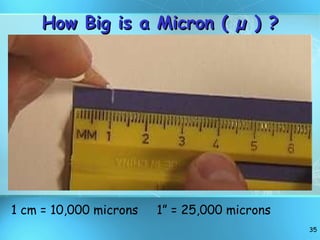
How Big is a Micron ( µ ) ? 1 cm = 10,000 microns  1” = 25,000 microns
Cell Size Question: Are the cells in an elephant bigger, smaller, or about the same size as those in a mouse?
Factors Affecting Cell Size Surface area (plasma membrane  surface) is determined by multiplying length times width (L x W) Volume of a cell  (inside the cell) is determined by multiplying length times width times height (L x W x H) Therefore,  Volume increases FASTER than the surface area
Cell Size When the surface area is no longer great enough to get rid of all the wastes and to get in enough food and water,  then the cell must divide Therefore, the cells of an organism are close in size
Cell Size Question: Are the cells in an elephant bigger, smaller, or about the same size as those in a mouse? About the same size, but … The elephant has MANY MORE cells than a mouse!
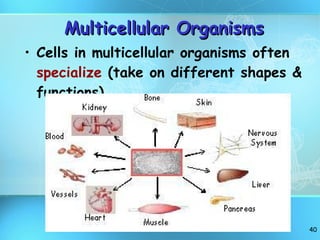
Multicellular Organisms Cells in multicellular organisms often  specialize  (take on different shapes & functions)
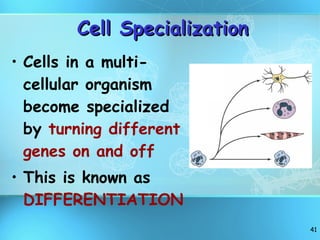
Cell Specialization Cells in a multi-cellular organism become specialized by  turning different genes on and off This is known as  DIFFERENTIATION
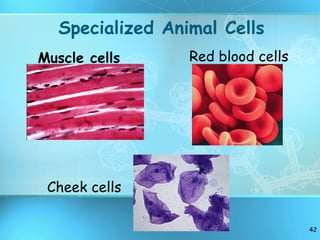
Specialized Animal Cells Muscle cells Red blood cells Cheek cells
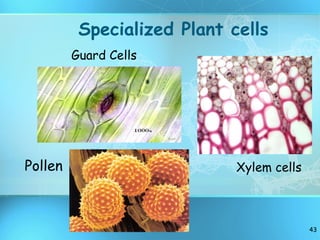
Specialized Plant cells Xylem cells Pollen Guard Cells
Organization Levels of Life Atoms to Organisms
ATOMS     MOLECULES    ORGANELLES Nonliving Levels
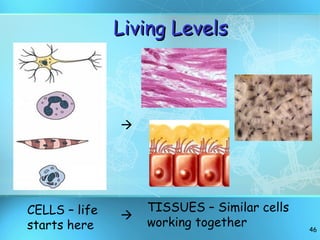
CELLS – life starts here TISSUES – Similar cells working together Living Levels  
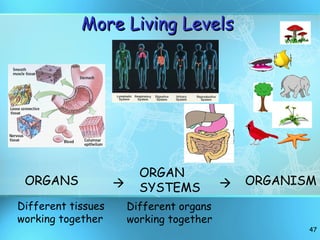
ORGANS ORGAN  SYSTEMS ORGANISM Different tissues working together Different organs working together   More Living Levels
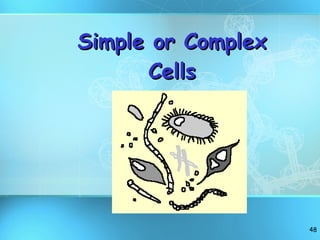
Simple or Complex Cells
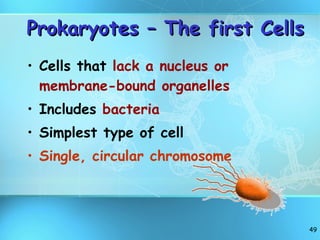
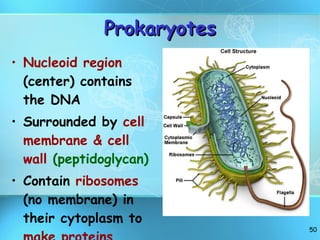
Prokaryotes – The first Cells Cells that  lack a nucleus or membrane-bound organelles Includes  bacteria Simplest type of cell Single, circular chromosome
Prokaryotes Nucleoid region  (center) contains the DNA Surrounded by  cell membrane & cell wall   (peptidoglycan) Contain  ribosomes  (no membrane)   in their cytoplasm to  make proteins
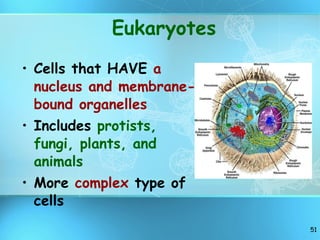
Eukaryotes Cells that HAVE  a nucleus and membrane-bound organelles Includes  protists, fungi, plants, and animals More  complex  type of cells
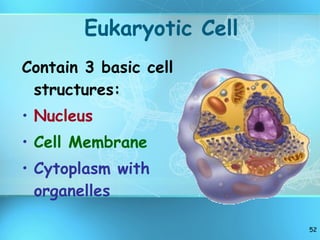
Eukaryotic Cell Contain 3 basic cell structures: Nucleus Cell Membrane Cytoplasm with organelles
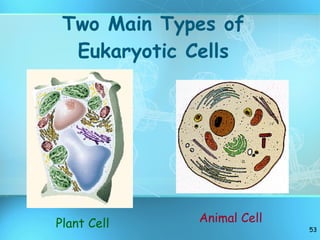
Two Main Types of Eukaryotic Cells Plant Cell Animal Cell
Organelles
Organelles Very  small  (Microscopic) Perform  various functions  for a cell Found in the  cytoplasm May or may not be  membrane-bound
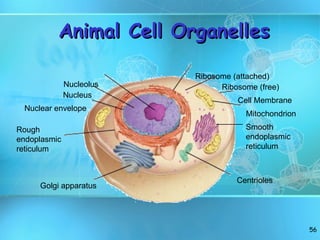
Animal Cell Organelles Nucleolus Nucleus Nuclear envelope Ribosome (attached) Ribosome (free) Cell Membrane Rough  endoplasmic  reticulum Golgi apparatus Mitochondrion Smooth  endoplasmic reticulum Centrioles
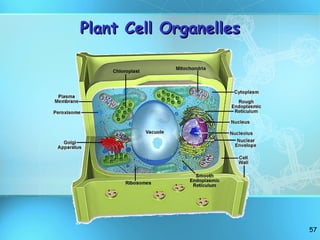
Plant Cell Organelles
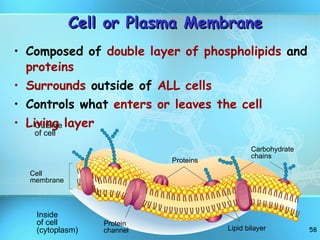
Cell or Plasma Membrane Composed of  double layer of phospholipids  and  proteins Surrounds  outside of  ALL cells Controls what  enters or leaves the cell Living layer Outside of cell Inside of cell (cytoplasm) Cell membrane Proteins Protein channel Lipid bilayer Carbohydrate chains
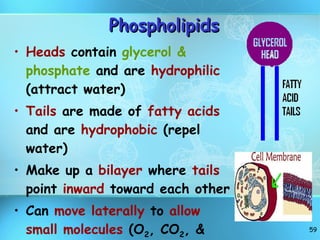
Phospholipids Heads  contain  glycerol & phosphate  and are  hydrophilic  (attract water) Tails  are made of  fatty acids  and are  hydrophobic  (repel water) Make up a  bilayer  where  tails  point  inward  toward each other Can  move laterally  to  allow small molecules  (O 2 , CO 2 , & H 2 O to enter)
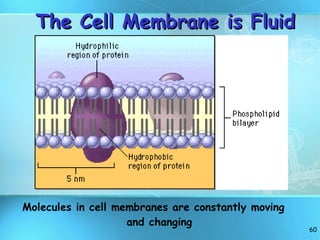
The Cell Membrane is Fluid Molecules in cell membranes are constantly moving and changing
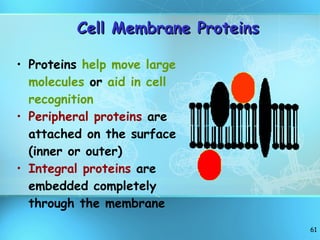
Cell Membrane Proteins Proteins  help move large molecules  or  aid in cell recognition Peripheral proteins  are attached on the surface (inner or outer) Integral proteins  are embedded completely through the membrane
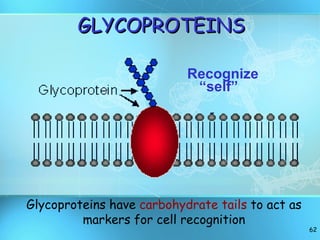
Recognize “self” GLYCOPROTEINS Glycoproteins have  carbohydrate tails  to act as markers for cell recognition
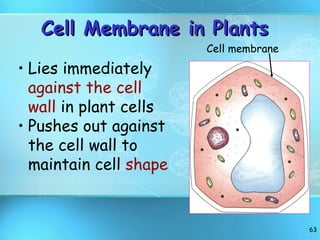
Cell Membrane in Plants Lies immediately  against the cell wall  in plant cells Pushes out against the cell wall to maintain cell  shape Cell membrane
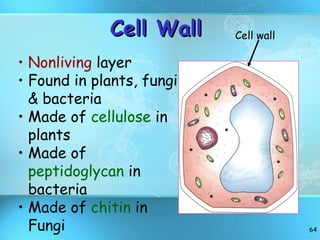
Cell Wall Nonliving  layer Found in plants, fungi, & bacteria Made of  cellulose  in plants Made of  peptidoglycan  in bacteria Made of  chitin  in Fungi Cell wall
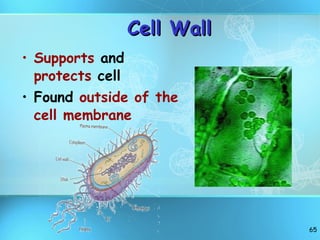
Cell Wall Supports  and  protects  cell Found  outside of the cell membrane
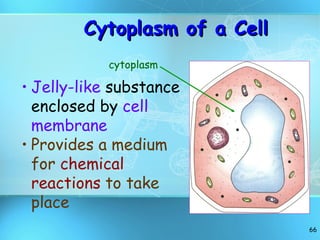
Cytoplasm of a Cell  Jelly-like  substance enclosed   by  cell membrane Provides a medium for  chemical reactions  to take place cytoplasm
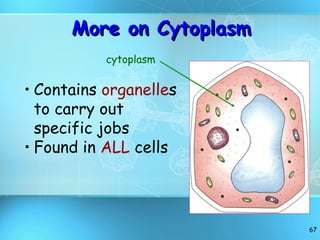
More on Cytoplasm Contains  organelle s to carry out specific jobs Found in  ALL  cells cytoplasm
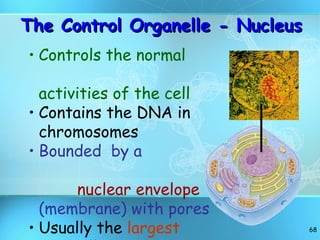
The Control Organelle - Nucleus Controls the normal  activities of the cell Contains the DNA in chromosomes Bounded  by a  nuclear envelope  (membrane) with pores Usually the  largest  organelle
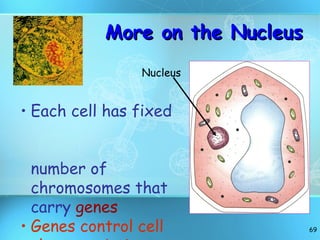
More on the Nucleus Each cell has fixed  number of chromosomes that carry  genes Genes control cell characteristics Nucleus
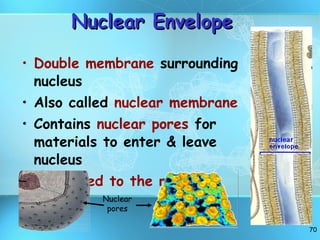
Nuclear Envelope Double membrane  surrounding nucleus Also called  nuclear membrane Contains  nuclear pores  for materials to enter & leave nucleus Connected to the rough ER Nuclear pores
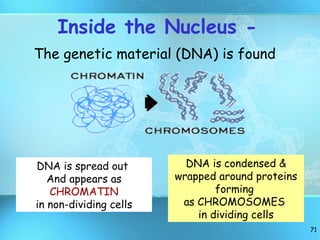
Inside the Nucleus - The genetic material (DNA) is found DNA is spread out  And appears as  CHROMATIN in non-dividing cells DNA is condensed & wrapped around proteins forming  as CHROMOSOMES  in dividing cells
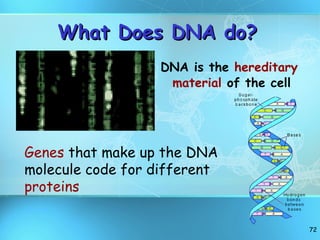
What Does DNA do? DNA is the  hereditary material  of the cell Genes  that make up the DNA molecule code for different  proteins
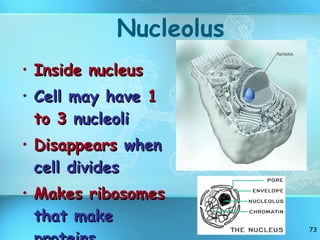
Nucleolus Inside nucleus Cell may have  1 to 3  nucleoli Disappears  when cell divides Makes ribosomes  that make proteins
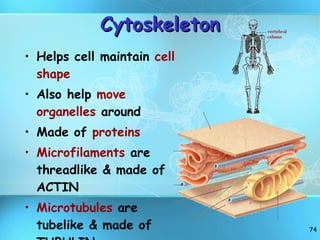
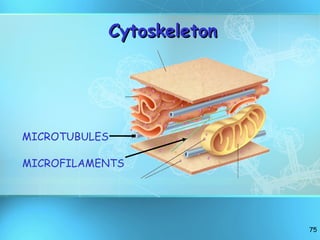
Cytoskeleton Helps cell maintain  cell shape Also help  move organelles  around Made of  proteins Microfilaments  are threadlike & made of ACTIN Microtubules  are tubelike & made of TUBULIN
Cytoskeleton MICROTUBULES MICROFILAMENTS
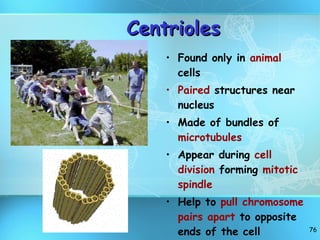
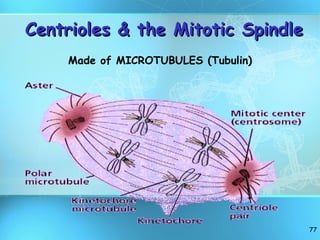
Centrioles Found only in  animal  cells Paired  structures near nucleus Made of bundles of  microtubules Appear during  cell division  forming  mitotic spindle Help to  pull chromosome pairs apart  to opposite ends of the cell
Centrioles & the Mitotic Spindle Made of MICROTUBULES (Tubulin)
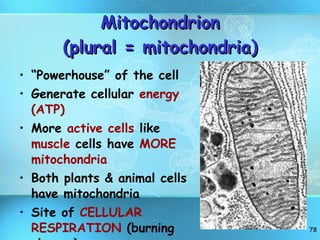
Mitochondrion (plural = mitochondria) “ Powerhouse” of the cell Generate cellular  energy (ATP) More  active cells  like  muscle  cells have  MORE mitochondria Both plants & animal cells have mitochondria Site of  CELLULAR RESPIRATION  (burning glucose)
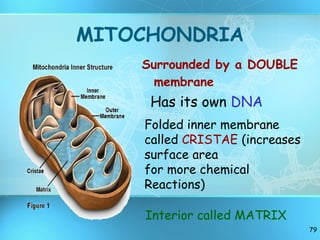
MITOCHONDRIA Surrounded by a DOUBLE membrane Folded inner membrane called  CRISTAE  (increases surface area for more chemical  Reactions) Has its own  DNA Interior called MATRIX
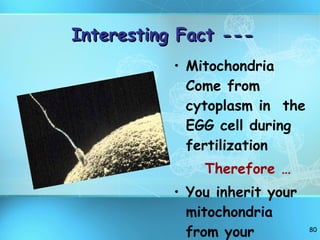
Interesting Fact --- Mitochondria Come from cytoplasm in  the EGG cell during fertilization  Therefore … You inherit your mitochondria from your mother !
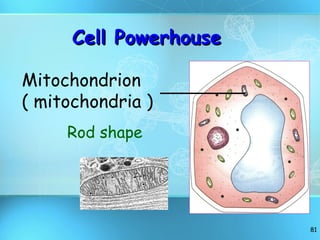
Cell Powerhouse Rod shape Mitochondrion ( mitochondria )
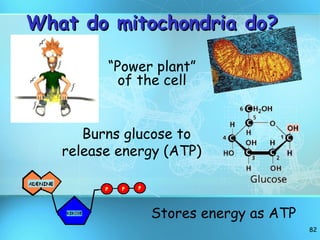
What do mitochondria do? Burns glucose to  release energy (ATP)  Stores energy as ATP “ Power plant” of the cell
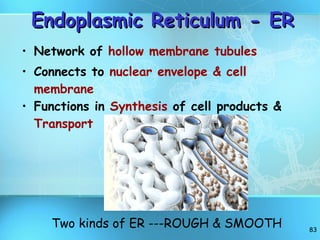
Endoplasmic Reticulum - ER Network of  hollow membrane tubules Connects to  nuclear envelope & cell membrane Functions in  Synthesis  of cell products &  Transport Two kinds of ER ---ROUGH & SMOOTH
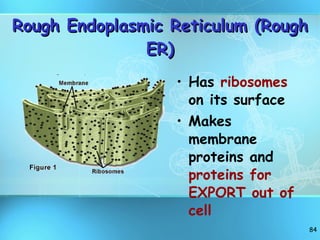
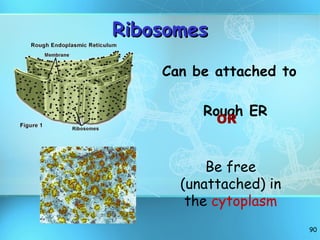
Rough Endoplasmic Reticulum (Rough ER) Has  ribosomes  on its surface  Makes membrane proteins and  proteins for EXPORT out of cell
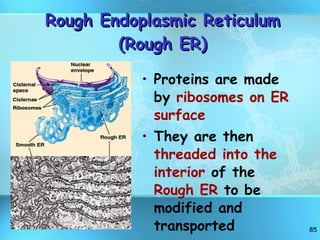
Rough Endoplasmic Reticulum (Rough ER) Proteins are made by  ribosomes on ER surface They are then  threaded into the interior  of the  Rough ER  to be modified and  transported
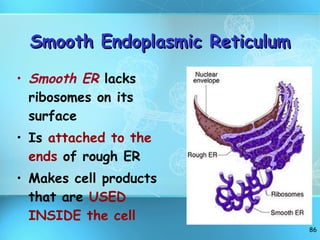
Smooth Endoplasmic Reticulum Smooth ER   lacks ribosomes on its surface Is  attached to the ends  of rough ER Makes cell products that are  USED INSIDE the cell
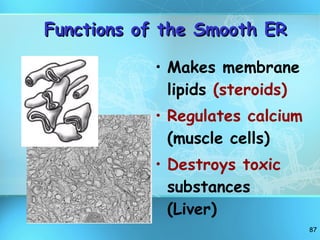
Functions of the Smooth ER Makes membrane lipids  (steroids) Regulates calcium  (muscle cells) Destroys toxic  substances (Liver)
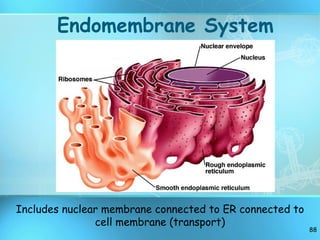
Endomembrane System Includes nuclear membrane connected to ER connected to cell membrane (transport)
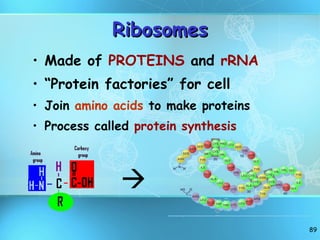
Ribosomes Made of  PROTEINS  and  rRNA “ Protein factories” for cell Join  amino acids  to make proteins Process called  protein synthesis 
Ribosomes Can be attached to  Rough ER OR Be free (unattached) in the  cytoplasm
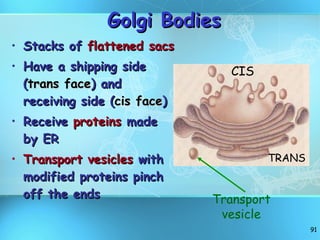
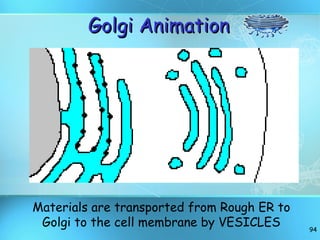
Golgi Bodies Stacks of  flattened sacs Have a shipping side ( trans face ) and receiving side ( cis face ) Receive  proteins  made by ER Transport vesicles  with modified proteins pinch off the ends Transport vesicle CIS TRANS
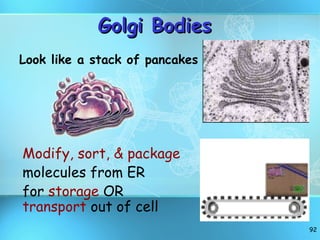
Golgi Bodies Look like a stack of pancakes Modify, sort, & package molecules from ER for  storage  OR  transport  out of cell
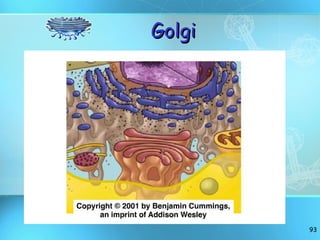
Golgi
Golgi Animation Materials are transported from Rough ER to Golgi to the cell membrane by VESICLES
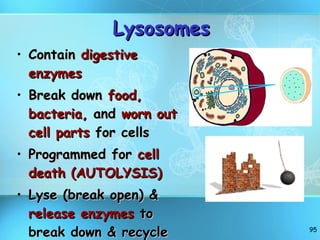
Lysosomes Contain  digestive enzymes Break down  food, bacteria,  and  worn out cell parts  for cells  Programmed for  cell death (AUTOLYSIS) Lyse (break open) &  release enzymes  to break down & recycle cell parts)
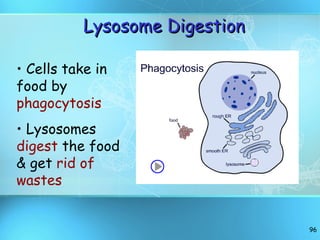
Lysosome Digestion Cells take in food by  phagocytosis Lysosomes  digest  the food & get  rid of wastes
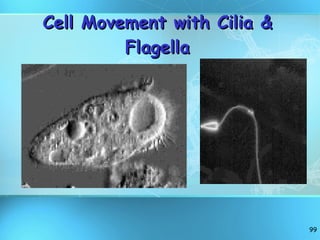
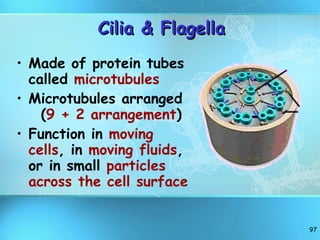
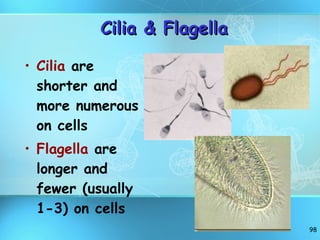
Cilia & Flagella Made of protein tubes called  microtubules   Microtubules arranged  ( 9 + 2 arrangement ) Function in  moving cells , in  moving fluids , or in small  particles across the cell surface
Cilia & Flagella Cilia  are shorter and more numerous on cells Flagella  are longer and fewer (usually 1-3) on cells
Cell Movement with Cilia & Flagella
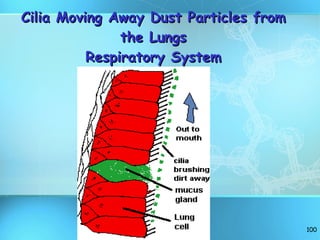
Cilia Moving Away Dust Particles from the Lungs Respiratory System
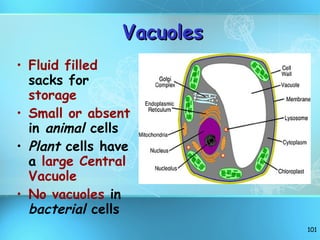
Vacuoles Fluid filled  sacks for  storage Small or absent  in  animal  cells Plant  cells have a  large Central Vacuole No vacuoles  in  bacterial  cells
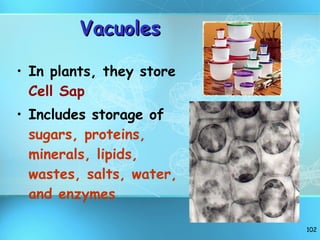
Vacuoles In plants, they store  Cell Sap Includes storage of  sugars, proteins, minerals, lipids, wastes, salts, water, and enzymes
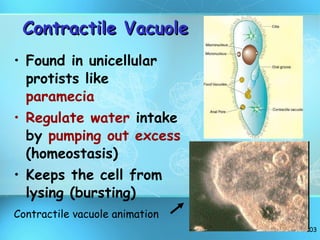
Contractile Vacuole Found in unicellular protists like  paramecia Regulate water  intake by  pumping out excess  (homeostasis) Keeps the cell from lysing (bursting) Contractile vacuole animation
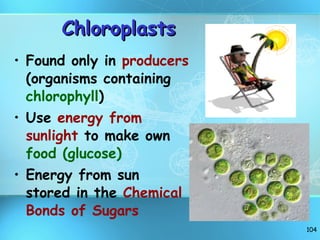
Chloroplasts Found only in  producers  (organisms containing  chlorophyll ) Use  energy from sunlight  to make own  food (glucose) Energy from sun stored in the  Chemical Bonds of Sugars
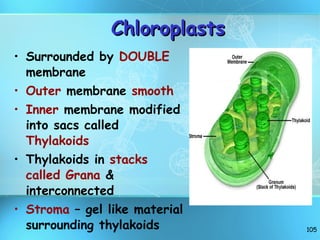
Chloroplasts Surrounded by  DOUBLE  membrane Outer  membrane  smooth Inner  membrane modified into sacs called  Thylakoids Thylakoids in  stacks called Grana  & interconnected Stroma  – gel like material surrounding thylakoids
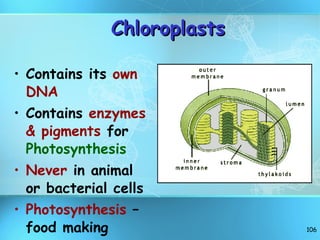
Chloroplasts Contains its  own DNA Contains  enzymes & pigments  for  Photosynthesis Never  in animal or bacterial cells Photosynthesis  – food making process
Please select a Team. Team 1 Team 2 Team 3 Team 4 Team 5
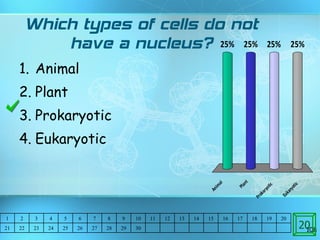
Which types of cells do not have a nucleus? Animal Plant Prokaryotic Eukaryotic 20 1 2 3 4 5 6 7 8 9 10 11 12 13 14 15 16 17 18 19 20 21 22 23 24 25 26 27 28 29 30
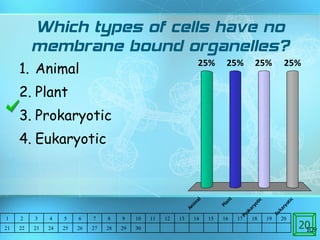
Which types of cells have no membrane bound organelles? Animal Plant Prokaryotic Eukaryotic 20 1 2 3 4 5 6 7 8 9 10 11 12 13 14 15 16 17 18 19 20 21 22 23 24 25 26 27 28 29 30
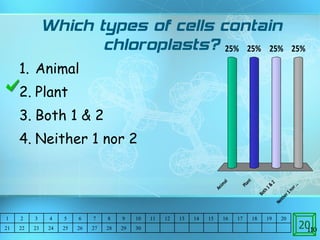
Which types of cells contain chloroplasts? Animal Plant Both 1 & 2 Neither 1 nor 2 20 1 2 3 4 5 6 7 8 9 10 11 12 13 14 15 16 17 18 19 20 21 22 23 24 25 26 27 28 29 30
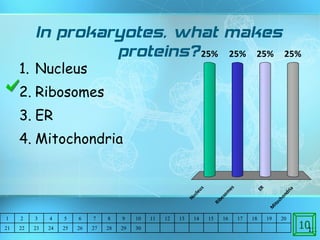
In prokaryotes, what makes proteins? Nucleus Ribosomes ER Mitochondria 10 1 2 3 4 5 6 7 8 9 10 11 12 13 14 15 16 17 18 19 20 21 22 23 24 25 26 27 28 29 30
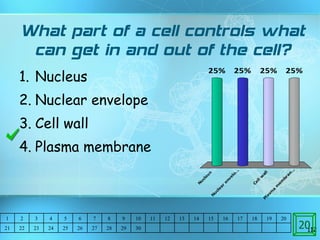
What part of a cell controls what can get in and out of the cell? Nucleus Nuclear envelope Cell wall  Plasma membrane 20 1 2 3 4 5 6 7 8 9 10 11 12 13 14 15 16 17 18 19 20 21 22 23 24 25 26 27 28 29 30
Team Scores 0 Team 1 0 Team 2 0 Team 3 0 Team 4 0 Team 5
Team MVP Points Team Participant 0 Team Participant 0 Team Participant 0 Team Participant 0 Team Participant 0 Team Participant 0 Team Participant 0 Team Participant 0 Team Participant 0 Team Participant 0 Team Participant
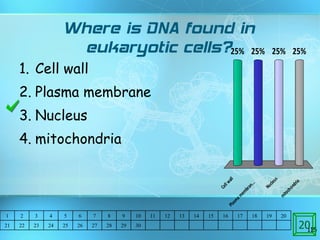
Where is DNA found in eukaryotic cells? Cell wall Plasma membrane Nucleus mitochondria 20 1 2 3 4 5 6 7 8 9 10 11 12 13 14 15 16 17 18 19 20 21 22 23 24 25 26 27 28 29 30
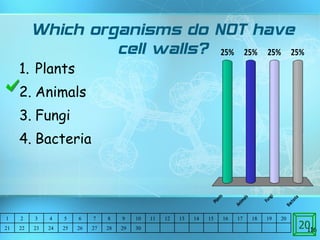
Which organisms do NOT have cell walls? Plants Animals Fungi Bacteria  20 1 2 3 4 5 6 7 8 9 10 11 12 13 14 15 16 17 18 19 20 21 22 23 24 25 26 27 28 29 30
What organelle helps keep cell shape and mover organelles? ER Nucleus Ribosomes Cytoskeleton  20 1 2 3 4 5 6 7 8 9 10 11 12 13 14 15 16 17 18 19 20 21 22 23 24 25 26 27 28 29 30
Which organelle makes cell products and transports them? ER Nucleus Ribosomes Mitochondria 20 1 2 3 4 5 6 7 8 9 10 11 12 13 14 15 16 17 18 19 20 21 22 23 24 25 26 27 28 29 30
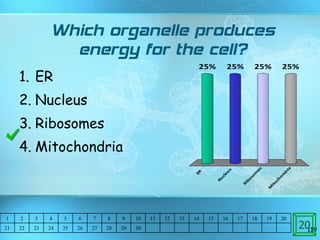
Which organelle produces energy for the cell? ER Nucleus Ribosomes Mitochondria 20 1 2 3 4 5 6 7 8 9 10 11 12 13 14 15 16 17 18 19 20 21 22 23 24 25 26 27 28 29 30
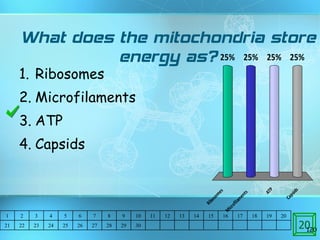
What does the mitochondria store energy as? Ribosomes Microfilaments ATP Capsids 20 1 2 3 4 5 6 7 8 9 10 11 12 13 14 15 16 17 18 19 20 21 22 23 24 25 26 27 28 29 30
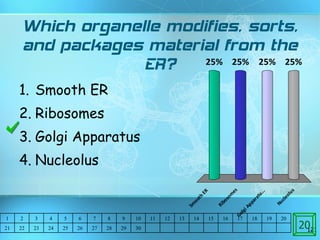
Which organelle modifies, sorts, and packages material from the ER? Smooth ER Ribosomes Golgi Apparatus Nucleolus  20 1 2 3 4 5 6 7 8 9 10 11 12 13 14 15 16 17 18 19 20 21 22 23 24 25 26 27 28 29 30
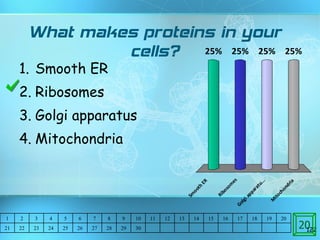
What makes proteins in your cells? Smooth ER Ribosomes Golgi apparatus Mitochondria  20 1 2 3 4 5 6 7 8 9 10 11 12 13 14 15 16 17 18 19 20 21 22 23 24 25 26 27 28 29 30
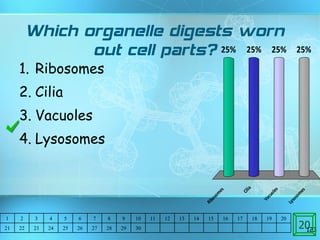
Which organelle digests worn out cell parts? Ribosomes Cilia Vacuoles Lysosomes 20 1 2 3 4 5 6 7 8 9 10 11 12 13 14 15 16 17 18 19 20 21 22 23 24 25 26 27 28 29 30
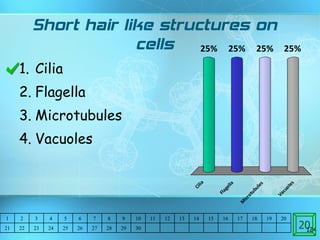
Short hair like structures on cells Cilia Flagella Microtubules Vacuoles  20 1 2 3 4 5 6 7 8 9 10 11 12 13 14 15 16 17 18 19 20 21 22 23 24 25 26 27 28 29 30
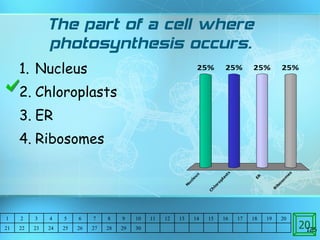
The part of a cell where photosynthesis occurs. Nucleus Chloroplasts ER Ribosomes  20 1 2 3 4 5 6 7 8 9 10 11 12 13 14 15 16 17 18 19 20 21 22 23 24 25 26 27 28 29 30
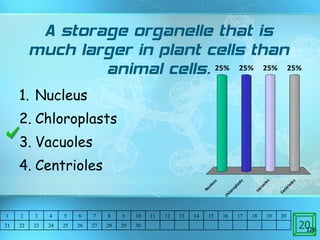
A storage organelle that is much larger in plant cells than animal cells. Nucleus Chloroplasts Vacuoles Centrioles 1 2 3 4 5 6 7 8 9 10 11 12 13 14 15 16 17 18 19 20 21 22 23 24 25 26 27 28 29 30 20
Team MVP Points Team Participant 0 Team Participant 0 Team Participant 0 Team Participant 0 Team Participant 0 Team Participant 0 Team Participant 0 Team Participant 0 Team Participant 0 Team Participant 0 Team Participant
Team Scores 0 Team 1 0 Team 2 0 Team 3 0 Team 4 0 Team 5

Cell structure lecture

  • 1.
  • 2.
    Review Facts AboutLiving Things
  • 3.
    What Are theMain Characteristics of organisms? Made of CELLS Require ENERGY (food) REPRODUCE (species) Maintain HOMEOSTASIS ORGANIZED RESPOND to environment GROW and DEVELOP EXCHANGE materials with surroundings (water, wastes, gases)
  • 4.
    LEVELS OF ORGANIZATIONNonliving Levels: ATOM (element) MOLECULE (compounds like carbohydrates & proteins) ORGANELLES (nucleus, ER, Golgi …)
  • 5.
    LEVELS OF ORGANIZATIONLiving Levels: CELL (makes up ALL organisms) TISSUE (cells working together ORGAN (heart, brain, stomach …) ORGAN SYSTEMS (respiratory, circulatory …) ORGANISM
  • 6.
    LEVELS OF ORGANIZATIONLiving Levels continued: POPULATION (one species in an area) COMMUNITY (several populations in an area ECOSYSTEM (forest, prairie …) BIOME (Tundra, Tropical Rain forest…) BIOSPHERE (all living and nonliving things on Earth)
  • 7.
    Please select aTeam. Team 1 Team 2 Team 3 Team 4 Team 5
  • 8.
    Which is NOTa characteristic of all living things Respond to environment Maintain homeostasis Movement Use energy 1 2 3 4 5 6 7 8 9 10 11 12 13 14 15 16 17 18 19 20 21 22 23 24 25 26 27 28 29 30 20
  • 9.
    Your heart isan example of A cell A tissue An organ An organ system 20 1 2 3 4 5 6 7 8 9 10 11 12 13 14 15 16 17 18 19 20 21 22 23 24 25 26 27 28 29 30
  • 10.
    Cells that worktogether are Tissues Organs Organ systems organisms 20 1 2 3 4 5 6 7 8 9 10 11 12 13 14 15 16 17 18 19 20 21 22 23 24 25 26 27 28 29 30
  • 11.
    One species livingin an area is: An organism A population An ecosystem A biome 20 1 2 3 4 5 6 7 8 9 10 11 12 13 14 15 16 17 18 19 20 21 22 23 24 25 26 27 28 29 30
  • 12.
    Different species livingin an area makes a(n): Organism Population Community Ecosystem 20 1 2 3 4 5 6 7 8 9 10 11 12 13 14 15 16 17 18 19 20 21 22 23 24 25 26 27 28 29 30
  • 13.
    Team Scores 0Team 1 0 Team 2 0 Team 3 0 Team 4 0 Team 5
  • 14.
    Team MVP PointsTeam Participant 0 Team Participant 0 Team Participant 0 Team Participant 0 Team Participant 0 Team Participant 0 Team Participant 0 Team Participant 0 Team Participant 0 Team Participant 0 Team Participant
  • 15.
    History of Cells& the Cell Theory Cell Specialization
  • 16.
    First to ViewCells In 1665, Robert Hooke used a microscope to examine a thin slice of cork (dead plant cell walls) What he saw looked like small boxes
  • 17.
    First to ViewCells Hooke is responsible for naming cells Hooke called them “CELLS” because they looked like the small rooms that monks lived in called Cells
  • 18.
    Anton van LeeuwenhoekIn 1673, Leeuwenhoek (a Dutch microscope maker), was first to view organism (living things) Leeuwenhoek used a simple, handheld microscope to view pond water & scrapings from his teeth
  • 19.
    Beginning of theCell Theory In 1838, a German botanist named Matthias Schleiden concluded that all plants were made of cells Schleiden is a cofounder of the cell theory
  • 20.
    Beginning of theCell Theory In 1839, a German zoologist named Theodore Schwann concluded that all animals were made of cells Schwann also cofounded the cell theory
  • 21.
    Beginning of theCell Theory In 1855, a German medical doctor named Rudolph Virchow observed, under the microscope, cells dividing He reasoned that all cells come from other pre-existing cells by cell division
  • 22.
    CELL THEORY Allliving things are made of cells Cells are the basic unit of structure and function in an organism (basic unit of life) Cells come from the reproduction of existing cells (cell division)
  • 23.
    Who was thefirst person to see a living cell? Robert Hooke Anton van Leeuwenhoek Matthias Schleiden Theodore Schwann 20 1 2 3 4 5 6 7 8 9 10 11 12 13 14 15 16 17 18 19 20 21 22 23 24 25 26 27 28 29 30
  • 24.
    Who was thefirst person to see a cell? Robert Hooke Anton van Leeuwenhoek Matthias Schleiden Theodore Schwann 20 1 2 3 4 5 6 7 8 9 10 11 12 13 14 15 16 17 18 19 20 21 22 23 24 25 26 27 28 29 30
  • 25.
    Who was thefirst person to state all animals are made of cells? Robert Hooke Anton van Leeuwenhoek Matthias Schleiden Theodore Schwann 20 1 2 3 4 5 6 7 8 9 10 11 12 13 14 15 16 17 18 19 20 21 22 23 24 25 26 27 28 29 30
  • 26.
    Team MVP PointsTeam Participant 0 Team Participant 0 Team Participant 0 Team Participant 0 Team Participant 0 Team Participant 0 Team Participant 0 Team Participant 0 Team Participant 0 Team Participant 0 Team Participant
  • 27.
    Team Scores 0Team 1 0 Team 2 0 Team 3 0 Team 4 0 Team 5
  • 28.
    Discoveries Since the Cell Theory
  • 29.
    ENDOSYMBIOTIC THEORY In1970, American biologist, Lynn Margulis , provided evidence that some organelles within cells were at one time free living cells themselves Supporting evidence included organelles with their own DNA Chloroplast and Mitochondria
  • 31.
    Cell Size andTypes Cells, the basic units of organisms, can only be observed under microscope Three Basic types of cells include: Animal Cell Plant Cell Bacterial Cell
  • 32.
    Number of CellsAlthough ALL living things are made of cells, organisms may be: Unicellular – composed of one cell Multicellular - composed of many cells that may organize into tissues, etc.
  • 33.
    CELL SIZE Typicalcells range from 5 – 50 micrometers (microns) in diameter
  • 34.
    Which Cell Typeis Larger? _________ > _____________ > ___________ Plant cell Animal cell bacteria
  • 35.
    How Big isa Micron ( µ ) ? 1 cm = 10,000 microns 1” = 25,000 microns
  • 36.
    Cell Size Question:Are the cells in an elephant bigger, smaller, or about the same size as those in a mouse?
  • 37.
    Factors Affecting CellSize Surface area (plasma membrane surface) is determined by multiplying length times width (L x W) Volume of a cell (inside the cell) is determined by multiplying length times width times height (L x W x H) Therefore, Volume increases FASTER than the surface area
  • 38.
    Cell Size Whenthe surface area is no longer great enough to get rid of all the wastes and to get in enough food and water, then the cell must divide Therefore, the cells of an organism are close in size
  • 39.
    Cell Size Question:Are the cells in an elephant bigger, smaller, or about the same size as those in a mouse? About the same size, but … The elephant has MANY MORE cells than a mouse!
  • 40.
    Multicellular Organisms Cellsin multicellular organisms often specialize (take on different shapes & functions)
  • 41.
    Cell Specialization Cellsin a multi-cellular organism become specialized by turning different genes on and off This is known as DIFFERENTIATION
  • 42.
    Specialized Animal CellsMuscle cells Red blood cells Cheek cells
  • 43.
    Specialized Plant cellsXylem cells Pollen Guard Cells
  • 44.
    Organization Levels ofLife Atoms to Organisms
  • 45.
    ATOMS  MOLECULES  ORGANELLES Nonliving Levels
  • 46.
    CELLS – lifestarts here TISSUES – Similar cells working together Living Levels  
  • 47.
    ORGANS ORGAN SYSTEMS ORGANISM Different tissues working together Different organs working together   More Living Levels
  • 48.
  • 49.
    Prokaryotes – Thefirst Cells Cells that lack a nucleus or membrane-bound organelles Includes bacteria Simplest type of cell Single, circular chromosome
  • 50.
    Prokaryotes Nucleoid region (center) contains the DNA Surrounded by cell membrane & cell wall (peptidoglycan) Contain ribosomes (no membrane) in their cytoplasm to make proteins
  • 51.
    Eukaryotes Cells thatHAVE a nucleus and membrane-bound organelles Includes protists, fungi, plants, and animals More complex type of cells
  • 52.
    Eukaryotic Cell Contain3 basic cell structures: Nucleus Cell Membrane Cytoplasm with organelles
  • 53.
    Two Main Typesof Eukaryotic Cells Plant Cell Animal Cell
  • 54.
  • 55.
    Organelles Very small (Microscopic) Perform various functions for a cell Found in the cytoplasm May or may not be membrane-bound
  • 56.
    Animal Cell OrganellesNucleolus Nucleus Nuclear envelope Ribosome (attached) Ribosome (free) Cell Membrane Rough endoplasmic reticulum Golgi apparatus Mitochondrion Smooth endoplasmic reticulum Centrioles
  • 57.
  • 58.
    Cell or PlasmaMembrane Composed of double layer of phospholipids and proteins Surrounds outside of ALL cells Controls what enters or leaves the cell Living layer Outside of cell Inside of cell (cytoplasm) Cell membrane Proteins Protein channel Lipid bilayer Carbohydrate chains
  • 59.
    Phospholipids Heads contain glycerol & phosphate and are hydrophilic (attract water) Tails are made of fatty acids and are hydrophobic (repel water) Make up a bilayer where tails point inward toward each other Can move laterally to allow small molecules (O 2 , CO 2 , & H 2 O to enter)
  • 60.
    The Cell Membraneis Fluid Molecules in cell membranes are constantly moving and changing
  • 61.
    Cell Membrane ProteinsProteins help move large molecules or aid in cell recognition Peripheral proteins are attached on the surface (inner or outer) Integral proteins are embedded completely through the membrane
  • 62.
    Recognize “self” GLYCOPROTEINSGlycoproteins have carbohydrate tails to act as markers for cell recognition
  • 63.
    Cell Membrane inPlants Lies immediately against the cell wall in plant cells Pushes out against the cell wall to maintain cell shape Cell membrane
  • 64.
    Cell Wall Nonliving layer Found in plants, fungi, & bacteria Made of cellulose in plants Made of peptidoglycan in bacteria Made of chitin in Fungi Cell wall
  • 65.
    Cell Wall Supports and protects cell Found outside of the cell membrane
  • 66.
    Cytoplasm of aCell Jelly-like substance enclosed by cell membrane Provides a medium for chemical reactions to take place cytoplasm
  • 67.
    More on CytoplasmContains organelle s to carry out specific jobs Found in ALL cells cytoplasm
  • 68.
    The Control Organelle- Nucleus Controls the normal activities of the cell Contains the DNA in chromosomes Bounded by a nuclear envelope (membrane) with pores Usually the largest organelle
  • 69.
    More on theNucleus Each cell has fixed number of chromosomes that carry genes Genes control cell characteristics Nucleus
  • 70.
    Nuclear Envelope Doublemembrane surrounding nucleus Also called nuclear membrane Contains nuclear pores for materials to enter & leave nucleus Connected to the rough ER Nuclear pores
  • 71.
    Inside the Nucleus- The genetic material (DNA) is found DNA is spread out And appears as CHROMATIN in non-dividing cells DNA is condensed & wrapped around proteins forming as CHROMOSOMES in dividing cells
  • 72.
    What Does DNAdo? DNA is the hereditary material of the cell Genes that make up the DNA molecule code for different proteins
  • 73.
    Nucleolus Inside nucleusCell may have 1 to 3 nucleoli Disappears when cell divides Makes ribosomes that make proteins
  • 74.
    Cytoskeleton Helps cellmaintain cell shape Also help move organelles around Made of proteins Microfilaments are threadlike & made of ACTIN Microtubules are tubelike & made of TUBULIN
  • 75.
  • 76.
    Centrioles Found onlyin animal cells Paired structures near nucleus Made of bundles of microtubules Appear during cell division forming mitotic spindle Help to pull chromosome pairs apart to opposite ends of the cell
  • 77.
    Centrioles & theMitotic Spindle Made of MICROTUBULES (Tubulin)
  • 78.
    Mitochondrion (plural =mitochondria) “ Powerhouse” of the cell Generate cellular energy (ATP) More active cells like muscle cells have MORE mitochondria Both plants & animal cells have mitochondria Site of CELLULAR RESPIRATION (burning glucose)
  • 79.
    MITOCHONDRIA Surrounded bya DOUBLE membrane Folded inner membrane called CRISTAE (increases surface area for more chemical Reactions) Has its own DNA Interior called MATRIX
  • 80.
    Interesting Fact ---Mitochondria Come from cytoplasm in the EGG cell during fertilization Therefore … You inherit your mitochondria from your mother !
  • 81.
    Cell Powerhouse Rodshape Mitochondrion ( mitochondria )
  • 82.
    What do mitochondriado? Burns glucose to release energy (ATP) Stores energy as ATP “ Power plant” of the cell
  • 83.
    Endoplasmic Reticulum -ER Network of hollow membrane tubules Connects to nuclear envelope & cell membrane Functions in Synthesis of cell products & Transport Two kinds of ER ---ROUGH & SMOOTH
  • 84.
    Rough Endoplasmic Reticulum(Rough ER) Has ribosomes on its surface Makes membrane proteins and proteins for EXPORT out of cell
  • 85.
    Rough Endoplasmic Reticulum(Rough ER) Proteins are made by ribosomes on ER surface They are then threaded into the interior of the Rough ER to be modified and transported
  • 86.
    Smooth Endoplasmic ReticulumSmooth ER lacks ribosomes on its surface Is attached to the ends of rough ER Makes cell products that are USED INSIDE the cell
  • 87.
    Functions of theSmooth ER Makes membrane lipids (steroids) Regulates calcium (muscle cells) Destroys toxic substances (Liver)
  • 88.
    Endomembrane System Includesnuclear membrane connected to ER connected to cell membrane (transport)
  • 89.
    Ribosomes Made of PROTEINS and rRNA “ Protein factories” for cell Join amino acids to make proteins Process called protein synthesis 
  • 90.
    Ribosomes Can beattached to Rough ER OR Be free (unattached) in the cytoplasm
  • 91.
    Golgi Bodies Stacksof flattened sacs Have a shipping side ( trans face ) and receiving side ( cis face ) Receive proteins made by ER Transport vesicles with modified proteins pinch off the ends Transport vesicle CIS TRANS
  • 92.
    Golgi Bodies Looklike a stack of pancakes Modify, sort, & package molecules from ER for storage OR transport out of cell
  • 93.
  • 94.
    Golgi Animation Materialsare transported from Rough ER to Golgi to the cell membrane by VESICLES
  • 95.
    Lysosomes Contain digestive enzymes Break down food, bacteria, and worn out cell parts for cells Programmed for cell death (AUTOLYSIS) Lyse (break open) & release enzymes to break down & recycle cell parts)
  • 96.
    Lysosome Digestion Cellstake in food by phagocytosis Lysosomes digest the food & get rid of wastes
  • 97.
    Cilia & FlagellaMade of protein tubes called microtubules Microtubules arranged ( 9 + 2 arrangement ) Function in moving cells , in moving fluids , or in small particles across the cell surface
  • 98.
    Cilia & FlagellaCilia are shorter and more numerous on cells Flagella are longer and fewer (usually 1-3) on cells
  • 99.
    Cell Movement withCilia & Flagella
  • 100.
    Cilia Moving AwayDust Particles from the Lungs Respiratory System
  • 101.
    Vacuoles Fluid filled sacks for storage Small or absent in animal cells Plant cells have a large Central Vacuole No vacuoles in bacterial cells
  • 102.
    Vacuoles In plants,they store Cell Sap Includes storage of sugars, proteins, minerals, lipids, wastes, salts, water, and enzymes
  • 103.
    Contractile Vacuole Foundin unicellular protists like paramecia Regulate water intake by pumping out excess (homeostasis) Keeps the cell from lysing (bursting) Contractile vacuole animation
  • 104.
    Chloroplasts Found onlyin producers (organisms containing chlorophyll ) Use energy from sunlight to make own food (glucose) Energy from sun stored in the Chemical Bonds of Sugars
  • 105.
    Chloroplasts Surrounded by DOUBLE membrane Outer membrane smooth Inner membrane modified into sacs called Thylakoids Thylakoids in stacks called Grana & interconnected Stroma – gel like material surrounding thylakoids
  • 106.
    Chloroplasts Contains its own DNA Contains enzymes & pigments for Photosynthesis Never in animal or bacterial cells Photosynthesis – food making process
  • 107.
    Please select aTeam. Team 1 Team 2 Team 3 Team 4 Team 5
  • 108.
    Which types ofcells do not have a nucleus? Animal Plant Prokaryotic Eukaryotic 20 1 2 3 4 5 6 7 8 9 10 11 12 13 14 15 16 17 18 19 20 21 22 23 24 25 26 27 28 29 30
  • 109.
    Which types ofcells have no membrane bound organelles? Animal Plant Prokaryotic Eukaryotic 20 1 2 3 4 5 6 7 8 9 10 11 12 13 14 15 16 17 18 19 20 21 22 23 24 25 26 27 28 29 30
  • 110.
    Which types ofcells contain chloroplasts? Animal Plant Both 1 & 2 Neither 1 nor 2 20 1 2 3 4 5 6 7 8 9 10 11 12 13 14 15 16 17 18 19 20 21 22 23 24 25 26 27 28 29 30
  • 111.
    In prokaryotes, whatmakes proteins? Nucleus Ribosomes ER Mitochondria 10 1 2 3 4 5 6 7 8 9 10 11 12 13 14 15 16 17 18 19 20 21 22 23 24 25 26 27 28 29 30
  • 112.
    What part ofa cell controls what can get in and out of the cell? Nucleus Nuclear envelope Cell wall Plasma membrane 20 1 2 3 4 5 6 7 8 9 10 11 12 13 14 15 16 17 18 19 20 21 22 23 24 25 26 27 28 29 30
  • 113.
    Team Scores 0Team 1 0 Team 2 0 Team 3 0 Team 4 0 Team 5
  • 114.
    Team MVP PointsTeam Participant 0 Team Participant 0 Team Participant 0 Team Participant 0 Team Participant 0 Team Participant 0 Team Participant 0 Team Participant 0 Team Participant 0 Team Participant 0 Team Participant
  • 115.
    Where is DNAfound in eukaryotic cells? Cell wall Plasma membrane Nucleus mitochondria 20 1 2 3 4 5 6 7 8 9 10 11 12 13 14 15 16 17 18 19 20 21 22 23 24 25 26 27 28 29 30
  • 116.
    Which organisms doNOT have cell walls? Plants Animals Fungi Bacteria 20 1 2 3 4 5 6 7 8 9 10 11 12 13 14 15 16 17 18 19 20 21 22 23 24 25 26 27 28 29 30
  • 117.
    What organelle helpskeep cell shape and mover organelles? ER Nucleus Ribosomes Cytoskeleton 20 1 2 3 4 5 6 7 8 9 10 11 12 13 14 15 16 17 18 19 20 21 22 23 24 25 26 27 28 29 30
  • 118.
    Which organelle makescell products and transports them? ER Nucleus Ribosomes Mitochondria 20 1 2 3 4 5 6 7 8 9 10 11 12 13 14 15 16 17 18 19 20 21 22 23 24 25 26 27 28 29 30
  • 119.
    Which organelle producesenergy for the cell? ER Nucleus Ribosomes Mitochondria 20 1 2 3 4 5 6 7 8 9 10 11 12 13 14 15 16 17 18 19 20 21 22 23 24 25 26 27 28 29 30
  • 120.
    What does themitochondria store energy as? Ribosomes Microfilaments ATP Capsids 20 1 2 3 4 5 6 7 8 9 10 11 12 13 14 15 16 17 18 19 20 21 22 23 24 25 26 27 28 29 30
  • 121.
    Which organelle modifies,sorts, and packages material from the ER? Smooth ER Ribosomes Golgi Apparatus Nucleolus 20 1 2 3 4 5 6 7 8 9 10 11 12 13 14 15 16 17 18 19 20 21 22 23 24 25 26 27 28 29 30
  • 122.
    What makes proteinsin your cells? Smooth ER Ribosomes Golgi apparatus Mitochondria 20 1 2 3 4 5 6 7 8 9 10 11 12 13 14 15 16 17 18 19 20 21 22 23 24 25 26 27 28 29 30
  • 123.
    Which organelle digestsworn out cell parts? Ribosomes Cilia Vacuoles Lysosomes 20 1 2 3 4 5 6 7 8 9 10 11 12 13 14 15 16 17 18 19 20 21 22 23 24 25 26 27 28 29 30
  • 124.
    Short hair likestructures on cells Cilia Flagella Microtubules Vacuoles 20 1 2 3 4 5 6 7 8 9 10 11 12 13 14 15 16 17 18 19 20 21 22 23 24 25 26 27 28 29 30
  • 125.
    The part ofa cell where photosynthesis occurs. Nucleus Chloroplasts ER Ribosomes 20 1 2 3 4 5 6 7 8 9 10 11 12 13 14 15 16 17 18 19 20 21 22 23 24 25 26 27 28 29 30
  • 126.
    A storage organellethat is much larger in plant cells than animal cells. Nucleus Chloroplasts Vacuoles Centrioles 1 2 3 4 5 6 7 8 9 10 11 12 13 14 15 16 17 18 19 20 21 22 23 24 25 26 27 28 29 30 20
  • 127.
    Team MVP PointsTeam Participant 0 Team Participant 0 Team Participant 0 Team Participant 0 Team Participant 0 Team Participant 0 Team Participant 0 Team Participant 0 Team Participant 0 Team Participant 0 Team Participant
  • 128.
    Team Scores 0Team 1 0 Team 2 0 Team 3 0 Team 4 0 Team 5

Editor's Notes