Photosynthesis PPT This PowerPoint was revised June 24, 2008. There is a TEKS Photosynthesis Notes handout to accompany this PPT.  (This is the same handout for SM as well.)  Review it for possible use in other Biology courses. There is repetition in this PPT used as a learning strategy. The notes section contains guides for discussion. PPT is 27 slides long.
Photosynthesis PHOTOSYNTHESIS
What is the ultimate source of all energy?
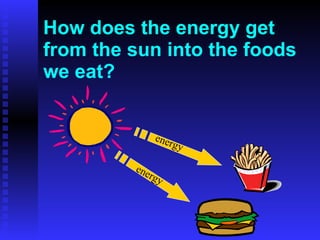
How does the energy get from the sun into the foods we eat? energy energy
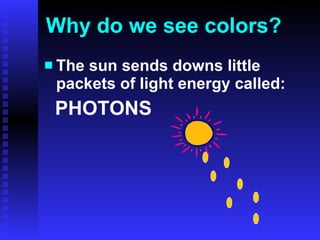
Why do we see colors? The sun sends downs little packets of light energy called: PHOTONS
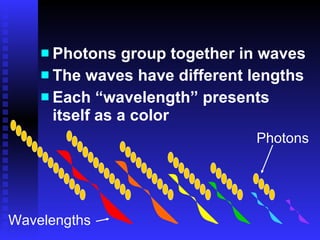
Why do we see colors?  Photons group together in waves The waves have different lengths Each “wavelength” presents itself as a color Photons Wavelengths
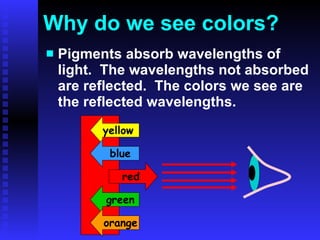
Why do we see colors? Pigments absorb wavelengths of light.  The wavelengths not absorbed are reflected.  The colors we see are the reflected wavelengths. red yellow blue green orange
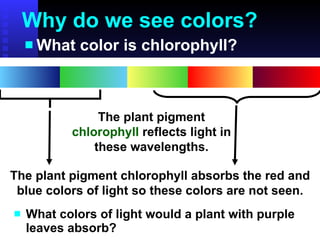
Why do we see colors? What color is chlorophyll? What colors of light would a plant with purple leaves absorb? The plant pigment  chlorophyll  reflects light in these wavelengths. The plant pigment chlorophyll absorbs the red and blue colors of light so these colors are not seen.
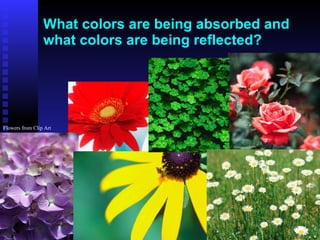
What colors are being absorbed and what colors are being reflected? Flowers from Clip Art
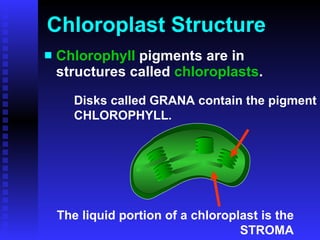
Chloroplast Structure Chlorophyll  pigments are in structures called  chloroplasts . Disks called GRANA contain the pigment CHLOROPHYLL. The liquid portion of a chloroplast is the STROMA
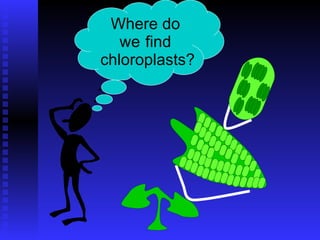
Where do  we   find  chloroplasts?
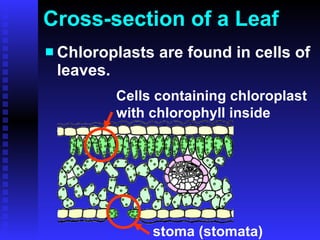
Cross-section of a Leaf Chloroplasts are found in cells of leaves. stoma (stomata) Cells containing chloroplast with chlorophyll inside
Review What is the ultimate source of all energy? In what form does light energy come to the earth? What compounds absorbs wavelengths? How do we see colors?
Review Which compound reflects the green wavelengths thereby making plants green? Where would we find this compound?  Where in a leaf do we find pigments? What are the small openings in leaves for gas exchange called?
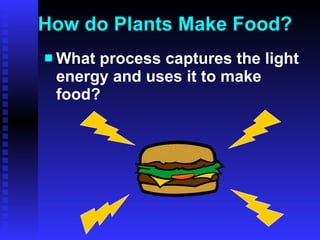
How do Plants Make Food? What process captures the light energy and uses it to make food?
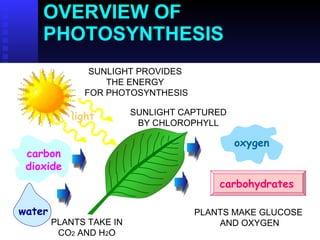
overview of photosynthesis OVERVIEW OF PHOTOSYNTHESIS PLANTS TAKE IN CO 2  AND H 2 O PLANTS MAKE GLUCOSE  AND OXYGEN SUNLIGHT PROVIDES  THE ENERGY  FOR PHOTOSYNTHESIS light SUNLIGHT CAPTURED BY CHLOROPHYLL water carbon dioxide carbohydrates oxygen
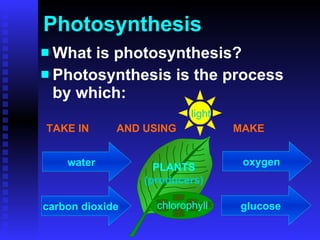
Photosynthesis What is photosynthesis? Photosynthesis is the process by which: water carbon dioxide oxygen glucose TAKE IN AND USING MAKE PLANTS (producers) light chlorophyll
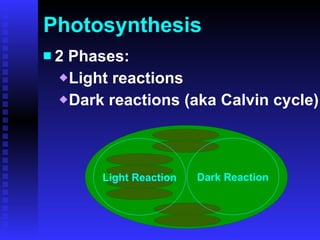
Photosynthesis 2 Phases: Light reactions Dark reactions (aka Calvin cycle) Light Reaction Dark Reaction
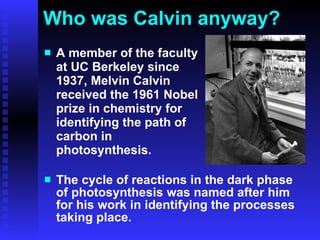
Who was Calvin anyway? A member of the faculty at UC Berkeley since 1937, Melvin Calvin received the 1961 Nobel prize in chemistry for identifying the path of carbon in photosynthesis. The cycle of reactions in the dark phase of photosynthesis was named after him for his work in identifying the processes taking place.
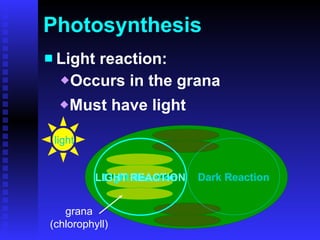
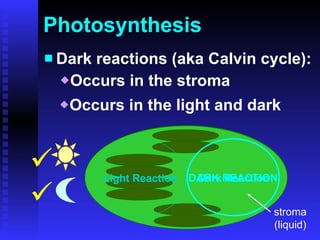
Photosynthesis Light reaction: Occurs in the grana Must have light light Light Reaction Dark Reaction LIGHT REACTION Dark Reaction grana (chlorophyll)
Photosynthesis Dark reactions (aka Calvin cycle): Occurs in the stroma Occurs in the light and dark Light Reaction Dark Reaction Light Reaction DARK REACTION stroma (liquid)  
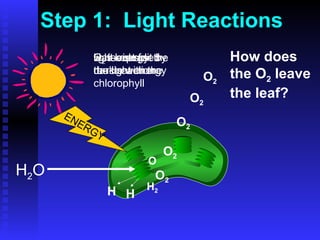
Step 1:  Light Reactions O 2 O 2 O 2 O 2  O 2 How does the O 2  leave the leaf? light energy reacts with the chlorophyll water is split by the light energy H is kept for the dark reaction O 2  is released O H 2 H 2 O H H ENERGY
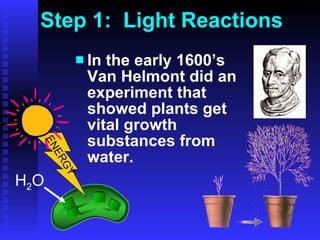
Step 1:  Light Reactions In the early 1600’s Van Helmont did an experiment that showed plants get vital growth substances from water. H 2 O ENERGY
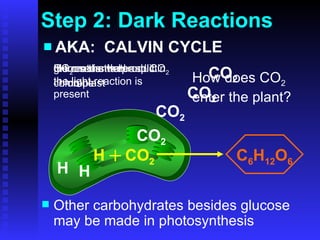
Step 2: Dark Reactions AKA:  CALVIN CYCLE CO 2 CO 2 CO 2 CO 2 H How does CO 2   enter the plant? H from the water split in the light reaction is present CO 2  enters the chloroplast the reactants H and CO 2  combine H glucose is the product Other carbohydrates besides glucose may be made in photosynthesis C 6 H 12 O 6 H + CO 2
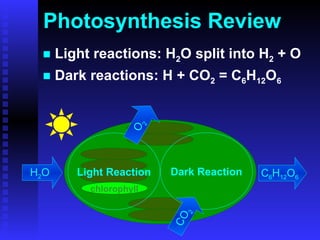
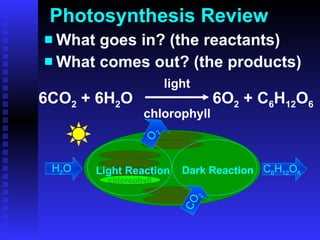
Photosynthesis Review Light reactions: H 2 O split into H 2  + O Dark reactions: H + CO 2  = C 6 H 12 O 6 H 2 O CO 2 C 6 H 12 O 6 O 2 chlorophyll Light Reaction Dark Reaction
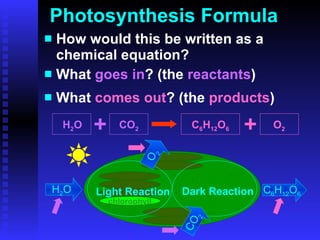
Photosynthesis Formula How would this be written as a chemical equation? What  goes in ? (the  reactants ) What  comes out ? (the  products ) H 2 O CO 2 C 6 H 12 O 6 O 2 H 2 O Light Reaction Dark Reaction CO 2 C 6 H 12 O 6 O 2 chlorophyll
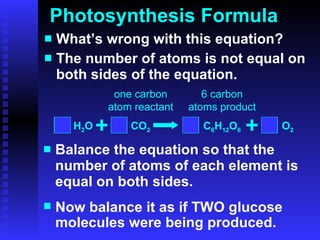
Photosynthesis Formula What’s wrong with this equation? The number of atoms is not equal on both sides of the equation. Balance the equation so that the number of atoms of each element is equal on both sides. 6 6 6 (1) Now balance it as if TWO glucose molecules were being produced. H 2 O CO 2 C 6 H 12 O 6 O 2 one carbon atom reactant 6 carbon atoms product
TRY THIS! Think-Pair-Share Analyze the relationship between photosynthesis, biogeochemical cycles, and food chains.
Photosynthesis Review What goes in? (the reactants) What comes out? (the products) H 2 O Light Reaction Dark Reaction CO 2 C 6 H 12 O 6 O 2 chlorophyll 6CO 2  + 6H 2 O  6O 2  + C 6 H 12 O 6 light chlorophyll
Work Cited Melvin Calvin picture. Online image http://www.lbl.gov/Science-Articles/Archive/Melvin-Calvin-obit.html

Photosynthesis ppt

  • 1.
    Photosynthesis PPT ThisPowerPoint was revised June 24, 2008. There is a TEKS Photosynthesis Notes handout to accompany this PPT. (This is the same handout for SM as well.) Review it for possible use in other Biology courses. There is repetition in this PPT used as a learning strategy. The notes section contains guides for discussion. PPT is 27 slides long.
  • 2.
  • 3.
    What is theultimate source of all energy?
  • 4.
    How does theenergy get from the sun into the foods we eat? energy energy
  • 5.
    Why do wesee colors? The sun sends downs little packets of light energy called: PHOTONS
  • 6.
    Why do wesee colors? Photons group together in waves The waves have different lengths Each “wavelength” presents itself as a color Photons Wavelengths
  • 7.
    Why do wesee colors? Pigments absorb wavelengths of light. The wavelengths not absorbed are reflected. The colors we see are the reflected wavelengths. red yellow blue green orange
  • 8.
    Why do wesee colors? What color is chlorophyll? What colors of light would a plant with purple leaves absorb? The plant pigment chlorophyll reflects light in these wavelengths. The plant pigment chlorophyll absorbs the red and blue colors of light so these colors are not seen.
  • 9.
    What colors arebeing absorbed and what colors are being reflected? Flowers from Clip Art
  • 10.
    Chloroplast Structure Chlorophyll pigments are in structures called chloroplasts . Disks called GRANA contain the pigment CHLOROPHYLL. The liquid portion of a chloroplast is the STROMA
  • 11.
    Where do we find chloroplasts?
  • 12.
    Cross-section of aLeaf Chloroplasts are found in cells of leaves. stoma (stomata) Cells containing chloroplast with chlorophyll inside
  • 13.
    Review What isthe ultimate source of all energy? In what form does light energy come to the earth? What compounds absorbs wavelengths? How do we see colors?
  • 14.
    Review Which compoundreflects the green wavelengths thereby making plants green? Where would we find this compound? Where in a leaf do we find pigments? What are the small openings in leaves for gas exchange called?
  • 15.
    How do PlantsMake Food? What process captures the light energy and uses it to make food?
  • 16.
    overview of photosynthesisOVERVIEW OF PHOTOSYNTHESIS PLANTS TAKE IN CO 2 AND H 2 O PLANTS MAKE GLUCOSE AND OXYGEN SUNLIGHT PROVIDES THE ENERGY FOR PHOTOSYNTHESIS light SUNLIGHT CAPTURED BY CHLOROPHYLL water carbon dioxide carbohydrates oxygen
  • 17.
    Photosynthesis What isphotosynthesis? Photosynthesis is the process by which: water carbon dioxide oxygen glucose TAKE IN AND USING MAKE PLANTS (producers) light chlorophyll
  • 18.
    Photosynthesis 2 Phases:Light reactions Dark reactions (aka Calvin cycle) Light Reaction Dark Reaction
  • 19.
    Who was Calvinanyway? A member of the faculty at UC Berkeley since 1937, Melvin Calvin received the 1961 Nobel prize in chemistry for identifying the path of carbon in photosynthesis. The cycle of reactions in the dark phase of photosynthesis was named after him for his work in identifying the processes taking place.
  • 20.
    Photosynthesis Light reaction:Occurs in the grana Must have light light Light Reaction Dark Reaction LIGHT REACTION Dark Reaction grana (chlorophyll)
  • 21.
    Photosynthesis Dark reactions(aka Calvin cycle): Occurs in the stroma Occurs in the light and dark Light Reaction Dark Reaction Light Reaction DARK REACTION stroma (liquid)  
  • 22.
    Step 1: Light Reactions O 2 O 2 O 2 O 2 O 2 How does the O 2 leave the leaf? light energy reacts with the chlorophyll water is split by the light energy H is kept for the dark reaction O 2 is released O H 2 H 2 O H H ENERGY
  • 23.
    Step 1: Light Reactions In the early 1600’s Van Helmont did an experiment that showed plants get vital growth substances from water. H 2 O ENERGY
  • 24.
    Step 2: DarkReactions AKA: CALVIN CYCLE CO 2 CO 2 CO 2 CO 2 H How does CO 2 enter the plant? H from the water split in the light reaction is present CO 2 enters the chloroplast the reactants H and CO 2 combine H glucose is the product Other carbohydrates besides glucose may be made in photosynthesis C 6 H 12 O 6 H + CO 2
  • 25.
    Photosynthesis Review Lightreactions: H 2 O split into H 2 + O Dark reactions: H + CO 2 = C 6 H 12 O 6 H 2 O CO 2 C 6 H 12 O 6 O 2 chlorophyll Light Reaction Dark Reaction
  • 26.
    Photosynthesis Formula Howwould this be written as a chemical equation? What goes in ? (the reactants ) What comes out ? (the products ) H 2 O CO 2 C 6 H 12 O 6 O 2 H 2 O Light Reaction Dark Reaction CO 2 C 6 H 12 O 6 O 2 chlorophyll
  • 27.
    Photosynthesis Formula What’swrong with this equation? The number of atoms is not equal on both sides of the equation. Balance the equation so that the number of atoms of each element is equal on both sides. 6 6 6 (1) Now balance it as if TWO glucose molecules were being produced. H 2 O CO 2 C 6 H 12 O 6 O 2 one carbon atom reactant 6 carbon atoms product
  • 28.
    TRY THIS! Think-Pair-ShareAnalyze the relationship between photosynthesis, biogeochemical cycles, and food chains.
  • 29.
    Photosynthesis Review Whatgoes in? (the reactants) What comes out? (the products) H 2 O Light Reaction Dark Reaction CO 2 C 6 H 12 O 6 O 2 chlorophyll 6CO 2 + 6H 2 O 6O 2 + C 6 H 12 O 6 light chlorophyll
  • 30.
    Work Cited MelvinCalvin picture. Online image http://www.lbl.gov/Science-Articles/Archive/Melvin-Calvin-obit.html

Editor's Notes

  • #4 The sun. Ask the students where they have heard this in previous units?
  • #5 Accept all answers. Tell the students this is the major concept we want them to learn today.
  • #6 Photons are packets of energy. This is one property of light energy. This slide should be used to help the students understand the concept, but they need not be tested on this.
  • #7 Ask the students what they know about wavelengths. All light comes from the sun as “white light”. The white light contains all wavelengths. When the wavelengths hit the atmosphere, dust particles and other matter in the atmosphere separate the white light into different wavelengths.
  • #8 Pigments absorb wavelengths of light. The wavelengths not absorbed are reflected. The colors we see are the reflected wavelengths. The visible spectrum are the wavelengths that can be reflected. Plants absorb most of the energy from the wavelengths at the 2 ends of the spectrum. What colors of light would a plant with purple leaves absorb? all colors except violet.
  • #9 Pigments absorb wavelengths of light. The wavelengths not absorbed are reflected. The colors we see are the reflected wavelengths. The visible spectrum are the wavelengths that can be reflected. Plants absorb most of the energy from the wavelengths at the 2 ends of the spectrum. What colors of light would a plant with purple leaves absorb? all colors except violet.
  • #10 The green plant reflects the color green and absorbs all other wavelengths. The purple flower reflects the color purple and absorbs all other wavelengths. The white flower reflects all colors and absorbs no wavelengths. The orange flower reflects the color orange and absorbs all other wavelengths. The red rose reflects the color red and absorbs all other wavelengths. Photos courtesy of flowerpictures.net and picturesof.net
  • #11 The chloroplast has two structures used in photosynthesis. The grana are the stacks of disks that contain the pigment, chlorophyll. This is where the light energy is captured. The stroma is the fluid that surrounds the grana. This is where the glucose is actually made.
  • #12 Ask this question. Lead the answer to “in the cells of green plants”.
  • #13 The leaf contains 2 important structures for photosynthesis. The chloroplast contain the pigments (chlorophyll) necessary for photosynthesis. The stoma are the small pores on the underside of the leaf where gas exchange occurs. Stomata is the plural of stoma.
  • #14 Ask these questions one at a time as review. Click to get to the next question 1. The sun Wavelengths Pigments The wavelengths not absorbed by pigments are reflected as color In the chloroplast
  • #15 Pigments Chlorophyll Chloroplast
  • #16 See if the students know the answer. Ask what they know about the process.
  • #17 The energy from the sun is captured by the chlorophyll in the leaf. Two compounds must be taken in by the plant from the environment – carbon dioxide and water. Carbon dioxide goes through the stoma on the leaf. Water is taken up through the roots. The water is split into oxygen and hydrogen. The oxygen is released from the plant through the stoma. The hydrogen combines with the carbon dioxide to make glucose.
  • #18 Photosynthesis is the process by which plants (producers) take in water and carbon dioxide and using light energy and chlorophyll make oxygen and glucose
  • #19 There are two main steps to photosynthesis: the light and the dark reactions. The light reaction occurs in the grana and must have light to occur. The dark reaction was discovered by Melvin Calvin. The dark reaction occurs in the stroma. Contrary to its name, it can occur in the dark and the light.
  • #21 There are two main steps to photosynthesis: the light and the dark reactions. The light reaction occurs in the grana and must have light to occur. The dark reaction was discovered by Melvin Calvin. The dark reaction occurs in the stroma. Contrary to its name, it can occur in the dark and the light.
  • #22 There are two main steps to photosynthesis: the light and the dark reactions. The light reaction occurs in the grana and must have light to occur. The dark reaction was discovered by Melvin Calvin. The dark reaction occurs in the stroma. Contrary to its name, it can occur in the dark and the light.
  • #23 Sunlight energy is trapped in the chlorophyll. That energy is used to split water into hydrogen and oxygen. The oxygen leaves the plant through the stoma. You can refer back to the diagram of the leaf.
  • #24 Sunlight energy is trapped in the chlorophyll. That energy is used to split water into hydrogen and oxygen. The oxygen leaves the plant through the stoma. You can refer back to the diagram of the leaf.
  • #25 The hydrogen from the light reactions combine with carbon dioxide to form glucose. Carbon dioxide enters the plant through the stoma. Plants like potatoes and lettuce store sugars as complex carbohydrates such as starch and cellulose.
  • #26 Photosynthesis Review Light reactions: H 2 O split into H 2 + O Dark reactions: H + CO 2 = C 6 H 12 O 6
  • #30 The equation shows that light and chlorophyll are needed for the reaction, but are not part of the reaction itself.