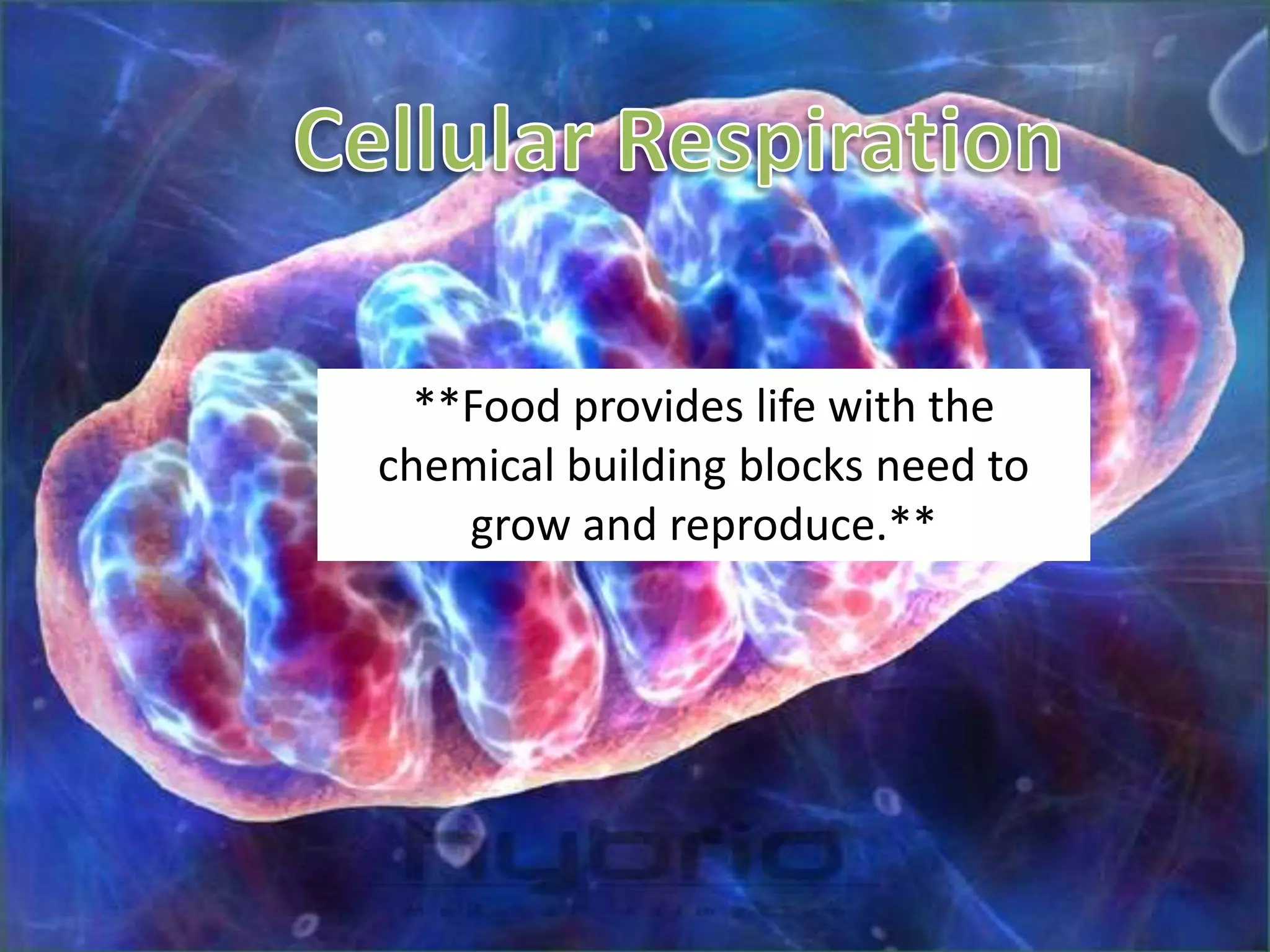
Cellular Respiration**Food provides life with the chemical building blocks need to grow and reproduce.**
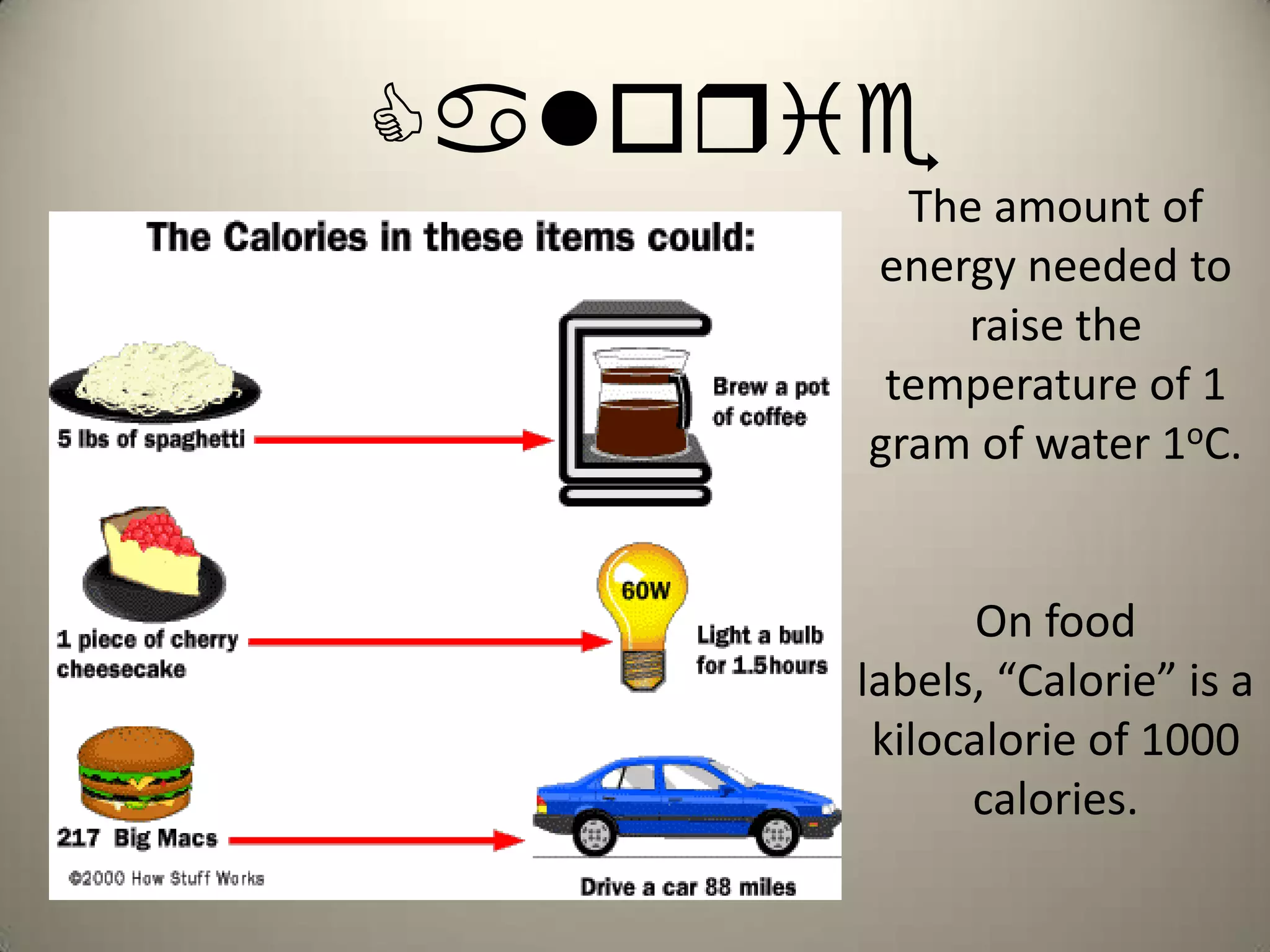
CalorieThe amount of energy needed to raise the temperature of 1 gram of water 1oC.On food labels, “Calorie” is a kilocalorie of 1000 calories.
GlycolysisIt is the beginning process of our food “burning” to release energy.Begins process of respiration and releases a small amount of energy that leads to 2 other processes that release A LOT of energy.
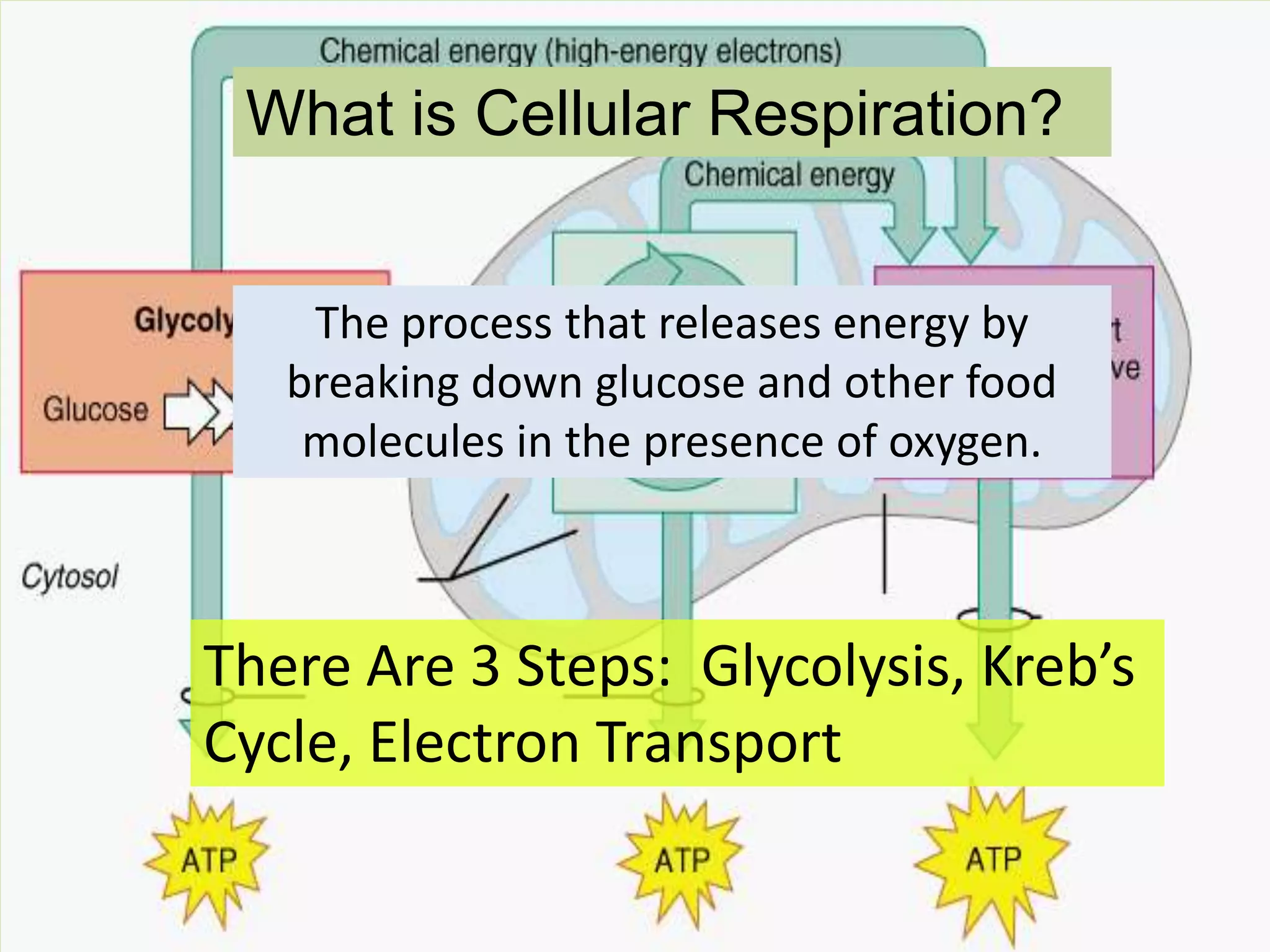
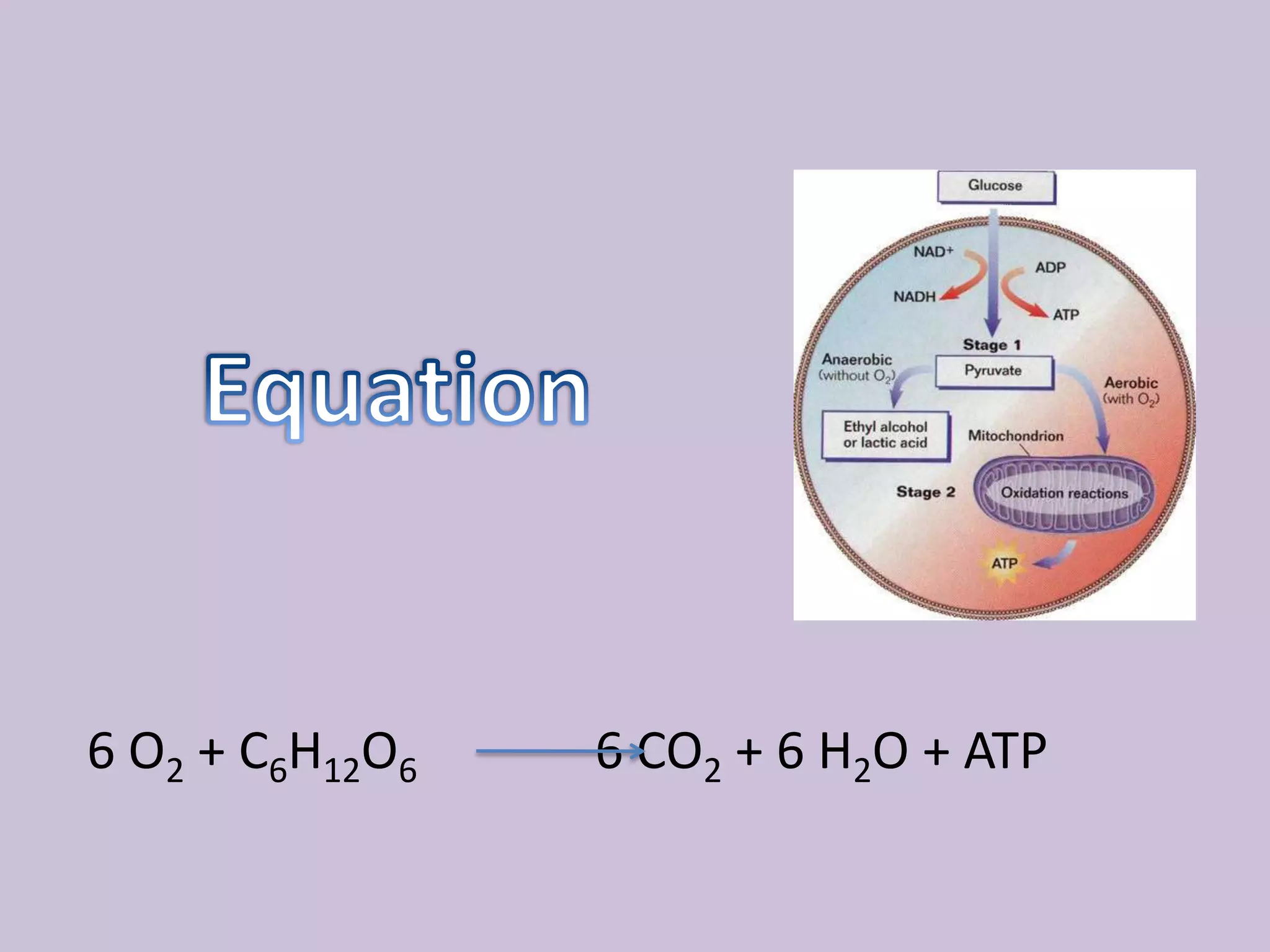
What is Cellular Respiration?The process that releases energy by breaking down glucose and other food molecules in the presence of oxygen.There Are 3 Steps:  Glycolysis, Kreb’s Cycle, Electron Transport
Equation6 O2 + C6H12O6 			6 CO2 + 6 H2O + ATP
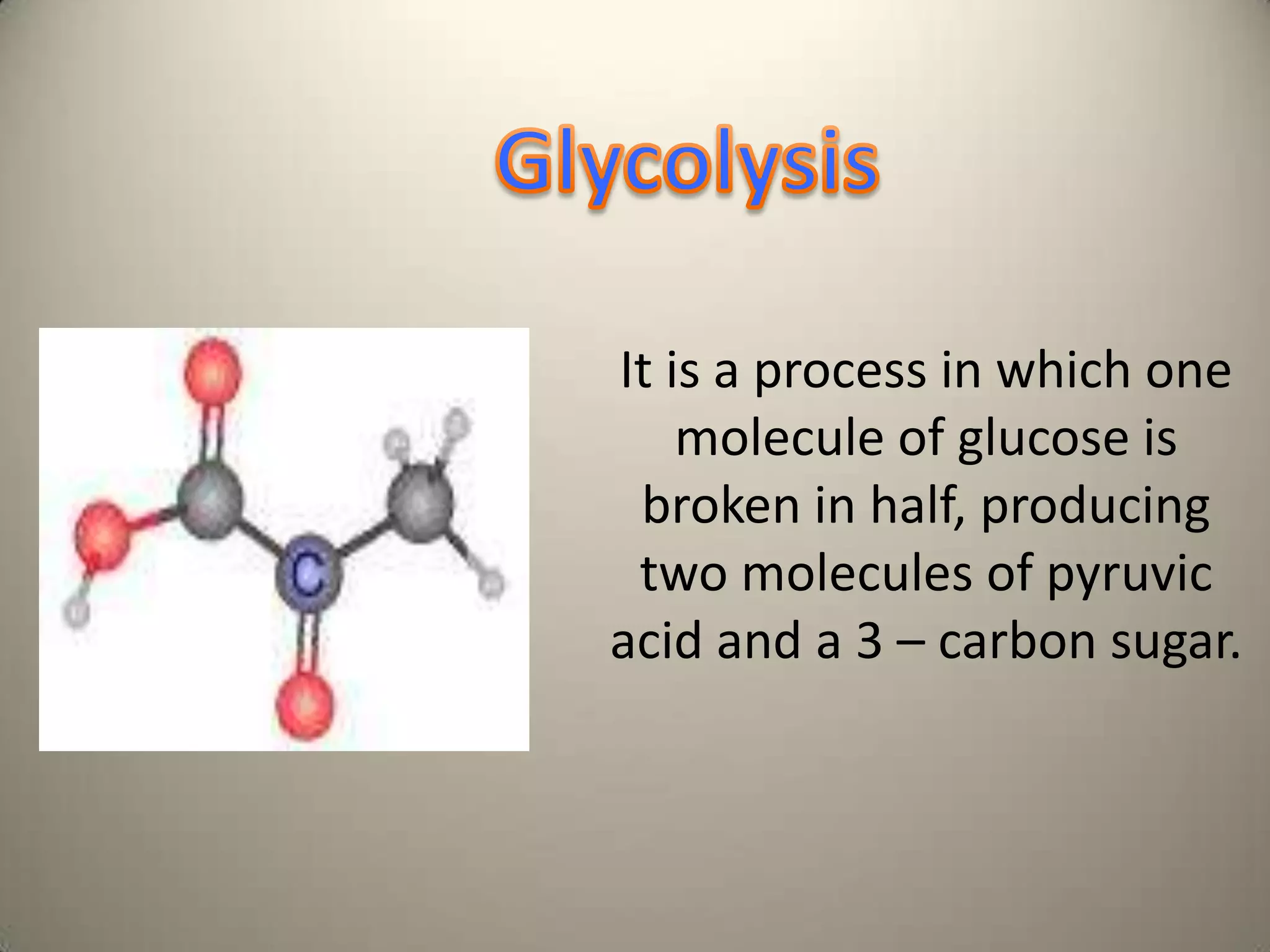
GlycolysisIt is a process in which one molecule of glucose is broken in half, producing two molecules of pyruvic acid and a 3 – carbon sugar.
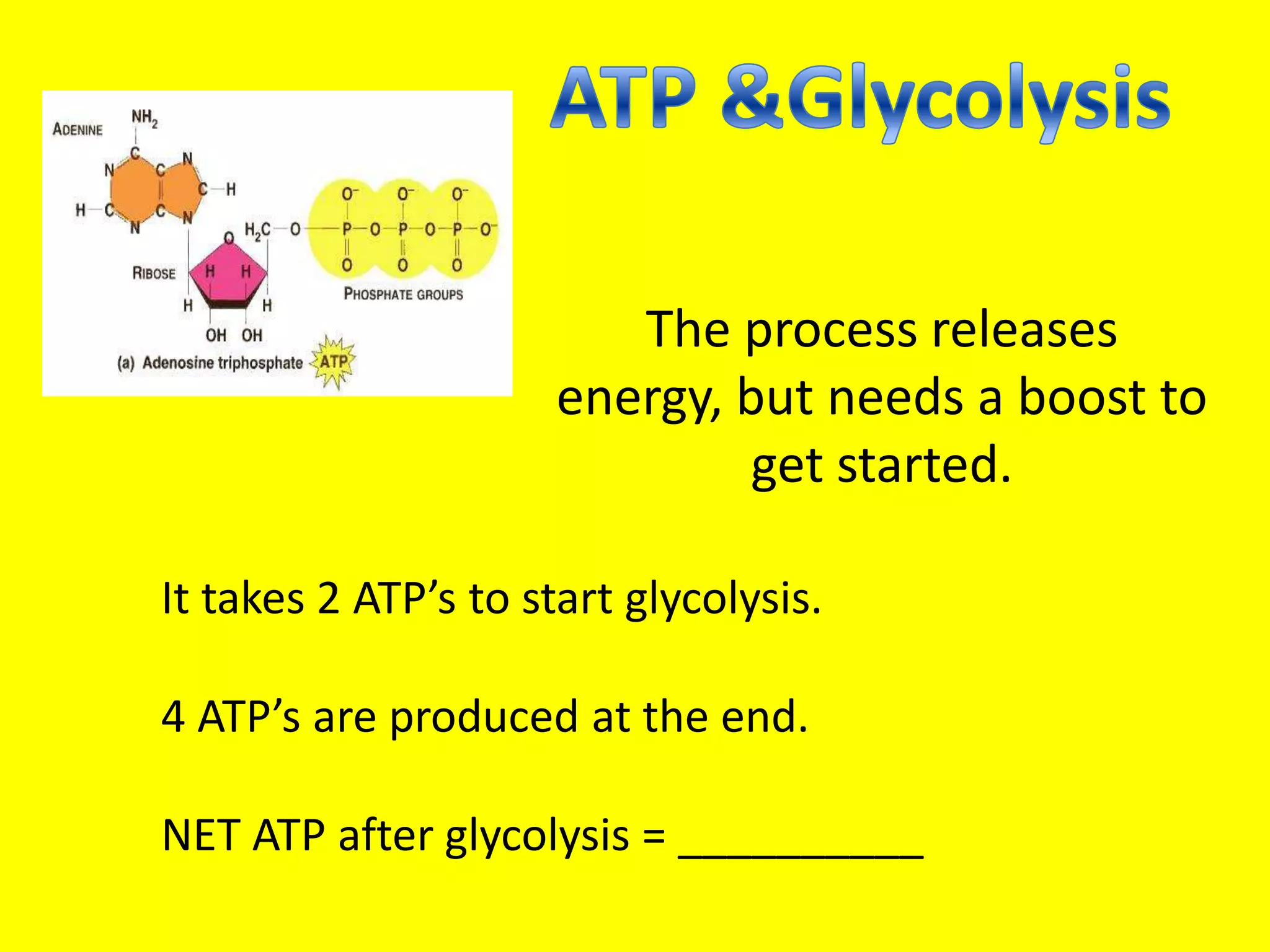
ATP & GlycolysisThe process releases energy, but needs a boost to get started.It takes 2 ATP’s to start glycolysis.4 ATP’s are produced at the end.NET ATP after glycolysis = __________
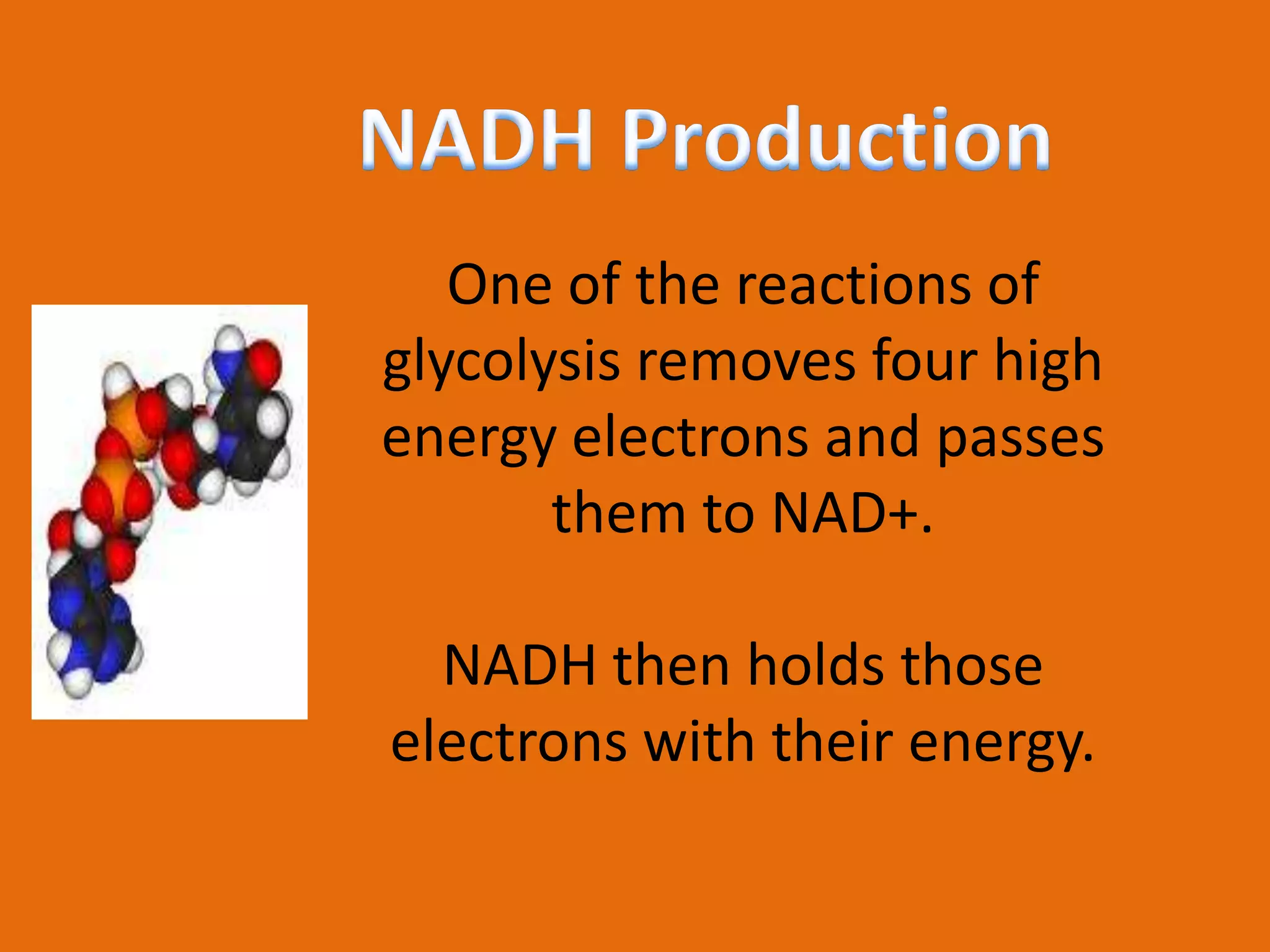
NADH ProductionOne of the reactions of glycolysis removes four high energy electrons and passes them to NAD+.NADH then holds those electrons with their energy.
Energy Output of GlycolysisThe process is so fast, it can produce thousands of ATP in milliseconds.Glycolysis doesn’t require oxygen, so it can supply chemical energy to cells when oxygen is not available.PROBLEM: All the NAD+ becomes filled up with electrons and cells run out.
Steps of Glycolysis
Step 1Two phosphates are added to glucose to with an ATP investment of 2 molecules.
Step 2The 2 phosphate sugar molecule is then split to form 2, 3 carbon molecules.
Step 3The two phosphate, 3 carbon molecules are then converted to 2 pyruvate (pyruvic acid).  As this occurs electrons are transferred to NAD+ to form NADH.  ATP is also formed.
Result	Two Pyruvates (with a lot of stored energy left)A net of 2 ATP’s
Kreb’s CycleAfter glycolysis, 90% of of the chemical energy from glucose is still left.For the Kreb’s Cycle, oxygen is necessary.The pyruvic acid will be further broken down into CO2 in a series of energy extracting steps.
Step 1 (Citric Acid Production)The pyruvic acid enters the mitochondria and loses a CO2 molecule.The 2 carbons left attach to coenzyme A to from Acetyl CoA.The Acetyl CoA is actually what enters the Krebs Cycle.
Step 1 -cont-The 2 C acetyl CoA then joins with a 4 carbon molecule to make Citric Acid.
Step 2The citric acid is broken down, releasing more CO2.One ATP is produced.   ⌘3 NADH and 1 FADH is converted to FADH2There is now a 4 carbon molecule left.
The Krebs Cycle must occur 2 times in order to break down both of the pyruvicaicds that were created during glycolysis.
NADH & FADH2Both these molecules are electron carriers that trap most of the energy from the Krebs cycle.
Electron TransportOccurs in inner Membrane of MitochondriaFirst StepThe electrons from the original glucose molecule are moved to an electron transport chain using NADH.(Electrons move to carriers that they have a stronger attraction for.)
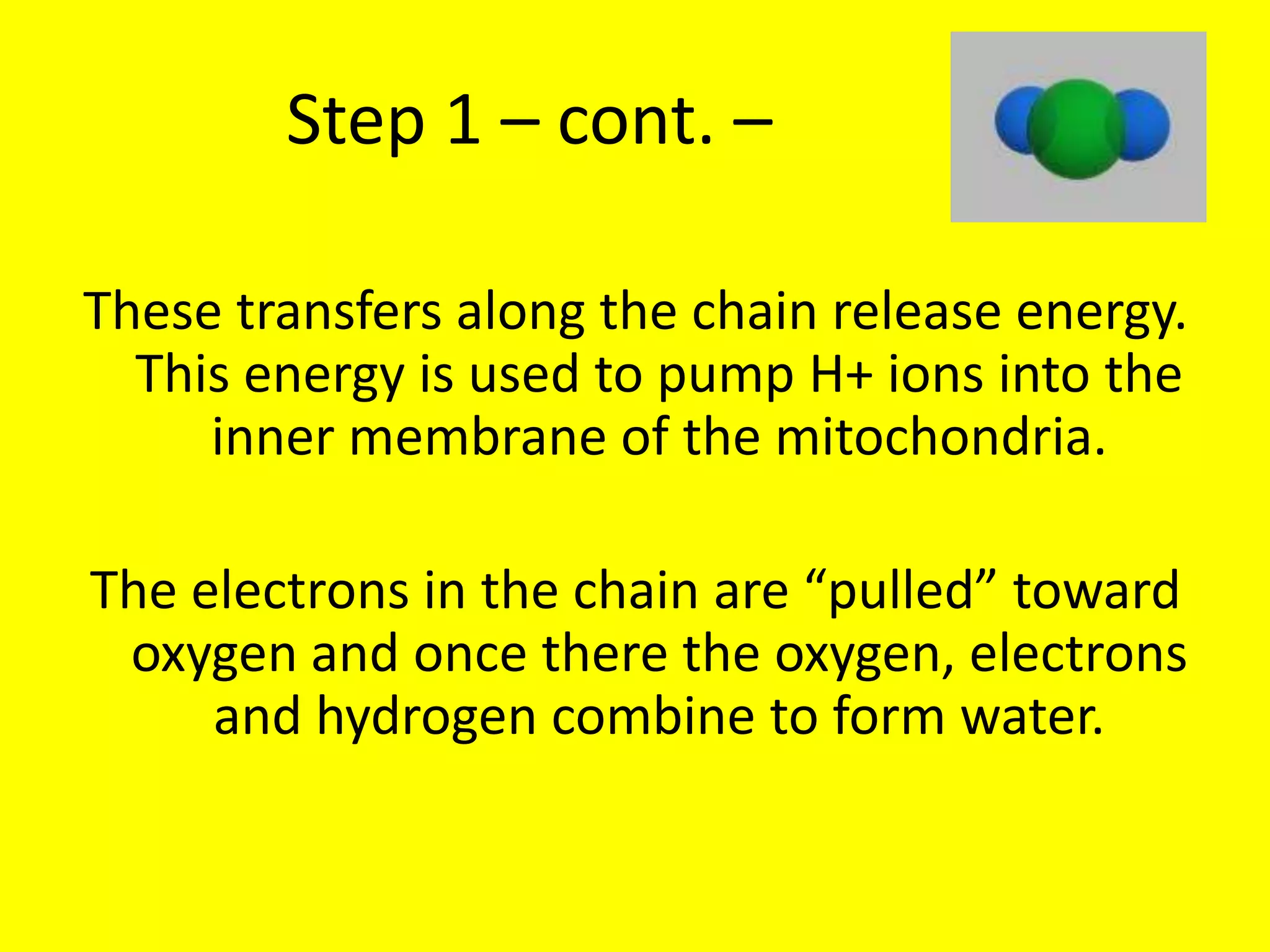
Step 1 – cont. – These transfers along the chain release energy.  This energy is used to pump H+ ions into the inner membrane of the mitochondria.The electrons in the chain are “pulled” toward oxygen and once there the oxygen, electrons and hydrogen combine to form water.
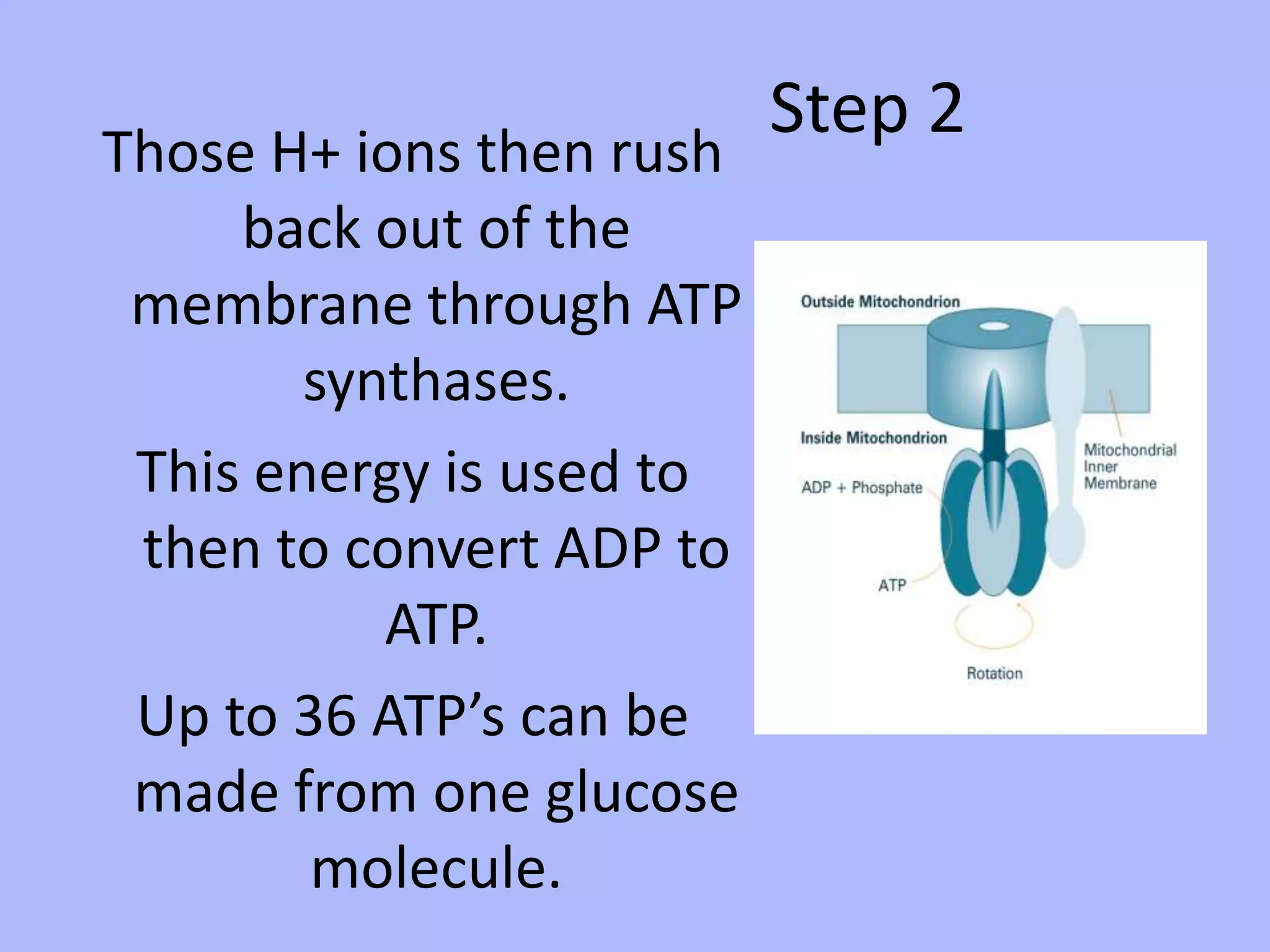
Step 2Those H+ ions then rush back out of the membrane through ATP synthases.This energy is used to then to convert ADP to ATP.  Up to 36 ATP’s can be made from one glucose molecule.
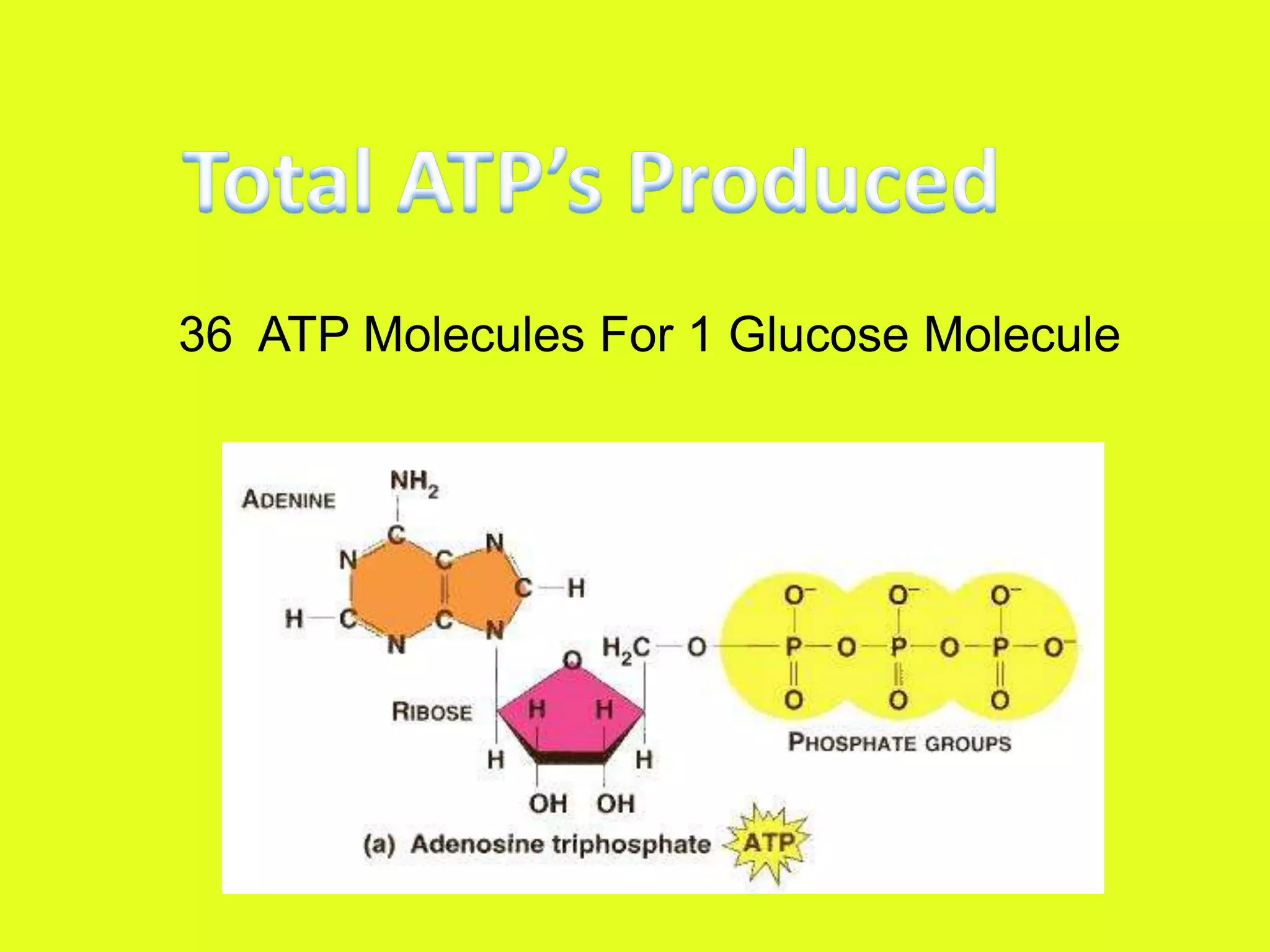
Total ATP’s Produced 36  ATP Molecules For 1 Glucose Molecule 

Respiration powerpoint

  • 1.
    Cellular Respiration**Food provideslife with the chemical building blocks need to grow and reproduce.**
  • 2.
    CalorieThe amount ofenergy needed to raise the temperature of 1 gram of water 1oC.On food labels, “Calorie” is a kilocalorie of 1000 calories.
  • 3.
    GlycolysisIt is thebeginning process of our food “burning” to release energy.Begins process of respiration and releases a small amount of energy that leads to 2 other processes that release A LOT of energy.
  • 4.
    What is CellularRespiration?The process that releases energy by breaking down glucose and other food molecules in the presence of oxygen.There Are 3 Steps: Glycolysis, Kreb’s Cycle, Electron Transport
  • 5.
    Equation6 O2 +C6H12O6 6 CO2 + 6 H2O + ATP
  • 6.
    GlycolysisIt is aprocess in which one molecule of glucose is broken in half, producing two molecules of pyruvic acid and a 3 – carbon sugar.
  • 7.
    ATP & GlycolysisTheprocess releases energy, but needs a boost to get started.It takes 2 ATP’s to start glycolysis.4 ATP’s are produced at the end.NET ATP after glycolysis = __________
  • 8.
    NADH ProductionOne ofthe reactions of glycolysis removes four high energy electrons and passes them to NAD+.NADH then holds those electrons with their energy.
  • 9.
    Energy Output ofGlycolysisThe process is so fast, it can produce thousands of ATP in milliseconds.Glycolysis doesn’t require oxygen, so it can supply chemical energy to cells when oxygen is not available.PROBLEM: All the NAD+ becomes filled up with electrons and cells run out.
  • 10.
  • 11.
    Step 1Two phosphatesare added to glucose to with an ATP investment of 2 molecules.
  • 12.
    Step 2The 2phosphate sugar molecule is then split to form 2, 3 carbon molecules.
  • 13.
    Step 3The twophosphate, 3 carbon molecules are then converted to 2 pyruvate (pyruvic acid). As this occurs electrons are transferred to NAD+ to form NADH. ATP is also formed.
  • 14.
    Result Two Pyruvates (witha lot of stored energy left)A net of 2 ATP’s
  • 15.
    Kreb’s CycleAfter glycolysis,90% of of the chemical energy from glucose is still left.For the Kreb’s Cycle, oxygen is necessary.The pyruvic acid will be further broken down into CO2 in a series of energy extracting steps.
  • 16.
    Step 1 (CitricAcid Production)The pyruvic acid enters the mitochondria and loses a CO2 molecule.The 2 carbons left attach to coenzyme A to from Acetyl CoA.The Acetyl CoA is actually what enters the Krebs Cycle.
  • 17.
    Step 1 -cont-The2 C acetyl CoA then joins with a 4 carbon molecule to make Citric Acid.
  • 18.
    Step 2The citricacid is broken down, releasing more CO2.One ATP is produced. ⌘3 NADH and 1 FADH is converted to FADH2There is now a 4 carbon molecule left.
  • 19.
    The Krebs Cyclemust occur 2 times in order to break down both of the pyruvicaicds that were created during glycolysis.
  • 20.
    NADH & FADH2Boththese molecules are electron carriers that trap most of the energy from the Krebs cycle.
  • 21.
    Electron TransportOccurs ininner Membrane of MitochondriaFirst StepThe electrons from the original glucose molecule are moved to an electron transport chain using NADH.(Electrons move to carriers that they have a stronger attraction for.)
  • 22.
    Step 1 –cont. – These transfers along the chain release energy. This energy is used to pump H+ ions into the inner membrane of the mitochondria.The electrons in the chain are “pulled” toward oxygen and once there the oxygen, electrons and hydrogen combine to form water.
  • 23.
    Step 2Those H+ions then rush back out of the membrane through ATP synthases.This energy is used to then to convert ADP to ATP. Up to 36 ATP’s can be made from one glucose molecule.
  • 24.
    Total ATP’s Produced36 ATP Molecules For 1 Glucose Molecule 