Respiration


              delightsofalevels.blogspot.com
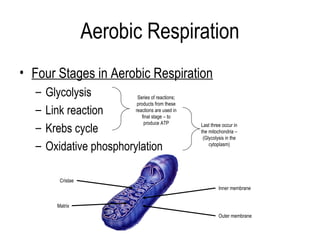
Aerobic Respiration
• Four Stages in Aerobic Respiration
  –   Glycolysis          Series of reactions;
                          products from these
  –   Link reaction      reactions are used in
                            final stage – to
                             produce ATP
  –   Krebs cycle                                Last three occur in
                                                 the mitochondria –
                                                  (Glycolysis in the
  –   Oxidative phosphorylation                      cytoplasm)


          Cristae
                                                          Inner membrane


         Matrix
                                                          Outer membrane
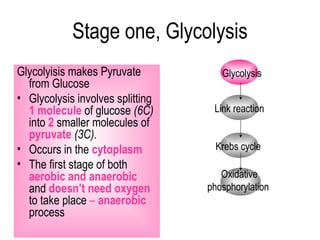
Stage one, Glycolysis
Glycolyisis makes Pyruvate           Glycolysis
  from Glucose
• Glycolysis involves splitting
  1 molecule of glucose (6C)       Link reaction
  into 2 smaller molecules of
  pyruvate (3C).
• Occurs in the cytoplasm           Krebs cycle
• The first stage of both
  aerobic and anaerobic              Oxidative
  and doesn’t need oxygen         phosphorylation
  to take place – anaerobic
  process
2 Stages of Glycolysis
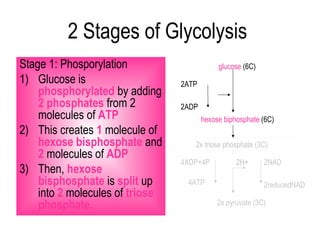
Stage 1: Phosporylation                      glucose (6C)
1) Glucose is                    2ATP
    phosphorylated by adding
    2 phosphates from 2          2ADP
    molecules of ATP                    hexose biphosphate (6C)
2) This creates 1 molecule of
    hexose bisphosphate and         2x triose phosphate (3C)
    2 molecules of ADP
                                 4ADP+4P           2H+      2NAD
3) Then, hexose
    bisphosphate is split up      4ATP                      2reducedNAD
    into 2 molecules of triose
    phosphate.                               2x pyruvate (3C)
2 Stages of Glycolysis
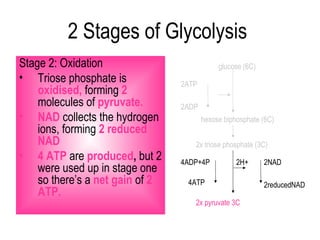
Stage 2: Oxidation                           glucose (6C)
• Triose phosphate is            2ATP
    oxidised, forming 2
    molecules of pyruvate.       2ADP
• NAD collects the hydrogen             hexose biphosphate (6C)
    ions, forming 2 reduced
    NAD                             2x triose phosphate (3C)
• 4 ATP are produced, but 2      4ADP+4P           2H+      2NAD
    were used up in stage one
    so there’s a net gain of 2    4ATP                      2reducedNAD
    ATP.
                                    2x pyruvate 3C
Stage 2, the link reaction
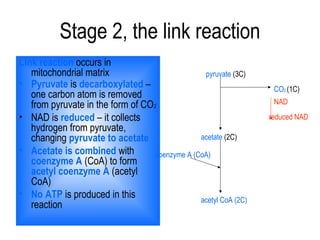
Link reaction occurs in
   mitochondrial matrix                          pyruvate (3C)
• Pyruvate is decarboxylated –                                     CO2 (1C)
   one carbon atom is removed
   from pyruvate in the form of CO2                                NAD

• NAD is reduced – it collects                                    reduced NAD
   hydrogen from pyruvate,
   changing pyruvate to acetate                 acetate (2C)
• Acetate is combined with         coenzyme A (CoA)
   coenzyme A (CoA) to form
   acetyl coenzyme A (acetyl
   CoA)
• No ATP is produced in this
                                                acetyl CoA (2C)
   reaction
Link reaction
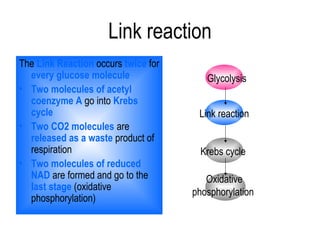
The Link Reaction occurs twice for
  every glucose molecule                Glycolysis
• Two molecules of acetyl
  coenzyme A go into Krebs
  cycle                               Link reaction
• Two CO2 molecules are
  released as a waste product of
  respiration                          Krebs cycle
• Two molecules of reduced
  NAD are formed and go to the          Oxidative
  last stage (oxidative              phosphorylation
  phosphorylation)
Mitochondria
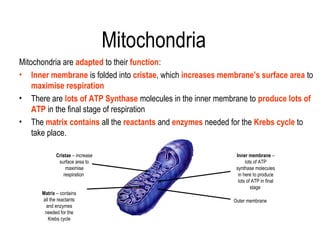
Mitochondria are adapted to their function:
• Inner membrane is folded into cristae, which increases membrane’s surface area to
    maximise respiration
• There are lots of ATP Synthase molecules in the inner membrane to produce lots of
    ATP in the final stage of respiration
• The matrix contains all the reactants and enzymes needed for the Krebs cycle to
    take place.

             Cristae – increase                              Inner membrane –
              surface area to                                     lots of ATP
                  maximise                                   synthase molecules
                 respiration                                  in here to produce
                                                              lots of ATP in final
                                                                     stage
      Matrix – contains
      all the reactants                                     Outer membrane
       and enzymes
       needed for the
         Krebs cycle
Stage 3, the Krebs Cycle
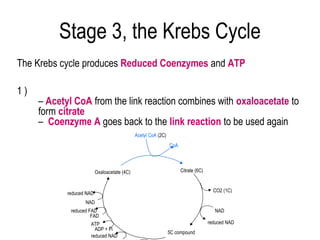
The Krebs cycle produces Reduced Coenzymes and ATP

1)
     – Acetyl CoA from the link reaction combines with oxaloacetate to
     form citrate
     – Coenzyme A goes back to the link reaction to be used again
                                              Acetyl CoA (2C)
                                                                CoA


                          Oxaloacetate (4C)                           Citrate (6C)


                                                                                       CO2 (1C)
            reduced NAD
                   NAD
             reduced FAD                                                                NAD
                      FAD
                     ATP                                                             reduced NAD
                       ADP + Pi
                                                                5C compound
                     reduced NAD
Stage 3, the Krebs Cycle
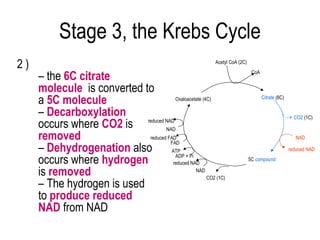
2)                                                         Acetyl CoA (2C)


     – the 6C citrate                                                         CoA


     molecule is converted to
     a 5C molecule                     Oxaloacetate (4C)                            Citrate (6C)


     – Decarboxylation                                                                               CO2 (1C)
     occurs where CO2 is reduced NAD
                                   NAD
     removed                reduced FAD
                                     FAD
                                                                                                      NAD

     – Dehydrogenation also           ATP                                                          reduced NAD

     occurs where hydrogen             ADP + Pi
                                      reduced NAD
                                                                             5C compound

     is removed                                 NAD
                                                      CO2 (1C)
     – The hydrogen is used
     to produce reduced
     NAD from NAD
Stage 3, the Krebs Cycle
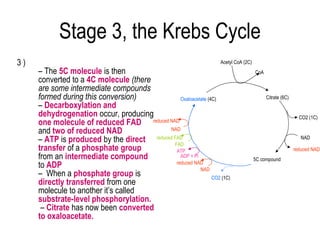
3)                                                                 Acetyl CoA (2C)
     – The 5C molecule is then                                                       CoA
     converted to a 4C molecule (there
     are some intermediate compounds
     formed during this conversion)             Oxaloacetate (4C)                          Citrate (6C)
     – Decarboxylation and
     dehydrogenation occur, producing                                                                       CO2 (1C)
     one molecule of reduced FAD reduced NAD
     and two of reduced NAD                NAD

     – ATP is produced by the direct reduced FAD
                                             FAD
                                                                                                             NAD

     transfer of a phosphate group            ATP                                                         reduced NAD
     from an intermediate compound              ADP + Pi
                                                                                     5C compound
     to ADP                                   reduced NAD
                                                         NAD
     – When a phosphate group is                               CO2 (1C)
     directly transferred from one
     molecule to another it’s called
     substrate-level phosphorylation.
      – Citrate has now been converted
     to oxaloacetate.
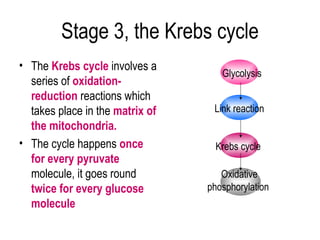
Stage 3, the Krebs cycle
• The Krebs cycle involves a
                                    Glycolysis
  series of oxidation-
  reduction reactions which
  takes place in the matrix of    Link reaction
  the mitochondria.
• The cycle happens once           Krebs cycle
  for every pyruvate
  molecule, it goes round           Oxidative
  twice for every glucose        phosphorylation
  molecule
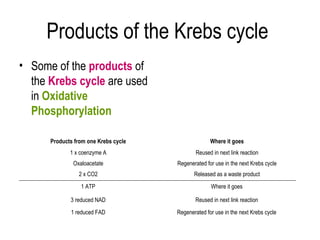
Products of the Krebs cycle
• Some of the products of
  the Krebs cycle are used
  in Oxidative
  Phosphorylation

      Products from one Krebs cycle                 Where it goes
             1 x coenzyme A                   Reused in next link reaction
              Oxaloacetate            Regenerated for use in the next Krebs cycle
                2 x CO2                      Released as a waste product
                 1 ATP                              Where it goes

             3 reduced NAD                   Reused in next link reaction
             1 reduced FAD            Regenerated for use in the next Krebs cycle
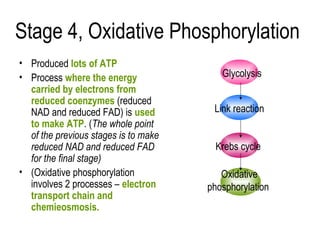
Stage 4, Oxidative Phosphorylation
• Produced lots of ATP
• Process where the energy               Glycolysis
  carried by electrons from
  reduced coenzymes (reduced
  NAD and reduced FAD) is used         Link reaction
  to make ATP. (The whole point
  of the previous stages is to make
  reduced NAD and reduced FAD           Krebs cycle
  for the final stage)
• (Oxidative phosphorylation             Oxidative
  involves 2 processes – electron     phosphorylation
  transport chain and
  chemieosmosis.
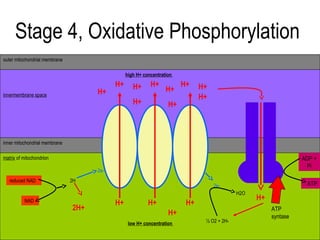
Stage 4, Oxidative Phosphorylation
Protons are pumped across the inner Mitochondrial Membrane.
• Hydrogen atoms are released from reduced NAD and reduced FAD as they’re
   oxidised to NAD and FAD – H atoms split into protons and electrons (H+ and e-)
• e- move along electron transport chain (made up of 3 electron carriers) losing
   energy at each carrier.
• This energy is used by electron carriers to pump protons from the mitochondrial
   matrix into the intermembrane space (space between the inner and outer
   mitochondrial membranes)
• Concentration of protons is now higher in the intermembrane space than the
   mitochondrial matrix - forms an electrochemical gradient
• Protons move down the electrochemical gradient back into the matrix via ATP
   synthase - this movement drives the synthesis of ATP from ADP and inorganic
   phosphate.
• Movement of H+ across a membrane, generates ATP = CHEMIOSMOSIS
• In matrix, at ed of transport chain the protons, electrons and O2 combine with water
   Oxygen is said to be the final electron acceptor
Stage 4, Oxidative Phosphorylation
outer mitochondrial membrane

                                                high H+ concentration
                                           H+      H+      H+           H+    H+
                                     H+                           H+
innermembrane space                                                           H+
                                                   H+              H+


inner mitochondrial membrane

matrix of mitochondrion                                                                                          ADP +
                                                                                                                  Pi
                                     2e-
   reduced NAD                 2H
                                                                                   2e-                            ATP
                                                                                            H2O
          NAD                                                                                     H+
                                           H+             H+             H+
                               2H+                                                                     ATP
                                                                   H+                                  syntase
                                                 low H+ concentration          ½ O2 + 2H-
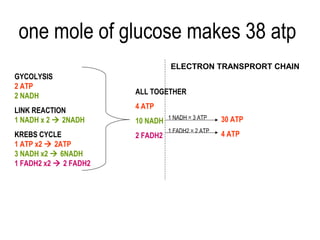
one mole of glucose makes 38 atp
                                 ELECTRON TRANSPRORT CHAIN
GYCOLYSIS
2 ATP
                       ALL TOGETHER
2 NADH
                       4 ATP
LINK REACTION
1 NADH x 2  2NADH               1 NADH = 3 ATP    30 ATP
                       10 NADH
                                 1 FADH2 = 2 ATP
KREBS CYCLE            2 FADH2                     4 ATP
1 ATP x2  2ATP
3 NADH x2  6NADH
1 FADH2 x2  2 FADH2

Respiration

  • 1.
    Respiration delightsofalevels.blogspot.com
  • 2.
    Aerobic Respiration • FourStages in Aerobic Respiration – Glycolysis Series of reactions; products from these – Link reaction reactions are used in final stage – to produce ATP – Krebs cycle Last three occur in the mitochondria – (Glycolysis in the – Oxidative phosphorylation cytoplasm) Cristae Inner membrane Matrix Outer membrane
  • 3.
    Stage one, Glycolysis Glycolyisismakes Pyruvate Glycolysis from Glucose • Glycolysis involves splitting 1 molecule of glucose (6C) Link reaction into 2 smaller molecules of pyruvate (3C). • Occurs in the cytoplasm Krebs cycle • The first stage of both aerobic and anaerobic Oxidative and doesn’t need oxygen phosphorylation to take place – anaerobic process
  • 4.
    2 Stages ofGlycolysis Stage 1: Phosporylation glucose (6C) 1) Glucose is 2ATP phosphorylated by adding 2 phosphates from 2 2ADP molecules of ATP hexose biphosphate (6C) 2) This creates 1 molecule of hexose bisphosphate and 2x triose phosphate (3C) 2 molecules of ADP 4ADP+4P 2H+ 2NAD 3) Then, hexose bisphosphate is split up 4ATP 2reducedNAD into 2 molecules of triose phosphate. 2x pyruvate (3C)
  • 5.
    2 Stages ofGlycolysis Stage 2: Oxidation glucose (6C) • Triose phosphate is 2ATP oxidised, forming 2 molecules of pyruvate. 2ADP • NAD collects the hydrogen hexose biphosphate (6C) ions, forming 2 reduced NAD 2x triose phosphate (3C) • 4 ATP are produced, but 2 4ADP+4P 2H+ 2NAD were used up in stage one so there’s a net gain of 2 4ATP 2reducedNAD ATP. 2x pyruvate 3C
  • 6.
    Stage 2, thelink reaction Link reaction occurs in mitochondrial matrix pyruvate (3C) • Pyruvate is decarboxylated – CO2 (1C) one carbon atom is removed from pyruvate in the form of CO2 NAD • NAD is reduced – it collects reduced NAD hydrogen from pyruvate, changing pyruvate to acetate acetate (2C) • Acetate is combined with coenzyme A (CoA) coenzyme A (CoA) to form acetyl coenzyme A (acetyl CoA) • No ATP is produced in this acetyl CoA (2C) reaction
  • 7.
    Link reaction The LinkReaction occurs twice for every glucose molecule Glycolysis • Two molecules of acetyl coenzyme A go into Krebs cycle Link reaction • Two CO2 molecules are released as a waste product of respiration Krebs cycle • Two molecules of reduced NAD are formed and go to the Oxidative last stage (oxidative phosphorylation phosphorylation)
  • 8.
    Mitochondria Mitochondria are adaptedto their function: • Inner membrane is folded into cristae, which increases membrane’s surface area to maximise respiration • There are lots of ATP Synthase molecules in the inner membrane to produce lots of ATP in the final stage of respiration • The matrix contains all the reactants and enzymes needed for the Krebs cycle to take place. Cristae – increase Inner membrane – surface area to lots of ATP maximise synthase molecules respiration in here to produce lots of ATP in final stage Matrix – contains all the reactants Outer membrane and enzymes needed for the Krebs cycle
  • 9.
    Stage 3, theKrebs Cycle The Krebs cycle produces Reduced Coenzymes and ATP 1) – Acetyl CoA from the link reaction combines with oxaloacetate to form citrate – Coenzyme A goes back to the link reaction to be used again Acetyl CoA (2C) CoA Oxaloacetate (4C) Citrate (6C) CO2 (1C) reduced NAD NAD reduced FAD NAD FAD ATP reduced NAD ADP + Pi 5C compound reduced NAD
  • 10.
    Stage 3, theKrebs Cycle 2) Acetyl CoA (2C) – the 6C citrate CoA molecule is converted to a 5C molecule Oxaloacetate (4C) Citrate (6C) – Decarboxylation CO2 (1C) occurs where CO2 is reduced NAD NAD removed reduced FAD FAD NAD – Dehydrogenation also ATP reduced NAD occurs where hydrogen ADP + Pi reduced NAD 5C compound is removed NAD CO2 (1C) – The hydrogen is used to produce reduced NAD from NAD
  • 11.
    Stage 3, theKrebs Cycle 3) Acetyl CoA (2C) – The 5C molecule is then CoA converted to a 4C molecule (there are some intermediate compounds formed during this conversion) Oxaloacetate (4C) Citrate (6C) – Decarboxylation and dehydrogenation occur, producing CO2 (1C) one molecule of reduced FAD reduced NAD and two of reduced NAD NAD – ATP is produced by the direct reduced FAD FAD NAD transfer of a phosphate group ATP reduced NAD from an intermediate compound ADP + Pi 5C compound to ADP reduced NAD NAD – When a phosphate group is CO2 (1C) directly transferred from one molecule to another it’s called substrate-level phosphorylation. – Citrate has now been converted to oxaloacetate.
  • 12.
    Stage 3, theKrebs cycle • The Krebs cycle involves a Glycolysis series of oxidation- reduction reactions which takes place in the matrix of Link reaction the mitochondria. • The cycle happens once Krebs cycle for every pyruvate molecule, it goes round Oxidative twice for every glucose phosphorylation molecule
  • 13.
    Products of theKrebs cycle • Some of the products of the Krebs cycle are used in Oxidative Phosphorylation Products from one Krebs cycle Where it goes 1 x coenzyme A Reused in next link reaction Oxaloacetate Regenerated for use in the next Krebs cycle 2 x CO2 Released as a waste product 1 ATP Where it goes 3 reduced NAD Reused in next link reaction 1 reduced FAD Regenerated for use in the next Krebs cycle
  • 14.
    Stage 4, OxidativePhosphorylation • Produced lots of ATP • Process where the energy Glycolysis carried by electrons from reduced coenzymes (reduced NAD and reduced FAD) is used Link reaction to make ATP. (The whole point of the previous stages is to make reduced NAD and reduced FAD Krebs cycle for the final stage) • (Oxidative phosphorylation Oxidative involves 2 processes – electron phosphorylation transport chain and chemieosmosis.
  • 15.
    Stage 4, OxidativePhosphorylation Protons are pumped across the inner Mitochondrial Membrane. • Hydrogen atoms are released from reduced NAD and reduced FAD as they’re oxidised to NAD and FAD – H atoms split into protons and electrons (H+ and e-) • e- move along electron transport chain (made up of 3 electron carriers) losing energy at each carrier. • This energy is used by electron carriers to pump protons from the mitochondrial matrix into the intermembrane space (space between the inner and outer mitochondrial membranes) • Concentration of protons is now higher in the intermembrane space than the mitochondrial matrix - forms an electrochemical gradient • Protons move down the electrochemical gradient back into the matrix via ATP synthase - this movement drives the synthesis of ATP from ADP and inorganic phosphate. • Movement of H+ across a membrane, generates ATP = CHEMIOSMOSIS • In matrix, at ed of transport chain the protons, electrons and O2 combine with water Oxygen is said to be the final electron acceptor
  • 16.
    Stage 4, OxidativePhosphorylation outer mitochondrial membrane high H+ concentration H+ H+ H+ H+ H+ H+ H+ innermembrane space H+ H+ H+ inner mitochondrial membrane matrix of mitochondrion ADP + Pi 2e- reduced NAD 2H 2e- ATP H2O NAD H+ H+ H+ H+ 2H+ ATP H+ syntase low H+ concentration ½ O2 + 2H-
  • 17.
    one mole ofglucose makes 38 atp ELECTRON TRANSPRORT CHAIN GYCOLYSIS 2 ATP ALL TOGETHER 2 NADH 4 ATP LINK REACTION 1 NADH x 2  2NADH 1 NADH = 3 ATP 30 ATP 10 NADH 1 FADH2 = 2 ATP KREBS CYCLE 2 FADH2 4 ATP 1 ATP x2  2ATP 3 NADH x2  6NADH 1 FADH2 x2  2 FADH2