Cells – lesson 1
Target – to know how to use a microscope
and what plant and animal cells contain.
Using a microscope
1. Eyepiece
3. Focus
adjustor
2. Arm
4. Base
5. Mirror
6. Stage
7. Lenses
Diagram of a microscope
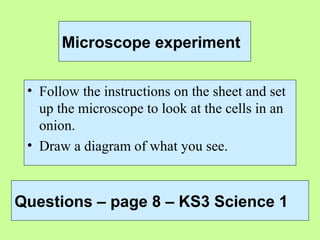
Microscope experiment
• Follow the instructions on the sheet and set
up the microscope to look at the cells in an
onion.
• Draw a diagram of what you see.
Questions – page 8 – KS3 Science 1
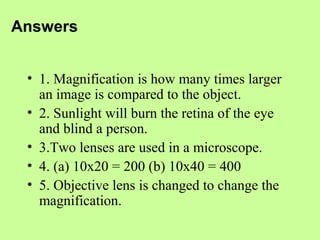
Answers
• 1. Magnification is how many times larger
an image is compared to the object.
• 2. Sunlight will burn the retina of the eye
and blind a person.
• 3.Two lenses are used in a microscope.
• 4. (a) 10x20 = 200 (b) 10x40 = 400
• 5. Objective lens is changed to change the
magnification.
Section through an Animal Cell
A jelly-like fluid that
fills the cell. Lots of
chemical reactions
occur here.
1.cytoplasm 2.cell membrane
Controls what
enters and leaves
the cell.
3.nucleus
Controls the
reactions of the
cell and how it
grows and divides
into new cells.
Section through a Plant Cell
A jelly-like fluid that
fills the cell. Lots of
chemical reactions
occur here.
1.cytoplasm 4.cell membrane
Controls what
enters and leaves
the cell.
5.nucleus
Controls the
reactions of the
cell and how it
grows and divides
into new cells.
Captures light and
make food by
photosynthesis.
2.chloroplast
Helps keep the
shape of the cell.
3.cell wall 6.vacuole
A space filled with
water and nutrients.
4)
1)
5)
6)
2)
3)
Plant cells vs. Animal cells
Both types of cell have these: Only plant cells
have these:
Cell wall – provides
support
Large Vacuole
– contains sap
Chloroplasts –
contain chlorophyll
Cell Membrane –
holds the cell
together
Cytoplasm -
this is where the
reactions happen
Nucleus –
The “brain” of
the cell
What is this?
What is this?
What is this?
What is this?
What is this?
What is this?
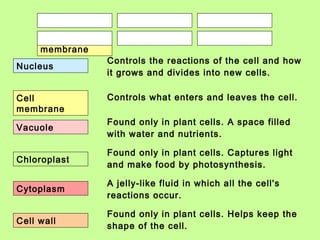
NucleusCytoplasmCell
membrane
VacuoleCell wallChloroplast
Nucleus
Cell
membrane
Vacuole
Chloroplast
Cytoplasm
Cell wall
Controls the reactions of the cell and how
it grows and divides into new cells.
Controls what enters and leaves the cell.
Found only in plant cells. A space filled
with water and nutrients.
Found only in plant cells. Captures light
and make food by photosynthesis.
A jelly-like fluid in which all the cell's
reactions occur.
Found only in plant cells. Helps keep the
shape of the cell.

Cells lesson 1

  • 1.
    Cells – lesson1 Target – to know how to use a microscope and what plant and animal cells contain.
  • 2.
    Using a microscope 1.Eyepiece 3. Focus adjustor 2. Arm 4. Base 5. Mirror 6. Stage 7. Lenses
  • 3.
    Diagram of amicroscope
  • 4.
    Microscope experiment • Followthe instructions on the sheet and set up the microscope to look at the cells in an onion. • Draw a diagram of what you see. Questions – page 8 – KS3 Science 1
  • 6.
    Answers • 1. Magnificationis how many times larger an image is compared to the object. • 2. Sunlight will burn the retina of the eye and blind a person. • 3.Two lenses are used in a microscope. • 4. (a) 10x20 = 200 (b) 10x40 = 400 • 5. Objective lens is changed to change the magnification.
  • 7.
    Section through anAnimal Cell A jelly-like fluid that fills the cell. Lots of chemical reactions occur here. 1.cytoplasm 2.cell membrane Controls what enters and leaves the cell. 3.nucleus Controls the reactions of the cell and how it grows and divides into new cells.
  • 8.
    Section through aPlant Cell A jelly-like fluid that fills the cell. Lots of chemical reactions occur here. 1.cytoplasm 4.cell membrane Controls what enters and leaves the cell. 5.nucleus Controls the reactions of the cell and how it grows and divides into new cells. Captures light and make food by photosynthesis. 2.chloroplast Helps keep the shape of the cell. 3.cell wall 6.vacuole A space filled with water and nutrients.
  • 9.
    4) 1) 5) 6) 2) 3) Plant cells vs.Animal cells Both types of cell have these: Only plant cells have these: Cell wall – provides support Large Vacuole – contains sap Chloroplasts – contain chlorophyll Cell Membrane – holds the cell together Cytoplasm - this is where the reactions happen Nucleus – The “brain” of the cell
  • 10.
    What is this? Whatis this? What is this? What is this? What is this? What is this? NucleusCytoplasmCell membrane VacuoleCell wallChloroplast Nucleus Cell membrane Vacuole Chloroplast Cytoplasm Cell wall Controls the reactions of the cell and how it grows and divides into new cells. Controls what enters and leaves the cell. Found only in plant cells. A space filled with water and nutrients. Found only in plant cells. Captures light and make food by photosynthesis. A jelly-like fluid in which all the cell's reactions occur. Found only in plant cells. Helps keep the shape of the cell.