Cell Structure
I. Looking at Cells A. Cells Under the Microscope-most cells are too  small  to be seen by the naked eye. 1.  Robert Hooke - first to observe and name cells by looking at slices of  cork . 2.  Anton van Leeuwenhoek -first to observe living cells. 3.  Magnification -quality of making an image appear larger. 4.  Resolution -measure of the clarity of an image.
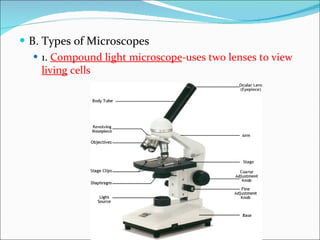
B. Types of Microscopes 1.  Compound light microscope -uses two lenses to view  living  cells
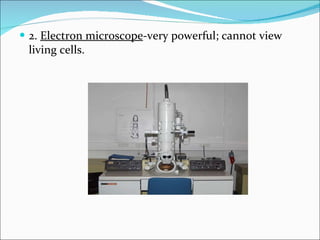
2.  Electron microscope -very powerful; cannot view living cells.
II. Cell Features A.  Cell Theory 1.  All living things are made of cells. 2.  Cells are the basic units of structure and function of living things. 3.  Cells come from existing cells.
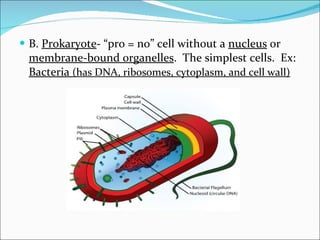
B.  Prokaryote - “pro = no” cell without a  nucleus  or  membrane-bound organelles .  The simplest cells.  Ex:  Bacteria  (has DNA, ribosomes, cytoplasm, and cell wall)
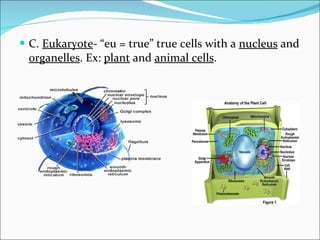
C.  Eukaryote - “eu = true” true cells with a  nucleus  and  organelles . Ex:  plant  and  animal cells .
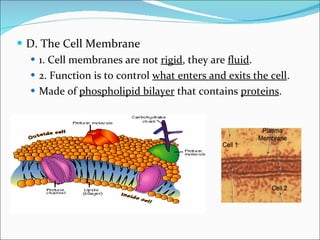
D. The Cell Membrane 1. Cell membranes are not  rigid , they are  fluid . 2. Function is to control  what enters and exits the cell . Made of  phospholipid bilayer  that contains  proteins .
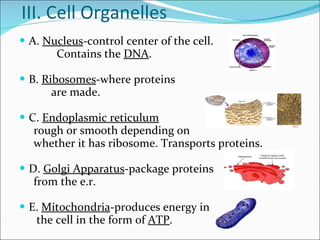
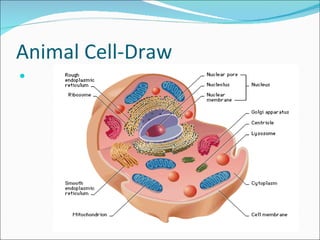
III. Cell Organelles A.  Nucleus -control center of the cell.  Contains the  DNA . B.  Ribosomes -where proteins  are made.  C.  Endoplasmic reticulum rough or smooth depending on  whether it has ribosome. Transports proteins. D.  Golgi Apparatus -package proteins from the e.r.  E.  Mitochondria -produces energy in  the cell in the form of  ATP .
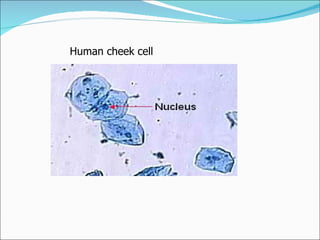
Human cheek cell
Animal Cell-Draw
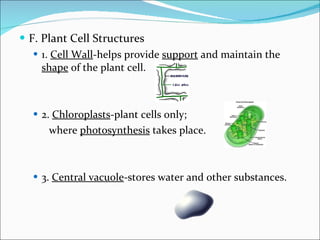
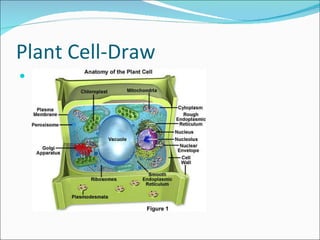
F. Plant Cell Structures 1.  Cell Wall -helps provide  support  and maintain the  shape  of the plant cell. 2.  Chloroplasts -plant cells only;  where  photosynthesis  takes place. 3.  Central vacuole -stores water and other substances.
Plant Cell-Draw
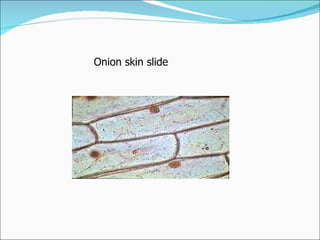
Onion skin slide

Chapter 3 notes

  • 1.
  • 2.
    I. Looking atCells A. Cells Under the Microscope-most cells are too small to be seen by the naked eye. 1. Robert Hooke - first to observe and name cells by looking at slices of cork . 2. Anton van Leeuwenhoek -first to observe living cells. 3. Magnification -quality of making an image appear larger. 4. Resolution -measure of the clarity of an image.
  • 3.
    B. Types ofMicroscopes 1. Compound light microscope -uses two lenses to view living cells
  • 4.
    2. Electronmicroscope -very powerful; cannot view living cells.
  • 5.
    II. Cell FeaturesA. Cell Theory 1. All living things are made of cells. 2. Cells are the basic units of structure and function of living things. 3. Cells come from existing cells.
  • 6.
    B. Prokaryote- “pro = no” cell without a nucleus or membrane-bound organelles . The simplest cells. Ex: Bacteria (has DNA, ribosomes, cytoplasm, and cell wall)
  • 7.
    C. Eukaryote- “eu = true” true cells with a nucleus and organelles . Ex: plant and animal cells .
  • 8.
    D. The CellMembrane 1. Cell membranes are not rigid , they are fluid . 2. Function is to control what enters and exits the cell . Made of phospholipid bilayer that contains proteins .
  • 9.
    III. Cell OrganellesA. Nucleus -control center of the cell. Contains the DNA . B. Ribosomes -where proteins are made. C. Endoplasmic reticulum rough or smooth depending on whether it has ribosome. Transports proteins. D. Golgi Apparatus -package proteins from the e.r. E. Mitochondria -produces energy in the cell in the form of ATP .
  • 10.
  • 11.
  • 12.
    F. Plant CellStructures 1. Cell Wall -helps provide support and maintain the shape of the plant cell. 2. Chloroplasts -plant cells only; where photosynthesis takes place. 3. Central vacuole -stores water and other substances.
  • 13.
  • 14.