CROP 111 -
Introduction to Agricultural
Botany
Dr. Agyemang Danquah
Office: WACCI; Office of the Coordinator, Teaching Programme
Tel: +233 24 471 1140
Email: agdanquah@ug.edu.gh
Skype: a.danquah
Duration of Lecture: 2.0 hrs
Consultation: Mon. to Fri. (3.00 - 5.00 p.m)
Cells
Tissues and Organs
Lecture 2
Objective
• Describe the plant cell
• Describe the internal structure of a plant cell
• The functions of the parts in a plant cell
Cells: Discovery
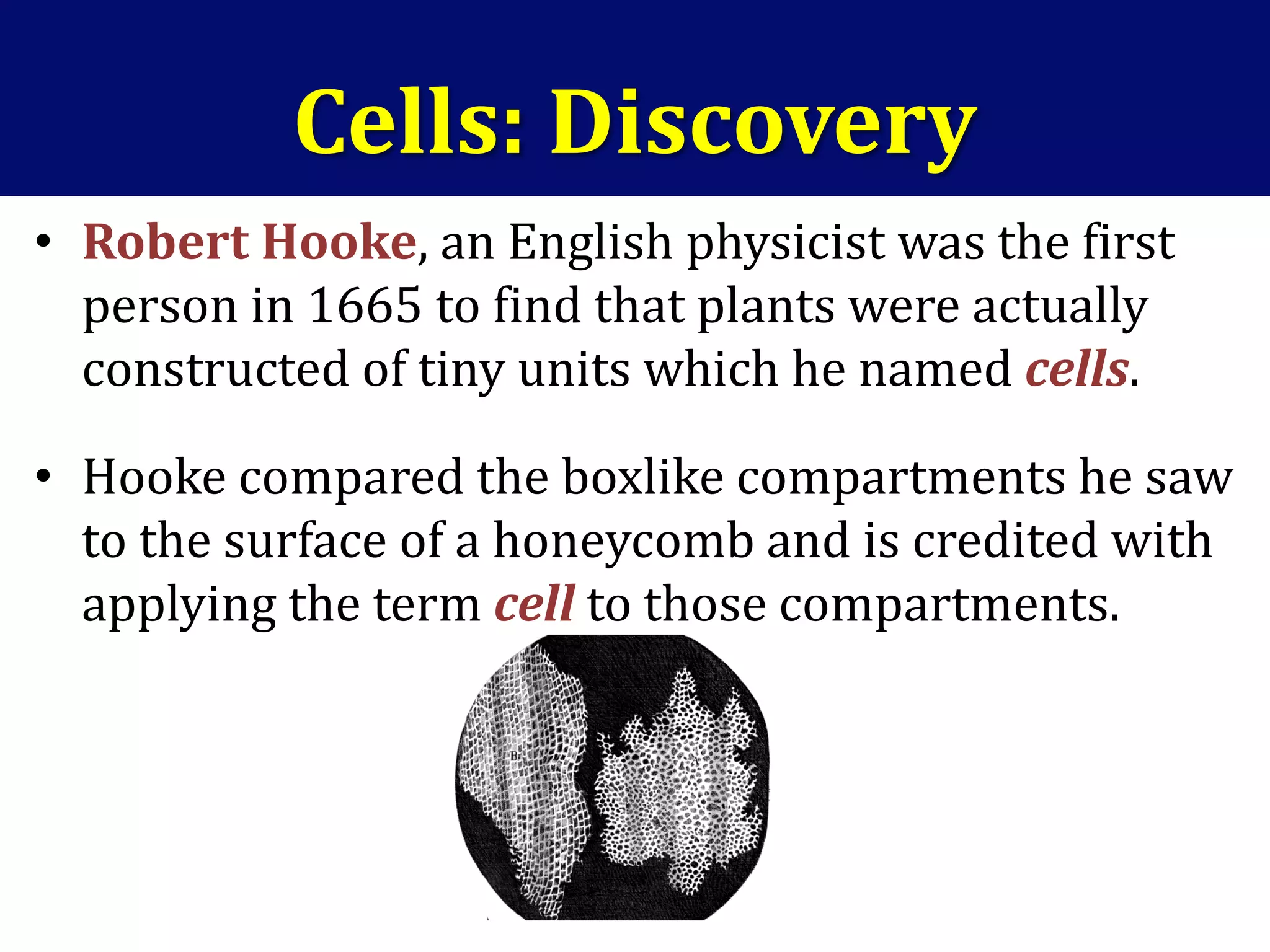
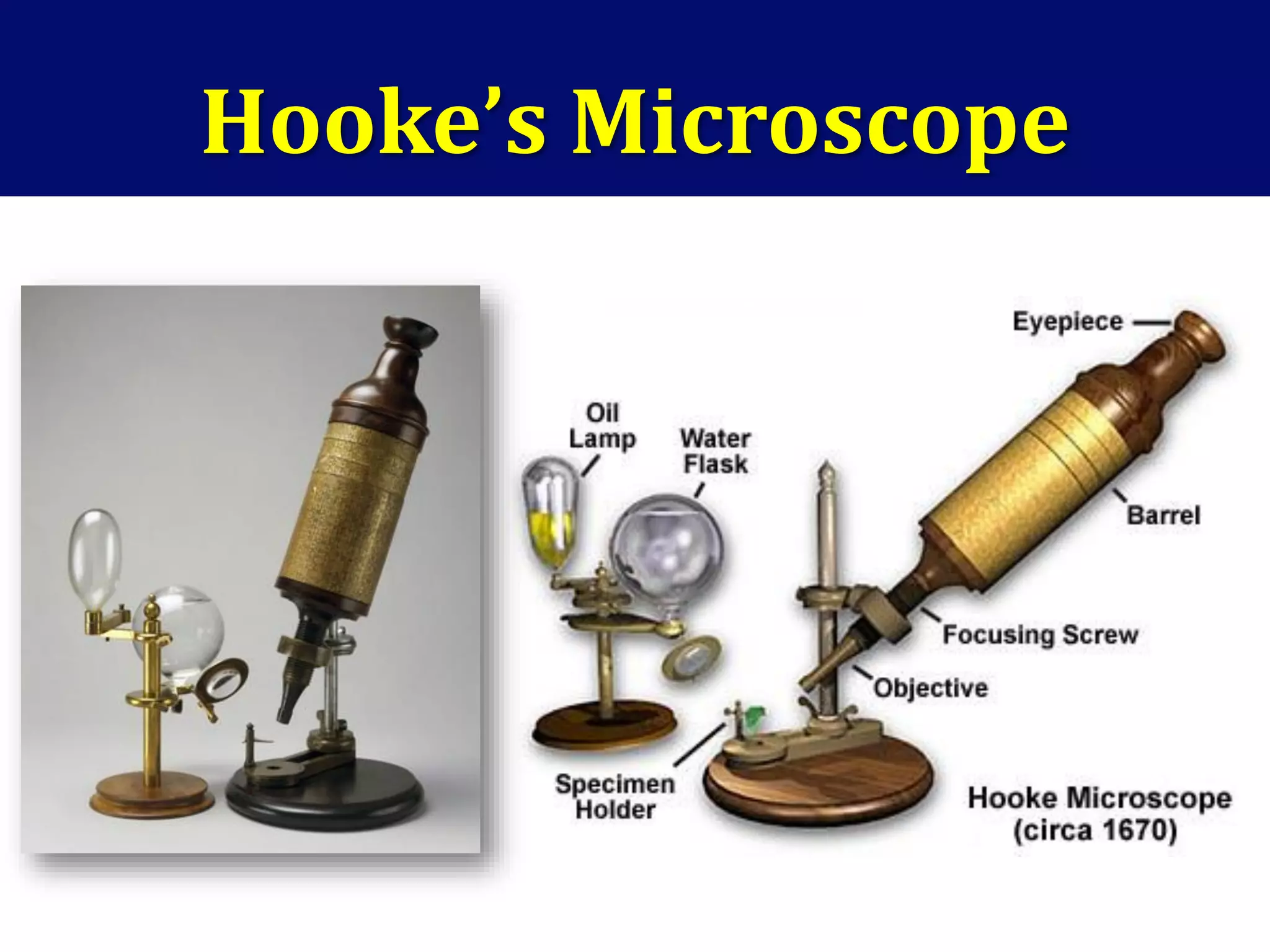
• Robert Hooke, an English physicist was the first
person in 1665 to find that plants were actually
constructed of tiny units which he named cells.
• Hooke compared the boxlike compartments he saw
to the surface of a honeycomb and is credited with
applying the term cell to those compartments.
Hooke’s Microscope
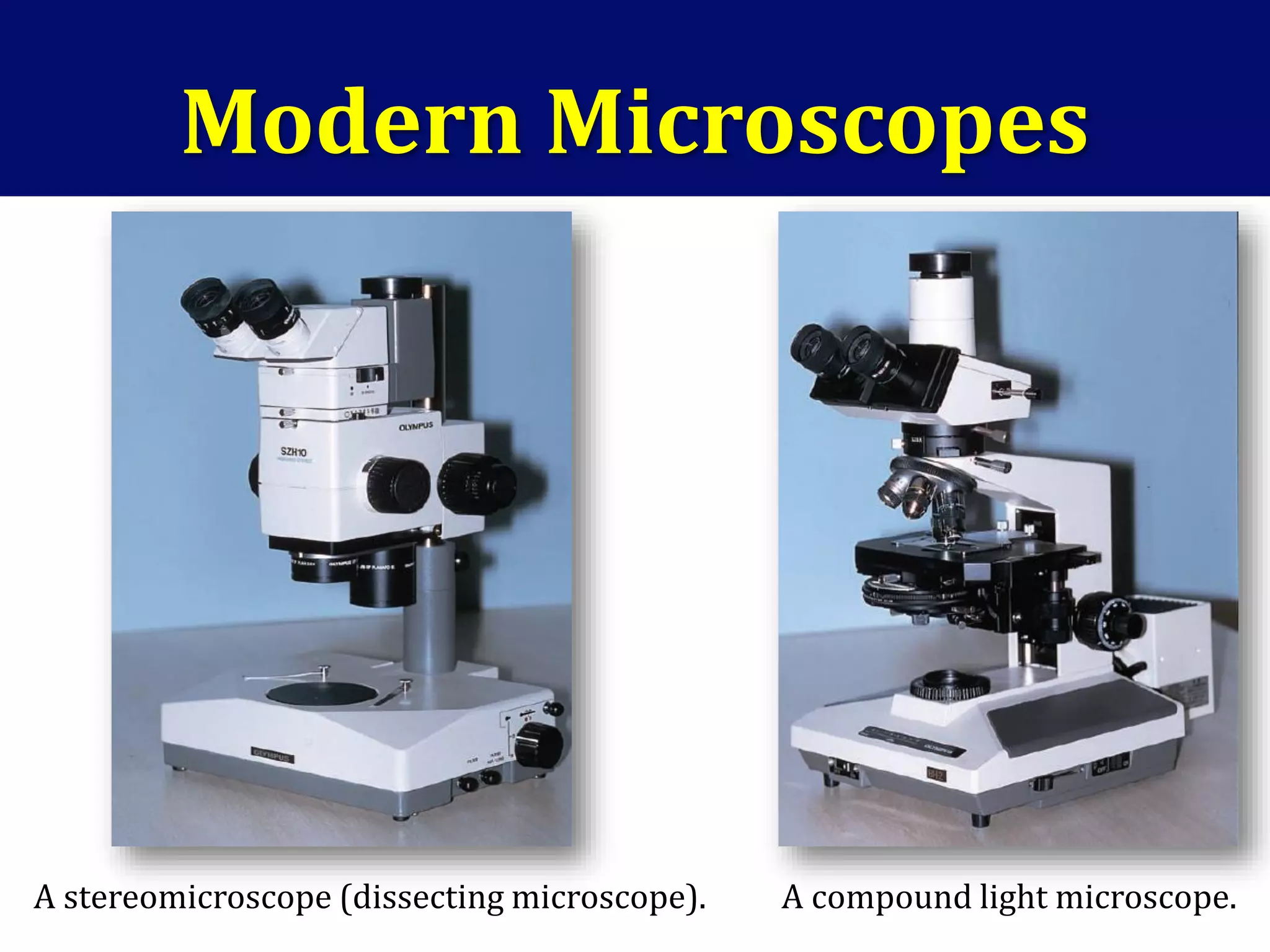
Modern Microscopes
A stereomicroscope (dissecting microscope). A compound light microscope.
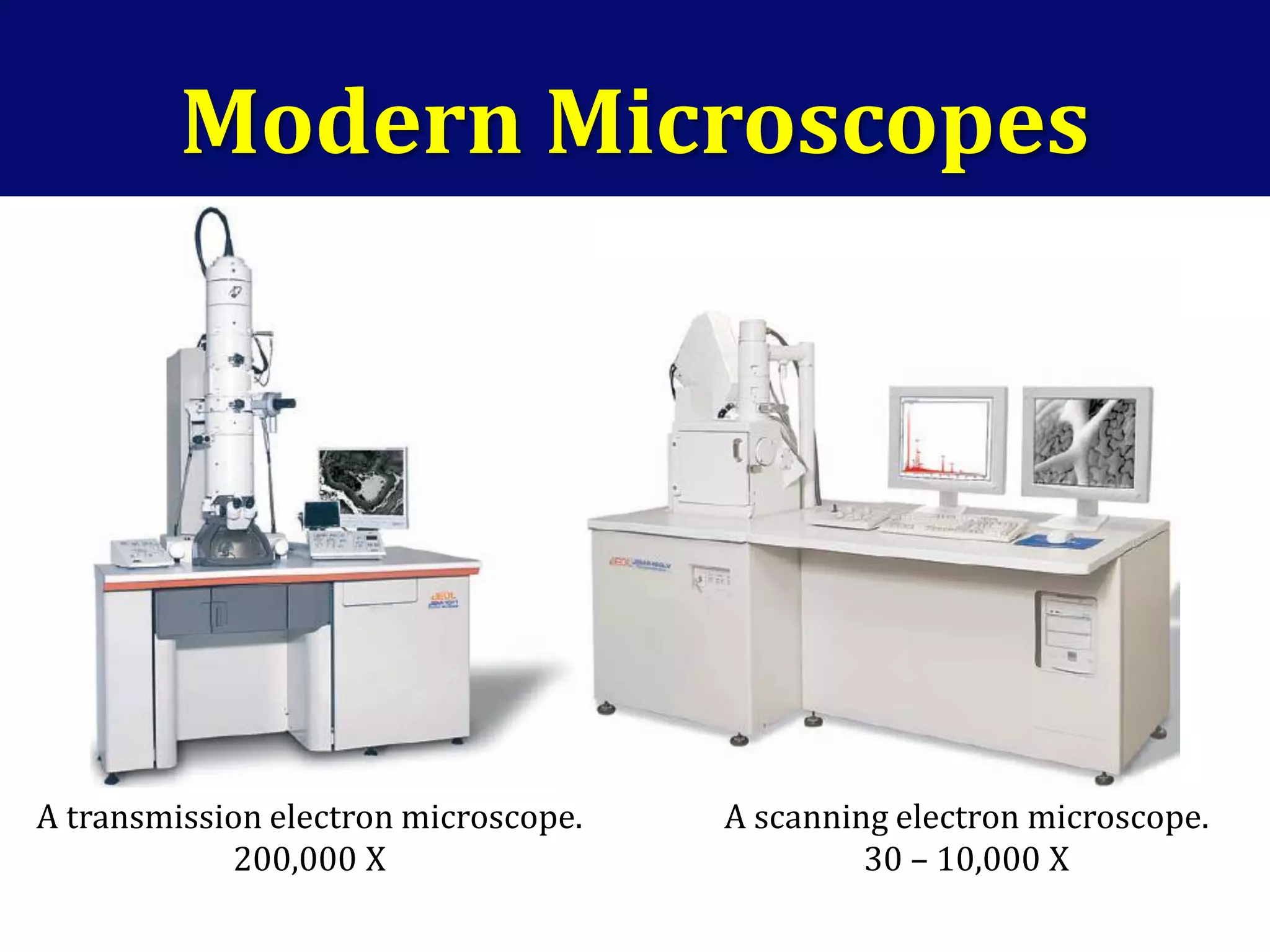
Modern Microscopes
A transmission electron microscope.
200,000 X
A scanning electron microscope.
30 – 10,000 X
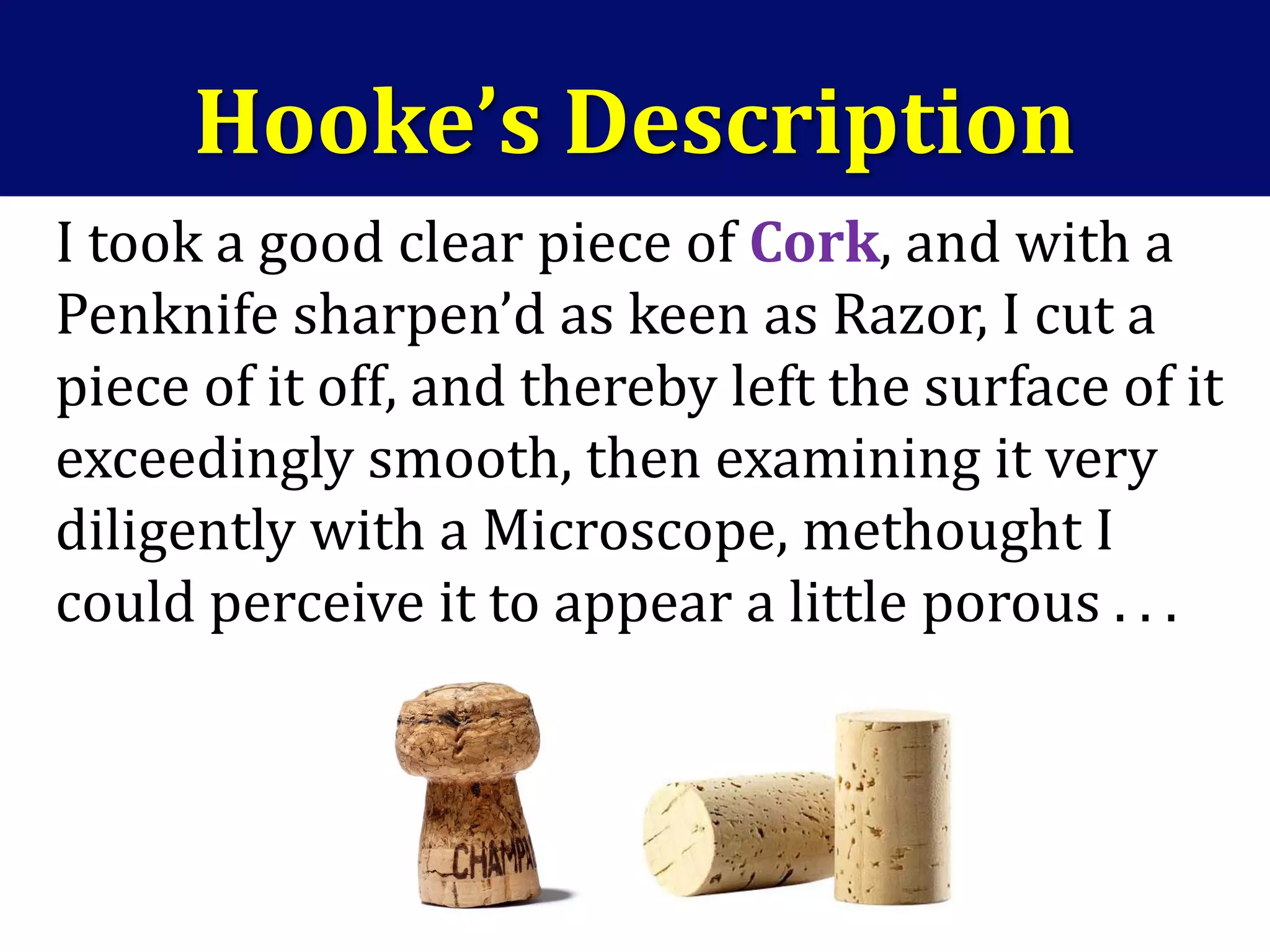
Hooke’s Description
I took a good clear piece of Cork, and with a
Penknife sharpen’d as keen as Razor, I cut a
piece of it off, and thereby left the surface of it
exceedingly smooth, then examining it very
diligently with a Microscope, methought I
could perceive it to appear a little porous . . .
…..these pores, or cells . . . were indeed the first
microscopical pores I ever saw, and perhaps that
were ever seen, for I had not met with any Writer
or Person, that had made mention of them before
this . . . I had with the discovery of them,
presently hinted to me the true and intelligible
reason of all the Phaenomena of Cork.
Hooke’s Description
Cell: History
• For the next 50 years after Hooke’s discovery, Anton
van Leeuwenhoek and Nehemiah Grew reported
frequently on the existence of cells in a variety of
tissues.
• In 1809, Jean Baptiste de Lamarck concluded that
all living tissue is composed of cells, and in 1824,
René J. H. Dutrochet reinforced Lamarck’s
conclusions.
• In 1831, Robert Brown discovered that all cells
contain a nucleus, and shortly thereafter, Matthias
Schleiden saw a nucleolus within a nucleus.
Cell: History
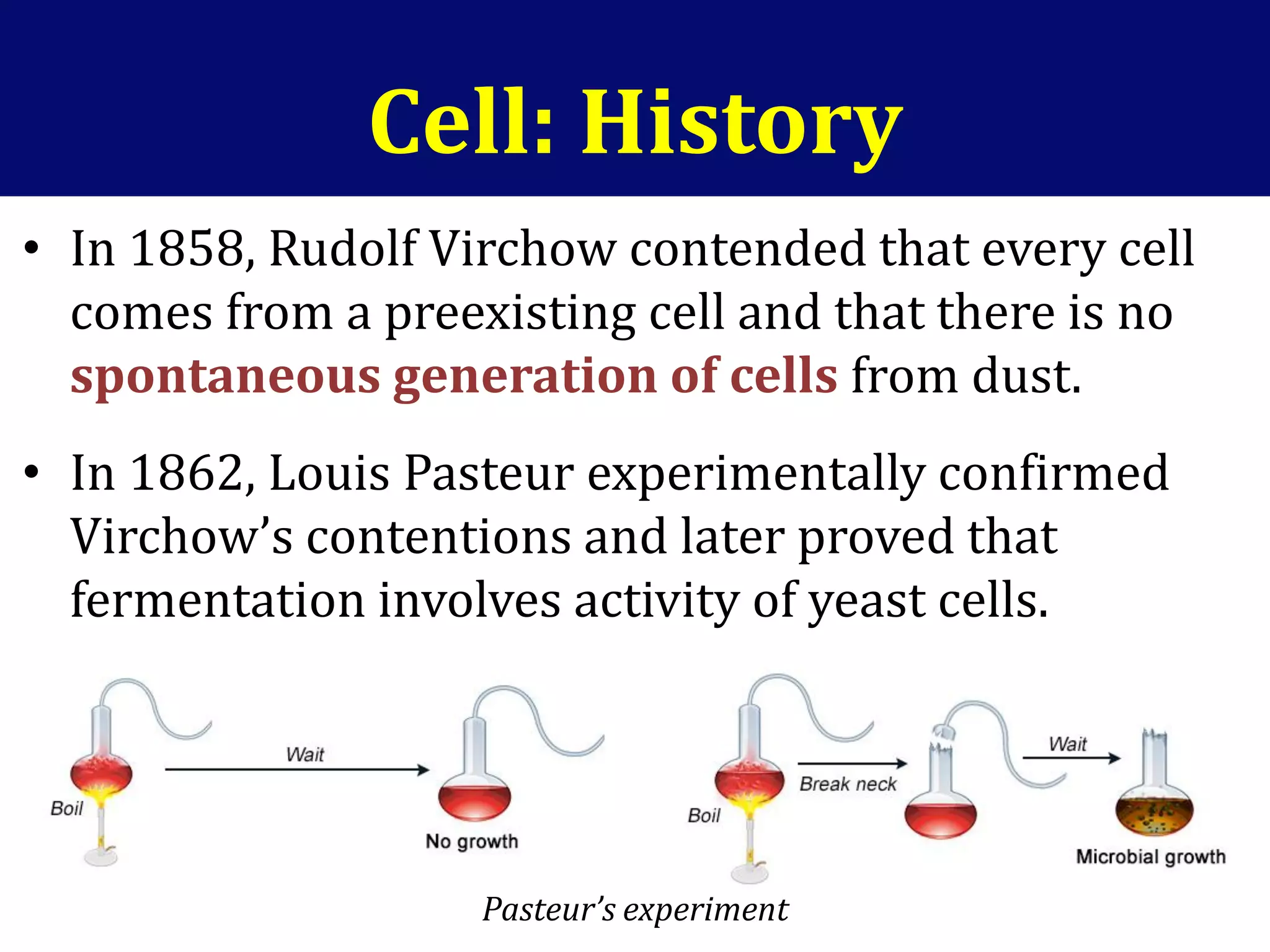
• In 1858, Rudolf Virchow contended that every cell
comes from a preexisting cell and that there is no
spontaneous generation of cells from dust.
• In 1862, Louis Pasteur experimentally confirmed
Virchow’s contentions and later proved that
fermentation involves activity of yeast cells.
Pasteur’s experiment
Cell Theory
• In 1838 – 39 two German scientists Mathias Schleiden
and Theodor Schwann proposed that all living things
are composed of cells or single cells and that all
cells and consequently all organisms arise from
pre-existing cells
• The modern cell theory states that:
– All organisms are composed of cells
– Except at the origin itself, all cells arise from
previously existing cells
– Cells are the functional units of life and metabolic
reactions, as well reactions necessary for
maintenance and reproduction occur in cells
Cells Biology
• The cell is the basic structural and functional
unit of all known living organisms.
• It is the smallest unit of life that is classified
as a living thing, and is often called the
building block of life.
• Organisms can be classified as unicellular
(most bacteria) or multicellular (including
plants and animals).
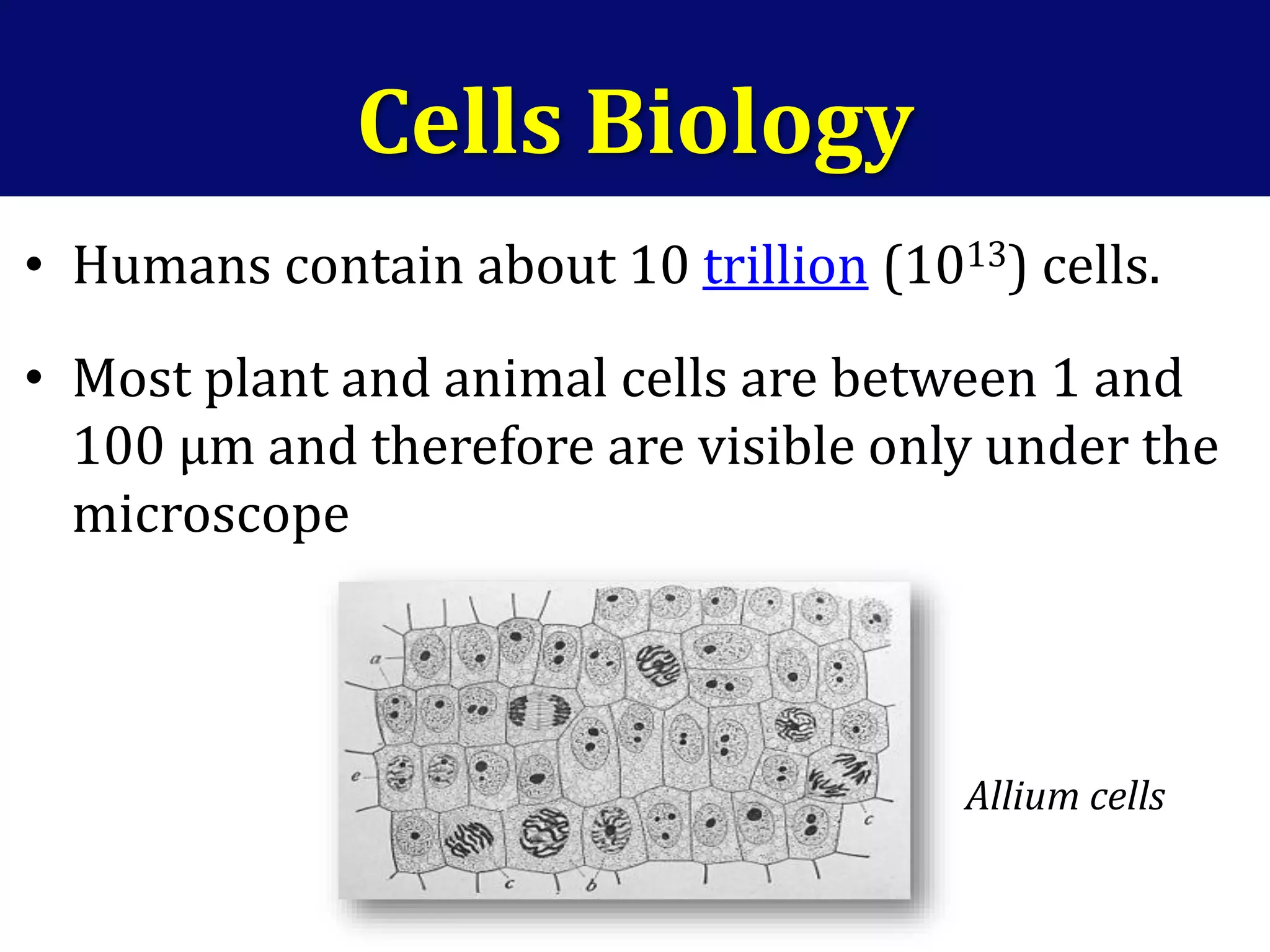
• Humans contain about 10 trillion (1013) cells.
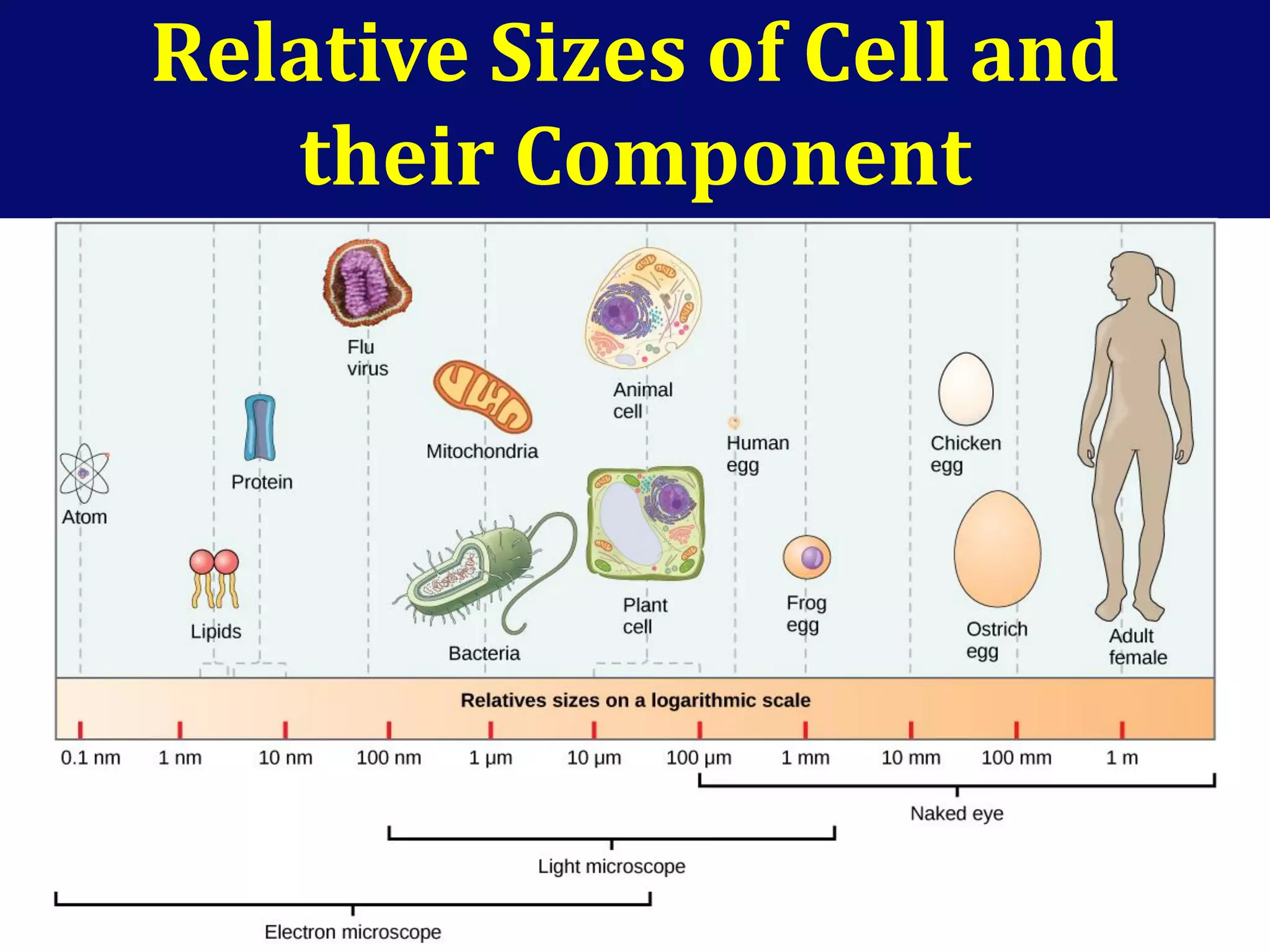
• Most plant and animal cells are between 1 and
100 µm and therefore are visible only under the
microscope
Allium cells
Cells Biology
Relative Sizes of Cell and
their Component
Cell
• Anything as small as a cell was unknown before
sophisticated optics became available
• With availability of Microscopes, researchers
began to observe the microscopic structure of
many substances
• In 1665, Robert Hooke described ‘cells’ in a
piece of cork
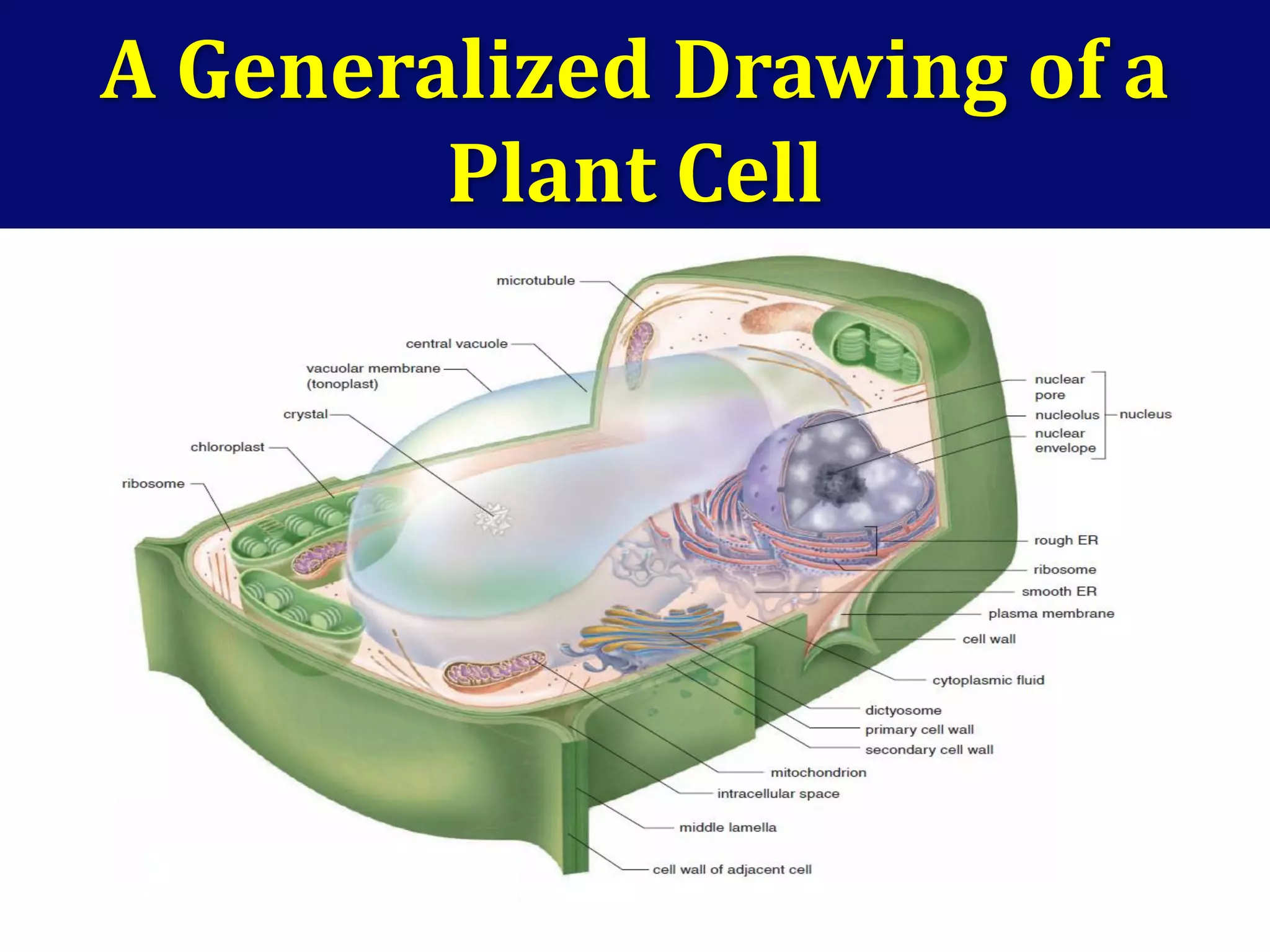
A Generalized Drawing of a
Plant Cell
A Simplified Diagram of
Plant Cell
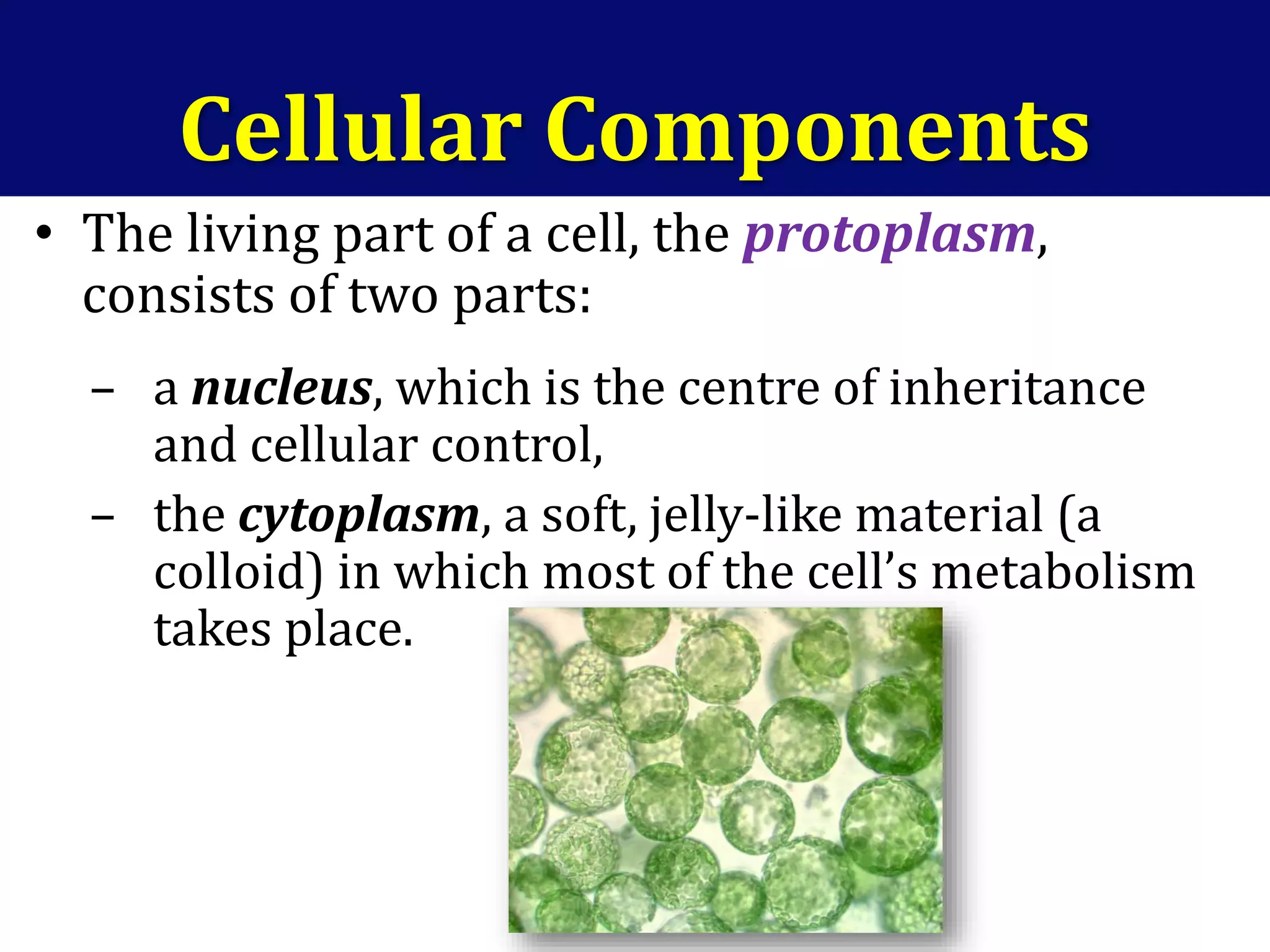
Cellular Components
• The living part of a cell, the protoplasm,
consists of two parts:
– a nucleus, which is the centre of inheritance
and cellular control,
– the cytoplasm, a soft, jelly-like material (a
colloid) in which most of the cell’s metabolism
takes place.
The Nucleus
• The nucleus of a cell is its control centre from which
instructions for the cell’s operation, maintenance, and
reproduction emanate
• The nucleus is bounded by a nuclear envelope
consisting of two membranes that are perforated by
numerous pores.
• Within the nucleus are a fluid called nucleoplasm and
one or more spherical nucleoli
• Inherited chromosomes, bearing genes that are
composed of the DNA are located in the nucleus. These
are the blueprints for making more cells
• Each species of organism has a specific number of
chromosomes in each cell
The Nucleus
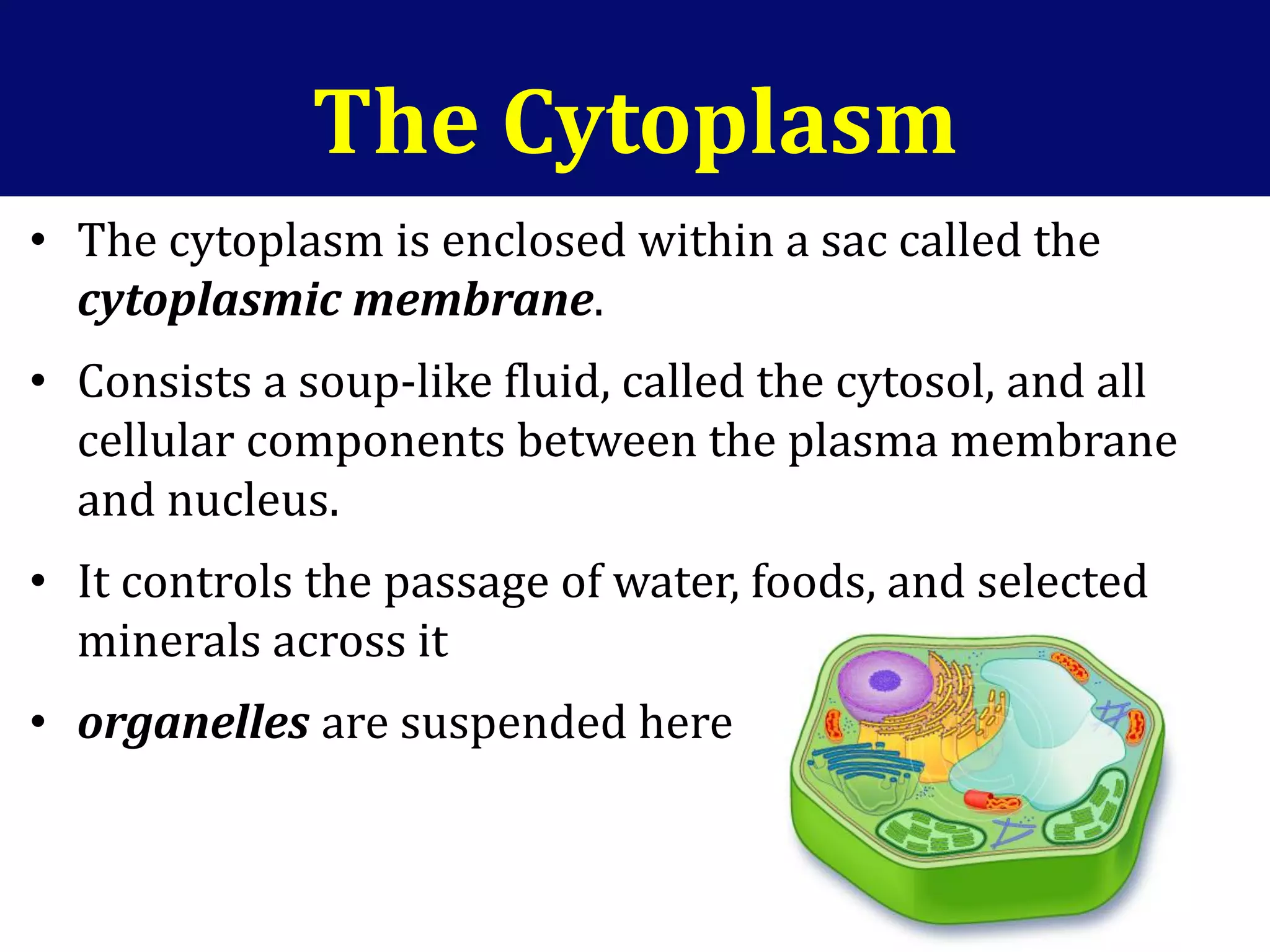
The Cytoplasm
• The cytoplasm is enclosed within a sac called the
cytoplasmic membrane.
• Consists a soup-like fluid, called the cytosol, and all
cellular components between the plasma membrane
and nucleus.
• It controls the passage of water, foods, and selected
minerals across it
• organelles are suspended here
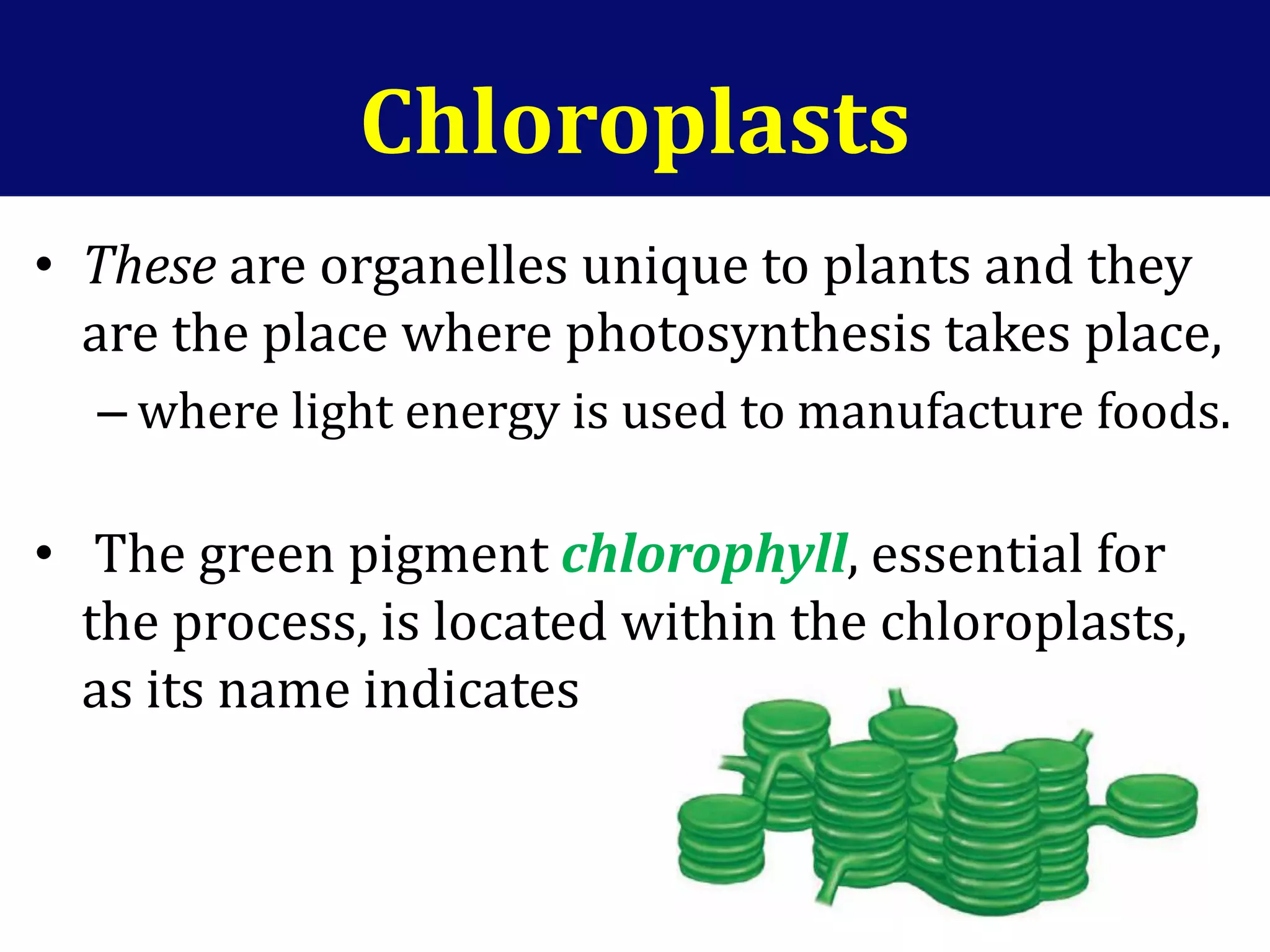
Chloroplasts
• These are organelles unique to plants and they
are the place where photosynthesis takes place,
– where light energy is used to manufacture foods.
• The green pigment chlorophyll, essential for
the process, is located within the chloroplasts,
as its name indicates
The Vacuole
• A vacuole occupies a large (90% or more in mature
cells) part of the volume of most plant cells.
vacuole means “empty space,”
• It is a membrane-bound inner sac (tonoplast)
containing much of a cell’s stored water (cell sap).
• It serves as a repository for excess mineral nutrients as
well as toxic waste products from the cell’s
metabolism.
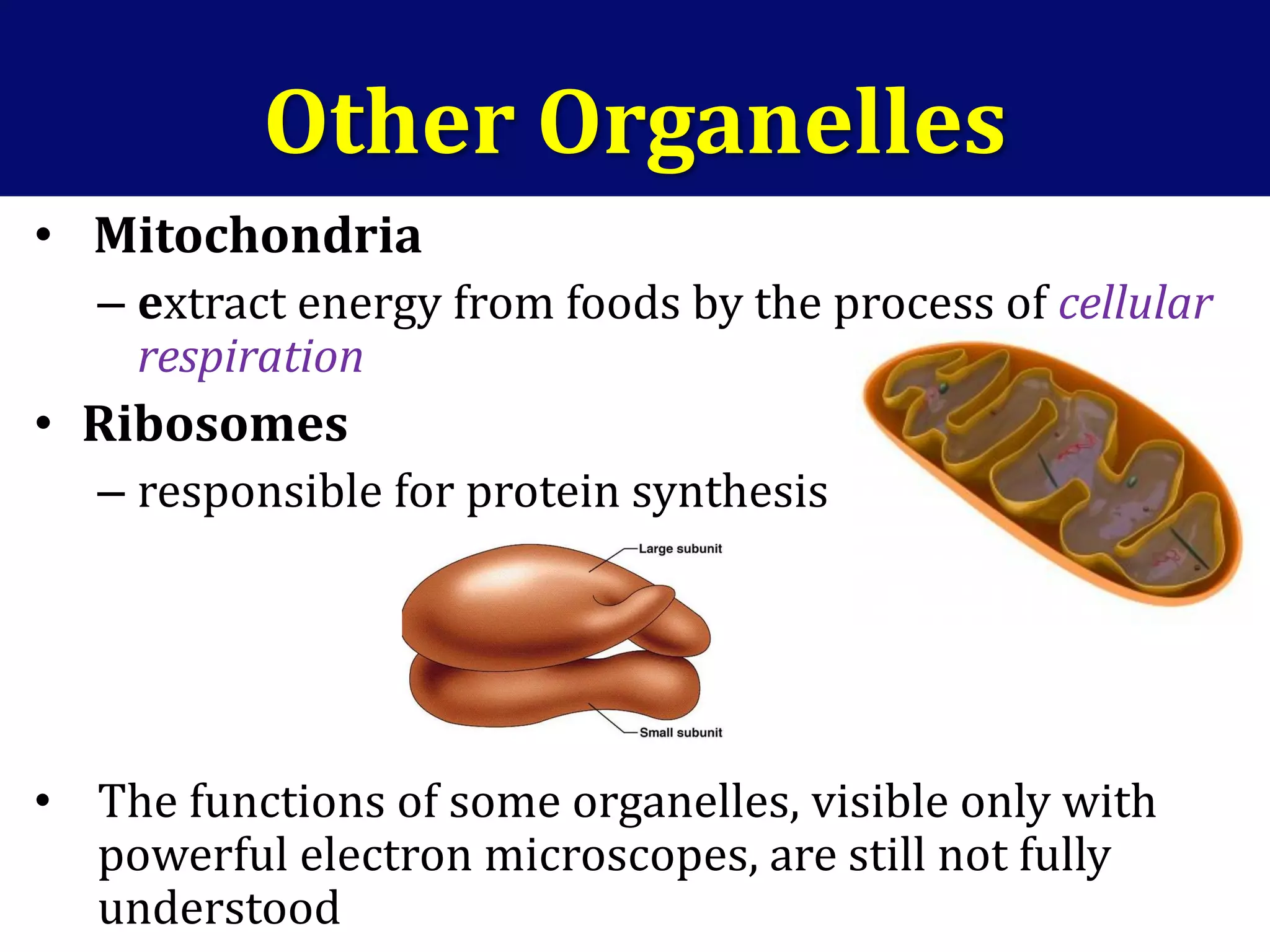
• Mitochondria
– extract energy from foods by the process of cellular
respiration
• Ribosomes
– responsible for protein synthesis
• The functions of some organelles, visible only with
powerful electron microscopes, are still not fully
understood
Other Organelles
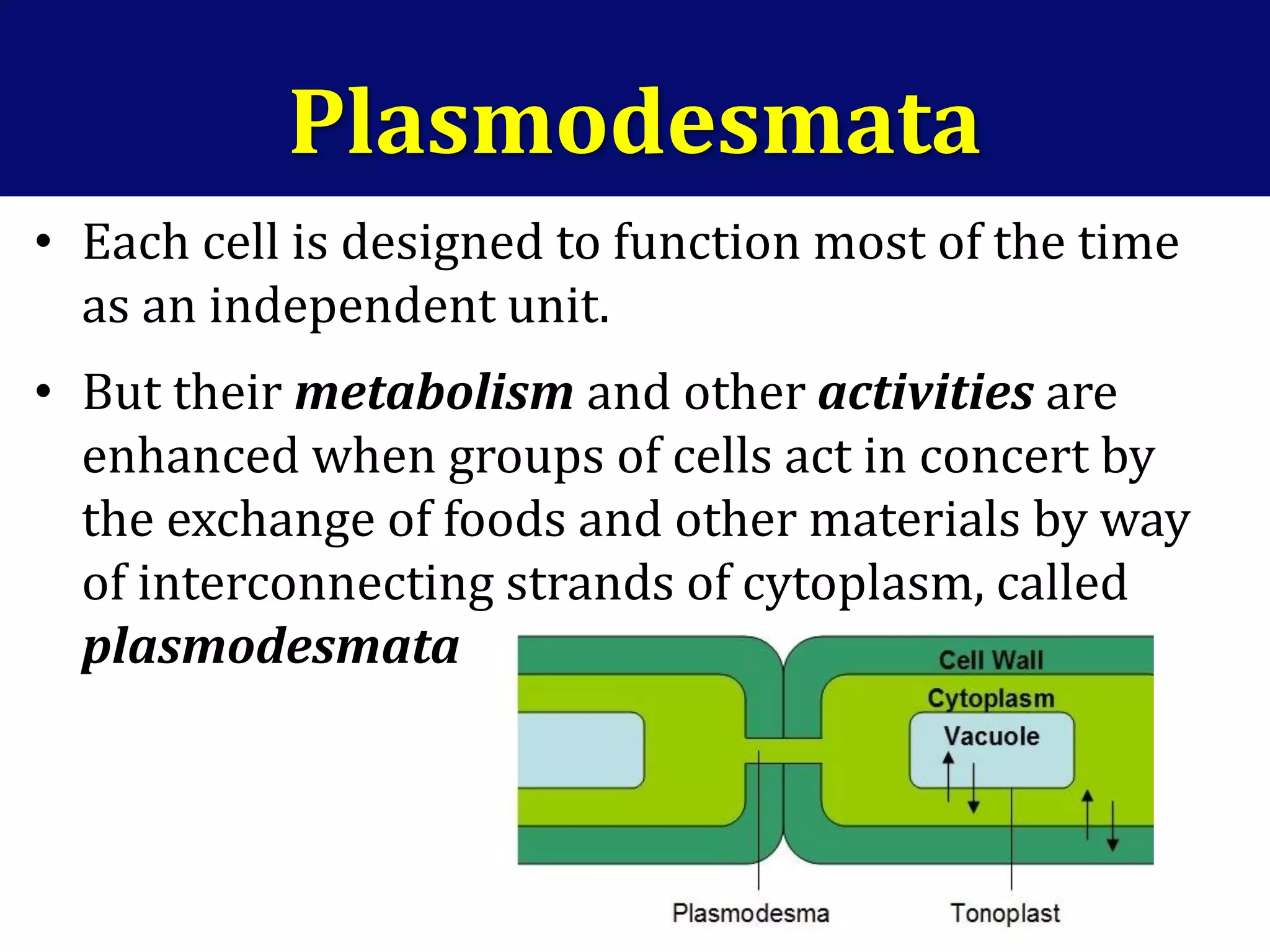
• Each cell is designed to function most of the time
as an independent unit.
• But their metabolism and other activities are
enhanced when groups of cells act in concert by
the exchange of foods and other materials by way
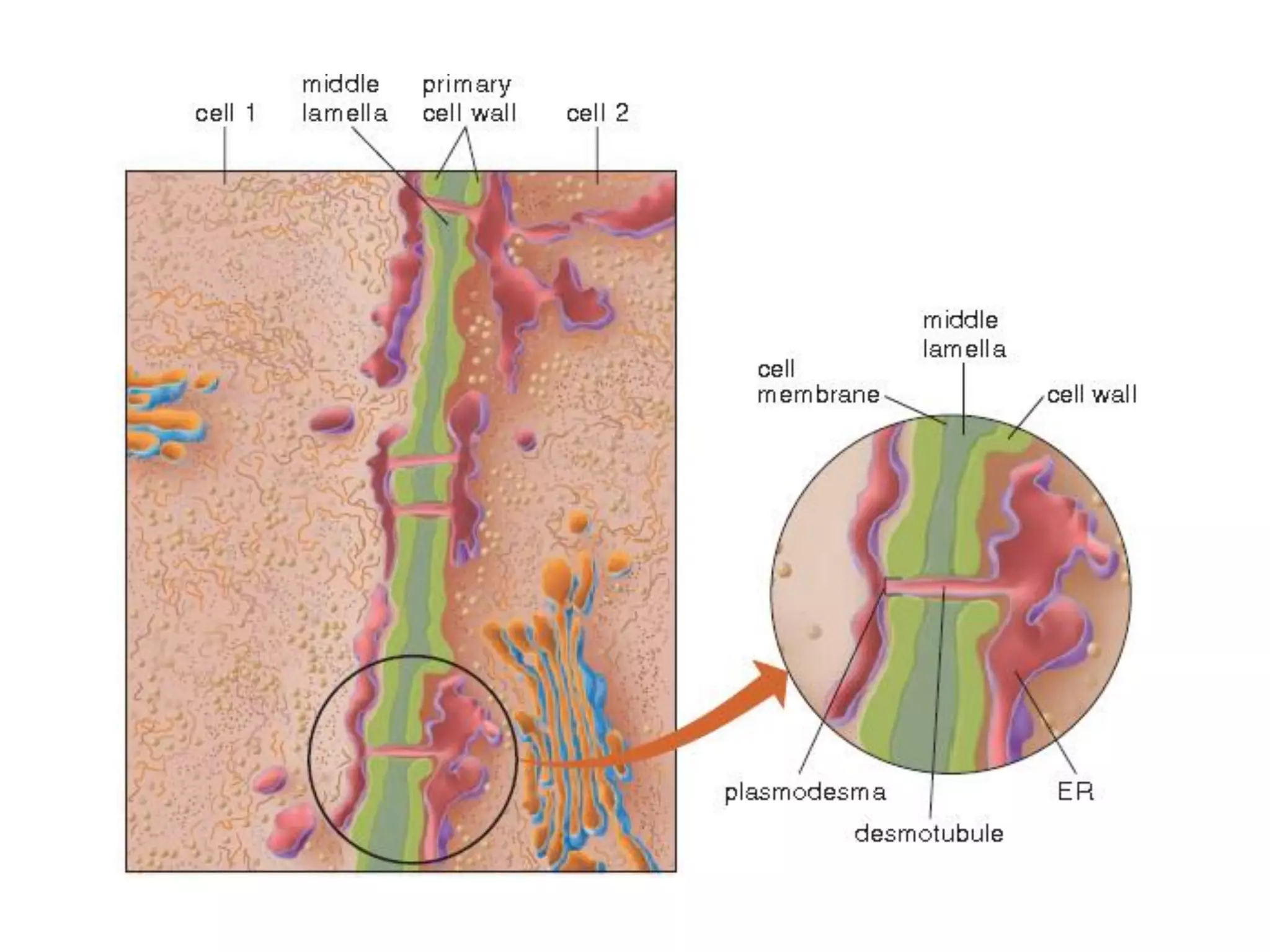
of interconnecting strands of cytoplasm, called
plasmodesmata
Plasmodesmata
The Cell Wall
• The protoplasm of each cell is surrounded by a
rigid cell wall that protects the living contents.
• Between adjacent cell walls the substance pectin
forms a thin layer, a middle lamella (a sheet), which
binds the cells together.
• This same substance, when commercially extracted
from plants and sold in supermarkets, is used to
thicken jams and fruit jellies.
• Collectively, cell walls give structural support to a
plant
• In woody stems supporting heavy loads, cells with extra-
thick walls are developed.
• When a cell is first formed, its wall is thin and largely
composed of the substance cellulose. This is the cell’s
primary wall.
• With increased age, the wall may thicken by addition of
more cellulose and by the introduction of lignin, a
hardening substance.
• Hardwoods are made up of cells with heavily lignified
walls.
• All of these extra layers constitute the cell’s secondary
wall
The Cell Wall
Tissues
• A plant is composed of countless cells having various
dimensions, shapes, and individual characteristics such
as
– cell wall thickness, being alive or dead at maturity
– having chloroplasts present or absent.
• These special features determine the specific function
of each cell.
• Distinctive cell types are not randomly arranged in
leaves, roots, or stems but in groups called tissues.
• Collectively, the cells carry out their specialized activity
more effectively than do individual cells.
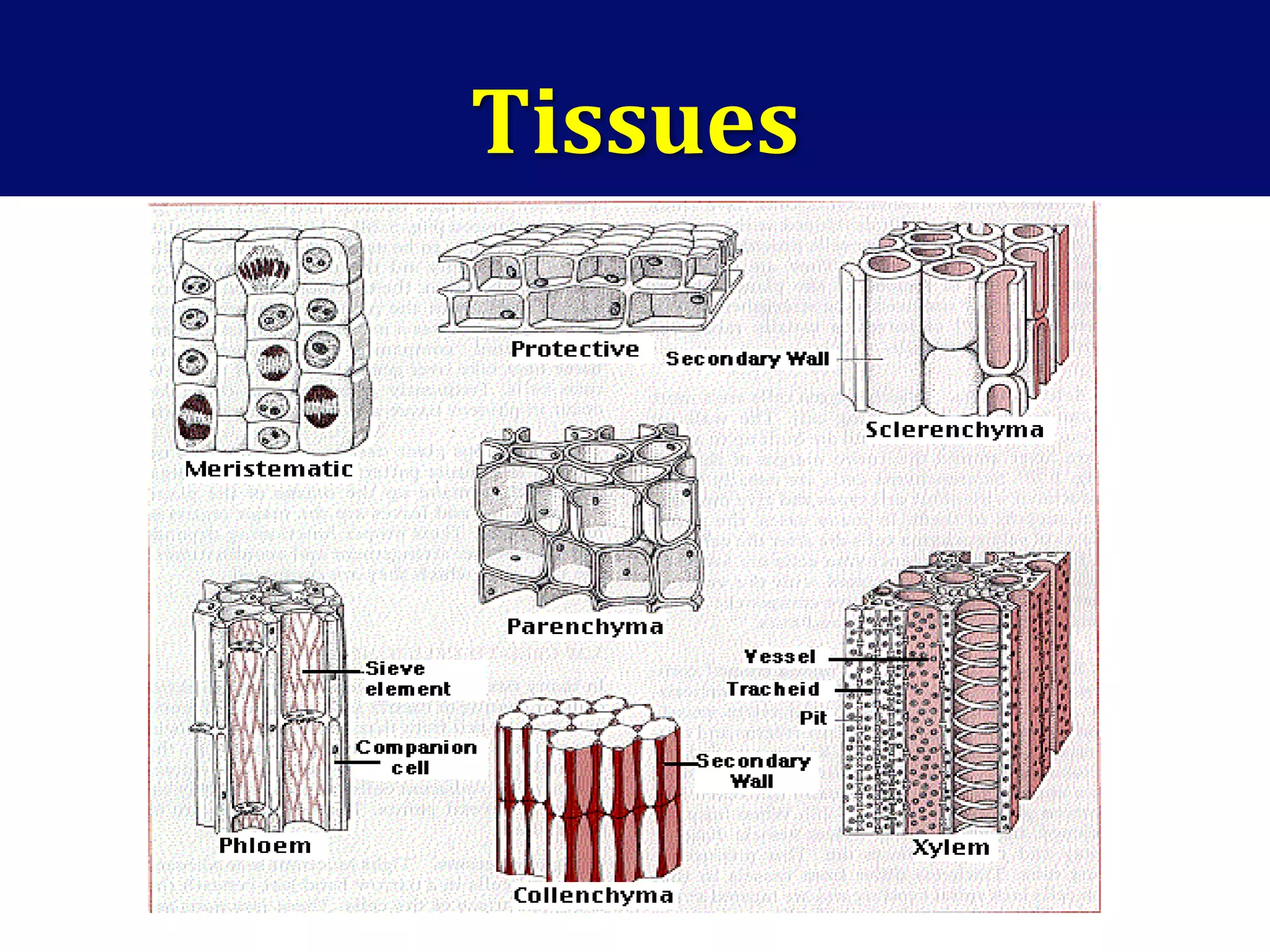
• For example, transportation of large volumes of water
through a plant is performed by groups of specialized
cells, organized into a xylem tissue
• Water conduction occurs only in an upward direction.
• Another tissue, the phloem conducts food molecules in
opposite directions between leaves and roots.
• There are tissues devoted to food storage,
photosynthesis, support, and protection, in addition to
one that simply packs the center of many stems.
Tissues
Tissues
Summary
• So, countless numbers and types of molecules
congregate to form the visible structures of
cells, including the organelles.
• Cells, in turn, are united into tissues;
• Tissues make up the next larger structures of
organs (roots, stems, leaves, flowers), while
they are parts of the whole organism, the plant.
Activity 1
1. Write down the definitions and functions of
the following:
a. Chloroplast
b. Mitochondrion
c. Nucleus
d. Protoplasm
e. Endoplasmic reticulum
2. Draw a diagram of a cell and label the cell
wall, Cytoplasm and the nucleus

Lecture 2

  • 1.
    CROP 111 - Introductionto Agricultural Botany Dr. Agyemang Danquah Office: WACCI; Office of the Coordinator, Teaching Programme Tel: +233 24 471 1140 Email: agdanquah@ug.edu.gh Skype: a.danquah Duration of Lecture: 2.0 hrs Consultation: Mon. to Fri. (3.00 - 5.00 p.m)
  • 2.
  • 3.
    Objective • Describe theplant cell • Describe the internal structure of a plant cell • The functions of the parts in a plant cell
  • 4.
    Cells: Discovery • RobertHooke, an English physicist was the first person in 1665 to find that plants were actually constructed of tiny units which he named cells. • Hooke compared the boxlike compartments he saw to the surface of a honeycomb and is credited with applying the term cell to those compartments.
  • 5.
  • 6.
    Modern Microscopes A stereomicroscope(dissecting microscope). A compound light microscope.
  • 7.
    Modern Microscopes A transmissionelectron microscope. 200,000 X A scanning electron microscope. 30 – 10,000 X
  • 8.
    Hooke’s Description I tooka good clear piece of Cork, and with a Penknife sharpen’d as keen as Razor, I cut a piece of it off, and thereby left the surface of it exceedingly smooth, then examining it very diligently with a Microscope, methought I could perceive it to appear a little porous . . .
  • 9.
    …..these pores, orcells . . . were indeed the first microscopical pores I ever saw, and perhaps that were ever seen, for I had not met with any Writer or Person, that had made mention of them before this . . . I had with the discovery of them, presently hinted to me the true and intelligible reason of all the Phaenomena of Cork. Hooke’s Description
  • 10.
    Cell: History • Forthe next 50 years after Hooke’s discovery, Anton van Leeuwenhoek and Nehemiah Grew reported frequently on the existence of cells in a variety of tissues. • In 1809, Jean Baptiste de Lamarck concluded that all living tissue is composed of cells, and in 1824, René J. H. Dutrochet reinforced Lamarck’s conclusions. • In 1831, Robert Brown discovered that all cells contain a nucleus, and shortly thereafter, Matthias Schleiden saw a nucleolus within a nucleus.
  • 11.
    Cell: History • In1858, Rudolf Virchow contended that every cell comes from a preexisting cell and that there is no spontaneous generation of cells from dust. • In 1862, Louis Pasteur experimentally confirmed Virchow’s contentions and later proved that fermentation involves activity of yeast cells. Pasteur’s experiment
  • 12.
    Cell Theory • In1838 – 39 two German scientists Mathias Schleiden and Theodor Schwann proposed that all living things are composed of cells or single cells and that all cells and consequently all organisms arise from pre-existing cells • The modern cell theory states that: – All organisms are composed of cells – Except at the origin itself, all cells arise from previously existing cells – Cells are the functional units of life and metabolic reactions, as well reactions necessary for maintenance and reproduction occur in cells
  • 13.
    Cells Biology • Thecell is the basic structural and functional unit of all known living organisms. • It is the smallest unit of life that is classified as a living thing, and is often called the building block of life. • Organisms can be classified as unicellular (most bacteria) or multicellular (including plants and animals).
  • 14.
    • Humans containabout 10 trillion (1013) cells. • Most plant and animal cells are between 1 and 100 µm and therefore are visible only under the microscope Allium cells Cells Biology
  • 15.
    Relative Sizes ofCell and their Component
  • 16.
    Cell • Anything assmall as a cell was unknown before sophisticated optics became available • With availability of Microscopes, researchers began to observe the microscopic structure of many substances • In 1665, Robert Hooke described ‘cells’ in a piece of cork
  • 17.
    A Generalized Drawingof a Plant Cell
  • 18.
    A Simplified Diagramof Plant Cell
  • 19.
    Cellular Components • Theliving part of a cell, the protoplasm, consists of two parts: – a nucleus, which is the centre of inheritance and cellular control, – the cytoplasm, a soft, jelly-like material (a colloid) in which most of the cell’s metabolism takes place.
  • 20.
    The Nucleus • Thenucleus of a cell is its control centre from which instructions for the cell’s operation, maintenance, and reproduction emanate • The nucleus is bounded by a nuclear envelope consisting of two membranes that are perforated by numerous pores. • Within the nucleus are a fluid called nucleoplasm and one or more spherical nucleoli • Inherited chromosomes, bearing genes that are composed of the DNA are located in the nucleus. These are the blueprints for making more cells • Each species of organism has a specific number of chromosomes in each cell
  • 21.
  • 22.
    The Cytoplasm • Thecytoplasm is enclosed within a sac called the cytoplasmic membrane. • Consists a soup-like fluid, called the cytosol, and all cellular components between the plasma membrane and nucleus. • It controls the passage of water, foods, and selected minerals across it • organelles are suspended here
  • 23.
    Chloroplasts • These areorganelles unique to plants and they are the place where photosynthesis takes place, – where light energy is used to manufacture foods. • The green pigment chlorophyll, essential for the process, is located within the chloroplasts, as its name indicates
  • 24.
    The Vacuole • Avacuole occupies a large (90% or more in mature cells) part of the volume of most plant cells. vacuole means “empty space,” • It is a membrane-bound inner sac (tonoplast) containing much of a cell’s stored water (cell sap). • It serves as a repository for excess mineral nutrients as well as toxic waste products from the cell’s metabolism.
  • 25.
    • Mitochondria – extractenergy from foods by the process of cellular respiration • Ribosomes – responsible for protein synthesis • The functions of some organelles, visible only with powerful electron microscopes, are still not fully understood Other Organelles
  • 26.
    • Each cellis designed to function most of the time as an independent unit. • But their metabolism and other activities are enhanced when groups of cells act in concert by the exchange of foods and other materials by way of interconnecting strands of cytoplasm, called plasmodesmata Plasmodesmata
  • 27.
    The Cell Wall •The protoplasm of each cell is surrounded by a rigid cell wall that protects the living contents. • Between adjacent cell walls the substance pectin forms a thin layer, a middle lamella (a sheet), which binds the cells together. • This same substance, when commercially extracted from plants and sold in supermarkets, is used to thicken jams and fruit jellies. • Collectively, cell walls give structural support to a plant
  • 29.
    • In woodystems supporting heavy loads, cells with extra- thick walls are developed. • When a cell is first formed, its wall is thin and largely composed of the substance cellulose. This is the cell’s primary wall. • With increased age, the wall may thicken by addition of more cellulose and by the introduction of lignin, a hardening substance. • Hardwoods are made up of cells with heavily lignified walls. • All of these extra layers constitute the cell’s secondary wall The Cell Wall
  • 30.
    Tissues • A plantis composed of countless cells having various dimensions, shapes, and individual characteristics such as – cell wall thickness, being alive or dead at maturity – having chloroplasts present or absent. • These special features determine the specific function of each cell. • Distinctive cell types are not randomly arranged in leaves, roots, or stems but in groups called tissues. • Collectively, the cells carry out their specialized activity more effectively than do individual cells.
  • 31.
    • For example,transportation of large volumes of water through a plant is performed by groups of specialized cells, organized into a xylem tissue • Water conduction occurs only in an upward direction. • Another tissue, the phloem conducts food molecules in opposite directions between leaves and roots. • There are tissues devoted to food storage, photosynthesis, support, and protection, in addition to one that simply packs the center of many stems. Tissues
  • 32.
  • 33.
    Summary • So, countlessnumbers and types of molecules congregate to form the visible structures of cells, including the organelles. • Cells, in turn, are united into tissues; • Tissues make up the next larger structures of organs (roots, stems, leaves, flowers), while they are parts of the whole organism, the plant.
  • 34.
    Activity 1 1. Writedown the definitions and functions of the following: a. Chloroplast b. Mitochondrion c. Nucleus d. Protoplasm e. Endoplasmic reticulum 2. Draw a diagram of a cell and label the cell wall, Cytoplasm and the nucleus