DETAILED LESSON PLAN IN SCIENCE 9
QUARTER: 1st
LESSON:CHAPTER 1; LESSON 1.2
DATE: MARCH 17, 2015
DAY: TUESDAY
I. OBJECTIVES
Duringthe lesson,studentswill be able to:
A. Identifythe partsof the respiratorysystem
B. Describe the mainfunctionsof the parts of respiratorysystem
C. Showcooperationinthe groupactivity
II. SUBJECT MATTER
a. Topic:Human RespiratorySystem
b. References:ExploringLife ThroughScience Series,PhoenixPublishingHouse
c. Concept:
The respiratorysystemconsistsof organsandbreathing structuresthatallow
gas exchange occur.
d. Materials:
i. Mineral WaterBottle
ii.
e. Science Processes:
i. Observing
ii. Identifying
iii. Describing
iv. Analyzing
III. A. Preparatory Activities:
Teacher’sActivity Student’sActivity
1. ENGAGE
“Good AfternoonClass...”
“Let us prayfirst...”
“Is there anyabsenteesfortoday?”
“Thank you_________, for youattendance
report.”
A. REVIEW
“Before we proceedwithournewtopic,who
amongyou remembersourtopicyesterday?”
“Thank youfor yourparticipation. “
“Good AfternoonSir.”
Studentswill remainstandingandone student
will leadthe prayer.
Classsecretarywill announce the numberof
studentspresentandnumberof students
absentforthe day.
One studentwill answerthe topic discussed
yesterday.
B. MOTIVATION
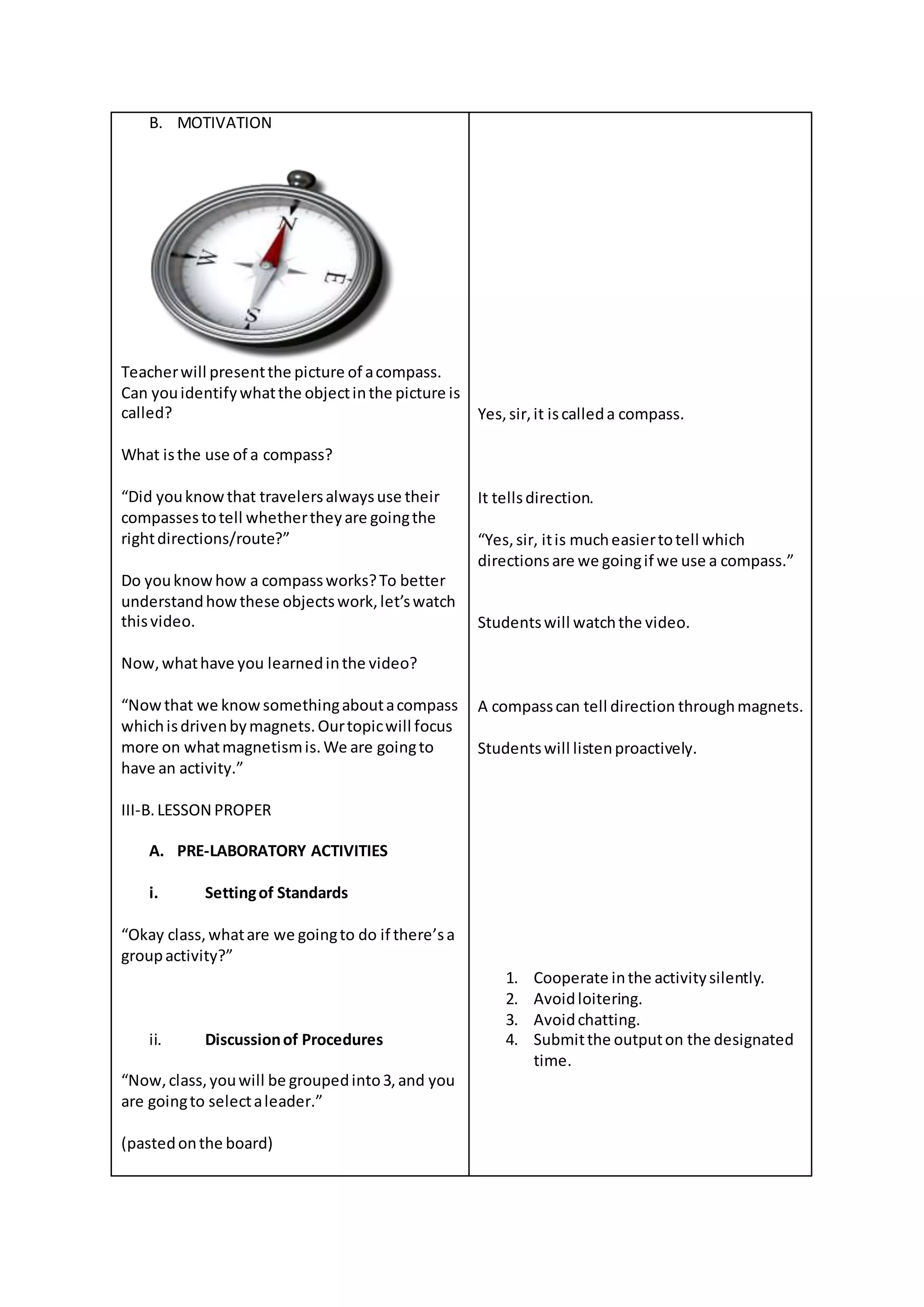
Teacherwill presentthe picture of acompass.
Can youidentifywhatthe objectinthe picture is
called?
What isthe use of a compass?
“Did youknowthat travelersalwaysuse their
compassestotell whethertheyare goingthe
rightdirections/route?”
Do youknowhow a compassworks?To better
understandhowthese objectswork,let’swatch
thisvideo.
Now,whathave you learnedinthe video?
“Nowthat we knowsomethingaboutacompass
whichisdrivenbymagnets.Ourtopicwill focus
more on whatmagnetismis.We are goingto
have an activity.”
III-B.LESSON PROPER
A. PRE-LABORATORY ACTIVITIES
i. Settingof Standards
“Okay class,whatare we goingto do if there’sa
groupactivity?”
ii. Discussionof Procedures
“Now,class,youwill be groupedinto3,and you
are goingto selectaleader.”
(pastedonthe board)
Yes,sir,it iscalleda compass.
It tellsdirection.
“Yes,sir, itis mucheasiertotell which
directionsare we goingif we use a compass.”
Studentswill watchthe video.
A compasscan tell direction throughmagnets.
Studentswill listenproactively.
1. Cooperate inthe activitysilently.
2. Avoidloitering.
3. Avoidchatting.
4. Submitthe outputon the designated
time.
Please readthe procedures,__________.
Thank you_________________.
iii. Checkingof Materials
Leaders,please getone activitysheet andthe
materialsneededforthe saidactivity.
2. EXPLORE
A. ActivityProper
Teacherwill supervise the class.
B. Post-LaboratoryActivity
Teacherwill receive the outputforthe activity.
3. EXPLAIN
Throughpickingthe numbers inside the bowl,
we are goingto selectwhichgroupwill explain
firsttheiroutput.
1. Checkthe materialsneededforthe
activity.
2. One activitysheetwill be provided
each group.
3. Each group will completeand answer
all the questionsinthe activitysheet.
4. Transferthe answersina manila
paper.
5. After10 minutes,eachgroupwill
submittheiroutput writtenina
manilapaper.
Leaderswill getthe materialsand the activity
sheet.
Leaderswill checkthe followingmaterials:
1. Magnetsin differentsizes
2. Paperclips
3. Basin
4. Water
5. Cork (Pepsi Cover)
6. Needle
7. Staple Wires
8. RubberBand
9. Popsicle Sticks
10. AluminumFoil
Studentswill answerthe activitysheet#1.
Group leaderswill submittheiractivitysheets
and groupmates will cleanthe materialsused
for the activity.
LeadersA,B, and C, will pickapaper
containingtheirnumber.The studentwhogot
no.1 will come first.
Okay,firstgroupwill presenttheiranswers.
IV. DISCUSSION
Before we proceed,we have tounderstandwhat
magnetismandmagnetsare.Kindlyreadtheir
definitions.
Have you everwonderedwhere magnetswere
discovered?
Please readthe firstchart.
Verygood. Now,lodestonesare naturally
occurringmagnets.To knowmore about
lodestonesanditshistory,letusall watchthis
short video.
Nowthat we knowthe magnetshistory,we are
goingto proceedwhatitspropertiesare.Onour
activity,whathave youobservedaboutthe
magnetsthat youused?
What aboutits parts?
Verygood.The firstpropertyof a magnet is“It
as polarity – the north pole andthe southpole.”
How aboutthe materialstheyare attractedto?
Materialswhichcan be easilymagnetizedare
knownas ferromagnetic.Kindlyreadthe
examplesof ferromagneticmaterials,_____.
Now,howaboutparamagneticmaterials?Kindly
read,________.
Firstgroup will presenttheiranswersfollowed
by the secondgroupthenthe last group.
Magnetismreferstophysical phenomena
arisingfromthe force betweenmagnets,
objectsthatproduce fieldsthatattract or
repel otherobjects.
Magnetsare materialsthatcan attract other
materialsdue toitsintrinsicproperty.
The firstevidence of magneticphenomena
was observedinthe ancientcityof Magnesia
where fragmentsof rocksknownas lodestones
were discovered.
Studentswill watchthe clipsilently.
It comesindifferentshapesandsizes.
It has 2 end-poles,the N-poleandthe S-pole.
Materialslike paperclipsandnailsare
attractedto magnetswhile the popsiclesticks
and rubberbandswere not.
Examplesof ferromagneticmaterialsinclude
iron,nickel andcobalt.
Paramagneticmaterialscanalsobe
magnetizedwhenplacedwithinastrong
magneticfield.However,these materialsare
not nearlyasmagneticallypermeable,and
thuswill notcreate nearlyas stronga magnet
as a ferromagneticmaterial will. Also,when
And,lastly, paramagnetic.Kindlyread,___.
Therefore,whatisthe secondpropertyof
magnet?
Verygood.Now,whenyoutriedtoattract two
magnetsto eachotherby placingbothN-poles,
whathappened?
How aboutbothS-poles?
How aboutN-pole andS-pole?
The third propertyof a magnetis?
Verygood.Now,whathappenedtothe needle
compassthat we have made?
Magnetshave two poles – the North-seeking
pole andthe South-seekingpole.Moreover,if
we suspendthe magnetfreely,itwill alignitself
withthe north andsouthdirections.That’sour
fourthpropertyof magnets.
What do youthinkwill happenif we cutthe
magnetsintohalves?
Verygood.However,thatidea,believedtobe a
single pole whenabarmagnetis cut intohalves,
iswhat we call magneticmonopole.Andit
doesn’texist.
Look at thispicture.
What have younoticedaboutthe picture?
removedfromthe magneticfield,theywill
immediatelyreverttobeingnon-magnetic.In
otherwords, theycannotbe permanently
magnetized.
Examplesof commonparamagneticmaterials
include aluminum, barium, calcium,uranium
and magnesium.
Diamagneticmaterials can not be
magnetized.Examplesare water,wood,and
plastic.
Magnetscan attract ferromagneticmaterials.
It isnot attracted.
Notattracted, either.
Easilyattractedto each other.
Like polesrepel andunlikepolesattract.
The needle pointstowardthe North.
The north and southpole separates.
Whenthe magnetis cut intohalves,both
magnetshave N and S poles.
That is a verygoodobservation. The last
propertyof magnetsis whenwe cut the magnets
intohalves,itwill alwayshave anorthand south
pole.Northandsouthpolesexistindependently.
V. GENERALIZATION
How manypropertiesof magnetsdowe have?
What are those?
Verygood.
4. EXTEND
To furtherunderstand the lesson,kindlygeta
partner.You will reviewthe historyand
propertiesof magnets,thenyouwillwrite at
least2 usesof magnetsinour dailyactivities.
5. EVALUATION
Kindlygetone fourthsheetof padpaperand
answerthe followingquestions. Write your
name and grade level.
Identification
1. Material that can attract othermaterials
due to itsintrinsicproperty.
2. Believedtobe a single pole whenabar
magnetiscut into halves.
3. Materialsthat are easilyattractedto
magnets.
4. Materialsthat can be attracted to
magnetsbutnot always.
5. Rocks that can attract iron.
True or false.
5
1. It as polarity – the north pole andthe
southpole.
2. Magnetscan attract ferromagnetic
materials.
3. Like polesrepel andunlikepoles
attract.
4. Magnetshave two poles – the North-
seekingpole andthe South-seeking
pole.Moreover,if we suspendthe
magnetfreely,itwill alignitself with
the north and southdirections.
5. Northand southpolesexist
independently.
Studentswill dothe activity.
Studentswill answerthe questions.
1. Magnet
2. MagneticMonopole
3. Ferromagnetic
4. Paramagnetic
5. Lodestones
6. False
7. False
8. True
9. True
6. Ferromagneticmaterialsare not
attractedto magnets.
7. Lodestones,whichare the natural rock-
magnets,were discoveredin
Manganese.
8. Like polesrepel,unlikepolesattract.
9. Magnetswhencut intohalveswill have
bothN-polesandS-poles.
10. Magnetscome indifferentshapesand
sizes.
VI. ASSIGNMENT
On yournotebook,please answerthe following
questions.
1. What isa magneticfield?
2. What isa magneticforce?
3. What isthe formulaformagneticforce?
10. True
Studentswill copythe questions. Theyare
goingto researcheitherelectronicorprinted
materials.Answerswillbe writtenintheir
notebooks.
Preparedby:
JUANMIGUEL OLARTE
PTC Practice Teacher

Lesson plan science respiratory system

  • 1.
    DETAILED LESSON PLANIN SCIENCE 9 QUARTER: 1st LESSON:CHAPTER 1; LESSON 1.2 DATE: MARCH 17, 2015 DAY: TUESDAY I. OBJECTIVES Duringthe lesson,studentswill be able to: A. Identifythe partsof the respiratorysystem B. Describe the mainfunctionsof the parts of respiratorysystem C. Showcooperationinthe groupactivity II. SUBJECT MATTER a. Topic:Human RespiratorySystem b. References:ExploringLife ThroughScience Series,PhoenixPublishingHouse c. Concept: The respiratorysystemconsistsof organsandbreathing structuresthatallow gas exchange occur. d. Materials: i. Mineral WaterBottle ii. e. Science Processes: i. Observing ii. Identifying iii. Describing iv. Analyzing III. A. Preparatory Activities: Teacher’sActivity Student’sActivity 1. ENGAGE “Good AfternoonClass...” “Let us prayfirst...” “Is there anyabsenteesfortoday?” “Thank you_________, for youattendance report.” A. REVIEW “Before we proceedwithournewtopic,who amongyou remembersourtopicyesterday?” “Thank youfor yourparticipation. “ “Good AfternoonSir.” Studentswill remainstandingandone student will leadthe prayer. Classsecretarywill announce the numberof studentspresentandnumberof students absentforthe day. One studentwill answerthe topic discussed yesterday.
  • 2.
    B. MOTIVATION Teacherwill presentthepicture of acompass. Can youidentifywhatthe objectinthe picture is called? What isthe use of a compass? “Did youknowthat travelersalwaysuse their compassestotell whethertheyare goingthe rightdirections/route?” Do youknowhow a compassworks?To better understandhowthese objectswork,let’swatch thisvideo. Now,whathave you learnedinthe video? “Nowthat we knowsomethingaboutacompass whichisdrivenbymagnets.Ourtopicwill focus more on whatmagnetismis.We are goingto have an activity.” III-B.LESSON PROPER A. PRE-LABORATORY ACTIVITIES i. Settingof Standards “Okay class,whatare we goingto do if there’sa groupactivity?” ii. Discussionof Procedures “Now,class,youwill be groupedinto3,and you are goingto selectaleader.” (pastedonthe board) Yes,sir,it iscalleda compass. It tellsdirection. “Yes,sir, itis mucheasiertotell which directionsare we goingif we use a compass.” Studentswill watchthe video. A compasscan tell direction throughmagnets. Studentswill listenproactively. 1. Cooperate inthe activitysilently. 2. Avoidloitering. 3. Avoidchatting. 4. Submitthe outputon the designated time.
  • 3.
    Please readthe procedures,__________. Thankyou_________________. iii. Checkingof Materials Leaders,please getone activitysheet andthe materialsneededforthe saidactivity. 2. EXPLORE A. ActivityProper Teacherwill supervise the class. B. Post-LaboratoryActivity Teacherwill receive the outputforthe activity. 3. EXPLAIN Throughpickingthe numbers inside the bowl, we are goingto selectwhichgroupwill explain firsttheiroutput. 1. Checkthe materialsneededforthe activity. 2. One activitysheetwill be provided each group. 3. Each group will completeand answer all the questionsinthe activitysheet. 4. Transferthe answersina manila paper. 5. After10 minutes,eachgroupwill submittheiroutput writtenina manilapaper. Leaderswill getthe materialsand the activity sheet. Leaderswill checkthe followingmaterials: 1. Magnetsin differentsizes 2. Paperclips 3. Basin 4. Water 5. Cork (Pepsi Cover) 6. Needle 7. Staple Wires 8. RubberBand 9. Popsicle Sticks 10. AluminumFoil Studentswill answerthe activitysheet#1. Group leaderswill submittheiractivitysheets and groupmates will cleanthe materialsused for the activity. LeadersA,B, and C, will pickapaper containingtheirnumber.The studentwhogot no.1 will come first.
  • 4.
    Okay,firstgroupwill presenttheiranswers. IV. DISCUSSION Beforewe proceed,we have tounderstandwhat magnetismandmagnetsare.Kindlyreadtheir definitions. Have you everwonderedwhere magnetswere discovered? Please readthe firstchart. Verygood. Now,lodestonesare naturally occurringmagnets.To knowmore about lodestonesanditshistory,letusall watchthis short video. Nowthat we knowthe magnetshistory,we are goingto proceedwhatitspropertiesare.Onour activity,whathave youobservedaboutthe magnetsthat youused? What aboutits parts? Verygood.The firstpropertyof a magnet is“It as polarity – the north pole andthe southpole.” How aboutthe materialstheyare attractedto? Materialswhichcan be easilymagnetizedare knownas ferromagnetic.Kindlyreadthe examplesof ferromagneticmaterials,_____. Now,howaboutparamagneticmaterials?Kindly read,________. Firstgroup will presenttheiranswersfollowed by the secondgroupthenthe last group. Magnetismreferstophysical phenomena arisingfromthe force betweenmagnets, objectsthatproduce fieldsthatattract or repel otherobjects. Magnetsare materialsthatcan attract other materialsdue toitsintrinsicproperty. The firstevidence of magneticphenomena was observedinthe ancientcityof Magnesia where fragmentsof rocksknownas lodestones were discovered. Studentswill watchthe clipsilently. It comesindifferentshapesandsizes. It has 2 end-poles,the N-poleandthe S-pole. Materialslike paperclipsandnailsare attractedto magnetswhile the popsiclesticks and rubberbandswere not. Examplesof ferromagneticmaterialsinclude iron,nickel andcobalt. Paramagneticmaterialscanalsobe magnetizedwhenplacedwithinastrong magneticfield.However,these materialsare not nearlyasmagneticallypermeable,and thuswill notcreate nearlyas stronga magnet as a ferromagneticmaterial will. Also,when
  • 5.
    And,lastly, paramagnetic.Kindlyread,___. Therefore,whatisthe secondpropertyof magnet? Verygood.Now,whenyoutriedtoattracttwo magnetsto eachotherby placingbothN-poles, whathappened? How aboutbothS-poles? How aboutN-pole andS-pole? The third propertyof a magnetis? Verygood.Now,whathappenedtothe needle compassthat we have made? Magnetshave two poles – the North-seeking pole andthe South-seekingpole.Moreover,if we suspendthe magnetfreely,itwill alignitself withthe north andsouthdirections.That’sour fourthpropertyof magnets. What do youthinkwill happenif we cutthe magnetsintohalves? Verygood.However,thatidea,believedtobe a single pole whenabarmagnetis cut intohalves, iswhat we call magneticmonopole.Andit doesn’texist. Look at thispicture. What have younoticedaboutthe picture? removedfromthe magneticfield,theywill immediatelyreverttobeingnon-magnetic.In otherwords, theycannotbe permanently magnetized. Examplesof commonparamagneticmaterials include aluminum, barium, calcium,uranium and magnesium. Diamagneticmaterials can not be magnetized.Examplesare water,wood,and plastic. Magnetscan attract ferromagneticmaterials. It isnot attracted. Notattracted, either. Easilyattractedto each other. Like polesrepel andunlikepolesattract. The needle pointstowardthe North. The north and southpole separates. Whenthe magnetis cut intohalves,both magnetshave N and S poles.
  • 6.
    That is averygoodobservation. The last propertyof magnetsis whenwe cut the magnets intohalves,itwill alwayshave anorthand south pole.Northandsouthpolesexistindependently. V. GENERALIZATION How manypropertiesof magnetsdowe have? What are those? Verygood. 4. EXTEND To furtherunderstand the lesson,kindlygeta partner.You will reviewthe historyand propertiesof magnets,thenyouwillwrite at least2 usesof magnetsinour dailyactivities. 5. EVALUATION Kindlygetone fourthsheetof padpaperand answerthe followingquestions. Write your name and grade level. Identification 1. Material that can attract othermaterials due to itsintrinsicproperty. 2. Believedtobe a single pole whenabar magnetiscut into halves. 3. Materialsthat are easilyattractedto magnets. 4. Materialsthat can be attracted to magnetsbutnot always. 5. Rocks that can attract iron. True or false. 5 1. It as polarity – the north pole andthe southpole. 2. Magnetscan attract ferromagnetic materials. 3. Like polesrepel andunlikepoles attract. 4. Magnetshave two poles – the North- seekingpole andthe South-seeking pole.Moreover,if we suspendthe magnetfreely,itwill alignitself with the north and southdirections. 5. Northand southpolesexist independently. Studentswill dothe activity. Studentswill answerthe questions. 1. Magnet 2. MagneticMonopole 3. Ferromagnetic 4. Paramagnetic 5. Lodestones 6. False 7. False 8. True 9. True
  • 7.
    6. Ferromagneticmaterialsare not attractedtomagnets. 7. Lodestones,whichare the natural rock- magnets,were discoveredin Manganese. 8. Like polesrepel,unlikepolesattract. 9. Magnetswhencut intohalveswill have bothN-polesandS-poles. 10. Magnetscome indifferentshapesand sizes. VI. ASSIGNMENT On yournotebook,please answerthe following questions. 1. What isa magneticfield? 2. What isa magneticforce? 3. What isthe formulaformagneticforce? 10. True Studentswill copythe questions. Theyare goingto researcheitherelectronicorprinted materials.Answerswillbe writtenintheir notebooks. Preparedby: JUANMIGUEL OLARTE PTC Practice Teacher