
College of Health Sciences
Dep. of Medical Laboratories
Biology/1st Stage
Lecture 3
Dr.: Shameeran S. Ismael
BVM & S, M.Sc Medical Microbiology(Parasitology),
PhD Molecular Parasitology
Cytoplasmic organelles Continue:
1. Endoplasmic reticulum (rough and smooth)
2. Ribosomes
3. Golgi complex
4. Vesicles
5. Lysosomes
6. Perioxisomes
7. Mitochondria
8. Vacuole
9. Centriole
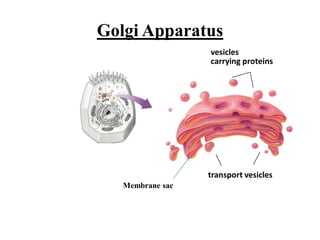
3.Golgi complex:
• It is an organelle made up of series of
membrane sacs
• The membrane of golgi body have connection
with membrane of endoplasmic reticulum
• The Golgi apparatus is present in all
Eukaryotic cells and absent in Prokaryotes.
• The Golgi apparatus is specially extensive in
the secretory cells.
• Collects, packages and modifies cell materials
to be used in other parts of the cell or
transported out of the cell
transport vesicles
vesicles
carrying proteins
Golgi Apparatus
Membrane sac
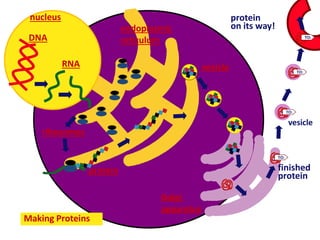
DNA
RNA
ribosomes
endoplasmic
reticulum
vesicle
Golgi
apparatus
vesicle
protein
on its way!
protein finished
protein
Making Proteins
TO:
TO:
TO:
TO:
nucleus
Function:
• Involved in the synthesis of protein, lipids and
carbohydrates.
• It helps in storage modification and packaging
of proteins.
• Creates lysosomes.
4. Vesicles
• It is a small organelle within a cell, consisting
of fluid enclosed by a lipid layer membrane
Transportation vesicle :
• Helps in transportation of materials made by
the cell (lipids and proteins).
Secretory vesicle :
• Helps in secretion of the vesicle content
outside the cell
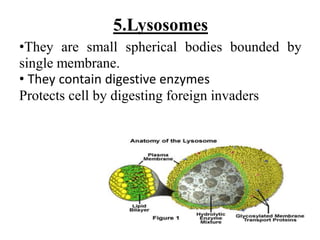
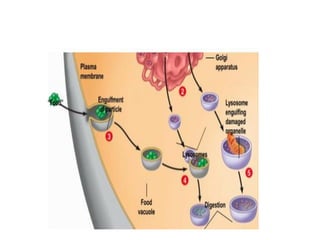
5.Lysosomes
•They are small spherical bodies bounded by
single membrane.
• They contain digestive enzymes
Protects cell by digesting foreign invaders
Function:
– Aid in cell renewal
– Break down old cell parts
– Digests invaders
6. Perioxisomes
•They originate from endoplasmic reticulum.
•Perioxisomes have the thickest membrane of all
organelles.
• There are at least 32 known perioxisomal proteins
called peroxins.
Function:
•Contains enzyme oxidase
• Protects cell from toxins especially hydrogen
peroxide.
7.Mitochondria
• The largest organ of the cell known as the
'power house of the cell'. a spherical or rod
shaped organelles and is enveloped by a
double membrane.
Function: The mitochondria aids in conversion
of glucose to high energy molecules (ATP) for
the cell.
Structure:
1.Outer Membrane: Simple phospholipid
bilayer, It encloses the mitochondrion.
Containing protein structures called porins.
Ions, nutrient molecules, ATP, ADP, etc. can
pass through the outer membrane with ease
2. Intermembrane Space: Is freely permeable
only to oxygen, carbon dioxide, and water
3. Inner Membrane: Is the space between inner
membrane and outer membrane
4. Cristae: Are folds of inner mitochondrial
membrane
5. Matrix
8.Vacuoles
• Membrane bound storage sacs
• More common in plants than animals
• Contents
– Water
– Food
– wastes
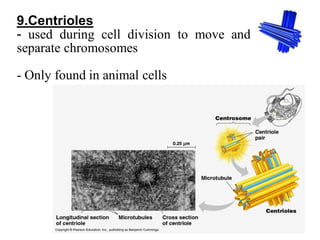
9.Centrioles
- used during cell division to move and
separate chromosomes
- Only found in animal cells
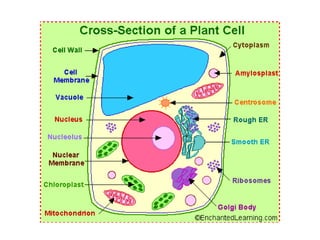
Organelles only found in Plant cell:
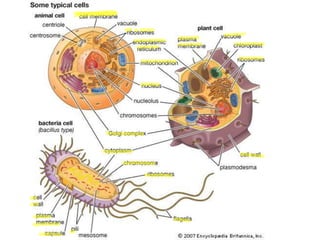
• Cell wall: a rigid layer that surrounds the plant
cells. It is located outside the cell membrane
whose main function is to provide rigidity,
strength, protection against mechanical stress and
infection.
• Chloroplasts: It is an elongated or disc shaped
organelle containing chlorophyll. It is the site for
photosynthesis in a plant cell.
• Plastids: Plastids are storage organelles. They
store products like starch for synthesis of fatty
acids and terpenes
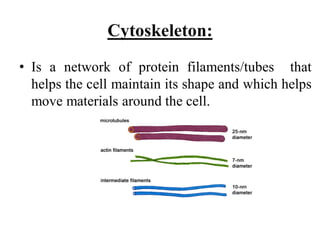
Cytoskeleton:
• Is a network of protein filaments/tubes that
helps the cell maintain its shape and which helps
move materials around the cell.
Function:
• Acts as skeleton and muscle
• Provides shape and structure
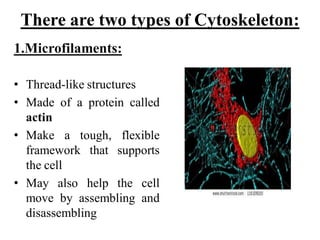
There are two types of Cytoskeleton:
• Thread-like structures
• Made of a protein called
actin
• Make a tough, flexible
framework that supports
the cell
• May also help the cell
move by assembling and
disassembling
1.Microfilaments:
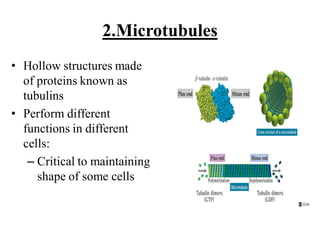
2.Microtubules
• Hollow structures made
of proteins known as
tubulins
• Perform different
functions in different
cells:
– Critical to maintaining
shape of some cells
 Form centrioles (animal cells only)
 Build projections from cell’s surface such as
flagella and cilia that enable some cells to
“swim”
 Some cells have them arranged so that they
can be used to produce controlled
movements of the cell.
Similarities between plant cells &
animal cells:
 Both have a cell membrane surrounding the
cytoplasm
 Both are filled with cytoplasm, a gel-like
substance containing chemicals needed by the
cell.
 Both have a nucleus
 Both contain mitochondria
 Both have ribosomes, protein builders of cells.
• Both have endoplasmic reticulum, where a
system of tubes transports proteins.
• Both have Golgi bodies to distribute proteins
outside of the cell
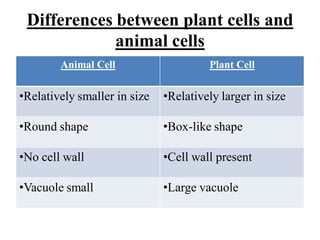
Differences between plant cells and
animal cells
Animal Cell Plant Cell
•Relatively smaller in size •Relatively larger in size
•Round shape •Box-like shape
•No cell wall •Cell wall present
•Vacuole small •Large vacuole
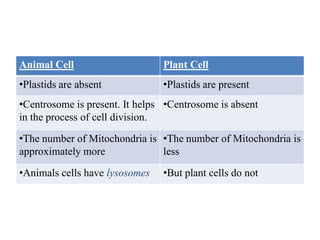
Animal Cell Plant Cell
•Plastids are absent •Plastids are present
•Centrosome is present. It helps
in the process of cell division.
•Centrosome is absent
•The number of Mitochondria is
approximately more
•The number of Mitochondria is
less
•Animals cells have lysosomes •But plant cells do not
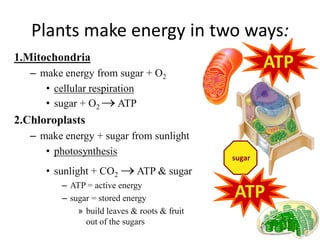
1.Mitochondria
– make energy from sugar + O2
• cellular respiration
• sugar + O2  ATP
2.Chloroplasts
– make energy + sugar from sunlight
• photosynthesis
• sunlight + CO2 ATP & sugar
– ATP = active energy
– sugar = stored energy
» build leaves & roots & fruit
out of the sugars
Plants make energy in two ways:
ATP
sugar
ATP
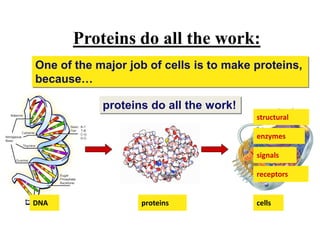
Proteins do all the work:
cellsDNA proteins
One of the major job of cells is to make proteins,
because…
proteins do all the work!
signals
structural
enzymes
receptors
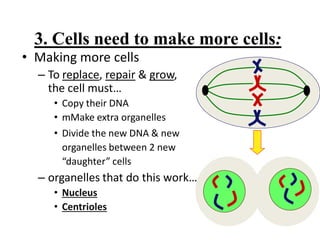
3. Cells need to make more cells:
• Making more cells
– To replace, repair & grow,
the cell must…
• Copy their DNA
• mMake extra organelles
• Divide the new DNA & new
organelles between 2 new
“daughter” cells
– organelles that do this work…
• Nucleus
• Centrioles
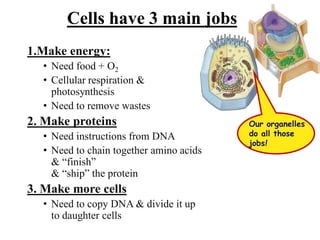
1.Make energy:
• Need food + O2
• Cellular respiration &
photosynthesis
• Need to remove wastes
2. Make proteins
• Need instructions from DNA
• Need to chain together amino acids
& “finish”
& “ship” the protein
3. Make more cells
• Need to copy DNA & divide it up
to daughter cells
Cells have 3 main jobs
Our organelles
do all those
jobs!
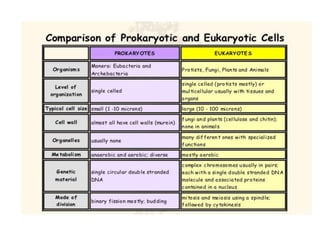
Prokaryotic cell
• Prokaryotic organisms are commonly called Bacteria.
• They are cells with simple structure. The have no
membrane around the nucleus and lack any
membrane bound organelles.
• They have a cell wall.
• They have a naked loop of DNA which stores the
genetic information.
• They also have circular rings of DNA called plasmids
Prokaryotic structures
1.Cell Wall: forms a protective outer layer that
prevents damage from outside. Prevents the
cell from bursting due to high internal pressure
2.Plasma Membrane : Controls the transfer of
substances in and out of the cell
3.Cytoplasm: Contains enzymes that catalyse
the chemical reactions of metabolism
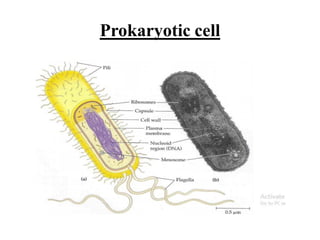
Prokaryotic cell
4.Pili: Are for adhesion allowing bacteria to
colonize environmental surfaces or cells and
resist flushing.
5.Flagella: A slender whip-like structure used
for locomotion.
6.Ribosomes: Protein synthesis
7.Naked DNA (Nucleoid): Stores the genetic
information that controls the cell and is passed
onto daughter cells
8.Mesosome: In folding of the plasma
membrane. Plays a role in cellular respiration
and movement of DNA
9. Plasmids:
• Circular rings of naked DNA
• Extra genetic material
• Can be passed from one cell to another cell
• Used as vectors in genetic engineering
10.Slime capsule: Protects the cell against
chemicals and drying out
11. Photosynthetic Membranes: Possess
pigments to assist in photosynthesis
Thanks for attention,,,

Biology Theory Lec. 3

  • 1.
    College of HealthSciences Dep. of Medical Laboratories Biology/1st Stage Lecture 3 Dr.: Shameeran S. Ismael BVM & S, M.Sc Medical Microbiology(Parasitology), PhD Molecular Parasitology
  • 2.
    Cytoplasmic organelles Continue: 1.Endoplasmic reticulum (rough and smooth) 2. Ribosomes 3. Golgi complex 4. Vesicles 5. Lysosomes 6. Perioxisomes 7. Mitochondria 8. Vacuole 9. Centriole
  • 3.
    3.Golgi complex: • Itis an organelle made up of series of membrane sacs • The membrane of golgi body have connection with membrane of endoplasmic reticulum • The Golgi apparatus is present in all Eukaryotic cells and absent in Prokaryotes.
  • 4.
    • The Golgiapparatus is specially extensive in the secretory cells. • Collects, packages and modifies cell materials to be used in other parts of the cell or transported out of the cell
  • 5.
  • 6.
  • 7.
    Function: • Involved inthe synthesis of protein, lipids and carbohydrates. • It helps in storage modification and packaging of proteins. • Creates lysosomes.
  • 8.
    4. Vesicles • Itis a small organelle within a cell, consisting of fluid enclosed by a lipid layer membrane Transportation vesicle : • Helps in transportation of materials made by the cell (lipids and proteins). Secretory vesicle : • Helps in secretion of the vesicle content outside the cell
  • 9.
    5.Lysosomes •They are smallspherical bodies bounded by single membrane. • They contain digestive enzymes Protects cell by digesting foreign invaders
  • 10.
    Function: – Aid incell renewal – Break down old cell parts – Digests invaders
  • 12.
    6. Perioxisomes •They originatefrom endoplasmic reticulum. •Perioxisomes have the thickest membrane of all organelles. • There are at least 32 known perioxisomal proteins called peroxins. Function: •Contains enzyme oxidase • Protects cell from toxins especially hydrogen peroxide.
  • 13.
    7.Mitochondria • The largestorgan of the cell known as the 'power house of the cell'. a spherical or rod shaped organelles and is enveloped by a double membrane. Function: The mitochondria aids in conversion of glucose to high energy molecules (ATP) for the cell.
  • 14.
    Structure: 1.Outer Membrane: Simplephospholipid bilayer, It encloses the mitochondrion. Containing protein structures called porins. Ions, nutrient molecules, ATP, ADP, etc. can pass through the outer membrane with ease
  • 15.
    2. Intermembrane Space:Is freely permeable only to oxygen, carbon dioxide, and water 3. Inner Membrane: Is the space between inner membrane and outer membrane 4. Cristae: Are folds of inner mitochondrial membrane 5. Matrix
  • 16.
    8.Vacuoles • Membrane boundstorage sacs • More common in plants than animals • Contents – Water – Food – wastes
  • 17.
    9.Centrioles - used duringcell division to move and separate chromosomes - Only found in animal cells
  • 18.
    Organelles only foundin Plant cell: • Cell wall: a rigid layer that surrounds the plant cells. It is located outside the cell membrane whose main function is to provide rigidity, strength, protection against mechanical stress and infection. • Chloroplasts: It is an elongated or disc shaped organelle containing chlorophyll. It is the site for photosynthesis in a plant cell. • Plastids: Plastids are storage organelles. They store products like starch for synthesis of fatty acids and terpenes
  • 19.
    Cytoskeleton: • Is anetwork of protein filaments/tubes that helps the cell maintain its shape and which helps move materials around the cell.
  • 20.
    Function: • Acts asskeleton and muscle • Provides shape and structure
  • 21.
    There are twotypes of Cytoskeleton: • Thread-like structures • Made of a protein called actin • Make a tough, flexible framework that supports the cell • May also help the cell move by assembling and disassembling 1.Microfilaments:
  • 22.
    2.Microtubules • Hollow structuresmade of proteins known as tubulins • Perform different functions in different cells: – Critical to maintaining shape of some cells
  • 23.
     Form centrioles(animal cells only)  Build projections from cell’s surface such as flagella and cilia that enable some cells to “swim”  Some cells have them arranged so that they can be used to produce controlled movements of the cell.
  • 24.
    Similarities between plantcells & animal cells:  Both have a cell membrane surrounding the cytoplasm  Both are filled with cytoplasm, a gel-like substance containing chemicals needed by the cell.  Both have a nucleus  Both contain mitochondria  Both have ribosomes, protein builders of cells.
  • 25.
    • Both haveendoplasmic reticulum, where a system of tubes transports proteins. • Both have Golgi bodies to distribute proteins outside of the cell
  • 26.
    Differences between plantcells and animal cells Animal Cell Plant Cell •Relatively smaller in size •Relatively larger in size •Round shape •Box-like shape •No cell wall •Cell wall present •Vacuole small •Large vacuole
  • 27.
    Animal Cell PlantCell •Plastids are absent •Plastids are present •Centrosome is present. It helps in the process of cell division. •Centrosome is absent •The number of Mitochondria is approximately more •The number of Mitochondria is less •Animals cells have lysosomes •But plant cells do not
  • 30.
    1.Mitochondria – make energyfrom sugar + O2 • cellular respiration • sugar + O2  ATP 2.Chloroplasts – make energy + sugar from sunlight • photosynthesis • sunlight + CO2 ATP & sugar – ATP = active energy – sugar = stored energy » build leaves & roots & fruit out of the sugars Plants make energy in two ways: ATP sugar ATP
  • 31.
    Proteins do allthe work: cellsDNA proteins One of the major job of cells is to make proteins, because… proteins do all the work! signals structural enzymes receptors
  • 32.
    3. Cells needto make more cells: • Making more cells – To replace, repair & grow, the cell must… • Copy their DNA • mMake extra organelles • Divide the new DNA & new organelles between 2 new “daughter” cells – organelles that do this work… • Nucleus • Centrioles
  • 33.
    1.Make energy: • Needfood + O2 • Cellular respiration & photosynthesis • Need to remove wastes 2. Make proteins • Need instructions from DNA • Need to chain together amino acids & “finish” & “ship” the protein 3. Make more cells • Need to copy DNA & divide it up to daughter cells Cells have 3 main jobs Our organelles do all those jobs!
  • 34.
    Prokaryotic cell • Prokaryoticorganisms are commonly called Bacteria. • They are cells with simple structure. The have no membrane around the nucleus and lack any membrane bound organelles. • They have a cell wall. • They have a naked loop of DNA which stores the genetic information. • They also have circular rings of DNA called plasmids
  • 35.
    Prokaryotic structures 1.Cell Wall:forms a protective outer layer that prevents damage from outside. Prevents the cell from bursting due to high internal pressure 2.Plasma Membrane : Controls the transfer of substances in and out of the cell 3.Cytoplasm: Contains enzymes that catalyse the chemical reactions of metabolism
  • 36.
  • 37.
    4.Pili: Are foradhesion allowing bacteria to colonize environmental surfaces or cells and resist flushing. 5.Flagella: A slender whip-like structure used for locomotion.
  • 38.
    6.Ribosomes: Protein synthesis 7.NakedDNA (Nucleoid): Stores the genetic information that controls the cell and is passed onto daughter cells 8.Mesosome: In folding of the plasma membrane. Plays a role in cellular respiration and movement of DNA
  • 39.
    9. Plasmids: • Circularrings of naked DNA • Extra genetic material • Can be passed from one cell to another cell • Used as vectors in genetic engineering 10.Slime capsule: Protects the cell against chemicals and drying out 11. Photosynthetic Membranes: Possess pigments to assist in photosynthesis
  • 42.