Plasma Membrane: The Gate Keeper Ms. Polson Biology October 18,2009
Plasma Membrane Lesson Objectives Students will be able to: Use vocabulary related to transport across the plasma membrane Differentiate between active and passive transport Identify membrane structures that permit transport Understand the function of the plasma membrane as a “gate keeper”
What is a Plasma Membrane? All living cells have them Selective permeability Asymmetric Gives cell structure Cell-cell recognition Fluid mosaic model Lipid movement in bilayer Maintains homeostasis
Animal and Plant Plasma (cell) Membrane
Plasma Membrane Function Separate inside organelles from external environment Regulate entrance and exit of substances Transfer information Establishment of electric potential difference Site of biological activities Attachment between cells Removal of waste
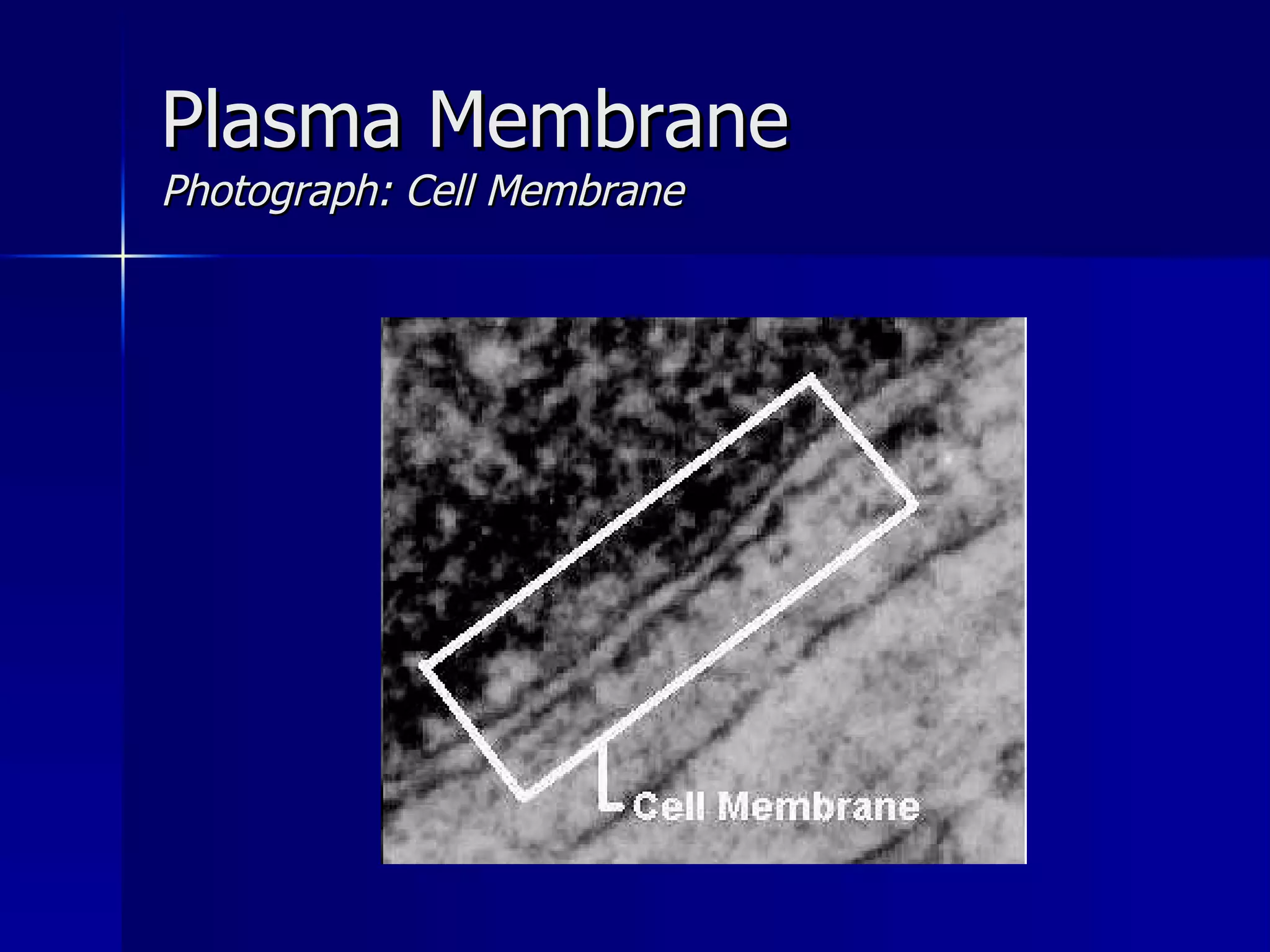
Plasma Membrane Photograph: Cell Membrane
Plasma Membrane Structure Lipids Phosphlipids, Glycolipids, Steroids Hydrophilic and hydrophobic properties Gives flexibility Proteins Integral - transport channels Peripheral - recognition sites Determines membranes specific functions Sugars
Lipid Bilayer Model Cross Section Gorter and Grendel, 1925 Two sheets of lipids 7.5 nm thick Found around cell Embedded with proteins Strengthened with cholesterol molecules (animal)
Lipid Bilayer Model Phospholipid  Hydrophilic Water loving Phosphate end Outside and inside  Hydrophobic Water fearing Lipid tail region Center
Plasma Membrane Hydrophilic and Hydrophobic
Passive Transport Simple Diffusion Result of inherent kinetic energy Thermal motion or heat No energy needed Diffusion and osmosis High concentration to low concentration: small molecules  O 2  , CO 2 , H 2 O
Simple Diffusion
Passive Transport Facilitated   Diffusion Proteins act as tunnels Carrier proteins help larger polar molecules cross membrane Glucose Moves materials along concentration gradient
Active Transport Energy  is  needed Low concentration to high concentration Movement of molecules up concentration gradient  Sodium-potassium pump
Active Transport Movement of large substances by vesicles Endocytosis – taking into cell Phagocytosis Pinocytosis Receptor mediate Exocytosis – expelling from cell ER or Golgi Apparatus
Types of Solutions Isotonic Concentration of dissolved substances are the same inside and outside the cell Hypotonic Concentration of dissolved substances are lower outside than inside Hypertonic Concentration of dissolved substances are higher outside than inside
Homeostasis Plasma Membrane Maintains constant internal environment Controls movement of materials in and out of the cell as a “gate keeper” Dynamic equilibrium Separates cellular organelles from external environment
Vocabulary Review Plasma Membrane Homeostasis Passive Transport Simple Diffusion Facilitated Diffusion Active Transport Hydrophilic Hydrophobic Endocytosis Exocytosis Isotonic Hypertonic Hypotonic
Questions… Comments… Thoughts?

Plasma Membrane

  • 1.
    Plasma Membrane: TheGate Keeper Ms. Polson Biology October 18,2009
  • 2.
    Plasma Membrane LessonObjectives Students will be able to: Use vocabulary related to transport across the plasma membrane Differentiate between active and passive transport Identify membrane structures that permit transport Understand the function of the plasma membrane as a “gate keeper”
  • 3.
    What is aPlasma Membrane? All living cells have them Selective permeability Asymmetric Gives cell structure Cell-cell recognition Fluid mosaic model Lipid movement in bilayer Maintains homeostasis
  • 4.
    Animal and PlantPlasma (cell) Membrane
  • 5.
    Plasma Membrane FunctionSeparate inside organelles from external environment Regulate entrance and exit of substances Transfer information Establishment of electric potential difference Site of biological activities Attachment between cells Removal of waste
  • 6.
  • 7.
    Plasma Membrane StructureLipids Phosphlipids, Glycolipids, Steroids Hydrophilic and hydrophobic properties Gives flexibility Proteins Integral - transport channels Peripheral - recognition sites Determines membranes specific functions Sugars
  • 8.
    Lipid Bilayer ModelCross Section Gorter and Grendel, 1925 Two sheets of lipids 7.5 nm thick Found around cell Embedded with proteins Strengthened with cholesterol molecules (animal)
  • 9.
    Lipid Bilayer ModelPhospholipid Hydrophilic Water loving Phosphate end Outside and inside Hydrophobic Water fearing Lipid tail region Center
  • 10.
  • 11.
    Passive Transport SimpleDiffusion Result of inherent kinetic energy Thermal motion or heat No energy needed Diffusion and osmosis High concentration to low concentration: small molecules O 2 , CO 2 , H 2 O
  • 12.
  • 13.
    Passive Transport Facilitated Diffusion Proteins act as tunnels Carrier proteins help larger polar molecules cross membrane Glucose Moves materials along concentration gradient
  • 14.
    Active Transport Energy is needed Low concentration to high concentration Movement of molecules up concentration gradient Sodium-potassium pump
  • 15.
    Active Transport Movementof large substances by vesicles Endocytosis – taking into cell Phagocytosis Pinocytosis Receptor mediate Exocytosis – expelling from cell ER or Golgi Apparatus
  • 16.
    Types of SolutionsIsotonic Concentration of dissolved substances are the same inside and outside the cell Hypotonic Concentration of dissolved substances are lower outside than inside Hypertonic Concentration of dissolved substances are higher outside than inside
  • 17.
    Homeostasis Plasma MembraneMaintains constant internal environment Controls movement of materials in and out of the cell as a “gate keeper” Dynamic equilibrium Separates cellular organelles from external environment
  • 18.
    Vocabulary Review PlasmaMembrane Homeostasis Passive Transport Simple Diffusion Facilitated Diffusion Active Transport Hydrophilic Hydrophobic Endocytosis Exocytosis Isotonic Hypertonic Hypotonic
  • 19.