Immunity
Immunity isbody's ability to resist or eliminate potentially harmful foreign materials
or abnormal cells.
Immunology is the study of the bodies defense mechanism against foreign disease
causing agents.
Consists of following activities:
– Defence against invading pathogens or microbes
– Removal of 'worn-out' cells & tissue debris
– Identification & destruction of abnormal or mutant cells
– Rejection of 'foreign' cells (e.g., organ transplant)
Inappropriate responses:
Allergies - response to normally harmless substances
Autoimmune diseases
5.
Differences b/n Innate& Acquired immunity
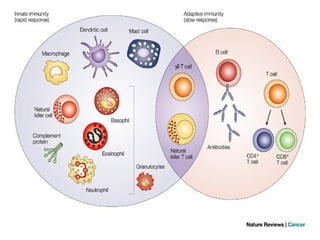
A. Innate immunity : is the inborn
capacity of body to resist
pathogens.
By chance, if the organisms enter the
body, innate immunity eliminates
them before development of a
disease.
It is otherwise called the natural or
non-specific immunity.
This type of immunity represents the
first line of defense against any type
of pathogens..
B. Acquired immunity :is the resistance
developed in the body against any
specific foreign body like bacteria,
viruses, toxins, vaccines or transplanted
tissues.
So, this type of immunity is also
known as specific immunity.
It is the most powerful immune
mechanism that protects the body from
the invading organisms or toxic
substances.
Lymphocytes are responsible for
acquired immunity
ANTIGENS
„ Antigensare the substances (chemicals) which induce specific immune reactions
in the body.
Antigens are of two types:
1. Autoantigens (self antigens) : present on the body’s own cells such as ‘A’ antigen
and ‘B’ antigen in RBCs.
2. Foreign antigen s (non-self antigens) : that enter the body from outside.
Following are non-self antigens:
Chemicals (proteins, lipoproteins, and polysaccharides ) located on the surfaces of
foreign bodies.
Toxins from microbial organisms.
Materials from transplanted organs or incompatible blood cells.
Allergens or allergic substances like pollen grains called haptens
9.
ANTIGENS…
Types of Non-selfAntigens
• Non-self antigens are classified into two types,
depending upon the response developed against
them in the body:
1. Antigens, which induce the development of
immunity or production of antibodies
(immunogenicity).
2. Antigens, which react with specific antibodies and
produce allergic reactions (allergic reactivity).
10.
Antigen-Presenting Cells
Antigen-presentingcells: are the special type of cells in the
body, which induce the release of antigenic materials from
invading organisms and later present these materials to the
helper T cells.
Types of Antigen-Presenting Cells
Antigen-presenting cells are of three types:
1. Macrophages: major antigen-presenting cells.
2. Dendritic cells: from spleen, skin & lymph nodes.
3. B lymphocytes: antigen presenting cells & antigen receiving cells
11.
Antigen-Presenting Cells…
Majorhistocompatiblility complex: are large molecule situated on the
surface of the antigen presenting cells. MHC are two types.
1. Class I MHC molecule: It is found on every cell in human body.
It is specifically responsible for presentation of endogenous antigens
(antigens produced intracellularly such as viral proteins and tumor
antigens) to cytotoxic T cells.
2. Class II MHC molecule: It is found on B cells, macrophages and other
antigen-presenting cells.
It is responsible for presenting the exogenous antigens (antigens of
bacteria or viruses which are engulfed by antigen-presenting cells) to
helper T cell.
12.
Antigen-Presenting Cells…
Whiteblood cells and all other nucleated cells in the
body have proteins, called major histocompatibility
(MHC) antigens, protruding from their plasma
membrane into the extracellular fluid.
These “cell identity markers” are unique for each
person (except identical twins).
Although RBCs possess blood group antigens, they
lack the MHC antigens.
Types of Acquiredimmunity & their Development
1. Cellular immunity
Cellular immunity develops from T-lymphocytic
cells.
“T” stands for Thymus gland located at the
lower portion of the trachea.
T-cells normally form in the stem cells of the
bone marrow and migrate to the thymus gland
b/s the thymus is a pre-processing or maturation
area of T-cells.
• Thymosin and cytokines help in the maturation
of T-cells
• Cell-mediated immunity does not involve
antibodies.
2. Humoral immunity
Humoral immunity develops from B-
lymphocytic cells.
B stands for “ Bursa of Fabricius”
from Birds.
B-cells emerge from the stem cells of
the bone marrow and are pre-
processed in the liver (early fetal life)
and as well as in the bone marrow
after birth.
Then B-Lymphocytes develop to
plasma cells that in turn secrete
different types of circulating
Development of Cellularimmunity
During fetal development, lymphocytes are produce from committed stem
cells in the bone marrow. Stem cells can not however activate T-cells
Therefore, T-cells migrate to thymus to be pre-processed. Here, T-cells
proliferate and diversify and learn to recognize their self antigens, so that
they do not destroy their own tissue
In the thymus, dangerous T-cells that attack self tissues are destroyed and
phagocytised (thymic selection).
Then, T-cells move to different lymphoid tissues through the blood and
stay in these lymphoid tissues for long until they meet or contact specific
antigen.
19.
Types of T-lymphocytes(Cells)
During the processing, T lymphocytes are transformed into four types:
1. Helper T cells or inducer T cells: These cells are also called CD4 cells
b/se of the presence of molecules called CD4 on their surface.
2. Cytotoxic T cells or killer T cells: These cells are also called CD8 cells
b/se of presence of molecules called CD8 on their surface.
3. Suppressor T cells or regulatory T cells: suppress the activities of the
killer T cells destroying the body’s own tissues along with invaded
organisms.
4. Memory T cells: When the body is exposed to the same organism for
the second time, the memory cells identify the organism and
immediately activate the other T cells.
20.
Figure: Differentiation ofT Cells within the Thymus : Thymocytes enter the thymus and go through a series of
developmental stages that ensures both function and tolerance before they leave and become
functional components of the adaptive immune response.
21.
Helper T-lymphocytes andtheir functions
Helper T-cells : important to know their functions b/s AIDS
(Acquired Immunodeficiency Syndrome) destroys mainly the
T-helper cells.
T-helper cells are the most numerous and produce
lymphokines
that produce different chemicals called interleukins (IL-2 to 6).
General Functions of Helper T-cells include:
Stimulation of T-cytotoxic and T-suppressor cells.
Stimulation of B-cells to form plasma cells.
Activation of the macrophage system etc.
22.
Release
Antigen-presenting cells
present theantigenic products
bound with human leukocyte
anti gen (HLA) (which is
present in class II MHC
molecule) to helper T cells.
This activates helper T cells
through series of events.
23.
Fig: Clonal Selectionand Expansion of T Lymphocytes :Stem cells differentiate into T cells with specific
receptors, called clones. The clones with receptors specific for antigens on the pathogen are selected for and
expanded.
24.
Cytotoxic T-cell andtheir functions
Cytotoxic -T-cells kill invaders by
direct attack (apoptosis) through
the following methods:
Bore a hole through the membrane,
so that electrolytes and fluid enters
& burst the microbes.
2. Release toxic substances and kill
invaders
3. Destroy all types of foreign cells
(e.g., cancer cells, transplant cells)
26.
Figure: Pathogen Presentation(a) CD4 is associated with helper and regulatory T cells. An extracellular
pathogen is processed and presented in the binding cleft of a class II MHC molecule, and this interaction is
strengthened by the CD4 molecule. (b) CD8 is associated with cytotoxic T cells. An intracellular pathogen
is presented by a class I MHC molecule, and CD8 interacts with it.
27.
Development of Humoralimmunity
B-lymphocytes also originate from stem cells in bone marrow.
They migrate to lymphoid tissues and become sensitized by specific
antigens. After sensitization, they multiply forming clones of identical
cells.
The blood and lymph are the body fluids (humours or humors in
Latin). Since the B lymphocytes provide immunity through humors,
this type of immunity is called humoral immunity.
B lymphocytes are transformed into two types:
1. Plasma cells: produce four types of antibodies
2. Memory cells: fight back when the same type of antigen comes into
contact in a 2nd
exposure.
28.
Cooperation between Tand B- cells
Helper T-cells support or help the B-cells by
producing chemicals known as Lymphokines or
(cytokines)
These cytokines can stimulate B- lymphocytes
and other immune cells (e.g, macrophages) to
perform their specific functions.
Without the helper T-cells, the amount of
antibodies produced by B-cells is not adequate
to combat infections.
HIV, the virus that causes AIDS normally infects
helper T-cells & inactivates immune response
30.
Figure: Clonal Selectionof B Cells: During a primary B cell immune response, both antibody-secreting
plasma cells and memory B cells are produced. These memory cells lead to the differentiation of more
plasma cells and memory B cells during secondary responses.
31.
Structure of Antibodies
There are 2-heavy and 2-light
chains, which have constant
and variable portions.
A. Constant portion = provides
an attachment surface on
tissues
B. Variable = is a place where
antigens attach to antibodies
specifically
32.
Figure: Antibody andIgG2 Structures :The typical four chain structure of a generic antibody
(a) and the corresponding three-dimensional structure of the antibody IgG2 (b). (credit b:
modification of work by Tim Vickers
33.
Functions of DifferentAntibodies
An antibody is defined as a protein that is produced by B
lymphocytes in response to the presence of an antigen.
Antibody is gamma globulin in nature and it is also called
immunoglobulin (Ig).
1. IgA : plays a role in localized defense mechanism found in
saliva , tears, colostrum, GIT.
2. IgD: : found mainly on the surface B-cells and involved in
recognition of the antigen by B cells.
3. IgE: involved in allergic reactions (bind to mast & basophils)
4. IgG: most abundant type & is responsible for passive
immunity to the fetus and complement fixation
Fig: Types of
antibodies
34.
Mechanism of actionof antibodies
A. Direct attack
B. Through complement System
A. By direct attack: inactivate the invaders by the following methods
1. Agglutination: involves the clumping or binding of bacterial
antigens to each other, so that they become dysfunctional.
2. Precipitation : The complex antigen-antibody reaction is made
insoluble and precipitates down.
3. Neutralization: The antibodies cover the active sites of the
invader and inactivate the toxic sites of the antigens.
4. Lyses: antibodies rupture the cell membrane of the organisms and
then destroy them.
The Complement System
Actions of Antibodies through Complement System
The indirect actions of antibodies are stronger than the
direct actions and play more important role in defense
mechanism of the body than the direct actions.
Complement system is the one that enhances or accelerates
various activities during fight against invading organisms.
It is a system of plasma enzymes, which are identified by
numbers from C1 to C9.
37.
The Complement System…
Mechanismof action
Phagocytosis
Lysis (rupture)
Agglutination and
Neutralization
Chemotaxis
Activation of mast cells
and basophiles
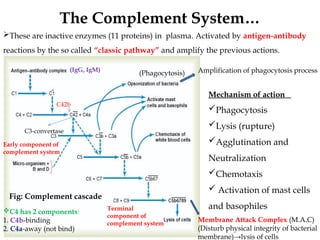
These are inactive enzymes (11 proteins) in plasma. Activated by antigen-antibody
reactions by the so called “classic pathway” and amplify the previous actions.
Fig: Complement cascade
(IgG, IgM)
C42b
C4 has 2 components:
1. C4b-binding
2. C4a-away (not bind)
C3-convertase
Membrane Attack Complex (M.A.C)
(Disturb physical integrity of bacterial
membrane)→lysis of cells
Early component of
complement system
Terminal
component of
complement system
(Phagocytosis) Amplification of phagocytosis process
38.
Figure 21.13 ComplementCascade and Function The classical pathway, used during adaptive
immune responses, occurs when C1 reacts with antibodies that have bound an antigen.
40.
Mechanism of SelfTolerance
Self tolerance is a condition of self-recognition of the bodies antigens
that prevents self-destruction of the bodies own cells.
The immunity system does not form antibodies or sensitized
lymphocytes against its own antigens.
Normally, self cells have a specific antigen which stands for each
individual. This specific antigen is called human leukocyte antigen
(HLA). This HLA is expressed by a group of genes called major
histocompatability complex (MHC).
The importance of MHC proteins is that they allow T-cells to distinguish
self from non-self.
In other words, T-cell receptors recognize antigenic peptides in
association with MHC molecules.
41.
Autoimmune Diseases
Autoimmunedisease: is defined as a condition in which the immune
system mistakenly attacks body’s own cells and tissues.
Normally, an antigen induces the immune response in the body. The
condition in which the immune system fails to give response to an
antigen is called tolerance.
This is true with respect to body’s own antigens that are called self
antigens or autoantigens.
Normally, body has the tolerance against self antigen.
However, in some occasions, the tolerance fails or becomes
incomplete against self antigen. This state is called autoimmunity
and it leads to the activation of T-lymphocytes.
43.
Immunization
Immunization :isdefined as the procedure by
which the body is prepared to fight against a
specific disease.
It is used to induce the immune resistance of the
body to a specific disease.
Active immunity = production of antibodies as
a result of exposure to an antigen (vaccine). Can
be natural or aquired
Passive immunity = direct transfer of
antibodies formed by another person (or
animal), e.g., transfer of IgG antibodies from
mother to fetus across placenta or in colostrum
IgA('first milk).