CONGESTIVE
CARDIAC FAILURE
RATHEESH R.L
OTHER NAMES ARE
•Congestive Heart Failure(CHF)
•Heart Failure (HF)
• Heart failure does not mean the heart has
stopped working. Rather, it means that the
heart's pumping power is weaker than
normal.
• With heart failure, blood moves through
the heart and body at a slower rate, and
pressure in the heart increases. As a result,
the heart cannot pump enough oxygen
and nutrients to meet the body's needs.
DEFINITION
• Heart failure describes the clinical
syndrome that develops when the heart
cannot maintain an adequate cardiac
output.
• The heart pumps blood inadequately,
leading to reduced blood flow, back-up
(congestion) of blood in the veins and
lungs, and other changes that may further
weaken the heart.
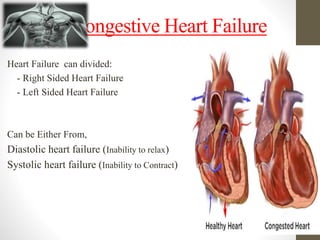
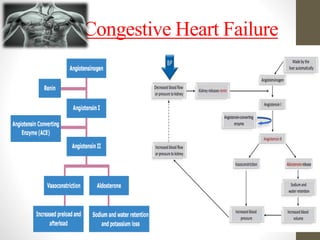
Congestive Heart Failure
Heart Failure can divided:
- Right Sided Heart Failure
- Left Sided Heart Failure
Can be Either From,
Diastolic heart failure (Inability to relax)
Systolic heart failure (Inability to Contract)
Right Sided Heart Failure
• In right-sided heart failure, the right ventricle loses
its pumping function, and blood may back up into
other areas of the body, producing congestion.
Left Sided Heart Failure
• Inability of the left heart to maintain its
circulatory load, with corresponding rise in
pressure in the pulmonary circulation usually
with pulmonary congestion and ultimately
pulmonary edema.
Diastolic heart failure
• Diastolic dysfunction refers to an abnormality in how
the heart fills with blood during diastole.
The heart muscles do not relax in a normal manner
and the heart may fill too slowly, asynchronously or
with an elevation in filling pressure only.
Systolic heart failure
• The left ventricle loses its ability to contract normally.
The heart can't pump with enough force to push
enough blood into circulation.
Causes
• Coronary artery disease: Coronary artery disease (CAD), a disease
of the arteries that supply blood and oxygen to the heart, causes
decreased blood flow to the heart muscle. If the arteries become
blocked or severely narrowed, the heart becomes starved for
oxygen and nutrients.
• Heart attack: A heart attack occurs when a coronary artery
becomes suddenly blocked, stopping the flow of blood to the heart
muscle. A heart attack damages the heart muscle, resulting in a
scarred area that does not function properly.
• Cardiomyopathy: Damage to the heart muscle from causes
other than artery or blood flow problems, such as from
infections or alcohol or drug abuse.
• Conditions that overwork the heart: Conditions including high
blood pressure, valve disease, thyroid disease, kidney
disease,diabetes, or heart defects present at birth can all cause
heart failure. In addition, heart failure can occur when several
diseases or conditions are present at once.
RISK FACTORS
• Coronary artery Diseases
• Myocardial Infarction
• Hypertension
• Diabetes
• Heart Valve Disease ( e.g.Aortic Stenosis)
• Smoking
• Obesity
• Previous heart attack
• Congenital heart defects
• Cardiomyopathy
• Infection of heart muscles
• Conduction defects
• Large amount of salt intake
Congestive Heart Failure
CLINICAL MANIFESTATIONS
DIAGNOSTIC EVALUATION
1. HISTORY COLLECTION
patient history may include gathering
information about the following:
• Alcohol and drug use
• History of hypertension, including treatment
• Prior chest pains or heart attack
• Recent viral illness
• Recent pregnancy
2. PHYSICAL EXAMINATION
The physician looks for an underlying cause and
assesses heart function. A stethoscope is used to detect
abnormal heart sounds (murmurs) that may indicate a leaky
or narrowed (stenotic) valve, and to detect fluid accumulation
in the lungs.
The physician also looks for enlarged
(distended) veins in the neck and for swelling (edema) in the
legs (particularly the ankles and feet) and/or the abdomen
3. ELECTROCARDIOGRAM
An electrocardiogram (ECG) is a noninvasive
test used to measure electrical activity in the heart. Electrical
sensors called leads are attached to predetermined positions
on the arms, legs, and chest to record electrical activity and
help assess heart function.
4. ECHOCARDIOGRAM
Echocardiogram (cardiac echo) is an
ultrasound examination of the heart that produces detailed images
of the organ. It can be used to detect abnormalities in the structure
of the heart and to measure the ejection fraction.
5. CARDIAC CATHETERIZATION
Cardiac catheterization may be performed in patients
with angina and patients with a history of heart attack to determine
if coronary heart disease (CHD) is causing heart failure.
• This procedure produces angiograms (i.e., x-ray images) of the
coronary arteries and the left ventricle, and can be used to
monitor heart function.
6. STRESS TEST/EXERCISE TEST
In this test, a patient simply walks on a
treadmill while connected to an electrocardiogram.
7. DOBUTAMINE STRESS ECHO CARDIOGRAPHY
In this cases, a drug(dobutamine) is
infused into the bloodstream to increase the heart rate or to
affect the flow of blood within the heart and an
echocardiogram is used to obtain images of the heart.
8. MRI (Magnetic resonance imaging):
• Magnetic fields are used to provide images of the
structure of the heart and its ability to pump blood to
the body.
• If used with a special MRI contrast agent (gadolinium),
it can provide information about inflammation, injury,
and blood flow to the heart.
9. Chest X-ray:
This is very helpful in identifying the
buildup of fluid in the lungs. Also, the heart usually
enlarges in congestive heart failure, and this may be
visible on the X-ray film.
10.BLOOD TESTS:
• People may have blood drawn for lab tests.
• Low blood cell counts (anemia) may cause symptoms much
like congestive heart failure or contribute to the condition.
• Sodium, potassium, magnesium, and other electrolyte
levels may be abnormal, especially if the person has been
treated with diuretics and/or has kidney disease.
• Tests for kidney function.
• LIFESTYLE MEASURES.
The first steps in the treatment of
heart failure may include limits on the amount of fluids
consumed (including alcohol) and reductions in dietary
sodium (less than 2,000 mg per day). In addition, follow
your doctor's instructions on getting regular exercise,
which can help prevent symptoms from worsening.
• MEDICATIONS.
A variety of drugs may be used to manage
heart failure.
THE DRUGS INCLUDE
ACE INHIBITORS.
ACE inhibitors—such as enalapril (Vasotec) and lisinopril
(Prinivil, Zestril)—are the choice of drug treatment for people with heart
failure. ACE inhibitors promote dilation of the blood vessels and thus
improve blood flow and slow the progression of CHD.
• DIURETICS AND DIGOXIN.
The physician may prescribe diuretics to
reduce fluid buildup and digoxin (Lanoxin) to strengthen the
heartbeat. Thiazide diuretics are effective for mild heart
failure, but more potent drugs such as the loop diuretic
furosemide (Lasix) are used for severe fluid retention.
BETA-BLOCKERS.
These drugs—such as carvedilol (Coreg)
and metoprolol (Toprol XL)—also can decrease the workload
of the heart.
• ALDOSTERONE BLOCKERS.
Spironolactone (Aldactone) and eplerenone
(Inspra) block the activity of aldosterone, an adrenal hormone that
causes sodium retention.
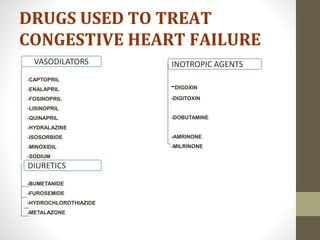
DRUGS USED TO TREAT
CONGESTIVE HEART FAILURE
-CAPTOPRIL
-ENALAPRIL
-FOSINOPRIL
-LISINOPRIL
-QUINAPRIL
-HYDRALAZINE
-ISOSORBIDE
-MINOXIDIL
-SODIUM
NIITROPRUSSIDE
DIURETICS
-BUMETANIDE
-FUROSEMIDE
-HYDROCHLOROTHIAZIDE
-METALAZONE
INOTROPIC AGENTS
-DIGOXIN
-DIGITOXIN
-DOBUTAMINE
-AMRINONE
-MILRINONE
VASODILATORS
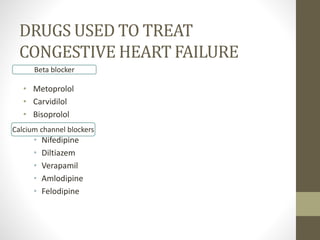
DRUGS USED TO TREAT
CONGESTIVE HEART FAILURE
• Metoprolol
• Carvidilol
• Bisoprolol
• Nifedipine
• Diltiazem
• Verapamil
• Amlodipine
• Felodipine
Calcium channel blockers
Beta blocker
• Coronary Artery Bypass Graft (CABG) Surgery
Coronary artery bypass graft (CABG)
surgery involves the use of a blood vessel graft to bypass one or more
blocked coronary arteries. The bypass restores normal blood flow to
the heart muscle. The graft goes around the clogged artery/arteries
and forms new pathways for oxygen-rich blood to flow to the heart
muscle. The blood vessel grafts usually come from your own arteries
and veins in the chest, leg or arm.
2. CORONARY ANGIOPLASTY
A coronary angioplasty is a procedure used to widen blocked or
narrowed coronary arteries (the main blood vessels supplying
the heart). The term 'angioplasty' means using a balloon to
stretch open a narrowed or blocked artery.
• 3. IMPLANTABLE CARDIAC DEFIBRILLATOR
An implantable cardioverter
defibrillator(ICD) is a small device that's placed in
the chest or abdomen. Doctors use the device to
help treat irregular heartbeats called arrhythmias
• 4. INTRA AORTIC BALLOON PUMP
The Intra-aortic balloon pump (IABP) is a
mechanical device that increases myocardial
oxygen perfusion while at the same time
increasing cardiac output. Increasing cardiac
output increases coronary blood flow and
therefore myocardial oxygen delivery.
• 5. LEFT VENTRICULAR ASSIST DEVICE
• The left ventricular assist device, or LVAD, is a
mechanical pump that is implanted inside a
person's chest to help a weakened heart
ventricle pump blood throughout the body.
OTHER…….
• 6. VALVE REPAIR OR VALVE REPLACEMENT SURGERY
• 7. PACEMAKER INSERTION
• 8. HEART TRANSPLANTATION
Nursing care of patients with congestiveheart
failure
•Maintain the patient in high fowler's position
•Elevate extremities except when the patient
is in acute distress
•Frequently monitor vital signs
•Change position frequently
•Monitor intake and output and daily weight
Nursing care of patients with congestiveheart
failure (cont…)
• Restrict fluids as ordered
• Teach the patient and family and provide emotional
support (life style change)
• Explain the side effect of diuretic medications for
additional actions ( side effects of diuretics include
electrolyte imbalance, symptomatic hypotension
• Use aseptic procedures when caring for invasive lines
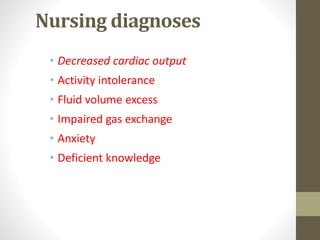
Nursing diagnoses
• Decreased cardiac output
• Activity intolerance
• Fluid volume excess
• Impaired gas exchange
• Anxiety
• Deficient knowledge
Ccf

Ccf

  • 1.
  • 2.
    OTHER NAMES ARE •CongestiveHeart Failure(CHF) •Heart Failure (HF)
  • 3.
    • Heart failuredoes not mean the heart has stopped working. Rather, it means that the heart's pumping power is weaker than normal. • With heart failure, blood moves through the heart and body at a slower rate, and pressure in the heart increases. As a result, the heart cannot pump enough oxygen and nutrients to meet the body's needs.
  • 4.
    DEFINITION • Heart failuredescribes the clinical syndrome that develops when the heart cannot maintain an adequate cardiac output. • The heart pumps blood inadequately, leading to reduced blood flow, back-up (congestion) of blood in the veins and lungs, and other changes that may further weaken the heart.
  • 5.
    Congestive Heart Failure HeartFailure can divided: - Right Sided Heart Failure - Left Sided Heart Failure Can be Either From, Diastolic heart failure (Inability to relax) Systolic heart failure (Inability to Contract)
  • 6.
    Right Sided HeartFailure • In right-sided heart failure, the right ventricle loses its pumping function, and blood may back up into other areas of the body, producing congestion.
  • 7.
    Left Sided HeartFailure • Inability of the left heart to maintain its circulatory load, with corresponding rise in pressure in the pulmonary circulation usually with pulmonary congestion and ultimately pulmonary edema.
  • 8.
    Diastolic heart failure •Diastolic dysfunction refers to an abnormality in how the heart fills with blood during diastole. The heart muscles do not relax in a normal manner and the heart may fill too slowly, asynchronously or with an elevation in filling pressure only.
  • 9.
    Systolic heart failure •The left ventricle loses its ability to contract normally. The heart can't pump with enough force to push enough blood into circulation.
  • 10.
    Causes • Coronary arterydisease: Coronary artery disease (CAD), a disease of the arteries that supply blood and oxygen to the heart, causes decreased blood flow to the heart muscle. If the arteries become blocked or severely narrowed, the heart becomes starved for oxygen and nutrients. • Heart attack: A heart attack occurs when a coronary artery becomes suddenly blocked, stopping the flow of blood to the heart muscle. A heart attack damages the heart muscle, resulting in a scarred area that does not function properly.
  • 11.
    • Cardiomyopathy: Damageto the heart muscle from causes other than artery or blood flow problems, such as from infections or alcohol or drug abuse. • Conditions that overwork the heart: Conditions including high blood pressure, valve disease, thyroid disease, kidney disease,diabetes, or heart defects present at birth can all cause heart failure. In addition, heart failure can occur when several diseases or conditions are present at once.
  • 12.
    RISK FACTORS • Coronaryartery Diseases • Myocardial Infarction • Hypertension • Diabetes • Heart Valve Disease ( e.g.Aortic Stenosis) • Smoking • Obesity
  • 13.
    • Previous heartattack • Congenital heart defects • Cardiomyopathy • Infection of heart muscles • Conduction defects • Large amount of salt intake
  • 14.
  • 15.
  • 16.
  • 18.
    DIAGNOSTIC EVALUATION 1. HISTORYCOLLECTION patient history may include gathering information about the following: • Alcohol and drug use • History of hypertension, including treatment • Prior chest pains or heart attack • Recent viral illness • Recent pregnancy
  • 19.
    2. PHYSICAL EXAMINATION Thephysician looks for an underlying cause and assesses heart function. A stethoscope is used to detect abnormal heart sounds (murmurs) that may indicate a leaky or narrowed (stenotic) valve, and to detect fluid accumulation in the lungs. The physician also looks for enlarged (distended) veins in the neck and for swelling (edema) in the legs (particularly the ankles and feet) and/or the abdomen
  • 20.
    3. ELECTROCARDIOGRAM An electrocardiogram(ECG) is a noninvasive test used to measure electrical activity in the heart. Electrical sensors called leads are attached to predetermined positions on the arms, legs, and chest to record electrical activity and help assess heart function.
  • 21.
    4. ECHOCARDIOGRAM Echocardiogram (cardiacecho) is an ultrasound examination of the heart that produces detailed images of the organ. It can be used to detect abnormalities in the structure of the heart and to measure the ejection fraction.
  • 22.
    5. CARDIAC CATHETERIZATION Cardiaccatheterization may be performed in patients with angina and patients with a history of heart attack to determine if coronary heart disease (CHD) is causing heart failure. • This procedure produces angiograms (i.e., x-ray images) of the coronary arteries and the left ventricle, and can be used to monitor heart function.
  • 23.
    6. STRESS TEST/EXERCISETEST In this test, a patient simply walks on a treadmill while connected to an electrocardiogram. 7. DOBUTAMINE STRESS ECHO CARDIOGRAPHY In this cases, a drug(dobutamine) is infused into the bloodstream to increase the heart rate or to affect the flow of blood within the heart and an echocardiogram is used to obtain images of the heart.
  • 24.
    8. MRI (Magneticresonance imaging): • Magnetic fields are used to provide images of the structure of the heart and its ability to pump blood to the body. • If used with a special MRI contrast agent (gadolinium), it can provide information about inflammation, injury, and blood flow to the heart.
  • 25.
    9. Chest X-ray: Thisis very helpful in identifying the buildup of fluid in the lungs. Also, the heart usually enlarges in congestive heart failure, and this may be visible on the X-ray film.
  • 26.
    10.BLOOD TESTS: • Peoplemay have blood drawn for lab tests. • Low blood cell counts (anemia) may cause symptoms much like congestive heart failure or contribute to the condition. • Sodium, potassium, magnesium, and other electrolyte levels may be abnormal, especially if the person has been treated with diuretics and/or has kidney disease. • Tests for kidney function.
  • 29.
    • LIFESTYLE MEASURES. Thefirst steps in the treatment of heart failure may include limits on the amount of fluids consumed (including alcohol) and reductions in dietary sodium (less than 2,000 mg per day). In addition, follow your doctor's instructions on getting regular exercise, which can help prevent symptoms from worsening.
  • 30.
    • MEDICATIONS. A varietyof drugs may be used to manage heart failure. THE DRUGS INCLUDE ACE INHIBITORS. ACE inhibitors—such as enalapril (Vasotec) and lisinopril (Prinivil, Zestril)—are the choice of drug treatment for people with heart failure. ACE inhibitors promote dilation of the blood vessels and thus improve blood flow and slow the progression of CHD.
  • 31.
    • DIURETICS ANDDIGOXIN. The physician may prescribe diuretics to reduce fluid buildup and digoxin (Lanoxin) to strengthen the heartbeat. Thiazide diuretics are effective for mild heart failure, but more potent drugs such as the loop diuretic furosemide (Lasix) are used for severe fluid retention. BETA-BLOCKERS. These drugs—such as carvedilol (Coreg) and metoprolol (Toprol XL)—also can decrease the workload of the heart.
  • 32.
    • ALDOSTERONE BLOCKERS. Spironolactone(Aldactone) and eplerenone (Inspra) block the activity of aldosterone, an adrenal hormone that causes sodium retention.
  • 33.
    DRUGS USED TOTREAT CONGESTIVE HEART FAILURE -CAPTOPRIL -ENALAPRIL -FOSINOPRIL -LISINOPRIL -QUINAPRIL -HYDRALAZINE -ISOSORBIDE -MINOXIDIL -SODIUM NIITROPRUSSIDE DIURETICS -BUMETANIDE -FUROSEMIDE -HYDROCHLOROTHIAZIDE -METALAZONE INOTROPIC AGENTS -DIGOXIN -DIGITOXIN -DOBUTAMINE -AMRINONE -MILRINONE VASODILATORS
  • 34.
    DRUGS USED TOTREAT CONGESTIVE HEART FAILURE • Metoprolol • Carvidilol • Bisoprolol • Nifedipine • Diltiazem • Verapamil • Amlodipine • Felodipine Calcium channel blockers Beta blocker
  • 36.
    • Coronary ArteryBypass Graft (CABG) Surgery Coronary artery bypass graft (CABG) surgery involves the use of a blood vessel graft to bypass one or more blocked coronary arteries. The bypass restores normal blood flow to the heart muscle. The graft goes around the clogged artery/arteries and forms new pathways for oxygen-rich blood to flow to the heart muscle. The blood vessel grafts usually come from your own arteries and veins in the chest, leg or arm.
  • 37.
    2. CORONARY ANGIOPLASTY Acoronary angioplasty is a procedure used to widen blocked or narrowed coronary arteries (the main blood vessels supplying the heart). The term 'angioplasty' means using a balloon to stretch open a narrowed or blocked artery.
  • 38.
    • 3. IMPLANTABLECARDIAC DEFIBRILLATOR An implantable cardioverter defibrillator(ICD) is a small device that's placed in the chest or abdomen. Doctors use the device to help treat irregular heartbeats called arrhythmias
  • 39.
    • 4. INTRAAORTIC BALLOON PUMP The Intra-aortic balloon pump (IABP) is a mechanical device that increases myocardial oxygen perfusion while at the same time increasing cardiac output. Increasing cardiac output increases coronary blood flow and therefore myocardial oxygen delivery.
  • 40.
    • 5. LEFTVENTRICULAR ASSIST DEVICE • The left ventricular assist device, or LVAD, is a mechanical pump that is implanted inside a person's chest to help a weakened heart ventricle pump blood throughout the body.
  • 41.
    OTHER……. • 6. VALVEREPAIR OR VALVE REPLACEMENT SURGERY • 7. PACEMAKER INSERTION • 8. HEART TRANSPLANTATION
  • 42.
    Nursing care ofpatients with congestiveheart failure •Maintain the patient in high fowler's position •Elevate extremities except when the patient is in acute distress •Frequently monitor vital signs •Change position frequently •Monitor intake and output and daily weight
  • 43.
    Nursing care ofpatients with congestiveheart failure (cont…) • Restrict fluids as ordered • Teach the patient and family and provide emotional support (life style change) • Explain the side effect of diuretic medications for additional actions ( side effects of diuretics include electrolyte imbalance, symptomatic hypotension • Use aseptic procedures when caring for invasive lines
  • 44.
    Nursing diagnoses • Decreasedcardiac output • Activity intolerance • Fluid volume excess • Impaired gas exchange • Anxiety • Deficient knowledge