INTRODUCTION
▶ Heart failure(HF) is a common cardiovascular condition with
increasing incidence and prevalence.
▶ Unlike western countries where heart failure is predominantly a disease
of elderly, in India it affects younger age group.
3.
KEY WORDS
1. HeartFailure-It refers to a condition when heart fails to pump
blood through out the body.
2. Hemochromatosis- It refers to buildup of iron.
3. Amyloidosis - It refers to buildup of protein.
4.
DEFINITION
▶ Heart failureis a chronic condition in which the heart
cannot pump enough blood and oxygen to support other
organs in your body. ( CDC- Centre of disease control &
prevention)
▶ Congestive heart failure (CHF) is a chronic progressive
condition that affects the pumping power of heart
muscles. While often referred to simply as “heart failure,”
5.
TYPES OF HEARTFAILURE
Left-sided heart failure -Fluid may back up in your lungs, causing shortness
of breath.
Right-sided heart failure- Fluid may back up into your abdomen, legs
and feet, causing swelling.
Systolic heart failure- The left ventricle can't contract vigorously, indicating
a pumping problem.
Diastolic heart failure- The left ventricle can't relax or fill fully, indicating
a filling problem.
(also called heart failure with preserved ejection fraction)
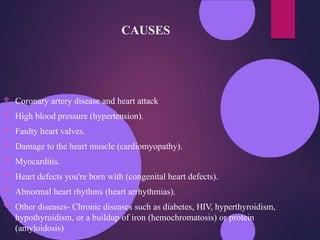
CAUSES
Coronary arterydisease and heart attack
High blood pressure (hypertension).
Faulty heart valves.
Damage to the heart muscle (cardiomyopathy).
Myocarditis.
Heart defects you're born with (congenital heart defects).
Abnormal heart rhythms (heart arrhythmias).
Other diseases- Chronic diseases such as diabetes, HIV, hyperthyroidism,
hypothyroidism, or a buildup of iron (hemochromatosis) or protein
(amyloidosis)
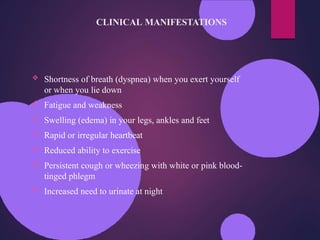
CLINICAL MANIFESTATIONS
Shortnessof breath (dyspnea) when you exert yourself
or when you lie down
Fatigue and weakness
Swelling (edema) in your legs, ankles and feet
Rapid or irregular heartbeat
Reduced ability to exercise
Persistent cough or wheezing with white or pink blood-
tinged phlegm
Increased need to urinate at night
10.
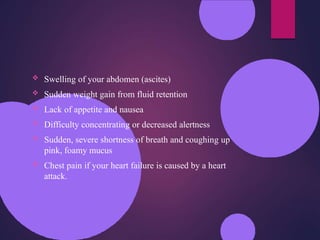
Swelling ofyour abdomen (ascites)
Sudden weight gain from fluid retention
Lack of appetite and nausea
Difficulty concentrating or decreased alertness
Sudden, severe shortness of breath and coughing up
pink, foamy mucus
Chest pain if your heart failure is caused by a heart
attack.
11.
DIAGNOSTIC EVALUATION
Historycollection
Physical Examination
Blood tests- Like LFT, KFT & TSH
A blood test to check for a chemical called N-terminal pro-B-type natriuretic
peptide (NT-proBNP) may help in diagnosing heart failure
Chest X-ray- heart may appear enlarged and fluid buildup may be visible in your
lungs.
Electrocardiogram (ECG)
12.
Echocardiogram
Stresstest- Stress tests measure how heart and blood vessels respond
to exertion.
Cardiac computerized tomography (CT) scan or magnetic
resonance imaging (MRI).-
Coronary angiogram
Myocardial biopsy
13.
MANAGEMENT
Medical management
Pharmacological Management
Angiotensin-converting enzyme (ACE) inhibitors-
enalapril (Vasotec), lisinopril (Zestril) and captopril
(Capoten).
Angiotensin II receptor blockers. losartan (Cozaar)
and valsartan (Diovan)
Beta blockers.-carvedilol , metoprolol (Lopressor) and
bisoprolol
Diuretics- furosemide (Lasix)
Aldosterone antagonists- spironolactone (Aldactone)
14.
Inotropes- improveheart pumping function and
maintain blood pressure.
Digoxin (Lanoxin).
Non- Pharmacological Management
Maintain input & output of the patient
Propped up position of the patients
Oxygen support should be provided to the patient.
15.
Surgical Management
Coronarybypass surgery
Heart valve repair or replacement.
Implantable cardioverter-defibrillators
Cardiac resynchronization therapy (CRT), or
biventricular pacing
Ventricular assist devices (vads)
Heart transplant
16.
NURSING MANAGEMENT
Decreasedcardiac output related to changes in myocardial
contractility
Ineffective breathing pattern related to insufficient supply of
oxygenated blood.
Excess fluid volume related to
decreased glomerular filtration rate
(GFR).
Activity intolerance related to decrease
CO.
Anxiety related to breathlessness from
inadequate oxygenation.
Powerlessness related to chronic illness
and hospitalizations.
Ineffective therapeutic regimen management related to lack of
knowledge.
HEALTH EDUCATION
SmokingCessation
Discuss weight monitoring.
Check legs, ankles and feet for swelling daily.
Eat a healthy diet.
Restrict salt in your diet & limit water
Maintain a healthy weight.
Limit fats and cholesterol.
Limit alcohol and fluids.
Active lifestyle
Reduce stress & get proper sleep .
19.
RELATED RESEARCH
▶ SullivanMJ et. Al. (2009) Conducted a study on Support, Education, and Research in
Chronic Heart Failure Study (SEARCH): a mindfulness-based psychoeducational
intervention improves depression and clinical symptoms in patients with chronic heart
failure. A prospective cohort study of 208 adults with left ventricular ejection fraction <
or
=40% and CHF was geographically assigned to treatment or control groups with follow-up at
3, 6, and 12 months. Treatment groups met weekly for 8 consecutive weeks for training in
mindfulness meditation, coping skills, and support group discussion. Subjects had a mean
age of 61 years, left ventricular ejection fraction 26%, and median New York Heart
Association class II. The majority were treated with angiotensin-converting enzyme
inhibitors (80%) and beta-blockers (86%). There were no treatment effects on
death/rehospitalization at 1 year. An 8-week mindfulness-based psychoeducational
intervention reduced anxiety and depression; this effect was attenuated at 1 year.
Importantly, the intervention led to significantly better symptoms of CHF at 12 months
compared to control subjects. Our results suggest that interventions of this type might
have a role in optimal therapy for CHF.
20.
PRESENTER’S VIEW
▶ Heartfailure requires to pay close attention to
change in symptoms. Reducing chances of
hospital visits by understanding symptoms and
knowing when they signal trouble.