INTEGUMENTARY
SYSTEM
RATHEESH R.L
• The skin is the largest organ of the body, with
a total area of about 20 square feet.
• The skin protects us from microbes and the
elements, helps regulate body temperature,
and permits the sensations of touch, heat, and
cold.
LAYERS
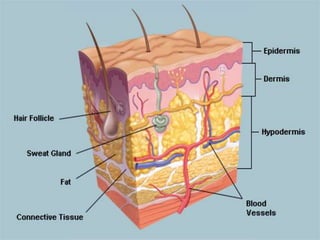
Skin has three layers:
• The epidermis, the outermost layer of skin,
provides a waterproof barrier and creates our
skin tone.
• The dermis, beneath the epidermis, contains
tough connective tissue, hair follicles, and
sweat glands.
• The deeper subcutaneous tissue (hypodermis)
is made of fat and connective tissue.
EPIDERMIS
• It is the outermost layer of the skin. It forms
the waterproof, protective wrap over the
body's surface which also serves as a barrier
to infection.
• The epidermis contains no blood vessels.
• It is nourished by the blood vessels in the
dermis.
• Replaced with new cells in every 28 days.
DERMIS
• The dermis is the layer of skin beneath
the epidermis that consists of epithelial
tissue and cushions the body from stress and
strain.
• The dermis is tightly connected to the
epidermis by a basement membrane.
• The dermis is highly vascular and assist in the
regulation of body tempareture.
HYPODERMIS
• The hypodermis is not part of the skin, and
lies below the dermis.
• Its purpose is to attach the skin to underlying
bone and muscle as well as supplying it with
blood vessels and nerves.
• It consists of loose connective tissue, adipose
tissue and elastin.
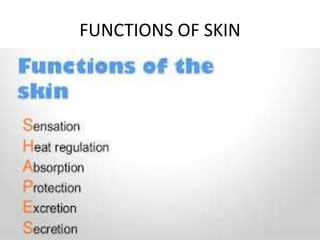
FUNCTIONS OF SKIN
ASSESSMENT OF INTEGUMENTARY
SYSTEM
• HISTORY COLLECTION
– Past health history
– Medication
– Surgery
• PHYSICAL EXAMINATION
– Inspection
– Palpation
COMMON DIAGNOSTIC TESTS
• BIOPSY
A skin biopsy is a procedure in which a
sample of skin tissue is removed, processed, and
examined under a microscope.
Several different methods may be used to
obtain a skin sample, depending on the size and
location of the abnormal area of skin, called
a skin lesion.
PUNCH BIOPSY
• Punch biopsy is considered the primary
technique to obtain diagnostic, full-thickness
skin specimens.
• It is performed using a circular blade attached
to a pencil-like handle.
• The instrument is rotated down through the
epidermis and dermis, and into the
subcutaneous fat.
SHAVE TEST
• This test is used to collect the superficial lesion
from the skin or a small sample of large lesion.
INCISION
• In this wedge shape incision is made and
useful when larger specimen than shave biopsy
is needed.
TZANCK TEST
• In dermatopathology, the Tzanck test, also Tzanck
smear, is scraping of an ulcer base to look
for Tzanck cells.
• It is sometimes also called the chickenpox skin
test and the herpes skin test.
• In this test the fluids and cells from the vesicles
are examined
CULTURE
• A skin or nail culture is a laboratory test to
look for and identify germs that cause
problems with the skin or nails.
• It is called a mucosal culture if the sample
involves the mucous membranes.
PATCH TEST
• A test to discover whether a person is allergic
to any of a range of substances which are
applied to the skin in light scratches or under a
plaster.
• In this technique a small amount of potentially
allergic material is applied over the skin and
watching for reactions.
Skin intro

Skin intro

  • 1.
  • 2.
    • The skinis the largest organ of the body, with a total area of about 20 square feet. • The skin protects us from microbes and the elements, helps regulate body temperature, and permits the sensations of touch, heat, and cold.
  • 4.
    LAYERS Skin has threelayers: • The epidermis, the outermost layer of skin, provides a waterproof barrier and creates our skin tone. • The dermis, beneath the epidermis, contains tough connective tissue, hair follicles, and sweat glands. • The deeper subcutaneous tissue (hypodermis) is made of fat and connective tissue.
  • 5.
    EPIDERMIS • It isthe outermost layer of the skin. It forms the waterproof, protective wrap over the body's surface which also serves as a barrier to infection. • The epidermis contains no blood vessels. • It is nourished by the blood vessels in the dermis. • Replaced with new cells in every 28 days.
  • 6.
    DERMIS • The dermisis the layer of skin beneath the epidermis that consists of epithelial tissue and cushions the body from stress and strain. • The dermis is tightly connected to the epidermis by a basement membrane. • The dermis is highly vascular and assist in the regulation of body tempareture.
  • 7.
    HYPODERMIS • The hypodermisis not part of the skin, and lies below the dermis. • Its purpose is to attach the skin to underlying bone and muscle as well as supplying it with blood vessels and nerves. • It consists of loose connective tissue, adipose tissue and elastin.
  • 8.
  • 9.
    ASSESSMENT OF INTEGUMENTARY SYSTEM •HISTORY COLLECTION – Past health history – Medication – Surgery • PHYSICAL EXAMINATION – Inspection – Palpation
  • 10.
    COMMON DIAGNOSTIC TESTS •BIOPSY A skin biopsy is a procedure in which a sample of skin tissue is removed, processed, and examined under a microscope. Several different methods may be used to obtain a skin sample, depending on the size and location of the abnormal area of skin, called a skin lesion.
  • 11.
    PUNCH BIOPSY • Punchbiopsy is considered the primary technique to obtain diagnostic, full-thickness skin specimens. • It is performed using a circular blade attached to a pencil-like handle. • The instrument is rotated down through the epidermis and dermis, and into the subcutaneous fat.
  • 12.
    SHAVE TEST • Thistest is used to collect the superficial lesion from the skin or a small sample of large lesion.
  • 13.
    INCISION • In thiswedge shape incision is made and useful when larger specimen than shave biopsy is needed.
  • 14.
    TZANCK TEST • Indermatopathology, the Tzanck test, also Tzanck smear, is scraping of an ulcer base to look for Tzanck cells. • It is sometimes also called the chickenpox skin test and the herpes skin test. • In this test the fluids and cells from the vesicles are examined
  • 15.
    CULTURE • A skinor nail culture is a laboratory test to look for and identify germs that cause problems with the skin or nails. • It is called a mucosal culture if the sample involves the mucous membranes.
  • 16.
    PATCH TEST • Atest to discover whether a person is allergic to any of a range of substances which are applied to the skin in light scratches or under a plaster.
  • 17.
    • In thistechnique a small amount of potentially allergic material is applied over the skin and watching for reactions.