CHIRAYU COLLEGE OF NURSING, BHOPAL
SUBJECT- MEDICAL SURGICAL NURSING
TOPIC- STATUS EPILEPTICUS
PROGRAMME & PLACEMENT- G.N.M. 2nd YEAR
PREPARED BY
MR. MIGRON RUBIN
TUTOR
INTRODUCTION
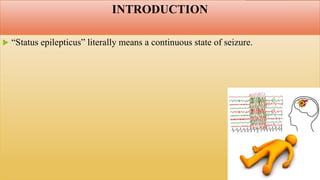
 “Status epilepticus” literally means a continuous state of seizure.
DEFINITION
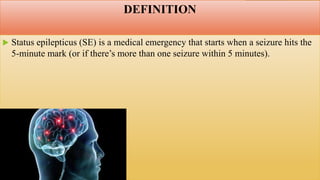
 Status epilepticus (SE) is a medical emergency that starts when a seizure hits the
5-minute mark (or if there’s more than one seizure within 5 minutes).
TYPES
 Convulsive Status epilepticus-
 The convulsive type is more common and more dangerous.
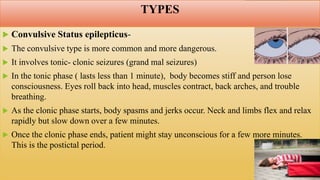
 It involves tonic- clonic seizures (grand mal seizures)
 In the tonic phase ( lasts less than 1 minute), body becomes stiff and person lose
consciousness. Eyes roll back into head, muscles contract, back arches, and trouble
breathing.
 As the clonic phase starts, body spasms and jerks occur. Neck and limbs flex and relax
rapidly but slow down over a few minutes.
 Once the clonic phase ends, patient might stay unconscious for a few more minutes.
This is the postictal period.
 Non-convulsive Status epilepticus-
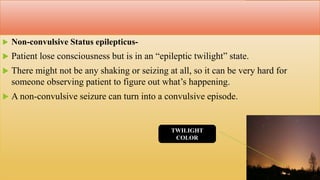
 Patient lose consciousness but is in an “epileptic twilight” state.
 There might not be any shaking or seizing at all, so it can be very hard for
someone observing patient to figure out what’s happening.
 A non-convulsive seizure can turn into a convulsive episode.
TWILIGHT
COLOR
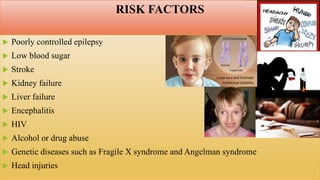
RISK FACTORS
 Poorly controlled epilepsy
 Low blood sugar
 Stroke
 Kidney failure
 Liver failure
 Encephalitis
 HIV
 Alcohol or drug abuse
 Genetic diseases such as Fragile X syndrome and Angelman syndrome
 Head injuries
ETIOLOGY
 Stroke
 Imbalance of substances in the blood, such as low blood sugar
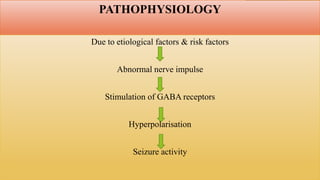
PATHOPHYSIOLOGY
Due to etiological factors & risk factors
Abnormal nerve impulse
Stimulation of GABA receptors
Hyperpolarisation
Seizure activity
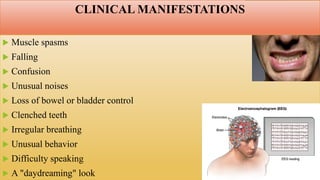
CLINICAL MANIFESTATIONS
 Muscle spasms
 Falling
 Confusion
 Unusual noises
 Loss of bowel or bladder control
 Clenched teeth
 Irregular breathing
 Unusual behavior
 Difficulty speaking
 A "daydreaming" look
DIAGNOSTIC EVALUATION
 History collection and physical examination
 Glucose and electrolyte levels tests
 Complete blood count
 Renal and liver function tests
 Toxicological screening
 Arterial blood gas tests
 Lumbar puncture
 CT Scan
 MRI
 EEG
COMPLICATIONS
 Permanent brain damage
 Death.
MANAGEMENT
 A. MEDICAL MANAGEMENT
 I. PHARMACOLOGICAL MANAGEMENT
 Intravenous (IV) diazepam or lorazepam to suppress seizure activity
 IV phenobarbital or phenytoin may be given to suppress electrical activity in the brain
and nervous system if IV lorazepam doesn’t work.
 II. NON- PHARMACOLOGICAL MANAGEMENT
 High-concentration oxygen followed by intubation
 Assessment of cardiac and respiratory function
 SURGICAL MANAGEMENT
 Focal resection
 Lobar resection
 Multilobar resection
 Hemispherectomy—functional/anatomical/modified
 Corpus callosotomy
 Vagal nerve stimulator implantation
 Low‐frequency repetitive cortical electrical stimulation
 NURSING MANAGEMENT
 ASSESSMENT
 Obtain seizure history, including prodromal signs and symptoms, seizure behavior,
postictal state, history of status epilepticus.
 Document the following about seizure activity
 Investigate the psychosocial effect of seizures.
 Obtain history of drug or alcohol abuse.
 Assess compliance and medication-taking strategies.
 NURSING DIAGNOSIS
 Risk for ineffective cerebral tissue perfusion related to decreased oxygen supply to the
brain.
 Risk for injury related to loss of consciousness during seizure activity and postictal
physical weakness.
 Ineffective airway clearance related to blockage of the tongue, endo-tracheal, increased
secretion of saliva.
 Ineffective breathing pattern related to: neuromuscular impairment, dyspnea and apnea
 Ineffective self-health management related to drug therapy and lifestyle adjustments.
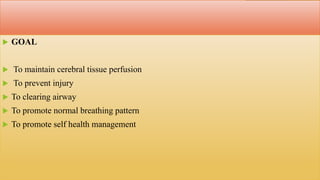
 GOAL
 To maintain cerebral tissue perfusion
 To prevent injury
 To clearing airway
 To promote normal breathing pattern
 To promote self health management
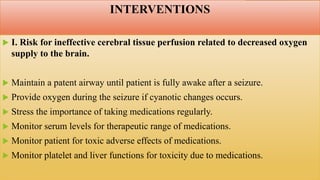
INTERVENTIONS
 I. Risk for ineffective cerebral tissue perfusion related to decreased oxygen
supply to the brain.
 Maintain a patent airway until patient is fully awake after a seizure.
 Provide oxygen during the seizure if cyanotic changes occurs.
 Stress the importance of taking medications regularly.
 Monitor serum levels for therapeutic range of medications.
 Monitor patient for toxic adverse effects of medications.
 Monitor platelet and liver functions for toxicity due to medications.
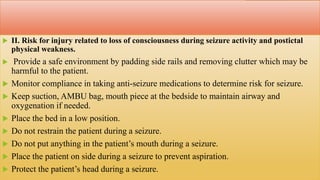
 II. Risk for injury related to loss of consciousness during seizure activity and postictal
physical weakness.
 Provide a safe environment by padding side rails and removing clutter which may be
harmful to the patient.
 Monitor compliance in taking anti-seizure medications to determine risk for seizure.
 Keep suction, AMBU bag, mouth piece at the bedside to maintain airway and
oxygenation if needed.
 Place the bed in a low position.
 Do not restrain the patient during a seizure.
 Do not put anything in the patient’s mouth during a seizure.
 Place the patient on side during a seizure to prevent aspiration.
 Protect the patient’s head during a seizure.
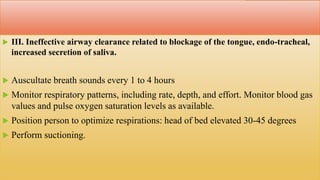
 III. Ineffective airway clearance related to blockage of the tongue, endo-tracheal,
increased secretion of saliva.
 Auscultate breath sounds every 1 to 4 hours
 Monitor respiratory patterns, including rate, depth, and effort. Monitor blood gas
values and pulse oxygen saturation levels as available.
 Position person to optimize respirations: head of bed elevated 30-45 degrees
 Perform suctioning.
 IV. Ineffective breathing pattern related to: neuromuscular impairment, dyspnea
and apnea
 Monitor respiratory and oxygenation status to determine presence and extent of
breathing problem and to initiate appropriate interventions.
 Position patient (side-lying) to maximize ventilation potential and decrease risk of
aspiration.
 Perform endotracheal or nasotracheal suctioning to maintain airway.
 Loosen clothing to prevent restricted breathing.
 Provide oxygen therapy
 V. Ineffective self-health management related to drug therapy and lifestyle
adjustments.
 Appraise the patient’s current level of knowledge related to specific disease process to
establish learning needs.
 Discuss lifestyle changes (e.g., avoidance of precipitating factors, driving restrictions,
wearing medical ID tags, moderation in drinking and eating, exposure to stress, and
avoidance of hazardous activities)
 Discuss therapy/treatment options so patient and family can make lifestyle
modifications to manage a chronic disease.
 EXPECTED OUTCOMES
 Maintenance of Cerebral Tissue Perfusion
 Prevention of Injury
 Clearing Airway
 Bringing Normal breathing pattern adequate to meet oxygen needs.
 Promoting Self Health Management
HEALTH EDUCATION
 Counsel patients with uncontrolled seizures about driving or operating dangerous equipment.
 Assess home environment for safety hazards in case the patient falls, such as crowded furniture
arrangement, sharp edges on tables, glass. Soft flooring and furniture and padded surfaces may be
necessary.
 Support patient in discussion about seizures with employer, school, and so forth
 Encourage the patient to determine existence of trigger factors for seizures (eg, skipped meals, lack of
sleep, emotional stress, menstrual cycle).
 Remind the patient of the importance of following medication regimen. Stress the importance of taking
medications regularly.
 Teach the patient regarding regular blood tests ,to monitor serum levels for therapeutic range of
medications which is very essential for the seizure control.
 Teach the patient regarding symptoms and the need to monitor the toxic adverse effects of medication.
 Tell the patient to avoid alcohol because it interferes with metabolism of antiepileptic medications.
 For the surgical candidate, reinforce instructions related to surgical outcome of the specific surgical
approach (temporal lobectomy, corpus callosotomy, hemispherectomy, and extratemporal resection).
Status epilepticus
Status epilepticus
Status epilepticus

Status epilepticus

  • 1.
    CHIRAYU COLLEGE OFNURSING, BHOPAL SUBJECT- MEDICAL SURGICAL NURSING TOPIC- STATUS EPILEPTICUS PROGRAMME & PLACEMENT- G.N.M. 2nd YEAR PREPARED BY MR. MIGRON RUBIN TUTOR
  • 2.
    INTRODUCTION  “Status epilepticus”literally means a continuous state of seizure.
  • 3.
    DEFINITION  Status epilepticus(SE) is a medical emergency that starts when a seizure hits the 5-minute mark (or if there’s more than one seizure within 5 minutes).
  • 4.
    TYPES  Convulsive Statusepilepticus-  The convulsive type is more common and more dangerous.  It involves tonic- clonic seizures (grand mal seizures)  In the tonic phase ( lasts less than 1 minute), body becomes stiff and person lose consciousness. Eyes roll back into head, muscles contract, back arches, and trouble breathing.  As the clonic phase starts, body spasms and jerks occur. Neck and limbs flex and relax rapidly but slow down over a few minutes.  Once the clonic phase ends, patient might stay unconscious for a few more minutes. This is the postictal period.
  • 5.
     Non-convulsive Statusepilepticus-  Patient lose consciousness but is in an “epileptic twilight” state.  There might not be any shaking or seizing at all, so it can be very hard for someone observing patient to figure out what’s happening.  A non-convulsive seizure can turn into a convulsive episode. TWILIGHT COLOR
  • 6.
    RISK FACTORS  Poorlycontrolled epilepsy  Low blood sugar  Stroke  Kidney failure  Liver failure  Encephalitis  HIV  Alcohol or drug abuse  Genetic diseases such as Fragile X syndrome and Angelman syndrome  Head injuries
  • 7.
    ETIOLOGY  Stroke  Imbalanceof substances in the blood, such as low blood sugar
  • 8.
    PATHOPHYSIOLOGY Due to etiologicalfactors & risk factors Abnormal nerve impulse Stimulation of GABA receptors Hyperpolarisation Seizure activity
  • 9.
    CLINICAL MANIFESTATIONS  Musclespasms  Falling  Confusion  Unusual noises  Loss of bowel or bladder control  Clenched teeth  Irregular breathing  Unusual behavior  Difficulty speaking  A "daydreaming" look
  • 10.
    DIAGNOSTIC EVALUATION  Historycollection and physical examination  Glucose and electrolyte levels tests  Complete blood count  Renal and liver function tests  Toxicological screening  Arterial blood gas tests  Lumbar puncture  CT Scan  MRI  EEG
  • 11.
  • 12.
    MANAGEMENT  A. MEDICALMANAGEMENT  I. PHARMACOLOGICAL MANAGEMENT  Intravenous (IV) diazepam or lorazepam to suppress seizure activity  IV phenobarbital or phenytoin may be given to suppress electrical activity in the brain and nervous system if IV lorazepam doesn’t work.
  • 13.
     II. NON-PHARMACOLOGICAL MANAGEMENT  High-concentration oxygen followed by intubation  Assessment of cardiac and respiratory function
  • 14.
     SURGICAL MANAGEMENT Focal resection  Lobar resection  Multilobar resection  Hemispherectomy—functional/anatomical/modified  Corpus callosotomy  Vagal nerve stimulator implantation  Low‐frequency repetitive cortical electrical stimulation
  • 15.
     NURSING MANAGEMENT ASSESSMENT  Obtain seizure history, including prodromal signs and symptoms, seizure behavior, postictal state, history of status epilepticus.  Document the following about seizure activity  Investigate the psychosocial effect of seizures.  Obtain history of drug or alcohol abuse.  Assess compliance and medication-taking strategies.
  • 16.
     NURSING DIAGNOSIS Risk for ineffective cerebral tissue perfusion related to decreased oxygen supply to the brain.  Risk for injury related to loss of consciousness during seizure activity and postictal physical weakness.  Ineffective airway clearance related to blockage of the tongue, endo-tracheal, increased secretion of saliva.  Ineffective breathing pattern related to: neuromuscular impairment, dyspnea and apnea  Ineffective self-health management related to drug therapy and lifestyle adjustments.
  • 17.
     GOAL  Tomaintain cerebral tissue perfusion  To prevent injury  To clearing airway  To promote normal breathing pattern  To promote self health management
  • 18.
    INTERVENTIONS  I. Riskfor ineffective cerebral tissue perfusion related to decreased oxygen supply to the brain.  Maintain a patent airway until patient is fully awake after a seizure.  Provide oxygen during the seizure if cyanotic changes occurs.  Stress the importance of taking medications regularly.  Monitor serum levels for therapeutic range of medications.  Monitor patient for toxic adverse effects of medications.  Monitor platelet and liver functions for toxicity due to medications.
  • 19.
     II. Riskfor injury related to loss of consciousness during seizure activity and postictal physical weakness.  Provide a safe environment by padding side rails and removing clutter which may be harmful to the patient.  Monitor compliance in taking anti-seizure medications to determine risk for seizure.  Keep suction, AMBU bag, mouth piece at the bedside to maintain airway and oxygenation if needed.  Place the bed in a low position.  Do not restrain the patient during a seizure.  Do not put anything in the patient’s mouth during a seizure.  Place the patient on side during a seizure to prevent aspiration.  Protect the patient’s head during a seizure.
  • 20.
     III. Ineffectiveairway clearance related to blockage of the tongue, endo-tracheal, increased secretion of saliva.  Auscultate breath sounds every 1 to 4 hours  Monitor respiratory patterns, including rate, depth, and effort. Monitor blood gas values and pulse oxygen saturation levels as available.  Position person to optimize respirations: head of bed elevated 30-45 degrees  Perform suctioning.
  • 21.
     IV. Ineffectivebreathing pattern related to: neuromuscular impairment, dyspnea and apnea  Monitor respiratory and oxygenation status to determine presence and extent of breathing problem and to initiate appropriate interventions.  Position patient (side-lying) to maximize ventilation potential and decrease risk of aspiration.  Perform endotracheal or nasotracheal suctioning to maintain airway.  Loosen clothing to prevent restricted breathing.  Provide oxygen therapy
  • 22.
     V. Ineffectiveself-health management related to drug therapy and lifestyle adjustments.  Appraise the patient’s current level of knowledge related to specific disease process to establish learning needs.  Discuss lifestyle changes (e.g., avoidance of precipitating factors, driving restrictions, wearing medical ID tags, moderation in drinking and eating, exposure to stress, and avoidance of hazardous activities)  Discuss therapy/treatment options so patient and family can make lifestyle modifications to manage a chronic disease.
  • 23.
     EXPECTED OUTCOMES Maintenance of Cerebral Tissue Perfusion  Prevention of Injury  Clearing Airway  Bringing Normal breathing pattern adequate to meet oxygen needs.  Promoting Self Health Management
  • 24.
    HEALTH EDUCATION  Counselpatients with uncontrolled seizures about driving or operating dangerous equipment.  Assess home environment for safety hazards in case the patient falls, such as crowded furniture arrangement, sharp edges on tables, glass. Soft flooring and furniture and padded surfaces may be necessary.  Support patient in discussion about seizures with employer, school, and so forth  Encourage the patient to determine existence of trigger factors for seizures (eg, skipped meals, lack of sleep, emotional stress, menstrual cycle).  Remind the patient of the importance of following medication regimen. Stress the importance of taking medications regularly.  Teach the patient regarding regular blood tests ,to monitor serum levels for therapeutic range of medications which is very essential for the seizure control.  Teach the patient regarding symptoms and the need to monitor the toxic adverse effects of medication.  Tell the patient to avoid alcohol because it interferes with metabolism of antiepileptic medications.  For the surgical candidate, reinforce instructions related to surgical outcome of the specific surgical approach (temporal lobectomy, corpus callosotomy, hemispherectomy, and extratemporal resection).