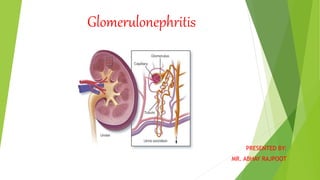


Glomerulonephritis
PRESENTED BY:
MR. ABHAY RAJPOOT
INTRODUCTION
 Glomerulonephritis is inflammation of the tiny filters in your kidneys (glomeruli).
Glomeruli remove excess fluid, electrolytes and waste from your bloodstream and
pass them into your urine. Glomerulonephritis can come on suddenly (acute) or
gradually (chronic).
 Glomerulonephritis occurs on its own or as part of another disease, such as lupus
or diabetes. Severe or prolonged inflammation associated with glomerulonephritis
can damage the kidneys
ANATOMY OF NEPHRON
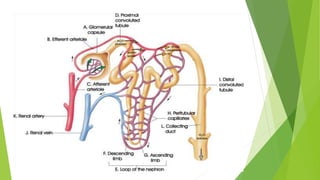
The nephron consist of a tubule closed at one end, to form the cup-shaped
glomerular capsule (bowman’s capsule), which almost completely enclose a network
of tinny arterial capillaries, the glomerulus. Continuing from the glomerulus capsule,
the remainder of the nephron is about 3cm long & is described in three parts-
• The proximal convoluted tubule
• Loop of henle ( medullary loop )
• Distal convoluted tubule lead them to collecting duct.
DEFINITION
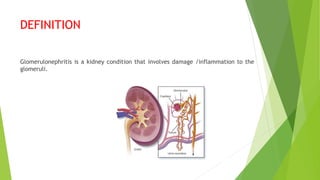
Glomerulonephritis is a kidney condition that involves damage /inflammation to the
glomeruli.
INCIDENCE
Glomerulonephritis Epidemiology Characterized. For the first time,
researchers have estimated the prevalence and incidence of the disorder. A
total of 1,693 cases of GN resulting from systemic immunologic disease were
diagnosed during 17,850,897 patient-years, for an incidence of 9.5 cases per
100,000 patient-years
CAUSES
Infections
 Post-streptococcal glomerulonephritis. Glomerulonephritis may develop
a week or two after recovery from a strep throat infection or, rarely, a
skin infection (impetigo). To fight the infection, your body produces extra
antibodies that can eventually settle in the glomeruli, causing
inflammation.
 Children are more likely to develop post-streptococcal glomerulonephritis
than are adults, and they're also more likely to recover quickly.
 Bacterial endocarditis. Bacteria occasionally can spread through your
bloodstream and lodge in your heart, causing an infection of one or more
of your heart valves. You're at greater risk of this condition if you have a
heart defect, such as a damaged or artificial heart valve. Bacterial
endocarditis is associated with glomerular disease, but the connection
between the two is unclear.
 Viral infections. Viral infections, such as the human immunodeficiency
virus (HIV), hepatitis B and hepatitis C, can trigger glomerulonephritis.
Immune diseases
 Lupus. A chronic inflammatory disease, lupus can affect many parts of your
body, including your skin, joints, kidneys, blood cells, heart and lungs.
 Goodpasture's syndrome. A rare immunological lung disorder that can
mimic pneumonia, Goodpasture's syndrome causes bleeding in your lungs as
well as glomerulonephritis.
 IgA nephropathy. Characterized by recurrent episodes of blood in the
urine, this primary glomerular disease results from deposits of
immunoglobulin A (IgA) in the glomeruli. IgA nephropathy can progress for
years with no noticeable symptoms.
Vasculitis
 Polyarteritis. This form of vasculitis affects small and medium blood
vessels in many parts of your body, such as your heart, kidneys and
intestines.
 Granulomatosis with polyangiitis. This form of vasculitis, formerly known
as Wegener's granulomatosis, affects small and medium blood vessels in
your lungs, upper airways and kidneys.
Conditions likely to cause scarring of the glomeruli
 High blood pressure. This can damage your kidneys and impair their ability to
function normally. Glomerulonephritis can also lead to high blood pressure because it
reduces kidney function and can influence how your kidneys handle sodium.
 Diabetic kidney disease (diabetic nephropathy). This can affect anyone with
diabetes, usually taking years to develop. Good control of blood sugar levels and blood
pressure might prevent or slow kidney damage.
 Focal segmental glomerulosclerosis. Characterized by scattered scarring of some of
the glomeruli, this condition can result from another disease or occur for no known
reason
TYPES OF GLOMERULONEPHRITIS
 Acute glomerulonephritis - begins suddenly. It occurs after 5-21 days of
streptococcal Infection.
 Chronic glomerulonephritis -develops gradually over several years. It occurs
after the acute phase.
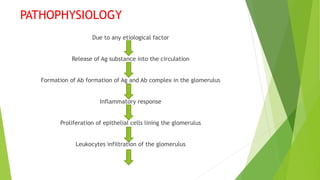
PATHOPHYSIOLOGY
Due to any etiological factor
Release of Ag substance into the circulation
Formation of Ab formation of Ag and Ab complex in the glomerulus
Inflammatory response
Proliferation of epithelial cells lining the glomerulus
Leukocytes infiltration of the glomerulus
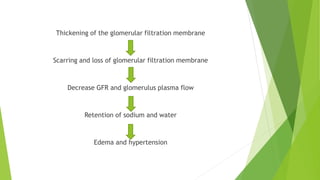
Thickening of the glomerular filtration membrane
Scarring and loss of glomerular filtration membrane
Decrease GFR and glomerulus plasma flow
Retention of sodium and water
Edema and hypertension
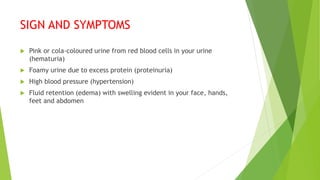
SIGN AND SYMPTOMS
 Pink or cola-coloured urine from red blood cells in your urine
(hematuria)
 Foamy urine due to excess protein (proteinuria)
 High blood pressure (hypertension)
 Fluid retention (edema) with swelling evident in your face, hands,
feet and abdomen
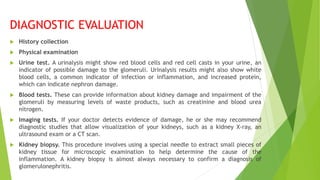
DIAGNOSTIC EVALUATION
 History collection
 Physical examination
 Urine test. A urinalysis might show red blood cells and red cell casts in your urine, an
indicator of possible damage to the glomeruli. Urinalysis results might also show white
blood cells, a common indicator of infection or inflammation, and increased protein,
which can indicate nephron damage.
 Blood tests. These can provide information about kidney damage and impairment of the
glomeruli by measuring levels of waste products, such as creatinine and blood urea
nitrogen.
 Imaging tests. If your doctor detects evidence of damage, he or she may recommend
diagnostic studies that allow visualization of your kidneys, such as a kidney X-ray, an
ultrasound exam or a CT scan.
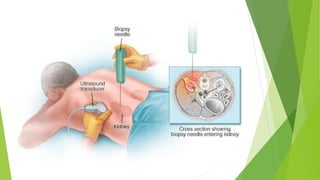
 Kidney biopsy. This procedure involves using a special needle to extract small pieces of
kidney tissue for microscopic examination to help determine the cause of the
inflammation. A kidney biopsy is almost always necessary to confirm a diagnosis of
glomerulonephritis.
COMPLICATION
 Acute kidney failure. Loss of function in the filtering part of the nephron can
result in rapid accumulation of waste products. You might need emergency
dialysis — an artificial means of removing extra fluids and waste from the blood —
typically by an artificial kidney machine.
 Chronic kidney disease. The kidneys gradually lose their filtering ability. Kidney
function that deteriorates to less than 10 percent of normal capacity results in
end-stage kidney disease, which requires dialysis or a kidney transplant to sustain
life.
 High blood pressure. Damage to your kidneys and the resulting buildup of wastes
in the bloodstream can raise in blood pressure.
 Nephrotic syndrome. With this syndrome, too much protein in your urine results
in too little protein in your blood. Nephrotic syndrome can be associated with
high blood cholesterol and swelling (edema) of the eyelids, feet and abdomen.
PREVENTION
 Seek prompt treatment of a strep infection with a sore throat or impetigo.
 To prevent infections that can lead to some forms of glomerulonephritis, such
as HIV and hepatitis, follow safe-sex guidelines and avoid intravenous drug use.
 Control high blood pressure, which lessens the likelihood of damage to your kidneys
from hypertension.
 Control your blood sugar to help prevent diabetic nephropathy
MEDICAL MANAGEMENT
 Treatment depend on the cause of the disorder, type and severity of the
symptoms.
 High B.P. may be hard to control. Controlling the B.P. usually the most important
part of the treatment.
 Dialysis
 Medication
 Diuretics
 Immuno-suppressants
 Anti-hypertensive
 Life style changes
 Sodium and water restriction
 Potassium, phosphorus, magnesium restriction.
 Limit intake of protein in the diet.
 Take calcium supplements.
 Maintain a healthy weight through diet and exercise.
 Physiotherapy treatment
 Patient education
 Lymphatic message to reduce the edema.
 Breathing exercise – pursed lip and diaphragmatic breathing.
 Endurance exercise such as walking, swimming, bicycling, aerobic dancing,
circulatory exercise.
This exercise improve your blood circulation, accelerate kidney to
discharge waste and toxins.
NURSING MANAGEMRENT
1) Nursing diagnosis - Acute pain related to inflammation of renal cortex as
evidenced by facial expressions and verbalization of patient.
 Goals: reduce pain
 Intervention:
 Assess the onset, duration, location, severity and intensity of pain.
 Provide comfort devices, quite environment and calm activities.
 Encourage use of relaxational technique.
 Provide diversion therapy.
 Administer the analgesic according to physician order.
2) Nursing diagnosis - excess fluid volume related to accumulation of fluid in
the body as evidenced by edema and weight gain.
Goal: to maintain the fluid volume •
Intervention:
 To change the position frequently.
 To elevate the edematous extremities.
 Allow the patient to heard the running water to promote the diuresis.
 Apply hot application on the bladder to promote the diuresis.
 To administer the diuretics to promote the diuresis.
 To administer the albumin helps in shifting the fluid from the ISC to IVC.
3) Nursing diagnosis – Ineffective breathing pattern related to
accumulation of fluid in the peritoneal cavity as evidence by respiration
rate, dyspnea.
Goal: to improve the breathing pattern
Intervention:
 Instruct the patient to perform the deep breathing exercise.
 To provide the semi-fowler position.
 Encourage the rest between the activities to Avoid The overexertion
 Instruct not to wear the tight dress to promote the breathing.
 To administer the diuretics and albumin.
Glomerulonephritis

Glomerulonephritis

  • 1.
  • 2.
    INTRODUCTION  Glomerulonephritis isinflammation of the tiny filters in your kidneys (glomeruli). Glomeruli remove excess fluid, electrolytes and waste from your bloodstream and pass them into your urine. Glomerulonephritis can come on suddenly (acute) or gradually (chronic).  Glomerulonephritis occurs on its own or as part of another disease, such as lupus or diabetes. Severe or prolonged inflammation associated with glomerulonephritis can damage the kidneys
  • 3.
    ANATOMY OF NEPHRON Thenephron consist of a tubule closed at one end, to form the cup-shaped glomerular capsule (bowman’s capsule), which almost completely enclose a network of tinny arterial capillaries, the glomerulus. Continuing from the glomerulus capsule, the remainder of the nephron is about 3cm long & is described in three parts- • The proximal convoluted tubule • Loop of henle ( medullary loop ) • Distal convoluted tubule lead them to collecting duct.
  • 5.
    DEFINITION Glomerulonephritis is akidney condition that involves damage /inflammation to the glomeruli.
  • 6.
    INCIDENCE Glomerulonephritis Epidemiology Characterized.For the first time, researchers have estimated the prevalence and incidence of the disorder. A total of 1,693 cases of GN resulting from systemic immunologic disease were diagnosed during 17,850,897 patient-years, for an incidence of 9.5 cases per 100,000 patient-years
  • 8.
    CAUSES Infections  Post-streptococcal glomerulonephritis.Glomerulonephritis may develop a week or two after recovery from a strep throat infection or, rarely, a skin infection (impetigo). To fight the infection, your body produces extra antibodies that can eventually settle in the glomeruli, causing inflammation.  Children are more likely to develop post-streptococcal glomerulonephritis than are adults, and they're also more likely to recover quickly.  Bacterial endocarditis. Bacteria occasionally can spread through your bloodstream and lodge in your heart, causing an infection of one or more of your heart valves. You're at greater risk of this condition if you have a heart defect, such as a damaged or artificial heart valve. Bacterial endocarditis is associated with glomerular disease, but the connection between the two is unclear.  Viral infections. Viral infections, such as the human immunodeficiency virus (HIV), hepatitis B and hepatitis C, can trigger glomerulonephritis.
  • 9.
    Immune diseases  Lupus.A chronic inflammatory disease, lupus can affect many parts of your body, including your skin, joints, kidneys, blood cells, heart and lungs.  Goodpasture's syndrome. A rare immunological lung disorder that can mimic pneumonia, Goodpasture's syndrome causes bleeding in your lungs as well as glomerulonephritis.  IgA nephropathy. Characterized by recurrent episodes of blood in the urine, this primary glomerular disease results from deposits of immunoglobulin A (IgA) in the glomeruli. IgA nephropathy can progress for years with no noticeable symptoms.
  • 10.
    Vasculitis  Polyarteritis. Thisform of vasculitis affects small and medium blood vessels in many parts of your body, such as your heart, kidneys and intestines.  Granulomatosis with polyangiitis. This form of vasculitis, formerly known as Wegener's granulomatosis, affects small and medium blood vessels in your lungs, upper airways and kidneys.
  • 11.
    Conditions likely tocause scarring of the glomeruli  High blood pressure. This can damage your kidneys and impair their ability to function normally. Glomerulonephritis can also lead to high blood pressure because it reduces kidney function and can influence how your kidneys handle sodium.  Diabetic kidney disease (diabetic nephropathy). This can affect anyone with diabetes, usually taking years to develop. Good control of blood sugar levels and blood pressure might prevent or slow kidney damage.  Focal segmental glomerulosclerosis. Characterized by scattered scarring of some of the glomeruli, this condition can result from another disease or occur for no known reason
  • 12.
    TYPES OF GLOMERULONEPHRITIS Acute glomerulonephritis - begins suddenly. It occurs after 5-21 days of streptococcal Infection.  Chronic glomerulonephritis -develops gradually over several years. It occurs after the acute phase.
  • 13.
    PATHOPHYSIOLOGY Due to anyetiological factor Release of Ag substance into the circulation Formation of Ab formation of Ag and Ab complex in the glomerulus Inflammatory response Proliferation of epithelial cells lining the glomerulus Leukocytes infiltration of the glomerulus
  • 14.
    Thickening of theglomerular filtration membrane Scarring and loss of glomerular filtration membrane Decrease GFR and glomerulus plasma flow Retention of sodium and water Edema and hypertension
  • 15.
    SIGN AND SYMPTOMS Pink or cola-coloured urine from red blood cells in your urine (hematuria)  Foamy urine due to excess protein (proteinuria)  High blood pressure (hypertension)  Fluid retention (edema) with swelling evident in your face, hands, feet and abdomen
  • 16.
    DIAGNOSTIC EVALUATION  Historycollection  Physical examination  Urine test. A urinalysis might show red blood cells and red cell casts in your urine, an indicator of possible damage to the glomeruli. Urinalysis results might also show white blood cells, a common indicator of infection or inflammation, and increased protein, which can indicate nephron damage.  Blood tests. These can provide information about kidney damage and impairment of the glomeruli by measuring levels of waste products, such as creatinine and blood urea nitrogen.  Imaging tests. If your doctor detects evidence of damage, he or she may recommend diagnostic studies that allow visualization of your kidneys, such as a kidney X-ray, an ultrasound exam or a CT scan.  Kidney biopsy. This procedure involves using a special needle to extract small pieces of kidney tissue for microscopic examination to help determine the cause of the inflammation. A kidney biopsy is almost always necessary to confirm a diagnosis of glomerulonephritis.
  • 18.
    COMPLICATION  Acute kidneyfailure. Loss of function in the filtering part of the nephron can result in rapid accumulation of waste products. You might need emergency dialysis — an artificial means of removing extra fluids and waste from the blood — typically by an artificial kidney machine.  Chronic kidney disease. The kidneys gradually lose their filtering ability. Kidney function that deteriorates to less than 10 percent of normal capacity results in end-stage kidney disease, which requires dialysis or a kidney transplant to sustain life.  High blood pressure. Damage to your kidneys and the resulting buildup of wastes in the bloodstream can raise in blood pressure.  Nephrotic syndrome. With this syndrome, too much protein in your urine results in too little protein in your blood. Nephrotic syndrome can be associated with high blood cholesterol and swelling (edema) of the eyelids, feet and abdomen.
  • 19.
    PREVENTION  Seek prompttreatment of a strep infection with a sore throat or impetigo.  To prevent infections that can lead to some forms of glomerulonephritis, such as HIV and hepatitis, follow safe-sex guidelines and avoid intravenous drug use.  Control high blood pressure, which lessens the likelihood of damage to your kidneys from hypertension.  Control your blood sugar to help prevent diabetic nephropathy
  • 20.
    MEDICAL MANAGEMENT  Treatmentdepend on the cause of the disorder, type and severity of the symptoms.  High B.P. may be hard to control. Controlling the B.P. usually the most important part of the treatment.  Dialysis  Medication  Diuretics  Immuno-suppressants  Anti-hypertensive
  • 21.
     Life stylechanges  Sodium and water restriction  Potassium, phosphorus, magnesium restriction.  Limit intake of protein in the diet.  Take calcium supplements.  Maintain a healthy weight through diet and exercise.  Physiotherapy treatment  Patient education  Lymphatic message to reduce the edema.  Breathing exercise – pursed lip and diaphragmatic breathing.  Endurance exercise such as walking, swimming, bicycling, aerobic dancing, circulatory exercise. This exercise improve your blood circulation, accelerate kidney to discharge waste and toxins.
  • 22.
    NURSING MANAGEMRENT 1) Nursingdiagnosis - Acute pain related to inflammation of renal cortex as evidenced by facial expressions and verbalization of patient.  Goals: reduce pain  Intervention:  Assess the onset, duration, location, severity and intensity of pain.  Provide comfort devices, quite environment and calm activities.  Encourage use of relaxational technique.  Provide diversion therapy.  Administer the analgesic according to physician order.
  • 23.
    2) Nursing diagnosis- excess fluid volume related to accumulation of fluid in the body as evidenced by edema and weight gain. Goal: to maintain the fluid volume • Intervention:  To change the position frequently.  To elevate the edematous extremities.  Allow the patient to heard the running water to promote the diuresis.  Apply hot application on the bladder to promote the diuresis.  To administer the diuretics to promote the diuresis.  To administer the albumin helps in shifting the fluid from the ISC to IVC.
  • 24.
    3) Nursing diagnosis– Ineffective breathing pattern related to accumulation of fluid in the peritoneal cavity as evidence by respiration rate, dyspnea. Goal: to improve the breathing pattern Intervention:  Instruct the patient to perform the deep breathing exercise.  To provide the semi-fowler position.  Encourage the rest between the activities to Avoid The overexertion  Instruct not to wear the tight dress to promote the breathing.  To administer the diuretics and albumin.