WORKING CAPITAL MANAGEMENT
1
FLOW OF CONTENTS
 OVERVIEW
 OPERATING CYCLE
 ESTIMATION OF WORKING CAPITAL
 WORKING CAPITAL FINANCING
2
Working Capital :- Meaning
 Working capital means the firm’s holding of current or short-term assets
such as cash, receivables, inventory and marketable securities.
 These items are also referred to as circulating capital
 Corporate executives devote a considerable amount of attention to the
management of working capital.
3
Working capital management
Working capital management is concerned with the problems that
arise in attempting to manage the current assets, the current liabilities
and the interrelations that exist between them.
4
Concepts of Working Capital
There are two possible interpretations of working capital concept:
1. Balance sheet concept
2. Operating cycle concept
5
Balance sheet concept
There are two interpretations of working capital under the balance sheet
concept.
 Excess of current assets over current liabilities
 gross or total current asset
6
Current assets
Current assets refer to those assets which in the ordinary course of business
can be, or will be, converted into cash within one year without undergoing a
diminution in value and without disrupting the operations of the firm.
Examples- cash, marketable securities, accounts receivable and inventory.
7
Current liabilities
Current liabilities are those liabilities which are intended, at their inception,
to be paid in the ordinary course of business, within a year, out of the
current assets or the earnings of the concern.
Examples- accounts payable, bills payable, bank overdraft and outstanding
expenses.
8
Classification or Kinds of Working CapitalKinds of
Working
Capital
On the basis
of Concept
Gross
Working
Capital
Net Working
Capital
On the basis
of Time
Permanent /
Fixed WC
Temporary /
Variable WC
9
Concepts of Working Capital
1. Gross working capital (GWC)
GWC refers to the firm’s total investment in current assets.
Current assets are the assets which can be converted into cash
within an accounting year (or operating cycle) and include cash,
short-term securities, debtors, (accounts receivable or book debts)
bills receivable and stock (inventory).
10
Concepts of Working Capital
Net working capital (NWC)
 NWC refers to the difference between current assets and current
liabilities.
 Current liabilities (CL) are those claims of outsiders which are expected to
mature for payment within an accounting year and include creditors
(accounts payable), bills payable, and outstanding expenses.
 NWC can be positive or negative.
o Positive NWC = CA > CL
o Negative NWC = CA < CL
11
Concepts of Working Capital
 GWC focuses on
 Optimisation of investment in current
 Financing of current assets
 NWC focuses on
 Liquidity position of the firm
12
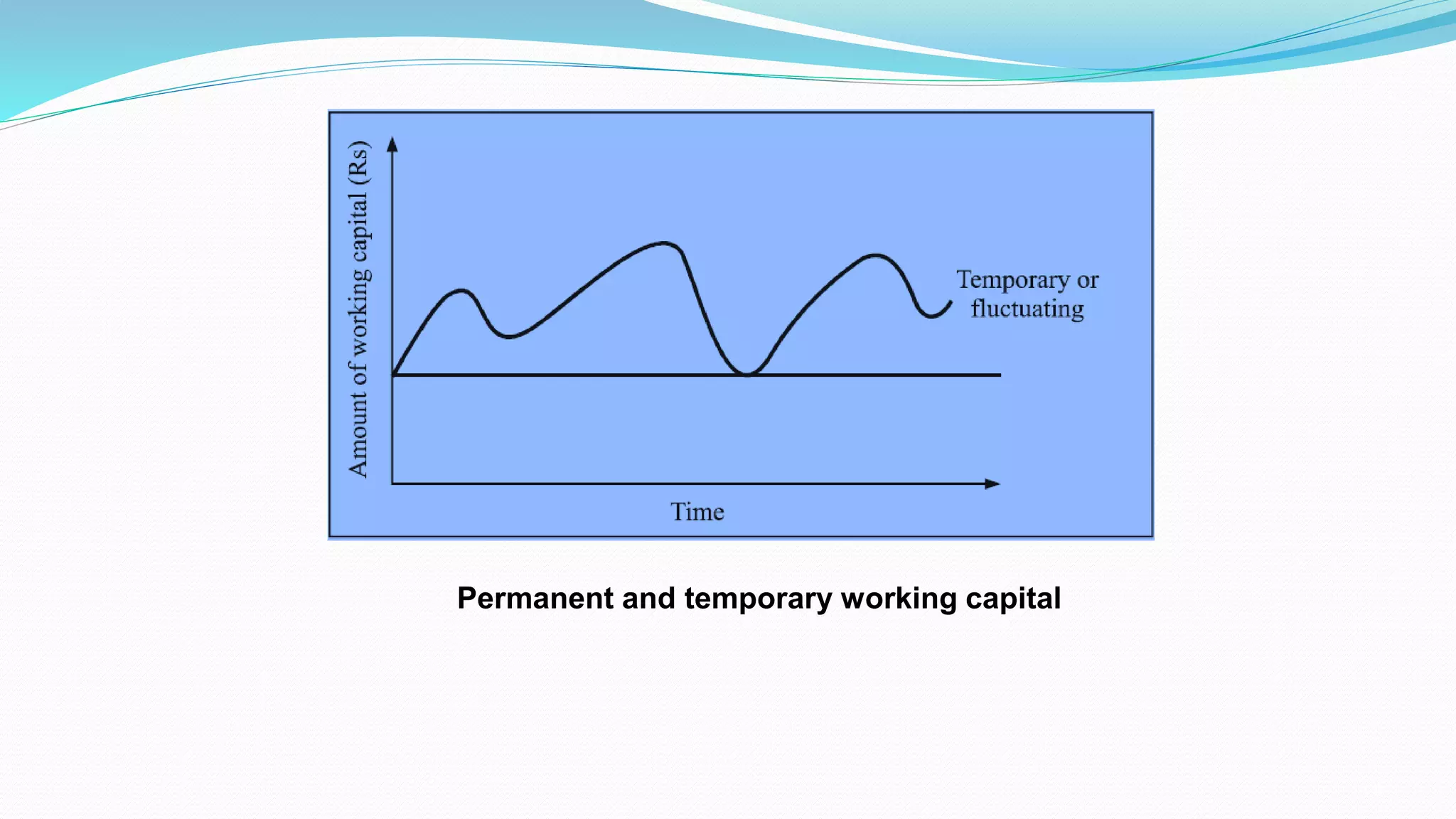
Permanent And Variable Working Capital
 Permanent or fixed working capital
A minimum level of current assets, which is continuously required by a firm
to carry on its business operations, is referred to as permanent or fixed
working capital.
 Fluctuating or variable working capital
The extra working capital needed to support the changing production and
sales activities of the firm is referred to as fluctuating or variable working
capital.
13
14
Permanent and temporary working capital
Operating Cycle
Operating cycle is the time duration required to convert sales, after
the conversion of resources into inventories, into cash. The
operating cycle of a manufacturing company involves three phases:
 Acquisition of resources such as raw material, labour, power and fuel
etc.
 Manufacture of the product which includes conversion of raw material
into work-in-progress into finished goods.
 Sale of the product either for cash or on credit. Credit sales create
account receivable for collection.
15
Working Capital Cycle.
cash
Raw
materials
Work in
progress
Finished
debtors
16
How to compute operating cycle
 RMCP – Raw material Conversion Period
 WIPCP – Work in progress conversion period
 FGCP – Finished goods conversion period
 RCP – Receivables Conversion period
Gross Operating Cycle = RMCP + WICP + FGCP +RCP
17
Importance or advantages of adequate working capital
1. Solvency of business
2. Goodwill
3. Easy loans
4. Cash discounts
5. Regular supply of raw materials
6. Regular payment of salaries, wages and other day to day expense
7. Ability face crisis
18
Dis-advantages of redundant or excessive WC
 Idle funds – earns no profit
 Leads to unnecessary purchase
 Implies Excessive debtors and defective credit policy
 Leads to overall inefficiency of the firm
 Bad relationship with bank and financial inst.
19
Dis advantages of Inadequate WC
 Cannot pay short term obligations in time
 Loose of goodwill
 Cannot avail discounts and other benefits (Economies of scale)
 Difficult for the firm to exploit favorable market condition
 Rate of return on investment fall with the shortage of working capital
 Difficult to pay day to day expenses of operations
20
Determinants of Working Capital Requirement
1. Nature or Character of business
2. Size of the business and scale of operation
3. Production policy
4. Seasonal variation
5. Credit policy
21
Estimation of Working Capital
Total approach
• All expenses and
profit margin are
included
Cash cost approach
• Only cash
expenses(excluding
depreciation) are
included
22
Working capital financing
SHORT TERM:
1. Factoring
2. Invoice discounts
3. Bank overdraft
4. Commercial papers
5. Trade finance
6. Letter of credit
23
Contd…
LONG TERM:
1. Equity capital
2. loans
24
25

Working capital management ppt

  • 1.
  • 2.
    FLOW OF CONTENTS OVERVIEW  OPERATING CYCLE  ESTIMATION OF WORKING CAPITAL  WORKING CAPITAL FINANCING 2
  • 3.
    Working Capital :-Meaning  Working capital means the firm’s holding of current or short-term assets such as cash, receivables, inventory and marketable securities.  These items are also referred to as circulating capital  Corporate executives devote a considerable amount of attention to the management of working capital. 3
  • 4.
    Working capital management Workingcapital management is concerned with the problems that arise in attempting to manage the current assets, the current liabilities and the interrelations that exist between them. 4
  • 5.
    Concepts of WorkingCapital There are two possible interpretations of working capital concept: 1. Balance sheet concept 2. Operating cycle concept 5
  • 6.
    Balance sheet concept Thereare two interpretations of working capital under the balance sheet concept.  Excess of current assets over current liabilities  gross or total current asset 6
  • 7.
    Current assets Current assetsrefer to those assets which in the ordinary course of business can be, or will be, converted into cash within one year without undergoing a diminution in value and without disrupting the operations of the firm. Examples- cash, marketable securities, accounts receivable and inventory. 7
  • 8.
    Current liabilities Current liabilitiesare those liabilities which are intended, at their inception, to be paid in the ordinary course of business, within a year, out of the current assets or the earnings of the concern. Examples- accounts payable, bills payable, bank overdraft and outstanding expenses. 8
  • 9.
    Classification or Kindsof Working CapitalKinds of Working Capital On the basis of Concept Gross Working Capital Net Working Capital On the basis of Time Permanent / Fixed WC Temporary / Variable WC 9
  • 10.
    Concepts of WorkingCapital 1. Gross working capital (GWC) GWC refers to the firm’s total investment in current assets. Current assets are the assets which can be converted into cash within an accounting year (or operating cycle) and include cash, short-term securities, debtors, (accounts receivable or book debts) bills receivable and stock (inventory). 10
  • 11.
    Concepts of WorkingCapital Net working capital (NWC)  NWC refers to the difference between current assets and current liabilities.  Current liabilities (CL) are those claims of outsiders which are expected to mature for payment within an accounting year and include creditors (accounts payable), bills payable, and outstanding expenses.  NWC can be positive or negative. o Positive NWC = CA > CL o Negative NWC = CA < CL 11
  • 12.
    Concepts of WorkingCapital  GWC focuses on  Optimisation of investment in current  Financing of current assets  NWC focuses on  Liquidity position of the firm 12
  • 13.
    Permanent And VariableWorking Capital  Permanent or fixed working capital A minimum level of current assets, which is continuously required by a firm to carry on its business operations, is referred to as permanent or fixed working capital.  Fluctuating or variable working capital The extra working capital needed to support the changing production and sales activities of the firm is referred to as fluctuating or variable working capital. 13
  • 14.
  • 15.
    Operating Cycle Operating cycleis the time duration required to convert sales, after the conversion of resources into inventories, into cash. The operating cycle of a manufacturing company involves three phases:  Acquisition of resources such as raw material, labour, power and fuel etc.  Manufacture of the product which includes conversion of raw material into work-in-progress into finished goods.  Sale of the product either for cash or on credit. Credit sales create account receivable for collection. 15
  • 16.
    Working Capital Cycle. cash Raw materials Workin progress Finished debtors 16
  • 17.
    How to computeoperating cycle  RMCP – Raw material Conversion Period  WIPCP – Work in progress conversion period  FGCP – Finished goods conversion period  RCP – Receivables Conversion period Gross Operating Cycle = RMCP + WICP + FGCP +RCP 17
  • 18.
    Importance or advantagesof adequate working capital 1. Solvency of business 2. Goodwill 3. Easy loans 4. Cash discounts 5. Regular supply of raw materials 6. Regular payment of salaries, wages and other day to day expense 7. Ability face crisis 18
  • 19.
    Dis-advantages of redundantor excessive WC  Idle funds – earns no profit  Leads to unnecessary purchase  Implies Excessive debtors and defective credit policy  Leads to overall inefficiency of the firm  Bad relationship with bank and financial inst. 19
  • 20.
    Dis advantages ofInadequate WC  Cannot pay short term obligations in time  Loose of goodwill  Cannot avail discounts and other benefits (Economies of scale)  Difficult for the firm to exploit favorable market condition  Rate of return on investment fall with the shortage of working capital  Difficult to pay day to day expenses of operations 20
  • 21.
    Determinants of WorkingCapital Requirement 1. Nature or Character of business 2. Size of the business and scale of operation 3. Production policy 4. Seasonal variation 5. Credit policy 21
  • 22.
    Estimation of WorkingCapital Total approach • All expenses and profit margin are included Cash cost approach • Only cash expenses(excluding depreciation) are included 22
  • 23.
    Working capital financing SHORTTERM: 1. Factoring 2. Invoice discounts 3. Bank overdraft 4. Commercial papers 5. Trade finance 6. Letter of credit 23
  • 24.
    Contd… LONG TERM: 1. Equitycapital 2. loans 24
  • 25.